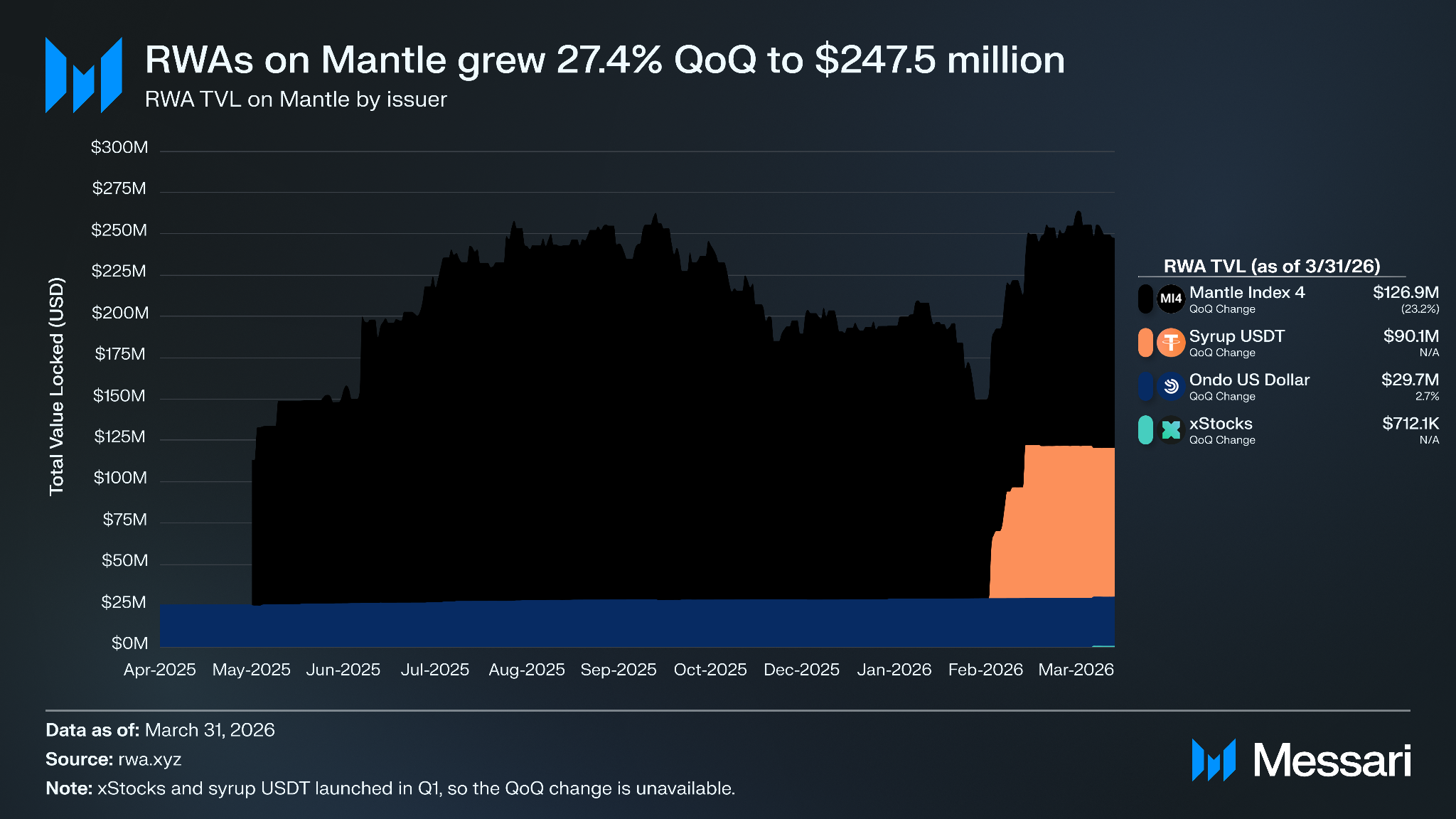
RWA TVL on Mantle grew 27.4% QoQ to $247.5 million at the end of Q1, driven by Maple Finance’s syrupUSDT bringing institutional lending yield onchain and the xStocks rollout enabling onchain trading of tokenized U.S. equities.
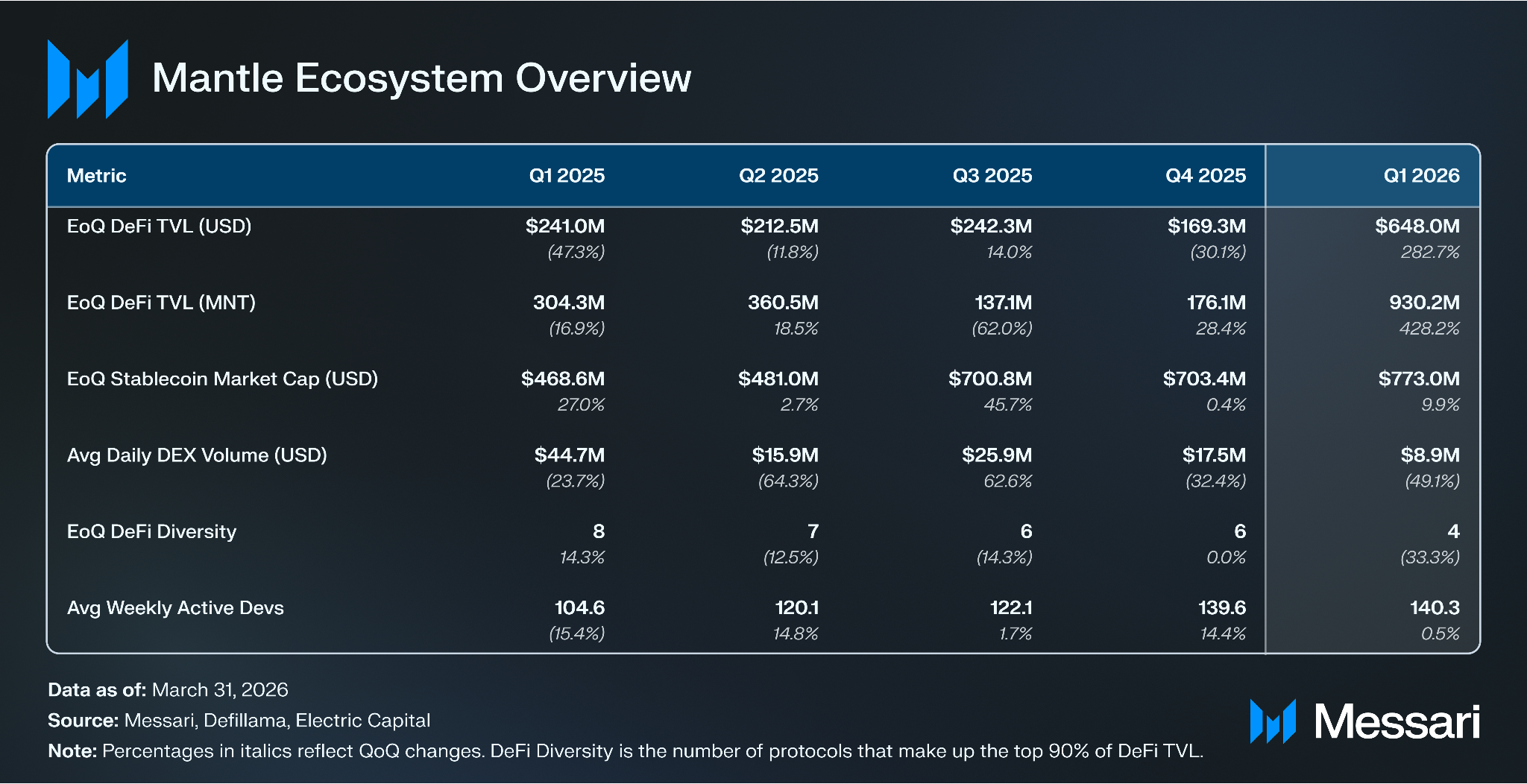
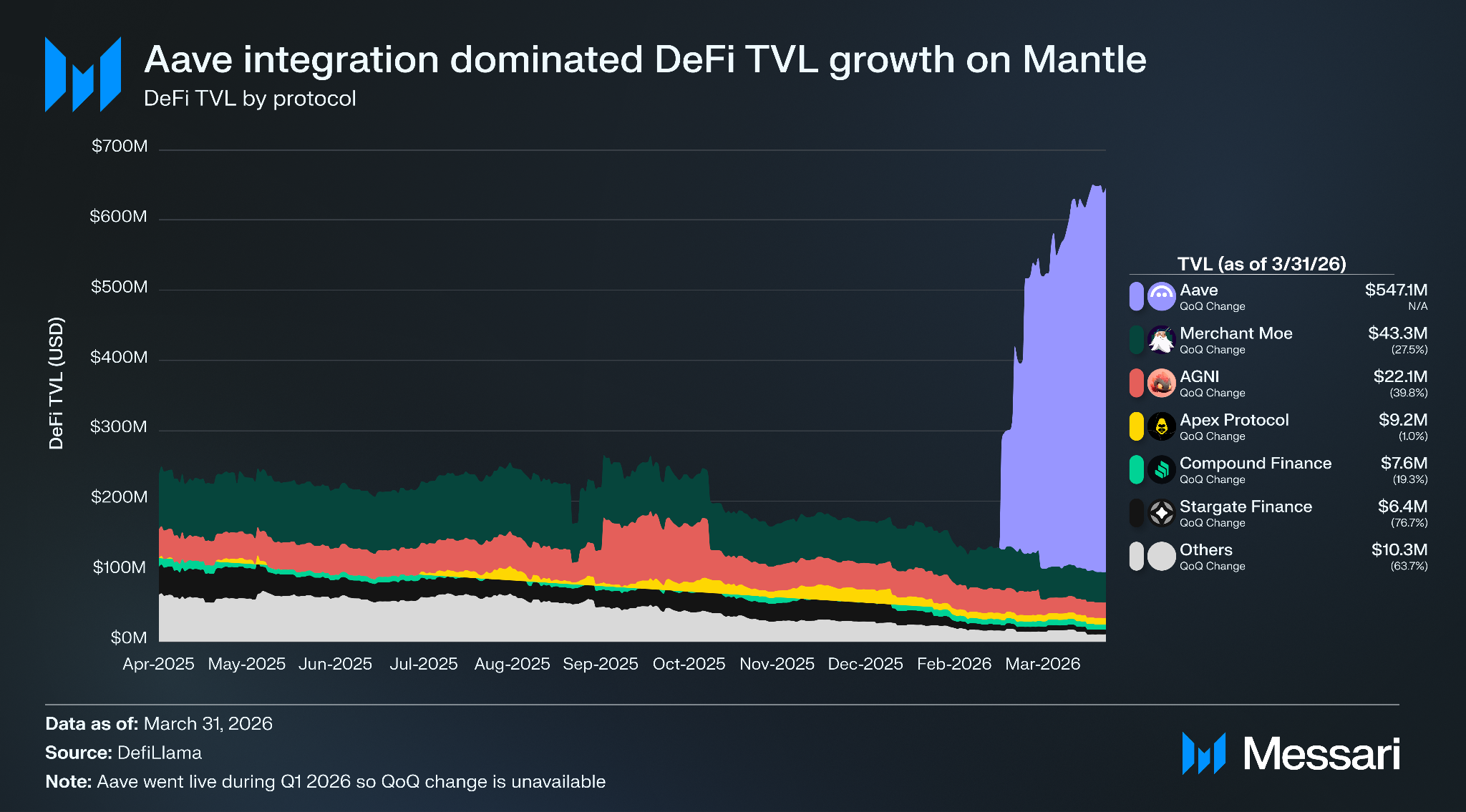
DeFi TVL on Mantle reached an all-time high of $648.0 million in Q1, up 282.7% QoQ as Aave V3 markets launched on Feb. 11, 2026, and TVL scaled to $547.1 million by quarter-end, offsetting declines of 27.5% to 76.7% across other DeFi protocols on the chain.
Mantle’s CeDeFi model, built in collaboration with Bybit, is a key driver of ecosystem growth. Mantle Vault provides CeFi user experience with DeFi yield opportunities, and Bybit Alpha provides a CeFi trading experience for Mantle-native tokens powered by DEX liquidity.
Mantle positioned itself as a settlement layer for autonomous agents through the Q1 deployment of ERC-8004, AI Agent Skills and Agent Scaffold, x402 payments via QuestFlow, and a Virtuals integration that powers agent commerce on the network. Together, these cover identity, development, payments, and transaction facilitation across the stack.
The Mantle Treasury closed Q1 at $2.4 billion as the largest DAO treasury and second-largest crypto treasury overall behind SharpLink Gaming (NASDAQ: SBET), with MI4's $126.8 million addition cutting MNT concentration from 94.3% to 90.0%.
Primer
Mantle is a distribution layer for onchain finance, structured as a vertically integrated financial hub anchored by the $2.4 billion Mantle Treasury. The protocol originated as BitDAO, a treasury DAO seeded by Bybit in 2021, before rebranding as Mantle in May 2023 and launching its Ethereum Layer-2 in July with the migration of BIT to MNT. The treasury underwrites the product suite, while Bybit’s exchange relationship provides distribution that few rollups can match.
Mantle operates as a ZK validium Layer-2 (L2) powered by Succinct’s SP1 zkVM. On April 16, 2026, the Arsia upgrade transitioned Mantle from Validium to a full ZK Rollup, with Ethereum as the data availability layer. It ranked third in Total Value Secured (TVS) among all rollups globally, with $1.7 billion secured at the time of writing. The architecture supports Mantle’s identity as a distribution layer, prioritizing institutional-grade settlement and capital efficiency for real-world assets (RWAs) over general-purpose execution. Ecosystem partners include USDT0 for stablecoin settlement, Bybit’s xStocks rollout for tokenized equities, and Dubai Financial Services Authority (DFSA) approved tokenized money market fund QCDT, with EthenaUSDe, OndoUSDY, and AgoraAUSD. Looking ahead, Mantle plans to deepen its distribution layer by onboarding additional RWA issuers across equities, credit, and yield-bearing instruments. The longer-term ambition is to broaden the network's reach until it can house the full stack of onchain finance under a single settlement venue.
Mantle’s other core innovation products include:
mETH Protocol: A liquid staking protocol operating at the intersection of the Mantle and Bybit ecosystems, with $2.2 billion in peak TVL, zero slashing incidents, and validator operators including Kraken Staked and P2P. mETH serves as an on-demand access point for ETH yield, enabling capital-efficient liquidity at an institutional scale.
Function (FBTC): Formerly known as Ignition FBTC, Function is Mantle’s infrastructure to enhance Bitcoin’s capital efficiency, liquidity, and composability. It is powered by core contributors Antalpha Prime, Mantle, and Galaxy Digital.
Mantle Index Four (MI4): An institutional-grade fund bridging traditional and decentralized finance, providing accredited investors access to blue-chip crypto assets with additional yield.
UR: UR is the account layer that introduces composable banking primitives for businesses delivered under a compliant regulatory framework.
The Project Team Commentary section of this report was written by the Mantle team and reflects the views, opinions, and forward-looking statements of Mantle only. This section is included to provide additional context on the project's strategy, priorities, and outlook and does not necessarily reflect the views or opinions of Messari, Inc.
The RWA market has a distribution problem, not an issuance problem.
As regulatory clarity expands globally, institutional capital is being tokenized on-chain, reaching up to $19B in market cap in Q1. But the gap between what gets issued and what actually reaches users, whether institutional or retail, remains enormous. That gap is not a technology failure. It is a distribution gap. And closing it is exactly what we are designed to do.
Mantle operates as the distribution layer for real-world assets. That means going beyond deploying RWAs on-chain. Through Tokenization as a Service, Mantle provides the full stack: issuance support, technical infrastructure, and direct distribution pathways into both CeFi and DeFi. A concrete example: Mantle onboarded QCDT, Qatar National Bank's DFSA-approved, tokenized money market fund, the first of its kind, and ensured it had real distribution, not just a smart contract address.
The reason this is possible comes down to where I sit.
I spent years building on the CEX side. What became clear is that the deepest liquidity and the largest user bases are in CeFi, while the most interesting composability opportunities live in DeFi. Those two worlds have remained largely disconnected. My role, and Mantle's role, is to connect them.
As Bybit's Spot Executive, Mantle's Key Advisor, and Byreal's Founder, I operate across the exact three points of this triangle. In practice, that means tokens can provide unified liquidity simultaneously on Bybit Spot and Mantle's DEX. It means RWAs like xStocks deploying not just on-chain, but into an RFQ-capable DEX environment where liquidity can be more stably supported. It means Bybit Alpha, where tokens native to Mantle can be traded directly by Bybit users within a familiar CEX interface, no wallet setup required. It means Bybit supports Mantle-native deposits and withdrawals, giving users a seamless path from CEX to on-chain without friction.
This is CeDeFi in practice: CeFi liquidity meeting DeFi opportunity in a single, coherent system.
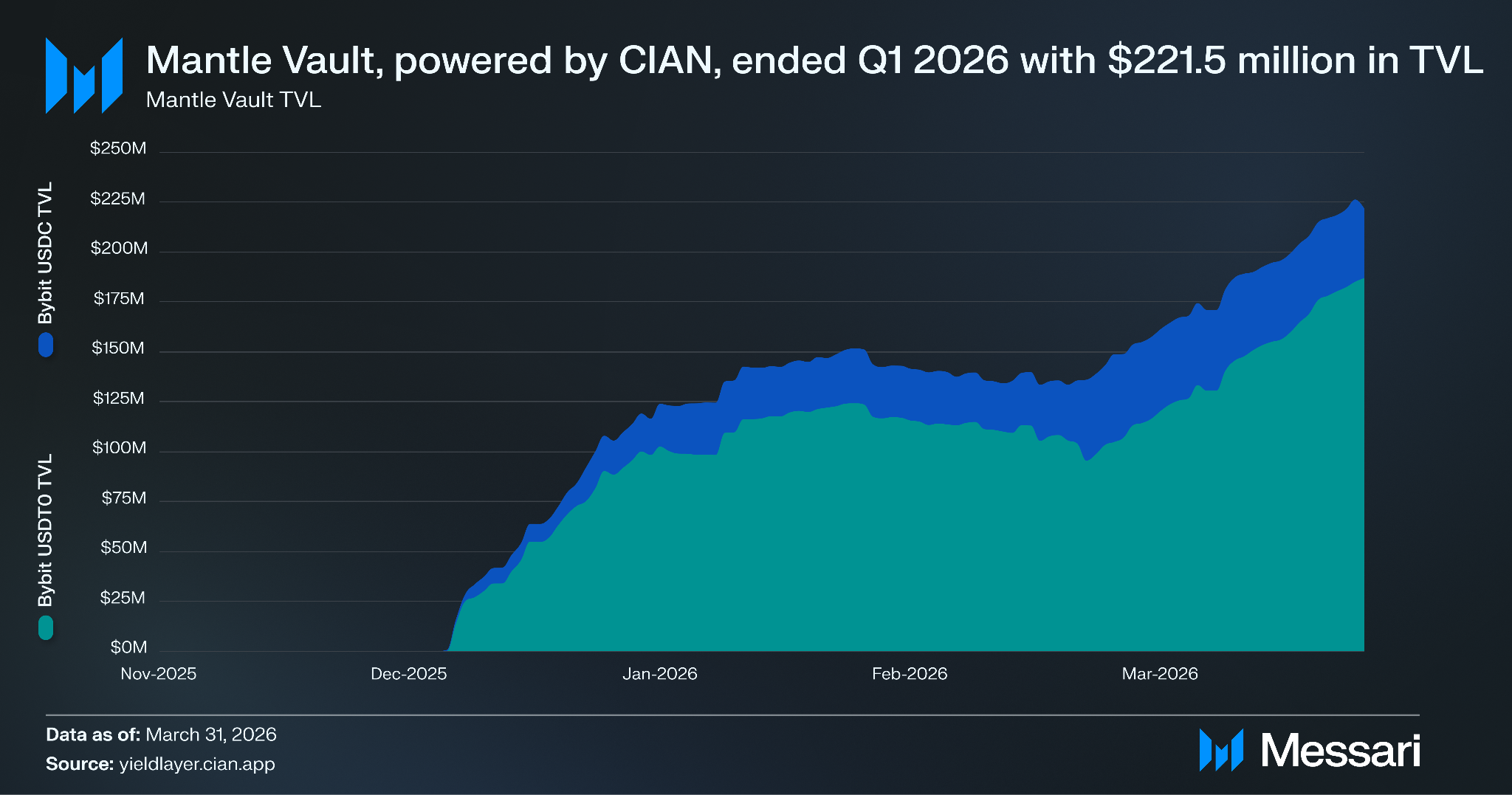
Mantle Vault is the clearest illustration of the model working, where the CEX user should not need to understand wallet infrastructure to access on-chain yield. Mantle Vault removes that barrier entirely, connecting Bybit users directly to DeFi protocols like Aave, with no additional complexity. In Q1 alone, Mantle Vault crossed $200M in AUM.
We are not theorizing about RWA adoption. We are building the actual use cases and bringing real users to them.
Key Metrics
Ecosystem Analysis
Real-World Assets
RWA TVL on Mantle grew 27.4% QoQ from $194.2 million at year-end 2025 to $247.5 million at the end of Q1 2026. The expansion came from two product integrations, including Maple Finance’s syrupUSDT and the xStocks tokenized equities rollout. syrupUSDT, the yield-bearing asset from Maple Finance, routes user USDT to back overcollateralized institutional lending pools, with the interest passed back to depositors. syrupUSDT entered Mantle as a supported deposit asset when Aave V3 markets launched on Feb. 11, 2026, reaching $90.1 million in TVL by quarter-end and becoming the largest contributor to Mantle’s RWA growth that quarter. xStocks launched late in Q1 to give Mantle users onchain exposure to tokenized U.S. equities, including TSLA, CRCL, NVDA, AAPL, GOOGL, and more, and closed the quarter with $712,110 in TVL. A separate integration with Blockstreet, which provides dedicated liquidity for tokenized assets on Mantle, positions xStocks and future equity issuances for deeper liquidity heading into Q2. Tether also brought XAUT to Mantle on Jan. 19, 2026, with deposits and withdrawals routed through Bybit, adding tokenized gold to the chain’s RWA stack.
Mantle Index Four (MI4) is a tokenized fund built with Securitize that gives institutional investors blue-chip digital asset exposure with embedded yield. The fund holds BTC, ETH, and SOL as its core allocations, then enhances returns on the non-BTC part of the fund by routing capital into yield-bearing wrappers: ETH allocations sit in liquid staking and staking collateral via mETH Protocol, SOL allocations sit in bbSOL (Bybit’s staked SOL product), and a sUSDe overlay from Ethena captures basis trade yield on the cash position. MI4 TVL fell 23.2% QoQ from $165.3 million at year-end 2025 to $126.9 million at the end of Q1 2026.
Stablecoins
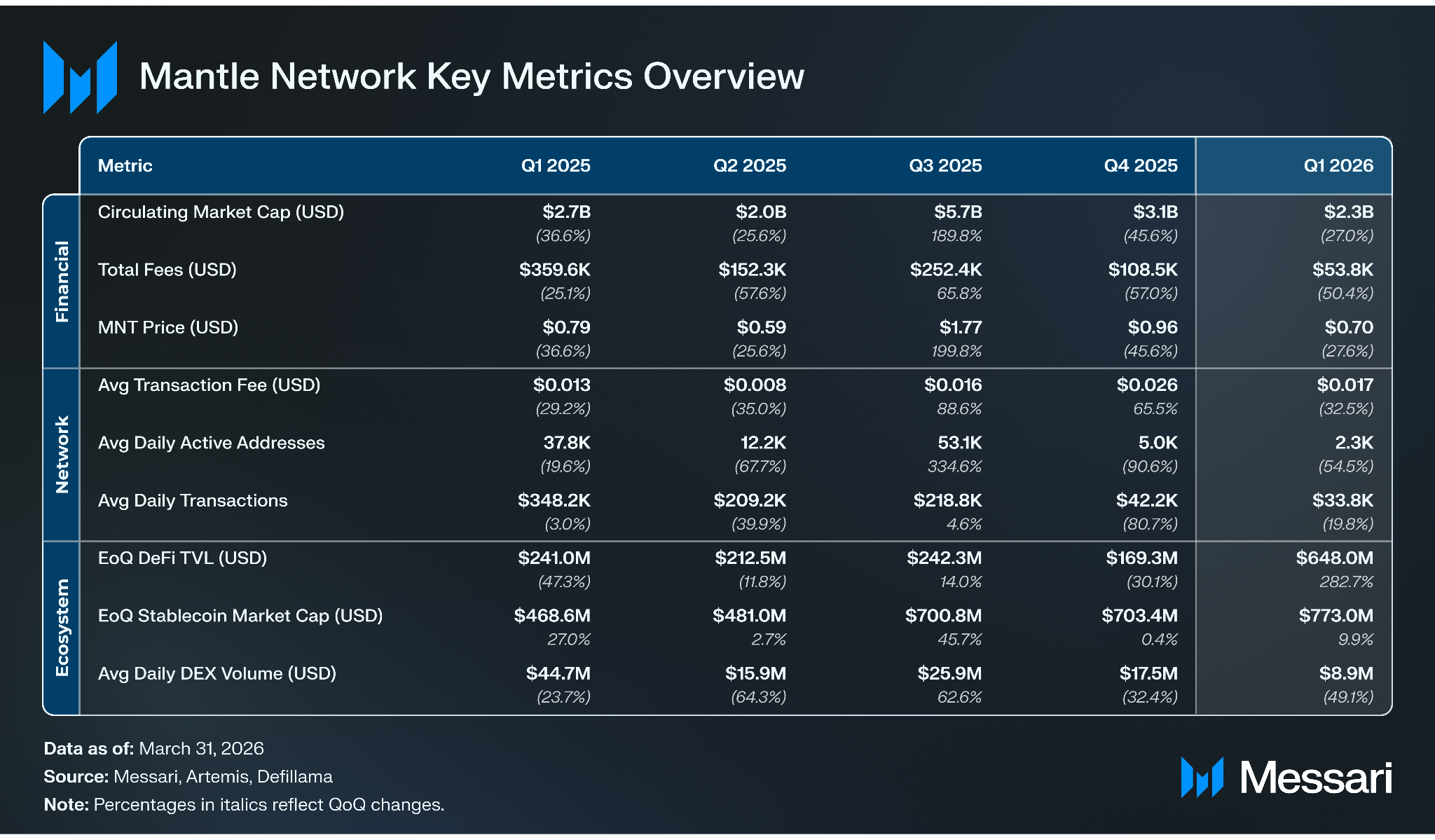
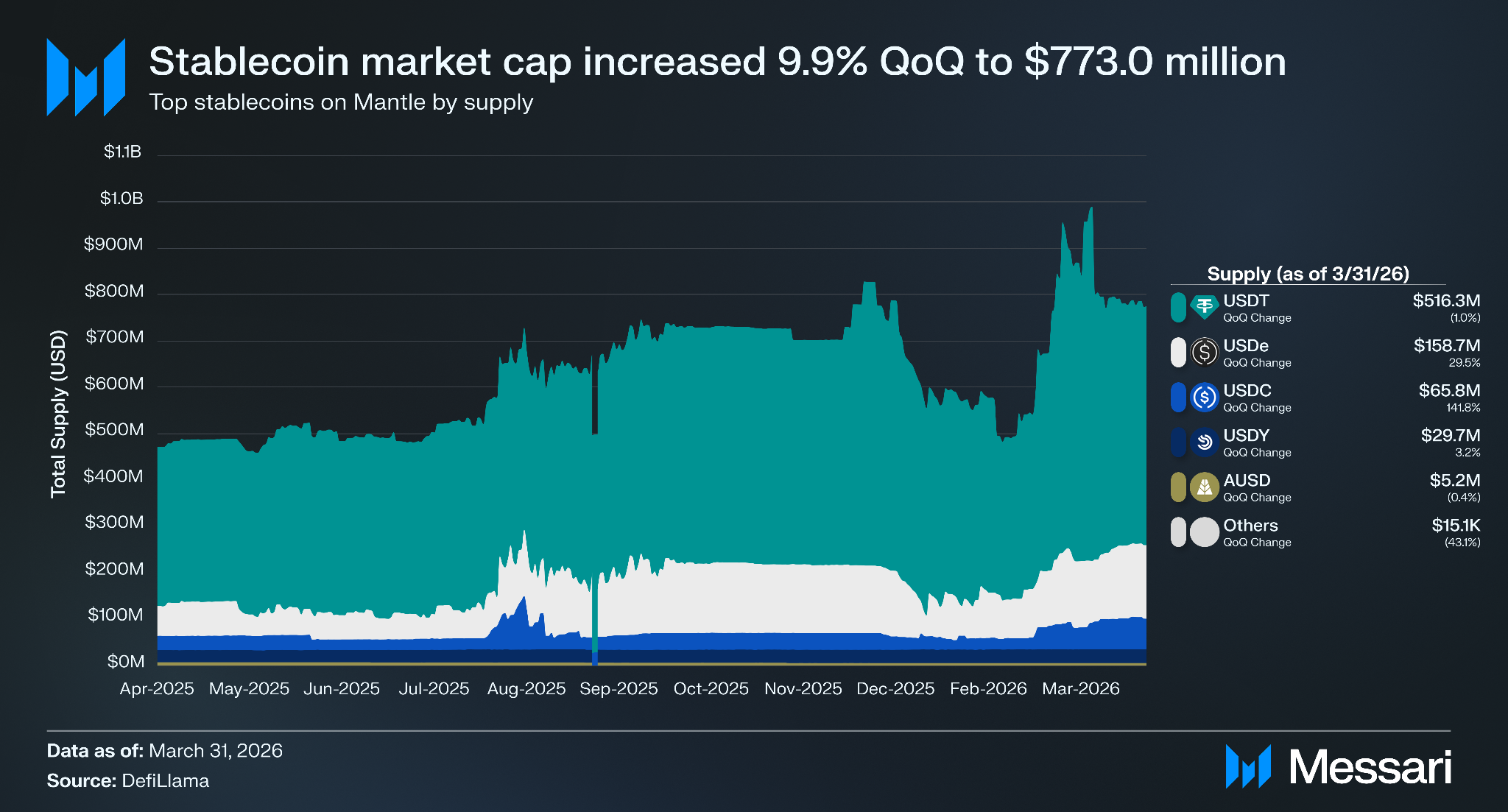
Stablecoin market cap on Mantle grew 9.9% QoQ from $703.4 million at year-end 2025 to $773.0 million at the end of Q1 2026. USDT remained the largest stablecoin on the network despite contracting by 1.0% over the quarter to $516.3 million, while USDe supply grew by 29.5% to $158.7 million. USDC had the fastest growth on Mantle, expanding 141.8% QoQ as Aave V3’s Feb. 11, 2026, launch on Mantle drew significant USDC supply into its deposit pools.
Mantle Vault
Mantle Vault is a Bybit Earn product that routes user stablecoin deposits into onchain yield strategies, giving exchange users access to DeFi returns without leaving the Bybit interface. Launched on Dec. 22, 2025, and curated by CIAN Protocol, a multichain vault manager, the product runs two vaults: USDT0 and USDC, which averaged 4.9% and 5.0% APY through Q1, respectively. TVL closed the quarter at $221.5 million, with the bulk of inflows concentrated throughout March after Bybit Earn Carnival incentives for Mantle Vault depositors went live on March 3, 2026, and ran through month-end.
mETH Protocol
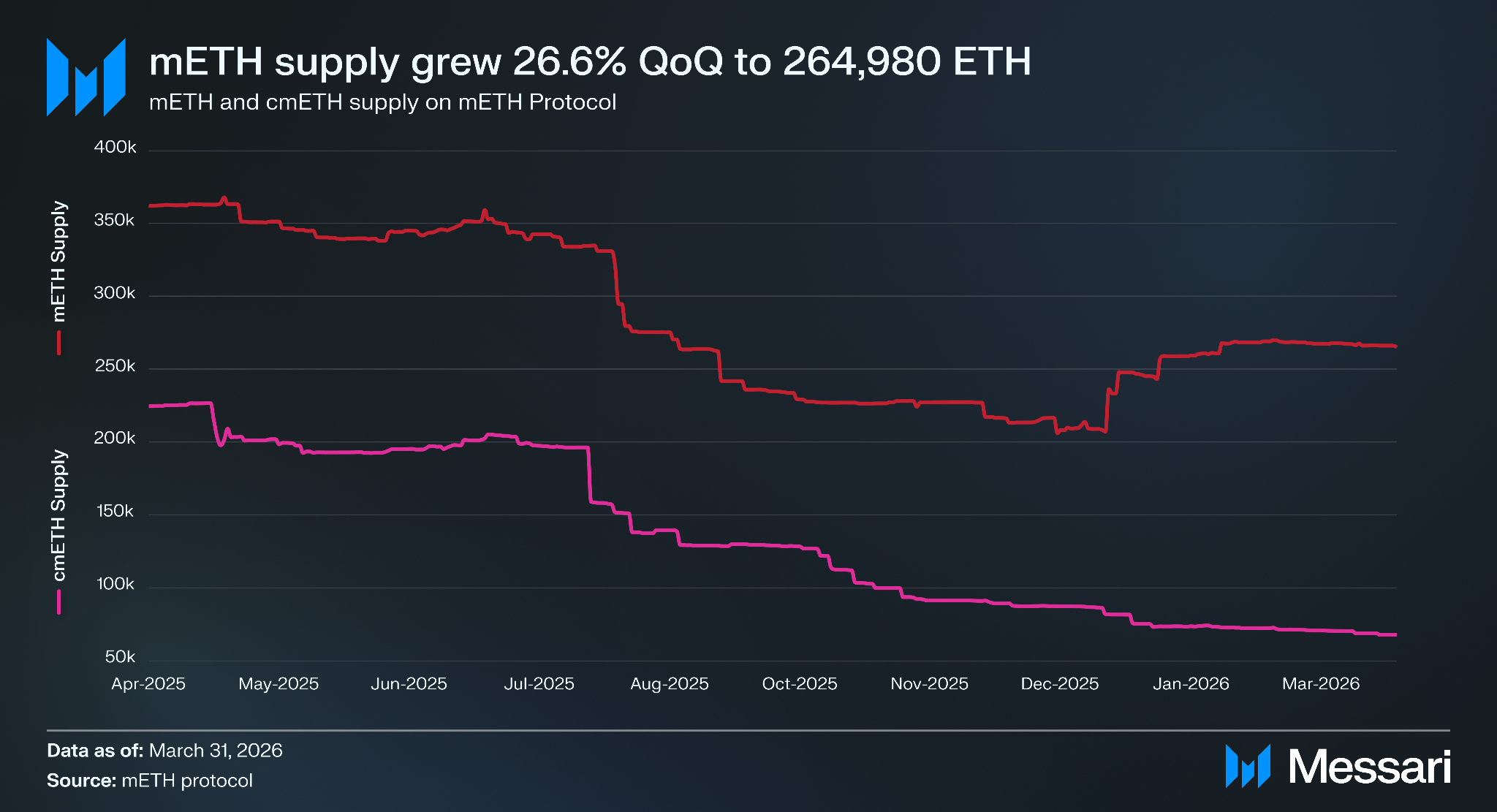
mETH Protocol is Mantle’s liquid staking and restaking platform, issuing two yield-bearing tokens that route ETH deposits into Ethereum staking and EigenLayer restaking strategies. mETH is the liquid staking token, representing a claim on staked ETH that accrues yield through an appreciating exchange rate against ETH rather than rebasing supply. cmETH is a 1:1 restaking receipt issued against mETH that earns boosted yield by routing the underlying stake into EigenLayer-secured services on top of base ETH staking returns. The protocol’s validator set includes Kraken, P2P, Blockdaemon, and Stakefish, with a 10% fee on staking rewards funding ongoing operations and node operator compensation.
mETH supply grew 26.6% QoQ from 209,280 mETH at year-end 2025 to 264,980 mETH by the end of Q1 2026. cmETH supply moved in the opposite direction, contracting 22.0% from 86,590 to 67,570, indicating reduced demand for the restaking wrapper relative to the underlying liquid staking token.
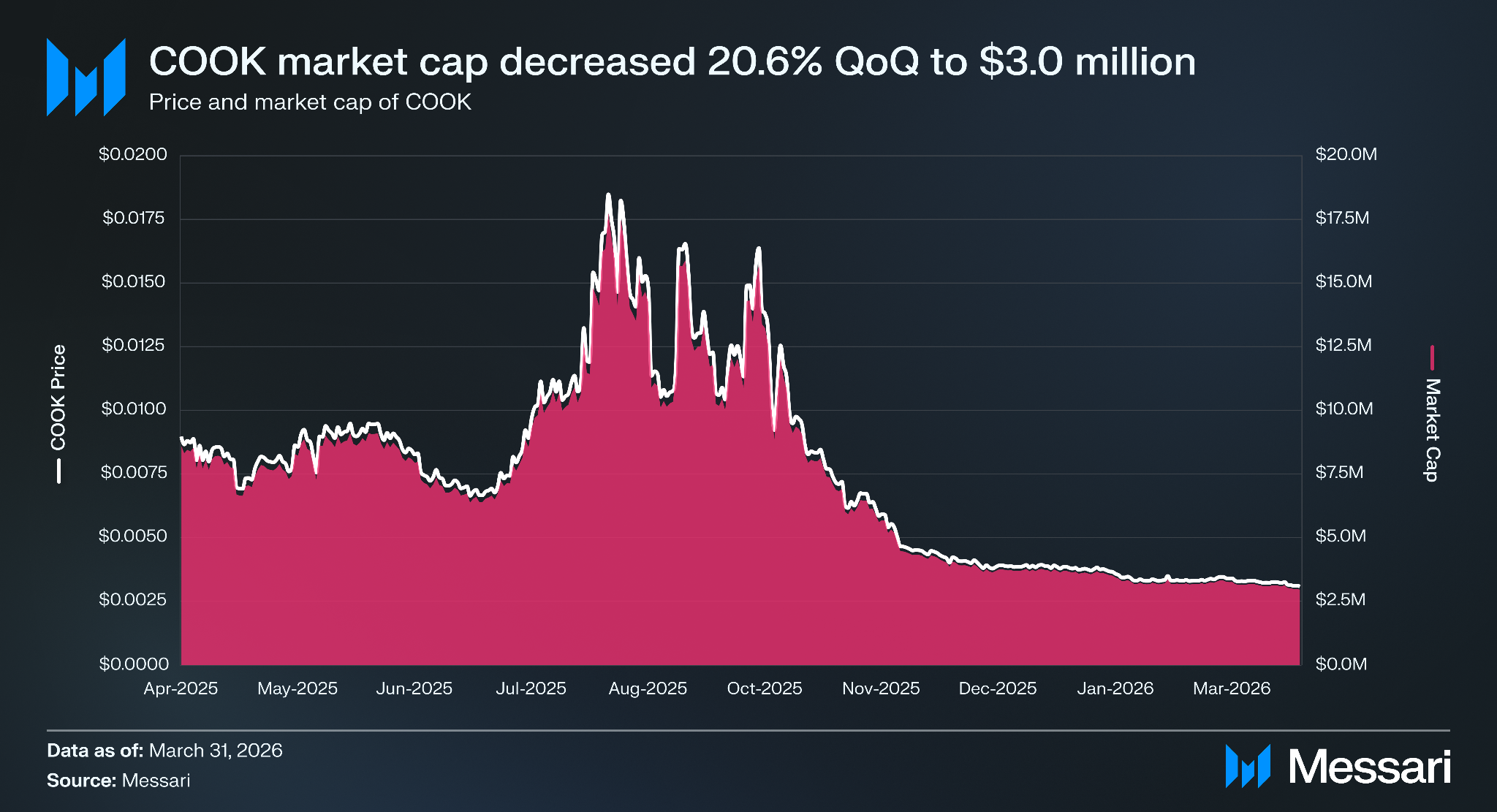
COOK is the native governance token of the mETH Protocol, designed to direct fees, validator onboarding, staking, and restaking allocations, and incentive design across both mETH and cmETH. Formal onchain governance using COOK is not yet active, with protocol decisions still coordinated through the Mantle Forum. COOK’s circulating market cap fell 20.6% QoQ from $3.8 million at year-end 2025 to $3.0 million at the end of Q1 2026.
DeFi TVL
DeFi TVL on Mantle reached an all-time high in Q1 2026, growing 282.7% QoQ from $169.3 million at year-end 2025 to $648.0 million at the end of Q1 2026. The expansion was driven almost entirely by the Feb. 11, 2026, launch of Aave V3 markets on Mantle, which grew from $0 to $547.1 million in TVL by quarter-end, representing 84.4% of all DeFi TVL on the network. The launch was paired with 8 million MNT and 1.5 million GHO in incentives, attracting new inflows as the markets came online. Every other large DeFi protocol on Mantle saw TVL decline during the quarter, with drawdowns ranging from 27.5% to 76.7%, underscoring that Mantle’s DeFi growth in Q1 was driven by the largest lending protocol in DeFi coming online on the network.
DEX Volume
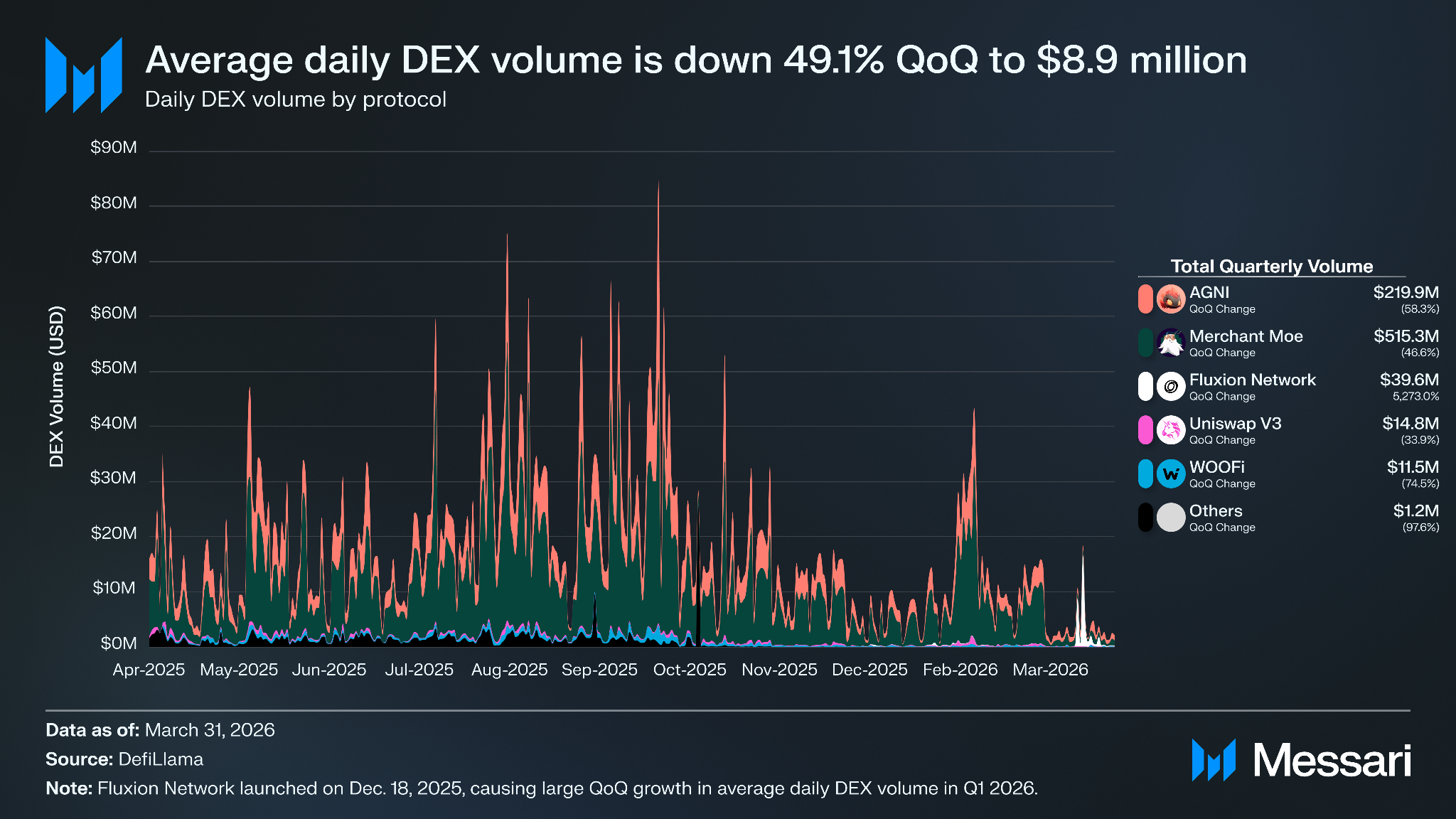
Average daily DEX volume on Mantle fell 49.1% QoQ from $17.5 million at year-end 2025 to $8.9 million in Q1 2026. AGNI Finance remained the dominant DEX by quarterly volume at $219.9 million, though its average daily volume fell 58.3% QoQ from $5.9 million to $2.4 million.
Fluxion Network posted the largest QoQ volume growth in the cohort, expanding more than 50x from $736,850 in Q4 2025 to $39.6 million in Q1 2026, its first full quarter following the Dec. 18, 2025, launch. The bulk of Fluxion’s Q1 volume traced back to printr, a Bybit-backed omnichain memecoin launchpad that routes graduated token liquidity to Fluxion on the Mantle network. As printr scaled through the quarter as a multichain memecoin venue, Fluxion captured the Mantle leg of that distribution, giving the newest DEX on the chain a structural pipeline of new pool launches and the associated trading flow.
Financial Analysis
Price and Market Cap
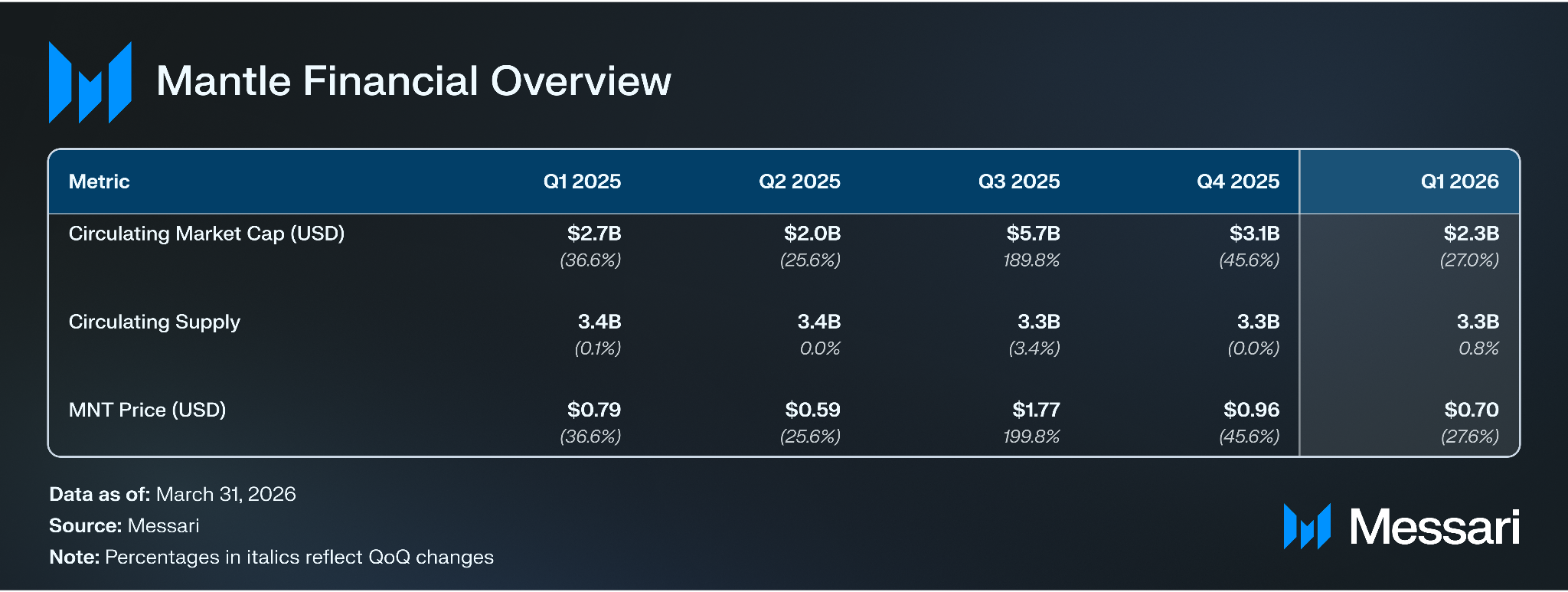
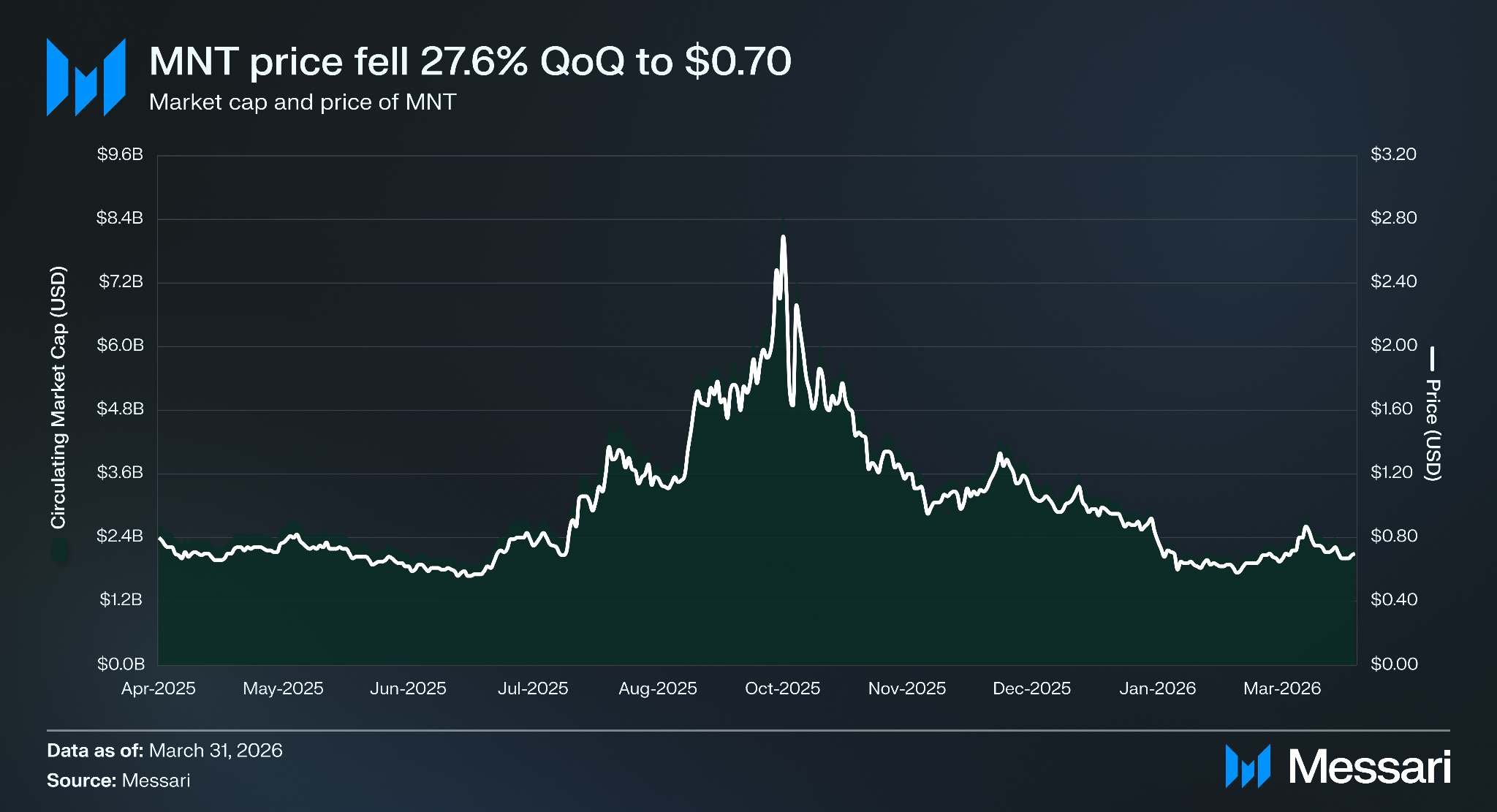
MNT’s circulating market cap fell 27.7% QoQ, from $3.1 billion at year-end 2025 to $2.3 billion at the end of Q1 2026, while the token price declined 27.6%, from $0.96 to $0.70, over the same period. The drawdown reflected broader cooling in crypto markets through Q1, with MNT moving lower despite a series of distribution catalysts that expanded the token’s reach across new venues.
The most notable of those catalysts came on Jan. 27, 2026, with the launch of Mantle Super Portal, a crosschain interface developed by Bybit, Mantle, and Byreal that extended MNT into the Solana ecosystem. The portal allows holders to bridge MNT from Ethereum to Solana and deploy into Solana-native DeFi markets on Byreal, paired with 96,000 MNT in liquidity incentives for the MNT-USDC pool on Solana distributed over three months. Robinhood also listed MNT, broadening its reach beyond crypto-native exchanges. The simultaneous expansion across Solana DeFi and a major U.S. retail brokerage positions MNT for broader holder distribution in Q2.
Transaction Fees
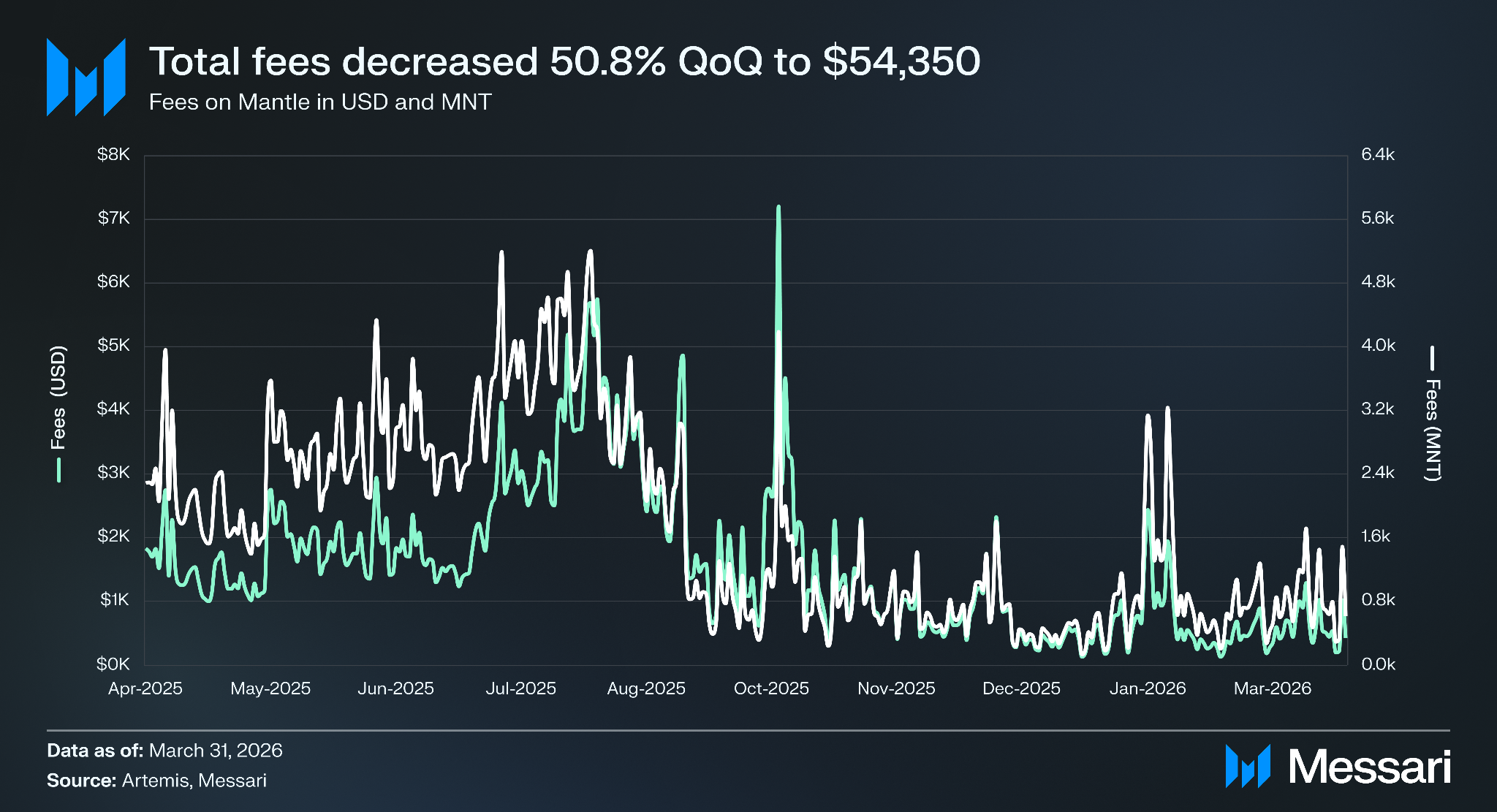
Mantle fees fell 50.7% QoQ from $110,500 at year-end 2025 to $54,350 in Q1 2026. As a ZK validium posting to Ethereum blobs, Mantle operates with structurally low transaction fees, and network fees track closely with onchain activity. Softer DEX volumes and lower transaction activity through the quarter pulled the already modest fee base lower.
Network Analysis
Onchain Activity
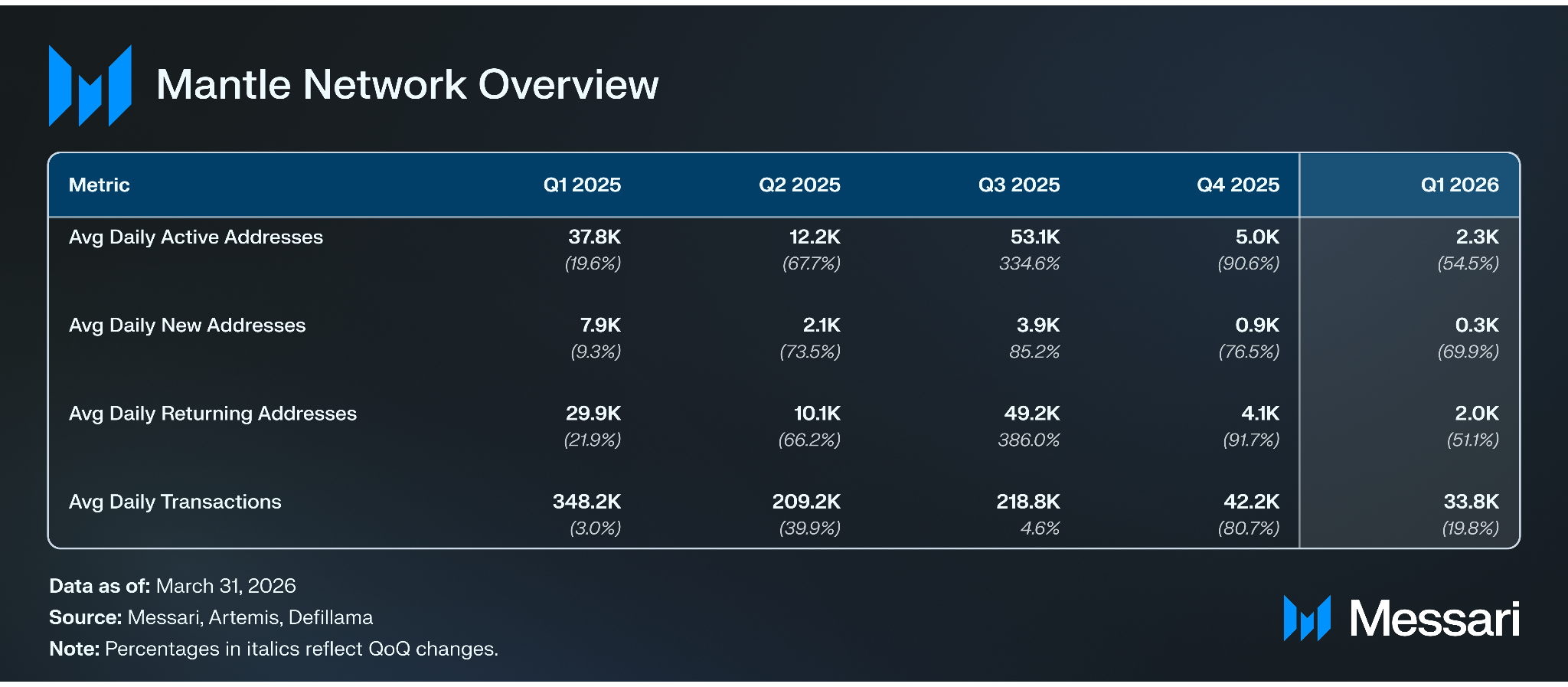
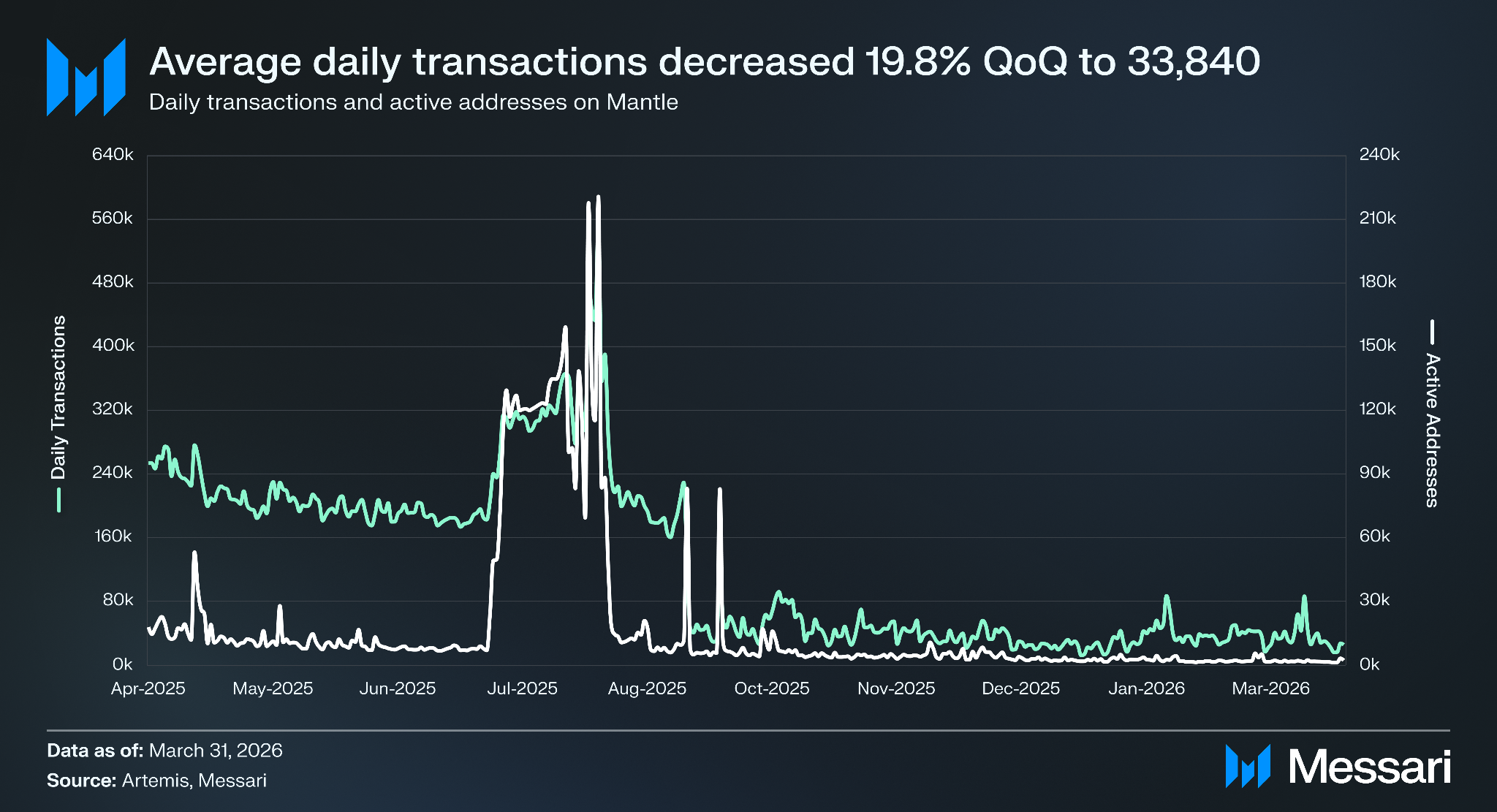
Onchain activity on Mantle contracted in Q1 2026, though the divergence between address and transaction declines points to a more concentrated user base on the network. Average daily active addresses fell 54.5% QoQ from 5,000 at year-end 2025 to 2,280 in Q1 2026, the lowest level since Mantle launched. Daily transactions held up better, declining 19.8% QoQ from 42,200 to 33,840 and lifting average transactions per active address from 8.4 in Q4 to 14.7 in Q1. A loyal set of addresses continued to engage with Mantle throughout the quarter, even as broader user acquisition softened. Catalysts for restoring address growth heading into Q2 include continued ecosystem integrations and the rollout of UR, Mantle’s neobank, which would extend the network’s reach into a new user segment beyond crypto-native DeFi participants.
Addresses
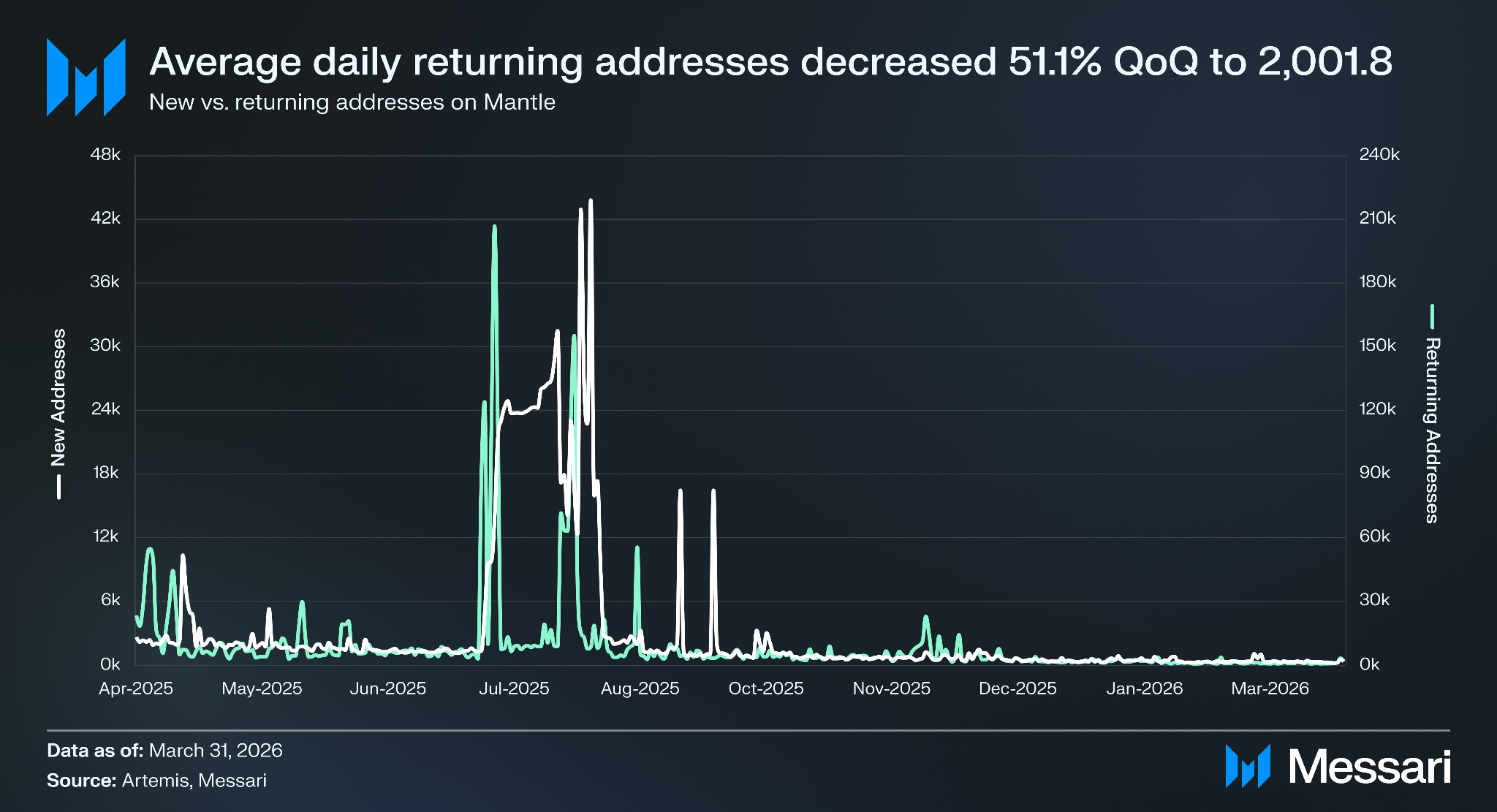
Breaking Q1 active addresses into new and returning groups confirms the concentration trend. Mantle averaged 273 new daily addresses and 2,001 returning daily addresses in Q1, meaning roughly 87% of daily activity in Q1 came from addresses that had previously transacted on the network. The mix shows healthy retention of existing users, with new acquisition the primary lever for further address growth.
Network Updates, Partnerships, and Integrations
Mantle completed the Limb hard fork on Jan. 14, 2026, bringing Mantle into full compatibility with Ethereum’s Fusaka upgrade and its PeerDAS-driven expansion of blob capacity. As part of the upgraded cycle, Mantle moved its primary data availability layer to Ethereum blobs, deepening alignment with Ethereum while maintaining its relationship with EigenCloud for related services.
Mantle expanded its ecosystem footprint through four Q1 integrations:
Infinex: Mantle went live on Infinex, a crosschain wallet platform, enabling Infinex users to access Mantle assets and applications from a single interface.
Allora: Allora went live on Mantle, bringing its decentralized AI inference network onto the chain and enabling onchain access to its predictive models.
Tristero: Mantle went live on Tristero, a trading and execution platform, simplifying access to MNT and other Mantle-native assets for Tristero users.
Everclear: Mantle partnered with Everclear, a crosschain settlement protocol, to enable composable crosschain flows for assets on Mantle.
Robinhood: MNT was listed on Robinhood in January 2026, broadening its reach to U.S. retail investors beyond crypto-native exchanges
XAUT: Tether brought tokenized gold to Mantle on Jan. 19, 2026, with deposits and withdrawals routed through Bybit, adding gold-backed RWA exposure to the chain's asset stack.
Anchorage Digital: Mantle partnered with Anchorage Digital to provide regulated institutional custody for $MNT on Ethereum through Anchorage's Porto wallet, enabling global institutions to hold $MNT directly on their balance sheets.
Mantle positioned itself as a home for autonomous AI agents during the quarter by rolling out agent infrastructure. The team deployed ERC-8004, an onchain identity, reputation, and validation standard for AI agents, on Mantle Mainnet on Feb. 16, 2026, giving agents a verifiable identity layer they can carry across organizational boundaries. Mantle also released its own AI Agent Skills and Agent Scaffold to give deployers a faster on-ramp to building, integrating, and running agents that reliably perform Mantle-related tasks. Rounding out the stack, Mantle deployed x402 payment infrastructure via QuestFlow, enabling agents to pay for resources programmatically and bringing QuestFlow’s agent ecosystem onto the chain.
Following Q1, Mantle completed the Arsia upgrade on April 16, 2026, an architectural shift from Validium to ZK Rollup with Ethereum as the data availability layer. The upgrade positions Mantle 3rd in Total Value Secured among all rollups globally, with $1.72B secured. This is the most significant infrastructure milestone in Mantle's history since the network launch.
Mantle Treasury
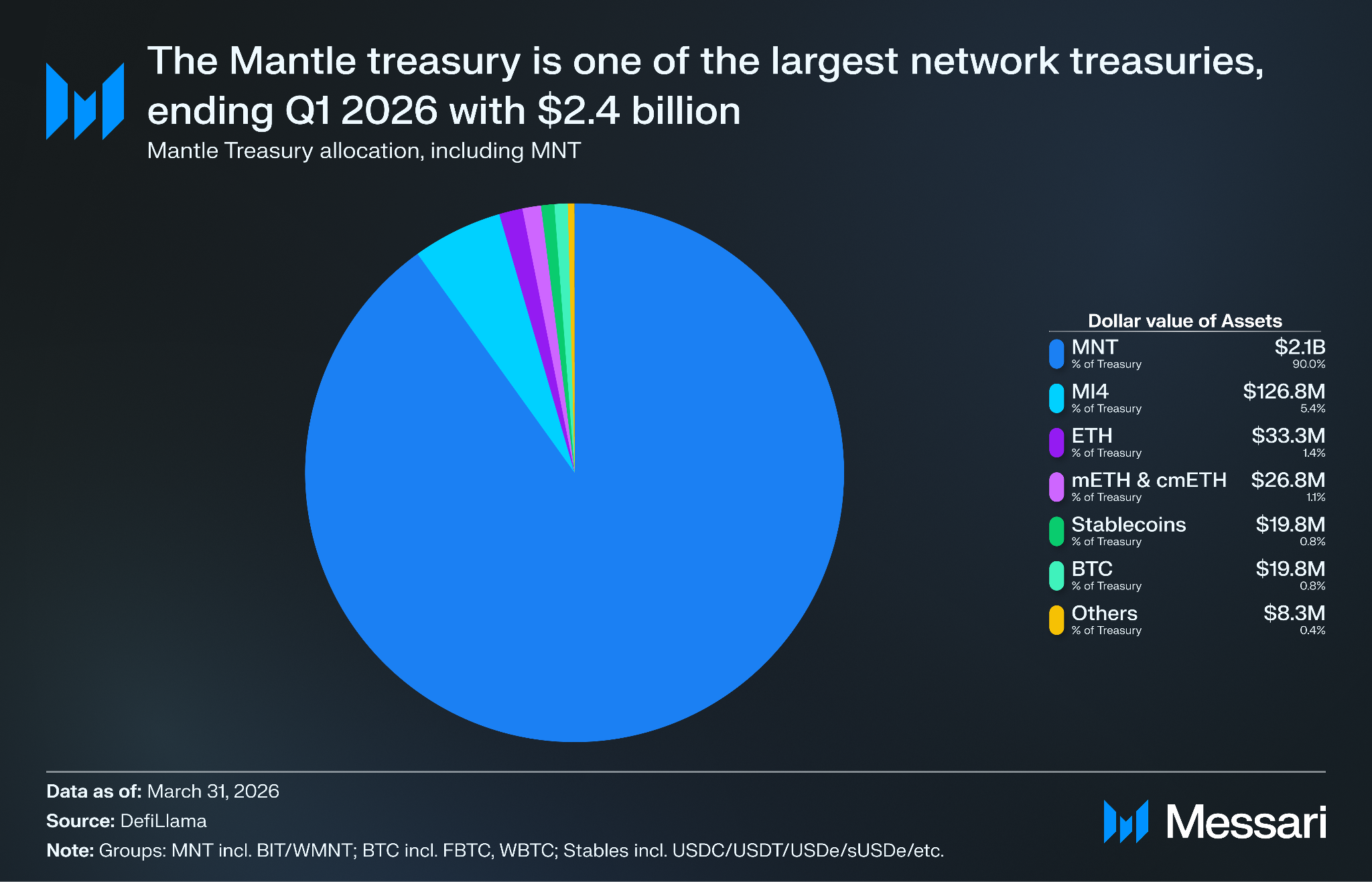
The Mantle Treasury closed Q1 2026 at $2.4 billion, the largest DAO treasury on DefiLlama and the second-largest treasury overall, trailing only Digital Asset Treasury (DAT) company SharpLink Gaming (NASDAQ: SBET). The treasury contracted 25.1% QoQ from $3.1 billion at year-end 2025, driven almost entirely by MNT’s price decline.
The Q1 allocation breakdown stands as follows:
MNT (including BIT, WMNT): $2.1 billion in holdings, representing 90.0% of the treasury.
MI4: $126.8 million in holdings, representing 5.4% of the treasury.
ETH (wETH): $33.3 million in holdings, representing 1.4% of the treasury.
mETH and cmETH: $26.7 million in holdings, representing 1.1% of the treasury.
Stablecoins (USDC, USDT, USDe): $19.8 million in holdings, representing 0.8% of the treasury.
BTC (FBTC, wBTC): $19.8 million in holdings, representing 0.8% of the treasury.
Others (bbSOL, COOK, and others): $8.3 million in holdings, representing 0.4% of the treasury.
MNT holdings declined 28.5% QoQ to $2.1 billion in Q1, an $843.3 million loss that drove the treasury's overall $788.4 million decline. The treasury opened a $126.8 million position in MI4 during the quarter, the only major new exposure added in Q1. Among existing positions, stablecoins expanded 95.6% to $19.8 million, mETH and cmETH increased 34.8% to $26.7 million, and BTC rose 15.6% to $19.8 million, while ETH holdings fell 72.7% to $33.3 million. The ETH drop was well beyond what price action alone would explain, consistent with a portion of treasury ETH being redeployed into the new MI4 allocation, which itself routes ETH into mETH Protocol for staking yield. The composition shift reduced MNT's share of treasury value from 94.3% to 90.0%, with MI4 and expanded stablecoin holdings beginning to diversify Mantle's asset profile.
Closing Summary
Mantle’s thesis is to serve as the distribution layer for onchain finance rather than a general-purpose Layer-2. This sharpened in Q1 2026 with major product launches across DeFi, RWAs, stablecoins, and AI agents. Aave V3 launched on Feb. 11, 2026, and scaled from zero to $547.1 million in TVL by quarter-end, driving DeFi TVL to an all-time high of $648.0 million. RWA TVL grew 27.4% QoQ to $247.5 million on Maple's syrupUSDT and Bybit's xStocks rollout, while Mantle Vault closed Q1 at $221.5 million in TVL by routing CEX-fronted stablecoin deposits into onchain yield. Mantle also deployed ERC-8004, AI Agent Skills, Agent Scaffold, and x402 payments via QuestFlow, assembling a complete agent stack on a single chain. The $2.4 billion Mantle Treasury began diversifying as MI4 entered the portfolio at $126.8 million and MNT concentration fell from 94.3% to 90.0%.
The quarter's headline metrics moved the other direction: MNT fell 27.6%, daily active addresses dropped 54.5% to a network low, and fees declined 50.7%. User composition told a more constructive story, with 87% of daily activity coming from returning addresses and transactions per address climbing from 8.4 to 14.7, indicating a loyal core engaging more intensively even as new acquisitions slowed. The Q2 setup hinges on whether the institutional infrastructure built in Q1 converts that loyal core into broader chain activity, and early Q2 data suggest it has. Aave on Mantle crossed $1.4B in total market size by April, xStocks with Atomic RFQ activating institutional-grade execution, and the Arsia upgrade completed Mantle's transition to a full ZK Rollup. The Turing Test Hackathon launched with 600+ builders from 63 countries, introducing a new user acquisition channel beyond crypto-native DeFi participants.
This report was commissioned by Mantle. All content was produced independently by the author(s) and does not necessarily reflect the opinions of Messari, Inc. or the organization that requested the report. The commissioning organization may have input on the content of the report, but Messari maintains editorial control over the final report to retain data accuracy and objectivity. Author(s) may hold cryptocurrencies named in this report. This report is meant for informational purposes only. It is not meant to serve as investment advice. You should conduct your own research and consult an independent financial, tax, or legal advisor before making any investment decisions. Past performance of any asset is not indicative of future results. Please see our Terms of Service for more information.
No part of this report may be (a) copied, photocopied, duplicated in any form by any means or (b) redistributed without the prior written consent of Messari®.
Eric is a research analyst at Messari and an ambassador for Maple Finance. He previously was a Product Manager for FINTRX and is passionate about DeFi and AI.
Eric is a research analyst at Messari and an ambassador for Maple Finance. He previously was a Product Manager for FINTRX and is passionate about DeFi and AI.