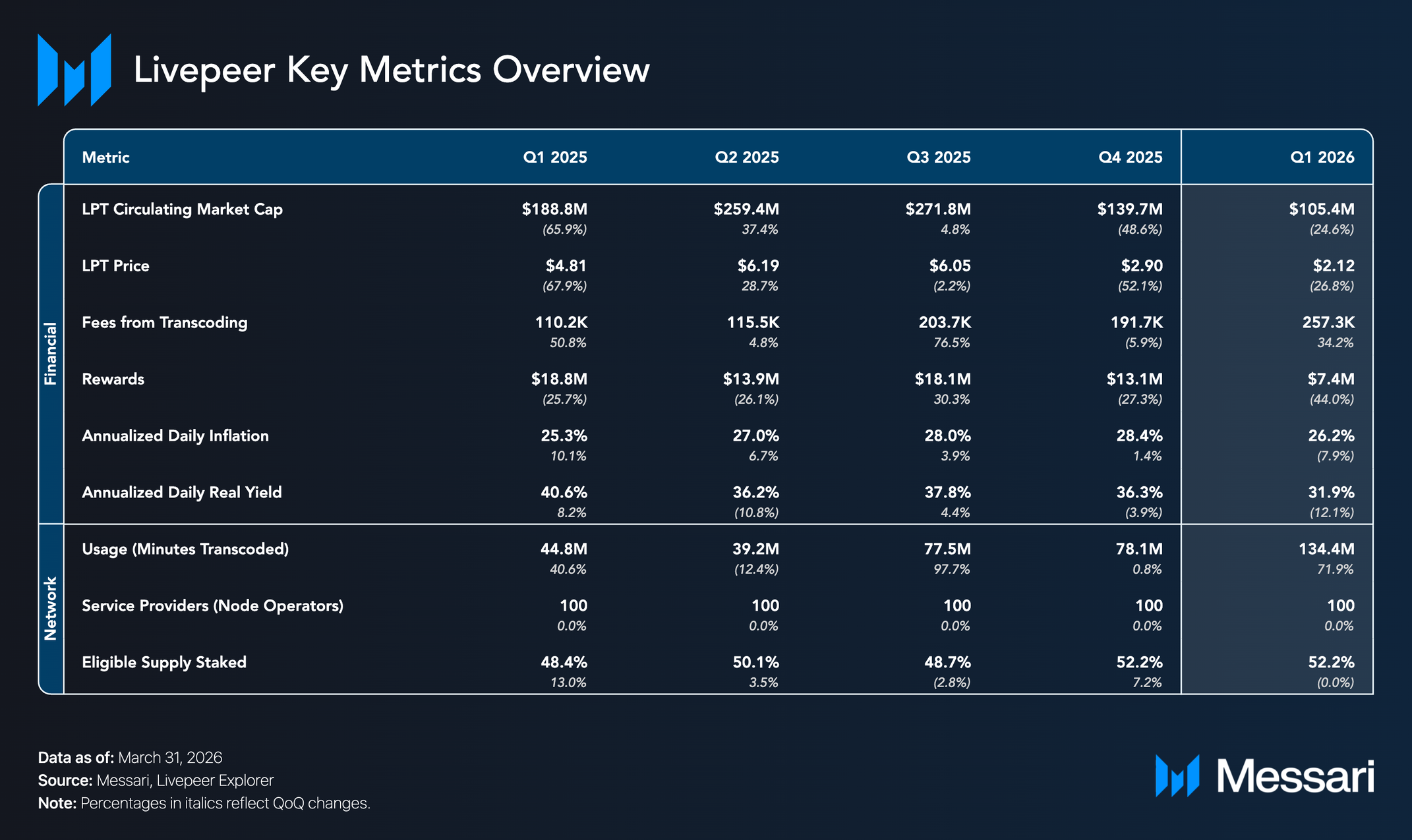
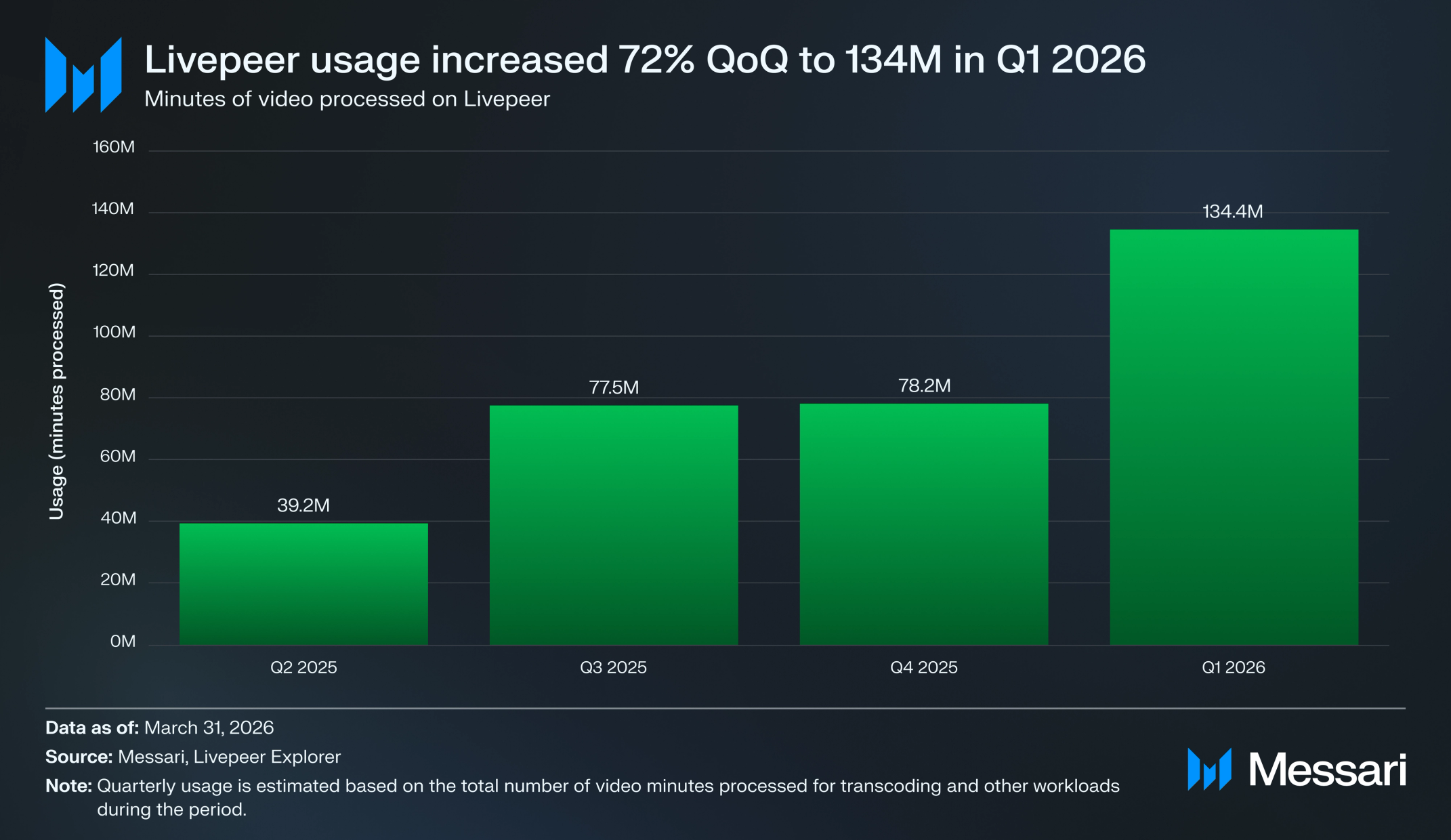
Network usage increased 71.9% QoQ to 134.4 million minutes, reaching a new quarterly high and reflecting deeper production usage and continued adoption across existing applications and builders.
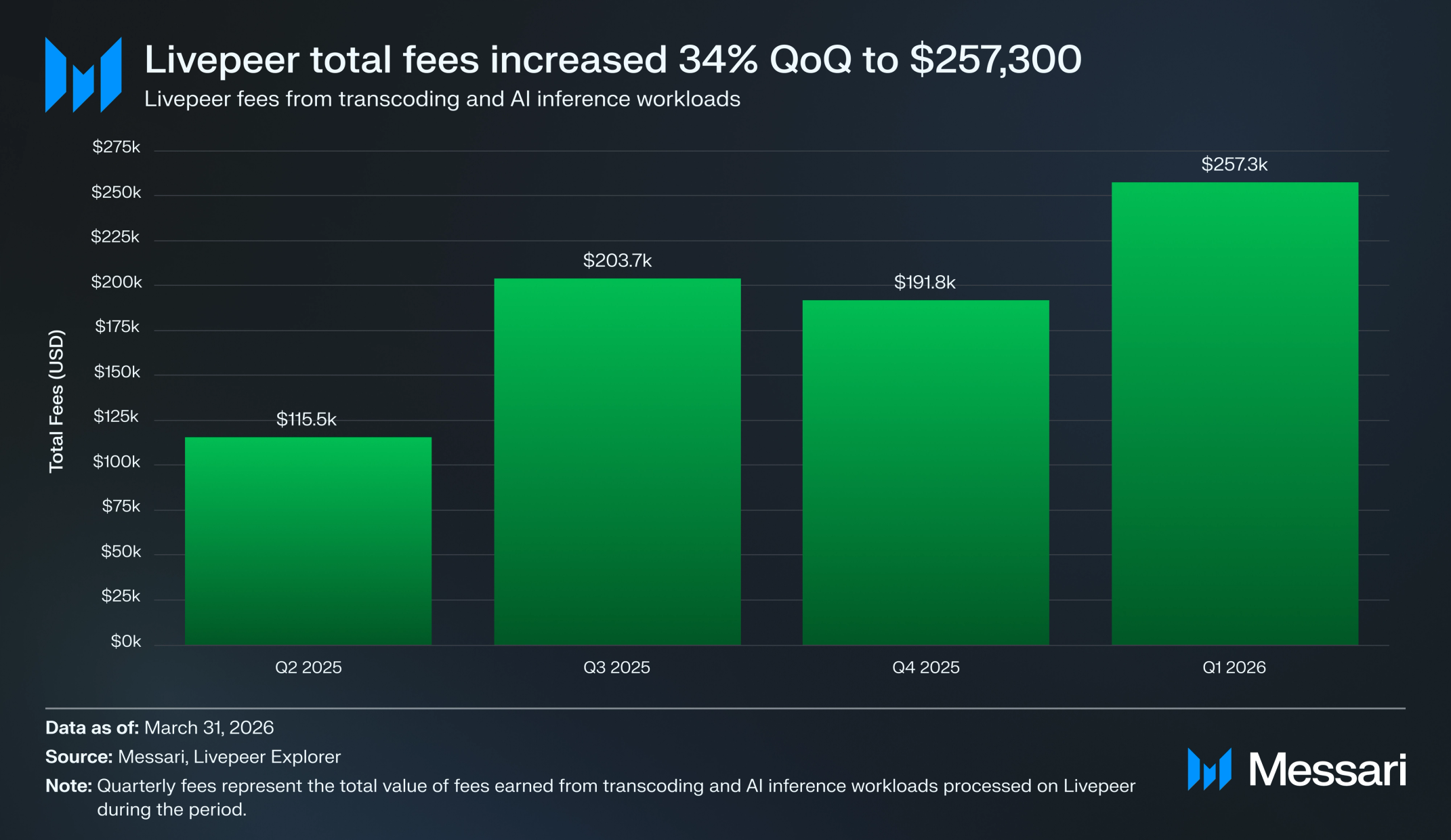
Demand-side fees increased 34.2% QoQ to $257,300, although average revenue per 1,000 minutes declined 22% as throughput expanded faster than fee capture.
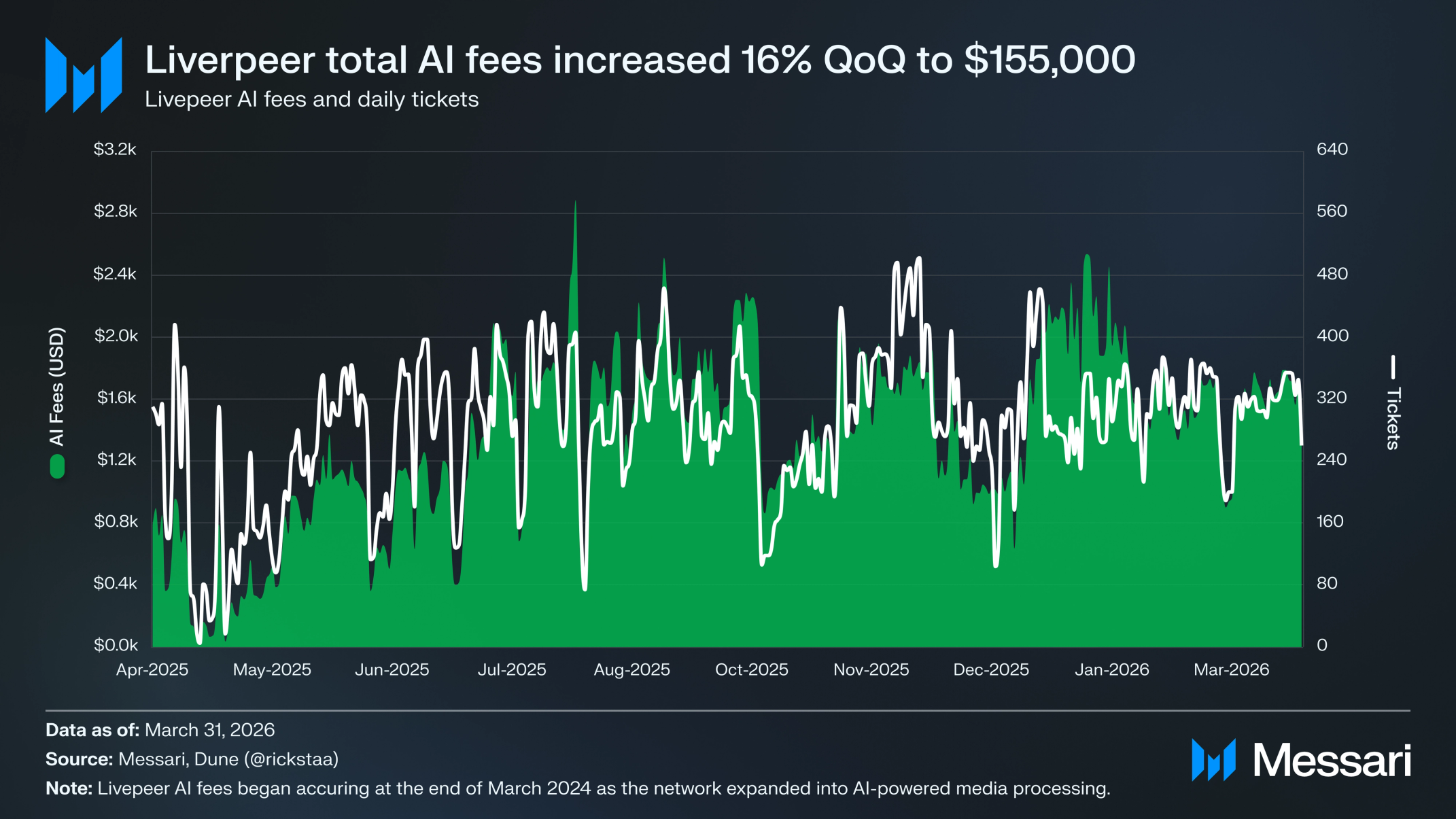
AI-driven fees totaled $154,700 in Q1, a 15.5% QoQ increase, and accounted for roughly 60% of total protocol revenue, remaining the network’s largest monetization driver.
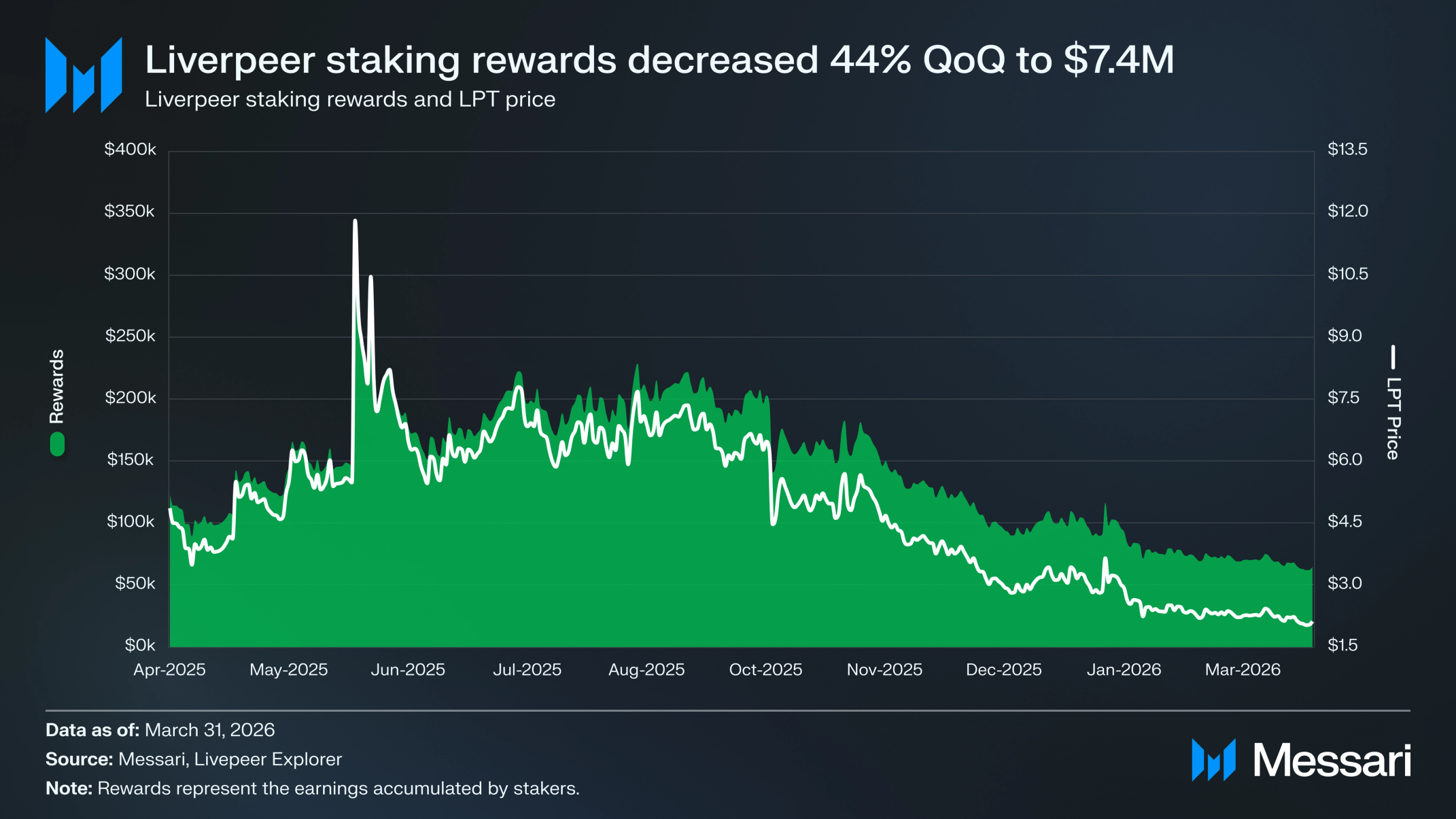
Staking participation remained above the 50% target in Q1, contributing to lower inflation; however, total staking rewards declined 44% QoQ to $7.4 million, driven by lower LPT price and reduced token issuance.
Livepeer governance reactivated treasury rewards via LIP-101, restoring a 10% treasury cut, and launched a Protocol R&D SPE to formalize maintenance, upgrades, and network operations.
Primer
Real-time AI video applications require infrastructure that can generate, transform, and deliver video as it is being produced. Unlike traditional video workflows, which primarily involve transcoding existing media into formats suited for different devices and bandwidth conditions, AI video workloads require low-latency GPU compute for inference, generation, and live transformation. Cloud providers such as AWS, Google Cloud, and Microsoft Azure are common sources of GPU and video infrastructure, but they can be costly and capacity-constrained for compute-intensive media workloads.
Livepeer (LPT) is a global compute network for AI video: an open, permissionless marketplace for media compute that powers live and on-demand streaming, video transcoding, and real-time AI video inference. By matching application demand with decentralized GPU supply, Livepeer aims to lower costs relative to centralized cloud providers while scaling workloads such as transcoding, remixing, generative overlays, and other forms of real-time video processing.
Its compute marketplace enables participants to contribute GPU resources for various workloads, including video transcoding and AI-powered video processing. As AI-driven video models demand significantly more GPU compute than text and image generation, Livepeer offers a scalable and cost-efficient solution for video-related compute tasks. The network can offer GPU compute at 60-85% lower cost than centralized cloud alternatives. Within Livepeer’s decentralized transcoding network, there are two key participants:
Orchestrators are GPU operators that perform compute work, including AI inference and video processing, and earn fees in ETH or stablecoins. The amount of work they receive is proportional to the amount of Livepeer native tokens (LPT) that has been delegated to them.
Delegators are LPT holders who assign their tokens to orchestrators they believe are reliable, helping secure the network and signal performance. In return, they earn a share of both network fees and newly minted LPT rewards
Livepeer’s network has evolved from a video transcoding protocol into infrastructure for real-time AI video processing, with AI inference now representing the primary workload on the network. This shift is reflected in Q1 activity, where AI-driven use cases accounted for the majority of protocol fees. These workloads include generating video with AI models (similar to tools like Sora), applying live effects and transformations to streams, or powering interactive environments such as virtual worlds that update in real time. Initiatives such as Daydream, a real-time AI video engine, and Cascade, a framework for scaling decentralized media compute, support this transition toward AI-native video workloads.
The Project Team Commentary section of this report was written by the Livepeer Foundation and reflects the views, opinions, and forward-looking statements of the Livepeer Foundation only. This section is included to provide additional context on the project's strategy, priorities, and outlook and does not necessarily reflect the views or opinions of Messari, Inc.
Q1 2026 was Livepeer's strongest quarter on record. Network usage reached 134.4 million minutes processed and demand-side fees reached $257,300, both all-time highs. AI inference fees grew to $154,700, with average per-ticket value up 12.2% to $5.46. Staking participation held above 50% all quarter (52.2%), resulting in materially lower issuance and a continued downward inflation trend.
Q1 usage reflects a mix of production workloads and reserved capacity from ecosystem partners building real-time AI video products; the Foundation's focus in the coming quarters is expanding the share driven by independent developer-led demand. We also expect transcoding fees to decline over time as the workload mix shifts toward AI-focused video generation.
Livepeer was built for real-time video processing. That infrastructure, optimized for low-latency, high-throughput compute, created the architecture that now serves AI inference on live streams alongside transcoding and streaming workloads, and Q1 showed what that breadth looks like at scale.
Q1 demonstrated that Livepeer's thesis is landing, with usage and fees reaching all-time highs, AI inference maturing in value, and builders across distinct verticals shipping production workloads on the network. The quarter also highlighted the importance of interpreting progress through workload mix and not just top-line aggregates. In Q2, the Foundation's focus is on lowering friction for independent developers to ship repeatable production workloads on Livepeer, and improving the legibility of orchestrator performance so delegators and other stakeholders can evaluate quality with confidence.
Performance Analysis
Demand for Livepeer stems from apps and developers requiring video transcoding, live streaming, and video generation capabilities. This includes decentralized social media (DeSoc) applications, Web3-native platforms, and traditional Web2 applications requiring scalable video infrastructure. While platforms like TikTok, Twitch, Spotify, and SoundCloud rely on centralized infrastructure for streaming, similar applications in the Web3 space, such as decentralized video platforms, music streaming apps with tokenized incentives, or NFT-based media platforms, can leverage Livepeer’s decentralized video streaming and transcoding services.
Network
Livepeer’s network usage is commonly estimated by the number of minutes of video transcoded or otherwise processed, which serves as a useful proxy for demand on the protocol.
Livepeer’s estimated video processing volume increased 71.9% QoQ, rising from 78.2 million minutes in Q4 2025 to 134.4 million minutes in Q1 2026. Network usage accelerated sharply in Q1, reaching a new quarterly high. Growth was driven by deeper production usage and continued adoption from existing applications, with demand increasingly concentrated in real-time AI and agent-related workloads. Improvements to live video pipelines, job scoring, and orchestrator reliability supported the network’s ability to sustain this higher baseline of completed work.
Fees from Transcoding and AI Inference
Services using the Livepeer network pay demand-side fees in ETH to access video transcoding and AI-powered processing tasks. Node operators (orchestrators) earn these fees for processing jobs and distribute a portion to their delegators based on their configured fee-sharing parameters. The likelihood of receiving transcoding jobs is proportional to the amount of LPT staked; orchestrators with higher self- and delegated LPT are prioritized for more work and thus earn greater fees. This system incentivizes both node operators and delegators, reinforcing network participation and security.
Livepeer’s demand-side fees increased 34.2% QoQ, rising from $191,800 in Q4 2025 to $257,300 in Q1 2026. However, based on total minutes processed, average revenue per 1,000 minutes fell from approximately $2.45 in Q4 to $1.91 in Q1, a 22.0% QoQ decline. This indicates that while aggregate fee generation increased, throughput grew materially faster than fee capture, with usage expanding 71.9% QoQ to 134.4 million minutes.
The decline in unit revenue aligns with an ongoing shift in workload composition toward lower-fee, high-throughput demand. As Livepeer continues to support more real-time AI inference and application-driven usage, throughput appears to be scaling faster than fee capture, reflecting a changing mix of workloads and early-stage pricing dynamics across the network.
At the same time, the increase in total fees suggests that network demand remains strong in absolute terms. Rather than reflecting weakening usage, the decline in fees per minute indicates that the network is becoming more cost-efficient for end users as throughput scales. This dynamic is consistent with a competitive compute marketplace, where increased supply and improved efficiency reduce unit costs even as total activity and fee generation continue to grow.
Fees from Livepeer AI
In Q1 2026, Livepeer AI continued to mature as a monetized workload category within the network. As Livepeer expanded support for real-time inference and media compute use cases such as video agents, live analytics, and interactive overlays, AI-related activity generated higher fees and improved realized pricing, reinforcing its role as a core demand driver beyond traditional transcoding.
In Q1 2026, Livepeer’s AI-generated fees totaled approximately $154,700, increasing 15.5% QoQ from $133,900 in Q4 2025. This increase reflects stronger demand for AI-related workloads following the modest decline in the prior quarter.
A total of 28,330 winning tickets were processed during the quarter, representing a 3.0% increase QoQ from 27,514 tickets in Q4. Ticket volume grew modestly, indicating that the rise in AI fees was driven by both higher workload activity and improved monetization per job.
Based on quarterly aggregates, the average fee per AI ticket increased from approximately $4.87 in Q4 to $5.46 in Q1, a 12.2% QoQ increase. This suggests a shift toward higher-value AI workloads or firmer pricing across orchestrators, reversing the compression in unit economics seen in the previous quarter.
The QoQ increase in AI fees likely reflects a combination of sustained inference demand and improved realized pricing, as AI workloads continue to mature into a more consistent and economically meaningful component of network activity.
Despite this growth, AI workloads accounted for approximately 60.1% of total network fees in Q1 2026, down from over 70% in Q4 2025, as non-AI demand-side fees expanded more rapidly during the quarter.
Staking Rewards
The Livepeer network distributes staking rewards in LPT to node operators and delegators. To provide video services on the Livepeer network, node operators must stake LPT. A node operator’s stake weight comprises their own tokens and tokens they were delegated.
Total staking rewards decreased 44.0% QoQ to approximately $7.4 million in Q1 2026, down from $13.1 million in Q4 2025, alongside a 26.8% QoQ decline in LPT price (from $2.90 to $2.12). The contraction in USD-denominated rewards primarily reflects continued price pressure, compounded by a reduction in token emissions during the quarter.
First, LPT price depreciation remained a key driver of lower rewards in USD terms. Even with relatively stable network participation, the decline in token price mechanically reduced the dollar value of rewards distributed to orchestrators and delegators.
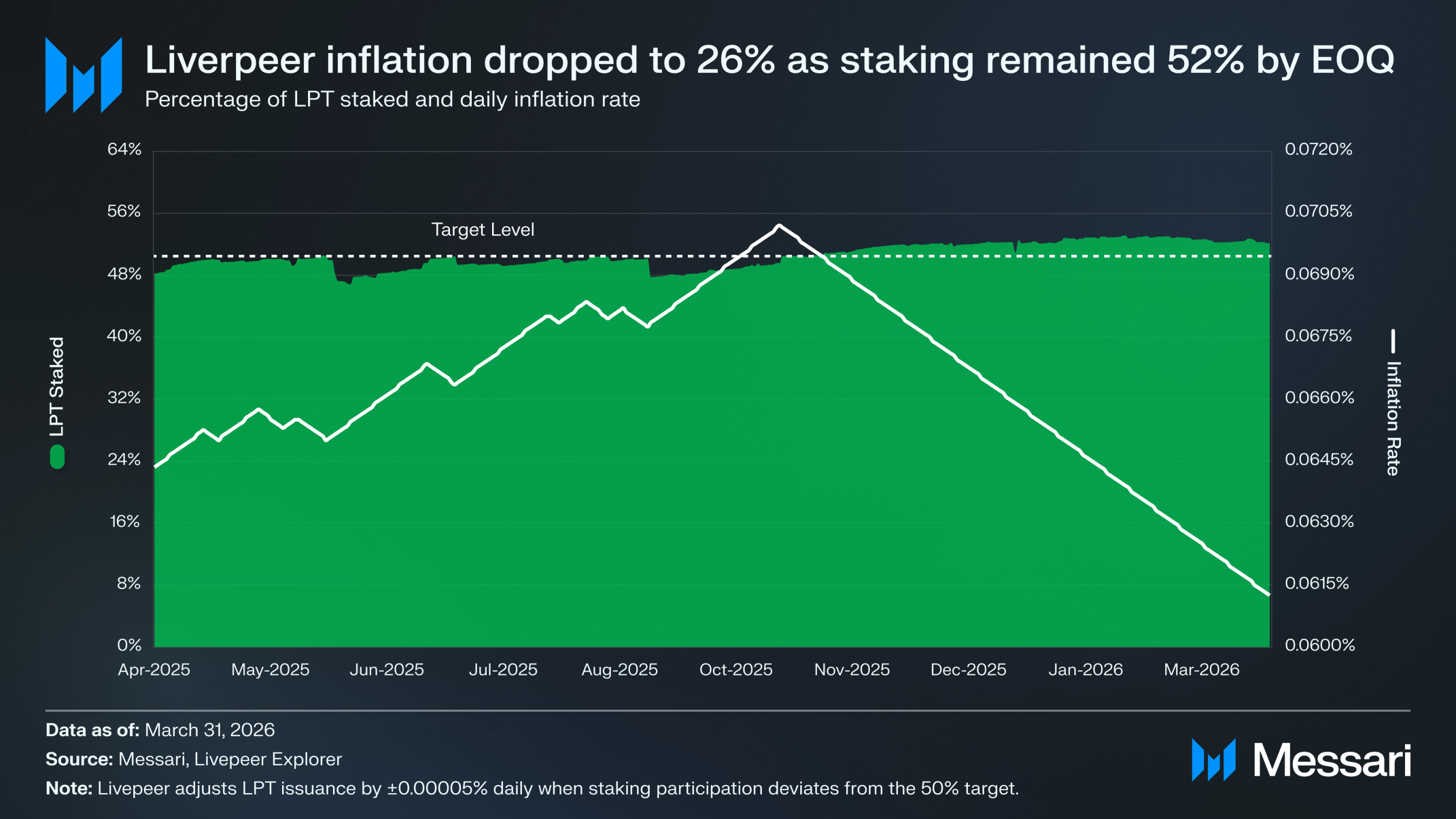
Second, staking participation remained elevated at 52.2%, in line with Q4 and above the protocol’s 50% target. This sustained level of participation continued to moderate issuance through Livepeer’s dynamic inflation mechanism, contributing to a decline in total rewards on both a token and USD basis. Annualized daily inflation decreased to 26.2% in Q1, down from 28.4% in Q4, reflecting this adjustment.
Third, network activity increased materially, with transcoded minutes rising 71.9% QoQ and demand-side fees increasing 34.2% QoQ. However, this growth in usage was not sufficient to offset the combined impact of lower token prices and reduced inflation, limiting the contribution of fee-derived compensation to total rewards.
Overall, the quarter highlights the continued sensitivity of USD-denominated rewards to token price and issuance dynamics. Even as network usage and fee generation expanded, lower inflation and declining LPT price drove a sharp reduction in total rewards.
Staking Participation
The Livepeer Token (LPT) operates under a Stake-for-Access (SFA) model, requiring node operators to stake LPT to perform work on the network. In Q1 2026, staking participation remained above the protocol’s 50% target, with 52.2% of eligible supply staked, unchanged from Q4 2025. Additionally, the number of delegators has declined, decreasing from 2,570 in Q4 2025 to 2,468 in Q1 2026, reflecting a contraction in the number of active participants helping to secure the network.
With staking participation holding above target throughout the quarter, Livepeer’s dynamic inflation mechanism continued to reduce issuance pressure. Annualized daily inflation declined from 28.4% in Q4 to 26.2% in Q1, while annualized daily real yield fell from 36.3% to 31.9%. The daily series also shows inflation trending lower across the quarter, consistent with staking participation remaining sustainably above the 50% threshold rather than continuing to recover toward it.
This dynamic reinforced the protocol’s shift toward a lower-inflation equilibrium, where staking rewards become less dependent on elevated token issuance and more sensitive to fee generation and token price. In Q1, demand-side fees increased 34.2% QoQ and usage rose 71.9% QoQ, indicating materially stronger network activity. However, that improvement was more than offset by a 26.8% QoQ decline in LPT price and lower inflation-driven issuance, which weighed on USD-denominated rewards.
Overall, Q1 reflected stable staking participation, moderating inflation, and materially stronger network usage. Even with stronger demand-side activity, lower token price and reduced issuance weighed on rewards, reinforcing that stake weight governs access to work, but realized economic output still depends on demand and workload mix across orchestrators.
Market Capitalization
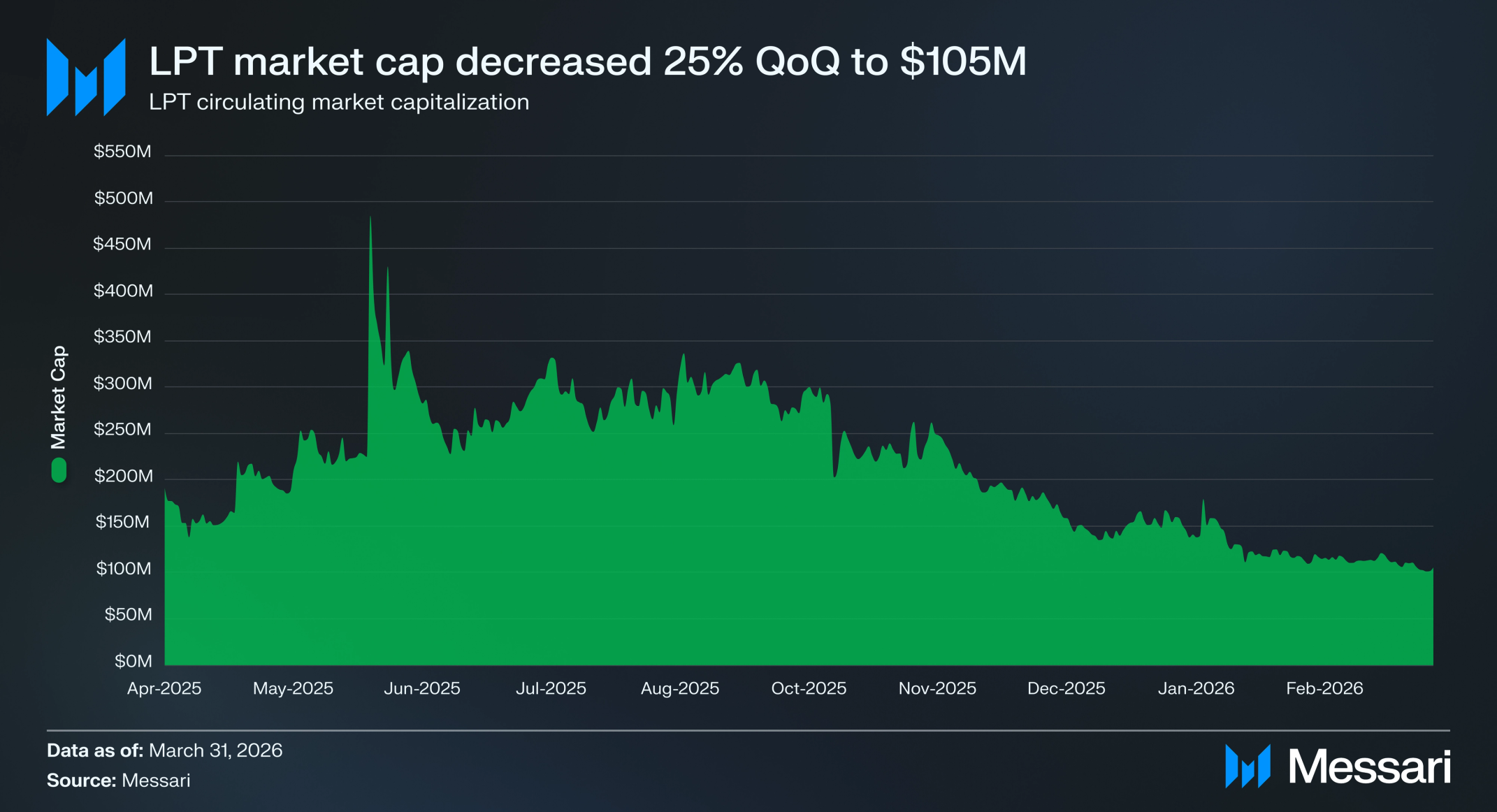
LPT’s circulating market capitalization declined 24.6% QoQ to $105.4 million in Q1 2026, down from $139.7 million in Q4 2025, driven primarily by a 26.8% QoQ decrease in token price to $2.12 from $2.90. The implied circulating supply increased modestly from approximately 48.2 million to 49.7 million LPT, an increase of about 1.5 million tokens, or 3.1% QoQ, consistent with ongoing emissions. However, this supply expansion was insufficient to offset the continued decline in token price, resulting in a further contraction in circulating market capitalization during the quarter.
Qualitative Analysis
Product and Infrastructure Updates
Real-time AI infrastructure maturity: Livepeer’s AI-focused infrastructure advanced toward production readiness in Q1 as real-time video inference capabilities were integrated more directly into core node software. The AI SPE (now Muxion Labs) merged bring-your-own-container (BYOC) streaming into go-livepeer and expanded ComfyStream to support multimodal outputs and data channels. The ai/live remote-signer stack was deployed across four updates between January and March, improving job routing, payments, and orchestration for real-time AI workloads.
Network-as-a-Product (NaaP) MVP definition: The NaaP initiative was reset in January to a narrower MVP following community feedback, focusing on near-term utility for gateways and orchestrators. Development included real-time AI job testing across multiple regions and ingestion of over 35 million historical records, establishing a pipeline for executing and analyzing network workloads.
Monitoring, analytics, and SLA foundations: The Cloud SPE proposal passed governance on Jan. 25 and delivered core observability infrastructure by the end of February, including a live Grafana dashboard, an Apache Flink processing pipeline, and APIs for GPU metrics and demand tracking. By the end of Q1, the system had expanded to a 46-endpoint API and incorporated real-time job testing across regions, culminating in an initial SLA scoring framework and a production-ready monitoring stack.
Protocol reliability and performance improvements: Core protocol updates included the release of go-livepeer v0.8.9 (Jan. 7) and v0.8.10 (March 10), with the latter addressing a critical transcoder crash issue. Additional improvements focused on latency reporting, broadcaster pricing stability, and capacity reporting refactors. The lpms media server library was also updated with encoding reliability improvements and failure handling mechanisms, supporting more stable performance as network usage increased.
Ecosystem Partnerships
Livepeer × XMTP: Livepeer partnered with XMTP to integrate encrypted, identity-based messaging into Livepeer-powered livestreaming, combining decentralized video infrastructure with messaging-native social features. The collaboration is designed as a two-way integration where Livepeer brings broadcast-scale video and real-time compute into messaging environments, while XMTP adds native chat and identity to Livepeer apps. Over time, this could support more interactive livestreams, watch parties, gaming broadcasts, and social video experiences with embedded payments, tipping, or gated access.
Livepeer × Ar.io: Livepeer collaborated with Ar.io to build media provenance infrastructure for AI-generated video. The partnership aims to embed verifiable records into video outputs, allowing content to carry metadata on when it was processed, by which system, and under what conditions. As AI-generated media becomes more common, this positions Livepeer to support authenticity and traceability as part of its media compute stack.
Livepeer × Spritz: Livepeer partnered with Spritz, a decentralized messaging app designed for regions where access is restricted or infrastructure is unreliable, to support live video broadcasting in constrained environments. Livepeer’s real-time transcoding enables streams to be delivered across multiple bitrates, improving accessibility under variable bandwidth conditions. This highlights a practical infrastructure use case for Livepeer beyond crypto-native experimentation.
Livepeer × minidev.fun: Livepeer collaborated with minidev.fun to expose video infrastructure to AI agents, enabling streaming and media workflows to be provisioned programmatically or via natural language.
Livepeer × embody.zone:embody.zonelaunched AI agent applications powered by Livepeer infrastructure, highlighting early adoption in embodied AI use cases such as training, product demos, and education.
Community Engagement and Events
Daydream AI program and builder engagement: Livepeer’s Daydream initiative ran a multi-week AI Video Program in Q1, culminating in a public demo day on March 25. The program engaged global creative technologists building real-time AI video applications, reflecting early-stage builder activity around generative video and interactive media use cases.
Ecosystem programs and community-led initiatives: Livepeer continued to support ecosystem development through grants and community-led programs. The Open Source Sponsorship Initiative published a nine-month report in January, detailing $19,115 distributed to maintain critical infrastructure dependencies. Community-driven transcoder campaigns also remained active, including initiatives focused on charitable contributions and geographic decentralization, reflecting ongoing participation from node operators beyond core protocol development.
Governance
Treasury rewards restart and protocol coordination: On Jan. 22, 2026, Livepeer governance reactivated treasury rewards through LIP-101, restoring the treasury reward cut at 10% and resuming protocol-level treasury accumulation. This re-established a recurring funding mechanism for protocol security, network development, and broader ecosystem investment as the network continued to scale AI-related workloads.
Protocol R&D SPE launch: Also on Jan. 22, 2026, the Protocol R&D Special Purpose Entity (SPE) launched, creating a more formal structure for protocol maintenance, upgrade delivery, public testnet operations, and continuous vulnerability response.
Closing Summary
In Q1 2026, Livepeer reaccelerated following a more measured Q4. Total video and AI processing volume increased 71.9% QoQ to 134.4 million minutes, reaching a new quarterly high and reflecting deeper production usage across existing applications and builders rather than one-off events or temporary demonstrations.
Demand-side fees increased 34.2% QoQ to $257,300, though average revenue per 1,000 minutes declined 22.0% as throughput expanded faster than fee capture. AI workloads remained the network’s largest monetization driver, generating approximately $154,700 in fees and accounting for roughly 60% of total protocol revenue, while non-AI demand-side fees expanded more rapidly during the quarter.
Total staking rewards declined 44.0% QoQ to $7.4 million, driven by a 26.8% QoQ decline in LPT price and lower token issuance as staking participation remained above the 50% target. This sustained participation contributed to moderating inflation dynamics, with annualized daily inflation declining to 26.2%, even as stronger network usage and fee growth were not enough to offset lower token-denominated reward value in USD terms.
Infrastructure development advanced toward production readiness for real-time AI workloads, with continued progress across core protocol upgrades, observability, and ecosystem tooling. Community activity also supported this shift, with builder programs like Daydream’s AI Video Program and ongoing ecosystem initiatives driving early-stage adoption and experimentation.
Overall, Q1 marked a quarter of renewed network expansion, with Livepeer reaching a new usage high, improving fee generation in absolute terms, and continuing its shift toward a lower-inflation, more usage-driven network model. At the same time, development and ecosystem activity increasingly centered on real-time AI infrastructure and applications, while governance reactivated treasury rewards and formalized protocol R&D coordination, strengthening Livepeer’s operational foundation as AI-related workloads continue to scale.
This report was commissioned by Livepeer Foundation. All content was produced independently by the author(s) and does not necessarily reflect the opinions of Messari, Inc. or the organization that requested the report. The commissioning organization may have input on the content of the report, but Messari maintains editorial control over the final report to retain data accuracy and objectivity. Author(s) may hold cryptocurrencies named in this report. This report is meant for informational purposes only. It is not meant to serve as investment advice. You should conduct your own research and consult an independent financial, tax, or legal advisor before making any investment decisions. Past performance of any asset is not indicative of future results. Please see our Terms of Service for more information.
No part of this report may be (a) copied, photocopied, duplicated in any form by any means or (b) redistributed without the prior written consent of Messari®.
Jake is a Research Analyst on the Protocol Research team. He previously worked as an Investment Analyst at an AI-driven crypto research platform and as a Venture Analyst at a digital assets venture fund. He advised multiple RWA tokenization projects on tokenomics. Jake graduated from the University of Southern California, where he studied Philosophy and Finance.
Jake is a Research Analyst on the Protocol Research team. He previously worked as an Investment Analyst at an AI-driven crypto research platform and as a Venture Analyst at a digital assets venture fund. He advised multiple RWA tokenization projects on tokenomics. Jake graduated from the University of Southern California, where he studied Philosophy and Finance.