For the first time in the past four quarters, the usage of the Livepeer transcoding network decreased 23% QoQ back to the usage levels seen in H1 2022.
As a result of decreased usage, demand-side revenue declined 22% QoQ in USD terms (down 36% in ETH terms).
Revenue from staking rewards remained flat QoQ in USD terms (up 7% in LPT terms).
By embedding with and supporting the Web3 community, the Livepeer roadmap is focused on developing the tooling and apps to drive demand to the network.
Primer on Livepeer
Building decentralized video apps like Twitch or TikTok requires heavy infrastructure for video streaming. Based on a user’s bandwidth and device, video content needs to be processed — i.e., transcoded — into viewable formats. While cloud providers like AWS, Google, or Microsoft are commonplace solutions for video transcoding services, they incur high costs.
Livepeer offers an open and permissionless transcoding marketplace — allowing anyone to contribute compute resources and to compete on price. The network is designed to reduce transcoding costs for end users by up to 10x.
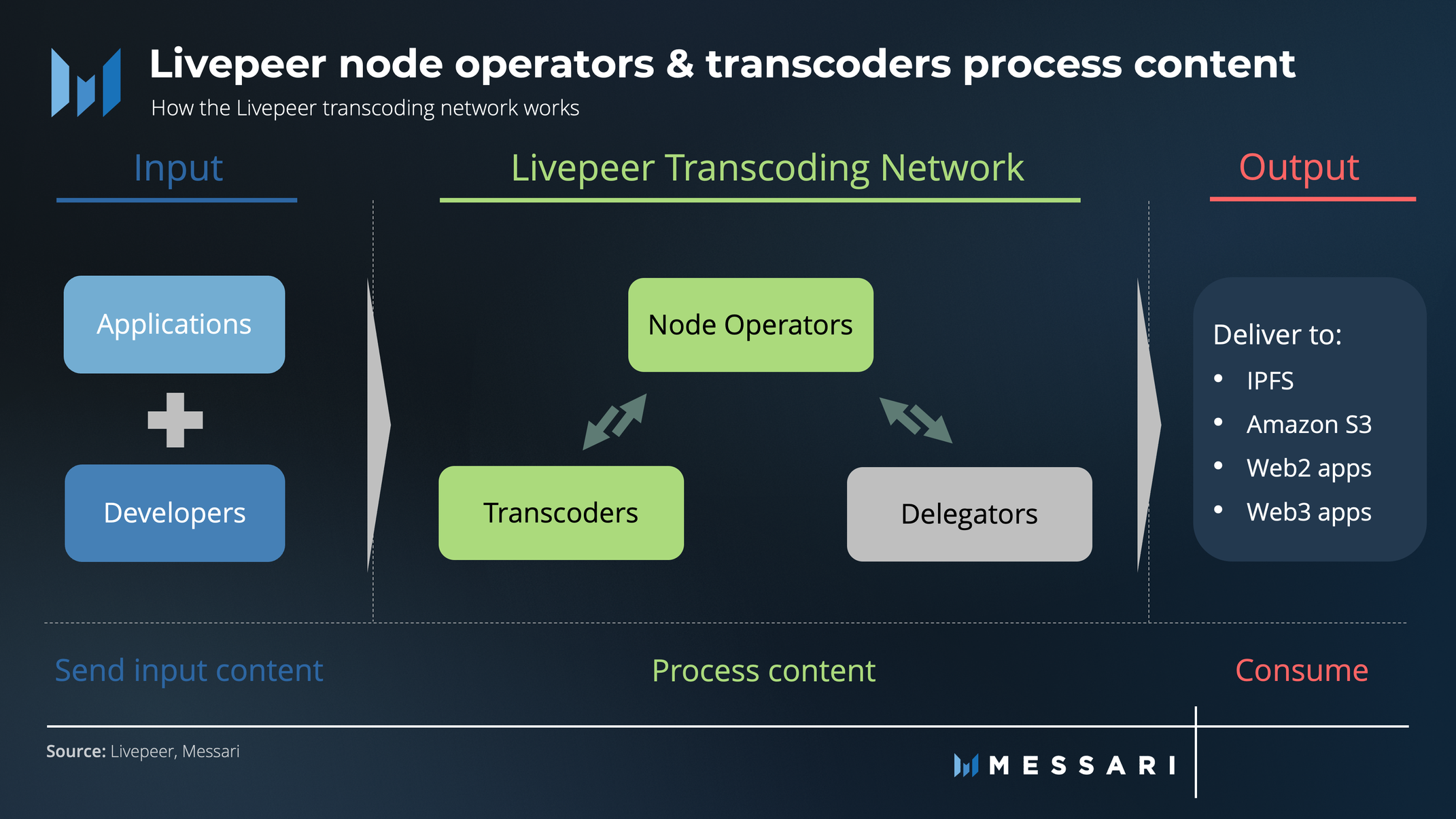
Within Livepeer’s decentralized transcoding network, there are three key participants:
Node operators — called "orchestrators" — route transcoding jobs. The amount of work a node operator can perform is proportional to how many Livepeer native tokens (LPT) it stakes. Node operators earn ETH fees and newly minted LPT rewards.
Transcoders provide compute resources for node operators and deliver transcoded video content. In return, they earn ETH fees.
Delegators stake LPT towards effective node operators to help secure the Livepeer network. Staking is rewarded with a portion of both ETH fees and newly minted LPT rewards.
Beyond transcoding, Livepeer offers a customizeable streaming layer on top of decentralized storage networks, e.g., IPFS and Arweave. Simultaneously, Livepeer aims to become the go-to decentralized technology stack for developers integrating video streaming into their apps. Although Livepeer’s target market is Web3 apps building novel experiences for end users, the Livepeer network can also be used by traditional streaming services to increase cost efficiency and improve profitability.
Key Metrics
Performance Analysis
Demand for Livepeer services comes from apps and developers in need of video transcoding and live streaming. For example, decentralized social media (DeSoc) apps, traditional Web2 apps (like TikTok or Twitch), or music streaming apps (like Spotify or SoundCloud) require streaming infrastructure to broadcast content.
Network Usage
Livepeer’s network usage can be gauged by the number of minutes of video transcoded.
For the first time in the past four quarters, the usage of the Livepeer transcoding network in Q1’23 decreased 23% QoQ to 32.5 million minutes of transcoded video. This relative decline needs to be put in context with the intensified development and testing activities of H2 2022.
Livepeer attended and hosted many hackathons in the latter portion of 2022, which led to the development of new proof of concept projects driving up the usage of the Livepeer transcoding network. Current usage levels mark the return to the usage levels last seen in H1 2022. With applications in the Lens ecosystem (like flagship app Lenster) completing integrations with Livepeer, decentralized social (DeSoc) networks are beginning to rely more heavily on video as a key part of their strategy. A detailed overview of the apps and technology combinations leveraging Livepeer can be found at Awesome Livepeer.
Network Revenue
Livepeer's network revenue consists of demand-side and supply-side revenue.
Demand-side revenue comprises ETH fees accrued from transcoding services. Node operators with larger amounts of stake are more likely to receive more transcoding work, which, in turn, results in them earning more transcoding fees.
Supply-side revenue consists of revenue from:
LPT staking rewards (accrued by node operators and delegators), which yields inflationary issuance of the token.
ETH fees for transcoding services (accrued by node operators and transcoders).
The latter doesn’t include ETH fees distributed to delegators, since delegators don’t actively participate in the supply of transcoding services.
Demand-Side Revenue from Transcoding
Fees from transcoding services are paid to node operators in ETH and are further distributed to transcoders and delegators.
In line with the usage of the Livepeer transcoding network in Q1’23, the revenue from fees in USD terms decreased 22% relative to the previous quarter. In ETH terms, Livepeer transcoding fee revenue decreased 36% QoQ.
Staking Reward Revenue
The Livepeer network distributes staking rewards in LPT to node operators and delegators.To provide transcoding services on the Livepeer network, node operators must stake LPT. A node operator’s stake weight comprises their own tokens and those delegated towards them.
Staking reward revenue in USD terms remained flat in Q1 2023 relative to the previous quarter. This corresponds to a decrease in staking participation, as discussed below.
Staking Participation
The LPT token follows the Stake-for-Access (SFA) model, also known as a work token model. That is, Livepeer requires its node operators to stake the native token (LPT) to perform work on the network.
Q1 2023 saw the Livepeer staking participation rate — the percentage of the circulating LPT supply that is staked — dropping to 45% in January, below the 50% equilibrium threshold. This event led to a gradual increase in daily LPT issuance from 0.020% in January to above 0.023% in March. The fluctuations of the staking participation rate should not be regarded as an anomaly but as a feature. Livepeer ensures that participation stays balanced around the predetermined target rate of 50% by dynamically issuing LPT staking rewards as follows:
When the participation rate falls below 50% in a given round, LPT issuance increases by 0.00005%.
Conversely, when the participation rate passes 50%, inflationary issuance decreases by 0.00005%.
The dynamic LPT issuance in absolute terms mirrors the pattern of successive increases and decreases in token inflation. Staking participation is thus expected to gradually return to the 50% equilibrium level as a result of the dynamic staking inflation mechanism.
Qualitative Analysis
The Livepeer API and SDK were launched in Q4 2022 to support devs harness transcoding in a cost-effective manner. Following this launch, Q1 2023 had several releases and ecosystem events.
Releases
Livepeer had two releases in Q1 2023:
January release enabled TensorFlow for content detection, added logging for high keyframe interval, reduced the Livepeer docker image size, and contained various bug fixes
February release fixed a transcoding bug and bumped various library dependencies
Together with partners at Bundlr and Polygon, Livepeer discussed creator centric applications, decentralized social media, and what innovations were at the heart of what blockchain can uniquely enable for creators.
Livepeer is an official partner on Filecoin Virtual Machine (FVM). The goal is to provide a compelling video archival and storage solution via Filecoin to developers.
Xeenon launched a new revenue sharing model that allows creators who stream on Xeenon to be paid without relying on advertising or direct user payments. Instead, creators get paid using the ETH generated by Xeenon running a node on Livepeer.
Closing Summary
For the first time in the past four quarters, usage of the Livepeer transcoding network in Q1’23 decreased 23% QoQ to the usage levels seen back in H1 2022. As a result of decreased usage, demand-side revenue declined 22% QoQ in USD terms (down 36% in ETH terms). Revenue from staking rewards remained flat QoQ in USD terms (up 7% in LPT terms). This increase in staking rewards in LPT terms corresponded to a gradual increase in daily LPT issuance from 0.020% to above 0.023% due to the staking participation rate dropping to 45% in January.
The Livepeer roadmap is focused on integrating the Livepeer transcoding network further with the Web3 world. Moreover, apps that got their start in Livepeer-hosted hackathons and grants are beginning to emerge from the production phase. By embedding with and supporting the Web3 community, Livepeer is focused on developing the tooling and apps that ultimately drive demand to the network.
This report was commissioned by Livepeer Inc. All content was produced independently by the author(s) and does not necessarily reflect the opinions of Messari, Inc. or the organization that requested the report. The commissioning organization may have input on the content of the report, but Messari maintains editorial control over the final report to retain data accuracy and objectivity. Author(s) may hold cryptocurrencies named in this report. This report is meant for informational purposes only. It is not meant to serve as investment advice. You should conduct your own research and consult an independent financial, tax, or legal advisor before making any investment decisions. Past performance of any asset is not indicative of future results. Please see our Terms of Service for more information.
No part of this report may be (a) copied, photocopied, duplicated in any form by any means or (b) redistributed without the prior written consent of Messari®.
Mihai is Director of Research at Messari. Mihai leads Protocol Research, covering base layers, mid-layer infrastructure, DeFi, and consumer apps. Prior to joining Messari, Mihai was a tech entrepreneur and worked in AI at UBS and Swiss Re in Zurich. His background is in computer science and math. Mihai holds a PhD in information systems from ETH Zurich, Switzerland
Mihai is Director of Research at Messari. Mihai leads Protocol Research, covering base layers, mid-layer infrastructure, DeFi, and consumer apps. Prior to joining Messari, Mihai was a tech entrepreneur and worked in AI at UBS and Swiss Re in Zurich. His background is in computer science and math. Mihai holds a PhD in information systems from ETH Zurich, Switzerland