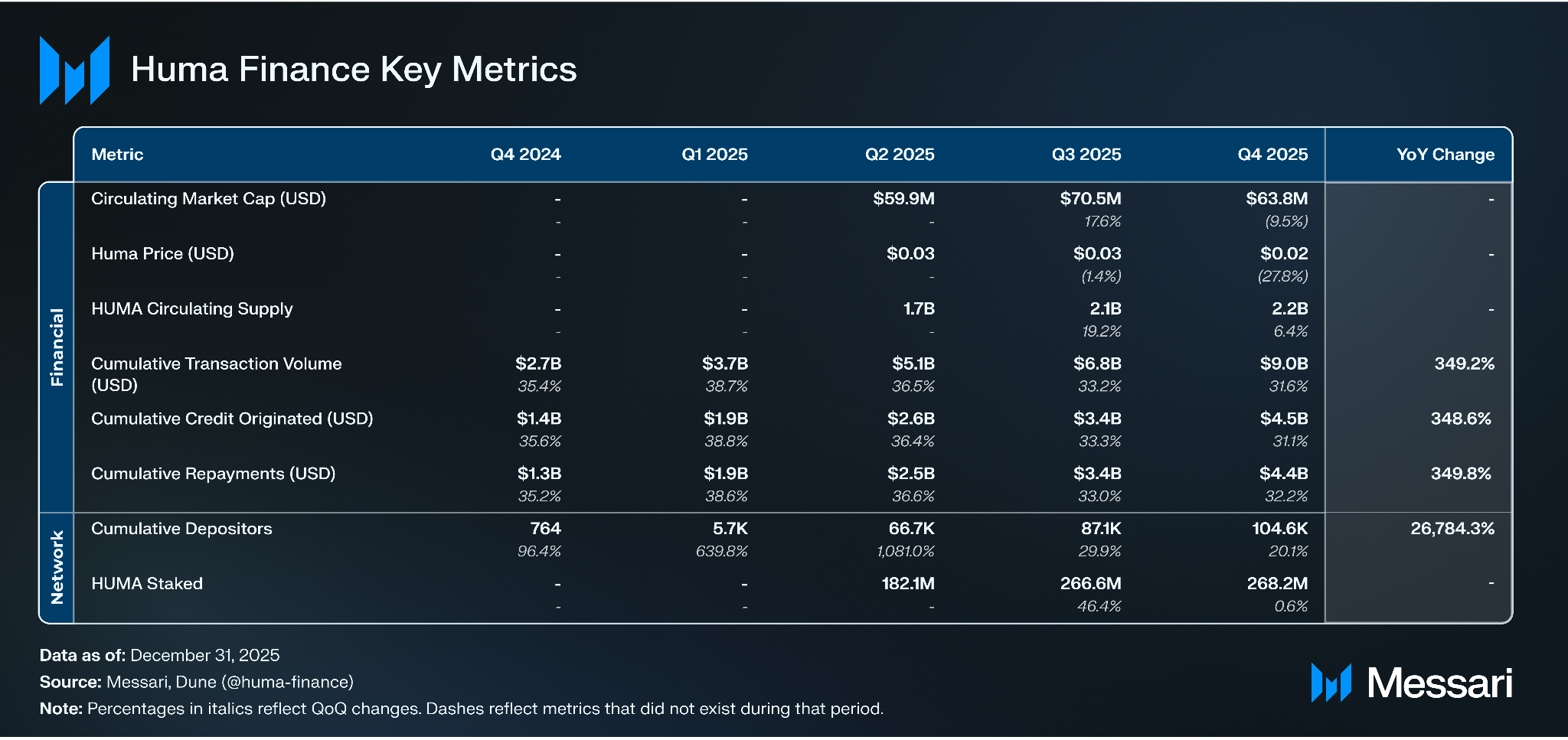
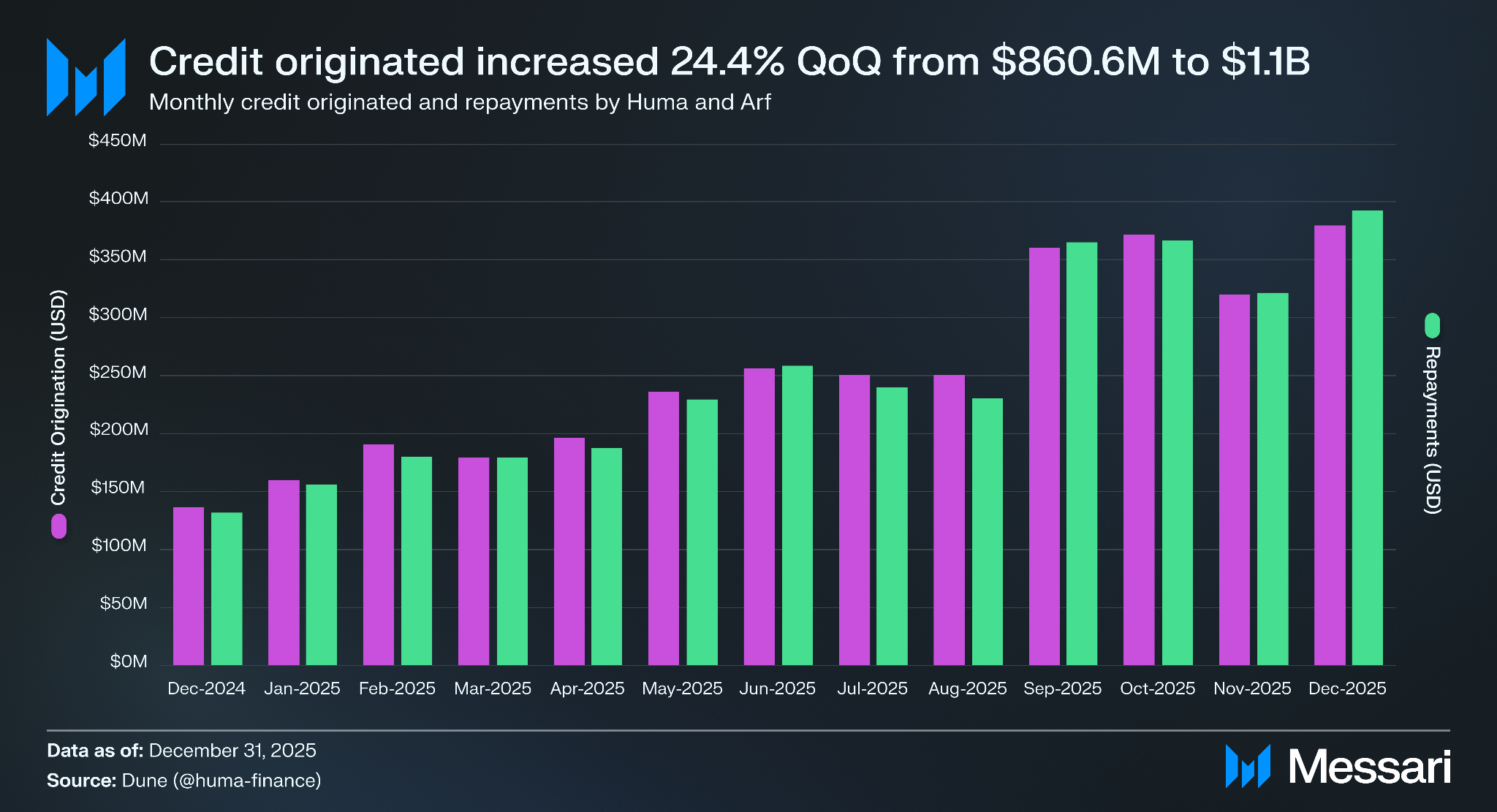
In Q4, Huma processed $2.2 billion in transaction volume, a 26.9% QoQ increase from $1.7 billion in Q3, while credit originations rose 24.4% QoQ from $860.6 million to $1.1 billion.
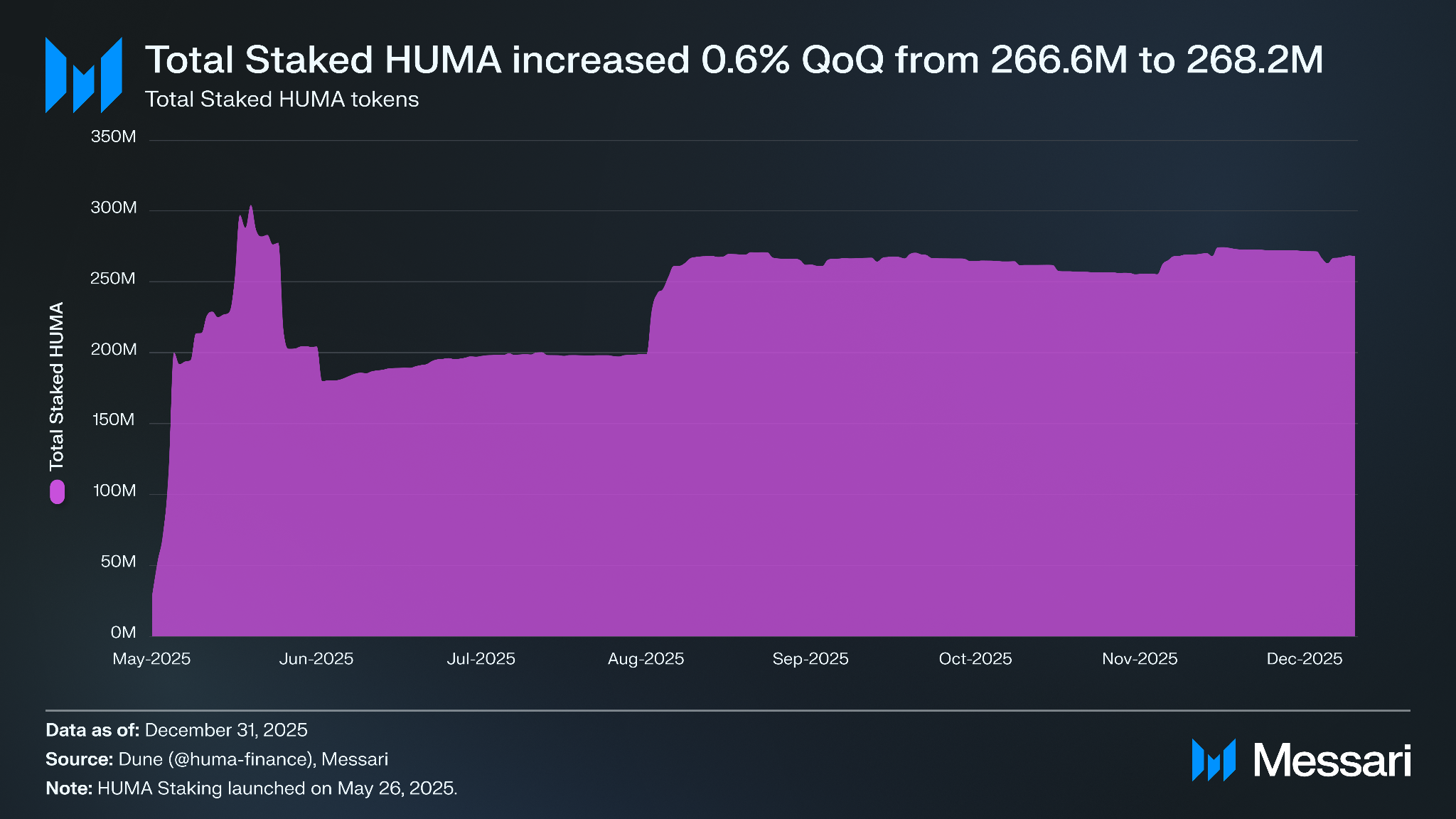
As of Dec. 31, users staked 268.2 million HUMA ($6.6 million), up 0.6% QoQ from 266.6 million on Sept. 30. This represents 14.9% of the 1.8 billion HUMA eligible for staking.
On Jan. 8, Huma introduced Huma Prime, a yield product where users deposit USDC to earn yield from Huma PayFi activity, which Huma then borrows against on Jupiter Lend and redeploys the borrowed USDC into Huma pools to amplify total returns.
As of Dec. 31, Huma 2.0 held $123.8 million in deposits, an 18.3% QoQ decrease from $151.6 million on Sept. 30.
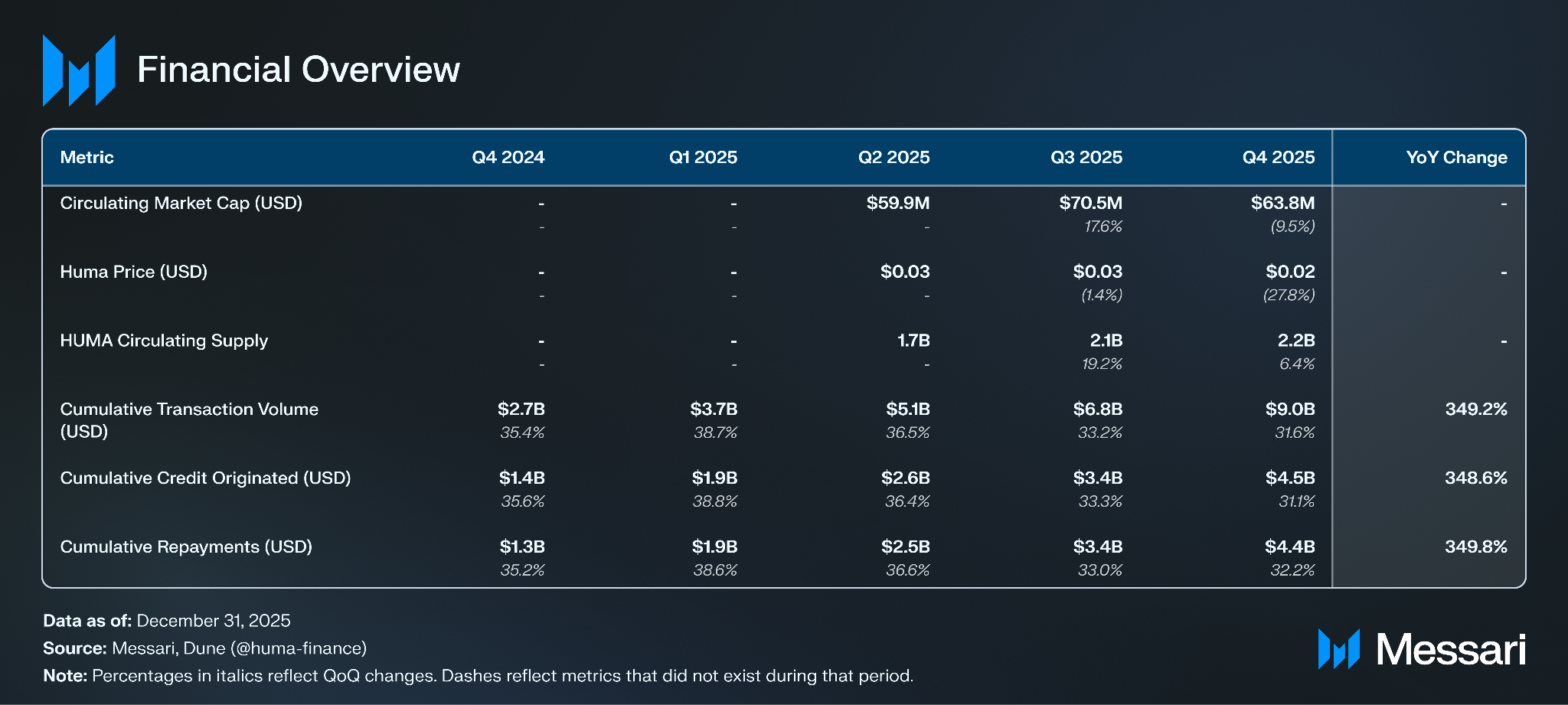
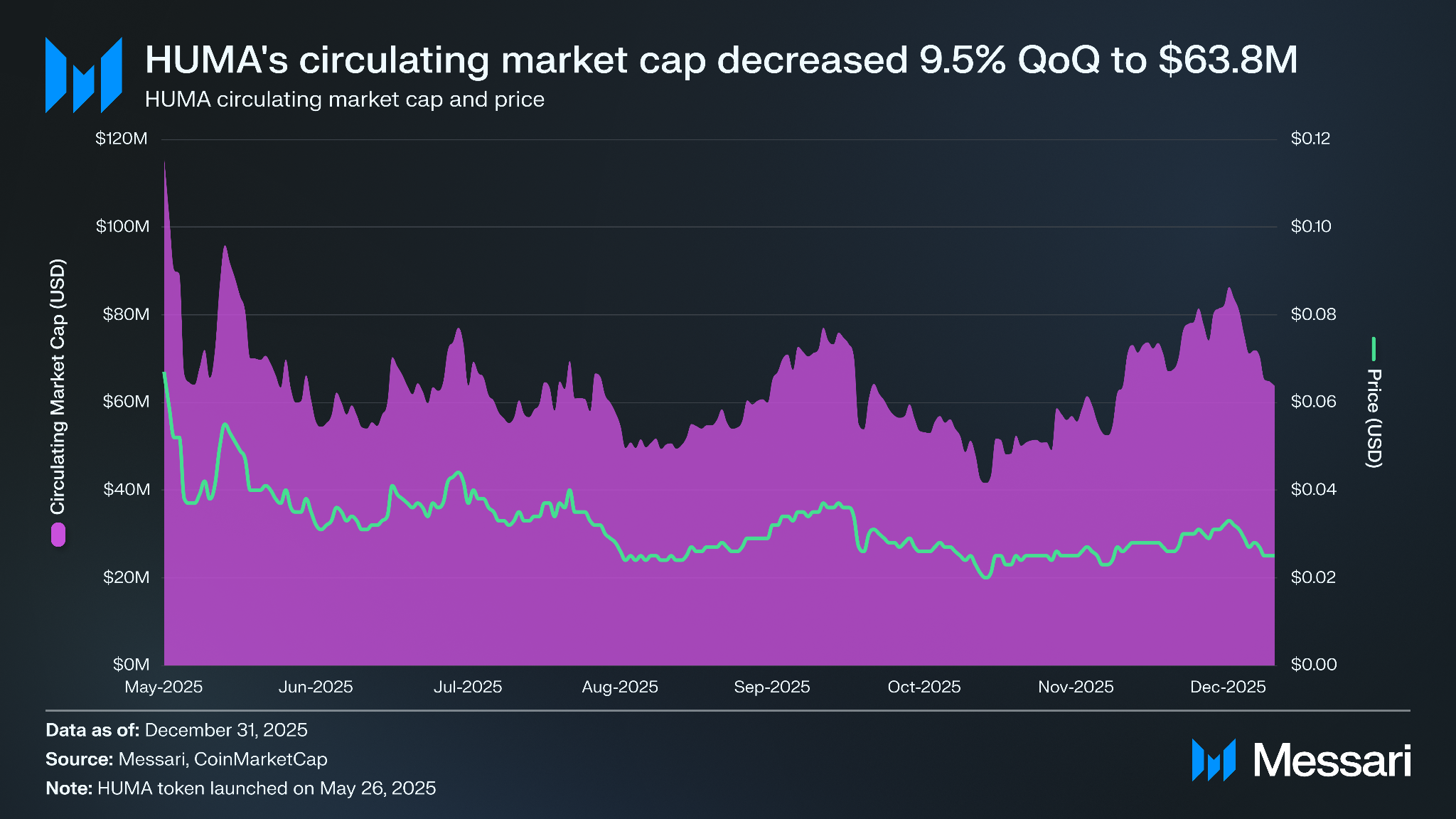
As of Dec. 31, HUMA's circulating market cap was $63.8 million, a 9.5% QoQ decrease from $70.4 million on Sept. 30, while HUMA token price decreased 27.8% QoQ from $0.034 to $0.025.
Primer
Huma Finance (HUMA) is a PayFi protocol that supplies settlement liquidity for cross-border transactions, payment service providers, and credit card settlements by connecting liquidity providers (LPs) to borrowers through smart contracts. It operates two products, Huma Institutional and Huma 2.0 (Permissionless), across 11 active lending pools, which generate yield from borrower fees.
PST in Prime Mode, which earns the same base USDC yield as Classic Mode (8% APY), additional yield from borrowing against initial deposits on Jupiter Lend and redeploying USDC into Huma lending pools, plus Huma Feather rewards, or
In February 2023, Huma raised $8.3 million in a seed round. Thereafter, in April 2024, it merged with Arf, a cross-border payments liquidity provider, and in September 2024, raised a $38 million Series A led by Distributed Global. For a complete primer on Huma Finance, refer to our Initiation of Coverage report.
The HUMA token’s circulating market cap decreased 9.5% QoQ from $70.4 million on Sept. 30 to $63.8 million on Dec. 31 despite 321.6 million HUMA tokens unlocked during Q4. The HUMA token price decreased 27.8% QoQ from $0.034 to $0.025.
Huma Finance launched HUMA on May 26, 2025, as a utility and governance token with a total supply of 10 billion tokens to reward LPs, community contributors, and ecosystem partners (i.e., Huma-integrated protocols). Token holders can stake HUMA to earn staking rewards, boost LP rewards, and vote on incentive allocations and protocol parameter changes. Longer staking durations increase voting power, and Huma plans to publish governance process details in 2026.
Transaction Volume
Credit origination refers to the value of loans issued through active lending pools, whereas credit repayment is the principal repaid by borrowers. In Q4, originations through Huma pools totaled $1.1 billion, up 24.4% QoQ from $860.6 million. Credit repayments increased 29.5% QoQ from $835.1 million to $1.1 billion. Transaction volume across all pools, including originations and repayments, grew 26.9% QoQ from $1.7 billion to $2.2 billion over the same period. This increase reflects more institutional use of alternative payment financing solutions and rising interest in onchain settlement and credit origination.
After closing 2025 with $9.0 billion in cumulative transaction volume (up 31.6% QoQ), Huma surpassed $10 billion in transaction volume on Feb. 4, reaching a milestone initially targeted by the end of 2025.
Both modes share the same underlying pool mechanics, with about 80% of capital deployed into Huma PayFi pools and about 20% into liquid DeFi strategies, including Kamino Lend (lending), Jupiter Lend (lending), Aave (lending), and Pendle (yield trading). Depositors can choose from no-lockup, three-month, or six-month commitments, with longer lockups earning higher rewards.
PST liquidity is available on Orca (exchange), Meteora (exchange), Jupiter (exchange aggregator), and Kamino Finance (exchange). Additionally, on May 12, RateX integrated with Huma 2.0, enabling users to split PST into yield tokens (YT-PST) for amplified returns or principal tokens (PT-PST) for fixed returns.
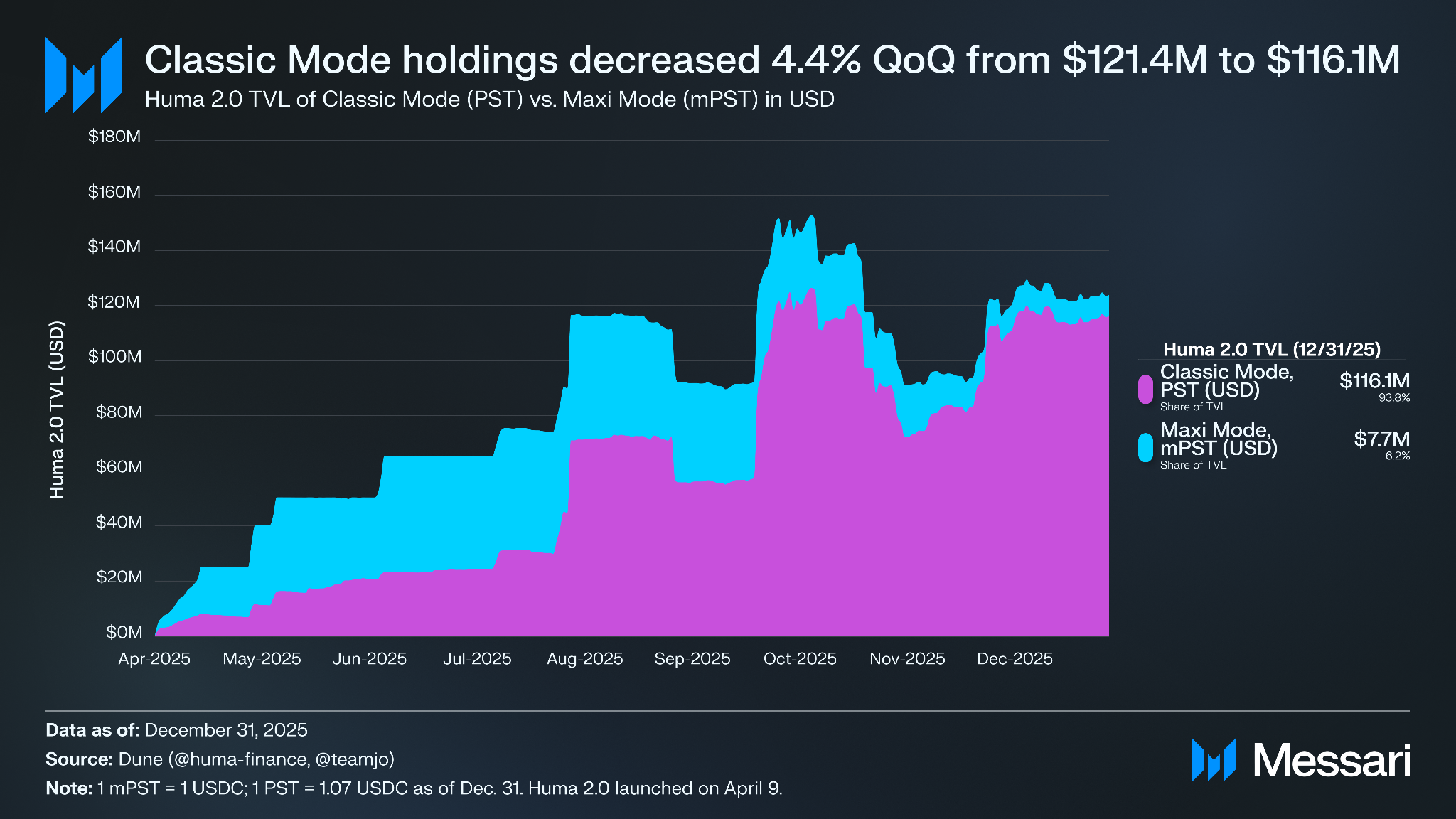
As of Dec. 31, Huma 2.0 held $123.8 million in deposits, an 18.3% QoQ decrease from $151.6 million. Over the same period, Classic Mode holdings fell 4.4% QoQ from $121.4 million to $116.1 million (93.8% share), and Maxi Mode holdings decreased 74.5% QoQ from $30.2 million to $7.7 million (6.2% share).
The decrease in Maxi holdings resulted from the 27.8% QoQ decrease in HUMA token price, combined with lower total yield compared to Classic Mode. As of Dec. 31, Maxi no-lockup deposits earned 0% USDC APY and an estimated 2.6% APY in HUMA token rewards. In comparison, Classic no-lockup deposits earned 8.0% USDC APY plus an estimated 1.0% APY in HUMA token rewards, totaling 9.0% APY.
On Nov. 21, Huma surpassed $8.0 billion in cumulative transaction volume and launched a limited-time deposit campaign offering 14% to 20% APY on Classic Mode no-lockup deposits, capped at $20 million in total new deposits. From Nov. 21 to Nov. 26, Classic Mode recorded $27.6 million in net deposits, exceeding the campaign cap in six days and marking the largest six-day deposit period in Q4.
Network Analysis
Depositors
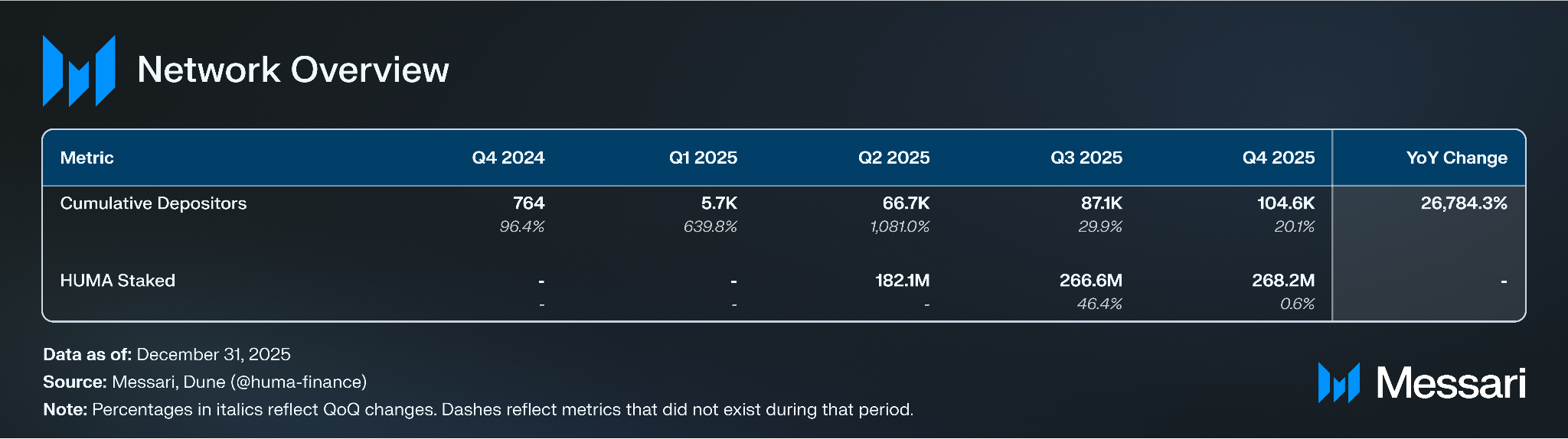
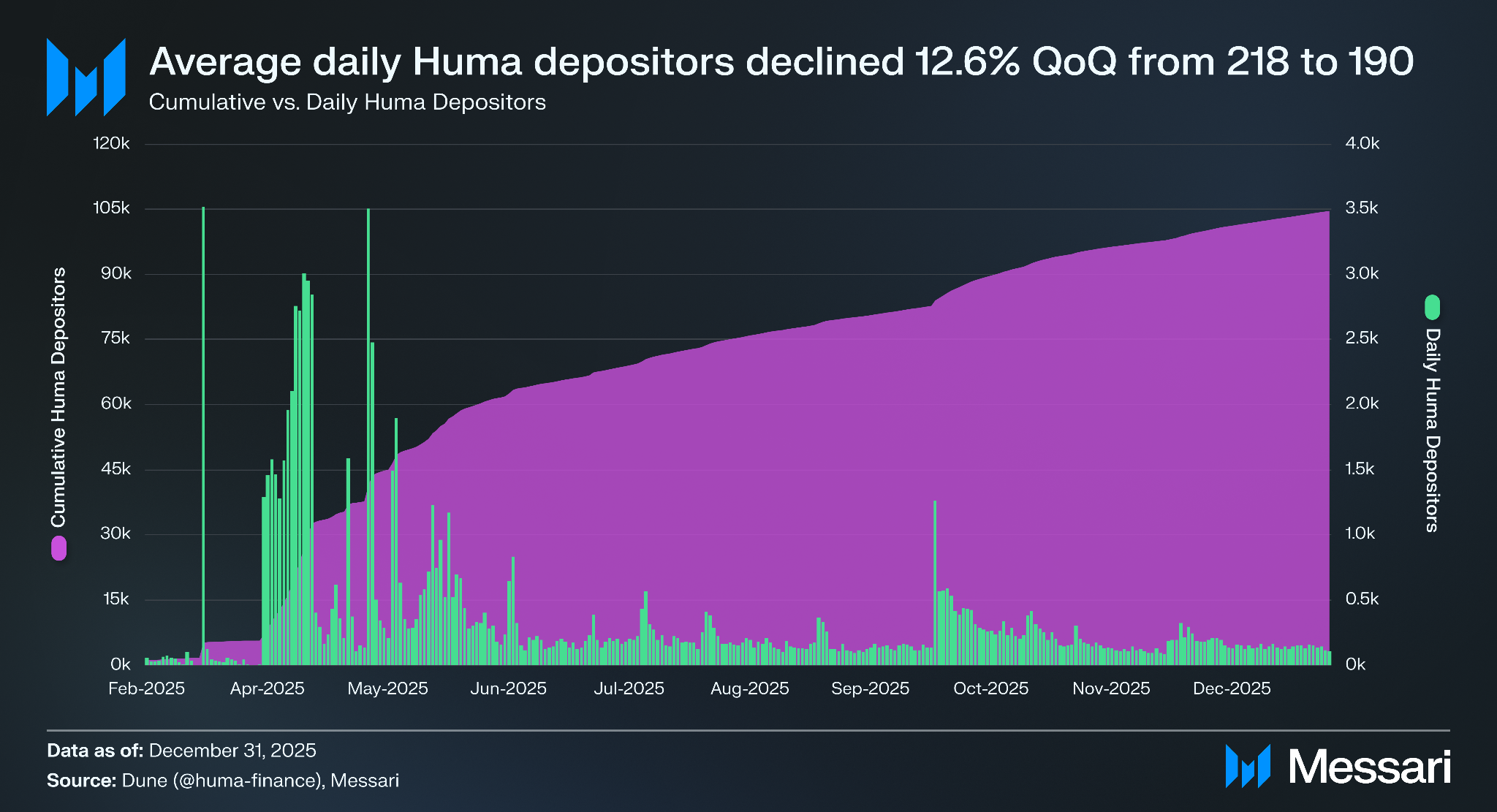
In Q4, average daily Huma pool depositors declined 12.6% QoQ from 218 to 190. The Q4 average daily depositor decrease was significantly smaller than the Q3 decline of 69.7%, indicating stabilized depositor activity. In October, Huma averaged 267 daily depositors, the highest monthly average in Q4, contributed by an integration with Binance Wallets.
Cumulative depositors increased 20.1% QoQ from 87,100 on Sept. 30 to 104,600 on Dec. 31. Since Huma 2.0 launched on April 9, no day has had fewer than 88 daily depositors, showing consistent baseline usage.
Staking
All of the HUMA circulating supply can be staked except the 400 million allocated to market-making and onchain liquidity. As of Dec. 31, users staked 268.2 million HUMA ($6.6 million), up 0.6% QoQ from 266.6 million on Sept. 30, which represents 14.9% of the 1.8 billion HUMA eligible for staking.
On June 30, the Huma Foundation announced the rewards framework for HUMA stakers, which includes governance voting rights, Feathers-based rewards, a staking multiple on LP rewards, early access to Huma 2.0 vault reopenings, and eligibility for select ecosystem promotions and partner airdrops. Staking rewards are calculated over 30-day periods based on the amount of HUMA staked and two protocol-controlled variables, the Staking Factor and α. The formula is 30-day staking rewards = (Staking Factor / α) × staked HUMA. At launch, the Staking Factor was 10, and α was 20, meaning 1,000 HUMA staked for 30 days would earn 500 Feathers.
Stakers who also LP receive a multiplier on their LP rewards, capped at 2x when their staked HUMA exceeds three times their PST or mPST balance. If an LP has multiple positions, the multiplier applies to all of them. Stakers must wait 14 days after initiating an unstake request before tokens can be withdrawn.
Qualitative Analysis
Huma Prime
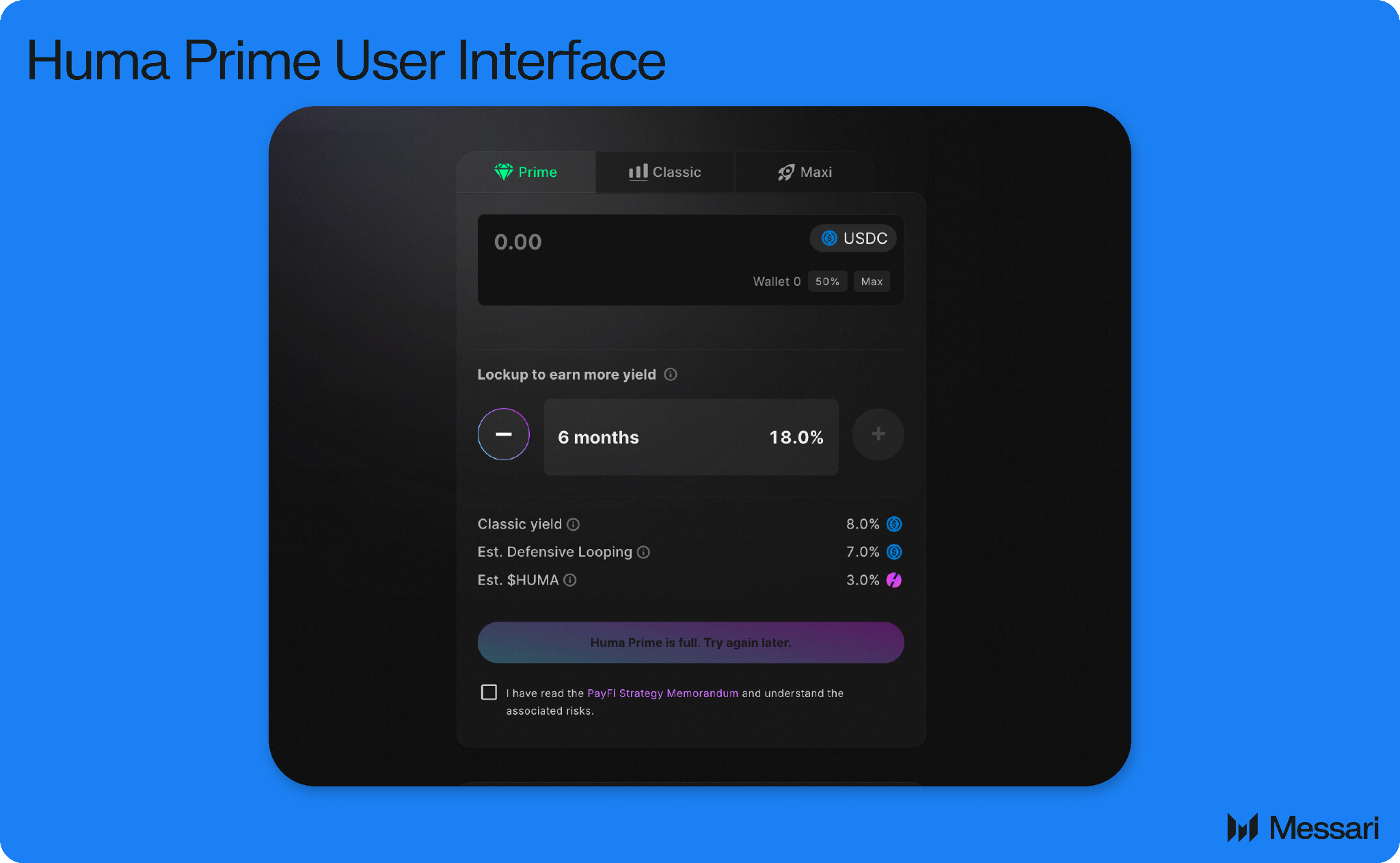
On Jan. 8, Huma launched Huma Prime, a yield product that borrows against USDC deposits on Jupiter Lend, and redeposits borrowed USDC into Huma lending pools to amplify returns. The protocol borrows USDC against deposited collateral at a lower borrow APY and redeposits the borrowed funds as additional collateral to increase the position. The cycle repeats (called looping) when supply APY exceeds borrow APY. The strategy profits from the spread between supply APY (interest earned on deposits) and borrow APY (interest paid on loans), plus protocol rewards.
Looping introduces interest rate risk. If the borrow APY rises above the supply APY, the position enters negative compounding, where losses multiply with each loop and erode capital. To mitigate this, Huma uses defensive looping. Huma continuously monitors the spread between borrow APY and supply APY. If borrowing costs threaten to exceed yield, the smart contract automatically deleverages the position to protect principal before losses occur.
For Prime deposits, Huma automatically borrows against depositors' USDC in Classic Mode and redeposits the borrowed USDC into Classic Mode to amplify base yield. Prime yield comes from three sources: supply APY on PST (8% APY for all lockup periods as of Jan. 8), yield from defensive looping (as of Feb. 11, an estimated 5% APY for no lockup, 6% for three-month lockup, and 7% for six-month lockup), and HUMA token rewards for badge holders or HUMA stakers.
Users can convert locked Classic Mode PST positions to Prime, but must lock Prime positions at a maturity date on or after the original Classic Mode deposit maturity. Unlike Classic Mode and Maxi Mode, Prime has no secondary exchange markets, so positions remain locked until maturity. As of Jan. 8, Prime launched with limited capacity for OG and Vanguard badge holders.
Partnerships
TradeFlow x Obligate
On Dec. 12, Huma announced a partnership with TradeFlow Capital Management and Obligate to provide USDC liquidity for trade finance bonds. TradeFlow is a Singapore-based trade finance company that purchases trade receivables from small and medium enterprises (SMEs) in emerging markets and issues onchain bonds backed by these receivables to qualified investors. Obligate is a Swiss fintech company that operates infrastructure for companies to issue and settle USDC onchain bonds, called eNotes, on Polygon and Base.
In the partnership, Huma provides USDC liquidity, TradeFlow is the asset issuer, and Obligate provides the issuance infrastructure for eNotes. TradeFlow issues USDC-denominated eNotes through Obligate, financing import and export transactions across Asia, Africa, and Latin America in sectors including commodities, consumer goods, and manufacturing.
Tala
On Dec. 10, Huma announced a partnership with Tala to provide USDC liquidity for tokenized lending on Solana. Tala is a fintech company that provides small loans ranging from $10 to $500 to 13 million users who lack traditional credit histories across Kenya, the Philippines, Mexico, and India. Tala uses smartphone data, alternative data sources, and an AI underwriting system to assess creditworthiness. Approved users can take out overcollateralized loans through the app, funded by Huma's USDC liquidity on Solana.
UnifAI
On Nov. 3, Huma partnered with UnifAI to allow its agents to allocate capital into Huma 2.0 lending pools on Solana, monitor yield performance, and automatically rebalance positions based on programmed parameters.
UnifAI is a DeFi infrastructure platform that enables autonomous AI agents to execute financial strategies across protocols. Users can deploy AI agents to automate yield, trading, and liquidity strategies, while developers can build agents using UnifAI's SDK.
Closing Summary
In Q4, HUMA's circulating market cap decreased 9.5% QoQ from $70.4 million on Sept. 30 to $63.8 million on Dec. 31 despite 321.6 million HUMA tokens unlocked during Q4. HUMA token price decreased 27.8% QoQ from $0.034 to $0.025. Huma processed $2.2 billion in transaction volume in Q4, a 26.9% QoQ increase from $1.7 billion in Q3.
As of Dec. 31, Huma 2.0 held $123.8 million in deposits, an 18.3% QoQ decrease from $151.6 million at Q3-end. Additionally, users had staked 268.2 million HUMA ($6.6 million), representing 14.9% of the 1.8 billion HUMA eligible for staking.
In addition to continued transaction volume growth, Huma expanded its product offerings and institutional partnerships in Q4. On Jan. 8, Huma introduced Huma Prime, a yield product that uses automated borrowing and redepositing of USDC deposits to amplify returns. On Dec. 12, Huma partnered with TradeFlow Capital Management and Obligate to provide USDC liquidity for trade finance, where TradeFlow issues USDC-denominated eNotes through Obligate's infrastructure, financing import and export transactions across Asia, Africa, and Latin America. Huma Prime's launch, new institutional partnerships, and sustained transaction volume growth reinforced Huma's position in the PayFi ecosystem. If Huma maintains this growth trajectory and expands its partnerships with PayFi leaders, it will be positioned to surpass $10.0 billion in cumulative transaction volume in Q1 2026.
This report was commissioned by Huma Global Ltd. All content was produced independently by the author(s) and does not necessarily reflect the opinions of Messari, Inc. or the organization that requested the report. The commissioning organization may have input on the content of the report, but Messari maintains editorial control over the final report to retain data accuracy and objectivity. Author(s) may hold cryptocurrencies named in this report. This report is meant for informational purposes only. It is not meant to serve as investment advice. You should conduct your own research and consult an independent financial, tax, or legal advisor before making any investment decisions. Past performance of any asset is not indicative of future results. Please see our Terms of Service for more information.
No part of this report may be (a) copied, photocopied, duplicated in any form by any means or (b) redistributed without the prior written consent of Messari®.
Austin is a Sr. Research Analyst for Messari’s Protocol Services team. He focuses on Prediction Markets, DeFi, & Interop. protocols. He previously worked on PwC's Digital Assets team.
Austin is a Sr. Research Analyst for Messari’s Protocol Services team. He focuses on Prediction Markets, DeFi, & Interop. protocols. He previously worked on PwC's Digital Assets team.