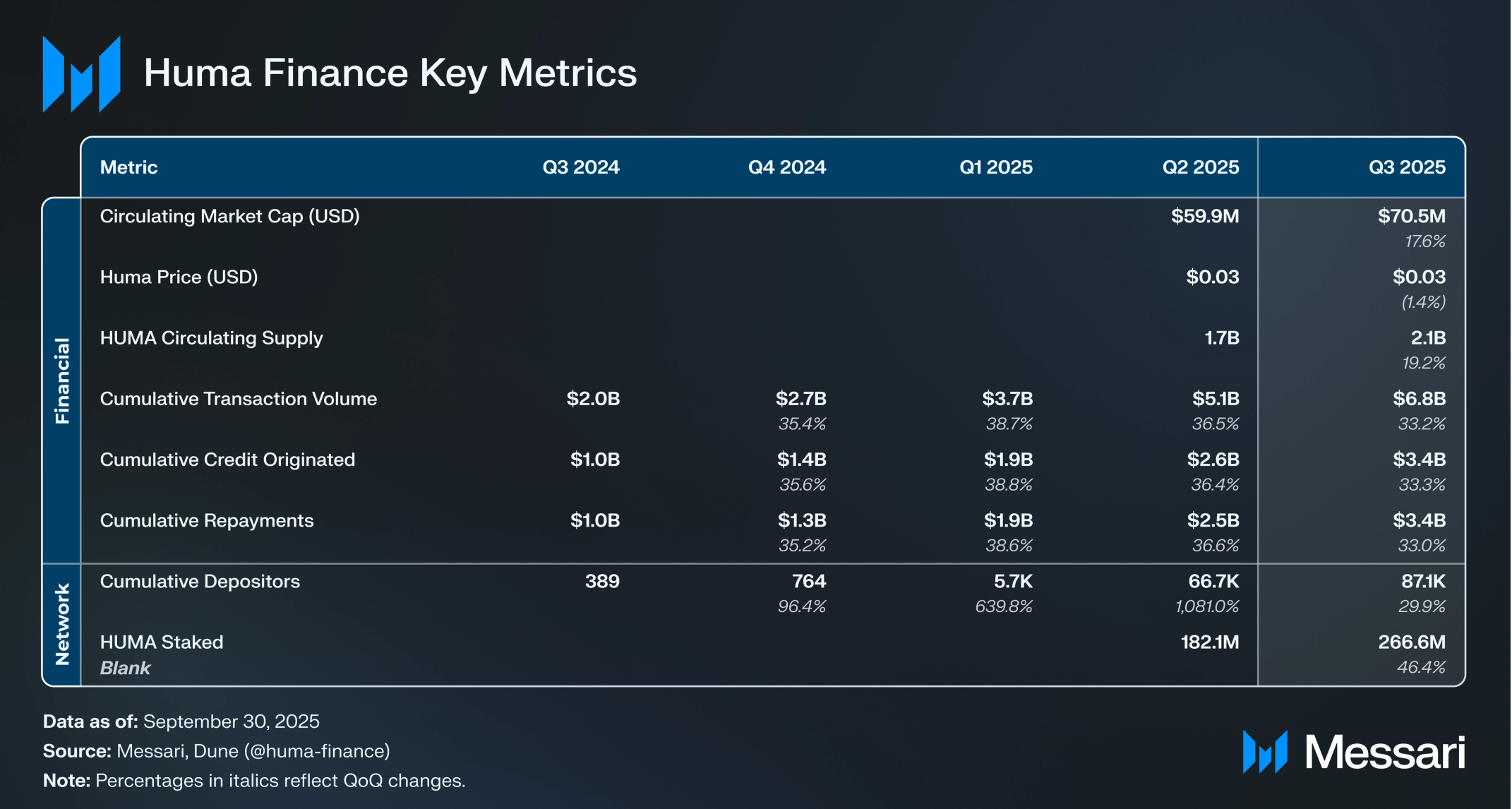
As of Sept. 30, Huma 2.0 held $151.6 million in deposits, a 132.3% QoQ increase from $65.1 million on June 30.
On Sept. 30, Huma became a liquidity provider for the Circle Payments Network (CPN), a cross-border payments network for financial institutions operated by USDC stablecoin issuer Circle.
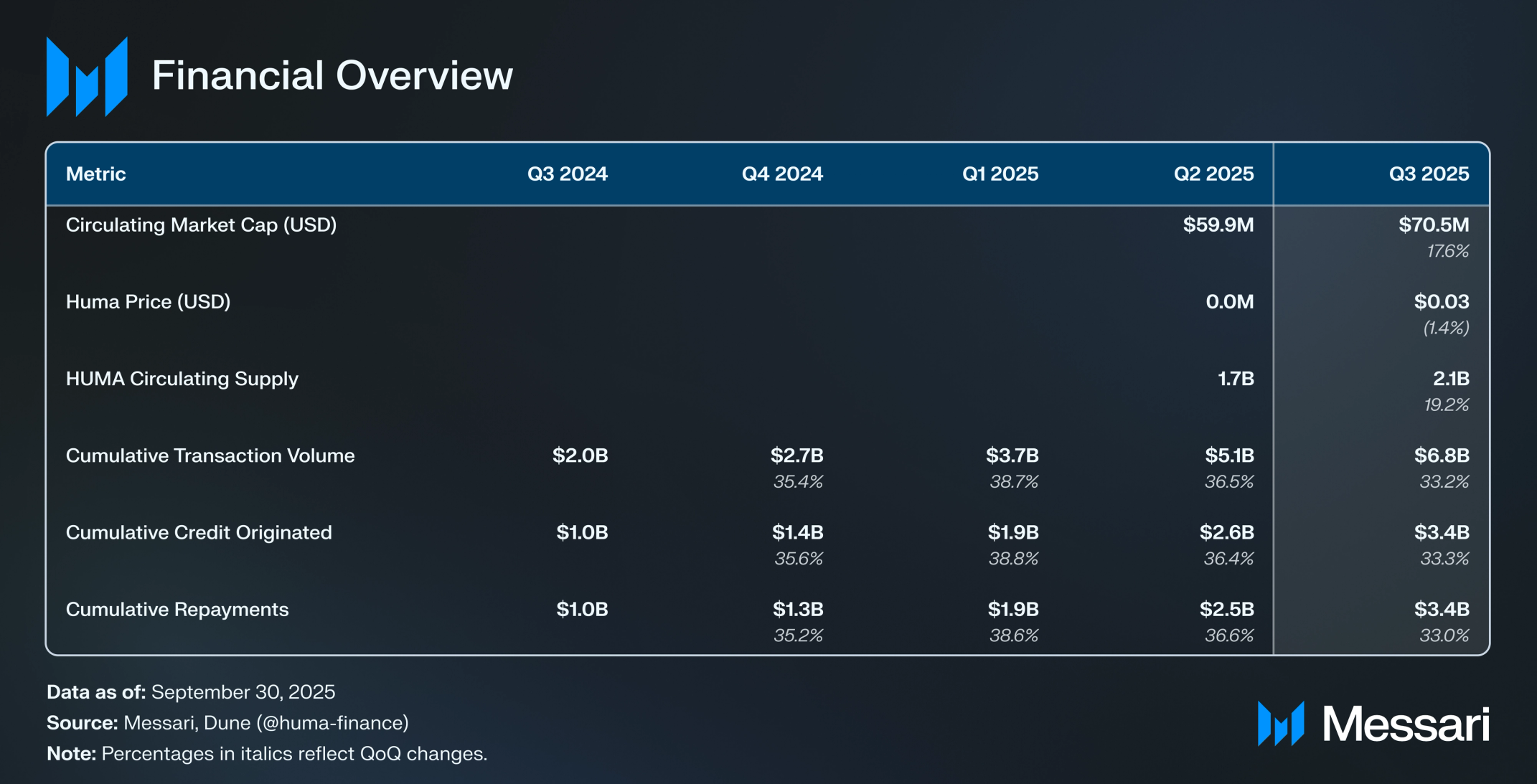
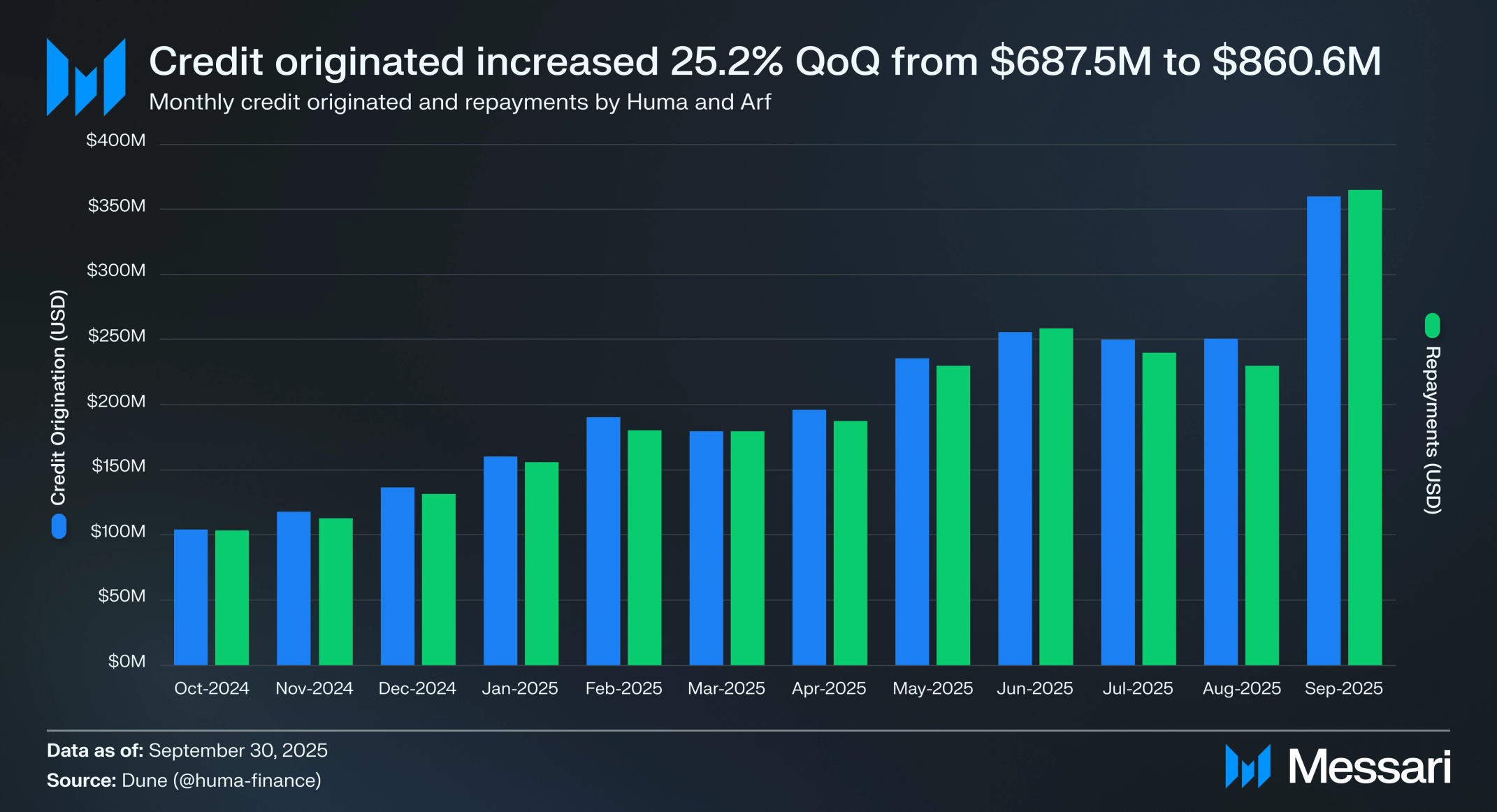
In Q3, Huma processed $1.7 billion in transaction volume, a 24.4% QoQ increase from $1.4 billion in Q2, while credit originations rose 25.2% QoQ from $687.5 million to $860.6 million.
As of Sept. 30, users staked 266.6 million HUMA ($9.1 million), up 46.4% QoQ from 182.1 million on June 30. This represents 16.0% of the 1.67 billion HUMA eligible for staking.
On Oct. 1, Huma co-hosted the Singapore PayFi Summit with the Solana Foundation to discuss stablecoin adoption in global payments and regulatory developments affecting the PayFi ecosystem.
Primer
Huma Finance (HUMA) is a PayFi protocol that supplies settlement liquidity for cross-border transactions, payment service providers, and credit card settlements by connecting liquidity providers (LPs) to borrowers through smart contracts. It operates two products, Huma Institutional and Huma 2.0 (Permissionless), across 11 active lending pools, which generate yield from borrower fees.
In February 2023, Huma raised $8.3 million in a seed round. Thereafter, in April 2024, it merged with Arf, a cross-border payments liquidity provider, and in September 2024, raised a $38 million Series A led by Distributed Global. For a complete primer on Huma Finance, refer to our Initiation of Coverage report.
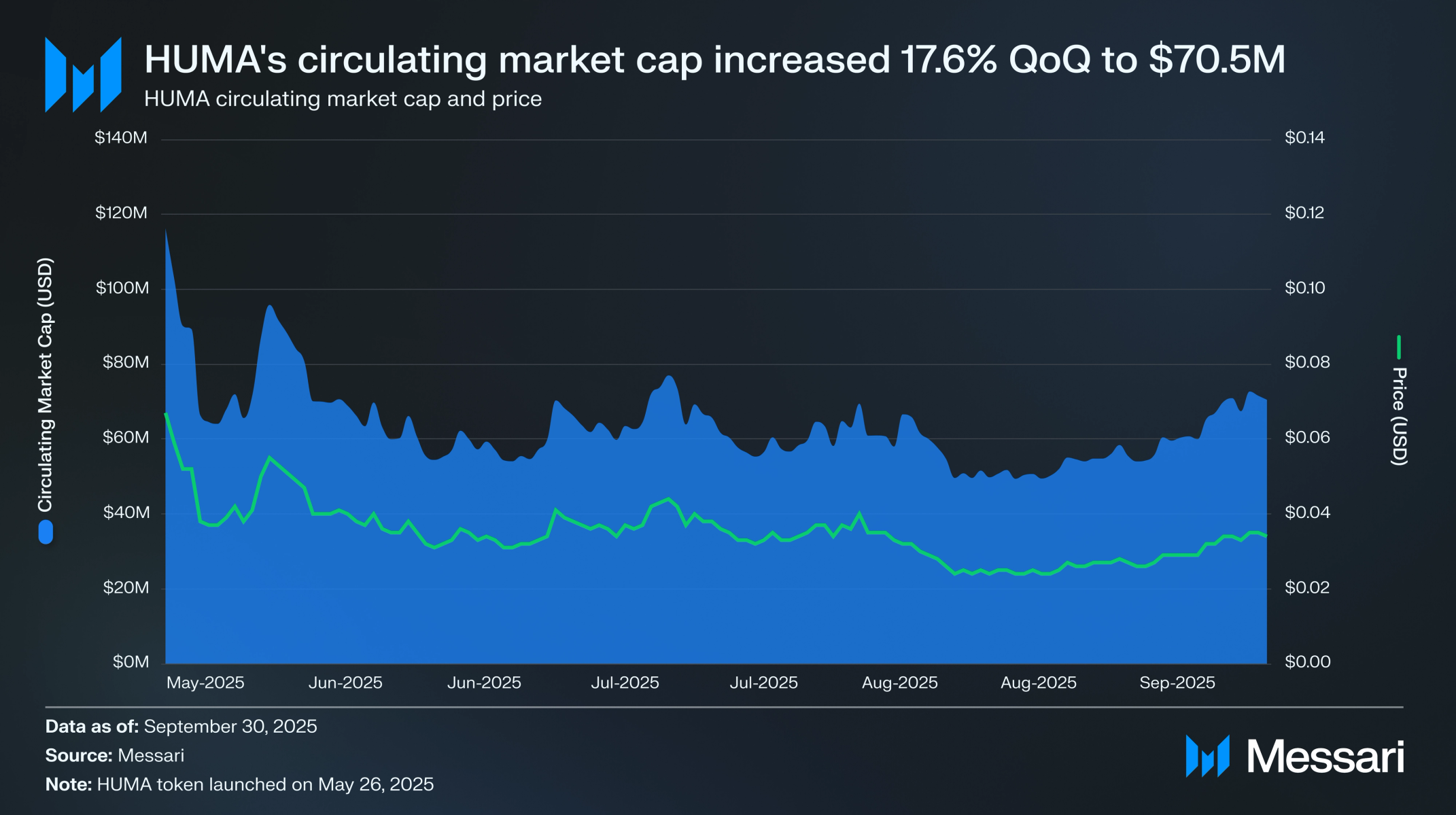
The HUMA token’s circulating market cap increased 17.6% QoQ from $59.9 million on June 30 to $70.5 million on Sept. 30 due to 333 million HUMA tokens unlocked in Q3. HUMA token price decreased 1.4% QoQ from $0.035 to $0.034. HUMA remains early in its market discovery phase, so price volatility is common as liquidity increases and market participants determine appropriate valuations.
Huma Finance launched HUMA on May 26, 2025, as a utility and governance token with a total supply of 10 billion tokens to reward LPs, community contributors, and ecosystem partners (i.e., Huma-integrated protocols).
Token holders can stake HUMA to earn staking rewards, boost LP rewards, and vote on incentive allocations and protocol parameter changes. Longer staking durations increase voting power, and Huma plans to publish governance process details in 2026.
Transaction Volume
Credit origination refers to the value of loans issued through active lending pools, whereas credit repayment is the principal repaid by borrowers. In Q3, originations through Huma pools totaled $860.6 million, up 25.2% QoQ from $687.5 million. Transaction volume across all pools, including originations and repayments, grew 24.4% QoQ from $1.4 billion to $1.7 billion over the same period. This increase reflects more institutional use of alternative payment financing solutions and rising interest in onchain settlement and credit origination.
Both modes share the same underlying pool mechanics, with about 80% of capital deployed into Huma PayFi pools and about 20% into liquid DeFi strategies, including Kamino Lend (lending), Jupiter Lend (lending), Aave (lending), and Pendle (yield trading). Depositors can choose from no-lockup, three-month, or six-month commitments, with longer lockups earning higher rewards.
PST liquidity is available on Orca (exchange), Meteora (exchange), Jupiter (exchange aggregator), and Kamino Finance (exchange). Additionally, on May 12, RateX integrated with Huma 2.0, enabling users to split PST into yield tokens (YT-PST) for amplified returns or principal tokens (PT-PST) for fixed returns.
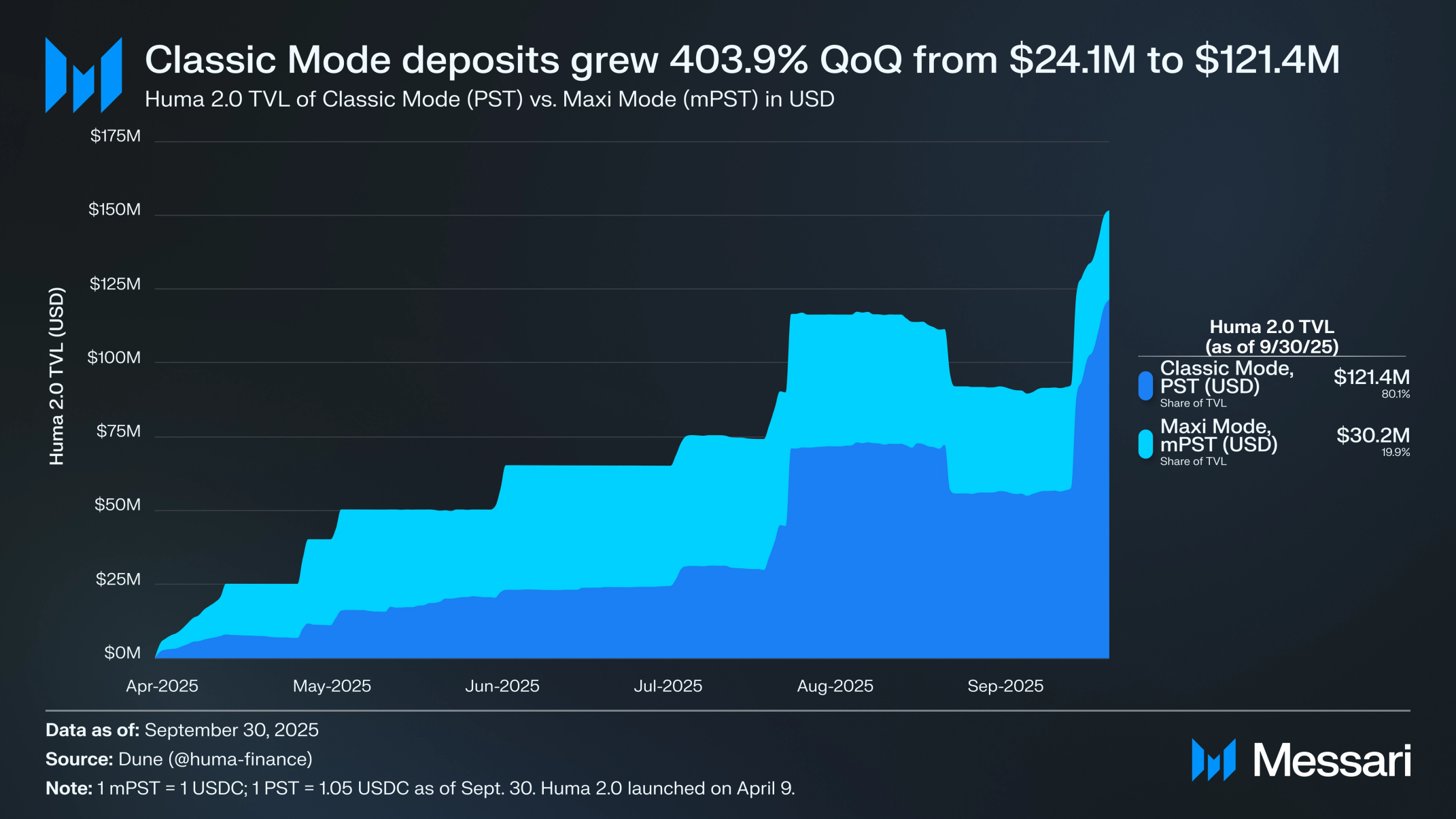
As of Sept. 30, Huma 2.0 held $151.6 million in deposits, a 132.3% QoQ increase from $65.1 million at Q2-end. Over the same period, Classic holdings rose 403.9% QoQ from $24.1 million to $121.4 million, and Maxi holdings decreased 26.7% QoQ from $41.1 million to $30.2 million. On Sept. 24, Classic Mode recorded $30.7 million in inflows, the largest single-day increase in Q3. On Sept. 24, Binance Wallet added Classic Mode deposit support and launched a campaign where users who deposited 50 USDC were eligible for a share of $300,000 in HUMA, which likely contributed to the spike. User preference for stablecoin-denominated APY over variable Feather rewards, along with lower Feather reward multipliers throughout Q3, likely contributed to sustained increases in Classic deposits during the quarter.
Network Analysis
Depositors
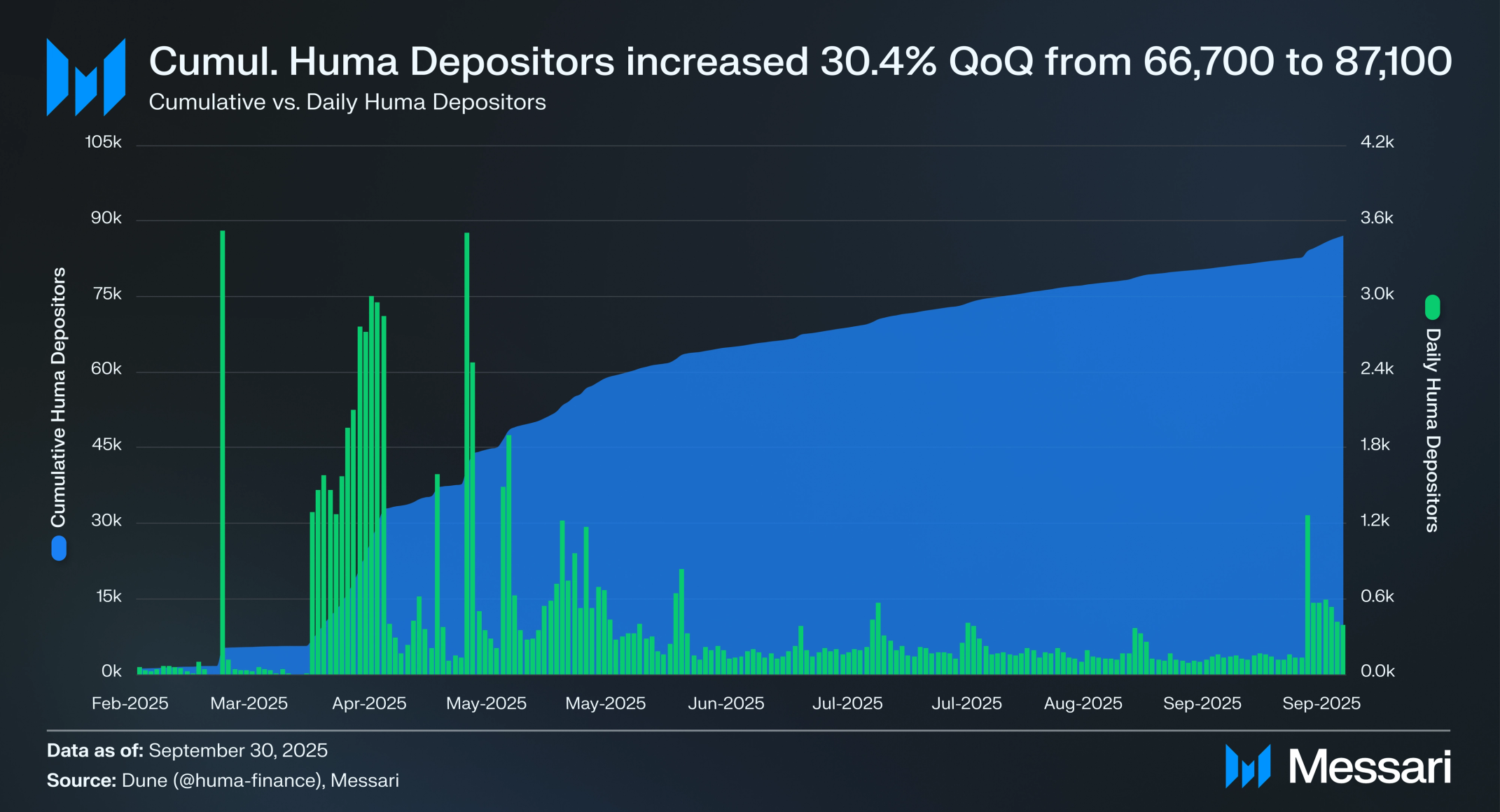
Huma Institutional requires lenders to be accredited investors and pass KYC/KYB, which constrained depositor growth. After Huma 2.0 launched on April 9, its reduced requirements drove a surge in daily depositors, averaging 1,900 over the following two weeks before the pool reached capacity on April 22, the highest two-week average in Huma’s history.
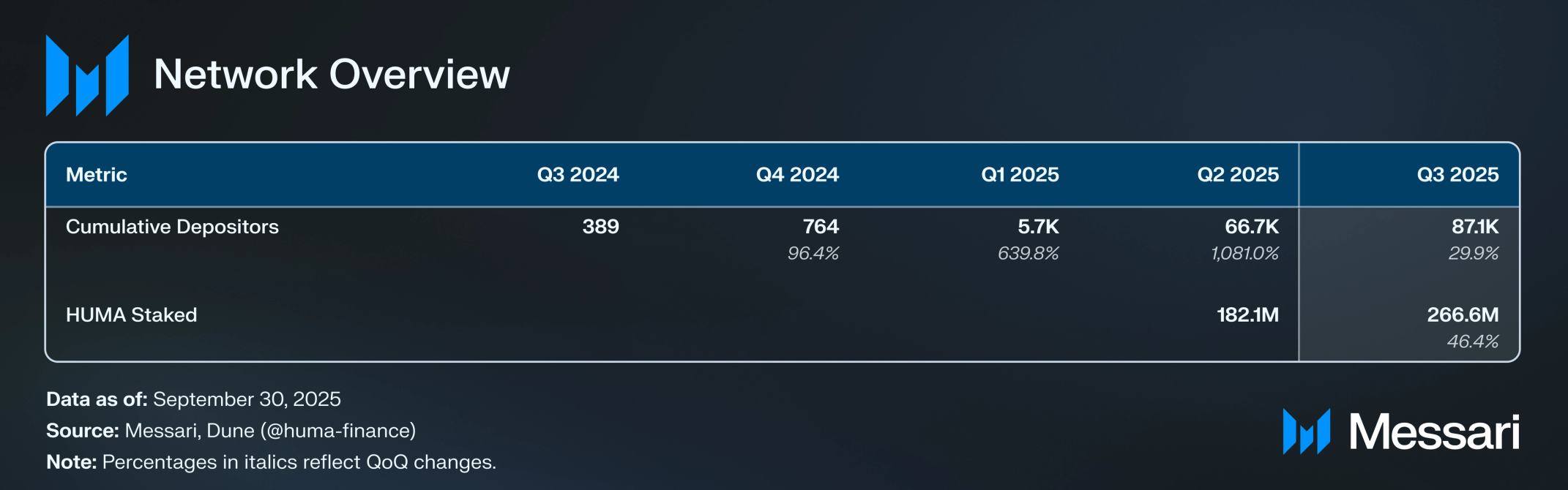
In Q3, cumulative depositors increased 30.4% QoQ from 66,700 on June 30 to 87,100 on Sept. 30, which means that more users interacted with Huma’s products over the quarter. Average daily Huma pool depositors declined 69.7% QoQ from 719 to 218 over the same period. Since Huma 2.0 went live, no day has had fewer than 95 daily depositors, which shows consistent baseline usage.
Staking
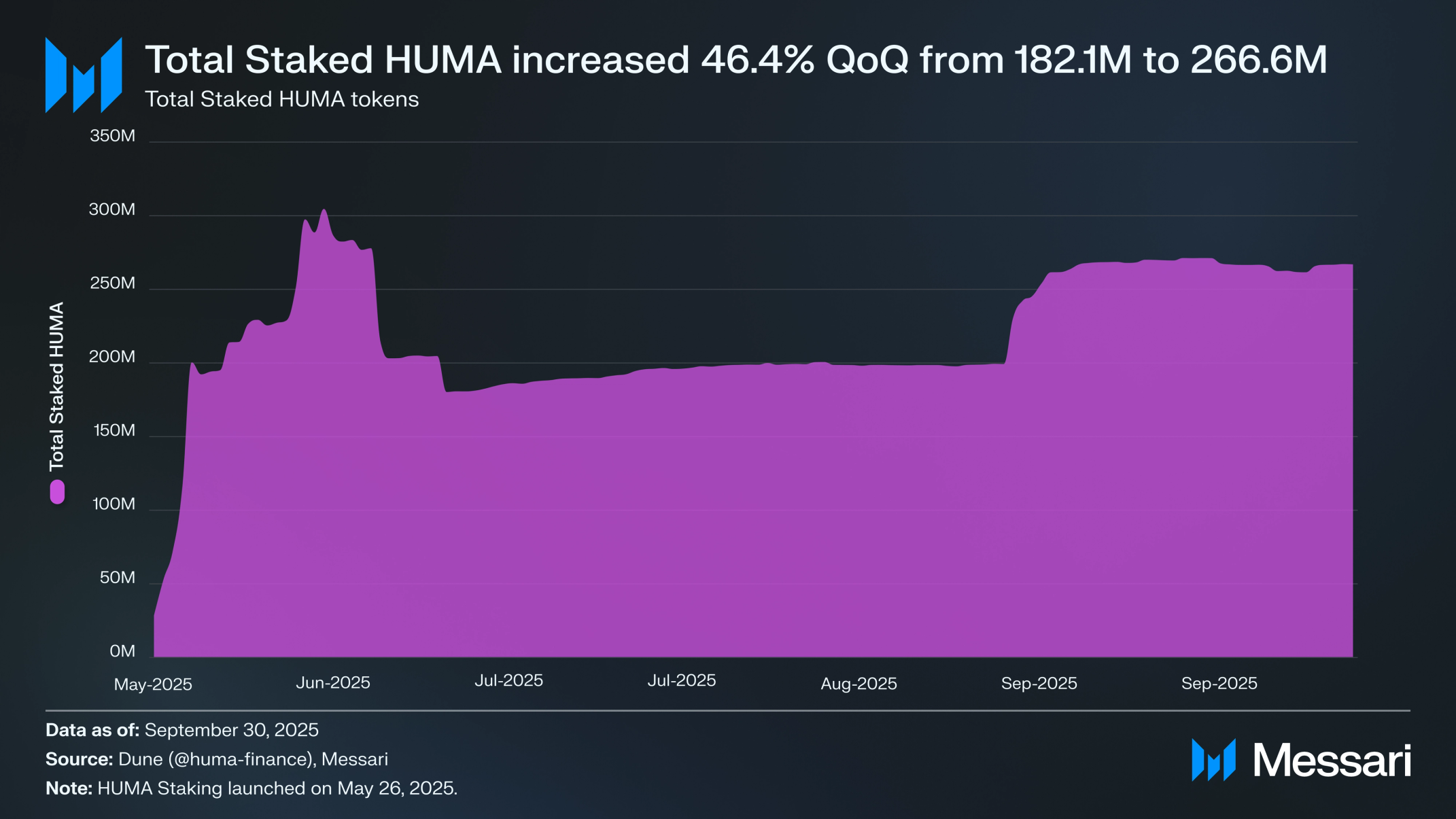
All of the HUMA circulating supply can be staked except the 400 million allocated to market-making and onchain liquidity. As of Sept. 30, users staked 266.6 million HUMA ($9.1 million), up 46.4% QoQ from 182.1 million on June 30, which represents 16.0% of the 1.67 billion HUMA eligible for staking.
On June 30, the Huma Foundation announced the rewards framework for HUMA stakers, which includes governance voting rights, Feathers-based rewards, a staking multiple on LP rewards, early access to Huma 2.0 vault reopenings, and eligibility for select ecosystem promotions and partner airdrops. Staking rewards are calculated over 30-day periods based on the amount of HUMA staked and two protocol-controlled variables, the Staking Factor and α. The formula is 30-day staking rewards = (Staking Factor / α) × staked HUMA. At launch, the Staking Factor was 10, and α was 20, meaning 1,000 HUMA staked for 30 days would earn 500 Feathers.
Stakers who also LP receive a multiplier on their LP rewards, capped at 2x when their staked HUMA exceeds three times their PST or mPST balance. If an LP has multiple positions, the multiplier applies to all of them. Stakers must wait 14 days after initiating an unstake request before tokens can be withdrawn.
CPN matches OFIs with BFIs in active payment corridors, designated country pairs where CPN supports regulated USDC flows, based on pricing and compliance preferences. Once matched, settlement occurs directly between the institutions’ wallets on the OFI-designated blockchain. Huma provides liquidity for these settlements on Solana. As of Sept. 30, CPN supported 29 institutions, with 55 undergoing eligibility review. Circle plans to expand coverage to 185 corridors by the end of 2026.
Superstate
On July 29, Huma partnered with Superstate, an asset manager of tokenized financial products, to help source and manage liquidity for Superstate’s funds. To date, Superstate has launched two products. The first is USTB, a tokenized private fund backed by U.S. Government Securities, including short-duration U.S. Treasuries. The second is USCC, a token representing ownership in the Superstate Crypto Carry Fund, which generates yield from crypto basis trades (a trade exploiting price differences between futures and spot markets for the same asset) in BTC, ETH, and SOL, and from U.S. Treasuries.
Geoswift
On Aug. 15, Huma partnered with Geoswift, a cross-border payments company, to launch same-day payments for online Amazon sellers in Asia. The solution uses Huma’s liquidity infrastructure for automated disbursements to provide shorter seller payment processing times without manual intervention.
Zeus Network
On Sept. 18, Huma partnered with Zeus Network, an interoperability protocol for the Bitcoin and Solana blockchains, to run an incentive campaign. The campaign rewarded users for completing a set of transactions, including depositing USDC on Huma 2.0, which earned a 1.1x Feathers reward multiplier on their deposit. The campaign ended on Oct. 9.
PayFi Summit
On Oct. 1, Huma Finance co-hosted the Singapore PayFi Summit with the Solana Foundation to discuss stablecoin adoption in global payment and credit applications, as well as regulatory developments affecting the PayFi ecosystem. Discussions covered the potential impact of PayFi applications to connect traditional and digital finance, the importance of clear stablecoin regulations for broader adoption, and how Solana’s high-throughput infrastructure supports payment and credit applications.
Closing Summary
In Q3, HUMA’s circulating market cap increased 17.6% QoQ from $59.9 million on June 30 to $70.5 million on Sept. 30 due to 333 million of HUMA tokens unlocked during the quarter. HUMA token price decreased 1.4% QoQ from $0.035 to $0.034. Huma processed $1.7 billion in transaction volume in Q3, a 24.4% QoQ increase from $1.4 billion in Q2.
As of Sept. 30, Huma 2.0 held $151.6 million in deposits, a 132.3% QoQ increase from $65.1 million at Q2-end. Additionally, users had staked 266.6 million HUMA ($9.1 million), representing 16.0% of the 1.67 billion HUMA eligible for staking.
In addition to growing user deposits, Huma expanded its role in regulated cross-border settlement when it became a liquidity provider to the Circle Payments Network on Sept. 30. On Aug. 15, Huma partnered with Geoswift to provide same-day payouts for online Amazon sellers in Asia. On Oct. 1, Huma co-hosted the Singapore PayFi Summit with the Solana Foundation, where discussions covered stablecoin adoption and regulatory developments for PayFi infrastructure. Huma 2.0’s deposit growth, its growing staker base, product integrations, and continued institutional activity reinforced its position as a contributor to the PayFi ecosystem. If Huma maintains this growth trajectory and expands its partnerships with PayFi leaders, it will be positioned to surpass $10.0 billion in cumulative transaction volume in Q1 2026.
This report was commissioned by Huma Global Ltd. All content was produced independently by the author(s) and does not necessarily reflect the opinions of Messari, Inc. or the organization that requested the report. The commissioning organization may have input on the content of the report, but Messari maintains editorial control over the final report to retain data accuracy and objectivity. Author(s) may hold cryptocurrencies named in this report. This report is meant for informational purposes only. It is not meant to serve as investment advice. You should conduct your own research and consult an independent financial, tax, or legal advisor before making any investment decisions. Past performance of any asset is not indicative of future results. Please see our Terms of Service for more information.
No part of this report may be (a) copied, photocopied, duplicated in any form by any means or (b) redistributed without the prior written consent of Messari®.
Austin is a Sr. Research Analyst for Messari’s Protocol Services team. He focuses on Prediction Markets, DeFi, & Interop. protocols. He previously worked on PwC's Digital Assets team.
Austin is a Sr. Research Analyst for Messari’s Protocol Services team. He focuses on Prediction Markets, DeFi, & Interop. protocols. He previously worked on PwC's Digital Assets team.