By the end of Q1 2025, the Helium Network had transferred over 1,140.9 TB of offloadeddata all-time from major mobile carriers in the U.S., a 138.6% QoQ increase.
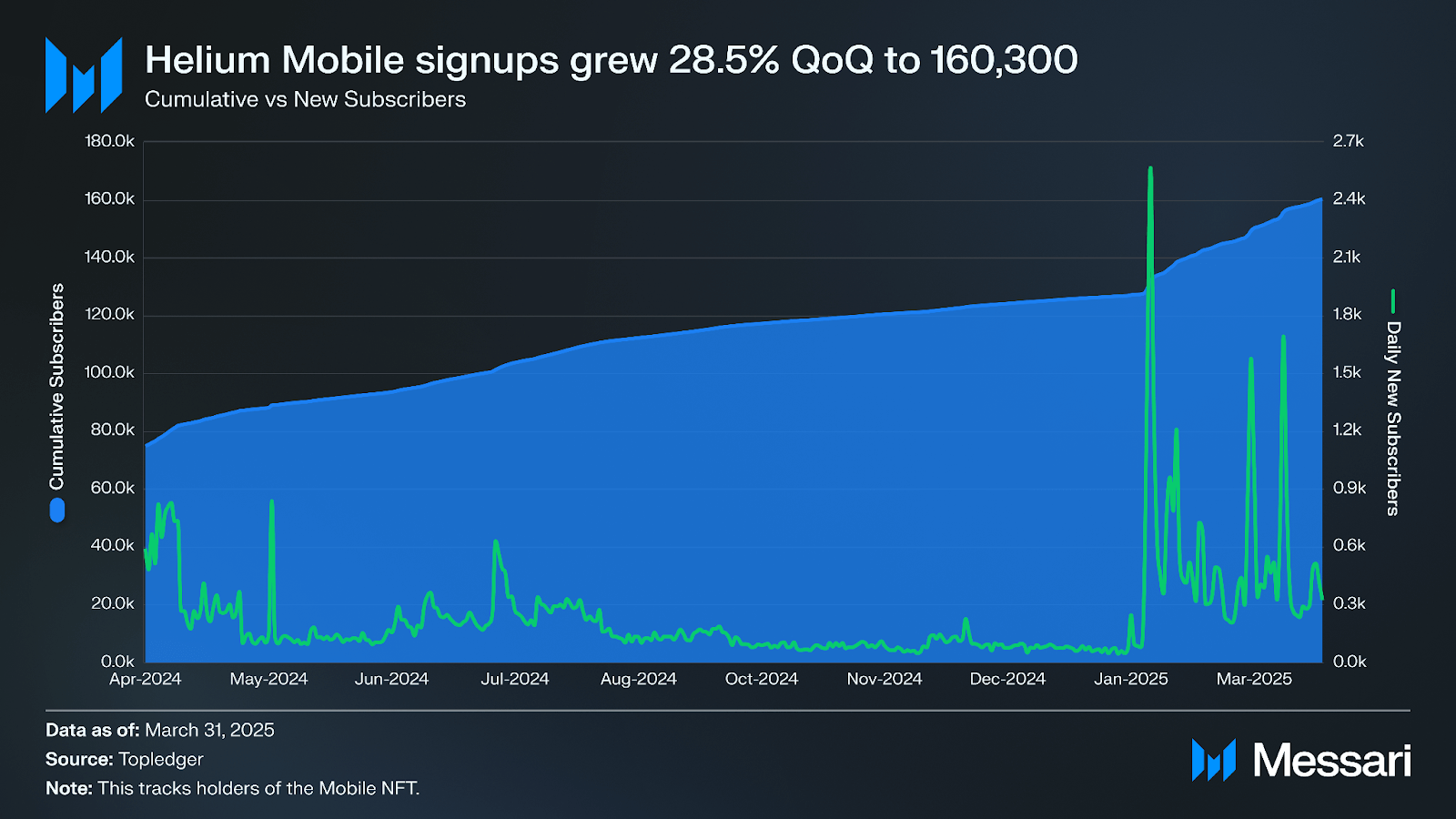
Over 160,000 accounts have signed up to Helium Mobile, a 28.5% QoQ increase.
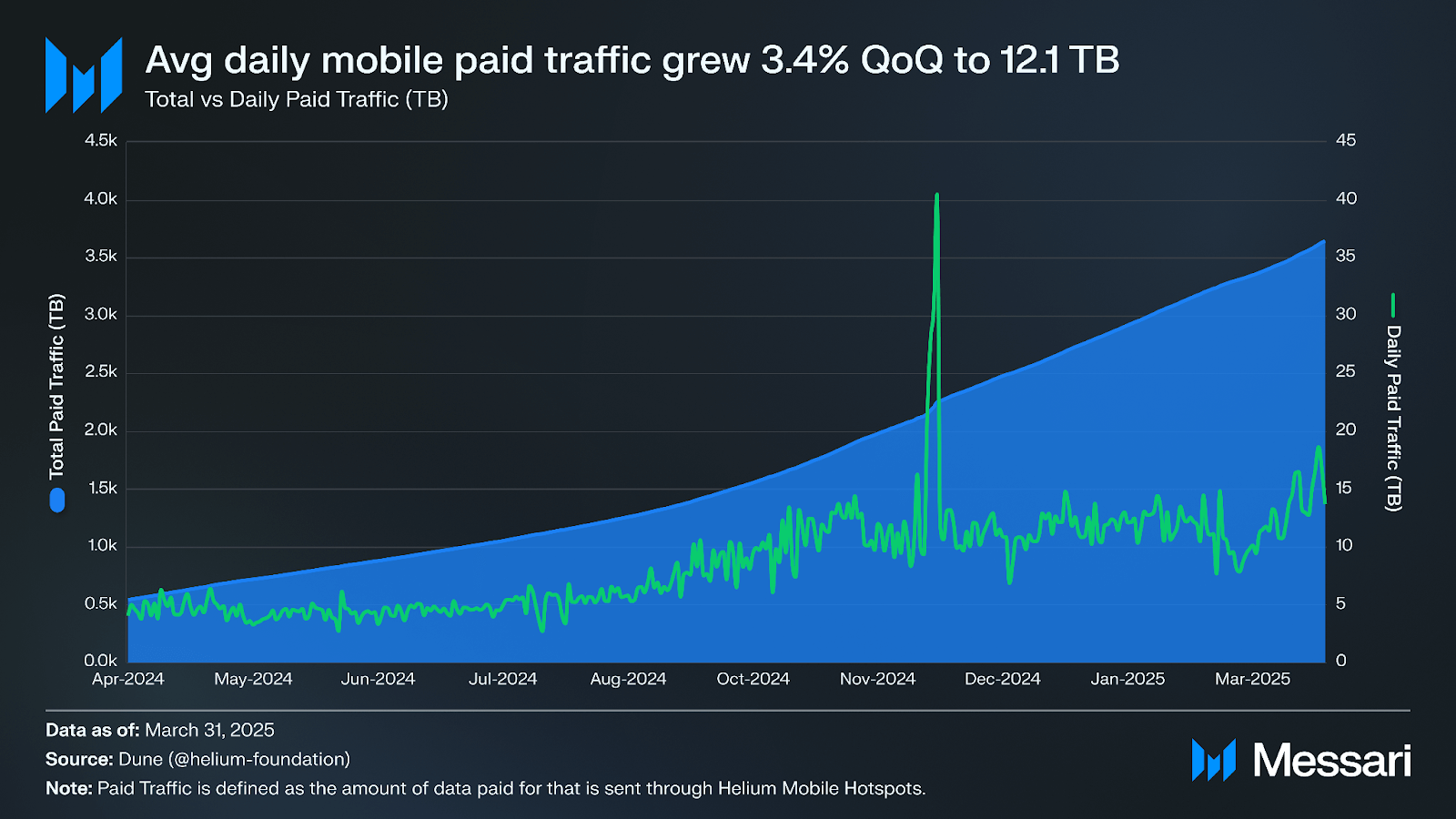
Over 3,644 TB of data has been transferred through Helium Hotspots since inception, a 42.5% QoQ increase.
Helium Mobile unveiled three new phone plans, ranging from $0 to $30/month. Subscribers can earn Cloud Points, which are redeemable for eGift cards or charitable donations.
Helium announced partnerships with AT&T and Telefónica in Mexico. Bringing Helium Network to more U.S. users and now Movistar subscribers.
Primer
Helium (HNT) is a decentralized wireless network that supports both cellular (Mobile) and low-power Internet of Things (IoT) connectivity. Helium’s Mobile Network is the world’s first people-built cellular network, offering affordable service plans by blending traditional carrier coverage with an incentive model powered by HNT. Phones connect using Helium Mobile, a service that utilizes both the community-deployed Helium Network and a nationwide partner to deliver consistent coverage across the United States.
The Helium Network launched in 2019 with an IoT network on its purpose-built Layer-1 blockchain for peer-to-peer wireless infrastructure. Users could send data to and from the Internet, and protocol miners were rewarded with HNT tokens for providing wireless network coverage. What began as a purpose-built IoT network has since expanded into a broader wireless ecosystem, with Helium now supporting multiple types of decentralized infrastructure under a single protocol.
After the approval of a governance proposal (HIP-70) in August 2022, Helium sunset its Layer-1 and migrated operations to Solana on Apr. 18, 2023. Helium operates with a subDAO framework laid out in Helium Improvement Proposals (HIPs) 51, 52, and 53.
The Helium Mobile Network's primary growth driver has been through partnerships with telecom carriers via its Carrier Offload Program. The program allows users of legacy telecom companies such as AT&T and Telefónica’s Movistar to use Helium Mobile Hotspots when in areas where Helium Hotspots provide sufficient coverage.
The Helium IoT Network has found traction in various use cases, with notable examples including its use in flood detection in Portugal and in monitoring humidity and temperature for museums. Helium’s founding team has raised over $360 million to date, including $200 million in its latest round in March 2022. For a full primer on the Helium Network, refer to our Initiation of Coverage report.
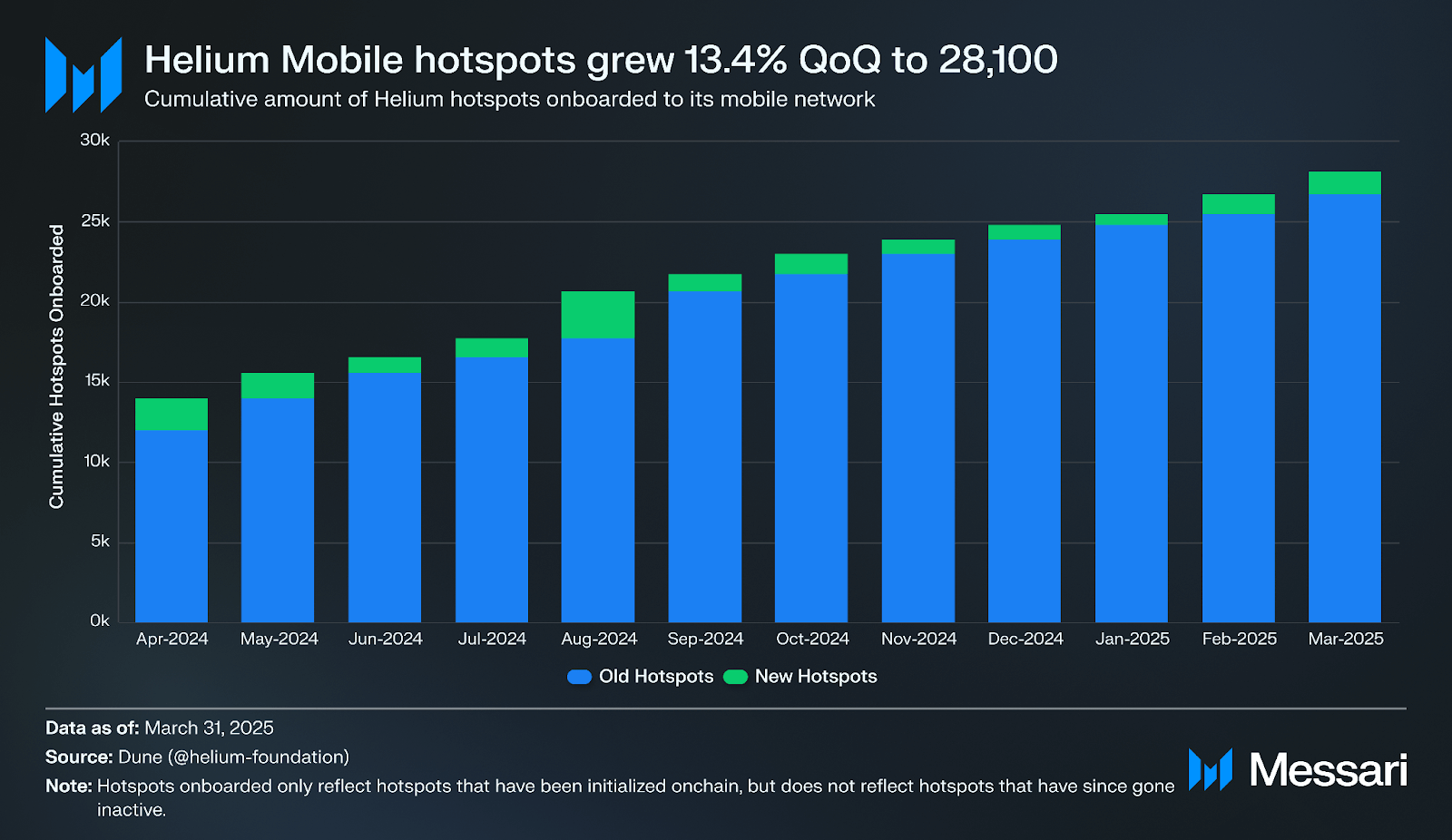
In Q1 2025, Helium Mobile’s onboarded Hotspots grew 13.4% QoQ from 24,800 to 28,100. This does not include converted hotspots; when included, the network ended the quarter with 63,806 hotspots, a 90.6% QoQ increase. Helium Mobile’s unlimited plan ($30/month) costs considerably less than the average three-figure plans that categorize American telecom. It also enables users to save even more through Cloud Points. Cloud Points are rewards Helium Mobile subscribers earn. They’re a way of paying users back for sharing their anonymized location data, which empowers the Helium community to identify coverage gaps, optimize Hotspot deployment, and guide strategic network expansion across the U.S.
Users’ location data is anonymized and shared with the network to understand where coverage is needed most. Cloud Points can be redeemed for eGift cards or donated to nonprofit organizations. In addition to its ability to attract network coverage suppliers via Hotspots, Helium Mobile seems primed to continue attracting new users to its telecom network, regardless of crypto-nativeness.
IoT Hotspots grew 4.7% QoQ, ending Q1’25 with 34,500 Hotspots onboarded since the Solana migration in April 2023. Before the migration, Helium had over 342,000 active Hotspots, bringing the network total to over 376,500.
To promote network growth in needed geographies, the IoT Network's unique Proof-of-Coverage (PoC) model adjusts the rewards mechanism based on density to encourage more strategic deployments. Today, coverage is strongest in major cities across North America, Europe, and Southeast Asia.
Data Credits
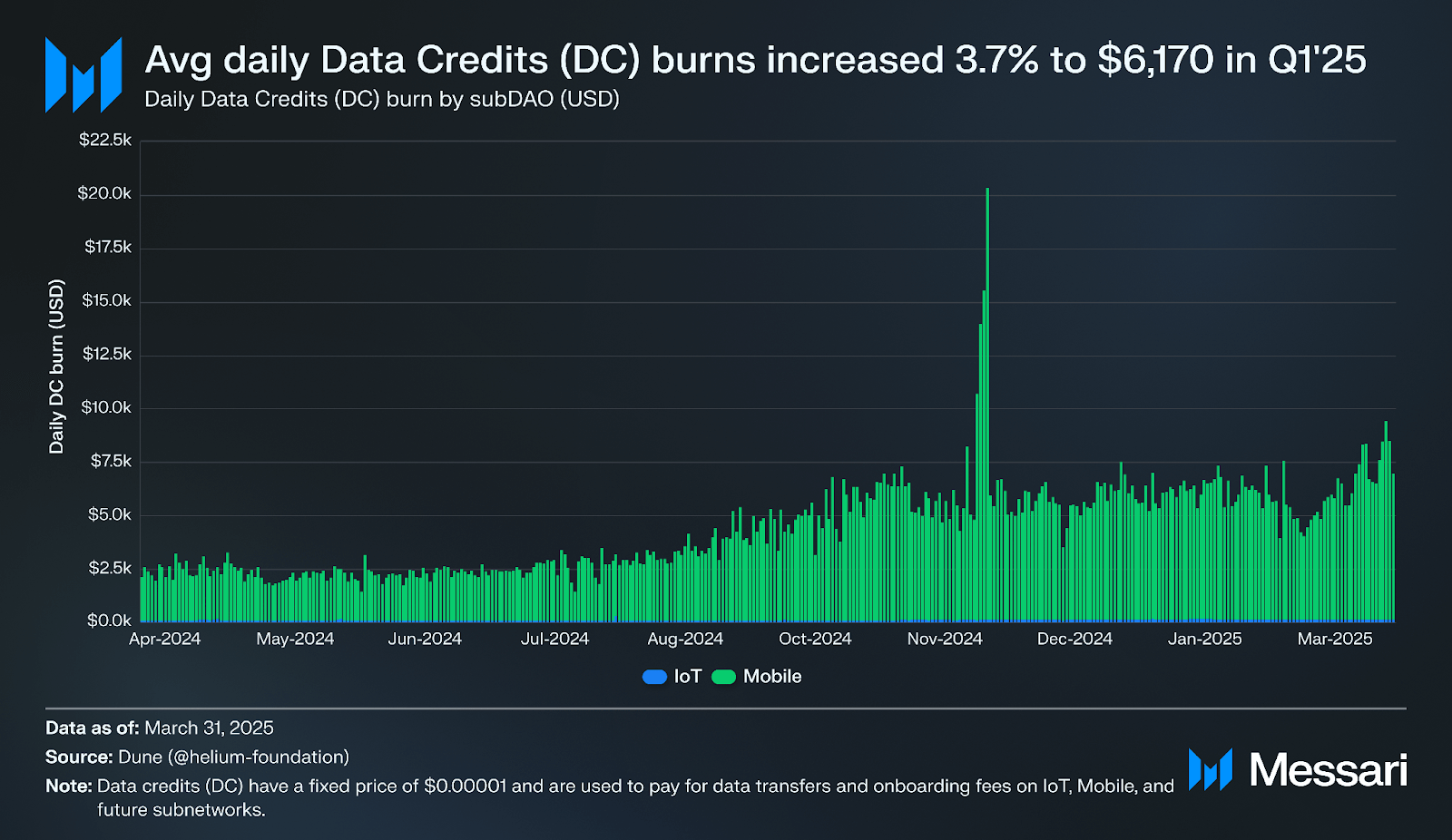
Data credits (DC) have a fixed price of $0.00001 and are used to pay for data transfers and onboarding fees on IoT, Mobile, and future subnetworks. The total DC burned in Q1’25 was $2.2 million. Average daily DC burns increased 3.7% QoQ from $5,950 to $6,170. $6,043 of the daily DC burns came from the Mobile subDAO, representing 97.9% of DC burns for the quarter, and $126.68 came from the IoT subDAO.
Helium Mobile Signups
When onboarding to Helium Mobile, users are sent a Mobile NFT to their wallet, which is used to track Helium Mobile signups. In Q1, account signups grew 28.5% QoQ from 124,800 to 160,300.
Helium Mobile users automatically connect to Helium Hotspots when available, and seamlessly switch to T-Mobile’s network when Hotspot coverage isn't.
In February 2025, Helium launched a free plan that allows users 3 GB of monthly data with the option to purchase additional data for $7.50/GB. Helium Mobile now offers three different tiers of plans:
Zero: $0.00/month with 3GB of data
Air: $15.00/month with 10GB of data
Infinity: $30.00/month with unlimited data
All of these plans are eligible to earn Cloud Points from their plan. The free plan requires users to share their location data anonymously with the network. Air and Infinity users have the option to opt in to earn Cloud Points.
Carrier Offloading
On June 18, 2024, Helium began partnering with legacy telecom companies to use Helium Mobile Hotspots when their users are in areas where Helium Hotspots provide sufficient coverage. Helium has partnered with six carriers to offload user data, including T-Mobile, Movistar, AT&T, Google Orion, and Wefi. In April 2025, Helium announced a partnership with AT&T as it joined the carrier offloading program.
Offloaded data is the amount of production data users from other carriers have transferred through the Helium Network. In Q1’25, cumulative all-time data offloaded (TB) grew 138.6% from 478.2 TB to 1,140.9 TB. Anyone can view up-to-date stats here.
Paid Traffic
Paid traffic is the amount of data paid for that is sent through Helium Mobile Hotspots. In Q1’25, average daily mobile paid traffic grew 3.4% QoQ from 11.7 TB to 12.1 TB. The growth brings the cumulative all-time paid traffic to 3,644.3 TB of data sent through a Hotspot, a 42.5% QoQ increase. As one of the main revenue drivers for the Helium network, this metric is expected to continue growing as more users join the network and partnerships for carrier offloading expand.
Financial
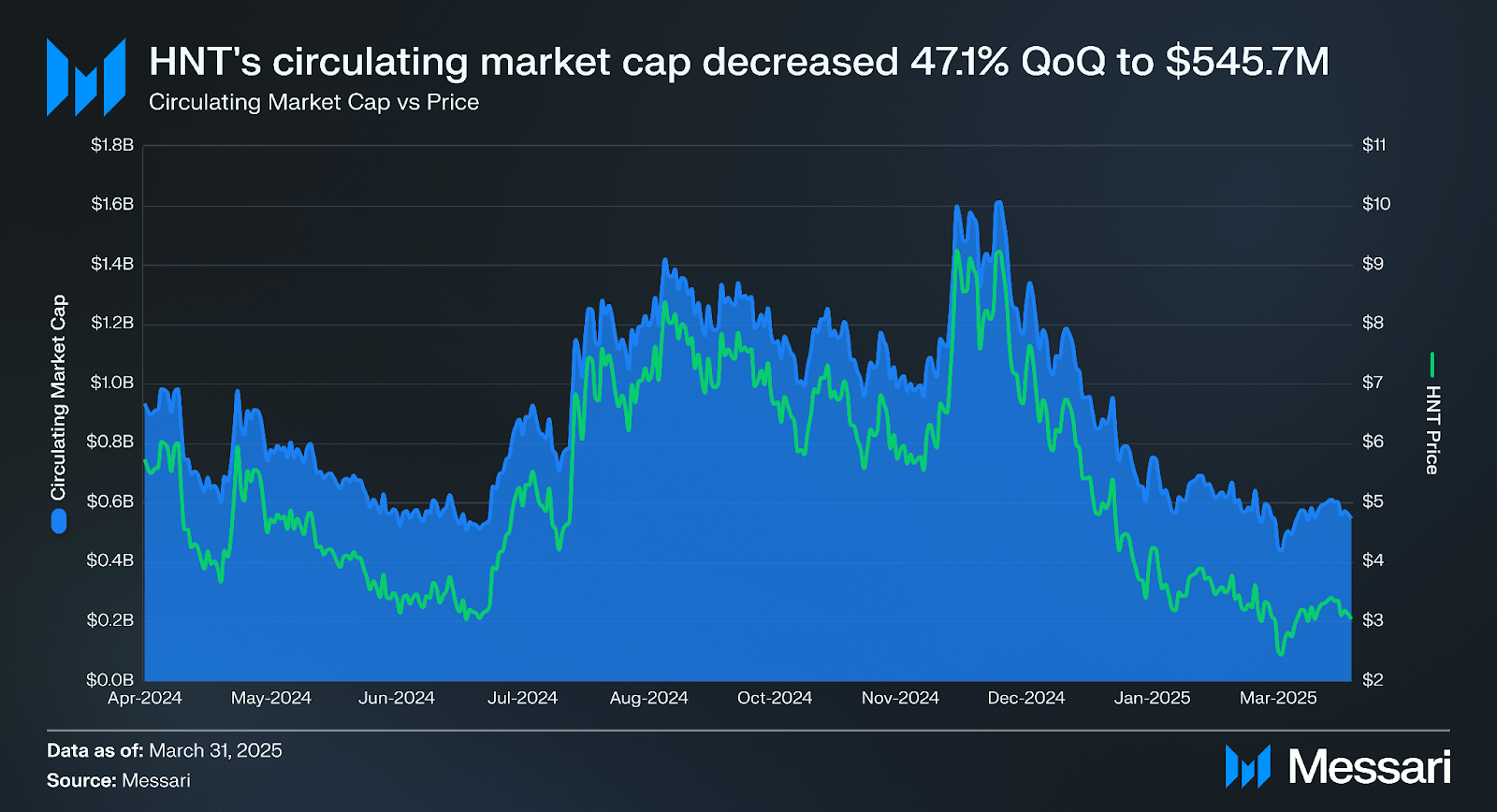
In Q1 2025, HNT’s circulating market cap decreased 47.1% QoQ from $1.0 billion to $545.7 million, as its market cap rank fell from 93rd to 96th. HNT’s price fell 48.3% to $3.04 from $5.88. The Helium Network token (HNT) is the network’s primary token. It is distributed from the Helium DAO minted through inflationary emissions, then distributed to subDAOs based on performance and engagement (i.e., Utility Score). There are two main functionalities for HNT:
Staketo receive veHNT and gain governance votes for the Helium DAO: Since the Helium Network is acting as an overarching structure for subnetworks (i.e., subDAOs) that are created, it needs its own governance mechanism. Members of the DAO (i.e., HNT tokenholders) can participate in the voting processes for HRPs by staking HNT and receiving proportional voting power. When you lock HNT, you receive veHNT, which gives you voting power to approve or reject proposals (HIPs) that shape the network’s future.
Notably, due to the implementation of HIP-138, HNT is no longer redeemable for IOT or MOBILE. There is no specified buyback for HNT, but it is necessary because the only way to buy DCs is to burn HNT. This token emission design, called burn and mint equilibrium, ensures that the network usage is aligned with the amount of HNT in circulation.
Qualitative Analysis
Implementation of New Governance Models
The quarter began with a significant shift in Helium's governance approach through the introduction of HIP-141: Single-Token Governance and Helium Release Proposals. Passed with overwhelming support, 98.6% of votes in favor, HIP-141 is a major step toward simplifying and strengthening the network’s decision-making processes. The proposal restructures Helium’s multi-token governance into a unified framework and introduces several changes to improve transparency, efficiency, and stakeholder alignment.
One of the most impactful changes implemented by HIP-141 is the consolidation of Helium governance under a single-token system. This move retires the IOT and MOBILE subnetwork tokens as mechanisms for governance participation. Instead, all governance activities will now be carried out exclusively through HNT, reinforcing HNT’s role as the core asset of the Helium ecosystem and simplifying participation across network stakeholders.
The proposal also reintroduces veHNT (voting-escrowed HNT) as the sole governance mechanism. While veHNT has existed since the Helium Network's migration to Solana, HIP-141 formalizes it as the single, unified approach to voting. Users must lock their HNT to obtain veHNT, which grants them voting rights on proposals and network upgrades. The locking mechanism is designed to encourage long-term commitment, as the amount of veHNT a participant receives is proportional to the amount and duration of their HNT lockup.
These changes aim to create a more streamlined governance structure, encouraging long-term commitment from stakeholders and aligning incentives with the network's overall health.
Partnership with Movistar Mexico and AT&T
A significant development this quarter was Helium's partnerships with Telefonica subsidiary Movistar Mexico, and AT&T. The partnership with Movistar aims to improve connectivity in Mexico by leveraging community-driven infrastructure to enhance network coverage and reliability, particularly in underserved areas. This model reduces infrastructure costs for Movistar while potentially improving service quality for users.
To support this expansion, Movistar is making Helium Mobile Hotspots available for purchase in its retail stores and online channels, encouraging public participation in building and expanding the network across over 300 target locations. This initiative accelerates network growth and aligns with Helium's philosophy of community-driven infrastructure development.
Integration with Existing Infrastructure
A factor in Helium's adoption has been its ability to integrate with existing infrastructure. The launch of Helium Plus on Jan. 28, 2025, allows users to enable Helium functionality on their existing Wi-Fi networks without additional hardware. This approach lowers the barrier to entry for participating in the Helium ecosystem and potentially earning rewards for sharing excess bandwidth.
Furthermore, the introduction of a Trade-Up Program on Feb. 5, 2025, enabled users to upgrade their existing radio equipment to enhance network infrastructure. This initiative helped to improve the overall performance and coverage of the Helium network while demonstrating the project's commitment to technological advancement.
Closing Summary
Q1 2025 was a milestone quarter for the Helium Network, marked by international expansion, product innovation, and governance transformation. The network scaled significantly, reaching over 1,140 TB in cumulative all-time carrier data offloaded to legacy telecom providers. Mobile account sign-ups grew 28.5% QoQ, aided by low-cost plans and strategic device partnerships. Its entry into Mexico through Movistar expanded Helium’s footprint and reinforced its model of community-led infrastructure.
Governance also advanced meaningfully, as HIP-141 unified the token ecosystem under HNT, reintroduced veHNT as the sole governance mechanism, and created new delegation incentives to strengthen protocol alignment. Technological developments like Helium Plus and the Trade-Up Program lowered barriers to participation while improving hardware efficiency.
Despite a challenging macro environment reflected in HNT’s market cap decline, the Helium Network’s operational performance and ecosystem resilience highlight its potential as a leading decentralized wireless protocol. The network is positioned to continue maturing across global deployments and community-driven bootstrapping.
This report was commissioned by the Helium Foundation. All content was produced independently by the author(s) and does not necessarily reflect the opinions of Messari, Inc. or the organization that requested the report. The commissioning organization may have input on the content of the report, but Messari maintains editorial control over the final report to retain data accuracy and objectivity. Author(s) may hold cryptocurrencies named in this report. This report is meant for informational purposes only. It is not meant to serve as investment advice. You should conduct your own research and consult an independent financial, tax, or legal advisor before making any investment decisions. Past performance of any asset is not indicative of future results. Please see our Terms of Service for more information.
No part of this report may be (a) copied, photocopied, duplicated in any form by any means or (b) redistributed without the prior written consent of Messari®.
Matthew is a Research Analyst in Protocol Research. He graduated from MIT with a Master's and Bachelor's in Comp Sci, Economics, and Data Science where he wrote his thesis on DeSoc. Matthew also has previous experience as an Analyst at Goldentree's crypto fund.
Matthew is a Research Analyst in Protocol Research. He graduated from MIT with a Master's and Bachelor's in Comp Sci, Economics, and Data Science where he wrote his thesis on DeSoc. Matthew also has previous experience as an Analyst at Goldentree's crypto fund.