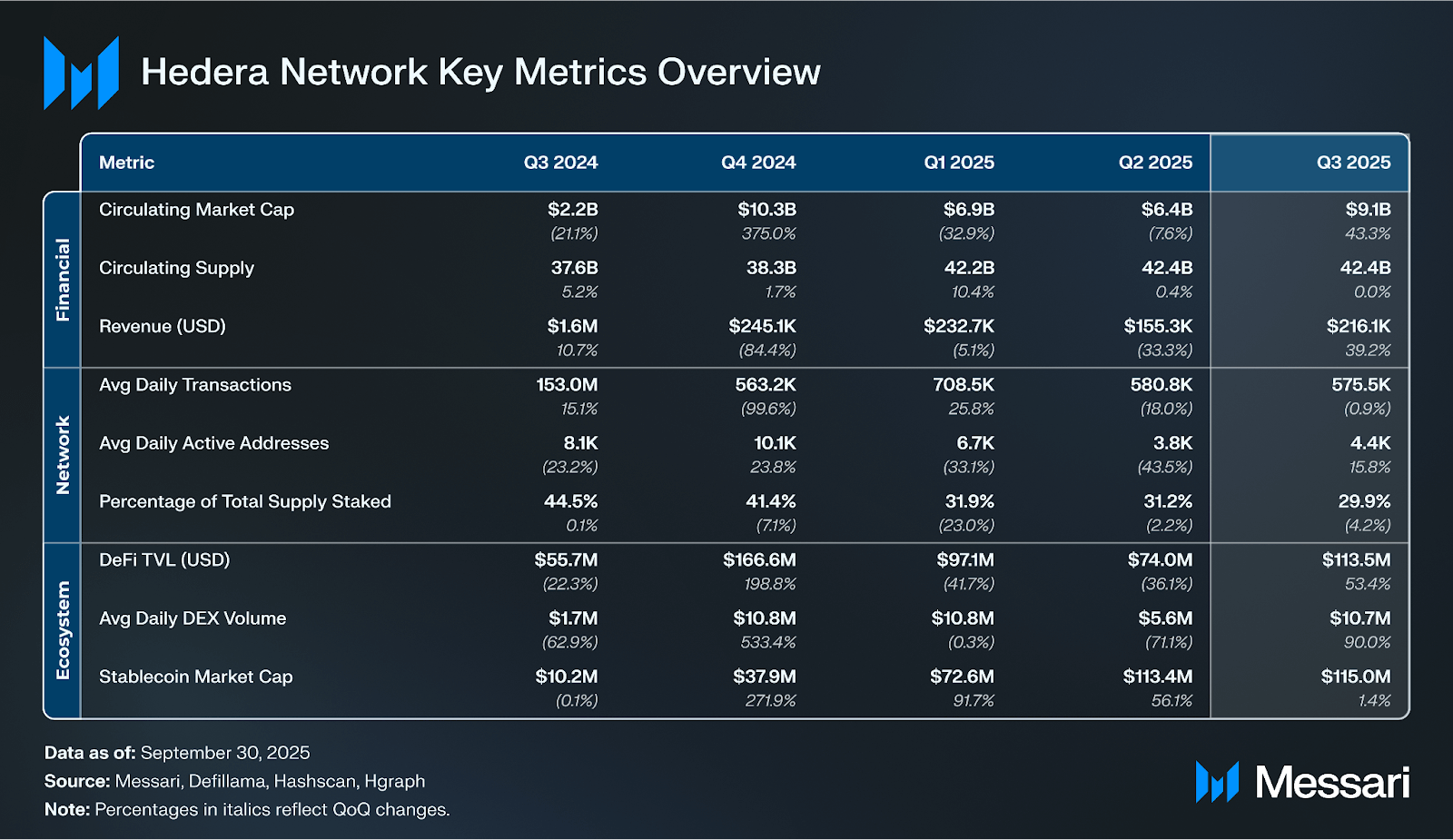
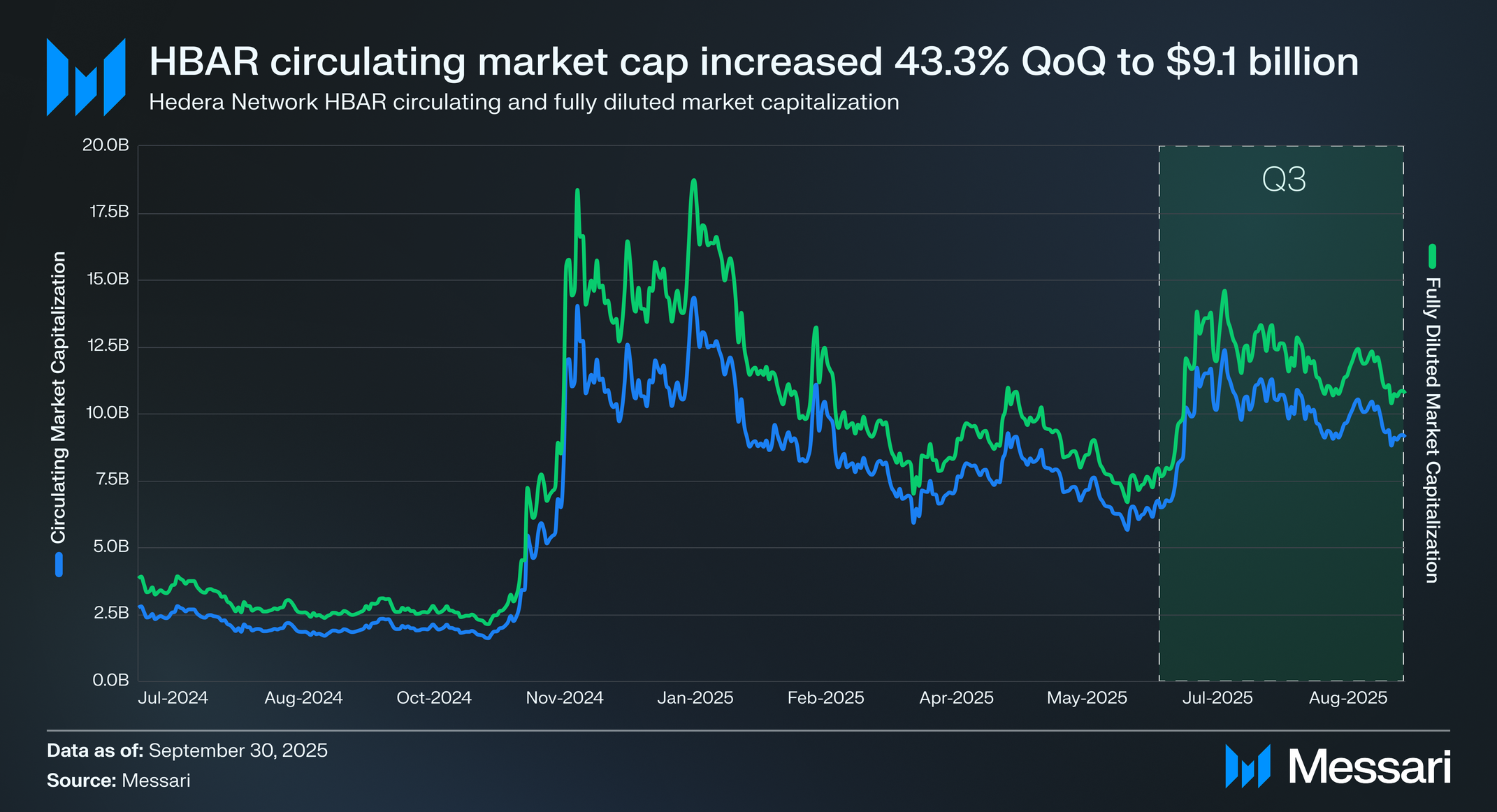
HBAR’s circulating market cap increased 43.3% QoQ to $9.1 billion, driven by a 43.2% rise in token price, while circulating supply remained steady at 42.4 billion.
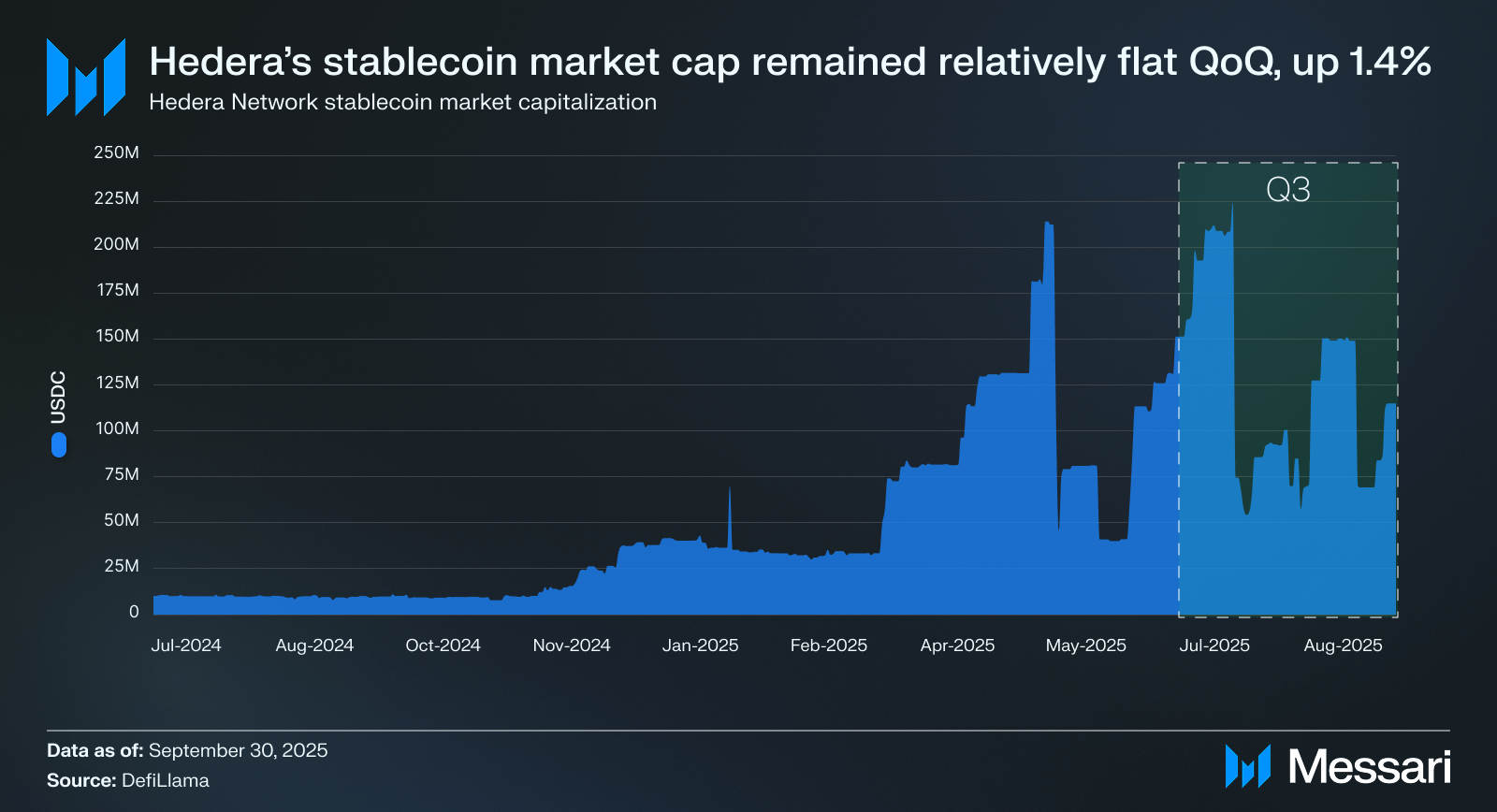
Hedera’s stablecoin market capitalization grew 1.4% QoQ to $115.0 million, supported by continued USDC inflows following the Q2 integration of Circle’s CCTP.
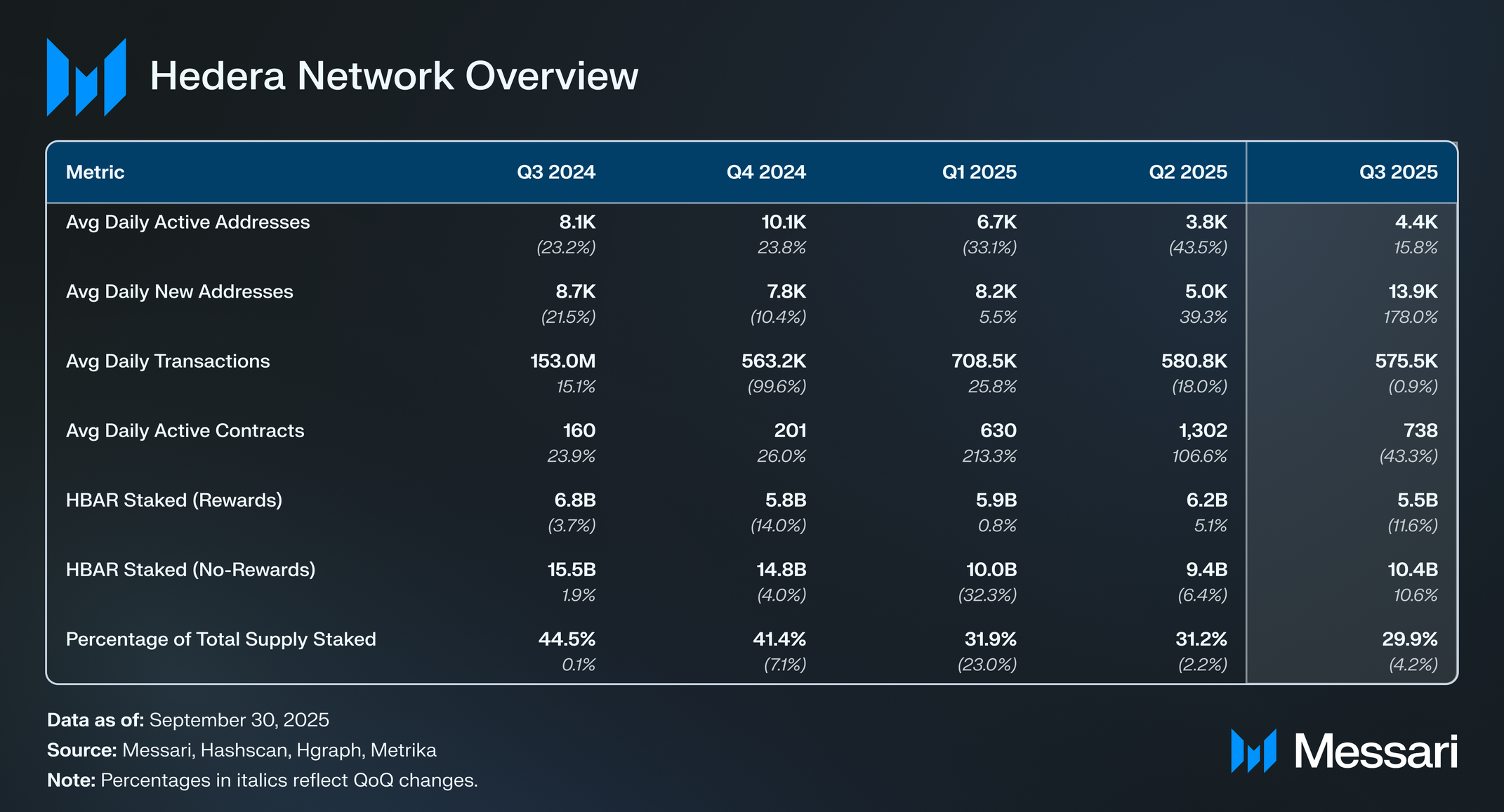
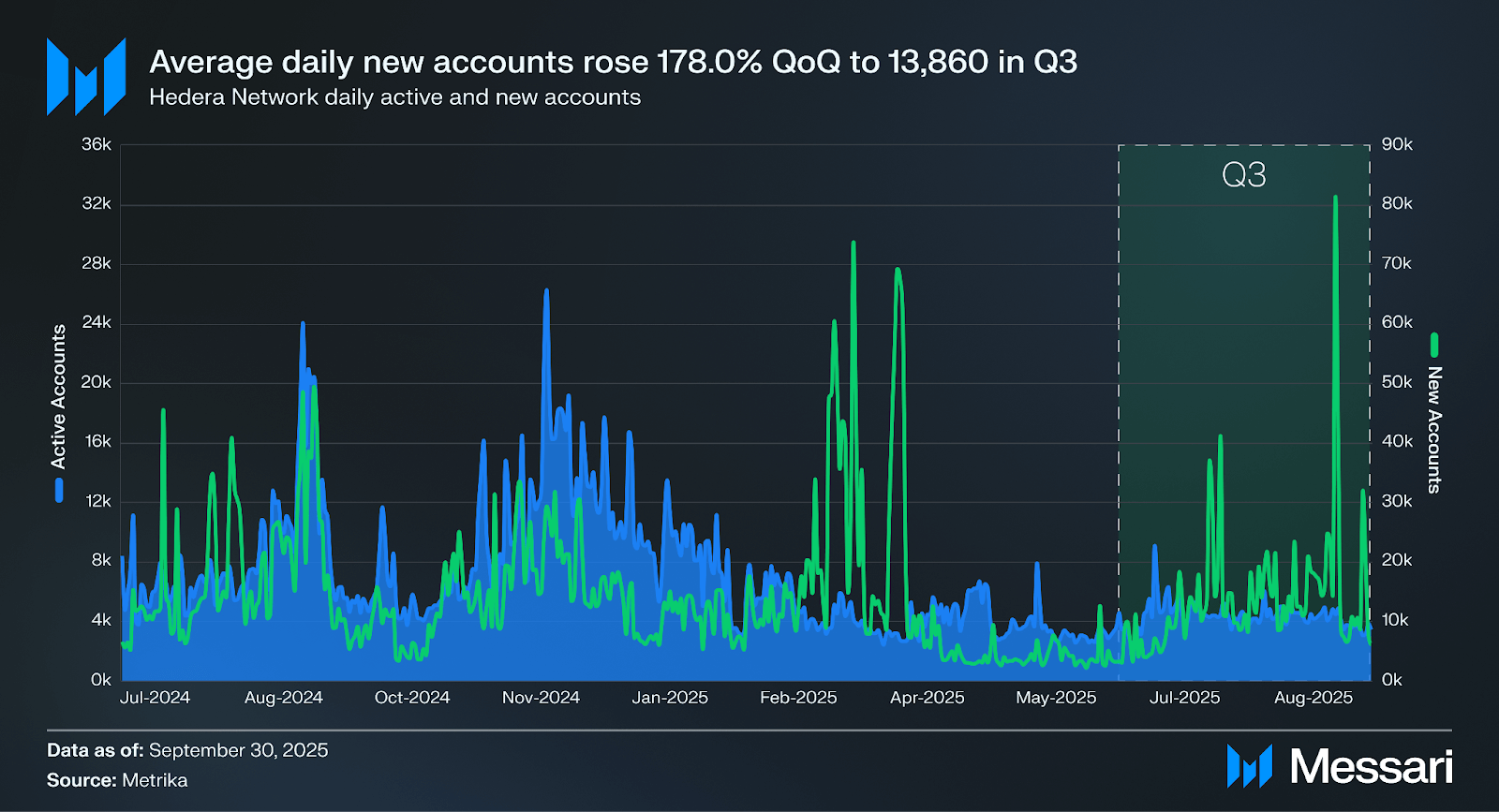
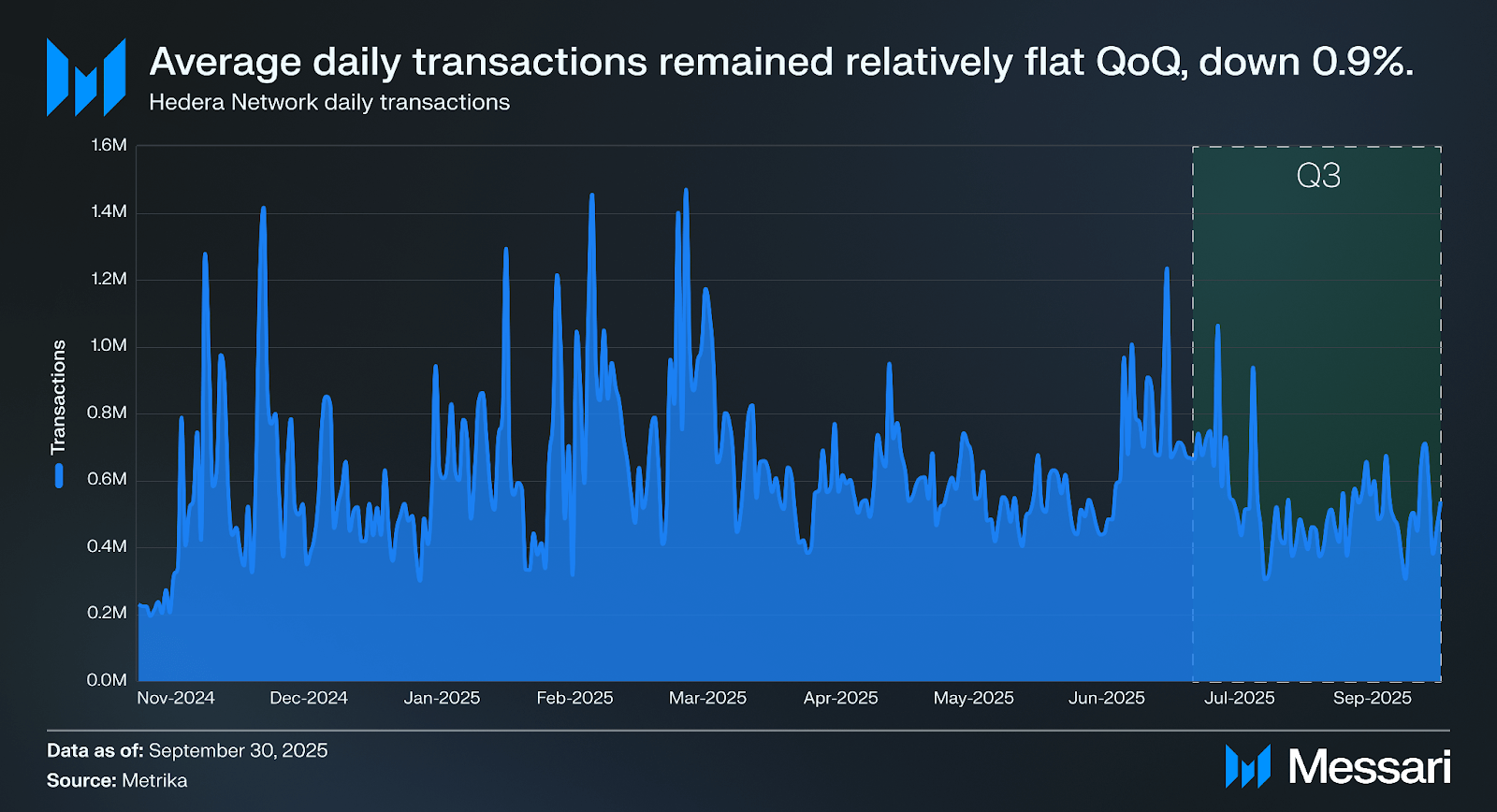
Average daily transactions declined slightly by 0.9% QoQ to 575,496, though daily active accounts rose 15.8% and new account creation increased 178.0%.
DeFi TVL rose 53.4% QoQ to $113.5 million, with DEX volumes nearly doubling and SaucerSwap accounting for over two-thirds of total liquidity.
The Wyoming Stable Token Commission announced the selection of Hedera as the only additional blockchain candidate for the Frontier Stable Token (FRNT), the first U.S. state-issued stable token.
Primer
Hedera (HBAR) is a high-performance, secure, and sustainable public, permissioned distributed ledger (DLT) network. Hedera is governed by a council of 31 global organizations, including banks, universities, and blockchain protocols, with community input on network features and standards received through Hedera Improvement Proposals (HIPs). While anyone can submit a transaction and view the network history and data, only pre-approved entities run the nodes that validate transactions and participate in consensus. While members of the Council currently operate Hedera’s validator nodes, the network plans to “eventually become permissionless for consensus”. Although Hedera's network operation is currently permissioned in nature, the division of responsibility across 31 geographically and industry-diversified council members is unique among public networks.
The Hedera Network offers an optimized version of the Besu EVM for smart contracts (Hedera Smart Contract Service) alongside a native tokenization service (Hedera Token Service) and a high-throughput data writing and verification service (Hedera Consensus Service). These services are known as the Hedera Network Services, which developers can use in a permissionless fashion to build decentralized applications in a variety of programming languages. The Hashgraph Consensus Algorithm powers the network, delivering high throughput, fair ordering, and low-latency consensus for all transactions.
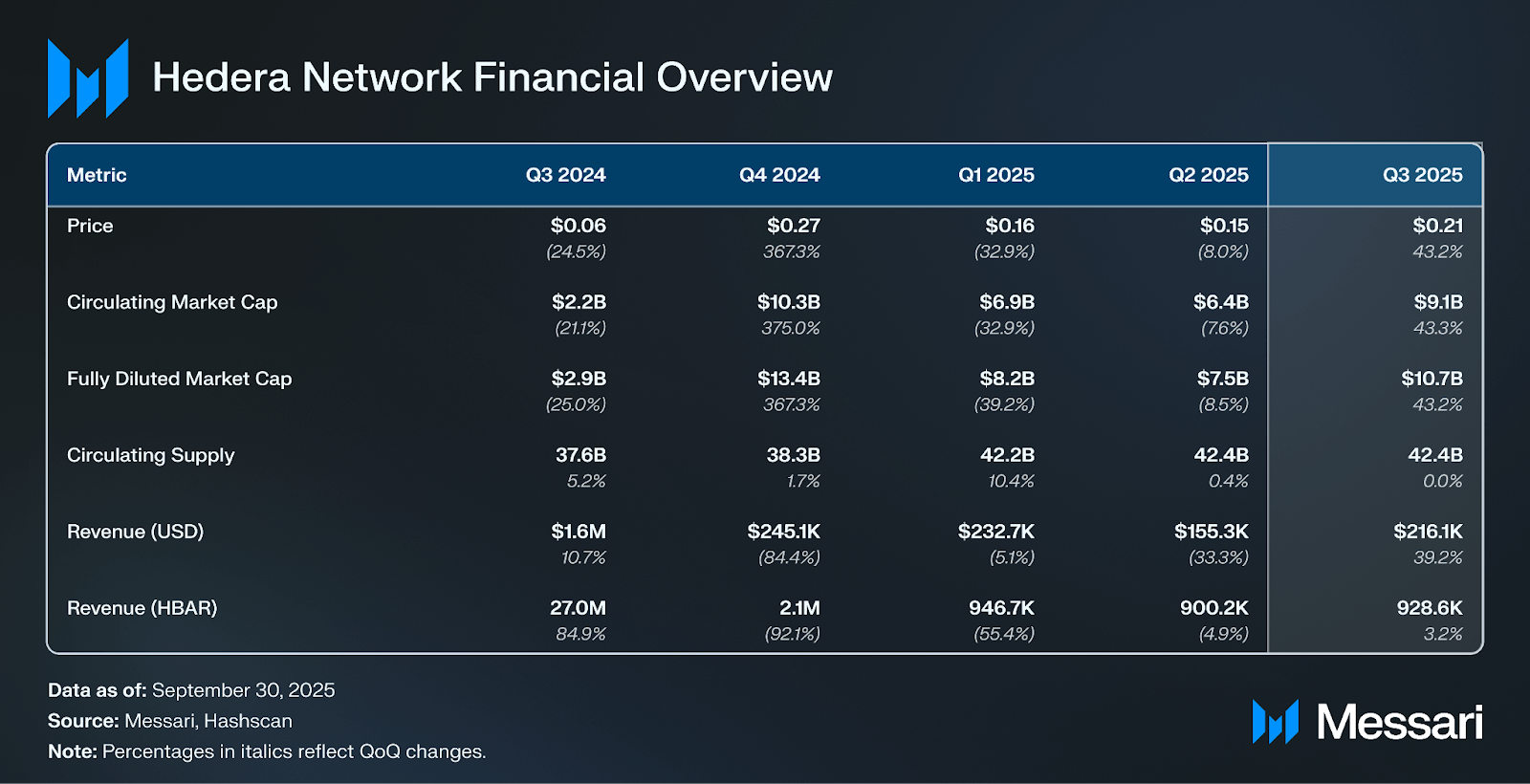
In Q3 2025, the circulating market capitalization of HBAR increased 43.3% QoQ from $6.4 billion to $9.1 billion. The circulating supply of HBAR remained roughly the same at 42.4 billion, compared to Q2. The price of HBAR increased 43.2% QoQ from $0.15 to $0.21.
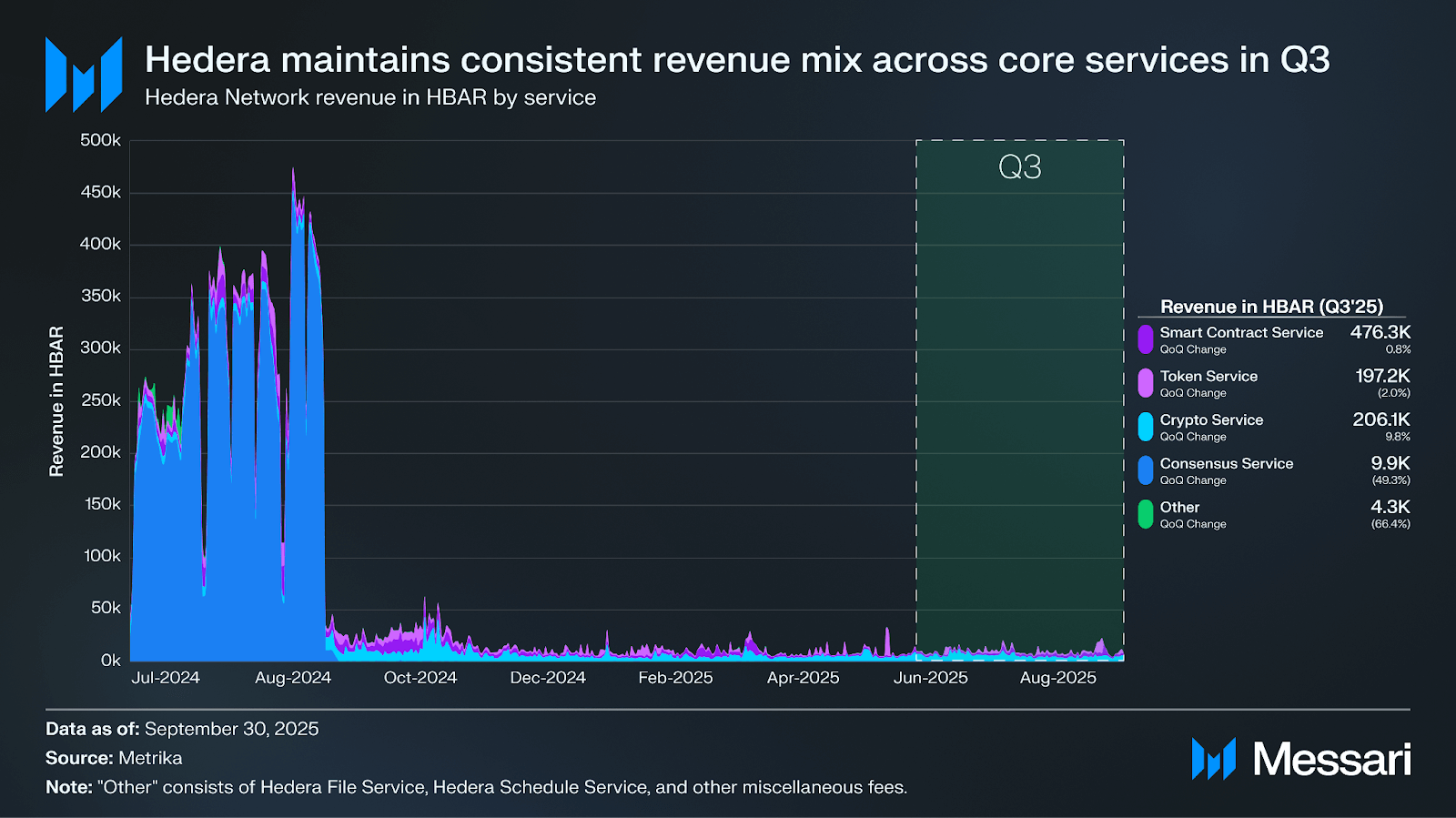
Transaction fees on the Hedera Network increased 3.2% QoQ to 928,597 HBAR. Dollar-denominated fees rose 39.2% QoQ to $216,088. The disproportionate increase in USD terms was primarily driven by a sharp rebound in HBAR’s average market price over the quarter, which lifted the fiat value of network fees despite relatively modest growth in usage.
Most of Hedera’s network services recorded modest changes in revenue during Q3. Smart Contract Service revenue remained the largest contributor, rising 0.8% QoQ to 476,341 HBAR. Crypto Service revenue grew 9.8% QoQ to 206,136 HBAR, while Token Service revenue declined slightly by 2.0% to 197,154 HBAR. Consensus Service revenue decreased 49.3% QoQ to 9,936 HBAR, and other sources of network revenue fell 66.4% to 4,293 HBAR.
Supply Dynamics
Hedera’s native token HBAR serves multiple network functions. It is used to pay network transaction fees, staked by validators to secure the network in the Proof-of-Stake (PoS) consensus algorithm, and rewarded to validators for securing and operating the network. Users can delegate their HBAR to network validators and earn a portion of staking rewards. In the future, the network plans to enable staking for permissionless public validators.
HBAR’s circulating supply remained stable at 42.4 billion. 84.8% of the total fixed supply of 50 billion is now circulating. HBAR is distributed each quarter as reported through the Hedera Treasury Management Report.
Network Overview
Usage
The daily average number of active accounts rose 15.8% QoQ from 3,814 to 4,368. Average new accounts created daily on the Hedera Network surged 178.0% QoQ from 4,984 to 13,860.
Average daily transactions decreased slightly by 0.9% QoQ from 580,788 to 575,496. Transaction activity remained relatively balanced across Hedera’s core services in Q3, with the distribution of average daily transactions as follows:
Crypto Service: 47.5% share (+12.0% QoQ)
Consensus Service: 25.8% share (-26.3%QoQ)
Smart Contract Service: 25.6% share (+28.2% QoQ)
Token Service: 2.9% share (+30.6% QoQ)
Other: 0.3% share (+0.2% QoQ)
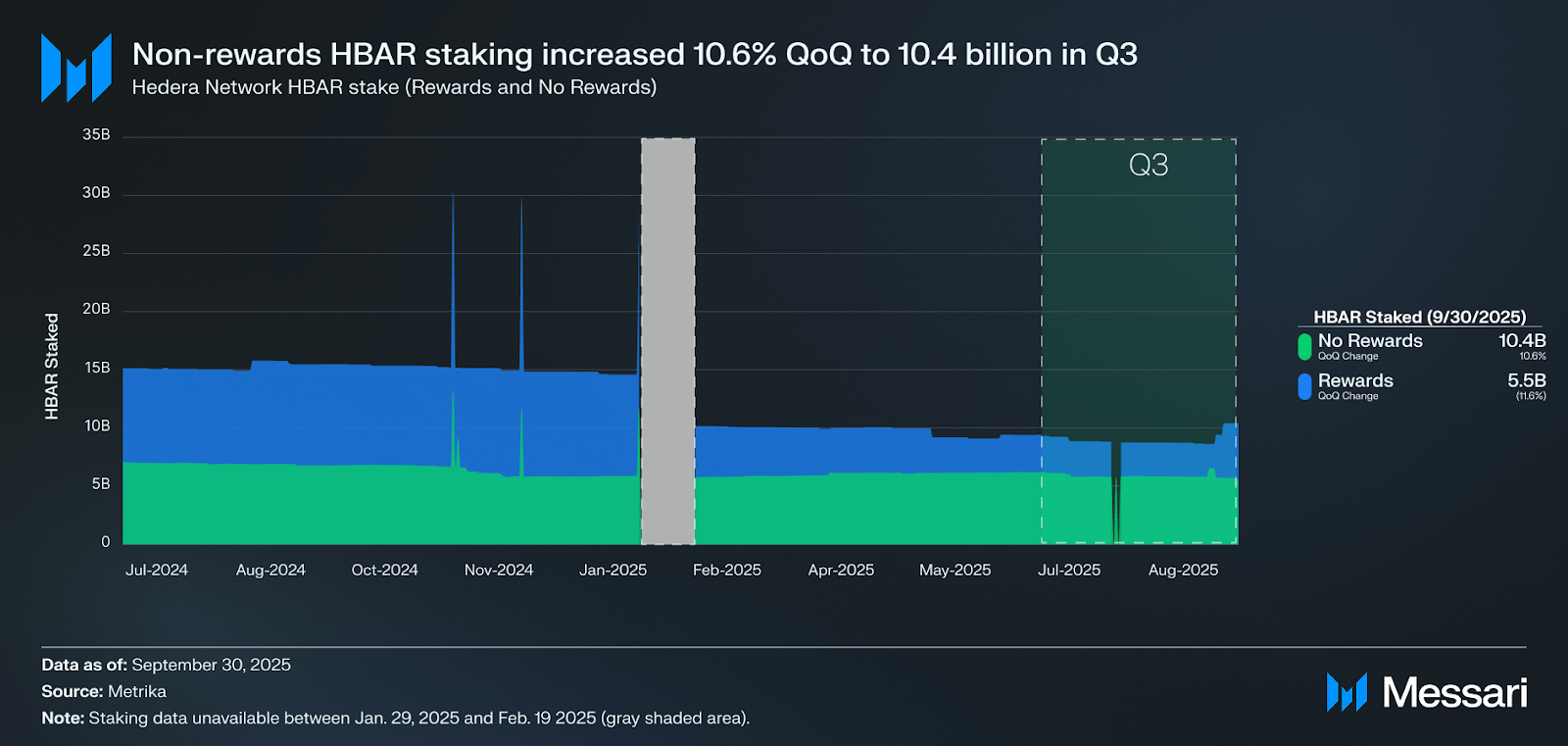
At the end of Q3, total HBAR staked on the Hedera network increased to 15.9 billion, a 1.9% rise QoQ, representing 37.5% of the circulating supply and 31.8% of the total supply. The increase was driven by a 10.6% rise in no-rewards staking, which grew to 10.4 billion HBAR, while rewards-eligible staking declined by 11.6% QoQ to 5.5 billion HBAR.
Development
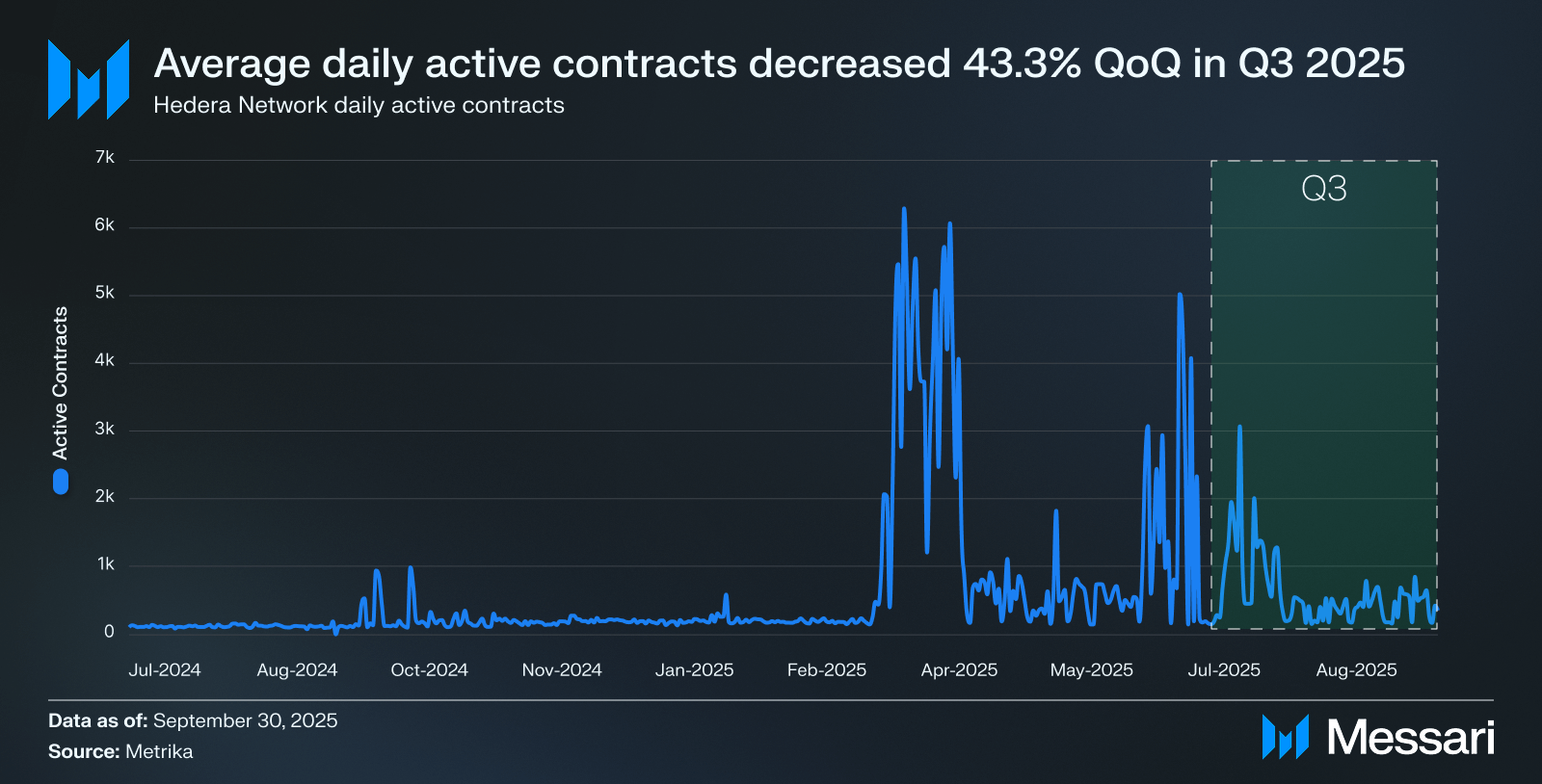
Daily average active contracts declined 43.3% QoQ to 738 in Q3, following a sharp drop from the prior quarter's all-time high of 1,302. While average usage fell, the quarter still featured several short bursts of elevated activity. Notably, the network recorded over 5,000 active contracts on July 2 and sustained multi-thousand contract counts through the first week of July.
Mainnet Upgrades in Q3 2025
Hedera implemented three mainnet upgrades in Q3 2025, each introducing technical enhancements across smart contract execution, node incentivization, and developer tooling.
v0.63:Updated on July 23, 2025, this version improved network performance and observability by aligning ancient event pruning with consensus time, enabling smoother node operations. It introduced low-overhead SDK and gRPC usage metrics and added full support for non-zero shard and realm IDs, removing legacy constraints and preparing for future network configurations.
v0.64:Released on August 20, 2025, the upgrade enhanced frontend developer workflows with dynamic gRPC-Web endpoint discovery and advanced block stream features.
HIP-1046: Enabled dynamic gRPC-Web proxy endpoint support via the address book, simplifying SDK integration and improving scalability for frontend applications.
HIP-1056: Delivered key progress on Block Streams, including stream size optimization, batch transaction support, and secure consensus-to-block node communication.
v0.65:Released on September 24, 2025, the upgrade introduced unified state management, improved scheduled transaction fee controls, and advanced Block Stream capabilities.
Virtual Mega Map: Consolidated all internal state entities into a single virtual map with one root hash, enhancing verifiability and simplifying block item proofs.
HIP-991: Enforced max_custom_fees for scheduled transactions, aligning with HTS standards and adding developer safeguards.
HIP-1056 & HIP-1127: Delivered forward-compatible Block Stream upgrades, including unified transaction records to reduce duplication, improve performance, and lower state data costs.
HIP-1217:Updated on September 1, 2025, this upgrade modularized the /contracts/call endpoint to align Mirror Node behavior with consensus execution, improving accuracy and reliability. It introduced stricter balance checks, enhanced gas estimation, and standardized error handling, enabling more predictable contract simulations and reducing discrepancies across environments.
Price Update: Effective January 4, 2026, this upcoming change will increase the fee for the ConsensusSubmitMessage transaction to better reflect its actual resource usage. The adjustment improves cost modeling across the network by aligning fees with the transaction’s compute and storage impact.
SALT Launches Trading Application to Support Hedera’s DeFi and MemeFi Ecosystem
On July 10, 2025, SALT, a South Korean trading application, launched on the Hedera network to offer a mobile-first experience for DeFi and MemeFi trading. The application features one-click wallet access, smart trade routing, and real-time market insights, enabling users to trade tokens quickly and securely. With support for onchain rewards, gamification, and MPC wallet infrastructure, SALT aims to expand Hedera’s reach in the APAC region and lower the barriers to onchain participation.
Hedera To Earn Launch
On July 13, 2025, the Hedera To Earn (HTE) platform launched, introducing a unified rewards system across applications like Cashtree, Mars Labs, and Berryfox. HTE enables users to earn onchain rewards from everyday activities such as gaming and shopping. The platform removes onboarding friction while showcasing Hedera’s capacity to support large-scale consumer applications with low fees, fast settlement, and real-time performance.
KAIO Brings Tokenized Institutional Funds Onchain via Hedera
On August 6, 2025, KAIOexpanded its regulated real-world asset (RWA) offerings by launching tokenized institutional funds on the Hedera network. The integration enables accredited and institutional investors to access strategies such as the Laser Digital Carry Fund, BlackRock ICS US Dollar Liquidity Fund, and Brevan Howard Master Fund through secure, compliant, and composable onchain infrastructure. KAIO facilitates programmable access to money markets and digital asset funds, supporting broader adoption of tokenized finance in capital markets.
Dfns Integrated with Hedera
On August 13, 2025, Dfnsannounced Hedera’s integration, enabling institutional users to securely build and manage Hedera wallets, HBAR, and native tokens within its wallet infrastructure. This integration supports secure transaction handling, real-time monitoring, and automatic asset recognition for developers building in DeFi, tokenization, AI, and supply chain.
Swarm: Tokenized Stocks Launch on Hedera
On August 15, 2025, Hedera and Swarm announced the launch of DeFi-compatible tokenized stocks such as AAPL, TSLA, and MSTR on the Hedera network. Issued under EU-compliant regulations, these 1:1 backed, insolvency-protected assets enable instant onchain redemption through Swarm’s smart contract infrastructure. The integration unlocks real-time settlement, reduces reliance on onchain TVL for liquidity, and bridges traditional market depth with decentralized applications, paving the way for advanced financial use cases across the Hedera ecosystem.
Wyoming Selects Hedera for State-Issued Stable Token (FRNT)
On September 4, 2025, the Wyoming Stable Token Commissionannounced the selection of Hedera as the only additional blockchain candidate for the Frontier Stable Token (FRNT), the first U.S. state-issued stable token. Hedera will support FRNT’s goal of enabling transparent, efficient public-sector payments. Backed by U.S. dollars and Treasuries, FRNT is designed to serve residents through use cases such as contractor payments and disaster relief, with interest proceeds directed to Wyoming’s School Foundation Program.
Canonical wETH Launches on Hedera via Stargate Finance
On September 15, 2025, canonical wrapped Ether (wETH) went live on Hedera through Stargate Finance and SaucerSwap Labs, marking Hedera’s entry into Stargate’s global liquidity network. The integration brings native support for Ethereum’s most liquid asset, enabling seamless cross-chain transfers with zero slippage and fast settlement. Developers can now integrate wETH into DeFi applications on Hedera, while users benefit from predictable fees, sub-three-second finality, and protection against front-running.
Hashport Launches HBAR Faucet and HashPass for Ecosystem Access
On October 1, 2025, Hashport introduced the HBAR Faucet and HashPass, two tools designed to simplify onboarding into the Hedera ecosystem. The HBAR Faucet allows eligible users to claim a small HBAR allocation to cover initial transactions. HashPass introduces an account verification score on Hedera based on wallet activity metrics such as account age, transaction count and diversity, NFT and token interactions, and staking and asset value. Together, these tools reduce friction for new users, improve wallet compatibility, and support dApp developers by streamlining user authentication.
Ecosystem Overview
DeFi
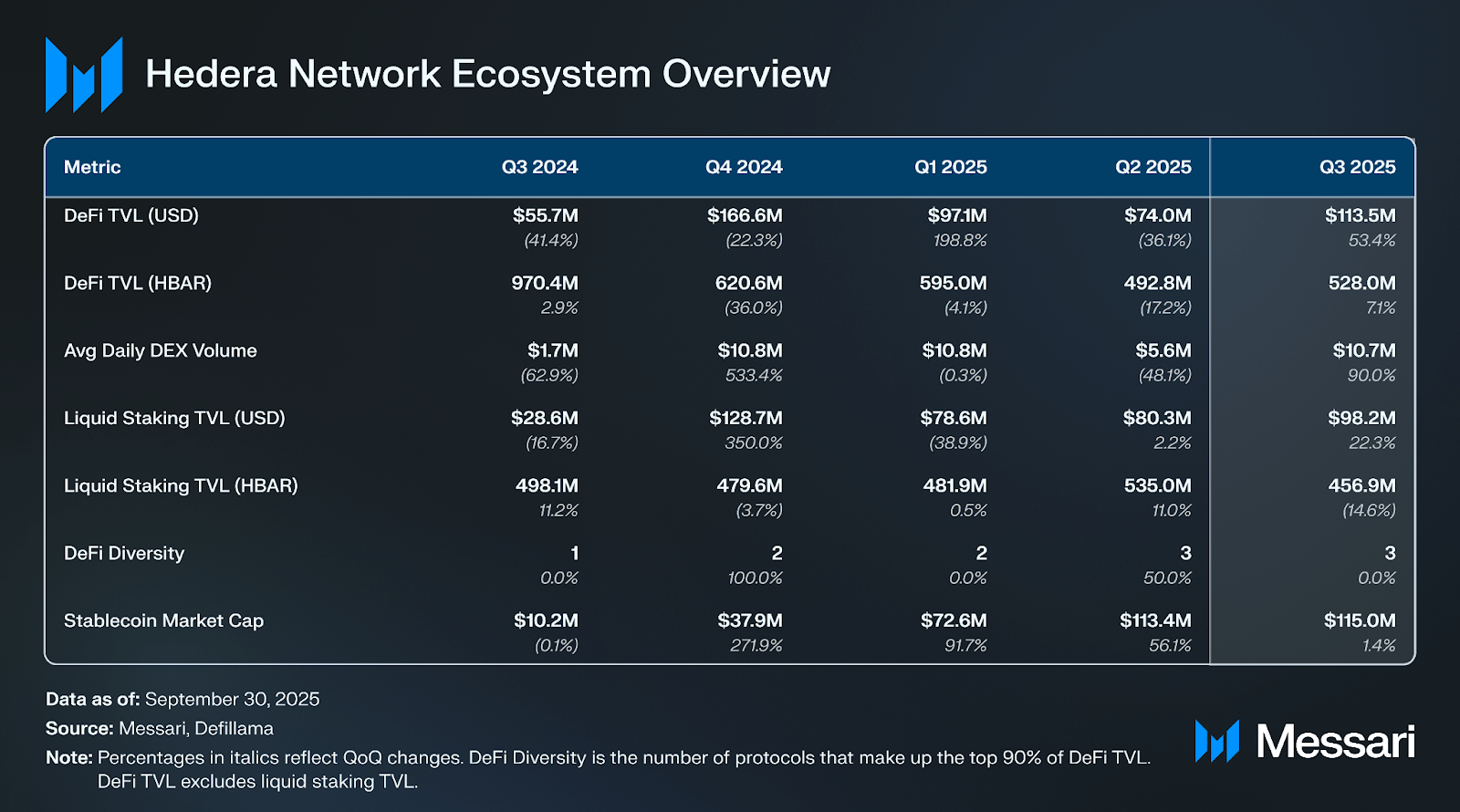
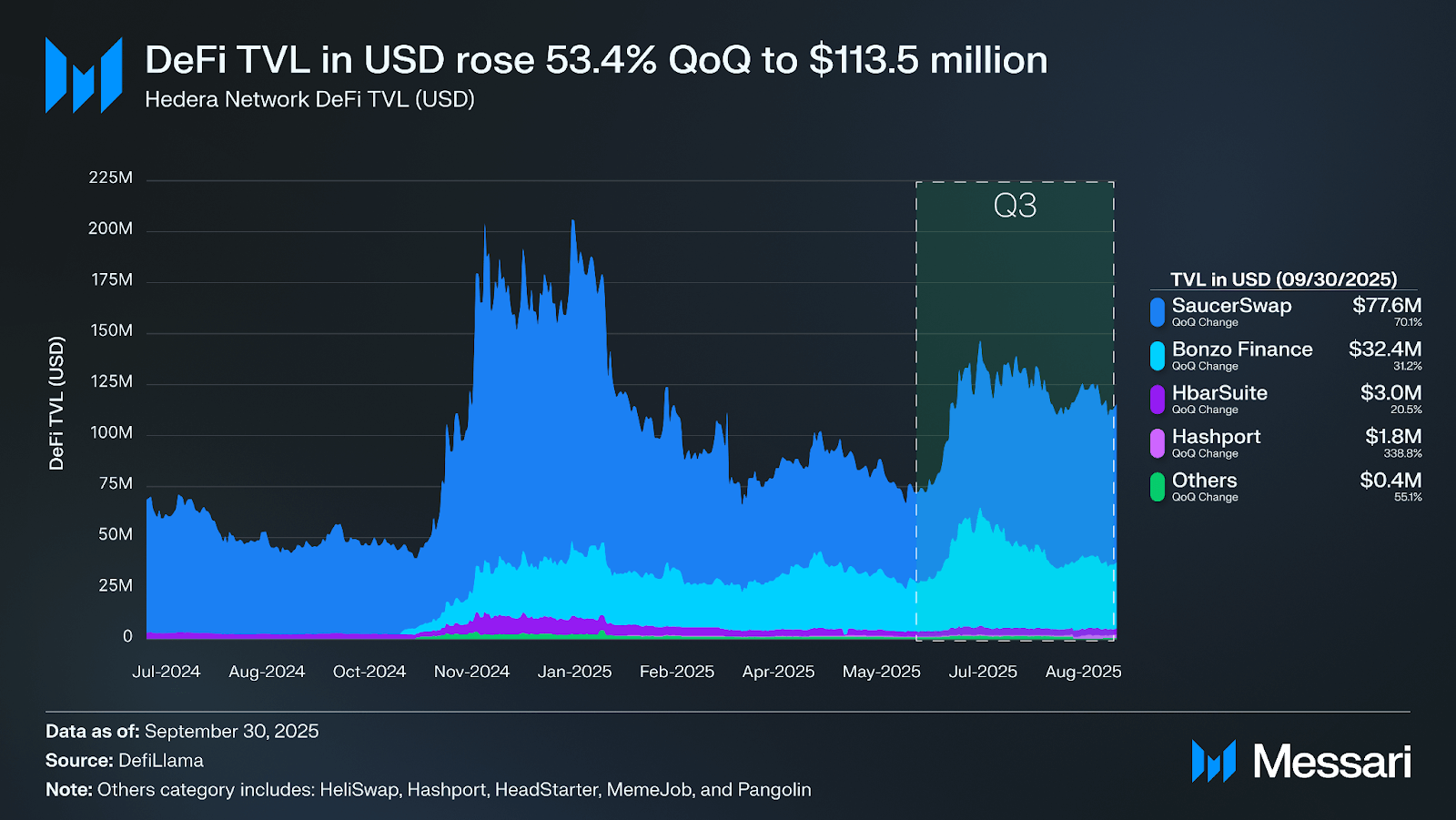
Hedera DeFi TVL in USD rose 53.4% QoQ to $113.5 million in Q3, recovering from its Q2 decline. TVL measured in HBAR terms increased more modestly, rising 7.1% QoQ to 528.0 million HBAR.
SaucerSwap remained the dominant DeFi protocol, growing TVL by 70.1% QoQ to $77.6 million, and accounted for over two-thirds of the network’s total DeFi liquidity. Bonzo Finance also posted strong growth, rising 31.2% QoQ to $32.4 million. HbarSuite TVL increased 20.5% to $3.0 million, while Hashport saw the largest relative increase, surging 339.8% QoQ to $1.8 million. The remaining protocols were grouped into the “Other” category, which totaled $0.4 million, up 55.1% QoQ.
DeFi Diversity remained stable at 3, with SaucerSwap, Bonzo Finance, and HbarSuite continuing to make up the top 90% of TVL. A higher DeFi Diversity score reflects a more even distribution of liquidity and lowers the risk of concentration-driven contagion. As before, liquid staking TVL is excluded from DeFi TVL calculations.
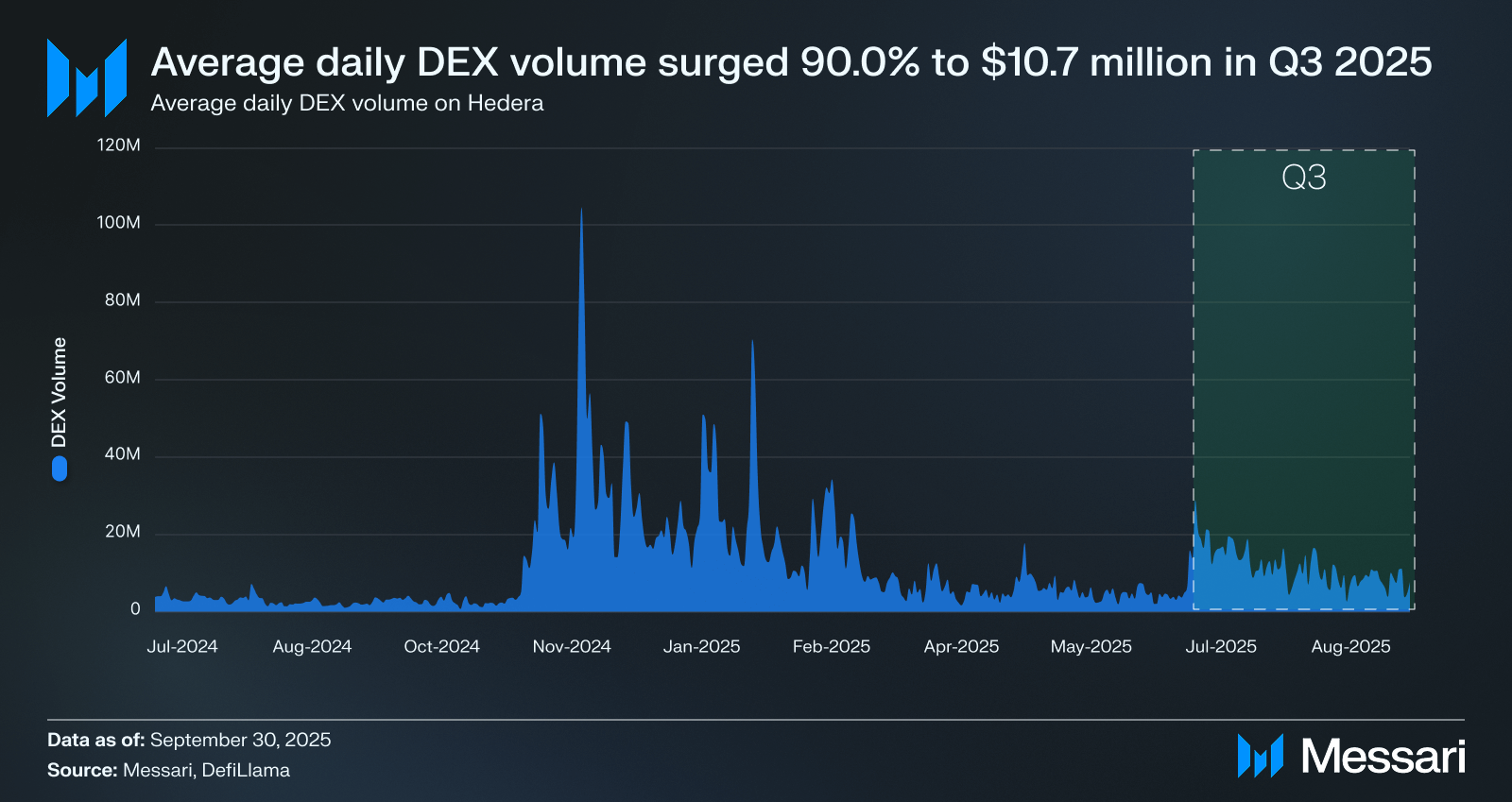
Hedera’s DEX activity rebounded in Q3, with average daily volumes rising 90.0% QoQ to $10.7 million. The recovery follows a steep decline in Q2 and suggests renewed interest in onchain trading. While volumes remain below the highs observed in late 2024, Q3 marked the strongest quarter for DEX activity since Q1 2025.
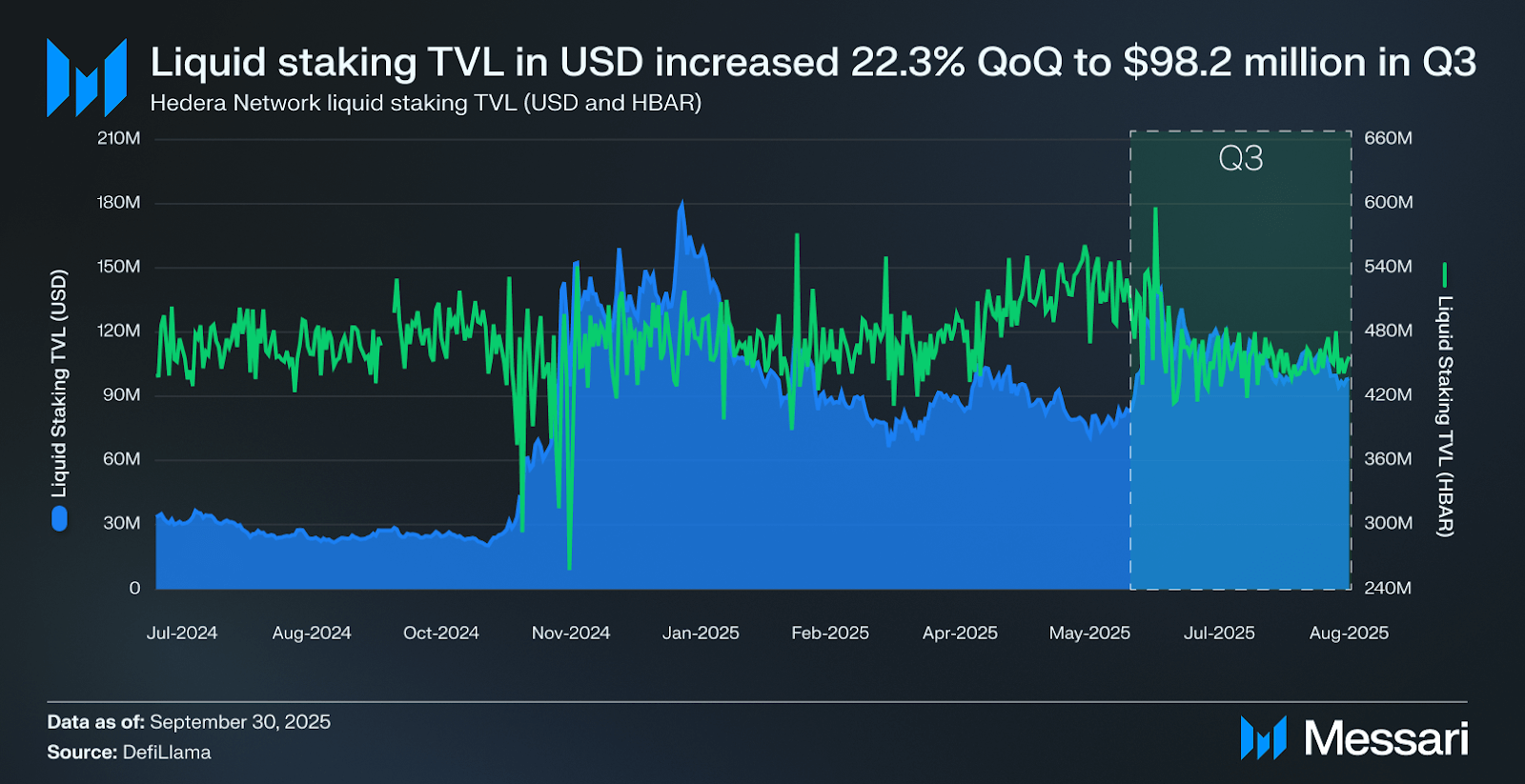
Although liquid staking TVL is not included in the DeFi TVL figure, it remains a relevant metric. Stader is the only liquid staking provider on the Hedera network. Liquid staking TVL in USD increased 22.3% QoQ, from $80.3 million to $98.2 million, primarily due to the appreciation of HBAR, as opposed to new inflows. Liquid staking TVL in HBAR declined 14.6% QoQ, from 535.0 million to 456.9 million HBAR.
Hedera’s onchain stablecoin market cap increased 1.4% QoQ from $113.4 million to $115.0 million in Q3. The increase followed Hedera’s Q2 integration of the Cross‑Chain Transfer Protocol (CCTP), which enabled native USDC transfers from Ethereum to Hedera without third-party bridges.
Network Services Overview
The Hedera Network Services are the core offerings of the Hedera network. These services include the Consensus Service (HCS), Smart Contract Service (HSCS), and Token Service (HTS). The Hashgraph algorithm supports all these services and offers official SDKs for accessing the API in programming languages such as JavaScript, Java, Go, and Swift, as well as community SDKs supporting .NET, Python, and Venin SDK for JavaScript. Usage frequency varies depending on the service, as each has its intended use cases and primary users.
Consensus Service
The Hedera Consensus Service (HCS) enables verifiable time-stamping and ordering of events for Web2 and Web3 applications. Users submit messages to the Hedera Network, where the messages are time-stamped and ordered by the Hashgraph algorithm. These messages form an auditable history of verifiable and trustless events. The Consensus Service is utilized by various applications in several ways, such as tracking supply chain provenance, logging asset transfers between blockchain networks, counting votes in DAOs, monitoring Internet of Things (IoT) devices, and more.
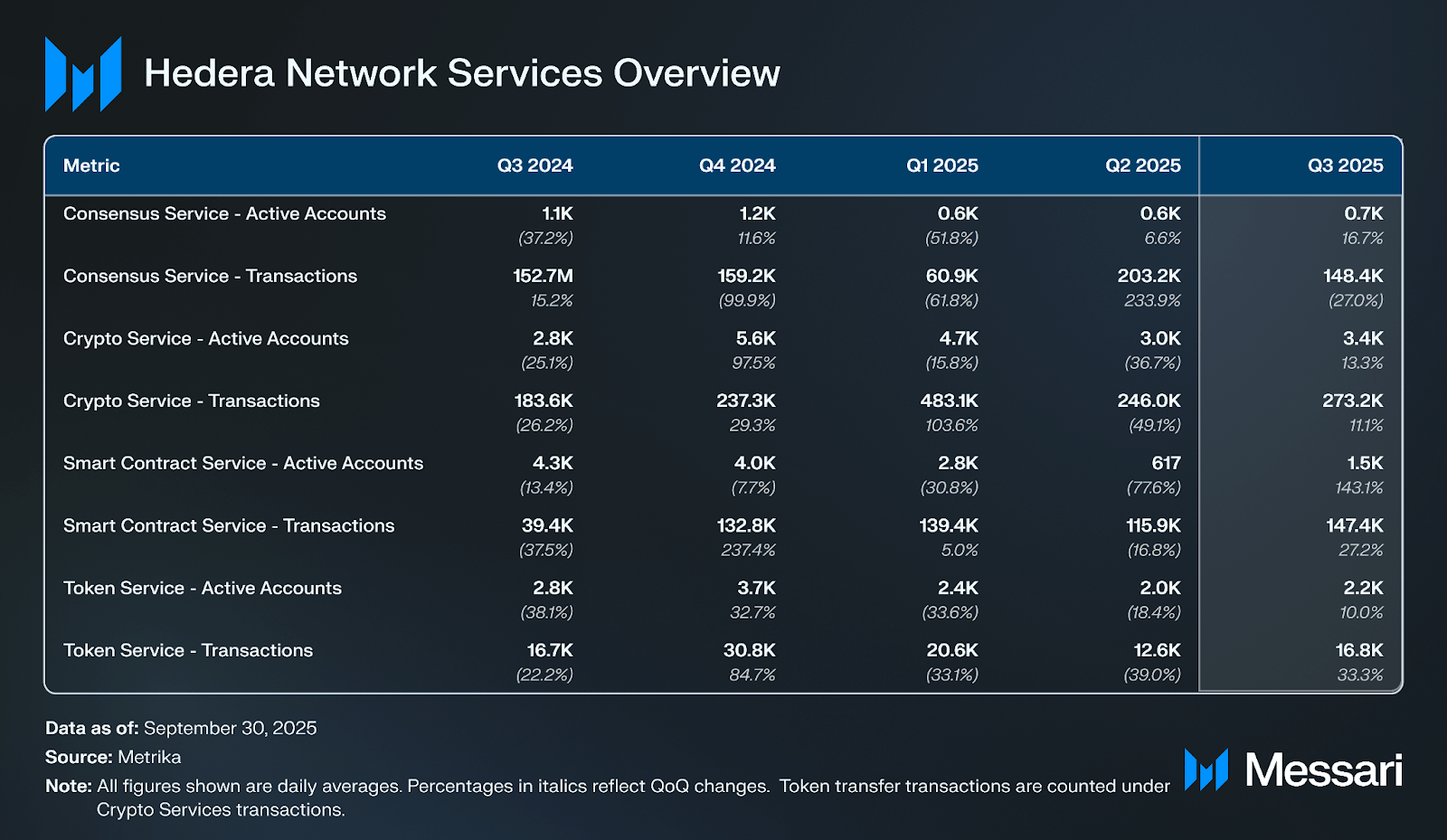
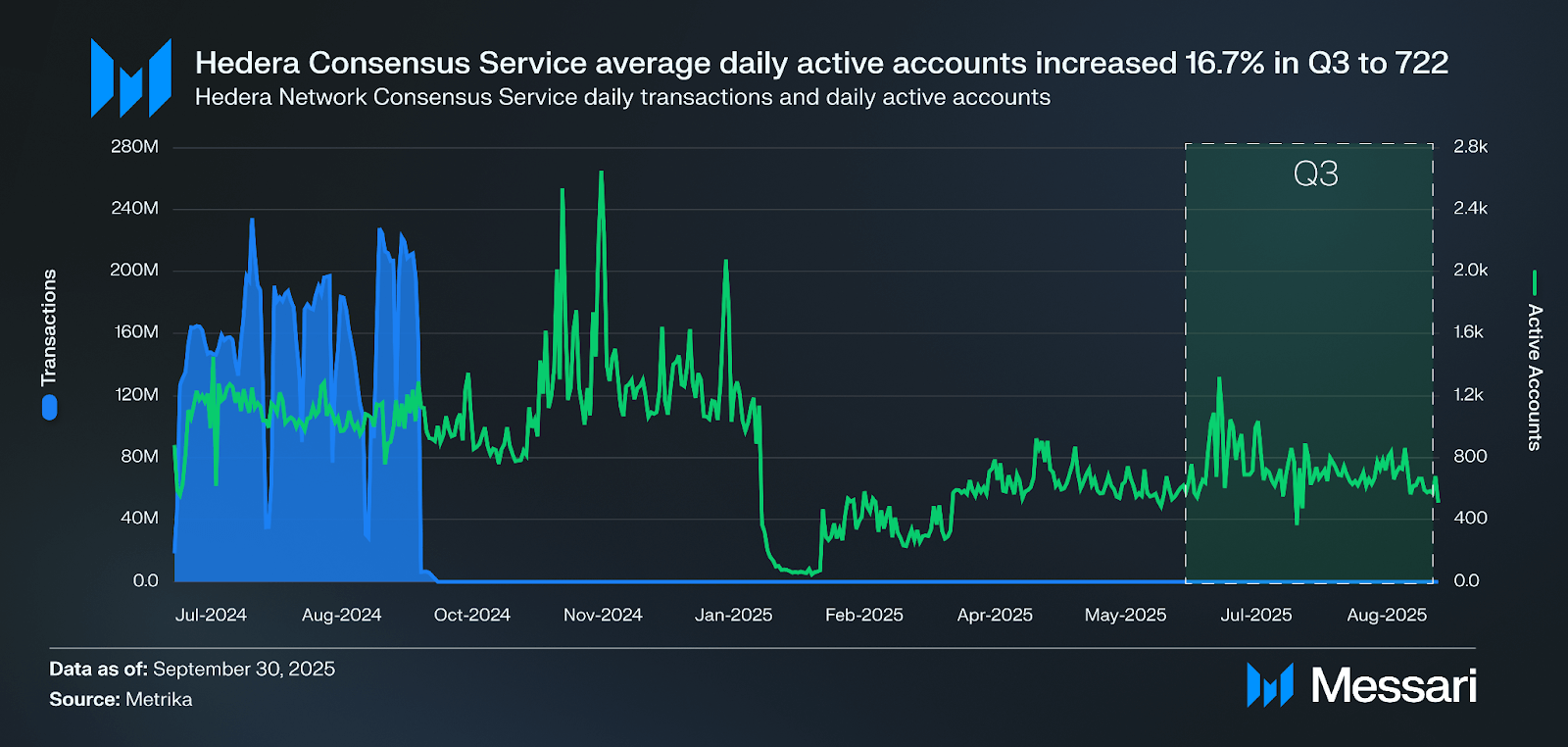
In Q3, average daily transactions on HCS declined 27.0% QoQ, falling from 203,193 to 145,177, reflecting reduced throughput following a surge in Q2 activity. Meanwhile, average daily active accounts increased 16.7% QoQ, from 617 to 723, suggesting that although transaction volumes slowed, user participation and engagement on the network modestly improved throughout the quarter.
Crypto Service
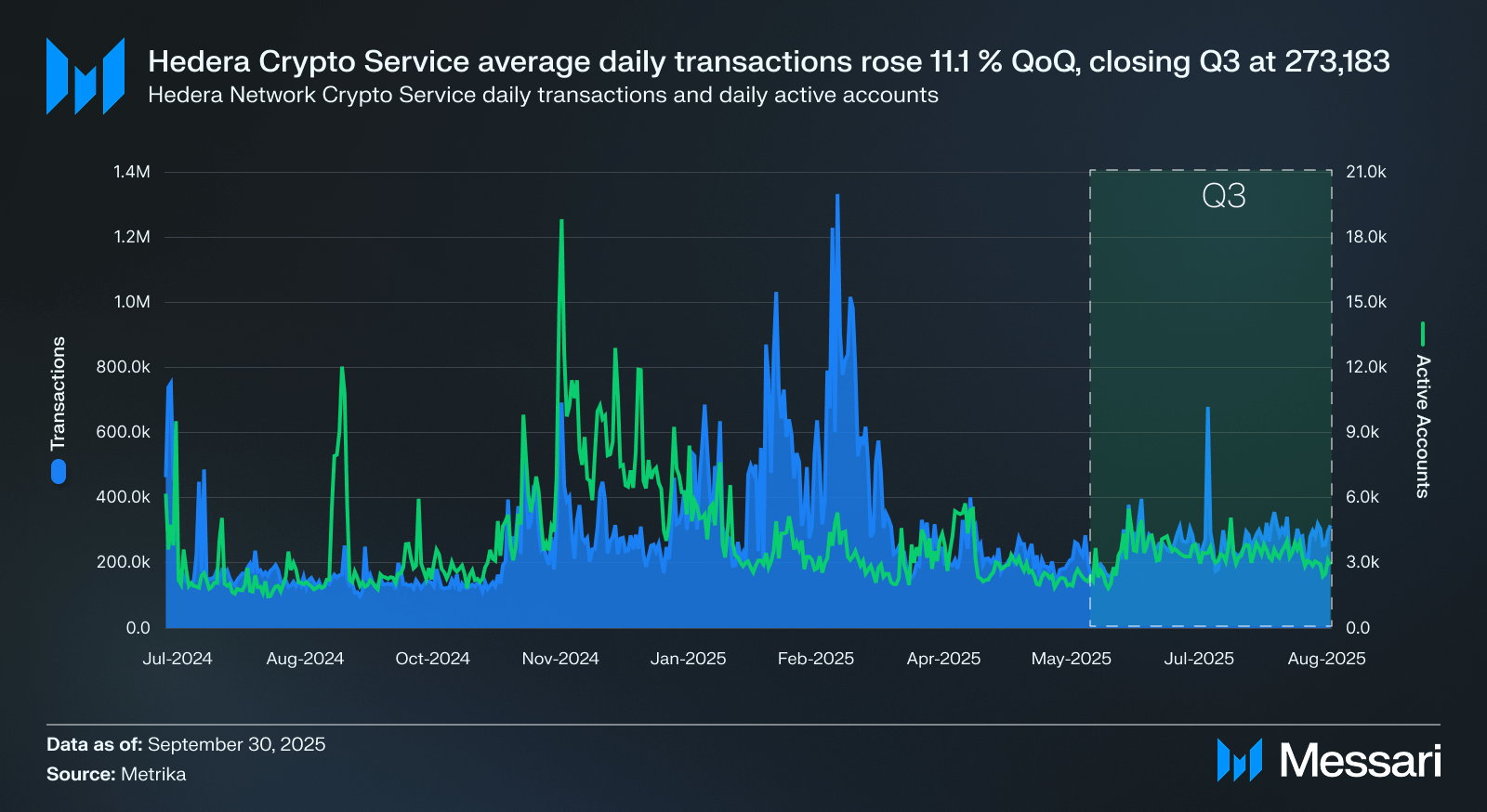
The Hedera Crypto Service (HCS) enables users to perform essential operations on the Hedera Network, including creating and managing accounts, transferring HBAR, fungible, and non-fungible tokens, rotating account keys, and approving account allowances.
Daily average active accounts increased 13.3% QoQ from 2,981 to 3,430, and daily average transactions rose 11.1% QoQ from 246,007 to 273,183.
Smart Contract Service
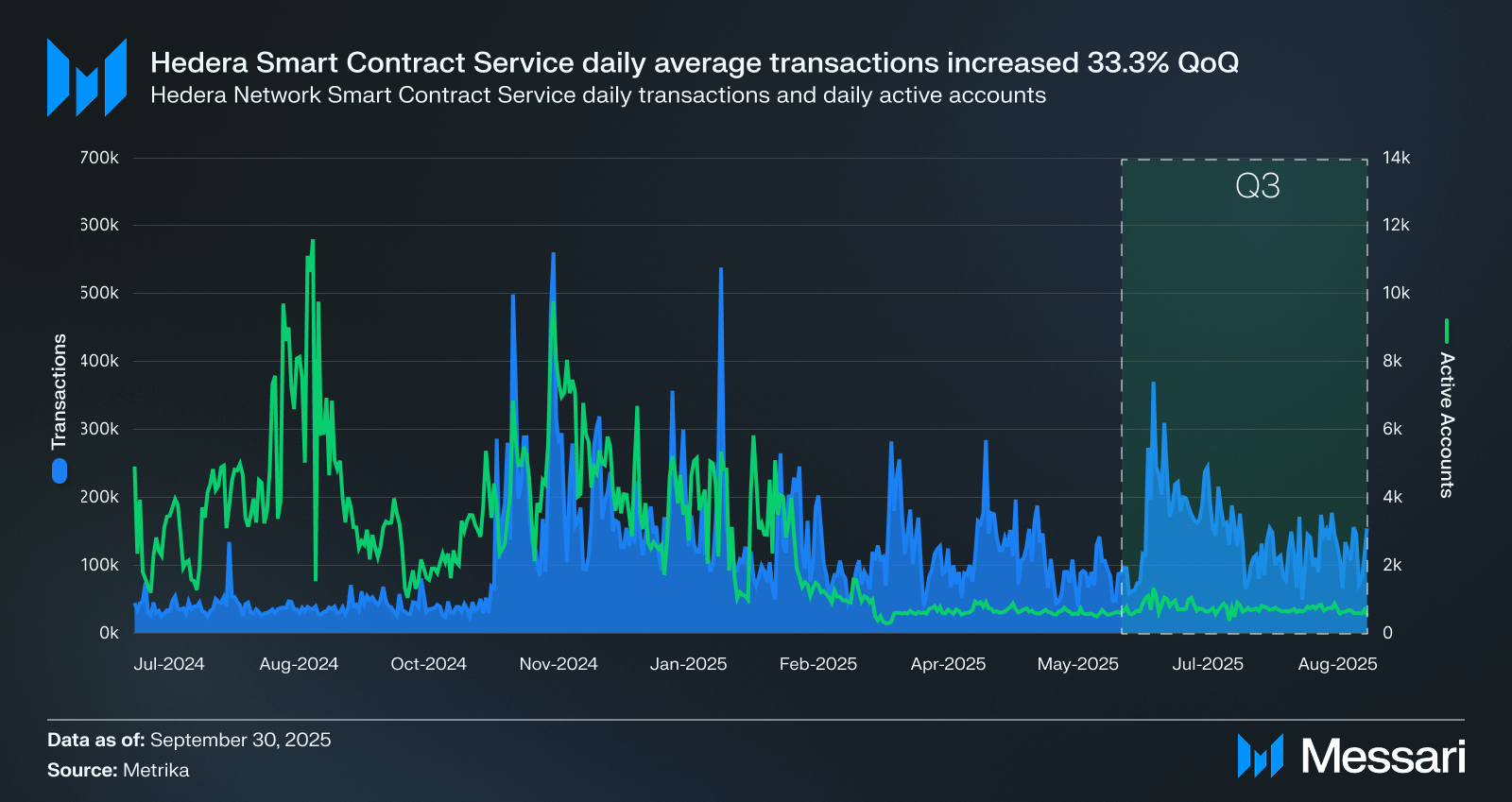
The Hedera Smart Contract Service (HSCS) enables developers to create and deploy smart contracts on Hedera. The service works with the Hedera Token Service to enable users to create and deploy fungible and non-fungible tokens. The service is also EVM-compatible via the HyperLedger Besu EVM client, providing support for Solidity-based smart contracts and core Ethereum tooling.
Daily average active accounts increased 143.1% QoQ from 617 to 1,485, while daily average transactions rose 27.2% QoQ from 115,938 to 147,361.
Token Service
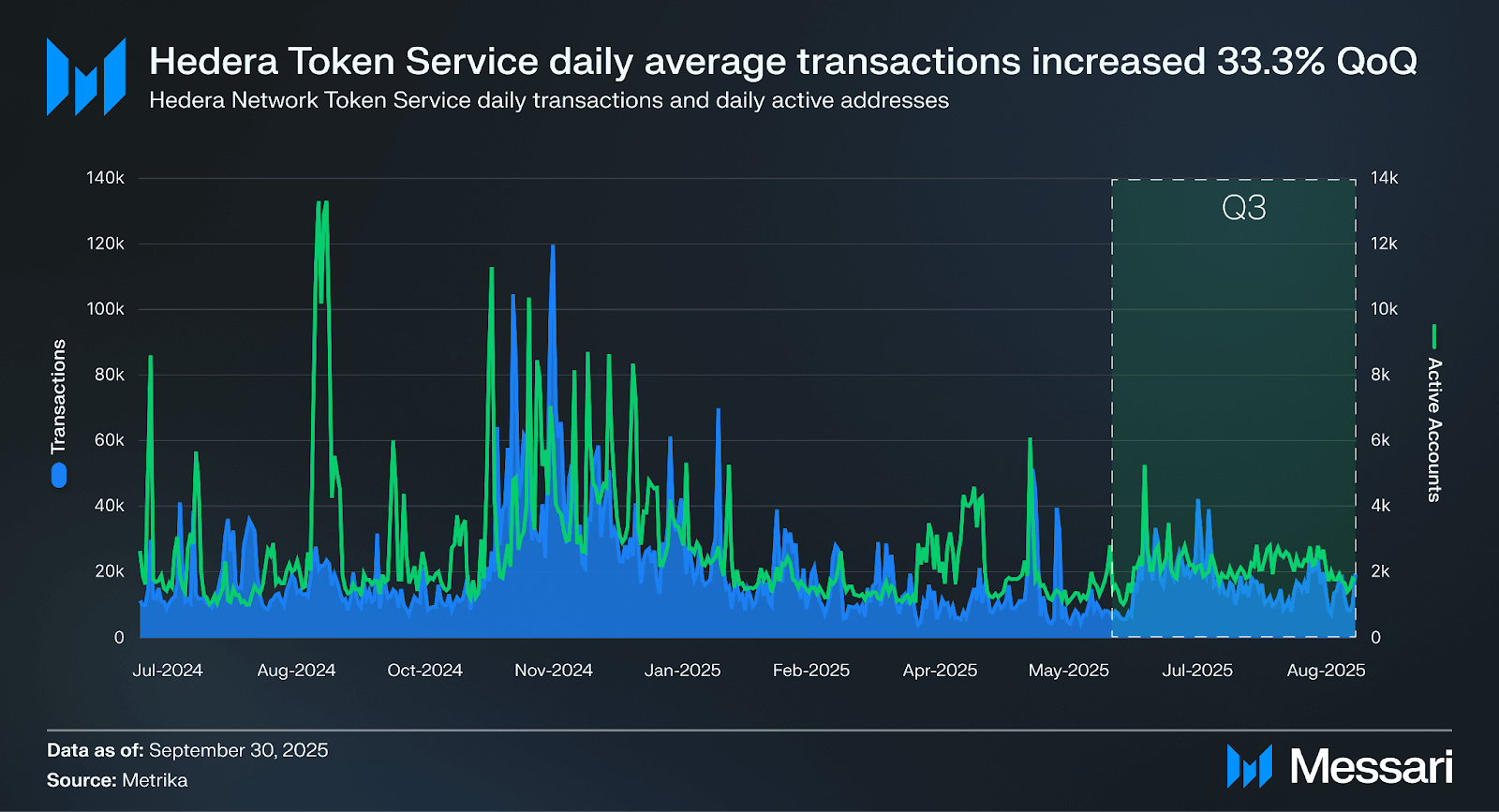
The Hedera Token Service (HTS) allows users to mint and manage custom fungible and non-fungible tokens on Hedera. Tokens issued on Hedera are also configurable with customizable parameters such as account KYC verification, freeze, token supply management, transfer, etc. Token transfers on Hedera have a fixed transaction fee of $0.0001 USD, paid in HBAR.
Daily average transactions for Hedera’s Token Service increased 33.3% QoQ, from 12,552 in Q2 to 16,778 in Q3. Daily average active accounts also rose 10.0% over the same period, from 1,988 to 2,154.
Closing Summary
Hedera closed Q3 2025 with a 43.3% increase in HBAR market capitalization, reaching $9.1 billion, alongside steady protocol development and expanding ecosystem activity. Transaction fees rose modestly in HBAR terms but increased significantly in USD terms due to the token's price appreciation. While average daily transactions remained relatively flat, user engagement improved, with notable growth in active accounts and new account creation. Core network services showed mixed performance, with Crypto, Smart Contract, and Token Services recording gains, while Consensus Service activity declined. Staked HBAR increased slightly, with a growing share allocated to no-rewards staking.
The network implemented three mainnet upgrades during the quarter, which enhanced smart contract execution, state management, and developer tooling. Ecosystem growth was supported by the launch of applications such as SALT and Hedera To Earn, institutional tokenization initiatives from KAIO and Swarm, and integrations with Dfns and Hashport. DeFi activity rebounded, with TVL rising 53.4% to $113.5 million and DEX volumes nearly doubling. Stablecoin market cap grew slightly to $115.0 million, supported by continued USDC inflows via CCTP.
This report was commissioned by Hedera Hashgraph, LLC. All content was produced independently by the author(s) and does not necessarily reflect the opinions of Messari, Inc. or the organization that requested the report. The commissioning organization may have input on the content of the report, but Messari maintains editorial control over the final report to retain data accuracy and objectivity. Author(s) may hold cryptocurrencies named in this report. This report is meant for informational purposes only. It is not meant to serve as investment advice. You should conduct your own research and consult an independent financial, tax, or legal advisor before making any investment decisions. Past performance of any asset is not indicative of future results. Please see our Terms of Service for more information.
No part of this report may be (a) copied, photocopied, duplicated in any form by any means or (b) redistributed without the prior written consent of Messari®.
Alice is a Research Analyst on the Protocol Services team. She previously worked as a Research Analyst at The Block and was an Investment Intern at Variant Fund. Alice graduated from Northwestern University, where she studied Economics.
Alice is a Research Analyst on the Protocol Services team. She previously worked as a Research Analyst at The Block and was an Investment Intern at Variant Fund. Alice graduated from Northwestern University, where she studied Economics.