Transaction volume saw an increase for the fifth consecutive quarter, achieving a new record of 99 million daily average transactions. The Hedera Consensus Service is responsible for 99% of all transactions on the network.
Hedera concluded Q3 with 28 billion HBAR staked, representing 85% of the circulating supply and 56% of the total supply. This high staking percentage is attributed to core entities staking their HBAR allocations to assist validators.
Hedera’s Total Value Locked was $31 million. SaucerSwap expanded its TVL to $27 million, accounting for 87% of Hedera's overall TVL.
The Hedera community rolled out new tools and forged partnerships to enhance its EVM capability. Notable releases include the JSON-RPC codebase, integration with Validation Cloud, the Stablecoin Studio toolkit, and the introduction of HIP-729 to refine contract creation.
Primer on Hedera
Hedera is an open-source, public-permissioned Proof-of-Stake (PoS) blockchain network. It is governed by 29 global organizations, known as the Hedera Governing Council, with input on the network’s features and ecosystem standards from the community via Hedera Improvement Proposals (HIPs). Members of the Governing Council operate Hedera’s validator nodes while the network transitions to fully permissionless node operation. Although Hedera's Network operation is currently permissioned in nature, the division of responsibility across each of the 29 geographically and industry diversified (collusion-proof) council members is unique among public DLTs.
The Hedera Network offers an optimized version of the Besu EVM for smart contracts, alongside a native tokenization service (Hedera Token Service) and high-throughput data writing and verification service (Hedera Consensus Service). These services are known as the Hedera Network Services, which developers can use to build decentralized applications. The network is powered by the Hashgraph Consensus Algorithm, which delivers high throughput, fair ordering, and low-latency consensus for all transactions.
In Q3 2023, despite favorable court rulings for XRP and Grayscale, the overall crypto market experienced a moderate downturn. The total crypto market capitalization decreased by 5.8%, while BTC and ETH fell by 7.5% and 10.0%, respectively.
In contrast, the Hedera Network’s native token, HBAR, exhibited growth during the quarter. The circulating market capitalization of HBAR grew by 7.6% QoQ, concluding the quarter at $1.7 billion. Additionally, HBAR’s fully diluted market capitalization increased by 2.5%, settling at $2.5 billion by the end of the quarter. By the close of Q3 2023, the Hedera Network stood as the 31st largest crypto protocol by its native token’s market capitalization.
Revenue
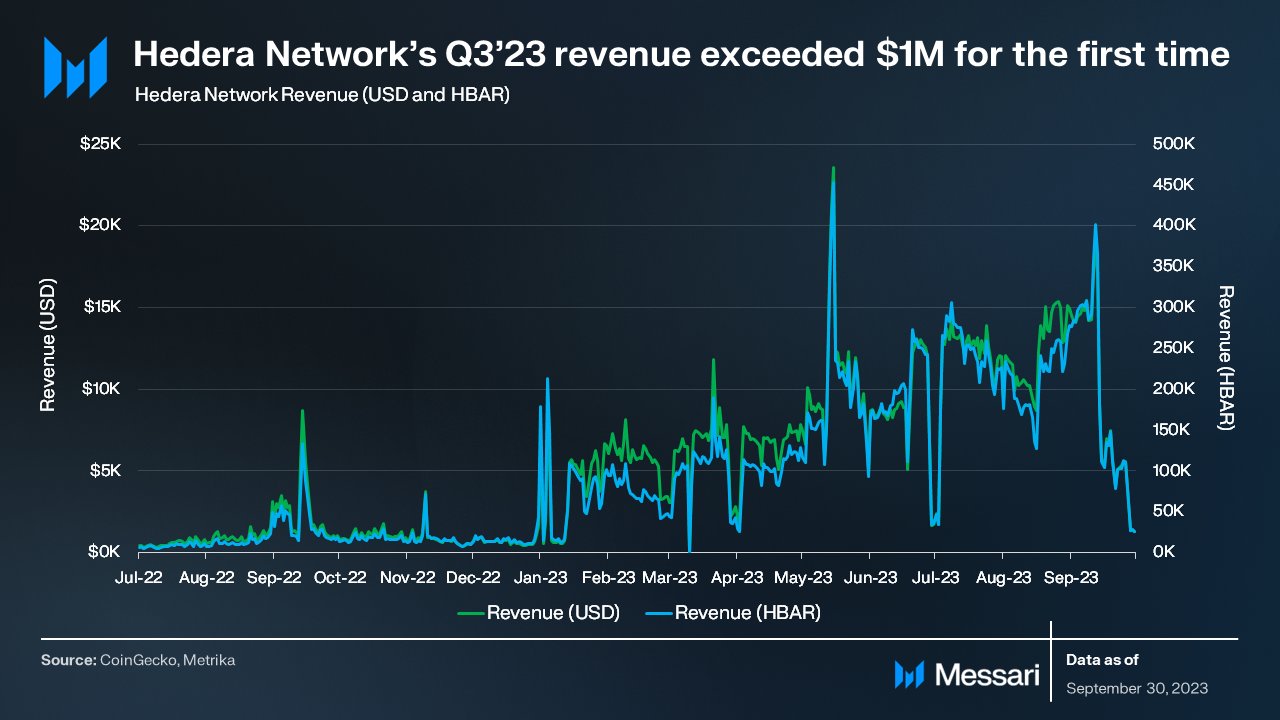
In Q3 2023, the Hedera Network's revenue, derived from network transaction fees, grew by 30% QoQ, crossing the $1.0 million mark for the first time. This rise in revenue was attributed to a 37% quarterly growth in transactions. Dominating this transaction activity was the Hedera Consensus Service, which accounted for more than 99% of total transactions and, consequently, was the principal source of the Hedera Network’s revenue growth. Notably, the growth in revenue was independent of HBAR’s price fluctuations, as HBAR transaction fees are fixed in USD terms.
Supply
HBAR, Hedera's native token, serves multiple purposes within the network. It is utilized for paying network gas fees, paying Hedera Network Services fees, delegating to validators, and securing the network. In the future, the Hedera Network will also enable staking for operating permissionless public validators and rewarding validators.
HBAR has a maximum total supply of 50 billion. As of the end of Q3, 33.4 billion HBAR, representing 67% of the total supply, was in circulation. The distribution of HBAR occurs quarterly and is reported through the Hedera Treasury Management Report. In Q4 2023, the Treasury Management Report forecasts that approximately another 2% of the HBAR total supply will be unlocked.
Network Overview
Usage
In Q2 2023, the Hedera Network established all-time highs in both active and new addresses. The uptick was predominantly attributed to the NFT sector, with the Karateka game hosting several notable events. However, Q3 did not witness any events of a similar magnitude as Karateka. Consequently, the Hedera Network’s address metrics saw QoQ reductions of 38% and 17%, landing at 8,500 daily active addresses and 8,500 daily new addresses, respectively. Nonetheless, these figures surpassed historical averages.
During Q3, the Hedera Network's transaction volume saw an increase for the fifth consecutive quarter, achieving a new record of 99 million daily average transactions. The Hedera Consensus Service remains the predominant source of this activity, responsible for 99% of all transactions on the network. However, a significant drop in transactions was observed towards the quarter's end for unknown reasons.
It's important to note that, despite the surge in transactions, the Hedera Network maintains fixed transaction fees. As such, users are not subjected to rising costs even with the increased network activity.
Development
During Q3 2023, the Hedera Network observed a decrease in active smart contracts for the second successive quarter. The peak reached 158 daily active smart contracts in Q1 2023 but declined to an average of 94 daily active smart contracts by Q3 2023.
Despite this decline, the Hedera community has maintained a strong emphasis on bolstering developer tools and collaborations throughout the year. In Q1 2023, Arkhia launched a comprehensive suite of tools that eased the development and deployment of smart contracts on the network. The second quarter highlighted the Hedera community's goal to achieve Ethereum Virtual Machine (EVM) equivalence.
In Q3, significant progress was made in this direction. The Hedera community introduced new developer-focused features and integrated the JSON-RPC codebase. This integration allows developers to employ widely used EVM tools, enhancing the Hedera Network's compatibility with EVM networks. Within the same period, Validation Cloud integrated its services with the Hedera Network. Moreover, the Hedera community introduced HIP-729, refining contract creation transactions to more closely align with EVM equivalence.
Decentralization and Security
The Hedera Governing Council is a group of organizations dedicated to supporting the growth and development of the Hedera Network, including the operation of Hedera validator nodes. In Q1, Dell Technologies joined as the 28th member, and in the second quarter, COFRA joined as the 29th member.
As Hedera's Network expands, the Governing Council anticipates more public nodes to bolster its infrastructure. Council members serve three-year terms, limited to two consecutive terms, and possess equal voting rights on network and platform decisions. Swirlds, the creator of Hashgraph, maintains a permanent Council seat but has an equal vote in decision making and lacks additional privileges.
The Council primarily focuses on governance for network stability and Hedera Treasury management through various committees:
TechCom: Oversees and provides insights on the Hedera Network's technological functionality, stability, and security.
MemCom: Guides strategic decisions concerning Council membership, encompassing recruitment, selection methods, policies, and retention.
CoinCom: Counsels the Council on treasury management, network pricing, and economic incentive structures, encompassing staking and node operations.
CorpCom: Aids Members in identifying Hedera Network use cases and orchestrates Council-wide collaboration on market entry strategies.
RegCom: Addresses public policy and regulatory matters impacting the Hedera Network, Council operations, or Member interactions with the network.
MarCom: Supervises and advises the Council on marketing, public relations, and outreach initiatives.
During the third quarter, Hedera Hashgraph, LLC’s Board of Directors approved Andrew Aitken as the Chief Open Source Officer. The Board also made the strategic decision to bifurcate the roles of Chair and President. Brett McDowell, presently holding both titles, has been chosen again to serve as Chair for an extended two-year term.
Hedera Network validator nodes are run by the Governing Council members. Of the 29 council members operating validator nodes, there are 27 service providers (93%).
The geographical distribution of the Hedera Network's validators is also balanced. North America is home to 10 of the 29 validators, accounting for 34.48%. Both Asia and Europe have eight validators each, each constituting 27.59% of the total.
In Q3 2023, the Hedera Network reported 28 billion HBAR staked, which represents 85% of the circulating supply and 56% of the total supply. This high staking percentage relative to the circulating supply can be attributed to entities such as HBAR Foundation, Swirlds, and Swirlds Labs. They are staking their HBAR allocations and the Hedera Treasury to assist validators in meeting the minimum staking threshold to participate in network consensus. Notably, these entities have chosen not to collect staking rewards.
Only 26% of staked HBAR opted to receive rewards. During Q3, the Hedera Governing Council made modifications to the staking rewards structure. The prior staking reward rate of 6.5% was adjusted to 2.5% in August. Furthermore, the highest quantity of coins that can be staked and qualify for the full 2.5% reward rate is set at 13% of the total 50B HBAR supply, which is equivalent to 6.5B HBAR. Should the total staked amount exceed 13% of the overall supply, the reward rate will proportionally decrease.
Ecosystem Overview
DeFi
The Hedera Network concluded Q3 2023 with a TVL of $31 million, marking a 29% increase from the previous quarter. Despite the QoQ growth, the Hedera Network's TVL has remained relatively consistent year-to-date. By the end of Q3, the Hedera Network secured approximately the 40th position in terms of TVL among blockchain networks. Notably, the Hedera Network's YoY TVL growth stands at 75%, which surpasses the broader market that witnessed a reduction in TVL during the same time frame.
The rise in TVL during a bear market is attributed to the debut of new protocols. SaucerSwap, the first to launch, has retained its lead in the Hedera ecosystem. By the end of the third quarter, SaucerSwap's TVL was $27 million, making up 87% of the Hedera Network's total TVL. Following SaucerSwap, HeliSwap had a TVL of $4 million, and Pangolin registered at $110,000. Notably, Pangolin, which started in Q1 and once held 27% of the ecosystem's TVL, concluded Q3 with less than 1% of TVL.
DeFi Diversity measures the number of protocols that constitute the top 90% of DeFi TVL. A greater distribution of TVL across protocols reduces the risk of widespread ecosystem contagion resulting from adverse events like exploits or protocol migrations. The Hedera Network ended Q3 with a DeFi diversity at 2.
Liquid staking is not included in the TVL figure. Despite this, it remains a relevant metric with growing significance. Stader is the only provider of liquid staking on the Hedera Network. Upon the introduction of the Hedera Network's staking program, Stader's TVL reached its highest in Q1. Following this peak, there has been a gradual decline in Stader's TVL over two quarters, concluding Q3 at $21 million.
In the third quarter, the Hedera Network's average daily DEX trading volume was $500,000, a 16% increase from the previous quarter. In alignment with the TVL distribution, SaucerSwap dominates DEX trading volume on the Hedera Network, accounting for 90% of the activity, with HeliSwap coming next.
In Q3, the Hedera Network's stablecoin market cap maintained its position, ending the quarter at a market cap of $3.6 million. USDC stands as the only stablecoin available on Hedera. The market cap for USDC on the Hedera Network peaked in mid-2022 and has consistently receded since then, mirroring the trajectory observed in the broader crypto stablecoin market cap. As of the end of Q3, the Hedera Network was ranked approximately 50th in stablecoin coin market cap among blockchain networks.
The period also marked some significant developments in the Hedera stablecoin sector. Shinhan Bank, SCB TechX, and a major Taiwan-based financial institution successfully completed a stablecoin remittance proof-of-concept pilot on the Hedera Network. The PoC achieved real-time settlement and foreign exchange rate integration for Thai Baht, New Taiwan dollar, and South Korean won. In addition, Hedera developers, alongside Swirlds Labs, The HBAR Foundation, and ioBuilders, introduced the Stablecoin Studio, an open-source SDK designed to simplify stablecoin issuance and management. The SDK offers a set of tools assisting organizations in launching and maintaining applications integrated with stablecoins.
Additionally, Fresh Supply Co (FSCO), which migrated to Hedera from the private Mastercard Provenance (MP) blockchain, announced that it has integrated Hedera into its Continuity payment trigger API. Through the Continuity API, Hedera can now connect to ACH (bank-to-bank payments), the Mastercard network, and soon the Mastercard Payment Gateway Services (MPGS) that focuses on serving online use cases like e-commerce, as well as other forthcoming Mastercard Web3 and digital asset products.
NFTs and Gaming
In Q2 2023, the Hedera Network experienced significant NFT activity due to two key events. First, Karate introduced its KARATE token, mobile application, and NFT collection, which culminated in approximately 250,000 transactions within a two-day span. Second, the HashPack Wallet conducted the HashPack NFT sale, resulting in a peak of 10,000 active NFT addresses in a single day.
In response to rising storage costs on validator nodes, particularly during bulk minting, the Hedera Governing Council revised the fee structure for NFT minting. With the v0.41 upgrade, the cost for minting an individual NFT was reduced to $0.02 from $0.05, and the cost for bulk minting 10,000 NFTs increased to $200 from $76.80.
Throughout Q3, the number of active NFT addresses on the Hedera Network grew, averaging 1,300 daily active NFT addresses, marking a 162% QoQ increase, while the number of transactions decreased by 33%, equating to 5,900 daily transactions.
Additionally, in Q3, the HBAR Foundation revealed its collaboration with the new game, Legends of the Past. Developed by former Ubisoft, Supercell, and Tap4Fun employees, this mobile game will utilize the Hedera Token Service for in-game item tokenization and for the generation of the LOP token. Calaxy, Spencer Dinwiddy's social app, launched on the Hedera Network in August. The platform now features creators like Luis Suarez, Logan Chitwood, and Mickie James, with more celebrities, such as Teyana Taylor and Ezekiel Elliott, set to join soon.
ESG
In August, Hyundai Motor Company and Kia Corporation introduced an AI-enabled, blockchain-based Supplier CO2 Emission Monitoring System (SCEMS) to manage the carbon emissions of business partners, utilizing the Hedera Network. Hyundai Motor and Kia ultimately aim to tackle climate change issues by preemptively meeting local and global environmental regulations and establishing sustainable supply chains within the companies and with their cooperative partners.
In September, ServiceNow launched the ServiceNow ESG ReFi application, which empowers companies, organizations, and their ecosystems to generate climate assets by integrating with the Hedera Guardian open-source tokenization engine. This integration utilizes the Hedera Network to track climate assets and individual token provenance.
Also in September, ALLCOT IO, the digital arm of climate leader and project developer ALLCOT, announced it is onboarding ALLCOT’s 500 million metric tonne portfolio of carbon credits to the Hedera Guardian ecosystem, opening the books on climate finance through Digital Measurement, Verification & Reporting (dMRV) of climate assets.
Network Services Overview
The Hedera Network Services are the core offerings of the Hedera Network. These services include the Consensus Service, Crypto Service, Smart Contract Service, and Token Service, all of which are supported by the Hashgraph algorithm and offer official SDKs for accessing the API in programming languages such as JavaScript, Java, Go and Swift, and community SDKs supporting .NET and Venin SDK or JavaScript. Each service has its intended use and primary users, and usage frequency varies depending on the service.
Consensus Service
The Hedera Consensus Service enables the verifiable time-stamping and ordering of events for Web2 and Web3 applications. Users submit messages to the Hedera Network, where the messages are time-stamped and ordered by the Hashgraph algorithm. These messages are used to form an auditable history of verifiable and trustless events. The Consensus Service is utilized by various applications such as tracking supply chain provenance, logging asset transfers between blockchain networks, counting votes in a decentralized autonomous organization (DAO), monitoring Internet of Things (IoT) devices, and more.
In the past year, the Hedera Consensus Service witnessed remarkable growth. During Q3, active addresses remained unchanged. However, there was a 37% QoQ increase in transactions, indicating that current users of the Consensus Service have elevated their usage.
Crypto Service
The Hedera Crypto Service enables users to perform basic operations on the Hedera Network. These operations include transferring HBAR, fungible, and non-fungible tokens, creating and updating accounts, clearing accounts, and approving account allowances.
After a notable increase in active addresses in Q2 2023, attributed to the Karate Combat app launch in May, Q3 witnessed a reduction. Both active addresses and transactions experienced approximately a 40% decline, bringing the metrics back to their previous baseline levels.
Smart Contract Service
The Hedera Smart Contract Service enables developers to create and deploy smart contracts on Hedera. The service works with the Hedera Token Service to enable users to create and deploy fungible and non-fungible tokens. The service is also EVM-compatible via the HyperLedger Besu EVM client, providing support for Solidity-based smart contracts and core Ethereum tooling.
In response to a security incident in March 2023, the Hedera Network's core developers took steps to bolster the security of the Smart Contract Service. By the third quarter, these revisions ensured account key signatures no longer authorize contract actions; smart contracts can only modify their own storage or that of delegate calls made to them. Furthermore, the Hedera community released developer-focused products and announced partnerships aimed at enhancing EVM tooling and compatibility, as detailed in the report's development section.
Token Service
The Hedera Token Service allows users to mint and manage custom fungible and non-fungible tokens on Hedera. Tokens issued on Hedera are also configurable with customizable parameters such as account KYC verification, freeze, token supply management, transfer, and more. Token transfers on Hedera always cost a transaction fee of $0.0001 USD, paid in HBAR.
During Q2, the HBAR Foundation sponsored an integration with D'CENT, a prominent blockchain hardware wallet in Korea. As a result of this integration, users can fully leverage Token Service features including token burn, minting, and freezing. However, despite this development, the activity associated with the Hedera Token Service remained consistent QoQ and matched the trends observed in the first half of 2023.
Closing Summary
In Q3'23, amidst a challenging crypto climate, Hedera demonstrated notable growth. While BTC and ETH experienced declines of 7.5% and 10%, HBAR's circulating market capitalization rose by 7.6% QoQ. This performance positioned HBAR as the 31st largest crypto protocol by market capitalization at the end of the quarter. Key financial and network metrics, including a record-setting 99 million daily average transactions — the fifth consecutive quarterly increase — contributed to this growth. The transaction surge subsequently led to a record in network revenue, as Hedera's revenue surpassed $1 million for the first time.
Hedera also continued rolling out new tools and forged partnerships to enhance its EVM capability. Notable releases include the JSON-RPC codebase, integration with Validation Cloud, the Stablecoin Studio toolkit, and the introduction of HIP-729 to refine contract creation.
Moving forward, Hedera's focus remains on sustaining its positive network growth trajectory. However, it's essential to recognize the vast competition Hedera faces from other base layers in crypto.
This report was commissioned by Hedera Hashgraph, LLC. All content was produced independently by the author(s) and does not necessarily reflect the opinions of Messari, Inc. or the organization that requested the report. The commissioning organization may have input on the content of the report, but Messari maintains editorial control over the final report to retain data accuracy and objectivity. Author(s) may hold cryptocurrencies named in this report. This report is meant for informational purposes only. It is not meant to serve as investment advice. You should conduct your own research and consult an independent financial, tax, or legal advisor before making any investment decisions. Past performance of any asset is not indicative of future results. Please see our Terms of Service for more information.
No part of this report may be (a) copied, photocopied, duplicated in any form by any means or (b) redistributed without the prior written consent of Messari®.