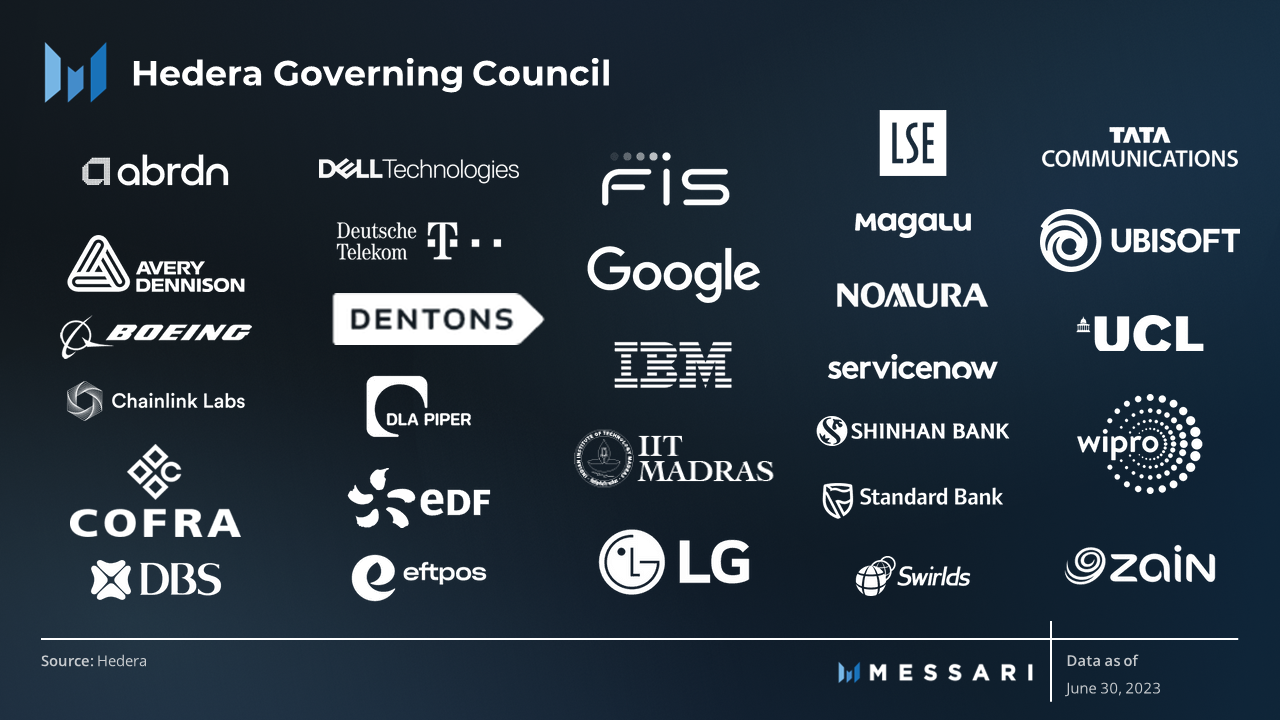
COFRA became the 29th member of the Hedera Governing Council. The Council consists of organizations that are dedicated to advancing the growth and development of Hedera, which includes operating Hedera's validator nodes.
There was consistent growth and adoption across all Hedera Network Services. The Hedera Consensus Service is the fastest growing of the Network Services.
The increase in Hedera network usage was primarily driven by NFTs. This is a shift from previous quarters where DeFi was the main driver.
Hedera announced a strategy for EVM equivalence. A key contribution to this strategy has been made by Swirlds Labs, which developed a Hedera-specific JSON-RPC Relay codebase, known as Hashio. This will pave the way for Solidity and Vyper smart contracts functionality on the Hedera network.
Primer on Hedera
Hedera is a public-permissioned leaderless Proof-of-Stake (PoS) blockchain network. It is governed by 29 global organizations, known as the Hedera Governing Council, with input from the community via Hedera Improvement Proposals (HIPs). Members of the Governing Council operate Hedera’s validator nodes while the network transitions to permissionless node hosting. Although Hedera's network operation is currently permissioned in nature, the division of responsibility across each of the 29 geographically and industry diversified (collusion-proof) council members is unique among public DLTs. This governance structure physically prevents aggregation of hash rate or stake to the same point that is threatening the security of other public ledgers.
Hedera offers developers core services, known as the Hedera Network Services, to build decentralized applications. The network is powered by the Hashgraph Consensus Algorithm, which offers high throughput, fair ordering, and low-latency consensus.
In Q2 2023, Hedera's market capitalization dropped by 22%, reaching $1.54 billion. The decline in market capitalization was influenced by external factors, including the SEC's complaints against Binance and Coinbase. Hedera ended Q2 ranked as the thirty-second largest crypto protocol by market capitalization.
Hedera's revenue, which represents the total fees spent on the network, experienced a significant increase of 67% QoQ, rising from $476,000 to $794,000. This growth in revenue was primarily driven by the surge in activity within the Hedera Consensus Service.
HBAR Token
HBAR, Hedera's native token, serves multiple purposes within the network. It is utilized for paying network gas fees, paying Hedera Network Services fees, delegating to validators, and securing the network In the future, Hedera will also enable staking for operating permission-less public validators and rewarding validators.
HBAR has a maximum total supply of 50 billion. As of the end of Q2, 32.2 billion HBAR, representing 64% of the total supply, was in circulation. The distribution of HBAR occurs quarterly through the Hedera Treasury, following a schedule that extends until 2025. In Q3 2023, another 3.7% of the HBAR total supply will be unlocked to support ecosystem programs, investors, and core contributors.
Network Overview
Usage
During the second quarter of 2023, Hedera experienced consistent and substantial growth in terms of account-related figures. Year to date, there has been a rise of 288% in Hedera's average daily active accounts, growing from 3,500 to 13,500 by Q2 2023. Concurrently, there was a 340% jump in the average daily creation of new accounts, growing from 2,300 to 10,200 in the same period.
The upsurge in account-related metrics during Q4 2022 and Q1 2023 was largely due to the introduction of new Decentralized Exchanges (DEXs) on the network. In contrast, the growth spurt in Q2 2023 was propelled by NFTs. The main driver of NFT activity was Karateka, which launched its KARATE token, mobile application, and NFT collection.
Analogous to the growth in account-related statistics, Hedera's transaction activity has experienced a multi-fold surge since Q4 2022. By Q2 2023, Hedera was processing an average of 72 million transactions on a daily basis. Notably, the Hedera Consensus Service contributes 99% to this total transaction count. Hedera Consensus Service transactions are transaction-based and do not log consensus-related events.
Development
The Hedera ecosystem has invested in product launches and partnerships over the past few quarters to bolster developer activity on its network. These include:
In February 2022, the introduction of Smart Contracts 2.0. This update brought in EVM compatibility, support for Solidity-based smart contracts, and core Ethereum tooling, leading to consistent growth of the service.
In Q1 2023, Arkhia unveiled a complete suite of developer tools that facilitates the development and deployment of smart contracts on the network.
The focus on developers was carried into Q2 2023 with several key initiatives:
A partnership between the HBAR Foundation and Tribe to host a series of educational programs, helping developers to understand and construct in Web3.
Joget Inc, a firm specializing in open-source no-code/low-code platforms, introduced the Hashgraph Application Studio, simplifying decentralized application development within the Hedera ecosystem.
Tuum Technologies released Identity Snap on Metamask, an advanced plugin for developers aiming to develop Digital Identifiers (DIDs) and Verifiable Credentials (VCs) on Hedera.
A collaborative effort with Google Cloud’s Web3 startup program, where Hedera offers numerous benefits to startups, such as up to $200,000 USD in Google Cloud credits over two years, funding from The HBAR Foundation, technical and collaboration support, early access to Google Cloud Web3 products and roadmap, as well as access to learning labs, Google Cloud courses, and Web3 community events.
The most significant developer announcement in Q2 was the reveal of Hedera's strategy for achieving Ethereum Virtual Machine (EVM) equivalence. The team provided insights into their approach for amalgamating the HyperLedger Besu EVM client with Hedera's native services. This integration will bring the functionality of Solidity and Vyper smart contracts to the Hedera network.
Swirlds Labs has made a significant contribution to this process by developing an open-source Hedera-specific JSON-RPC Relay codebase. The Swirlds Labs “community service” implementation is named Hashio, and commercial providers Arkhia and Validation Cloud are providing commercial offerings for JSON-RPC. This innovation facilitates the integration of existing EVM development environments and wallets with the Hedera platform. Moreover, Hedera has successfully merged its native services, such as the Hedera Token Service and Hedera Consensus Service, into the EVM.
Through the first half of 2023, Hedera is averaging 150 daily active smart contracts.
Governing Council
The Hedera Governing Council is a group of organizations dedicated to supporting the growth and development of Hedera, including the operation of Hedera validator nodes. In Q1, the Council welcomed its 28th member, Dell Technologies. In Q2, the Council welcomed its 29th member, COFRA. With a maximum of 39 members, each holding an equal vote in Hedera's decision-making process, the Council aims for balanced governance.
As Hedera's network expands, Hedera anticipates more public nodes to bolster its infrastructure. Council members serve three-year terms, limited to two consecutive terms, and possess equal voting rights on network and platform decisions. Swirlds, the creator of Hashgraph, maintains a permanent Council seat but lacks additional privileges. The Council primarily focuses on governance for network stability and Hedera Treasury management.
The Council holds a monthly meeting and publishes minutes from the meeting:
April meeting- The Council members approved the COFRA Group as the 29th Council member and the March 8, 2023 meeting minutes and voted to form the Marketing Committee, contingent upon Council’s election of two Marketing Committee Co-Chairs, and approved the Marketing Committee’s charter as presented at the meeting.
May meeting - Hosted in-person at Google’s headquarters, the Council members approved the April 12, 2023 meeting minutes and the allocation of 3.735 billion HBAR to fulfill existing contractual obligations for token purchase agreements, network governance and operations, and ecosystem and open-source development and voted to appoint Shuchi Rana and Ian Jebbit as Co-Chairs of the Marketing Committee, with each serving a term of May 17, 2023 through December 31, 2024.
June meeting- The Council members approved the development and implementation of certain changes to the staking rewards algorithm as presented at the meeting.
Hedera Improvement Proposals (HIPs)
HIP-513: Smart Contract Traceability Extension - Enabling mirror nodes to download traceability info only if they need or want to process it. Enabling full replay of smart contract service transactions will improve the usability, auditability, and debuggability of smart contract service transactions.
HIP-584: Mirror EVM Archive Node- Describes EVM execution APIs on the mirror node and transaction simulations. The HIP also describes initial Mirror Node APIs that will handle contract execution-related queries, thus allowing the Mirror Node to serve the role of an EVM Archive Node.
HIP-719: Associate and Dissociate Tokens via Facade Contract - HIP-218 proposed a way to enable treating HTS tokens in an equivalent manner to ERC-20 and ERC-721 tokens by creating a proxy redirect facade contract. This proposal extends this functionality to include the HTS "associate," "dissociate," and "isAssociated" functions.
Validators
As of Q2 2023, Hedera operates as a public permissioned network, with the Governing Council members running its validator nodes. Despite the permissioned nature of its network operations, there's notable distribution among the council members and their validators across various service providers, geographical regions, and industries.
Out of the 29 council members who operate validator nodes, there are 27 service providers, constituting 93% of the total. Moreover, no single service provider holds more than 7% of the total stake.
Hedera's validators are well distributed geographically. Of the 29 validators, North America hosts ten, making up 34.48% of the total. These are located across various states including Washington, Pennsylvania, North Carolina, New Jersey, Michigan, Florida, and California. Asia and Europe each accommodate eight validators, contributing 27.59% individually. Key cities housing these validators encompass Tokyo, Seoul, Singapore, Paris, Nuremberg, London, Frankfurt, and Helsinki. Furthermore, South America, Oceania, and Africa each have one validator, adding 3.45% apiece to the total validator count.
Staking
A significant milestone for Hedera in 2022 was the introduction of staking. In June 2022, the Hedera Improvement Proposal (HIP-406) laid the groundwork for staking to be implemented on the network. Over the subsequent months, the first three phases of staking were launched, allowing users to stake their HBAR tokens and earn rewards.
As of Q1 2023, an aggregate of 31 billion HBAR tokens were staked by a pool of 30,000 entities. By the end of Q2 2023, while the total amount of staked HBAR remained unchanged, the number of staking entities saw a rise of 13,000, bringing the total count to 43,000. Contributions to these staking figures come from various entities, including the Hedera Treasury, Swirlds, and Swirlds Labs, which staked a percentage of the Treasury to help validators reach the minimum staking amount required. The upcoming and final stage of staking, Phase 4, is expected to be initiated soon.
Ecosystem Overview
TVL
In Q2 2023, Hedera experienced a decline in Total Value Locked (TVL) by 33%, reaching $24 million. This decrease can be attributed to the 26% drop in the price of HBAR. Despite the decline, Hedera's TVL remained relatively flat year-to-date at $24 million.
The Hedera DeFi ecosystem predominantly consists of decentralized exchange (DEX) protocols. SaucerSwap, the first to launch, has maintained its position as the leading protocol within the ecosystem. By the end of Q2, SaucerSwap recorded a TVL of $16 million, representing 67% of Hedera's overall TVL. Pangolin, with a TVL of $5 million, held the second-largest position, accounting for 22% of Hedera's TVL. During Q2, Pangolin announced plans for further decentralization and a new token, PBAR. HeliSwap rounded out the top three protocols with a TVL of $2 million. Bubbleswap, a DEX within the ecosystem, ceased its operations in Q2.
In addition, several noteworthy DeFi-related announcements were made during Q2:
Red Swan CRE, the commercial real estate company with $5 billion in Assets Under Management (AUM), is launching its token studio on Hedera for Real-World Asset (RWA) tokenization.
StraitsX, the Southeast Asia-based digital asset payment infrastructure, announced support for the StraitsX Singapore Dollar (XSGD) on the Hedera network
Shinhan Bank (the first modern bank in Korea), SCB TechX (a digital technology-focused subsidiary of the SCBX Group), and the largest financial institution in Taiwan announced the successful completion of a stablecoin remittance proof-of-concept (PoC) pilot.
Stablecoins
By the conclusion of Q2 2023, the market capitalization for Hedera's stablecoin stood at $3.5 million. Currently, USDC is the sole stablecoin recognized on the Hedera network. In Q2 2022, Hedera boasted a stablecoin market cap exceeding $20 million.
NFTs
In Q2 2023, the Hedera NFT sector experienced a significant increase in activity. Average daily NFT transactions surged by 116%, while average daily NFT accounts grew 255%. As mentioned, these increases were primarily driven by Karate, which launched its KARATE token, mobile application, and NFT collection, as well as a HashPack appreciation NFT mint.
In Q1 2023, Hedera introduced an NFT Utilities SDK. The NFT Utilities SDK is designed to provide developers with user-friendly tools for creating and managing NFTs. It offers essential features such as NFT creation, management, transfer, as well as metadata management and storage. Compatible with popular programming languages such as JavaScript, Java, and Go, developers can leverage the SDK to create customized NFTs for various use cases.
Throughout Q2, Hedera continued to foster collaborations and announce new partnership:
The HBAR Foundation announced a multimedia brand sponsorship with Sporting Crypto.
Accubits Technologies and The HBAR Foundation joined forces to empower eco-friendly NFT marketplaces on the Hedera network.
RAK Digital Assets Oasis (RAK DAO), the world's first free zone dedicated to global digital and virtual assets companies, signed a Memorandum of Understanding (MOU) with The HBAR Foundation. This collaboration aims to support RAK DAO ecosystem members in leveraging the power of blockchain and building economies and applications on Hedera, the leading enterprise-grade public network.
Gaming
In the gaming sector, notable developments have taken place on the Hedera network. In Q4 2022, Realm, an esports platform utilizing the Hedera Consensus Service, made its debut on Apex Legends. In Q1 2023, Astra Nova, a meta RPG game developed on Unreal Engine 5, migrated from Ethereum to Hedera to enhance its gaming ecosystem.
During Q2 2023, Karateka, a Web3 game developed by GameOn using the Karate Combat IP, announced its integration with the Hedera network. Karateka introduced playable digital fighter NFTs, catering to combat sports enthusiasts worldwide. Karate Combat secured $18 million in funding for its crypto-driven martial arts venture, with investors including Bitkraft Ventures, Delphi Digital, The Operating Group, Alpha Wave Global, Hashkey, and others. With partnerships with major sports broadcasters like Eurosport, Globo's Combate, BeIN Sports, CBS Sports, and ESPN Deportes, Karate Combat has already garnered a significant following from over 100 countries, amassing 4.5 million followers and over 10 million views per event. Karate Combat is also continuing its status as a leading DAO with its partnership with Symphony, a leading global software design and development organization.
Network Services Overview
The Hedera Network Services are the core offerings of the Hedera Network. These services include the Consensus Service, Crypto Service, Smart Contract Service, and Token Service, all of which are supported by the Hashgraph algorithm and offer official SDKs for accessing the API in popular programming languages such as JavaScript, Java, Go and Swift, and community SDKs supporting .NET and Venin SDK or JavaScript. Each service has its intended use and primary users, and usage frequency varies depending on the service.
Consensus Service
The Hedera Consensus Service enables the verifiable time-stamping and ordering of events for Web2 and Web3 applications. Users submit messages to the Hedera Network, where the messages are time-stamped and ordered by the Hashgraph algorithm. These messages are used to form an auditable history of verifiable and trustless events. The Consensus Service is utilized by various applications such as tracking supply chain provenance, logging asset transfers between blockchain networks, counting votes in a decentralized autonomous organization (DAO), monitoring Internet of Things (IoT) devices, and more.
The Hedera Consensus Service has experienced remarkable growth in the past year, driven by several key developments. In Q1 2023, the Consensus Service integrated Avery Dennison's atma.io platform. This collaboration introduced a novel approach to digital identification, establishing sustainable and trusted connections throughout the value chain.
Building on this momentum, Q2 witnessed continued expansion and increased adoption. The Hedera Consensus Service attracted an average of 3,000 daily active users, reflecting a 19% growth compared to the previous quarter. Moreover, daily transactions soared to 72 million, representing an 81% increase QoQ. The usage of the Atma platform notably surged towards the end of June, contributing to the uptick in activity.
Crypto Service
The Hedera Crypto Service enables users to perform basic operations on the Hedera Network. These operations include transferring HBAR, fungible, and non-fungible tokens, creating and updating accounts, clearing accounts, and approving account allowances.
Hedera's Crypto Service exhibited a mixed performance in Q2, with a doubling in active users but a decline in transactions by 31% QoQ. This discrepancy can be attributed to the Karate Combat app launch that coincided with KC39 in May, which caused a significant four-day surge in users. Overall, the Crypto Service has demonstrated consistent activity over the past year, excluding short-term spikes.
Smart Contract Service
The Hedera Smart Contract Service enables developers to create and deploy smart contracts to power their applications, with benefits such as no congestion, guaranteed cost, and seamless integration with the Hedera Token Service to create and deploy fungible and non-fungible tokens. In February 2022, the launch of Smart Contracts 2.0 introduced EVM compatibility, support for Solidity-based smart contracts, and core Ethereum tooling, resulting in a steady growth of the service.
Hedera's Smart Contract Service continued its upward trajectory in Q2 2023, witnessing increased adoption as active users reached an all-time high at 2,100 per day. This growth in user engagement has been consistent since the service's launch. However, there was a 12% decline in transactions during the quarter, although they remained at levels near their previous highs.
To bolster the security of its Smart Contract Service, Hedera implemented significant enhancements to its security model. These changes restrict the authorization of contract actions by account key signatures. By aligning the behavior of Hedera's Smart Contract Service and Hedera Token Service system contracts with Ethereum's Virtual Machine and standard token APIs such as ERC-20 and ERC-721, the network aims to eliminate potential attack vectors. These enhancements were prompted by a security incident in March 2023.
Token Service
The Hedera Token Service allows users to configure, mint, and manage their own fungible and non-fungible tokens, and includes native royalty configurations at the protocol level.
The Hedera Token service witnessed a 7% increase in active users during Q2, while transaction activity remained steady. Similar to other services, the Token Service experienced an upsurge in usage around the Karate Combat launch. Additionally, D'CENT, the leading blockchain hardware wallet in Korea, has integrated with the Hedera Token Service. This integration enables users to fully utilize HTS features such as token burn, minting, and freezing, ensuring enhanced security for developers, institutions, and retail users operating within the Hedera network.
Closing Summary
Despite a hostile regulatory environment in the US, Hedera has shown resilience. In Q2 2023, while market capitalization fell 22% QoQ, revenue surged by 67% QoQ, driven by the growth in the Hedera Consensus Service. Account-related metrics have grown steadily, fueled by new DEXs and NFTs. Notable developments in the ecosystem include collaborations with well-known organizations and significant announcements in the DeFi, NFT, and gaming sectors. Developer activity has been bolstered through strategic partnerships and initiatives.
The expanding Hedera Governing Council continues to focus on balanced governance and network stability. The forthcoming Phase 4 of staking will likely boost the network's ecosystem further. Even with hurdles, Hedera's core services have maintained growth and activity, indicating a promising future for the network.
This report was commissioned by Hedera Hashgraph, LLC. All content was produced independently by the author(s) and does not necessarily reflect the opinions of Messari, Inc. or the organization that requested the report. The commissioning organization may have input on the content of the report, but Messari maintains editorial control over the final report to retain data accuracy and objectivity. Author(s) may hold cryptocurrencies named in this report. This report is meant for informational purposes only. It is not meant to serve as investment advice. You should conduct your own research and consult an independent financial, tax, or legal advisor before making any investment decisions. Past performance of any asset is not indicative of future results. Please see our Terms of Service for more information.
No part of this report may be (a) copied, photocopied, duplicated in any form by any means or (b) redistributed without the prior written consent of Messari®.
Looking to dive deeper? Subscribe to Messari Pro. Messari Pro memberships provide access to daily crypto news and insights, exclusive long-form daily research, advanced screener, charting & watchlist features, and access to curated sets of charts and metrics. Learn more at messari.io/pro.