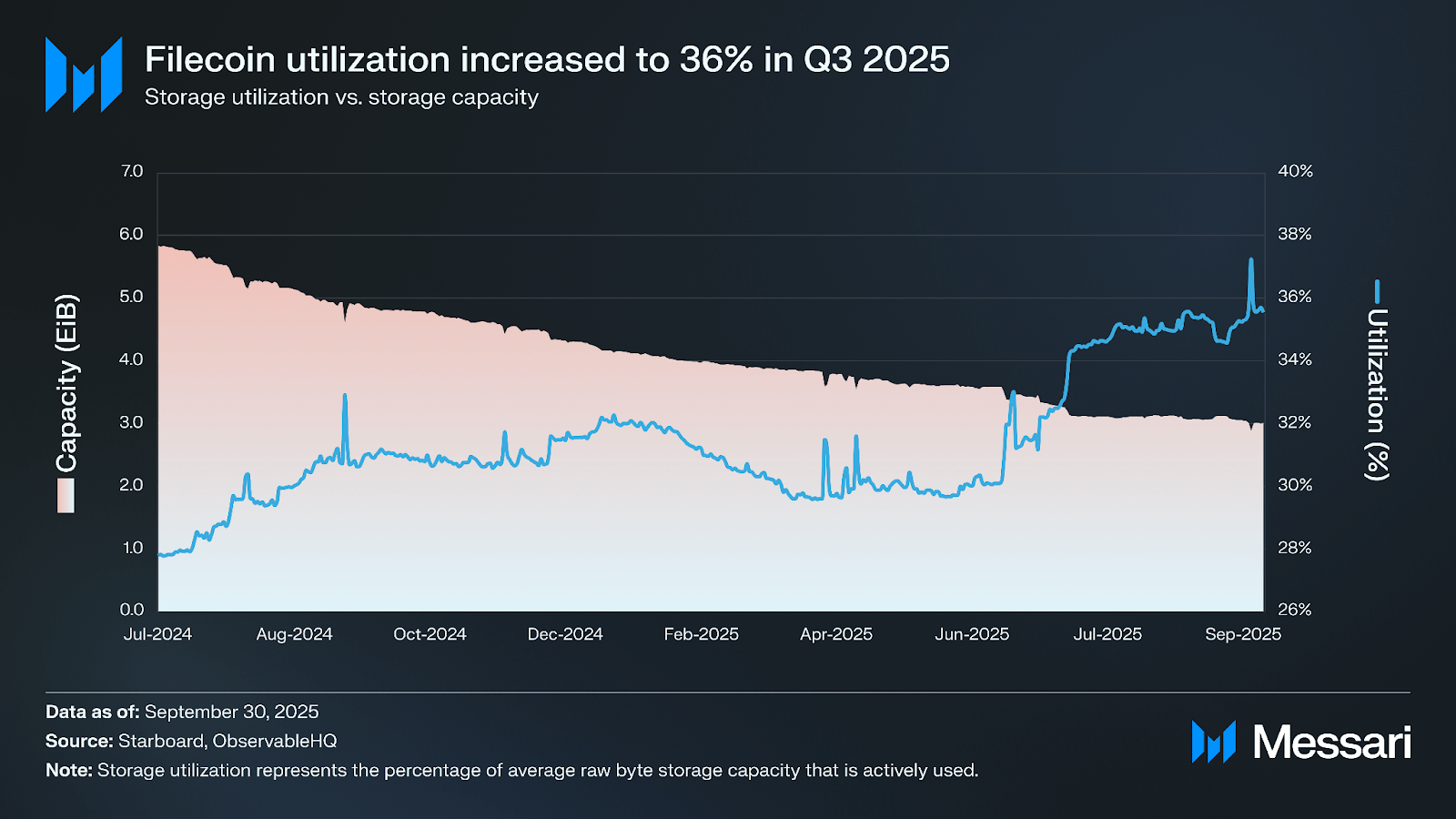
Network utilization rose to 36% (from 32% in Q2) as total capacity declined 10% QoQ to 3.0 EiB, reflecting miner exits and efficiency gains following the Network v27 “Golden Week” upgrade.
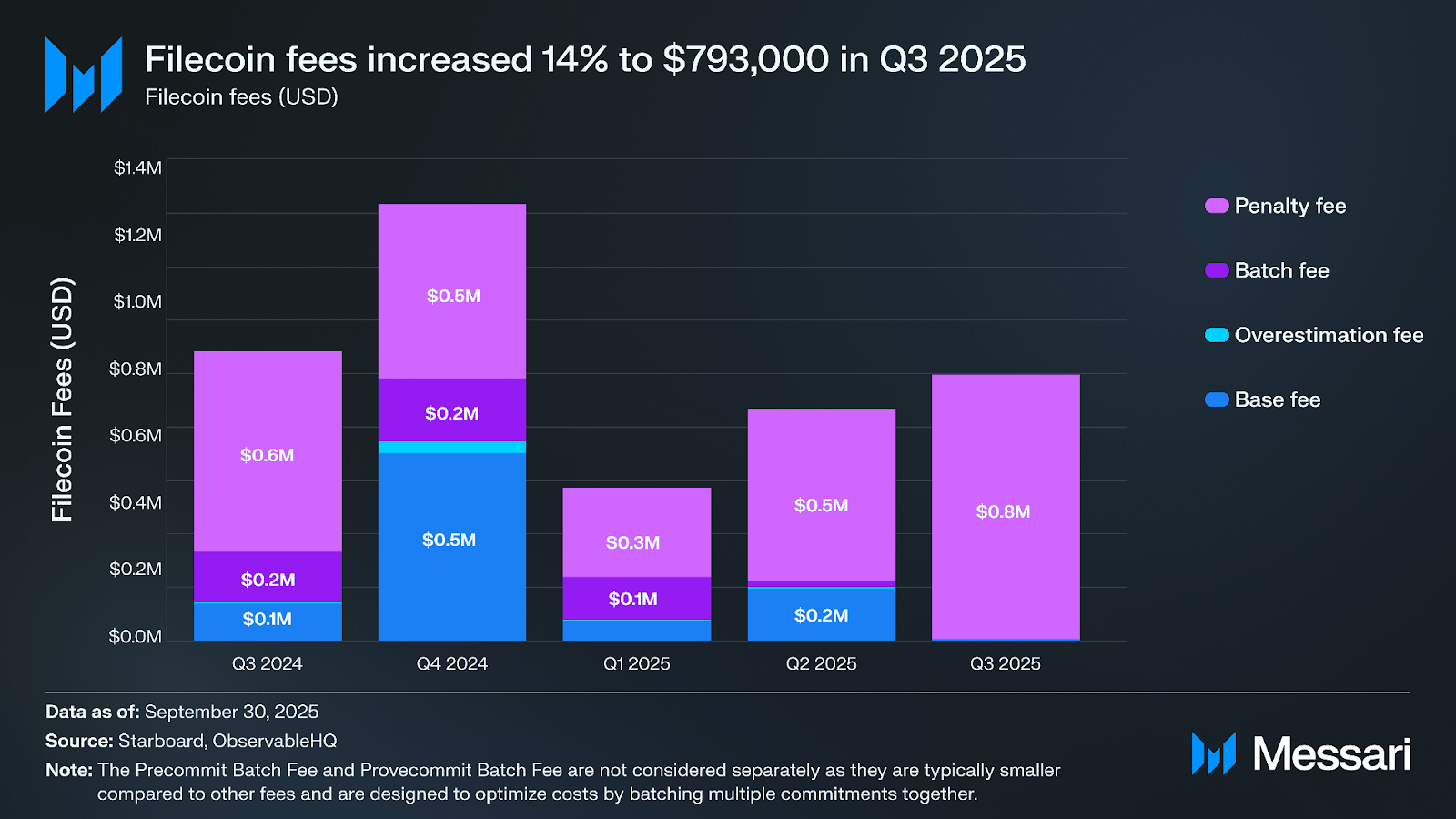
Total network fees increased 14% QoQ to $793K, driven almost entirely by penalty fees (99.5%), while batch and base fees fell to near zero after the removal of legacy sector methods.
Active storage demand held steady, with total data stored down just 1% QoQ to 1,110 PiB, even as average daily new deals fell 19% as providers and allocators adapted to new Fil+ pathways and operational adjustments.
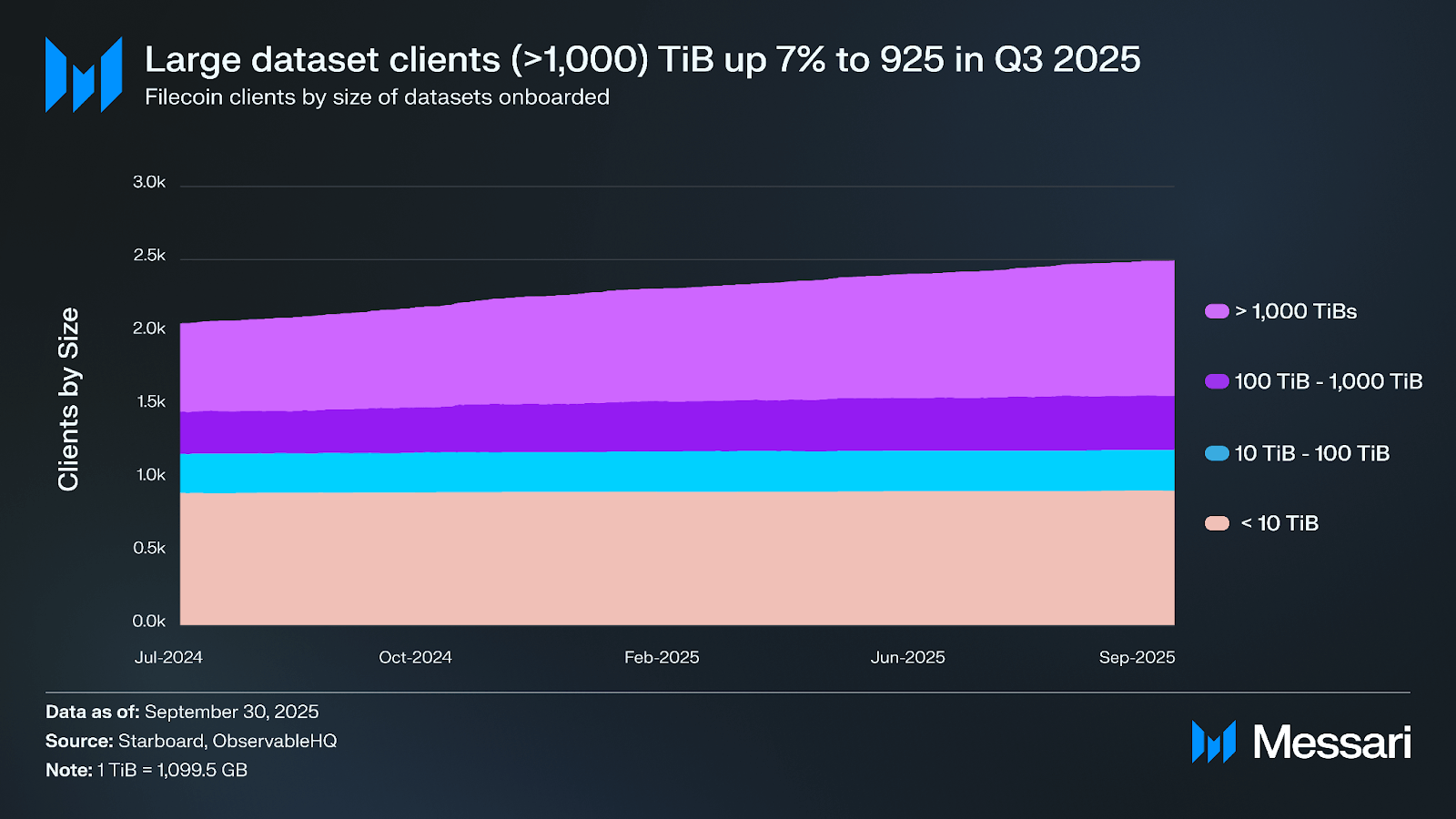
Onboarded datasets grew 3% QoQ to 2,491, with 925 datasets exceeding 1,000 TiB, reflecting continued enterprise and research adoption for large-scale, durable storage.
Filecoin Foundation and GSR Foundations funded an impact cohort, including The Starling Lab and Oceanic Whispers by CROSSLUCID, reinforcing Filecoin’s role in verifiable, socially driven data preservation.
Primer
Filecoin (FIL) is building a marketplace for data services, with the first service being storage on top of the InterPlanetary File System (IPFS). Filecoin uses a market-driven model where users negotiate storage deals with providers at variable pricing. A storage deal functions similarly to a service agreement, where users pay providers to store data for a specified period.
Filecoin uses an incentive model based on cryptographic proofs, Proof of Replication (PoRep) and Proof of Spacetime (PoSt), to verify that storage providers reliably store client data over time. Additionally, Proof of Data Possession (PoDP) launched in May 2025, adding ongoing lightweight verification of stored data and a hot-storage tier for high-speed availability. Providers are rewarded with FIL, the network’s native token, for participating in storage deals. Storage providers are slashed if they fail to provide reliable uptime or act maliciously against the network.
To retrieve data, Filecoin users pay a retrieval provider to fetch data. Unlike storage deals, which involve transactions onchain, retrieval deals use payment channels to settle payments offchain, to enable faster retrieval. Besides storage and retrieval, Filecoin aims to offer an open market where compute power can be contracted to run over data, providing more efficient alternatives to traditional centralized systems. Key protocol upgrades to enable compute-over-data services include smart contracts (Filecoin Virtual Machine - FVM) and scaling (Interplanetary Consensus - IPC). With the upcoming launch of Filecoin Onchain Cloud, the network’s infrastructure will further expand to support onchain cloud services.
Filecoin is primarily used to decentrally store data through two parties:
The demand side, i.e., storage users needing data storage.
The supply side, i.e., storage providers with excess storage capacity.
The amount of data stored in active storage deals between users and storage providers gauges the demand for Filecoin storage.
Storage Deals
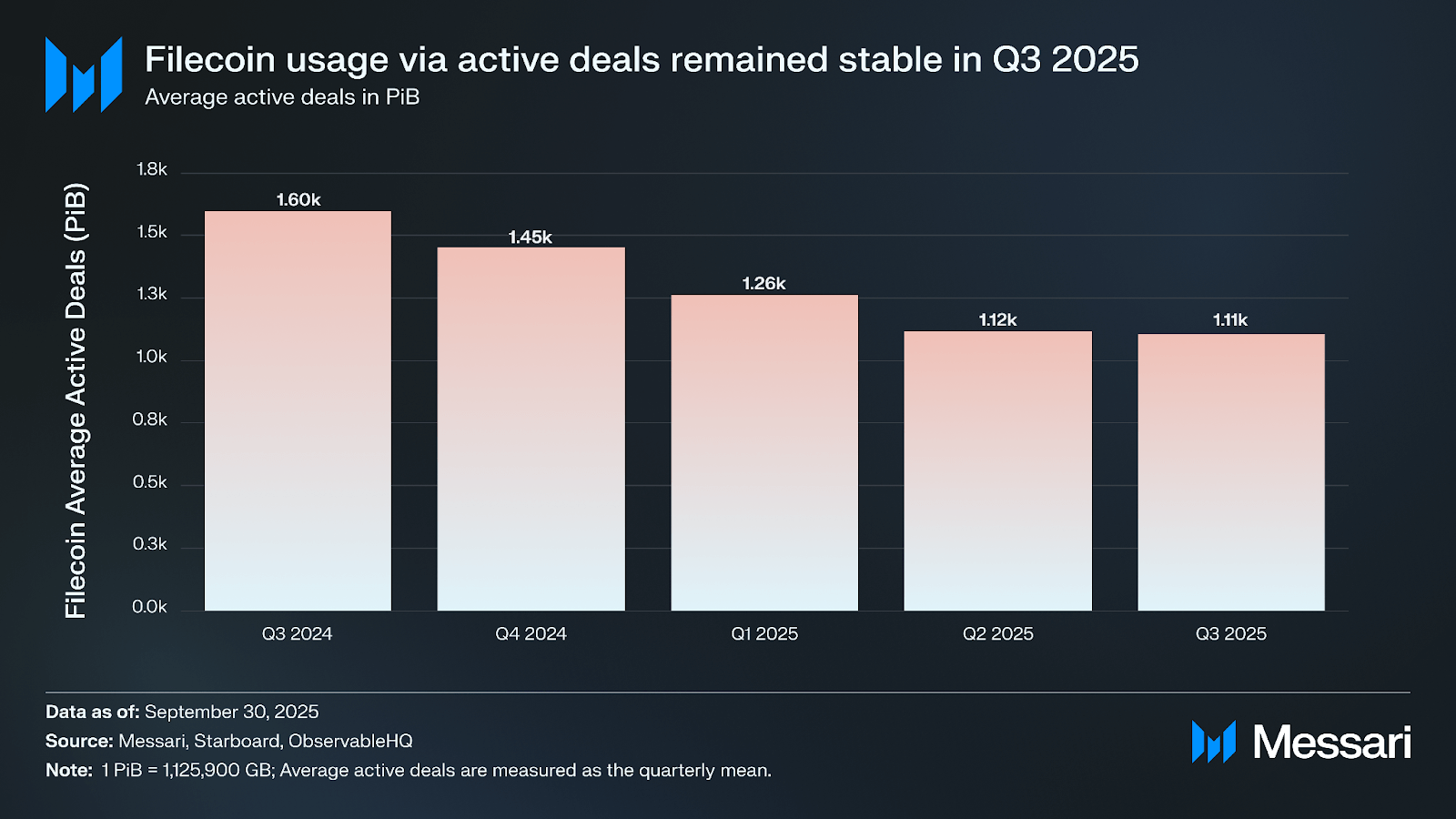
In Q3 2025, total data stored through active deals on Filecoin reached 1,110 pebibyte (PiB), down just 1% from 1,120 PiB in Q2, indicating overall stability in onchain storage demand. The average number of active deals decreased marginally by 1% to 35.2 million. This minimal decline, despite ongoing capacity reductions, underscores Filecoin’s continued transition from maximizing raw storage supply to supporting higher-value, enterprise-grade, and verified data workloads.
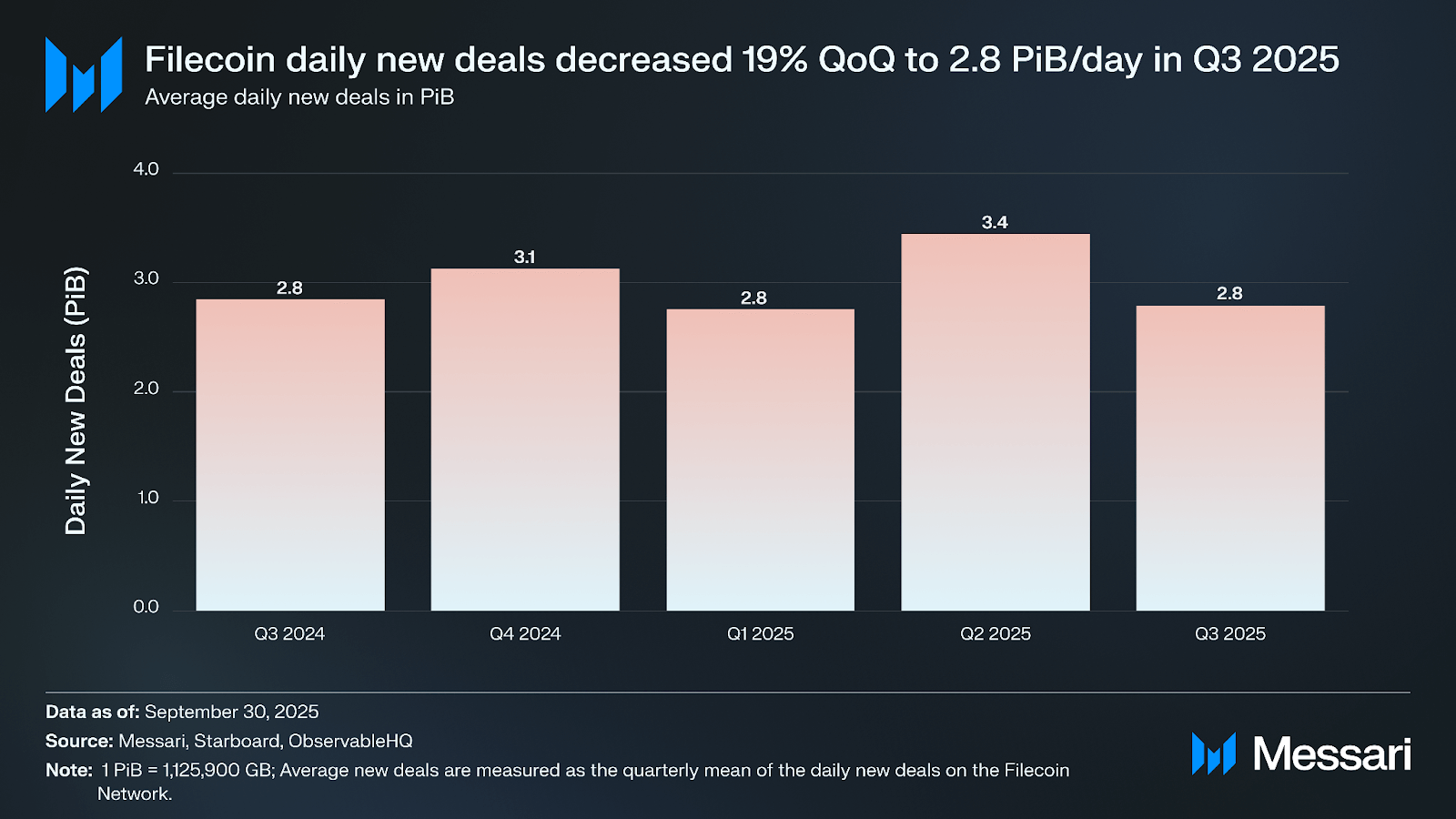
In Q3 2025, average daily new storage deals on Filecoin declined 19% QoQ, falling from 3.4 PiB to 2.8 PiB. This reversal from the previous quarter’s growth reflects a cooling in new data onboarding activity, even as total active storage remained largely stable, down just 1% from 1,120 PiB to 1,110 PiB. This divergence suggests that new data onboarding slowed, but existing verified datasets remained stable.
The rollout of Filecoin Plus (Fil+) Allocator Pathways in late Q2 2025 prioritized large verified data clients and streamlined enterprise onboarding, resulting in fewer but higher-value deals. Verified storage now dominates total activity, while smaller, short-term regular deals have nearly disappeared. At the same time, the Network v27 “Golden Week” upgrade simplified miner operations and deprecated several sealing and aggregation methods, temporarily reducing new deal formation as Storage Providers adapted to the new tooling. Miner consolidation further contributed, with many smaller operators exiting amid tighter efficiency standards and rising collateral requirements.
Despite these short-term declines in new deal volume, overall utilization improved as existing verified datasets remained active, particularly those tied to long-term archival, scientific, and enterprise use cases introduced through Q3 initiatives such as the Cultural and Scientific Preservation program.
Utilization vs. Capacity
In Q3 2025, Filecoin’s storage utilization rate rose to 36%, up from 32% in Q2, even as total committed capacity fell 10% QoQ from 3.3 exabytes (EiB) to 3.0 EiB. This inverse trend reflects ongoing miner consolidation and network right-sizing. The decline in total capacity stems primarily from smaller or underperforming Storage Providers exiting the network amid tighter operational and collateral requirements introduced in the Network v27 “Golden Week” upgrade. The upgrade simplified sealing and sector maintenance (via FIP-0101, FIP-0103, and FIP-0106), deprecating older, less efficient workflows and prompting some miners to retire outdated infrastructure. At the same time, average daily new deal onboarding fell 19% QoQ, reducing new data inflows. As a result, while overall capacity contracted, the remaining space was used more efficiently, driving utilization higher despite a smaller network footprint.
Clients
Filecoin is currently geared toward providing cold storage solutions (e.g., archival and recovery) for enterprises and developers. Low storage prices help attract traditional businesses seeking cost-effective alternatives for storing large amounts of archival data.
DeStor, a service provider on Filecoin that connects clients to storage providers, partnered with Qamcom Decentralised Data Security (DDS). The partnership includes potential data clients like YayPal, a Web3 gaming studio with over 500,000 users, and Fieldstream, an AI marketing analytics platform. Examples of other client solutions include:
GhostDrive: Focused on prioritizing privacy and security through encryption, decentralization, and novel storage optimization techniques;
CIDGravity: Focused on enterprise integrations with open-source platforms like Nextcloud.
Beyond cold storage, other efforts are driven by storage solutions from Lighthouse, Akave, and Storacha, among others.
By the end of Q3 2025, Filecoin hosted 2,491 onboarded datasets, up 3% from 2,416 in Q2. Of these, 925 datasets exceeded 1,000 TiB in size, a 7% increase from 864 in Q2, underscoring continued adoption for high-volume, durable storage. This growth was supported by ongoing Filecoin Plus onboarding activity, the addition of new on-ramp integrations that lowered dataset-ingestion barriers, and an uptick in enterprise and research workloads.
FVM Traction
The Filecoin Virtual Machine (FVM) enables Ethereum-style smart contracts directly on top of Filecoin’s storage layer, allowing developers to build applications that automate data onboarding, pricing, retrieval, and compute coordination.
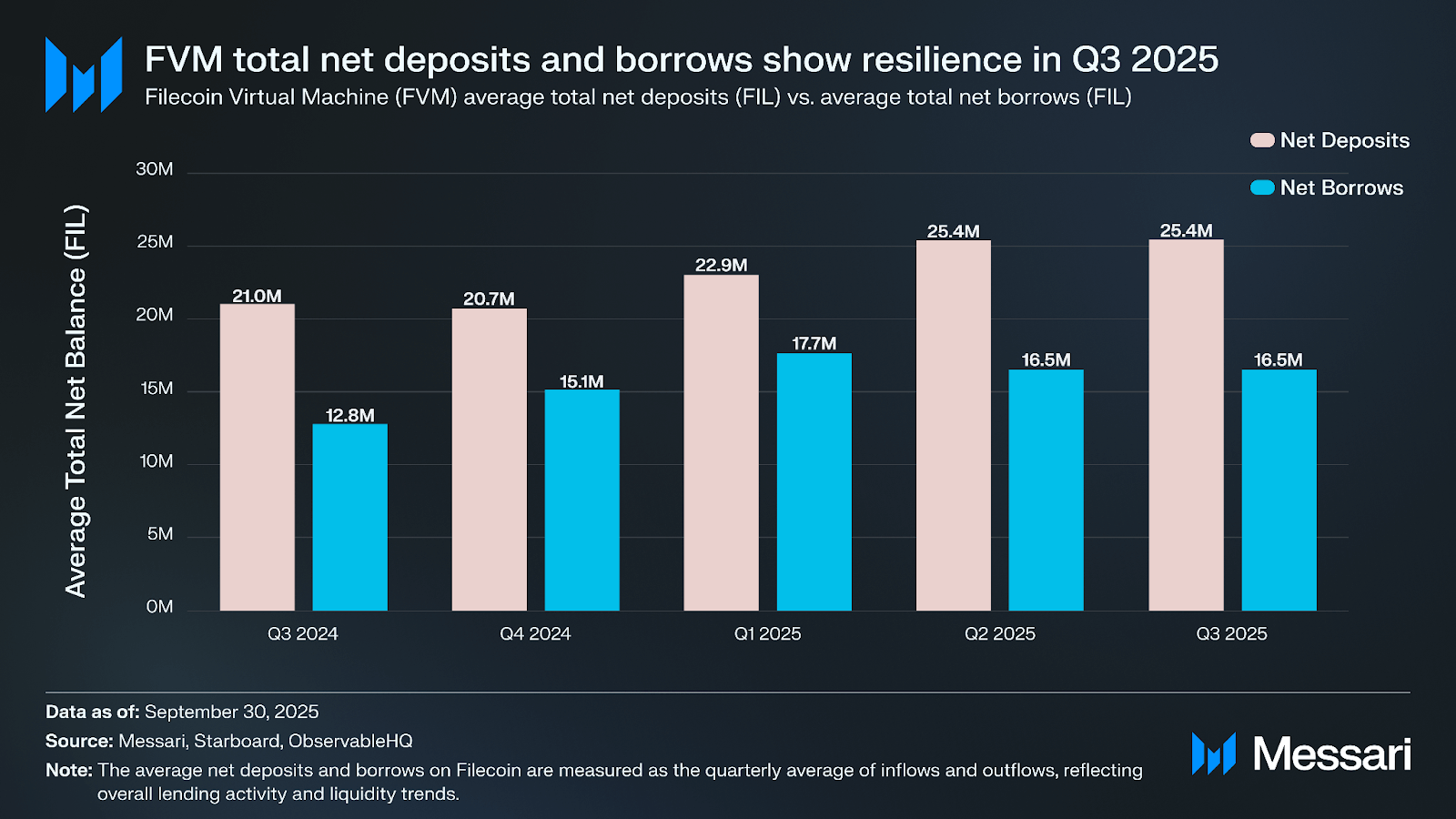
In Q3 2025, Filecoin recorded $62.4 million in total inflows (net deposits), down 6.5% from $66.8 million in Q2, while total outflows and borrows declined 6.8%, from $43.4 million to $40.5 million over the same period.
When measured in FIL, however, token activity moved in the opposite direction, inflows rose 0.16% QoQ, from 25.39 million FIL to 25.43 million FIL, while outflows edged down 0.03%, from 16.53 million FIL to 16.52 million FIL. This divergence is due to the 5% decline in FIL’s price during the quarter (from $2.30 to $2.19), which reduced the USD-denominated value of otherwise steady onchain token flows.
Financial Overview
Filecoin's revenue model shares similarities with Ethereum due to its EIP-1559-inspired gas system, where some network fees are burned to regulate congestion. However, unlike Ethereum, Filecoin’s economy is storage-driven, with storage users paying fees and storage providers earning revenue while managing collateral and penalties.
Base Fees: Determined by blockspace congestion and required by any storage proof.
Batch Fees: Used for bundling storage proofs to optimize costs.
Overestimation Fees: Required to optimize gas usage.
Penalty Fees: Collected for storage provider failures.
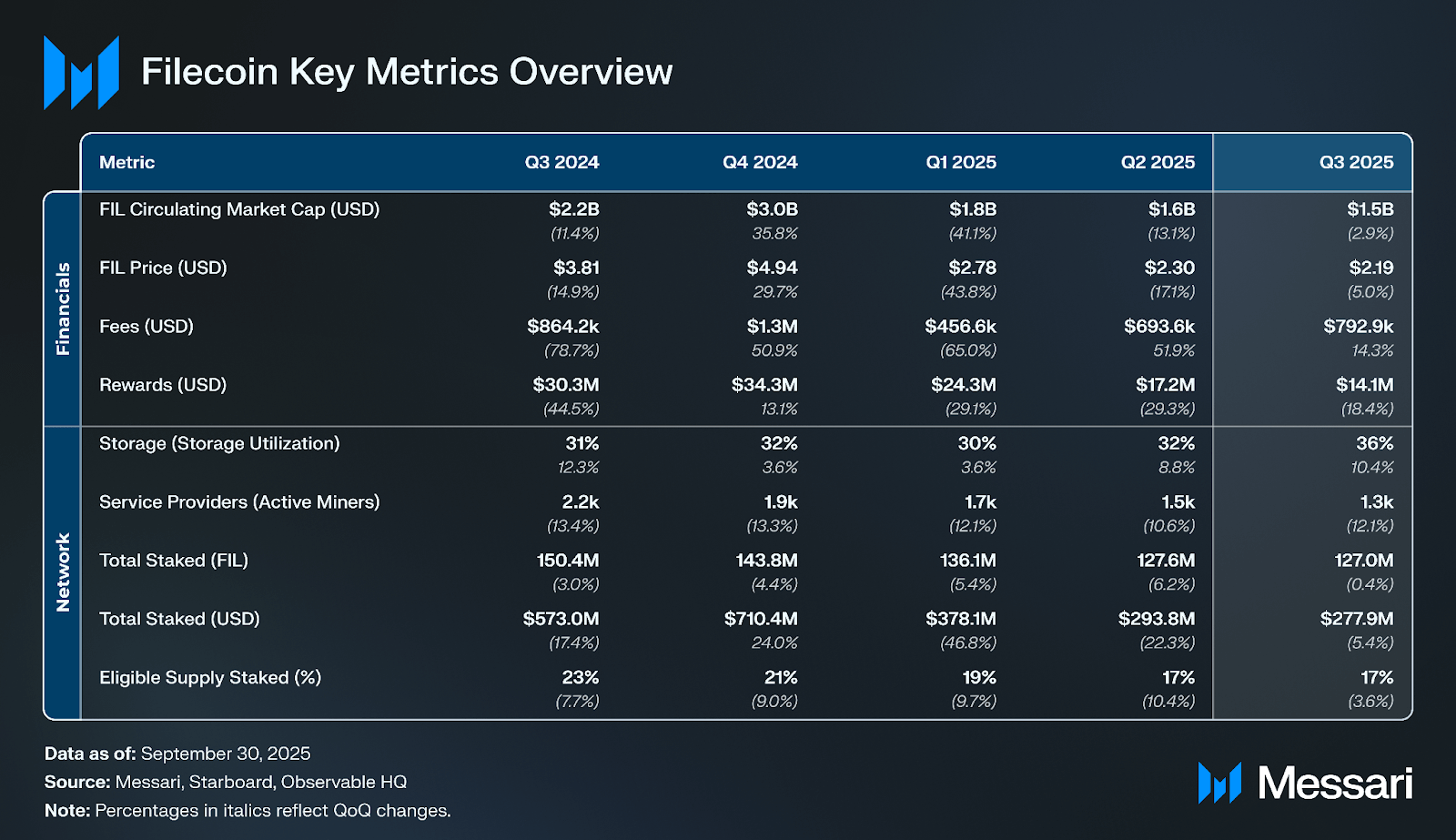
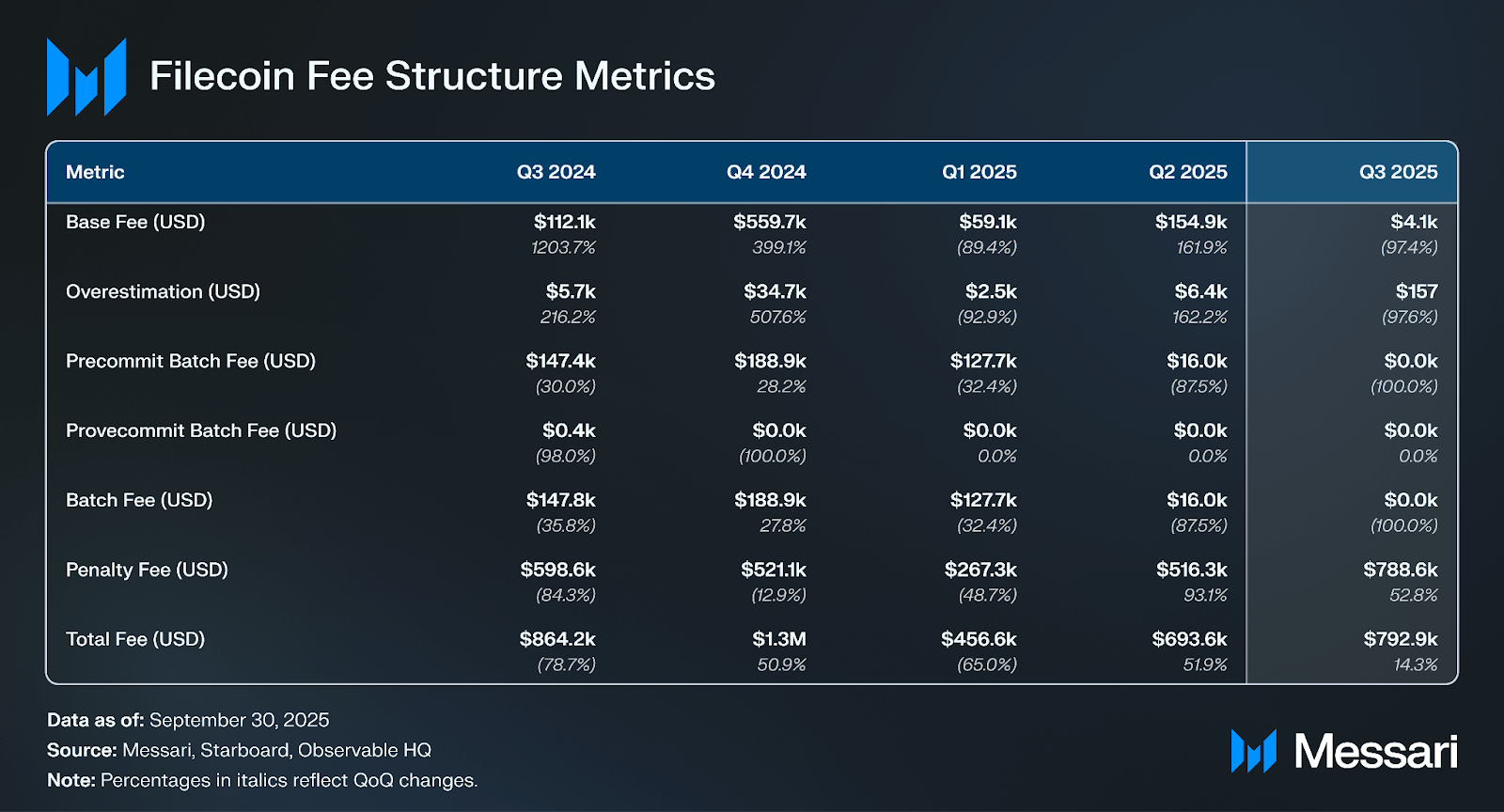
In Q3 2025, total network fees on Filecoin reached $792,900, up 14.3% QoQ from $693,600 in Q2 2025. The increase was driven almost entirely by penalty fees, while base and batch-related fees collapsed following protocol-level changes introduced in the Network v27 upgrade.
Base Fees: fell 97% QoQ to $4,100. This decline reflects lower onchain transactional throughput after the deprecation of several sector-related methods (FIP-0103 - FIP-0106 - FIP-0101), rather than a drop in network demand.
Batch Fees: fell 100% QoQ to $0, as miners submitted far fewer batched precommit transactions consistent with reduced sector onboarding and a continued decline in total active storage volume.
Overestimation Fees: fell 98% QoQ to just $157, down from $6,400, mirroring the drop in gas-related activity as overall transaction frequency declined.
Penalty Fees: rose 53% QoQ to $788,600, accounting for roughly 99.5% of total network fees. This surge likely reflects increased slashing during a period of network restructuring and miner exits under stricter operational requirements.
Q3 marked a transitional period for Filecoin’s economy as the network streamlined operations under v27. The reduction in batch and base fees reflects a shift away from high-volume, short-term onboarding toward fewer but larger verified deals, while the spike in penalty fees highlights the operational pressure of raising quality standards on smaller providers. These trends indicate a network progressing through consolidation, less fee activity from expansion, but stronger enforcement and efficiency across active participants.
Market Cap
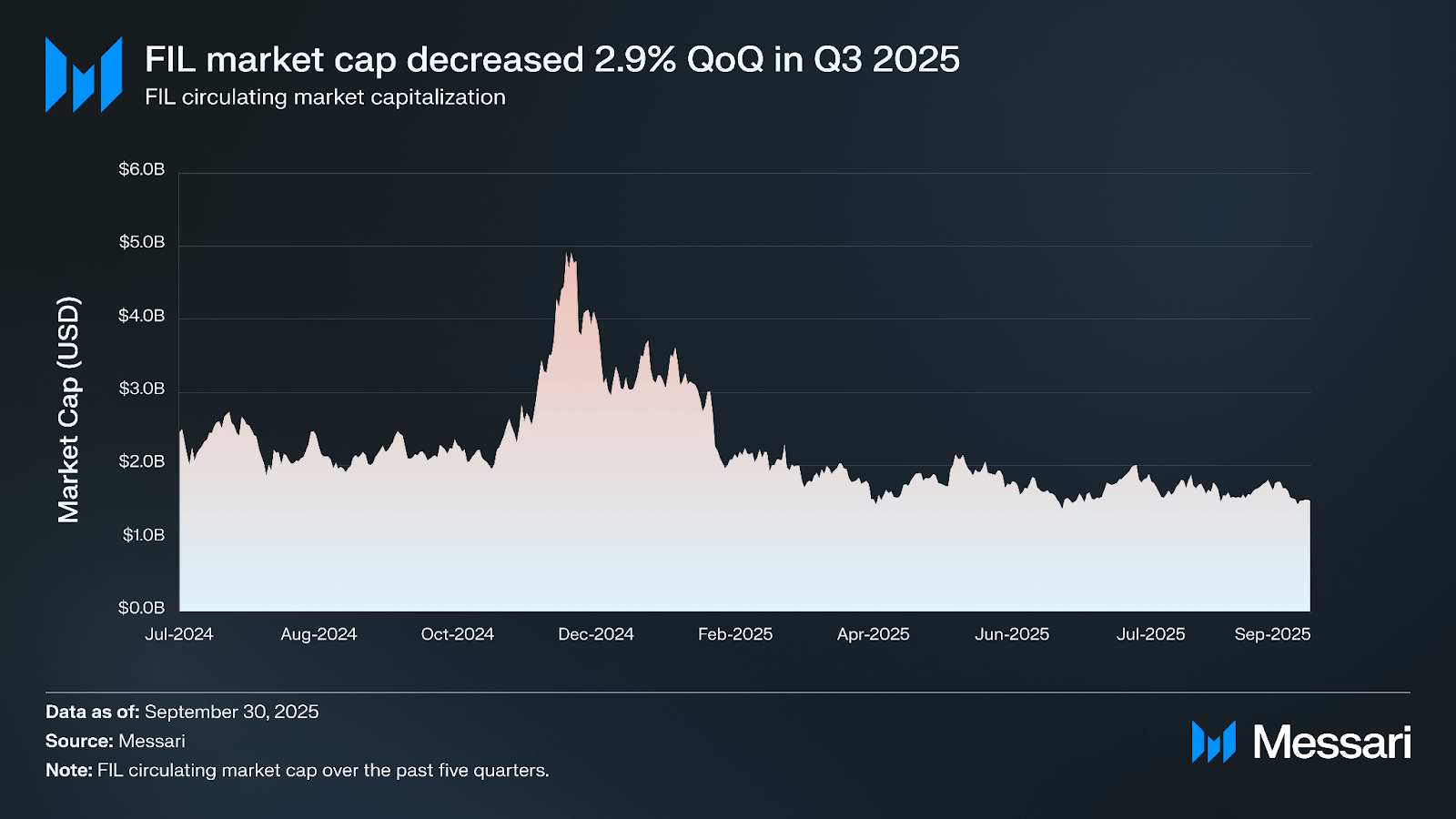
In Q3 2025, FIL’s circulating market cap (USD) declined 3% QoQ to $1.5 billion, down from $1.6 billion in Q2 2025. The decrease was driven by a 5% QoQ drop in FIL’s token price, which fell from $2.30 to $2.19, while circulating supply grew 2.2% QoQ to 692.4 million FIL, consistent with previous issuance rates.
DeFi Ecosystem
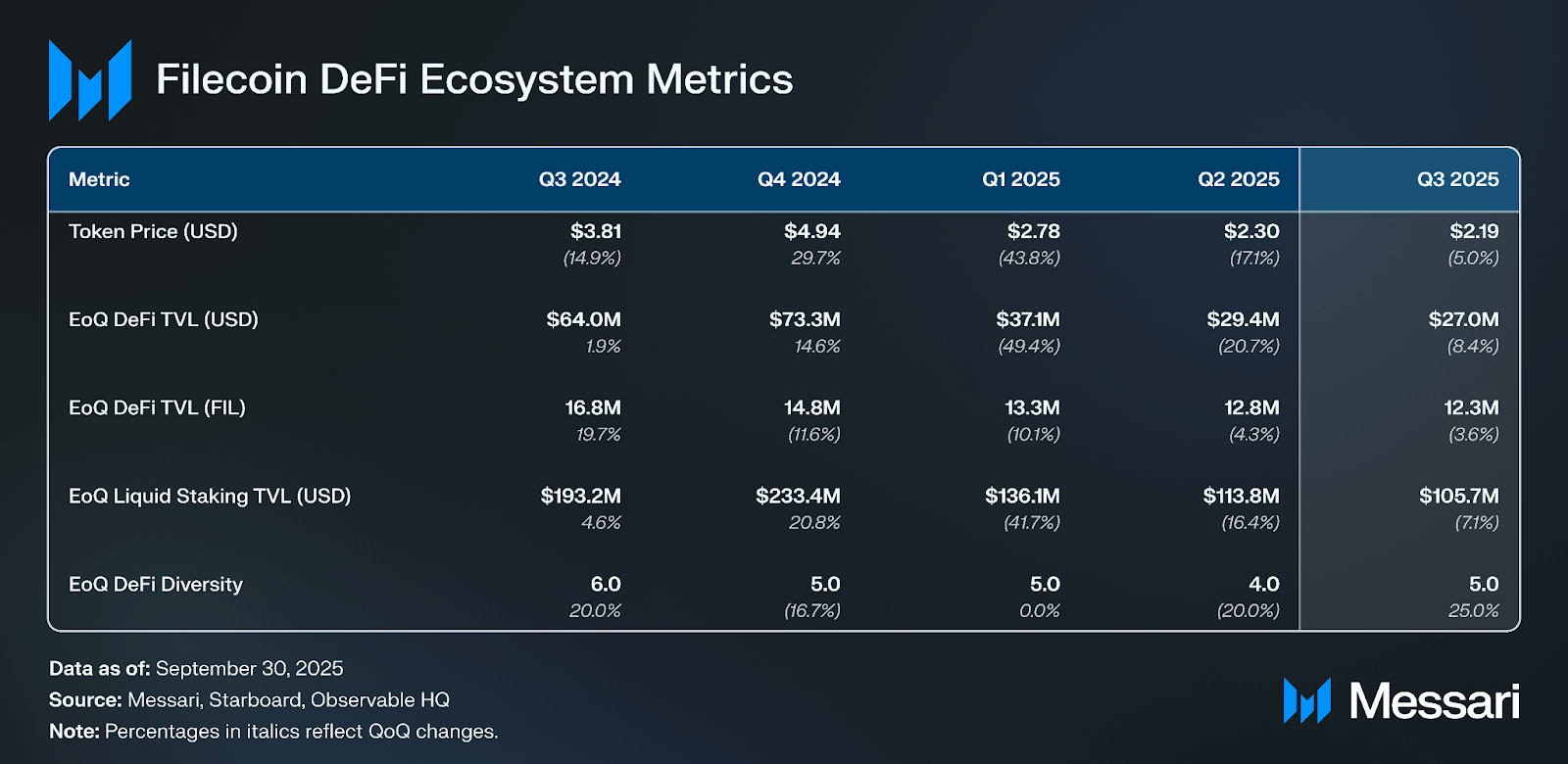
In Q3 2025, total FIL staked declined slightly by 0.4% QoQ, falling from 127.6 million to 127.0 million FIL, marking the fifth consecutive quarterly decrease. In USD terms, the staked value dropped 5.4% to $277.9 million, driven primarily by FIL’s 5% price decline during the quarter rather than a significant change in staking participation.
The eligible supply staked ratio held steady at 17%, unchanged from Q2 but down from 19% in Q1 2025, reflecting a stable but relatively low level of network participation. Meanwhile, the annualized nominal yields fell sharply from 52% to 24%, as the temporary reward spike in Q2, caused by reduced staking participation and inflation-driven payouts, normalized once staking activity stabilized.
TVL Trends
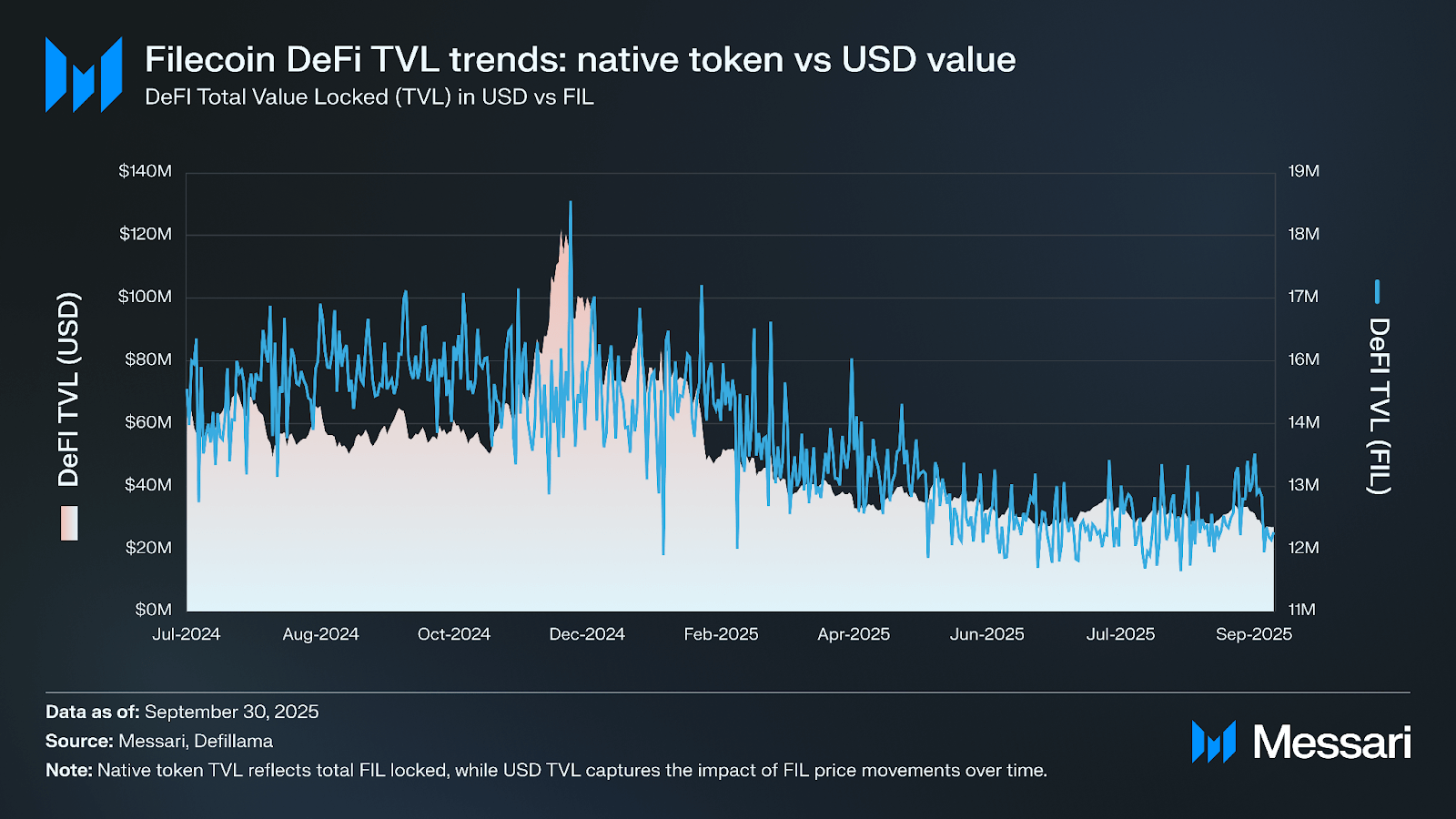
In Q3 2025, Filecoin’s DeFi activity continued to contract, extending the downtrend that began in early 2024. End-of-quarter DeFi TVL fell 8.4% QoQ to $27.0 million, down from $29.4 million in Q2, marking the fifth consecutive quarterly decline. When measured in FIL terms, TVL decreased more modestly by 3.6% QoQ to 12.3 million FIL, showing that most of the drop was driven by FIL’s 5% price decline rather than meaningful capital outflows.
Liquid staking TVL followed the same trend, declining 7.1% QoQ to $105.7 million, as staking rewards normalized following the Q2 yield spike and network incentives tapered. In FIL terms, core liquidity products and staking participation remained steady, showing that user engagement and network participation stayed healthy even as USD-denominated metrics declined.
Stablecoins
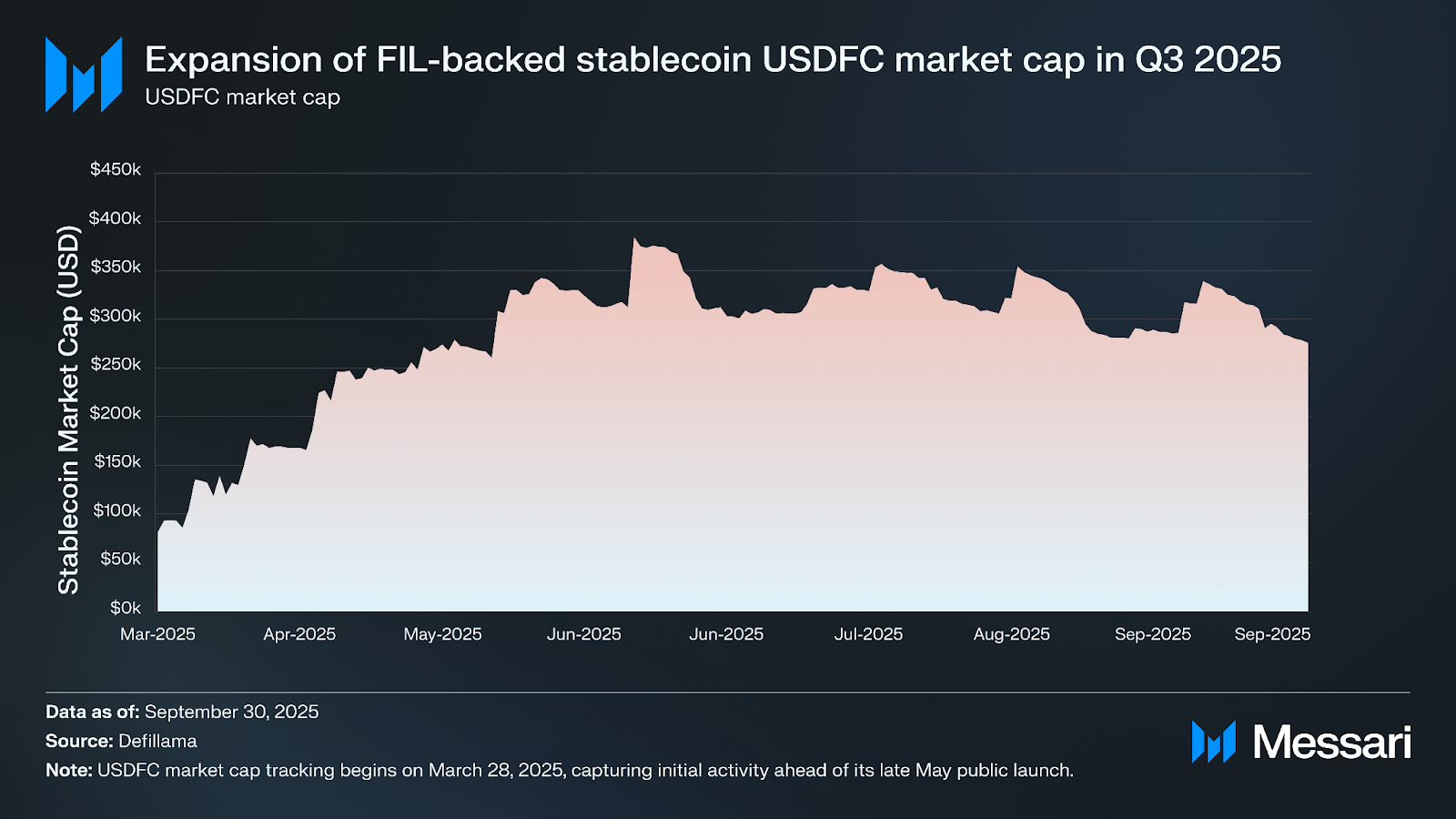
USDFC, a FIL-backed stablecoin launched by Secured Finance in early 2025, is designed to increase liquidity within the Filecoin economy by allowing FIL collateralization and reducing FIL sell pressure. It provides a native, dollar-pegged asset for trading, lending, and DeFi use without leaving the network.
In Q3 2025, USDFC’s circulating supply declined 8.5% QoQ, falling from $301,000 at end-Q2 to $275,000 by September 30, its first contraction since launch. After peaking near $355,000 in mid-August, the stablecoin’s outstanding supply eased lower through September as DeFi activity and yield opportunities cooled.
The pullback was market-driven, not structural. FIL’s 5% price decline reduced the collateral value supporting new issuance, while staking and DeFi yields normalized from Q2’s temporary 52% spike to 24%, lowering minting incentives for liquidity providers and lenders. Broader onchain liquidity also softened as participants prioritized protocol stability after the Network v27 “Golden Week” upgrade.
Despite this moderation, USDFC maintained full peg stability and healthy circulation, indicating steady confidence among storage providers and DeFi participants. Rather than a sign of weakness, the contraction marked a natural consolidation phase following Q2’s rapid expansion, setting the stage for steadier growth as FIL-denominated markets and FVM-based integrations mature through 2025.
Qualitative Analysis
Protocol Upgrades
Network v27 Upgrade (“Golden Week”): The Filecoin Network v27 upgrade, codenamed “Golden Week,” was successfully deployed at epoch 5,348,280 on September 24 and announced the following day, September 25, 2025. The release focused on simplifying Storage Provider (SP) operations, improving EVM compatibility, and reducing technical debt.
FIP-0105: Introduced BLS12-381 precompiles for the Filecoin EVM (EIP-2537 equivalent) to enable efficient BLS signature verification and cross-chain interoperability with Ethereum-based rollups.
FIP-0077: Introduced a deposit requirement equal to 10 % of the initial pledge for 10 TiB of storage capacity (≈ 4 FIL at current rates) for new Storage Provider (SP) IDs, to discourage spam actor creation and improve state efficiency.
FIP-0103 / FIP-0106 / FIP-0101: Removed deprecated methods (Extend Sector Expiration, Prove Replica Updates, Prove Commit Aggregate) to streamline SP actor logic and maintenance.
FIP-0109: Enabled smart-contract notifications for Direct Data Onboarding (DDO), allowing onchain applications to subscribe to storage events and trigger workflows programmatically.
FRC-0108: Expanded snapshot formats to include Fast Finality (F3) certificates, reducing node sync times and bandwidth requirements for new participants.
All major client implementations (Lotus, Venus, Forest, Curio, Boost) released compatible versions ahead of activation. The upgrade enhanced developer tooling and aligned Filecoin’s virtual machine with Ethereum standards, laying the foundation for programmable data services and retrieval markets.
Cultural and Scientific Preservation on Filecoin
On September 30, 2025, Filecoin Foundation announced a new cohort of partners preserving cultural and scientific archives on the Filecoin network. Building on earlier collaborations with renowned institutions, the initiative underscores Filecoin’s growing role as a decentralized physical infrastructure network (DePIN) for durable, verifiable, and censorship-resistant data storage. New datasets preserved on Filecoin include:
Digital Public Library of America (DPLA): A pilot project to store select materials from its collection of more than 50 million cultural items, such as photographs, oral histories, and government documents.
Earth Species Project (ESP): The BEANS-Zero benchmark dataset, used to train NatureLM-audio, an audio-language model for animal vocalizations, ensuring global and resilient research access.
Prelinger Archives: Tens of thousands of archival films documenting U.S. social and cultural history, including Rick Prelinger’s Lost Landscapes series.
Rohingya Project: A community-led archive preserving the cultural identity and oral histories of stateless Rohingya communities.
Oceanic Whispers by CROSSLUCID: Developed in part with RadicalxChange, an experimental data trust that stores marine protected-area datasets on Filecoin and converts them into AI-generated interactive experiences with a partial-ownership revenue model.
Together, these partnerships demonstrate how decentralized storage can support open science and cultural preservation through verifiable, tamper-resistant archiving.
Ecosystem Integrations and Partnerships
Filecoin Foundation and GSR Foundation Impact Cohort: Filecoin Foundation announced a partnership with the GSR Foundation on July 23, 2025, to launch the Impact Cohort, a joint initiative supporting five blockchain-based public-interest projects within the Filecoin ecosystem. The GSR Foundation, a philanthropic arm of digital asset market maker GSR, collaborates with Filecoin Foundation to fund The Starling Lab for Data Integrity, Easier Data Initiative, Transfer Data Trust, Akashic, and Oceanic Whispers by CROSSLUCID. Each project applies decentralized storage to social-impact areas such as digital truth preservation, geospatial data access, artistic governance, and environmental stewardship. The partnership highlights Filecoin’s role as core technical infrastructure for socially impactful, real-world applications.
S3-Compatible Object Storage via Akave Cloud: On September 16, 2025, Akave announced the launch of an S3-compatible, Filecoin-backed object storage service designed for enterprise and DePIN adoption. The integration allows developers and organizations to store and access data using standard S3 APIs while benefiting from Filecoin’s verifiable storage and retrieval guarantees. Built to bridge traditional cloud tooling with decentralized infrastructure, Akave’s release simplifies enterprise migration to blockchain-based storage and enables verifiable, low-latency “warm” data use cases through Proof of Data Possession (PDP) support.
Storacha’s Bluesky Backup App: Announced on June 12, 2025 (adoption expanded through Q3) Storacha, a decentralized hot-storage network built on Filecoin and IPFS, released bsky.storage, a user-facing application for automated hourly backups of Bluesky social data. The tool enables users to export and recover their posts and identity keys independently, reinforcing Filecoin’s broader mission of enabling data portability, user ownership, and self-sovereign digital identity.
Developer Initiatives and Community Growth
FIL Dev Summit 7 (FDS-7):Announced in September 2025, the seventh Filecoin Developer Summit was scheduled to run virtually on October 16–17 and in-person in Buenos Aires on November 13–15 during DevConnect Argentina. The summit focuses on scaling Filecoin for enterprise and data-intensive applications and explores advancements introduced with Network v27, including Direct Data Onboarding (DDO), BLS precompiles, and fast-finality snapshots, as well as new retrieval markets and AI data workflows.
Filecoin Onchain Cloud (Alpha Cohort): On August 12, 2025, FIL-Builders and FilOz launched the Onchain Cloud Alpha Cohort. The initiative introduced modules for onchain payments, warm storage, standardized retrieval interfaces, and smart-contract-based SLAs, enabling developers to deploy decentralized data services with the ease of smart contracts.
PL Genesis Hackathon – “Hack the Sovereign Data Layer with Filecoin”: Part of the Modular Worlds series hosted by Protocol Labs, the hackathon began in early June and ran through July 6, 2025. The event invited developers to experiment with Filecoin’s onchain stack for decentralized data ownership and retrieval, exploring new applications for programmable storage and verifiable data access. Winning projects, announced on September 5, 2025, showcased innovations such as smart-contract-based retrieval logic, verifiable AI datasets, and developer tooling for data DAOs. With $15,000 in total prizes, the hackathon strengthened developer participation in Filecoin’s evolving onchain cloud ecosystem.
Orbit Program and Community Events: Throughout September 2025, the FIL Builders Orbit Program expanded global developer outreach through a series of community workshops and hackathons. Highlights included FIL Warsaw (September 5) and ETHAccra (September 4–6), which featured AI and DeFi bounty challenges; Code & Corgi workshops in Pune (September 12) and Delhi (September 25); and Decentralized Storage 101 in Japan (September 18), co-hosted with Pacific Meta. These sessions focused on developer education around the Filecoin Virtual Machine (FEVM), data-onboarding tools, and community-led open-source development.
Key Governance Developments
ProPGF Batch 1: On August 11, 2025, Protocol Labs completed the first Filecoin Public Goods Funding (ProPGF) batch, allocating $3.68 million across 14 ecosystem projects, including IPNI, CID Gravity Gateway, Curio Storage, Fil Ponto, and FilCDN Retrieval Services. The program supports forward-looking infrastructure and developer initiatives that strengthen Filecoin’s core ecosystem and long-term sustainability.
RetroPGF Round 3: On August 25, 2025, RetroPGF Round 3 was announced, allocating 585,000 FIL to retroactively fund contributors who delivered verifiable impact across the ecosystem. The round adopted an Optimism-style public goods funding model to reward open-source contributions in infrastructure, tooling, research, and client onboarding, reinforcing Filecoin’s commitment to sustainable, impact-driven ecosystem growth.
Filecoin Plus (Fil+) Allocator Pathways: By September 2025, the Fil+ governance team reviewed more than 140 allocator applications, approving roughly 75% and distributing over 450 PiB of DataCap. A new meta-allocator pathway was introduced to streamline enterprise onboarding and automated allocation tools. Regular governance calls and published recordings in August and September improved transparency, accountability, and operational efficiency within the program.
Closing Summary
In Q3 2025, Filecoin’s circulating market cap fell 3% QoQ to $1.5 billion, driven by a 5% decline in FIL’s price to $2.19, while circulating supply grew 2.2%. Network activity remained stable, with active storage down 1% to 1,110 PiB and utilization improving from 32% to 36% as capacity contracted 10% amid miner consolidation.
The Network v27 “Golden Week” upgrade simplified storage operations, deprecated legacy sector methods, and enhanced FVM compatibility, temporarily slowing new deal formation but improving long-term efficiency. Economic activity normalized, with total network fees rising 14% QoQ to $793,000, driven primarily by penalties, while staking participation held at 17% and yields eased from 52% to 24%. DeFi TVL fell 8% to $27 million, and FIL-backed stablecoin USDFC contracted 8.5% to $275,000 as onchain yields cooled.
On the ecosystem front, Filecoin Foundation advanced cultural and scientific preservation efforts and launched co-funding cohort with the GSR Foundation; Akave and Storacha announced new applications for the network; and FIL-Builders and FilOz expanded developer initiatives through the Onchain Cloud Alpha Cohort and PL Genesis Hackathon. The team also announced FIL Dev Summit 7, set for November 2025 in Buenos Aires during DevConnect Argentina, to showcase Filecoin’s evolution toward verifiable, programmable data infrastructure.
Overall, Q3 reflected a consolidation phase, a leaner, more efficient network focused on verified data, enterprise storage, and the foundation for compute-over-data services.
This report was commissioned by Filecoin Foundation. All content was produced independently by the author(s) and does not necessarily reflect the opinions of Messari, Inc. or the organization that requested the report. The commissioning organization may have input on the content of the report, but Messari maintains editorial control over the final report to retain data accuracy and objectivity. Author(s) may hold cryptocurrencies named in this report. This report is meant for informational purposes only. It is not meant to serve as investment advice. You should conduct your own research and consult an independent financial, tax, or legal advisor before making any investment decisions. Past performance of any asset is not indicative of future results. Please see our Terms of Service for more information.
No part of this report may be (a) copied, photocopied, duplicated in any form by any means or (b) redistributed without the prior written consent of Messari®.
Armita is a protocol researcher with a robust background in technology and blockchain. Before her role at Messari, she distinguished herself as a tech entrepreneur, executive, and advisor for various blockchain startups. Armita holds two master's degrees, one in Computer Engineering and another in Business Management, as well as a double major undergraduate degree in Physics and Pure Mathematics.
Armita is a protocol researcher with a robust background in technology and blockchain. Before her role at Messari, she distinguished herself as a tech entrepreneur, executive, and advisor for various blockchain startups. Armita holds two master's degrees, one in Computer Engineering and another in Business Management, as well as a double major undergraduate degree in Physics and Pure Mathematics.