edgeX's competitive fee structure and orderbook depth are emerging as key differentiators. A point-in-time benchmark of Gold perpetuals showed edgeX within 3% of Hyperliquid's depth at 1 bps and the cheapest round-trip execution at clip sizes up to $500,000. As market maker incentives scale with open interest and additional asset classes go live, these execution advantages should compound across a broader product surface.
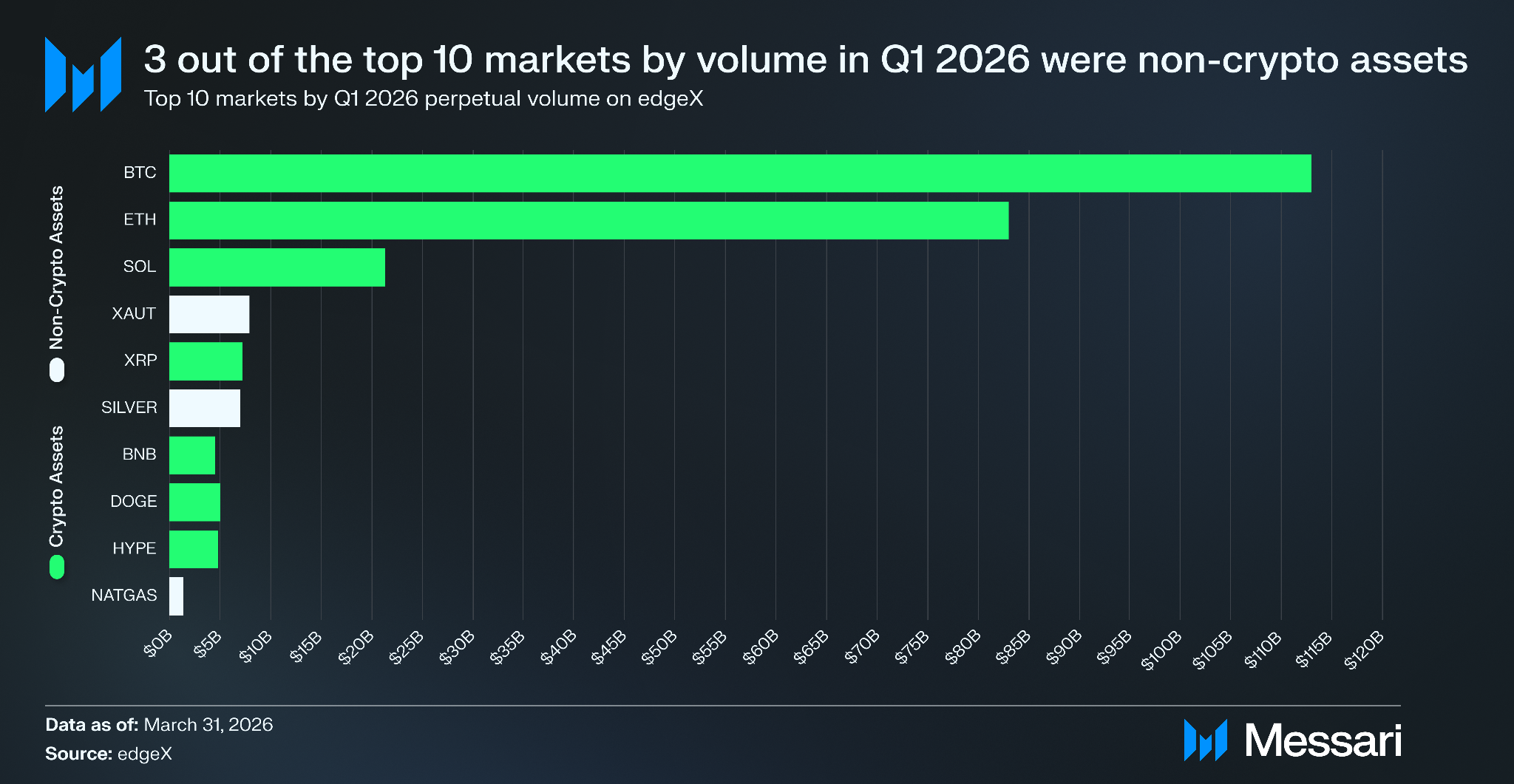
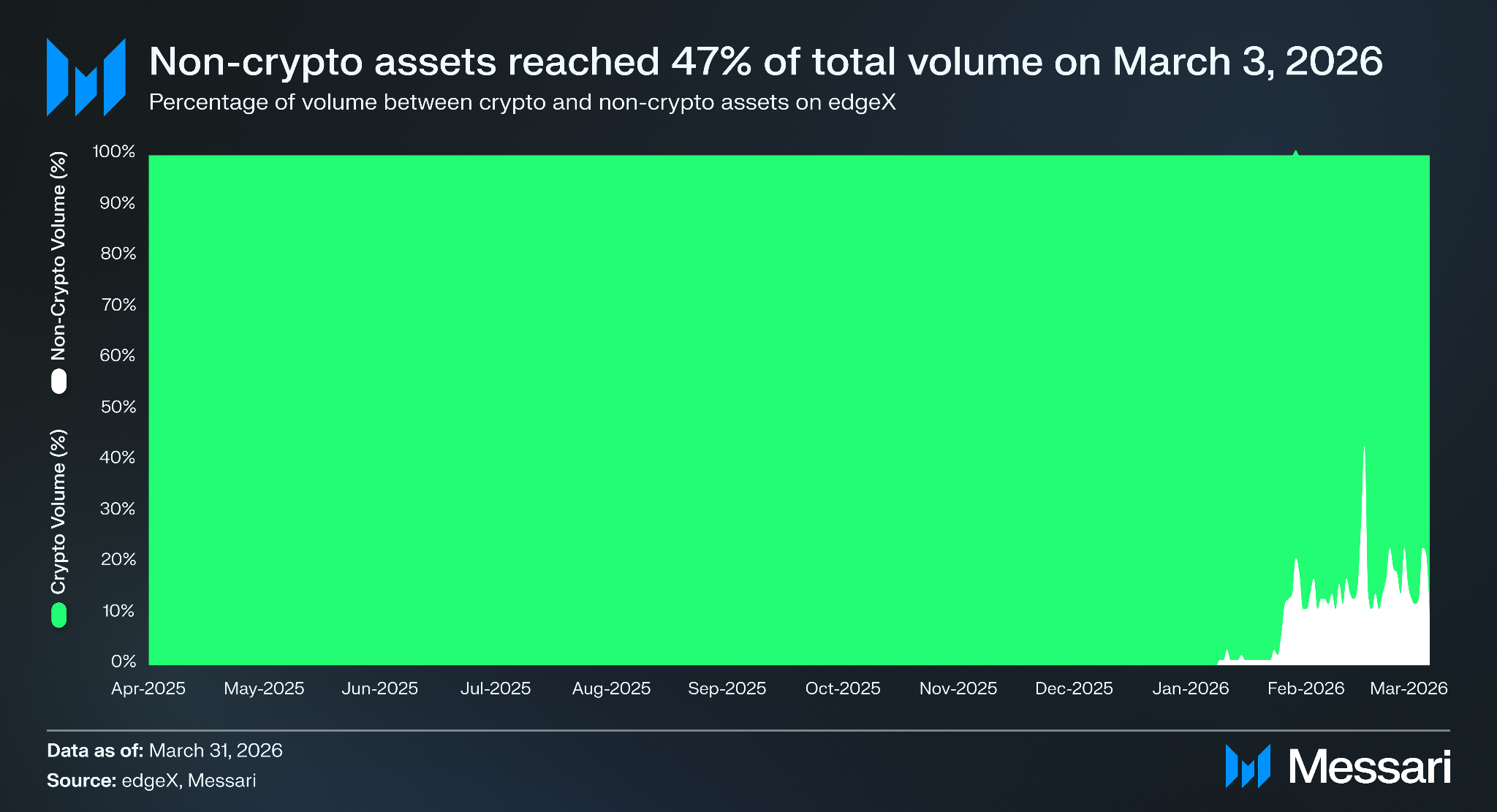
Three non-crypto perps (XAUT, SILVER, NATGAS) entered edgeX's top 10 markets by cumulative volume in Q1. Non-crypto volume averaged 17.8% of daily perpetual activity in March, up from zero at the start of the quarter. With equity perps still maturing and additional commodity listings in the pipeline, the non-crypto mix shift is likely still in its early innings.
EDGE launched on March 31, 2026, reaching a $970 million fully diluted valuation. The team followed the TGE with an RFC proposing staking, delegation, and Guardian Committee governance for the EDGE Chain, alongside EDGE buybacks trackable via the protocol’s dashboard.
Circle Ventures made a strategic investment in edgeX during Q1, enabling native USDC and CCTP support on EDGE Chain. The subsequent launch of a 10% APR USDC rewards program on the first $30 million in deposits introduced a yield layer for idle stablecoins, creating a flywheel effect in which rising deposits deepen liquidity, tighten spreads, and attract larger traders as deposit caps increase.
Primer
edgeX (EDGE) is a high-performance trading application for global assets built by a team of experienced derivatives traders, liquidity operators, and engineers with deep backgrounds in centralized trading systems and blockchain infrastructure. The protocol is designed to deliver centralized-exchange-like execution quality onchain, with a focus on deep liquidity, low latency, and capital efficiency for perpetual futures trading.
edgeX launched V1 in November 2024, offering access to perpetual futures via desktop and mobile applications. During its initial rollout, edgeX focused on validating its trading engine by demonstrating reliable order matching, risk management, and execution performance under live conditions. edgeX V2 was introduced in Q1 2026, upgrading edgeX from a single-product perpetual decentralized exchange (perp DEX) into a multi-asset platform spanning perpetuals, spot markets, and prediction markets through a Polymarket integration. V2 runs on the EDGE Chain, an execution layer optimized for latency-sensitive financial workloads that inherits Ethereum-level security through Arbitrum’s Layer-2 infrastructure.
The platform’s perpetual futures product now extends beyond crypto into commodities, equities, and indices, offering 24/7 access to global asset classes with onchain settlements.
Key Metrics
edgeX Team Commentary
Team Commentary Disclaimer
The Project Team Commentary section of this report was written by the edgeX team and reflects the views, opinions, and forward-looking statements of edgeX only. This section is included to provide additional context on the project's strategy, priorities, and outlook and does not necessarily reflect the views or opinions of Messari, Inc.
edgeX is evolving from a crypto into a broader financial infrastructure. In Q1 2026, Commodities reached 7.4% of platform volume in their first full month, and gold is among the lowest-cost venues for trades under $500K. 10% of crypto users traded commodities within weeks of launch, and weekend gold markets maintained a continuous flow while traditional venues were closed. On the infrastructure side, liquidity APIs and parallel execution architecture reduce the marginal cost of expansion, enabling continuous price discovery for institutions looking to hedge, arbitrage, and position ahead of traditional market opens. The opportunity - continuous execution across asset classes, around the clock, accessible to any participant - remains largely uncaptured. edgeX is accelerating toward that vision, and the early data supports the direction.
Market Microstructure
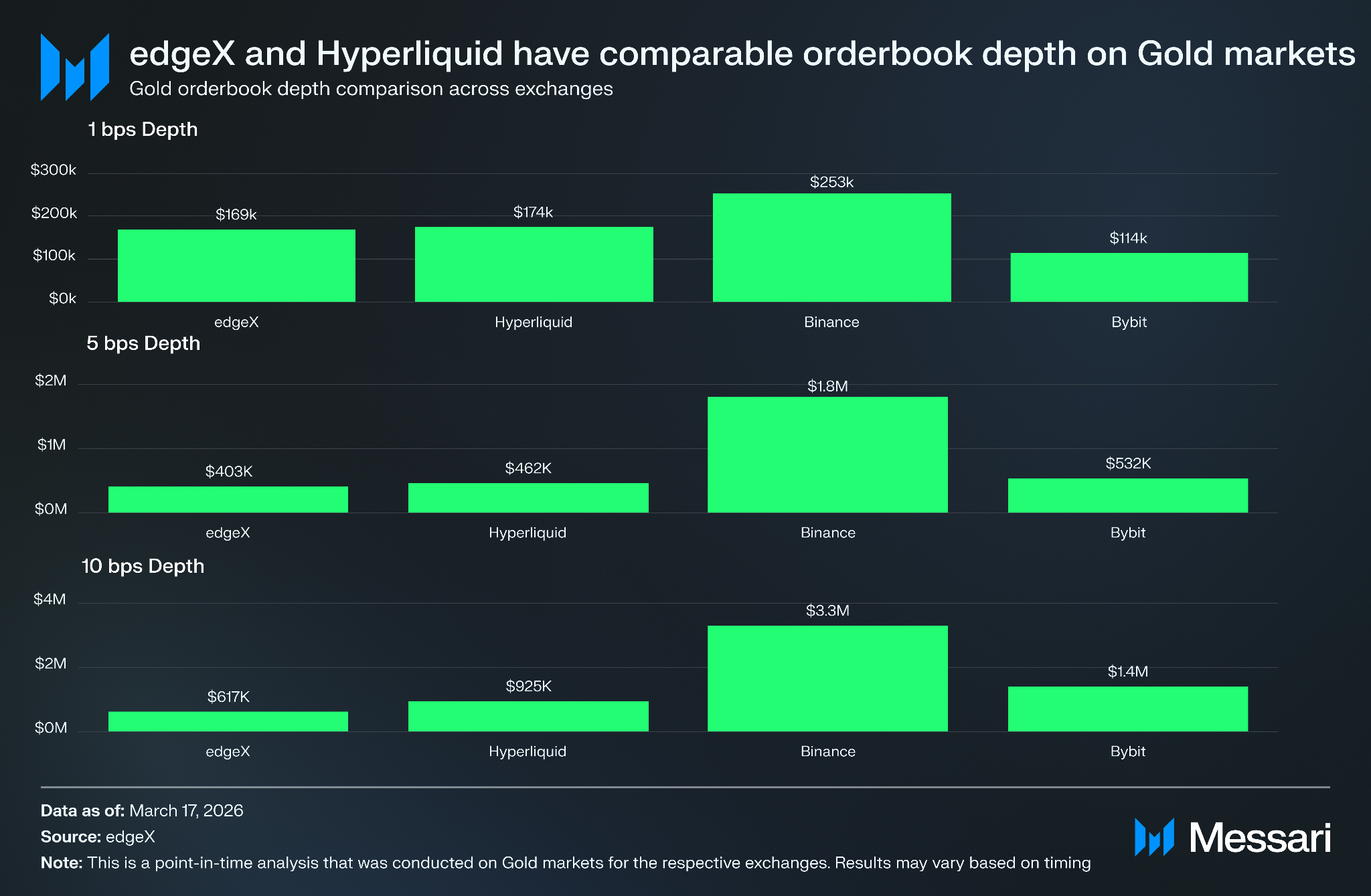
As edgeX expands into non-crypto asset classes, orderbook quality becomes a central measure of platform viability. To benchmark execution conditions, a point-in-time liquidity analysis was conducted on March 17, 2026, comparing edgeX’s Gold perpetual markets against the same contract on Hyperliquid, Binance, and Bybit. edgeX and Hyperliquid are both onchain perpetual decentralized exchanges (perp DEX), whereas Binance and Bybit are centralized exchanges (CEX). Depth and cost data were captured using the average orderbook observed over a one-hour window.
Orderbook Depth
At the tightest spread (1bps), edgeX posted $169,000 in resting depth, within 3% of Hyperliquid’s $174,000 and ahead of Bybit’s $114,000. Binance led the group at $253,000. The gap widened at 5 bps, where edgeX showed $403,000 compared to Hyperliquid’s $462,000 and Binance’s $1.8 million, and widened further at 10 bps ($617,000 vs. $925,000 on Hyperliquid and $3.3 million on Binance).
The 1 bps and 5 bps tiers matter most for active traders sizing into positions. Within those bands, edgeX’s depth was comparable to the largest perp DEX on the market, despite Gold being a relatively new listing. For traders executing standard clip sizes, the practical difference in fill quality between edgeX and Hyperliquid was negligible at the top of the book.
Execution Costs
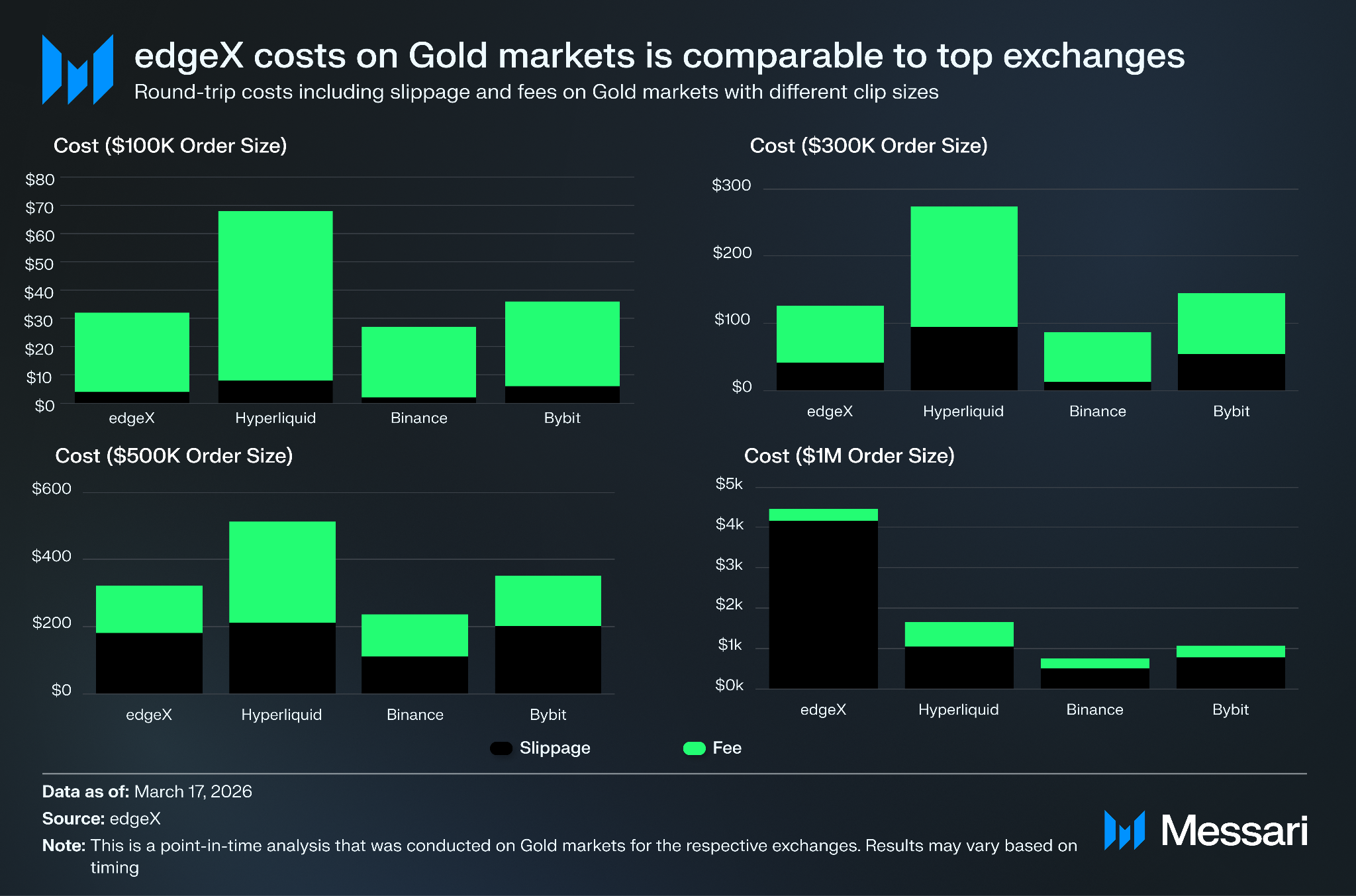
Total execution cost (slippage plus fees, where fees are the average of taker and maker rates) reinforces that picture at a moderate size. edgeX’s average fee rate of 0.028% is the second-lowest among the four venues, undercutting Hyperliquid (0.06%) and Bybit (0.03%). Binance does offer the lowest fees among the largest incumbent CEXs at 0.025%.
At a $100,000 clip, edgeX’s total round-trip costs were $32 ($4 slippage, $28 fees), compared to $68 on Hyperliquid, $27 on Binance, and $36 on Bybit. At $300,000, edgeX came in at $126 versus $274 on Hyperliquid, $87 on Binance, and $144 on Bybit. The fee advantage kept edgeX competitive through $500,000, where the total cost reached $321 compared to $511 on Hyperliquid.
Costs diverged meaningfully only at the $1 million mark, where edgeX’s thinner depth drove slippage to $4,170, pushing total costs to $4,450 versus $1,643 on Hyperliquid and $750 on Binance. That outcome is expected for a market still building liquidity provider depth at the tail end of the book. It represents an area where continued market maker onboarding should compress the gap over time.
Trading Activity
Perpetual Volume
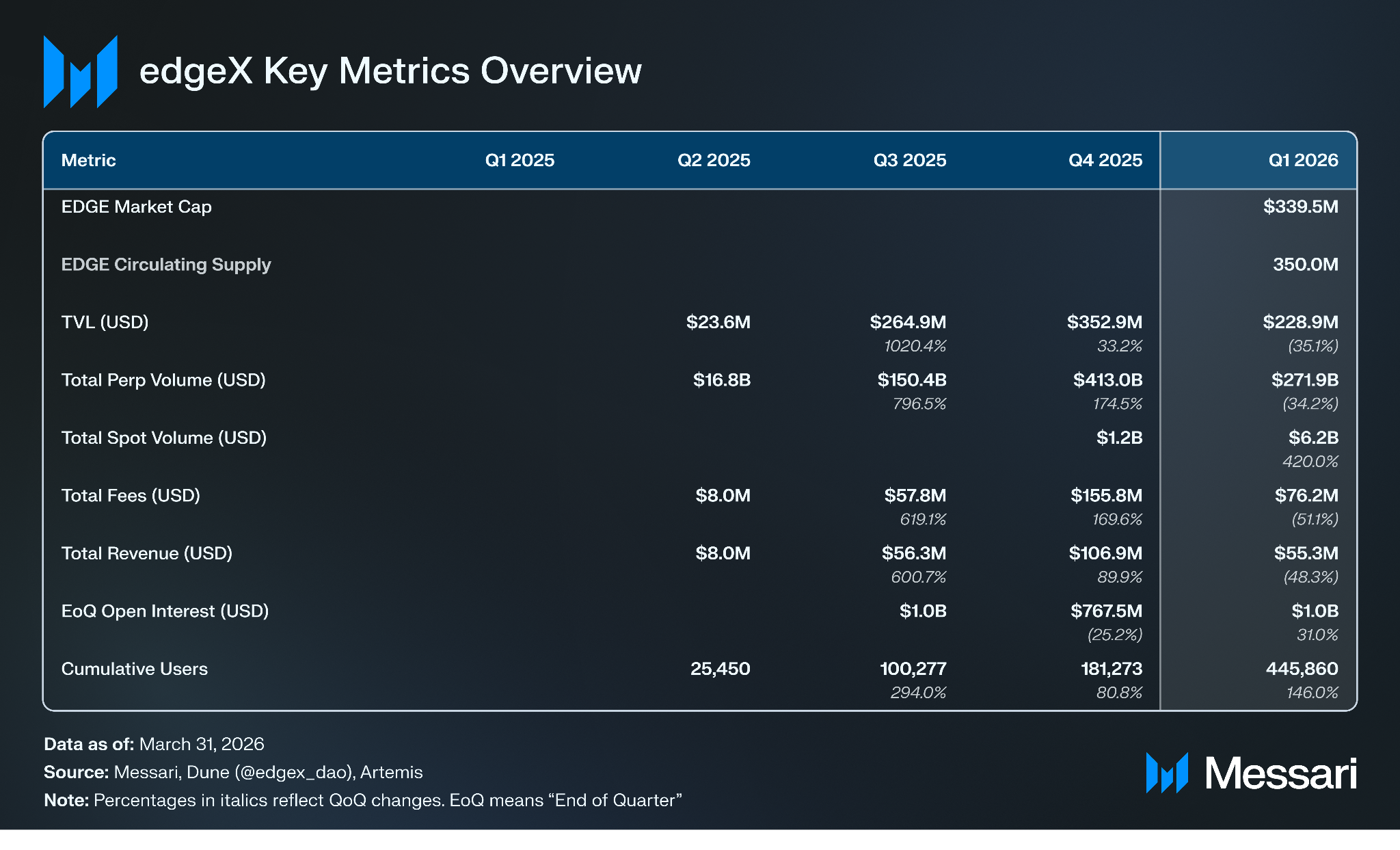
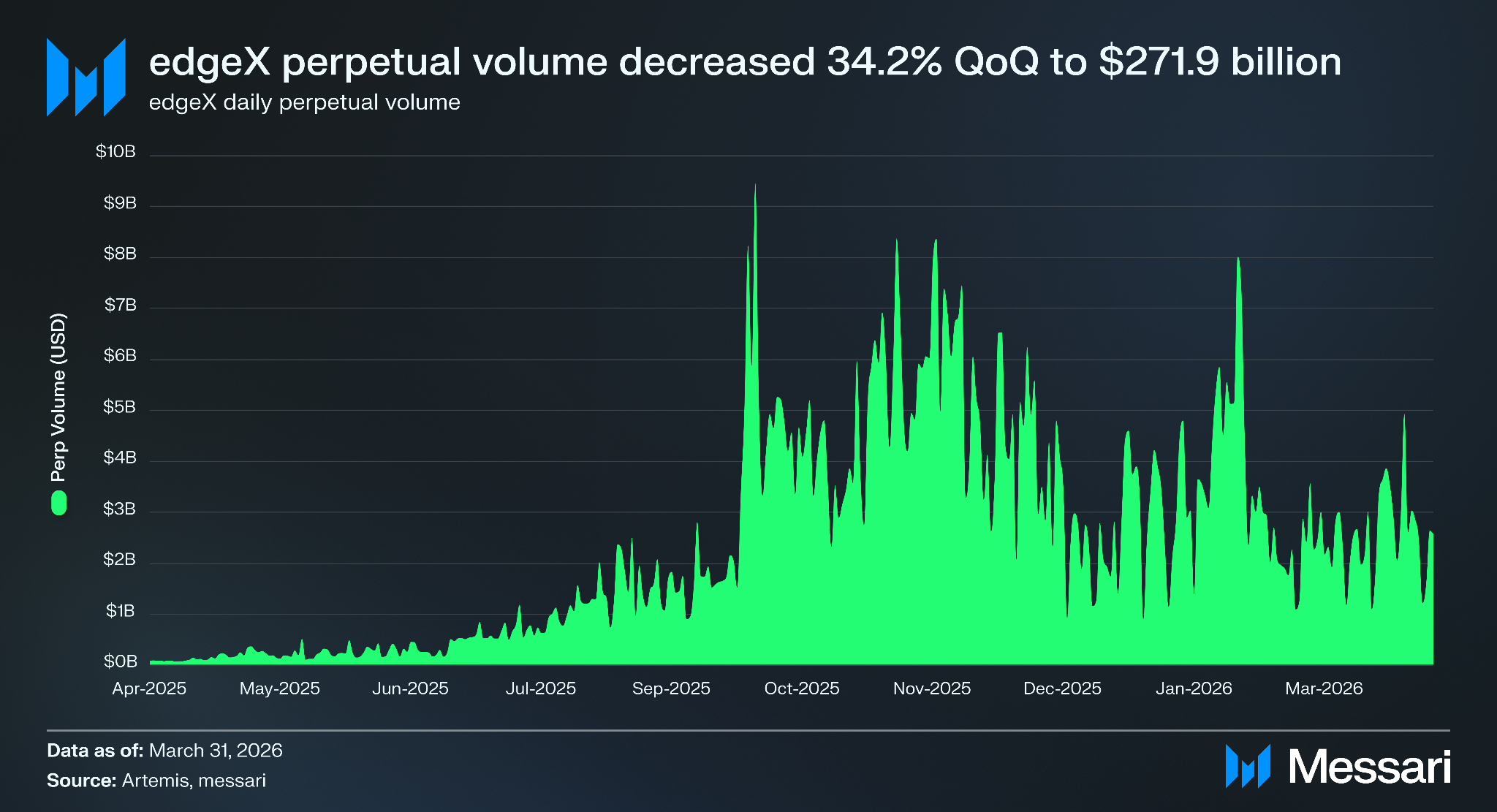
Cumulative perpetual volume on edgeX totaled $271.9 billion in Q1 2026, a 34.2% decline from $413.0 billion in Q4 2025. The pullback tracked a broader cooldown in crypto derivatives markets following the elevated activity of Q4.
The sequential decline, however, obscures the platform’s longer-term trajectory. Q1 2026 volume remained 80.7% above Q3 2025’s $150.4 billion, a quarter that marked the inflection point in edgeX’s growth curve. The platform’s daily average in Q1 was nearly double its Q3 2025 level ($3.0 billion vs. $1.6 billion), reflecting a structurally higher base of trading activity even as market conditions softened.
Market Composition
BTC and ETH remained the dominant pairs, generating $113.0 billion and $83.1 billion in cumulative Q1 volume, respectively, and combining for 76.7% of top-10 activity. SOL held third at $21.4 billion. Beyond the majors, the composition of the top 10 shifted meaningfully as edgeX expanded into non-crypto asset classes throughout the quarter.
Three non-crypto markets entered the top 10: XAUT (Gold) at $7.9 billion, SILVER at $7.1 billion, and NATGAS at $1.4 billion. Combined, these accounted for $16.4 billion in Q1 volume, 6.0% of total platform throughput, despite none existing on edgeX before late January. Equity perps launched on Jan. 19, 2026, starting with NVDA and SPY and expanding through February to include AAPL, TSLA, GOOGL, META, AMZN, and others. The first commodity perps (SILVER, COPPER) went live on Jan. 27, 2026, followed by Crude Oil and NATGAS on Feb. 5, 2026.
The traction in commodity markets was particularly notable. Gold and Silver each outpaced established crypto pairs like BNB ($4.5 billion) and DOGE ($5.1 billion) over the quarter. Continued global instability and the associated run-up in precious metal prices provided a macro tailwind: traders seeking exposure to safe-haven assets found a venue with 24/7 access and onchain settlements. NATGAS volume accelerated after the onset of the Iran-U.S. conflict on Feb. 28, 2026. Key escalations landed on weekends, when traditional commodity venues were closed, giving edgeX's 24/7 trading window a structural edge in capturing real-time positioning.
Asset Class Diversification
Non-crypto volume on edgeX went from zero to a meaningful share of platform activity during Q1 2026. Before Jan. 22, 2026, 100% of perpetual volume was crypto-denominated. By end of quarter, the daily non-crypto share averaged 17.8%, up from 10.5% in February and 1.3% in the final 10 days of January. On March 3, 2026, non-crypto assets accounted for 43% of daily volume, the highest single-day reading of the quarter.
The acceleration in February coincided with edgeX’s Commodities Season incentive program, announced on Feb. 11, 2026, which allocated $100,000 USDT and 1 million MARU tokens to commodity market activity. The program achieved its intended effect: non-crypto share jumped from single digits in early February to a sustained 10-20% range through the rest of the quarter, with spikes above 20% on days when precious metal volatility peaked.
The trajectory suggests a structural shift in edgeX’s volume composition rather than a temporary incentive-driven bump as additional non-crypto markets come online across equities, commodities, and indices. KF, the founder of edgeX, noted during Messari’s Q4 2025 call that non-crypto volume could feasibly exceed crypto volume on the platform by year-end. Given the pace of listings and the macro environment sustaining commodity demand, that threshold is within reach if edgeX maintains its current onboarding cadence.
Spot Volume
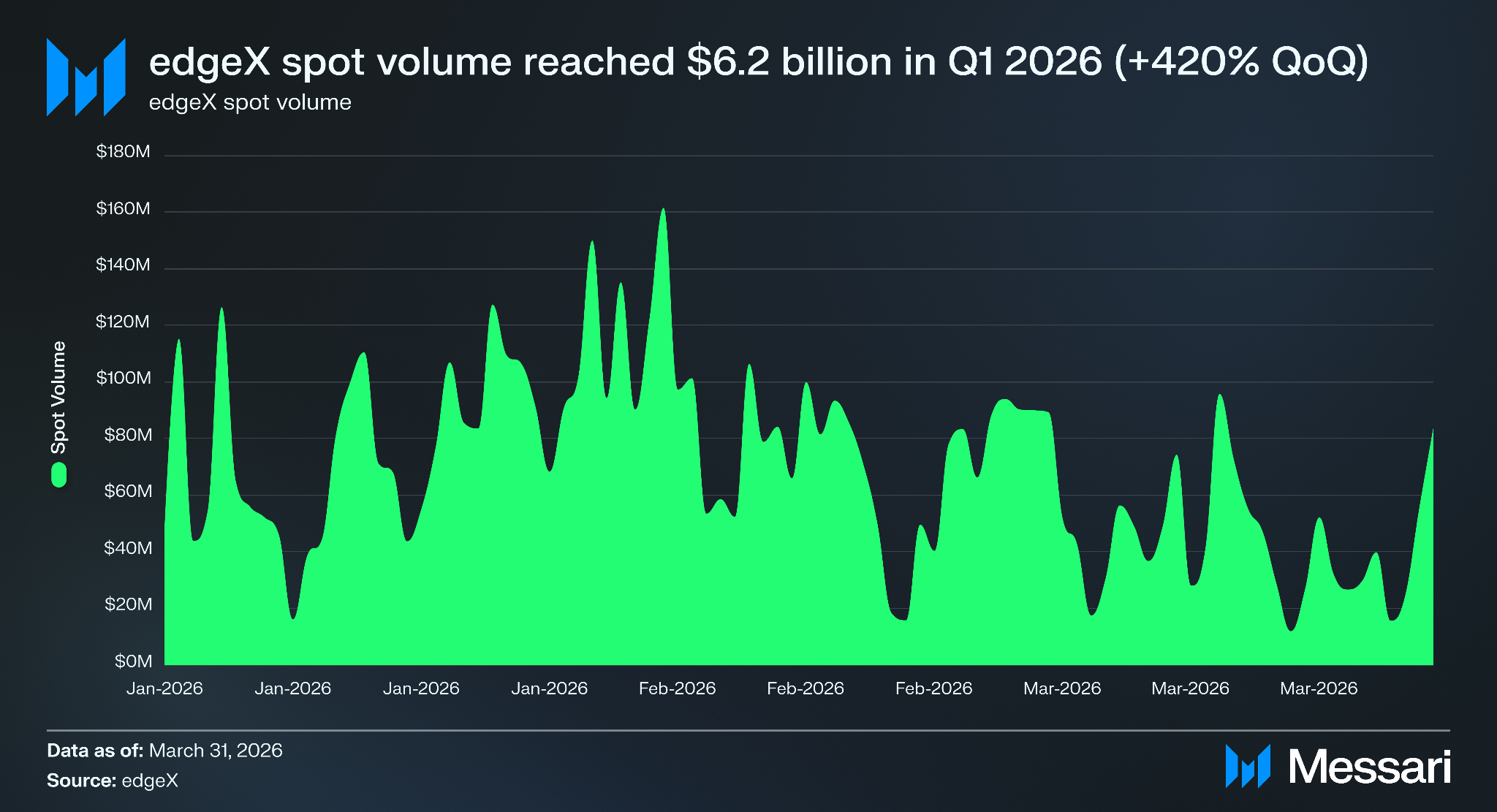
Spot volume on edgeX totaled $6.2 billion in Q1 2026, a 420.0% increase from $1.2 billion in Q4 2025. The spot market currently lists four assets: ETH, MARU, LIT, and EDGE, the last of which launched on March 31, 2026. Daily averages held steady through January ($78.5 million) and February ($79.4 million), then declined to $49.6 million in March as broader activity cooled. March 31 bucked the trend, with $84.0 million in spot volume, as the native token, EDGE, held its token generation event, driving a late-quarter spike.
Spot remains a small fraction of total platform volume at 2.2% of combined Q1 throughput, consistent with edgeX’s positioning as a derivatives-first venue. The 420% QoQ increase, however, reflects the early-stage growth of a market vertical that did not exist on a meaningful scale until Q4 2025. As the spot catalog expands and the EDGE token establishes secondary market liquidity, spot volume has room to grow as a complement to edgeX’s core perpetual business.
Protocol Performance
Fees and Open Interest
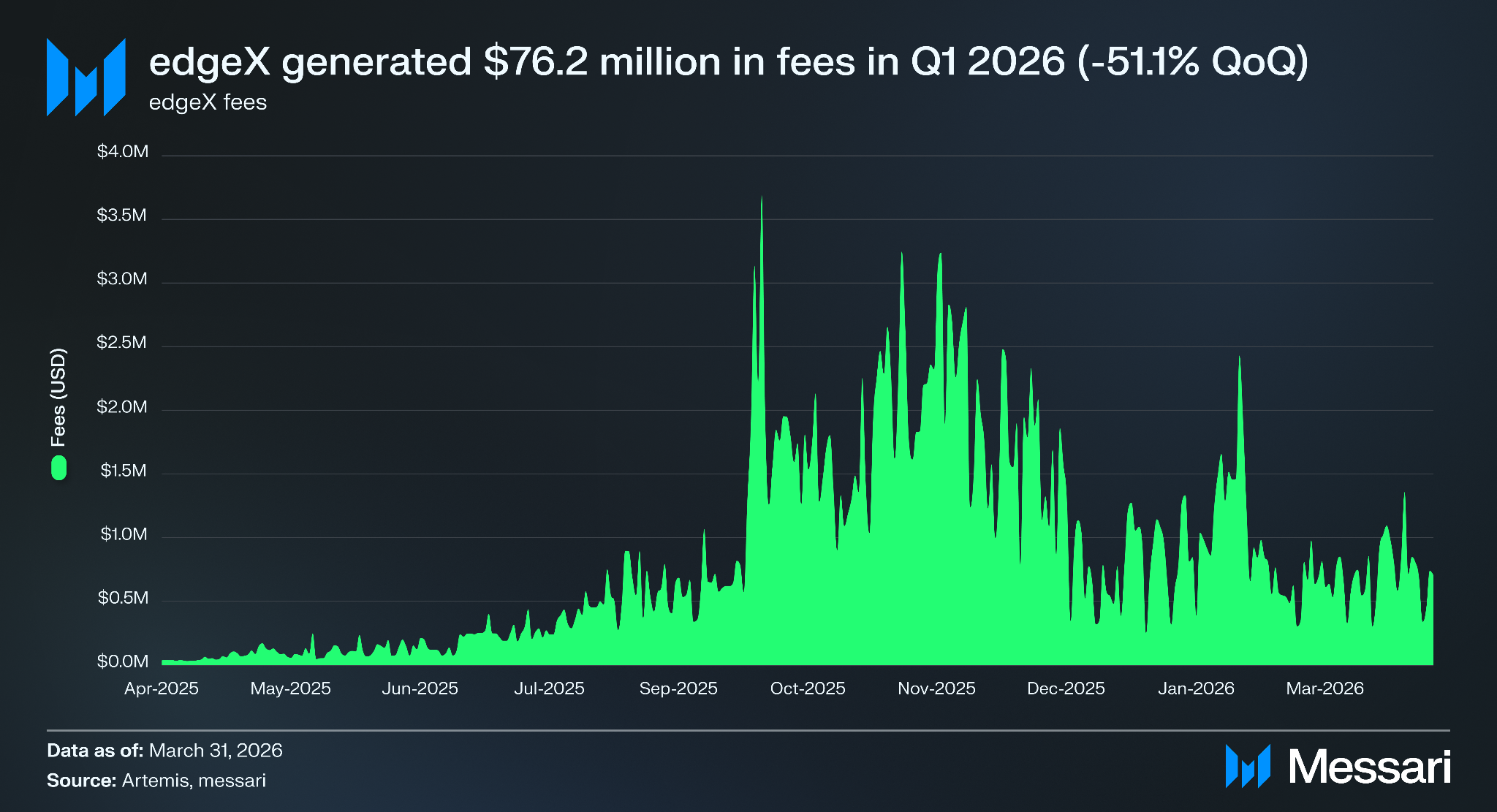
edgeX collected $76.2 million in trading fees during Q1 2026, a 51.1% decline from $155.8 million in Q4 2025. The drawdown tracked the 34.2% decrease in perpetual volume, compounded by a lower effective fee rate as newly listed non-crypto markets with competitive pricing pulled the blended rate from 0.038% to 0.028%. All fees accrue directly to the edgeX protocol treasury and are used to buy back EDGE. The platform employs a tiered maker-taker fee model based on a trader’s rolling 30-day volume, with tiers updating daily. Maker orders, which add liquidity to the order book, are charged lower fees than taker orders, which remove liquidity. Volume across sub-accounts aggregates at the account level, allowing active users to unlock lower tiers as their activity scales. Perpetual fees range from 0.018% maker / 0.038% taker for non-VIP users down to 0.000% maker / 0.024% taker at the highest volume tier. Spot fees range from 0.040% maker / 0.070% taker down to 0.000% maker / 0.025% taker.
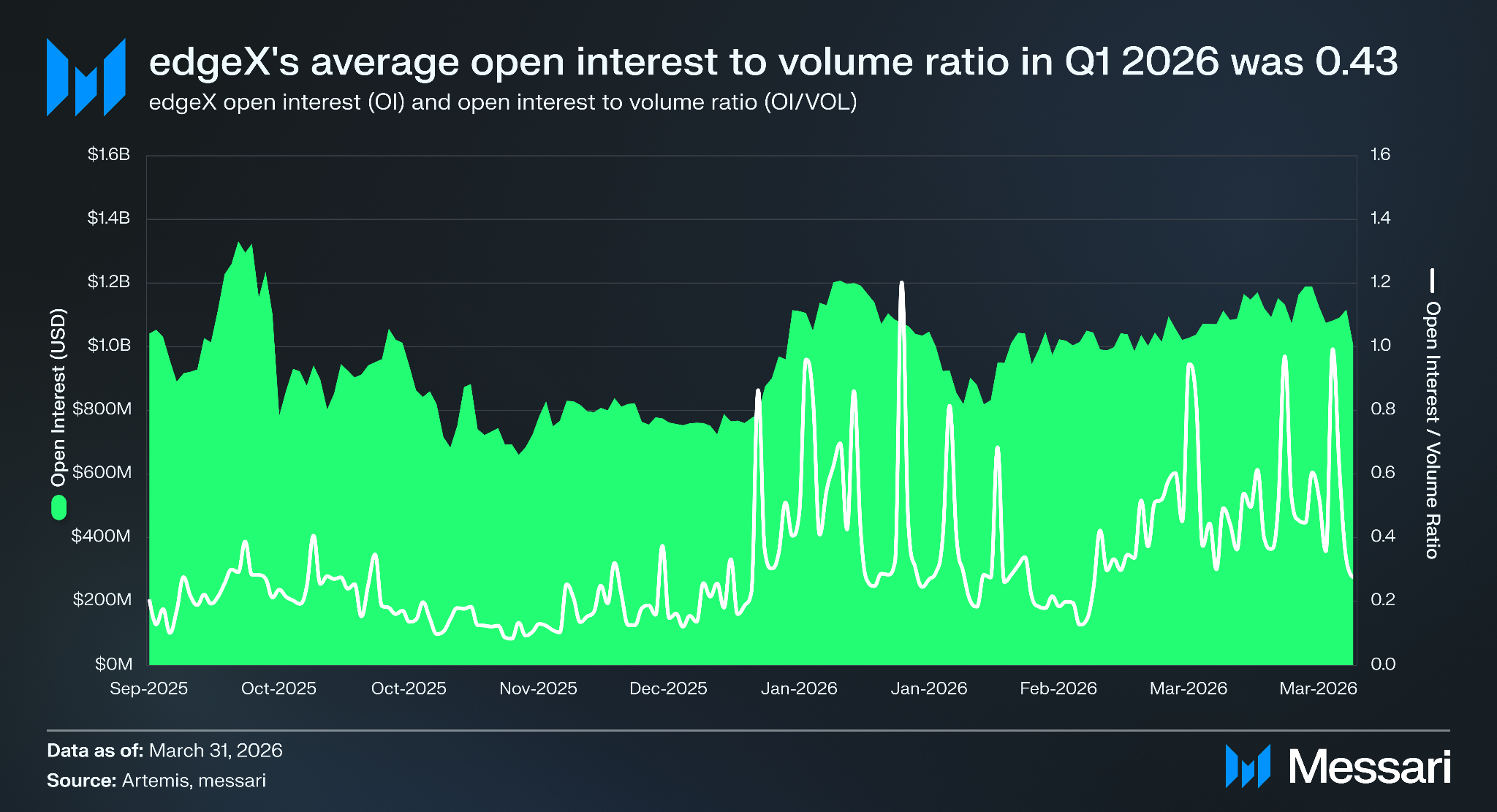
Average open interest on edgeX rose 19.7% QoQ to $1.0 billion in Q1 2026, from $867.8 million in Q4 2025. Open interest peaked at $1.2 billion in mid-January before stabilizing in the $1.0-$1.1 billion range through February and March.
The divergence between rising open interest and declining volume produced a meaningful shift in the open interest/volume (OI/VOL) ratio, which averaged 0.43 in Q1 2026, nearly double the 0.23 average in Q4 2025.
A rising OI/VOL ratio signals that traders are holding positions longer rather than frequently entering and exiting. As short-term, incentive-driven capital rotated off the platform through Q1, edgeX’s core user base came into sharper focus: traders who size into directional views and hold them, rather than churning for rewards. The result is a healthier composition of open interest, anchored by users who engage with the platform on its execution merits. For a derivatives venue, this is a constructive signal. Sustained open interest from a loyal trading base indicates that users trust the platform’s execution quality and liquidation engine enough to maintain exposure over multi-day and multi-week horizons, a prerequisite for attracting institutional flow. As edgeX continues onboarding non-crypto markets with inherently longer holding periods, the OI/VOL ratio may continue to structurally trend higher as the platform’s user composition matures alongside its product offering.
TVL and User Growth
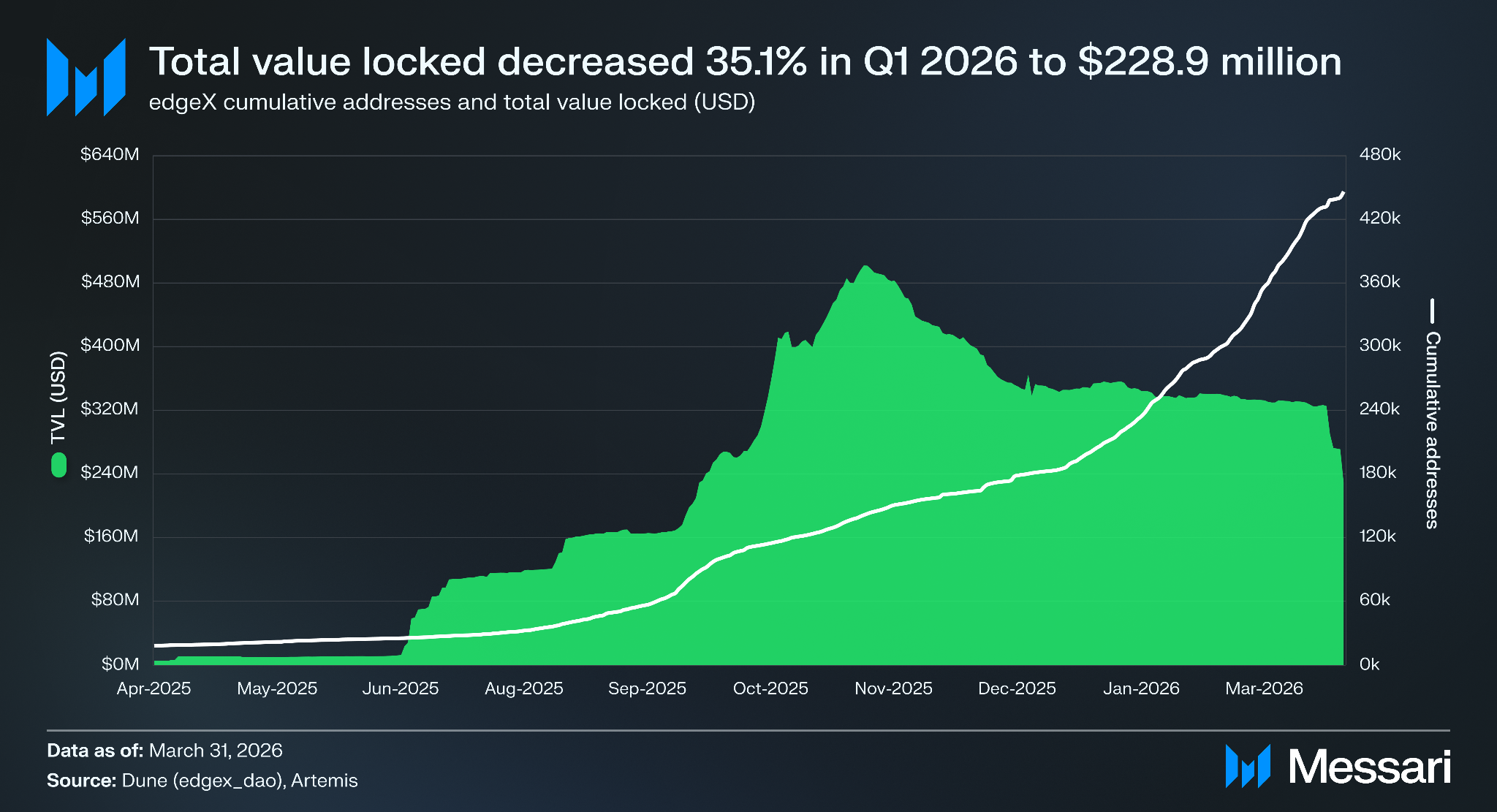
TVL on edgeX ended Q1 2026 at $228.9 million, a 35.1% decline from $352.9 million at the end of Q4 2025. TVL held relatively steady through January and February, averaging $349.7 million and $338.7 million, respectively, before declining sharply in late March as the platform approached TGE. By quarter-end, deposits had settled to a baseline that more accurately reflects edgeX’s retained trading community.
User growth told the opposite story. Cumulative addresses reached 445,860 by March 31, 2026, a 146.0% increase from 181,270 at the end of Q4 2025. edgeX added 264,590 new addresses during the quarter, averaging 2,940 per day, more than triple the 880 daily average in Q4. Two catalysts drove the acceleration. The Polymarket integration, which went live on Feb. 26, 2026, brought a new subset of prediction market users onto edgeX for the first time, contributing to the step-up in daily registrations through March. Simultaneously, the expansion into equity and commodity perps attracted traders who had not previously engaged with perpDEXs but were drawn by 24/7 access to RWA markets with the execution quality outlined in the Market Microstructure section of this report.
Net Flows
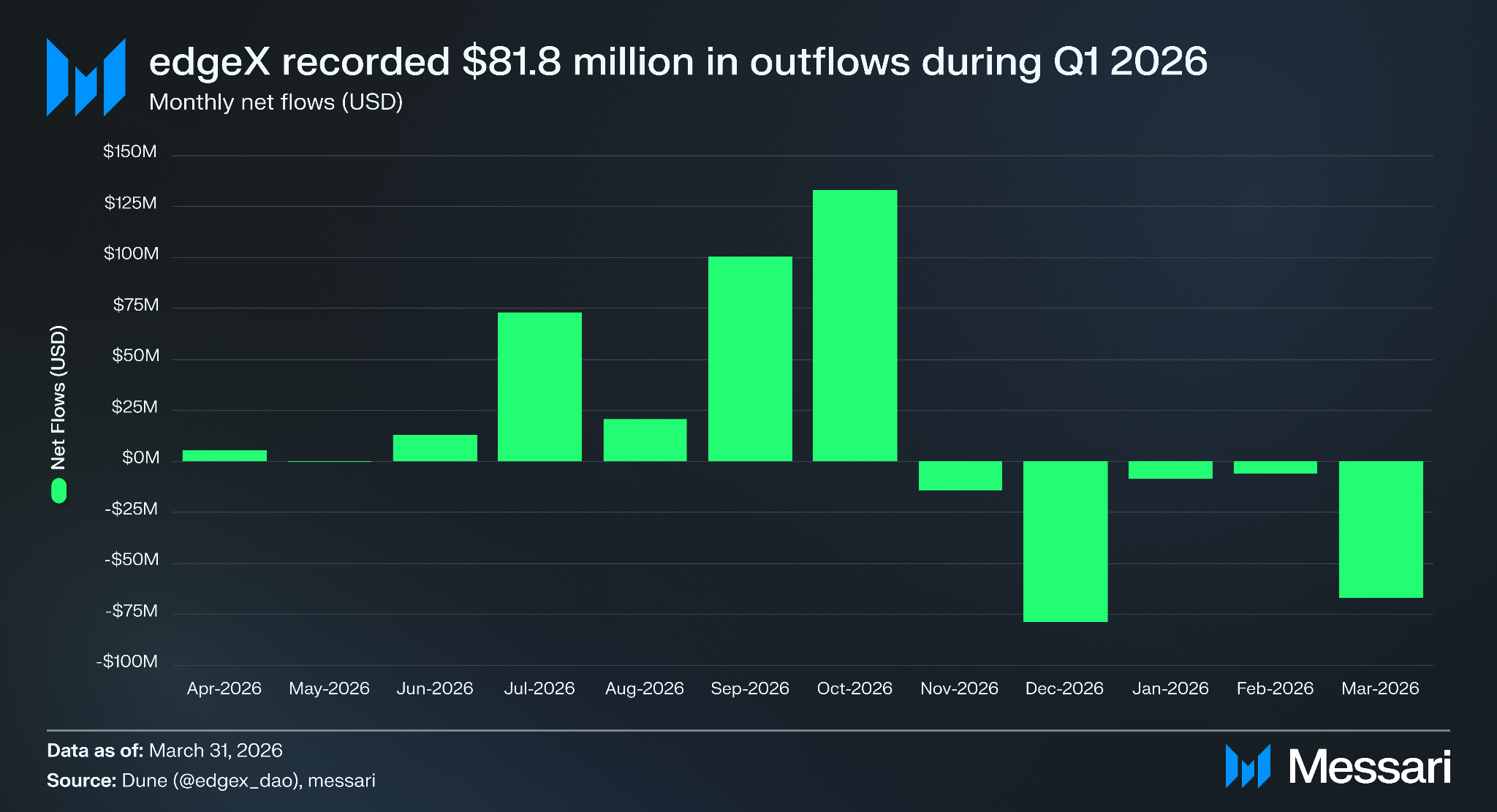
Net flows on edgeX were negative for a fifth consecutive month, with Q1 2026 recording $81.8 million in cumulative outflows ($329.8 million in deposits against $411.6 million in withdrawals). The outflow trend began in November 2025 as incentive-driven capital started rotating off the platform, and continued through the quarter as edgeX transitioned from its pre-TGE growth phase to a more organic footing.
A strategic investment from Circle Ventures, announced on Feb. 10, 2026, set the stage for a structural improvement in deposits to edgeX. The partnership brought native USDC and Cross-Chain Transfer Protocol (CCTP) support to EDGE Chain, which went live on March 10, 2026. On March 25, 2026, edgeX launched a native USDC rewards program offering 10% APR on the first $30 million deposited on the platform, giving idle stablecoins a yield component alongside active trading. As deposit caps increase, the program creates a compounding incentive for new capital. Users can trade across edgeX’s expanding market catalog while earning yield on their undeployed stablecoins, a combination that few perpDEXs currently offer.
With the pre-TGE incentive cycle now complete and the platform’s retained user base established, the sustained outflow trend should moderate in Q2. The core depositor base that remained through Q1 is users engaged with edgeX on its trading merits. Rising monthly deposit inflows, native USDC infrastructure, and stablecoin yield incentives provide multiple vectors for deposit growth as caps expand and additional markets come online.
EDGE TGE
EDGE went live on March 31, 2026, listing on edgeX alongside Coinbase, Binance, Bybit, Gate.io, KuCoin, MEXC, and Bitget. The token reached a fully diluted valuation of $970 million on launch day. edgeX also listed EDGE as a perpetual market with up to 30x leverage, making the platform both the asset's issuer and primary trading venue. Since launch, the team has conducted EDGE buybacks, with activity trackable via the edgeX buyback dashboard.
On April 15, 2026, the edgeX team published an RFC outlining proposed utility for the EDGE token through a staking and delegation framework tied to EDGE Chain governance. Under the proposal, EDGE holders would delegate stake to node operators, with the top-ranked operators by delegated stake forming the Guardian Committee for each epoch. The committee would assume two responsibilities: data guardianship (storing and attesting to EDGE Chain transaction data) and withdrawal guardianship (collectively approving crosschain withdrawals to reduce delays typical of rollup designs).
Beyond governance, the RFC proposes three additional utility mechanisms: protocol revenue participation for stakers, trading fee discounts for holders who meet unspecified thresholds, and onchain governance participation in a later phase. Users would be able to stake directly from their edgeX trading account without withdrawing to an external wallet or paying gas fees.
The RFC is open for community feedback and subject to revision before implementation.
Closing Summary
Q1 2026 marked edgeX’s transition from incentive-driven growth to organic platform maturity. The quarter's defining development was the expansion into equity, commodity, and index perps, which took non-crypto volume from zero to 17.8% of daily activity in March. Gold and Silver outpaced established crypto pairs like BNB and DOGE by cumulative volume despite launching mid-quarter. Spot volume surged 420% QoQ to $6.2 billion. User growth accelerated to 2,940 new accounts per day, more than tripling Q4's pace and pushing cumulative addresses past 445,000. Open interest rose 19.7% to $1.0 billion as retained traders held positions with greater conviction. Those organic gains came even as topline figures cooled, with perpetual volume declining 34.2% QoQ to $271.9 billion, fees falling 51.1% to $76.2 million, and TVL settling at $228.9 million as short-term capital rotated out amid a broader cooldown in the derivatives market.
The foundation for Q2 growth is already in place. EDGE Chain went live on Arbitrum, the EDGE token launched across seven major exchanges, reaching a $970 million valuation, and the team moved quickly toward defining a long-term token utility through the Guardian Committee and staking RFC. With the pre-TGE incentive cycle behind it, edgeX’s deposit base now reflects genuine trading demand rather than reward-driven capital, and monthly inflows grew throughout Q1 even as net flows remained negative. The platform’s demonstrated execution quality on non-crypto markets, competitive with Hyperliquid at the top of book and cheaper on a round-trip basis at standard clip sizes, positions edgeX to capture an expanding share of onchain derivatives activity as additional asset classes come online.
This report was commissioned by edgeX. All content was produced independently by the author(s) and does not necessarily reflect the opinions of Messari, Inc. or the organization that requested the report. The commissioning organization may have input on the content of the report, but Messari maintains editorial control over the final report to retain data accuracy and objectivity. Author(s) may hold cryptocurrencies named in this report. This report is meant for informational purposes only. It is not meant to serve as investment advice. You should conduct your own research and consult an independent financial, tax, or legal advisor before making any investment decisions. Past performance of any asset is not indicative of future results. Please see our Terms of Service for more information.
No part of this report may be (a) copied, photocopied, duplicated in any form by any means or (b) redistributed without the prior written consent of Messari®.
Eric is a research analyst at Messari and an ambassador for Maple Finance. He previously was a Product Manager for FINTRX and is passionate about DeFi and AI.
Eric is a research analyst at Messari and an ambassador for Maple Finance. He previously was a Product Manager for FINTRX and is passionate about DeFi and AI.