In Q2 2022, outstanding loans and deposits fell 77% and 70%, respectively.
Adjusted net income grew 66% in the quarter.
Protocol utilization fell to new lows of 27.3%.
Compound Labs distributed a Compound III code repository for developers and auditors.
Integration of Aztec Connect, a ZK-Rollup scaling solution to reduce gas fees and enable privacy.
A Primer to Compound
Launched in September 2018, Compound is a leading interest rate protocol that enables users to permissionlessly borrow and lend assets from a pool of collateral. The interest rates for these assets are set algorithmically using an interest rate model based on the proportion of assets lent out. This is known as the utilization ratio. Compound launched its V2 protocol in May 2019, introducing additional assets, individual risk models, and smart contract gateways for each asset, among other features. In April 2020, Compound replaced the administrator of the protocol with community governance, empowering COMP tokenholders to take control of the protocol. In June 2020, Compound began distributing COMP to users via a pioneering liquidity mining program. The program reserves 42% of the total COMP supply to be distributed to users over the next four years.
The total crypto market cap fell by roughly 56% from ~$2.05 trillion in Q1 to ~$901 billion in Q2, the lowest value since January 31, 2021. Aside from broader macroeconomic factors, a few negative catalysts specific to crypto include the ~$18 billion collapse of UST in May and prominent crypto hedge fund Three Arrows Capital (3AC) in June. Despite these idiosyncratic events, decentralized finance (DeFi) lending protocols were stress tested and proved to be resilient compared to their centralized counterparts.
Performance Analysis
Compound Markets - Macro Overview
Compound’s key performance indicators (KPIs) continued to trend downward in Q2 2022, with many eventually reaching new all-time-lows.
Outstanding loans and outstanding deposits both reached new all-time-lows during Q2; loans declined 77% from $3.5 billion in Q1 to a modest $812 million in Q2 while deposits declined 70% from $9.7 billion to ~$3 billion.
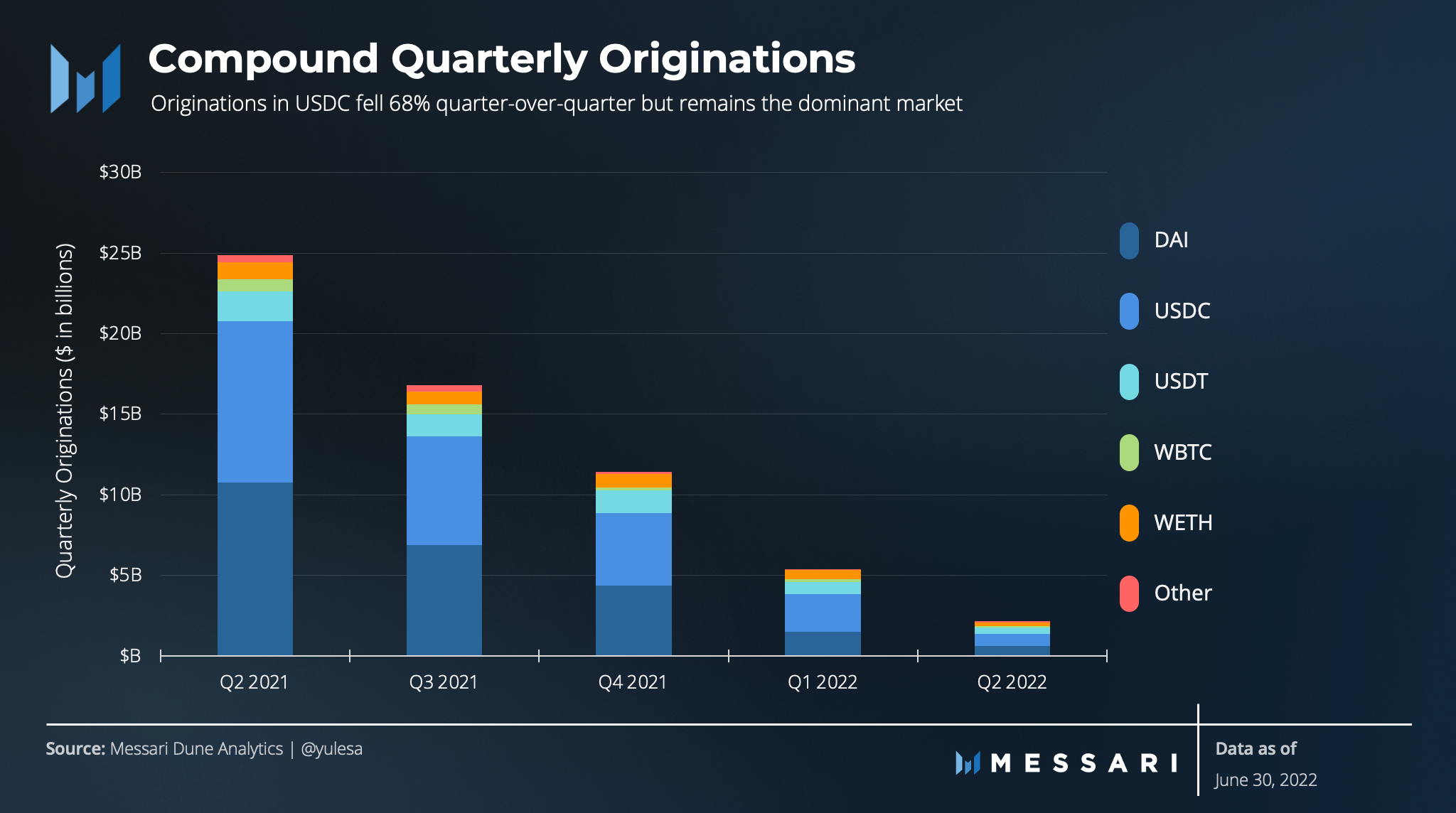
The market’s lack of demand for leverage was further evidenced by a 60% drop in quarterly loan originations, a figure that is now down 11x since Q2 2021. Quarterly deposits were at an all-time-low of $6 billion in the trailing twelve months (TTM). Similar to the previous quarter, liquidations were the only category to see any growth with a 71% increase from Q1.
Despite the declining financial figures in Q2, the increased liquidations allowed Compound’s net income to still grow 11%. Subsequently, adjusted net income, which is net of token incentive fees paid, grew 66%. The positive impact to the bottom line is largely due to the 50% reduction in COMP incentives through Proposal 092.
Annualized borrower interest rates peaked to 4.32% at the beginning of Q2 then bottomed out at 2.21% towards the end of the quarter. The cost of borrowing is directly correlated with the decline in loan demand and the bearish sentiment felt across the crypto market. The average annualized interest rate hovered around 3.12%, down from 3.85% in Q1. Rates decreased as users’ demand for leverage decreased during the market cool-off in Q1.
Given the current market sentiment coupled with the halving of COMP incentives, the protocol has been bleeding deposits. Outstanding deposits fell 31% in Q2 and were down 79% year-to-date. For the first time, USDC overtook WETH as the favored form of deposits in the quarter, likely a result of Ethereum losing 71% of its value year-to-date.
Annualized depositor interest rates fell to 0.58% in the quarter, its lowest since launch. The average quarterly depositor interest rate was 0.95%, down from 1.51% in Q1. Depositor interest rates peaked at 1.52%, with the average annualized rates down 51% year-to-date.
The overall loan appetite relative to supply has diminished since Q4 2021. Compound’s aggregate utilization ratio has declined rapidly, shedding 35% year-to-date. In Q2, utilization saw its lowest at 27.3%, coinciding with fears of a recession and the overall market experiencing turmoil.
The decline was further evidenced by a 61% decline in interest income from Q1 2022. This figure fell by 82% year-to-date, with USDC, WBTC, and DAI accounting for 86%, 84%, and 82%, respectively. Interest income fell over 50% for the second consecutive quarter and is largely driven by the decreased demand for loans.
Similar to interest income, protocol income fell 63% from $5 million to $2 million. DAI was down 67% quarter-over-quarter, which is responsible for over 53% of protocol income in Q2.
Total originations were down 60% in the quarter, led by USDC with a $2.9 billion or 68% loss in new loans. WBTC, DAI, and WETH all experienced losses of over 50% with 62.6%, 59.5%, and 54.2%, respectively. USDC and DAI are closing the gap in the dominance in origination volume with $0.8 million and $0.6 million, respectively.
As the overall markets experienced volatility, liquidations on Compound gained steam. In Q2, liquidations grew to $229 million, up from $134 million in Q1. This activity was fueled by liquidations across the WBTC and WETH markets resulting in increases of 687% and 56%, respectively. WBTC liquidations grew from $6.6 million in Q1 to $52 million in Q2. WETH markets accounted for $166 million in liquidations over the quarter while USDC liquidation volume shrank from $18 million in Q1 to $3 million in Q2.
Governance passed Proposal 092 at the end of Q1. It would reduce COMP incentives by 50% with plans to eliminate incentive rewards. Although plans to eliminate the rewards entirely failed, these incentives are a key driver of depositor and borrower activity. As expected, COMP token incentives fell by 66% in Q2, compared to 52% in Q1.
Micro Overview - Compound’s Five Largest Markets
Quarter-over-quarter, the DAI market continued to see declines in a majority of its performance indicators. However, DAI continued to be the favored denomination for outstanding loans YTD despite falling by 80% to $291 million in Q2. DAI lost its dominance in outstanding deposits to USDC, declining from $1.7 billion to $394 million in Q2. Both interest and protocol income are areas where DAI met or exceeded metrics compared to other markets. Quarterly originations were down 60% from $1.5 billion in Q1 to $604 million in Q2 but fell at a slower rate than the prior quarter. DAI liquidations ballooned 226% to $0.1 million mostly due to a lack of liquidations in the prior quarter.
The utilization ratio fell over 60% quarter-over-quarter from 75.4% in Q1 to 26.7% in Q2. Naturally, this caused the average annualized interest rate to fall from 4.12% in Q1 to 3.31% in Q2. For the first time, borrower interest rates fell below 2.5%, dropping to 2.27% after peaking at 5.05% early in the quarter.
DAI has lost substantial loan market share to USDT in the quarter, whereas USDC was the main contender in Q1. Loans denominated in DAI and USDT currently comprise 36% and 35% of all loans outstanding, respectively.
USDC has generally been the de facto fiat-backed stablecoin on Compound for both deposits and loans. However, in Q2, USDC lost its standing behind DAI to USDT in loans outstanding. Deposits outstanding in USDC continued to be the second largest market. It’s worth noting USDC experienced the largest decline across all markets, falling from $1.3 billion in Q1 to $189 million in Q2, or 86%. Deposits outstanding fell to historically low levels of $709 million, or 59%.
The overall decline in both loans and deposits heavily impacted the utilization ratio, declining from 76% utilization in Q1 to just 27% in Q2.
The USDC borrowing fell to its lowest rate below 1% but managed to close the quarter at 1.15%. Borrower rates experienced a high of 3.94% early in the quarter and had an average annualized rate of 2.52% in Q2. As users adjusted to current market conditions, USDC took the lead in total deposits outstanding, pushing DAI into second place.
Similar to the prior quarter, outstanding loans and deposits in USDT fell modestly compared to DAI and USDC. Loans denominated in USDT declined 49%, from $555 million in Q1 to $283 million in Q2. Subsequently, deposits fell 41% from $663 million to $394 million.
Utilization rates in USDT maintained the highest levels across all markets at 72% with average annualized borrower rates of 3.4%. USDT rates peaked at 4.87% in early April before hitting a floor of 2.58% in Q2.
The USD value of outstanding deposits in WBTC continued to plunge in Q2, falling from $1.6 billion in Q1 to $643 million in Q2. In contrast, the amount of native units in WBTC deposits quarter-over-quarter declined by 6%. The USD value of outstanding loans declined 74%, dropping to $13 million in Q2 compared to a 38% decline in native units in WBTC.
Historically, WETH was the leading form of deposits in Compound. However, USDC took over the leaderboard in Q2. Outstanding deposits fell 80% from $3.5 billion in Q1 to $686 million in Q2, whereas native deposits fell by 38%. Unlike the other top five markets, outstanding deposits in WETH declined more rapidly than outstanding loans. WETH loans denominated in USD fell by 63%, to $28 million, whereas loans in the native WETH grew by 18%. The growth in users deciding to borrow WETH during times of volatility could be a positive signal in the near term, especially compared to its WBTC counterpart. Compared to other markets and the protocol as a whole, the WETH utilization ratio improved by 86% to a 4.1% utilization. The reeling markets continued to perpetuate WETH liquidations, growing 56% from $106 million in Q1, to $166 million in Q2.
Qualitative Analysis
Governance & Key Events:
With the help of governance and partnerships from Gauntlet and OpenZeppelin, the Compound markets incorporated modifications in the quarter. These protocol integrations include collateral factor adjustments across seven markets, reducing the borrow limit on the MKR market, cToken implementations, and the grant made to Aztec.
Aztec Connect
Governance passed Proposal 105 granting Aztec $100,000 to subsidize deposits into Compound with $50,000 distributed upfront and the remaining $50,000 to be released three months after launch. Aztec Connect is a ZK-Rollup scaling and privacy solution that may reduce gas costs by ~95% compared to Ethereum mainnet. Additionally, its zero-knowledge nature will enable users to deposit and borrow privately.
Grants Program Overview
Version 1.0 of the Compound Grant Program successfully funded over $1 million across 30 grants. The second iteration, CGP 2.0, is currently being designed with the vision to build the best community-led organization possible. The protocol would like to staff a full-time team to develop clear communication processes that enable more transparency and encourage participation across the community. However, the CGP continues to be inactive in Q2, due to a lack of focused resources.
At the end of Q4 2021, OpenZeppelin was selected to offer the Compound DAO security services including continuous audit, security advisory, and monitoring. At the start of every quarter OpenZeppelin will create a proposal to update the service fee payment.
Proposal 108 – Risk Parameter Updates for Five Collateral Assets
The proposal made updates to the following assets: cUSDC collateral factor from 82.5% to 84.0%; cLINK collateral factor from 77.0% to 79.0%; cSUSHI collateral factor from 70.0% to 73.0%; cAAVE collateral factor from 70.0% to 73.0%; and cYFI collateral factor from 73.0% to 75.0%
Proposal 107 – Risk Parameter Updates for Five Collateral Assets
The proposal made updates to the following assets: cDAI collateral factor from 80.0% to 82.5%; cLINK collateral factor from 75.0% to 77.0%; cMaker collateral factor 70.0% to 73.0%; cUSDC collateral factor from 80.0% to 82.5%; and cYFI collateral factor from 70.0% to 73.0%
Proposal 105 – Grant Request for Launching Compound with Aztec Connect
A $100,000 grant awarded to Aztec to subsidize deposits into Compound for the integration of Aztec Connect, a ZK-Rollup scaling solution. Users will be able to deposit and borrow from Compound with significant gas savings while enabling privacy. These new features will bring confidence with privacy and will help attract users who were deterred by costly gas fees.
This proposal brings the following cTokens (cUSDT, cDAI, and cWBTC2) up to the new implementation. It also grants $350,000 worth of COMP to Equilibria for the upgrade work and 79,764.36 USDC to Compound Labs for performing the ChainSecurity.
Proposal 103 – Risk Parameter Updates for MKR and AAVE
The proposal made updates to the following assets: cAAVE collateral factor from 65.0% to 70.0% and cMKR collateral factor from 65.0% to 70.0%.
OpenZeppelin completed auditing the Compound Deployed Contracts and finalized the cToken Refractor Audit. OpenZeppelin will be focusing on improving the security of the Proposal Process and Asset Listings, as well as aiming to release an initial solution on Security Monitoring by end of March
This proposal brings the following cTokens (cUSDP, cSUSHI, cYFI, cAAVE, and cFEI) up to the new implementation.
Roadmap
Compound III (Comet)
The discussion for a new multichain version, Compound III, has been brewing since early this year. At the end of Q2, Compound Labs released a code repository to the community to help form a basis of a multichain strategy. This allows developers to begin integrating, auditing and suggesting any improvements to the codebase.
The goal of Compound III is to create a more gas- and capital-efficient platform cross-chain while simplifying governance. A few major changes from the existing protocol include:
Featuring a single borrowable base asset (USDC) that is interest bearing
Using all other assets as collateral, reducing risk and increasing capital efficiency
Separating of borrowing and liquidity collateral factors
Closing Summary
DeFi proves to be resilient during times of unprecedented volatility. Where select centralized lenders failed in transparency and lack of risk management practices, DeFi lending protocols demonstrated the versatility and efficacy of a fully functioning and transparent system. Compound is no exception. The ongoing efforts from Gauntlet to provide risk management recommendations has served a critical role during this bearish cycle.
Although current market conditions are a primary cause for the overall decline in protocol activity, Compound still needs to incentivize new and existing protocol users in a better, more sustainable way. Fortunately, the integration of Aztec Connect is a big step in the right direction. It will knock down barriers to entry by reducing gas costs by ~95% and enabling privacy using ZK-Rollups as a scaling solution. Compound Lab’s distribution of the Compound III code repository will be another great opportunity to showcase the power of community and governance. Considering the steps taken and those still to come, Compound is well-positioned to become a capital- and gas-efficient cross-chain protocol.
This report was commissioned by Compound. All content was produced independently by the author(s) and does not necessarily reflect the opinions of Messari, Inc. or the organization that requested the report. The commissioning organization may have input on the content of the report, but Messari maintains editorial control over the final report to retain data accuracy and objectivity. Author(s) may hold cryptocurrencies named in this report. This report is meant for informational purposes only. It is not meant to serve as investment advice. You should conduct your own research and consult an independent financial, tax, or legal advisor before making any investment decisions. Past performance of any asset is not indicative of future results. Please see our Terms of Service for more information.
No part of this report may be (a) copied, photocopied, duplicated in any form by any means or (b) redistributed without the prior written consent of Messari®.
Looking to dive deeper? Subscribe to Messari Pro. Messari Pro memberships provide access to daily crypto news and insights, exclusive long-form daily research, advanced screener, charting & watchlist features, and access to curated sets of charts and metrics. Learn more at messari.io/pro.
Before joining Messari as a Research Analyst, Sean worked as a Portfolio Analyst at First Eagle Alternative Credit and an Associate at US Bank. Since falling down the rabbit hole, he has developed an interest in DeFi and Layer-1 protocols.
Before joining Messari as a Research Analyst, Sean worked as a Portfolio Analyst at First Eagle Alternative Credit and an Associate at US Bank. Since falling down the rabbit hole, he has developed an interest in DeFi and Layer-1 protocols.