Chromia continued to position its Layer-1 as infrastructure for data-intensive applications, with Q4 execution focused on strengthening core network participation and expanding its AI and data tooling surface.
Chromia broadened its AI and data infrastructure footprint while bringing AI infrastructure closer to production readiness through three milestones, completing Base and Arbitrum interoperability on Dec. 5, 2025, integrating with Virtuals’ Agent Commerce Protocol on Dec. 11, 2025 to support structured, queryable agent job data on Chromia, and launching a GPU-powered inference demo on testnet on Dec. 23, 2025.
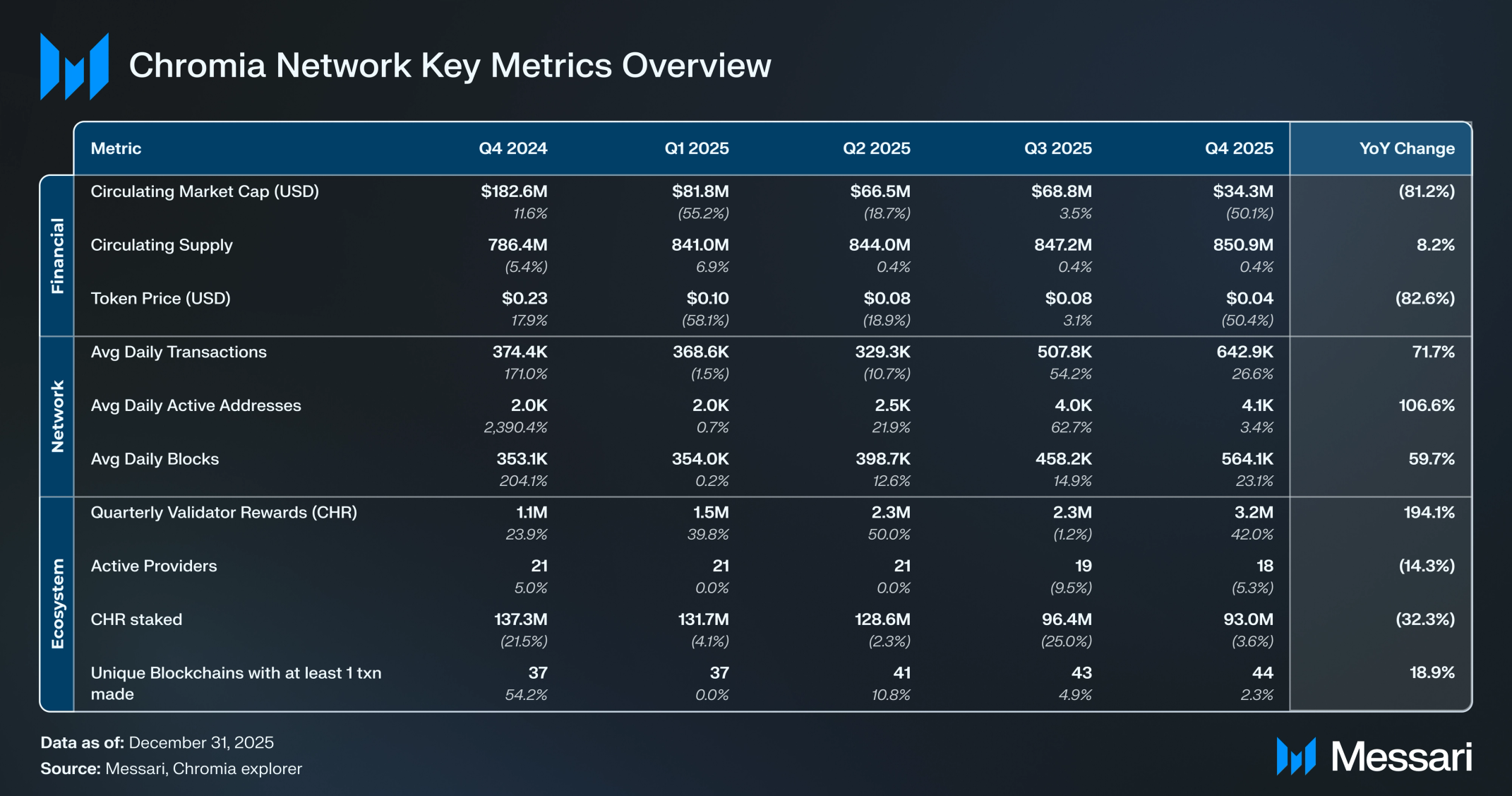
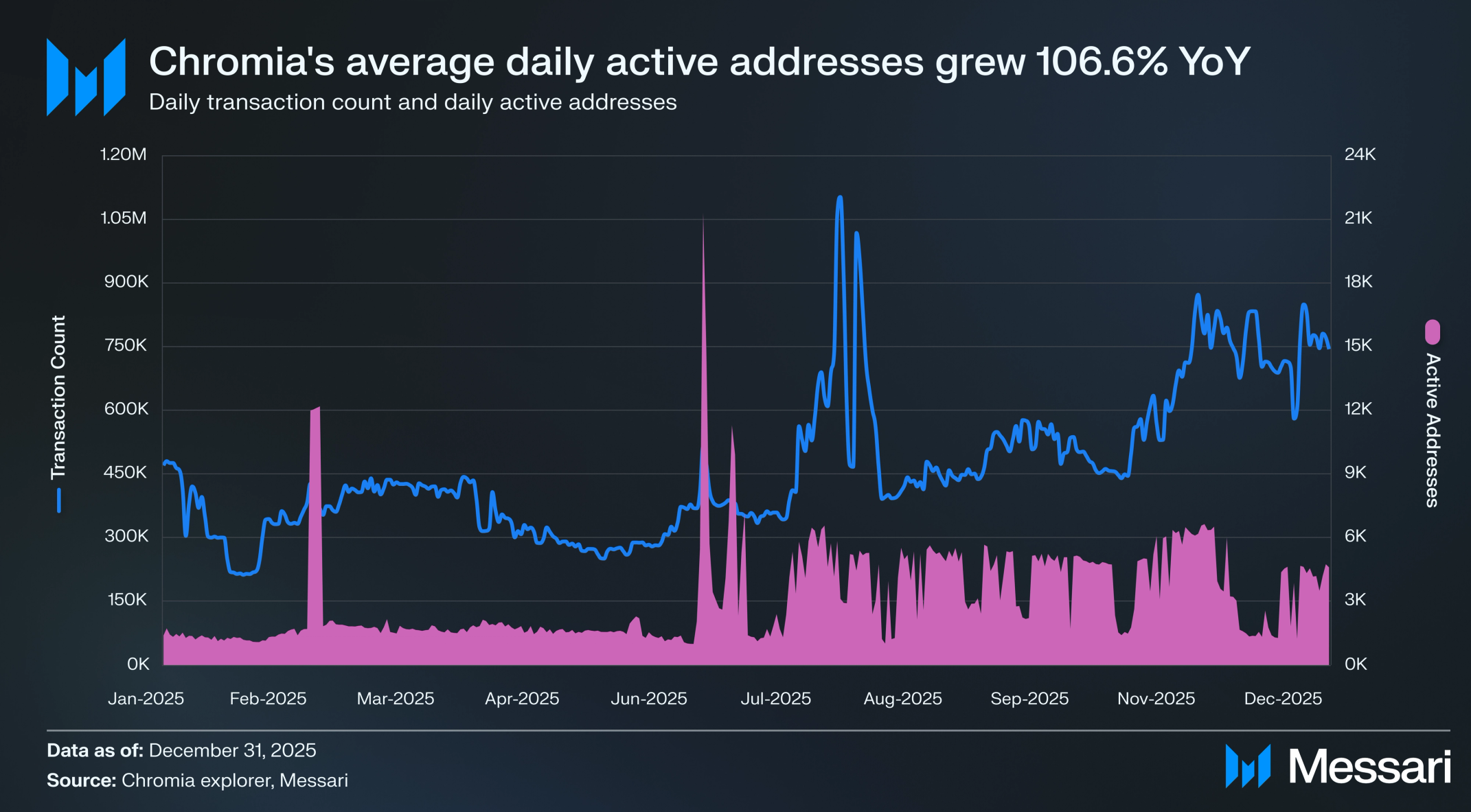
Chromia’s network activity expanded in Q4, with average daily transactions increasing 26.6% QoQ and 71.7% YoY to 642,900, while average daily active addresses increased 3.4% QoQ and 106.6% YoY to 4,128.
Chromia initiated the scheduled phaseout of staking rewards on Ethereum and BNB Smart Chain on Dec. 2, 2025, shifting staking incentives toward Chromia mainnet and aligning long-term incentives with native staking ahead of governance activation.
The Chromia team shipped a major redesign of the Chromia Vault in Q4, introducing portfolio-style balance aggregation across application chains, improved application discovery, and improved staking transparency through dynamic fee sharing and estimated APR displays.
Primer
Chromia (CHR) is a Layer-1 network designed for data-intensive decentralized applications. Its architecture is built around a cluster-based design, where different groups of nodes called clusters are responsible for running specific parts of the network. Instead of relying on a single global chain, Chromia delegates execution and state management to independent clusters, each with a consensus group, storage backend, and execution environment. This modular approach isolates workloads, enables application-specific fine-tuning, and allows the network to scale horizontally without causing network congestion as more applications come online.
Clusters are divided into two main types: System Clusters and Application Clusters. System Clusters run the protocol's core infrastructure. Application Clusters are dedicated to running application-specific blockchains. Each application operates in a Standard Container Unit (SCU), a self-contained environment with its own PostgreSQL database server (software that stores application data and allows users to run queries against it), and an execution engine for smart contracts. For a full primer on Chromia, refer to our Initation of Coverage report.
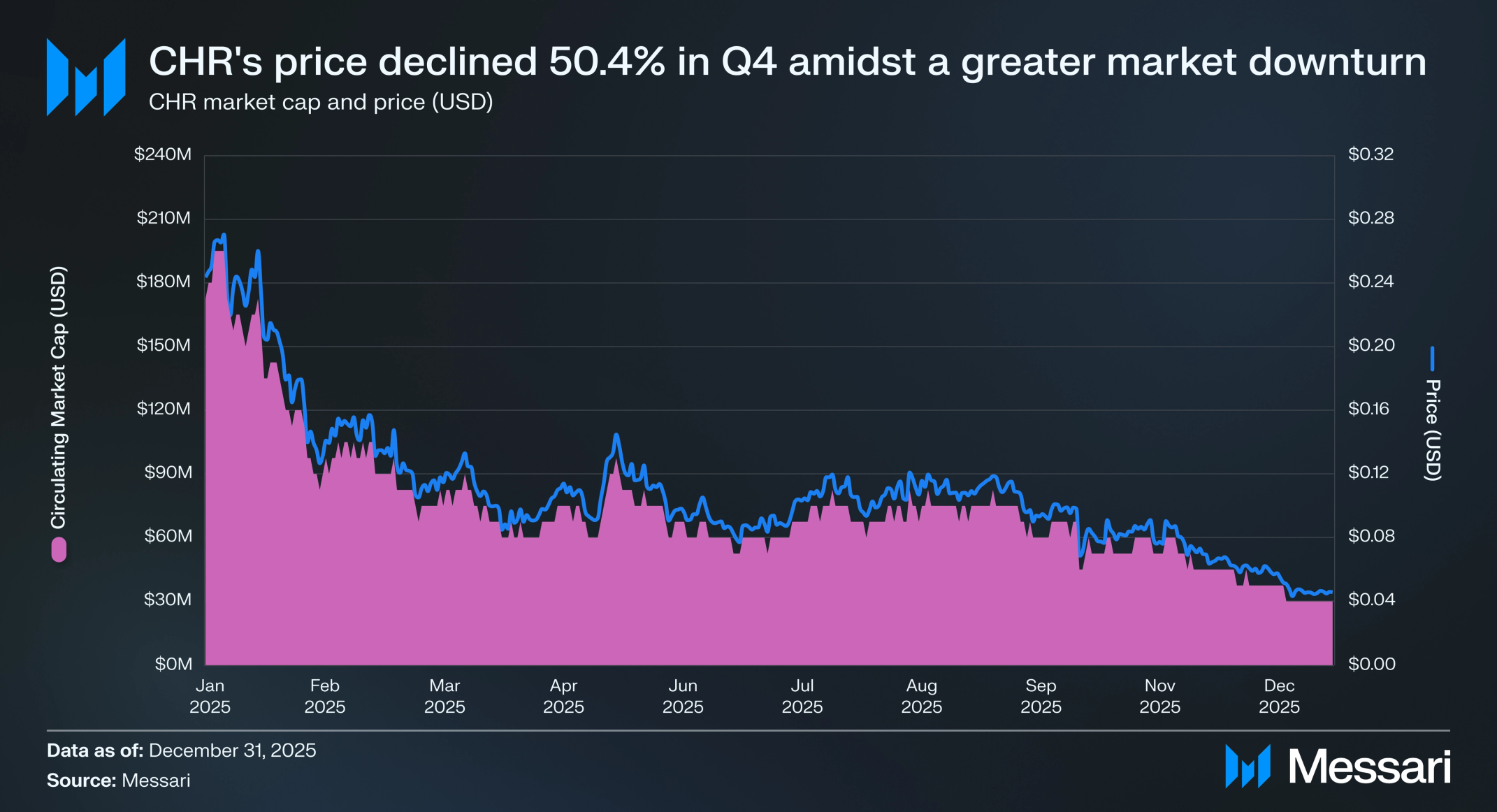
CHR ended Q4 2025 with a circulating market cap of $34.3 million, down 50.1% QoQ from $68.8 million. This move came amid a broader selloff, as crypto’s total market cap dropped 27.5% from $4.0 trillion to $2.9 trillion QoQ. CHR ended Q4 at $0.04 while circulating supply rose 0.4% from 847.2 million to 850.9 million.
Network Updates
Usage activity
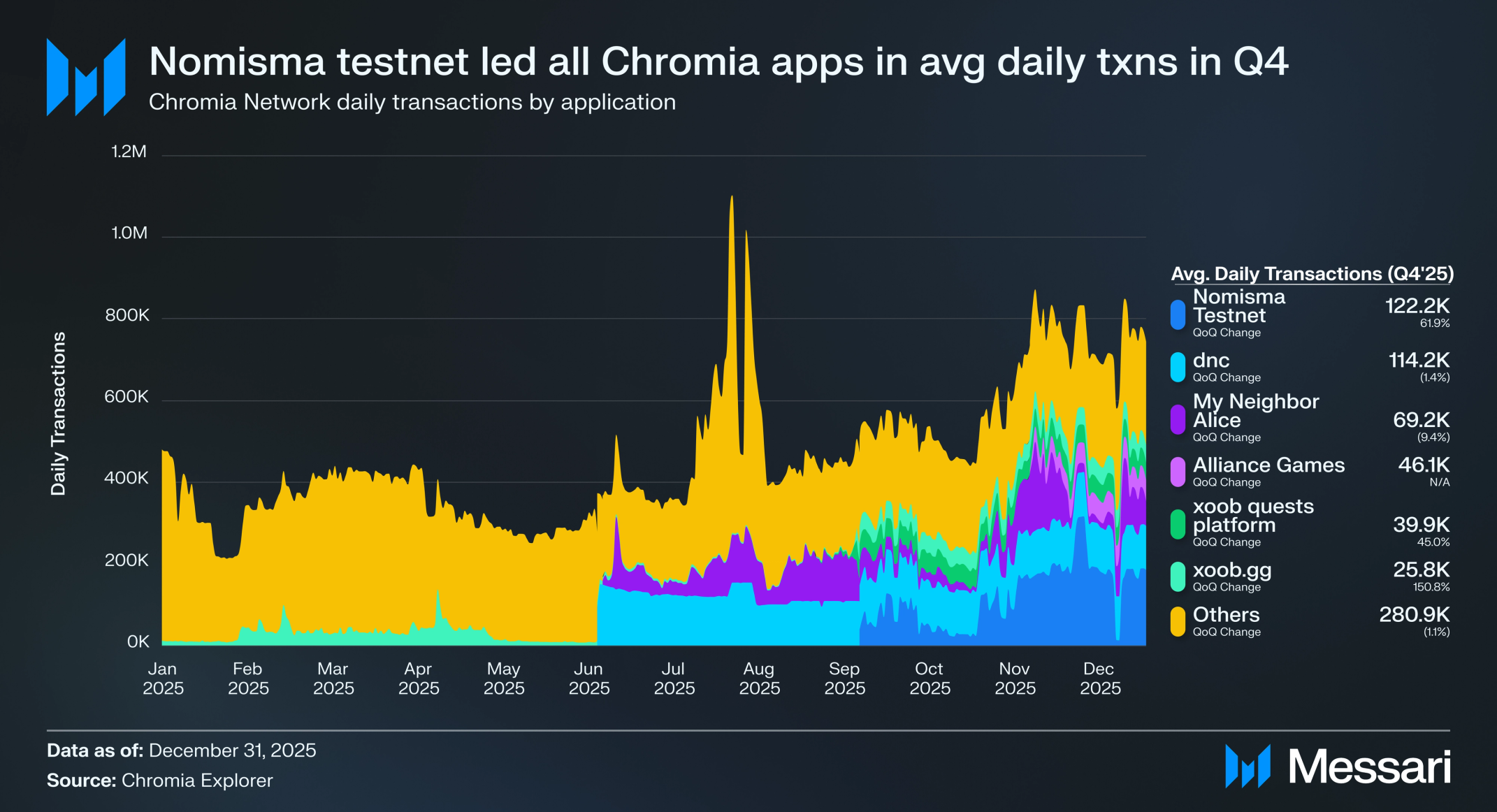
Average daily transactions on Chromia increased 26.6% QoQ and 71.7% YoY to 642,860 in Q4, up from 507,780 in Q3 and 374,420 in Q4 2024. On Nov. 10, 2025, Chromia crossed 150 million cumulative transactions. Average daily active addresses were steady QoQ, rising 3.4% from 3,992 to 4,128, and up 106.6% YoY from 1,998 in Q4 2024. Chromia produced 564,090 blocks per day on average in Q4, up 23.1% QoQ from 458,220 and 59.7% YoY from 353,150, scaling block output alongside application throughput.
Updates to the Chromia Vault
As activity expands across more application chains, visibility and asset management become important at the interface layer. Chromia Vault’s Q4 asset-centric redesign restructured the product around portfolio-style navigation across the network. The updated applications view organizes a user’s footprint through expandable tiles for each application and system chain, surfacing the balances held on each chain and making it easier to understand where assets and activity live across mainnet.
The redesign also introduced a portfolio-style Assets view that aggregates token balances across application and system chains in one place, reducing the friction of managing assets that sit across multiple chains. This is complemented by faster action paths for common tasks such as transfers, deposits, and swaps, which help users move capital to the chain they need.
Finally, Vault’s staking interface was upgraded to better support delegation decisions. Dynamic fee-sharing is now live, and the Vault clearly displays estimated yield information that combines the base staking rate with the provider-specific reward share, making it easier to evaluate the differences between providers at a glance. Over time, a more intuitive mainnet interface can improve retention and repeat usage, reinforcing growth in transaction activity as more users interact across multiple application chains.
Active Providers
Each application on Chromia features its own blockchain. These blockchains are run by a set of nodes using a lightly modified version of Practical Byzantine Fault Tolerance (PBFT) consensus, called eBFT. Each blockchain within Chromia is associated with a set of validators, known as providers, and is hosted on a subset of nodes that establish consensus on any modifications to the application state. Chromia software runs on nodes controlled by individuals or organizations.
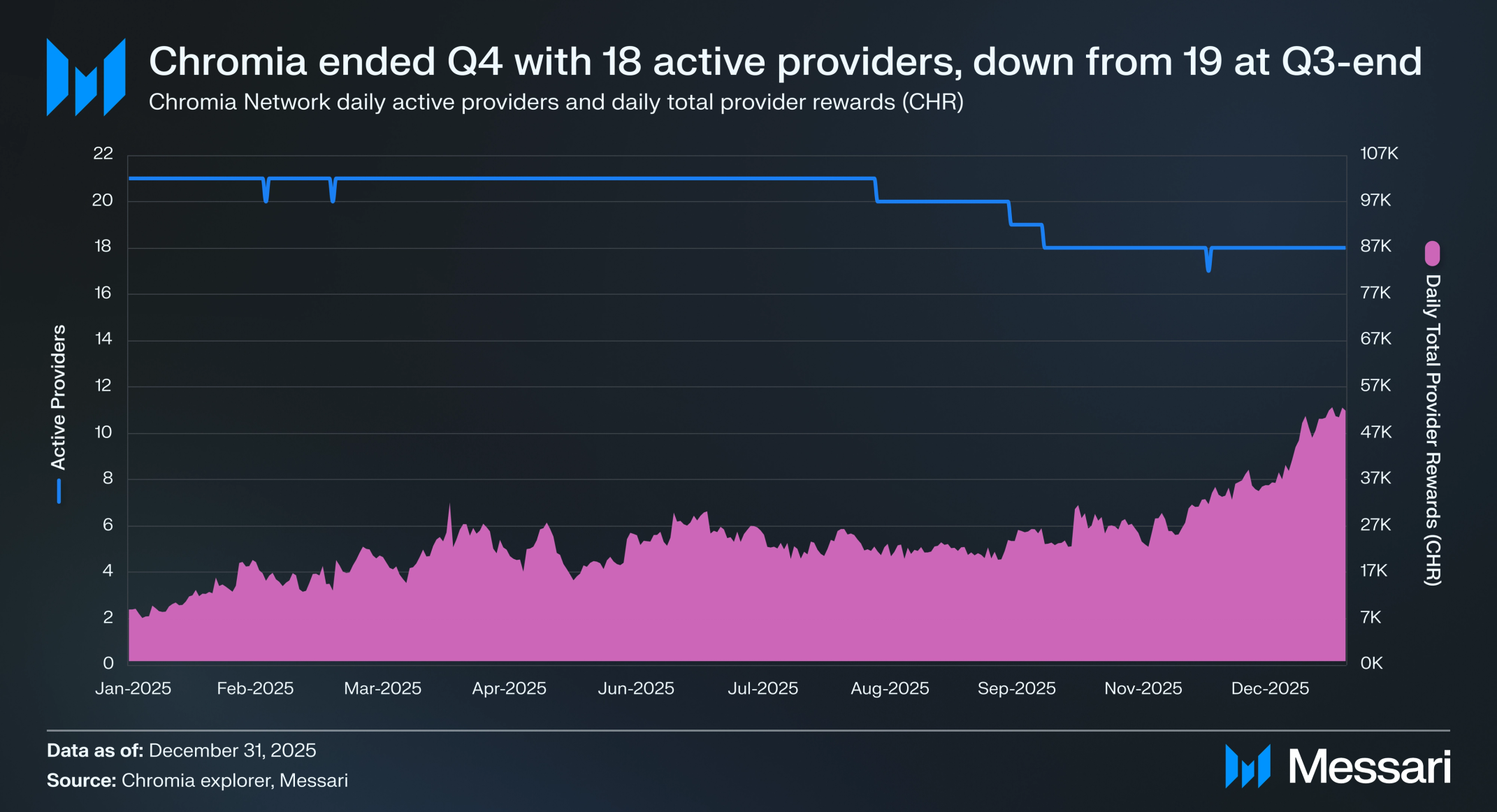
At the end of Q4, Chromia had 18 active providers, down 5.3% QoQ from 19 at Q3’25 end. Provider rewards totaled 3.2 million CHR in Q4, up 42% QoQ from 2.3 million CHR in Q3. Continued growth in usage across gaming, DeFi, and AI applications is a direct catalyst for new providers to join the Chromia ecosystem. Growth in application-specific blockchains and aggregate transaction throughput increases demand for validator capacity on Chromia, which is provided by operators running provider nodes that secure and execute application chains.
Staking
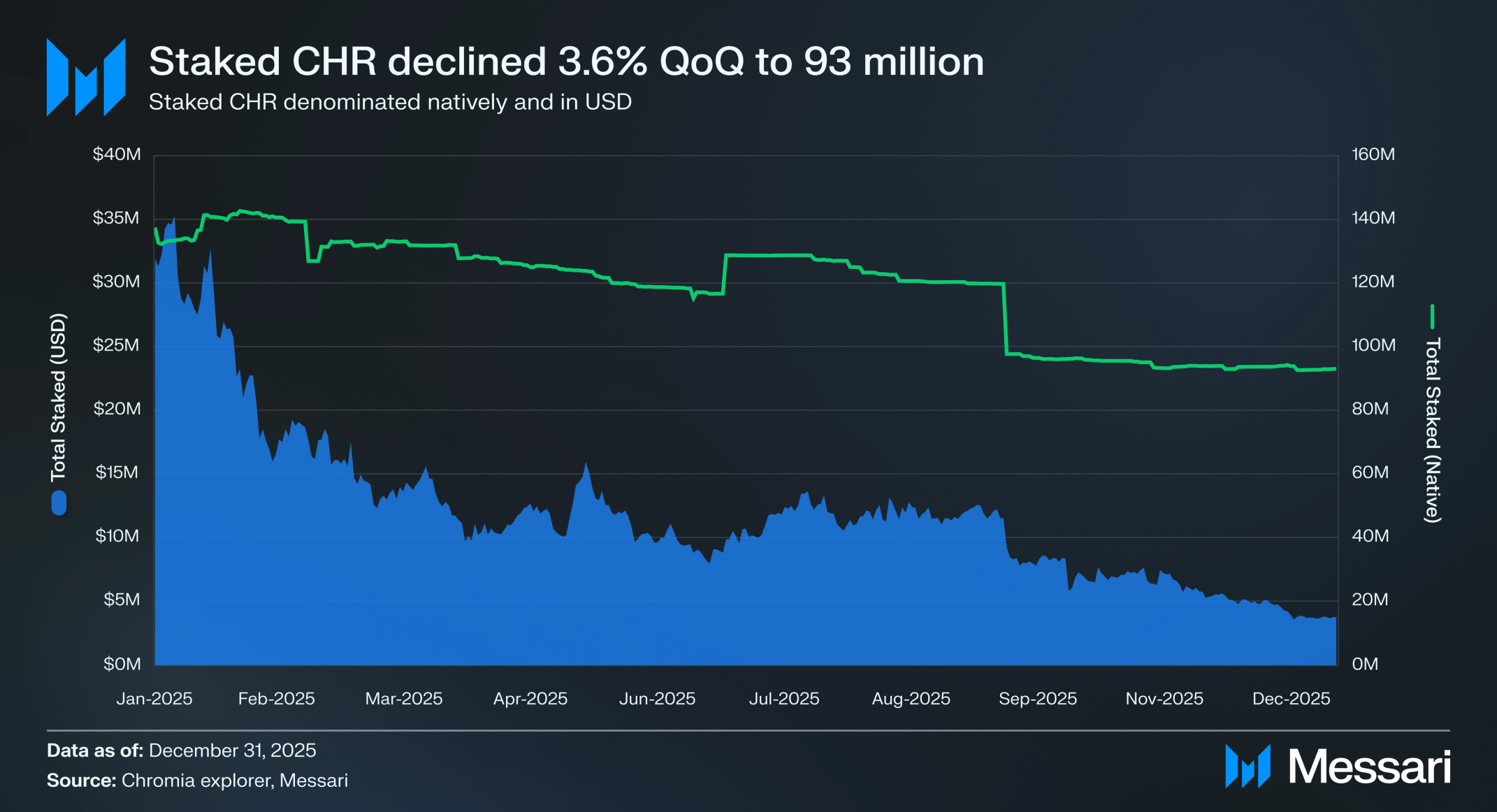
Staking activity remained steady in Q4 as the quarter ended with 93 million CHR staked (-3.6% QoQ). In USD terms, the value of staked CHR fell from $7.8 million to $3.8 million, a 52.1% QoQ decline due to the downturn in CHR price.
Q4 also marked the start of a shift in how Chromia intends staking to function across its ecosystem. On Dec. 2, 2025, Chromia initiated a gradual phaseout of staking rewards on Ethereum and BNB Smart Chain. The base APR drops to 2% on Dec. 2, 2025, 1% on Feb. 3, 2026, and 0% on April 1, 2026, at which point reward share is discontinued. Native CHR stakers on Chromia mainnet continue to receive a 3% base APR, plus a reward share, and are positioned to become the core constituency once Chromia Governance goes live. Vault’s staking view now reflects dynamic fee sharing and surfaces estimated yield to support clearer provider comparison.
Chromia Governance
Chromia Governance is expected to go live by April 1, 2026, aligning with the completion of the EVM staking rewards phaseout and reinforcing mainnet as the long-term venue for both staking and protocol decision-making. The governance application is expected to enable native stakers to propose and vote on provider nominations and ecosystem grant allocations, with voting power increasing in proportion to the amount of CHR staked, and to support delegation for users who prefer a more passive role. The staking phase out and governance rollout are linked because shifting stake to mainnet is a prerequisite for ensuring that network governance reflects the users actively securing the chain and participating in its long-term economic design.
For EVM stakers, migration requires planning around the 14-day unstaking waiting period. Users must request to unstake on the staking portal, withdraw after the waiting period, bridge CHR to Chromia via the Vault deposit page, and then stake natively in the Chromia Vault. To reduce onboarding friction, the Vault also includes a consolidated Get CHR guide and streamlined deposit flows for bridging assets into mainnet.
Top Applications on Chromia by Usage
The number of unique blockchains with at least one transaction increased 2.3% QoQ from 43 to 44. In Q4’25, the leaders for daily transactions by application were as follows:
Nomisma Testnet: An AI-driven DeFi platform building as a Chromia subchain, designed to use Chromia’s relational execution environment to reduce onchain friction and enable more data-intensive DeFi workflows. Nomisma Testnet averaged 122,150 daily transactions in Q4 2025, up 61.9% QoQ from 75,470 in Q3 2025.
DNC: A dedicated high-throughput application chain that launched in June 2025 and has remained one of Chromia’s largest sources of application-layer throughput. DNC’s average daily transactions declined 1.4% QoQ, from 115,840 in Q3 2025 to 114,170 in Q4 2025.
My Neighbor Alice: A fully onchain multiplayer farming and builder game that mixes land management, crafting, and NFT trading, built on Chromia’s relational architecture. My Neighbor Alice’s average daily transactions declined 9.4% QoQ, from 76,380 in Q3 2025 to 69,220 in Q4 2025.
Alliance Games: A gaming infrastructure partner in the Chromia ecosystem, best known for Chain of Alliance and, more recently, the rollout of its Virtual Arcade experience to the public on Dec. 3, 2025. Alliance Games launched in Q4 and averaged 46,100 daily transactions.
Xoob quests platform: A quest and rewards platform that uses mini-games, points farming, and seasonal quests to drive ongoing engagement across Web3 games. Xoob quests platform averaged 39,880 in Q4 2025, up 45% QoQ from 27,500 in Q3 2025.
Xoob.gg: The user-facing XOOB app that packages quests and game interactions into a single Web3 gaming experience, including a Telegram mini app implementation that records activity on Chromia. xoob.gg averaged 25,760 daily transactions in Q4 2025, up 150.8% QoQ from 10,270 in Q3 2025.
Q4’s top application activity shows that Chromia’s transaction throughput remains anchored in gaming and consumer engagement, with My Neighbor Alice, Alliance Games, and XOOB-related chains driving much of the day-to-day activity. These application patterns also align with Chromia’s AI and data infrastructure direction. Games and quest systems generate large volumes of structured state updates, user histories, and progression data, which map naturally to Chromia’s relational design and support its positioning as a verifiable database layer for data-intensive applications.
Base, Arbitrum, and Virtuals ACP Integration
Chromia’s relational design also extends to AI-native applications that need structured, queryable data storage for agent activity. On Nov. 20, 2025, Chromia’s Head of Data and AI, Johnson Lai, published a technical walkthrough showing how Chromia can be used as a decentralized database layer for Virtuals’Agent Commerce Protocol (ACP). Virtuals is an application on Base, an Ethereum Layer-2 network, where users can create and co-own autonomous AI agents. ACP is Virtuals’ onchain job marketplace, coordinating tasks, payments, and evaluation between agents and users.
Lai’s walkthrough demonstrated how agents can write job creation events, status updates, and results into Chromia’s relational model. Since much of the ACP’s job lifecycle data can remain buried in calldata or be routed through centralized indexing stacks, the implementation into Chromia’s relational model became practical. Chromia acted on this concept in December. On Dec. 5, 2025, Chromia completed interoperability with Base and Arbitrum, creating a direct path for Base and Arbitrum’s applications to connect to Chromia's mainnet. As part of this rollout, EVAL, an AI agent evaluation plugin originally deployed on Base, bridged its token and execution to Chromia, signalling agentic adoption on Chromia’s infrastructure. On Dec. 11, 2025, Chromia integrated with ACP, positioning Chromia as the structured storage layer for verifiable agent job histories, logs, and audit trails that can be queried directly. This enables actions such as archiving X posts, with each entry stored permanently on Chromia’s Filehub, creating a tamper-resistant record for agent memory and audit trails.
Other Key Updates
GPU-Powered Inference available on Testnet
Chromia advanced its AI roadmap in Q4 by launching a GPU-powered version of its AI Inference Extension on testnet. The team has explored onchain inference throughout 2025, with early iterations demonstrating that lightweight models can run on standard Chromia nodes using CPU resources. However, it has also made clear that more capable, large language models require significantly higher compute capacity.
On Dec. 23, 2025, Chromia published a public demonstration of LLM inference executed onchain using GPU-enabled Chromia nodes operating on testnet. The current implementation runs the Qwen2.5-1.5B-Instruct model, showing that both model execution and the recording of inputs and outputs can occur within Chromia’s execution environment rather than relying on offchain model hosting. While the demo is best interpreted as a technical proof of concept rather than a production product, it establishes the infrastructure path for GPU-backed inference clusters.
Mainnet deployment is now primarily a question of rollout design. Chromia highlighted three key gating considerations before introducing GPU nodes to mainnet: defining sustainable economics for higher-cost hardware and power requirements, validating demand and market readiness for verifiable inference, and coordinating technical and product integration with broader AI and data initiatives planned for 2026.
Additional Q4 Highlights
Several other ecosystem updates complemented Chromia’s core Q4 milestones.
Oct. 7, 2025: The centralized exchange Gate integrated Chromia mainnet, enabling native CHR deposits and withdrawals.
Oct. 15, 2025: The Chromia team executed a $400,000 buyback of CHR, repurchasing 6.4 million CHR (0.75% of supply as of Dec. 31, 2025).
Nov. 12, 2025: DeFi protocol UdonFiintroduced liquid staking on Chromia. Stake CHR and receive stCHR.
Nov. 24, 2025: Traced Systems, a ChromaWay venture studio company built on Chromai, was named the winner of the MASSIV program in Mastercard Lighthouse Fall 2025, Mastercard’s Nordics and Baltics startup partnership program for sustainability and impact tech, adding external validation for a Chromia-aligned real-world application.
Dec. 18, 2025: Chromaway announced a partnership with AICrit, a research-to-business initiative led by the University of Turku’s Faculty of Law and funded by Business Finland, focused on prototyping an AI solution for critical thinking, trust, and transparency with an emphasis on data and execution sovereignty and decentralization.
Roadmap
Chromia’s near-term roadmap prioritizes making Chromia mainnet the primary venue for staking and governance, while bringing AI infrastructure closer to production readiness. Highlighted milestones include the deployment of Chromia Governance, continued refinement of dynamic fee-sharing, and the mainnet staking experience in Vault, as well as the rollout of GPU-capable AI clusters as provider-operated infrastructure that can support heavier inference workloads beyond CPU-only nodes.
On the product side, Chromia aims to expand its AI and data services to enhance the utility of its relational architecture for developers. Priorities include deeper integrations with agent ecosystems such as Virtuals ACP, exploring VectorDB-as-a-Service style abstractions that reduce integration friction, and advancing the extensions toolchain so more teams can deploy specialized functionality without modifying the base protocol.
Partnerships remain a core part of Chromia’s roadmap as integrations with Base and Virtuals in Q4 continue to position Chromia as a verifiable data and storage layer beneath application and agent ecosystems that originate on other chains. As a result, Chromia’s value proposition remains anchored to observable usage and durable infrastructure adoption.
Closing Summary
Chromia closed Q4 2025 continuing to position its Layer-1 as infrastructure for data-intensive applications, with execution focused on strengthening core network participation while expanding its AI and data tooling surface. Progress on that AI and data agenda was most visible in three milestones that brought AI infrastructure closer to production readiness. Chromia completed Base and Arbitrum interoperability on Dec. 5, 2025, integrated with Virtuals’ Agent Commerce Protocol on Dec. 11, 2025 to support structured, queryable agent job data on Chromia, and launched a GPU-powered inference demo on testnet on Dec. 23, 2025, demonstrating a path toward higher-compute inference running inside Chromia’s execution environment.
Network activity expanded alongside these product and infrastructure steps. Average daily transactions increased to 642,900, and average daily active addresses reached 4,128, with the network also surpassing 150 million cumulative transactions on Nov. 10, 2025. On the staking side, Chromia initiated the scheduled phaseout of staking rewards on Ethereum and BNB Smart Chain on Dec. 2, 2025, shifting staking incentives toward Chromia mainnet ahead of governance activation and reinforcing mainnet as the long-term venue for staking participation. To support that transition at the interface layer, Chromia shipped a major redesign of Chromia Vault, improving application discovery, aggregating balances across application chains in a portfolio-style view, and making delegation comparisons clearer through dynamic fee sharing and estimated APR displays. Heading into 2026, the focus shifts to execution as Chromia works to turn Q4’s infrastructure milestones into sustained mainnet participation, live governance, and developer demand that compounds into higher network usage.
This report was commissioned by Chromia. All content was produced independently by the author(s) and does not necessarily reflect the opinions of Messari, Inc. or the organization that requested the report. The commissioning organization may have input on the content of the report, but Messari maintains editorial control over the final report to retain data accuracy and objectivity. Author(s) may hold cryptocurrencies named in this report. This report is meant for informational purposes only. It is not meant to serve as investment advice. You should conduct your own research and consult an independent financial, tax, or legal advisor before making any investment decisions. Past performance of any asset is not indicative of future results. Please see our Terms of Service for more information.
No part of this report may be (a) copied, photocopied, duplicated in any form by any means or (b) redistributed without the prior written consent of Messari®.
Eric is a research analyst at Messari and an ambassador for Maple Finance. He previously was a Product Manager for FINTRX and is passionate about DeFi and AI.
Eric is a research analyst at Messari and an ambassador for Maple Finance. He previously was a Product Manager for FINTRX and is passionate about DeFi and AI.