Chromia launched its Token Chain, a central hub for asset transfers, token creation, and external bridging. This significantly enhances scalability by reducing dApp interconnection complexity and supporting the FT4 token standard.
TheColorPool DEX launched with $400k TVL, USDC bridging, and incentivized liquidity farming. The gaming sector saw My Neighbor Alice’s “Chapter One” release and new integrations like WebGPU rendering and Pudgy Penguins NFT crossover.
Social Agents introduced dynamic NFT personalities, enabling interactive behavior and programmable utility, expanding the potential for entertainment and social applications.
The TAC partnership enabled Telegram Mini Apps to store logic and transactions on Chromia, bridging EVM and TON ecosystems. XOOB, a gamified Telegram Mini App, was the first implementation of this partnership.
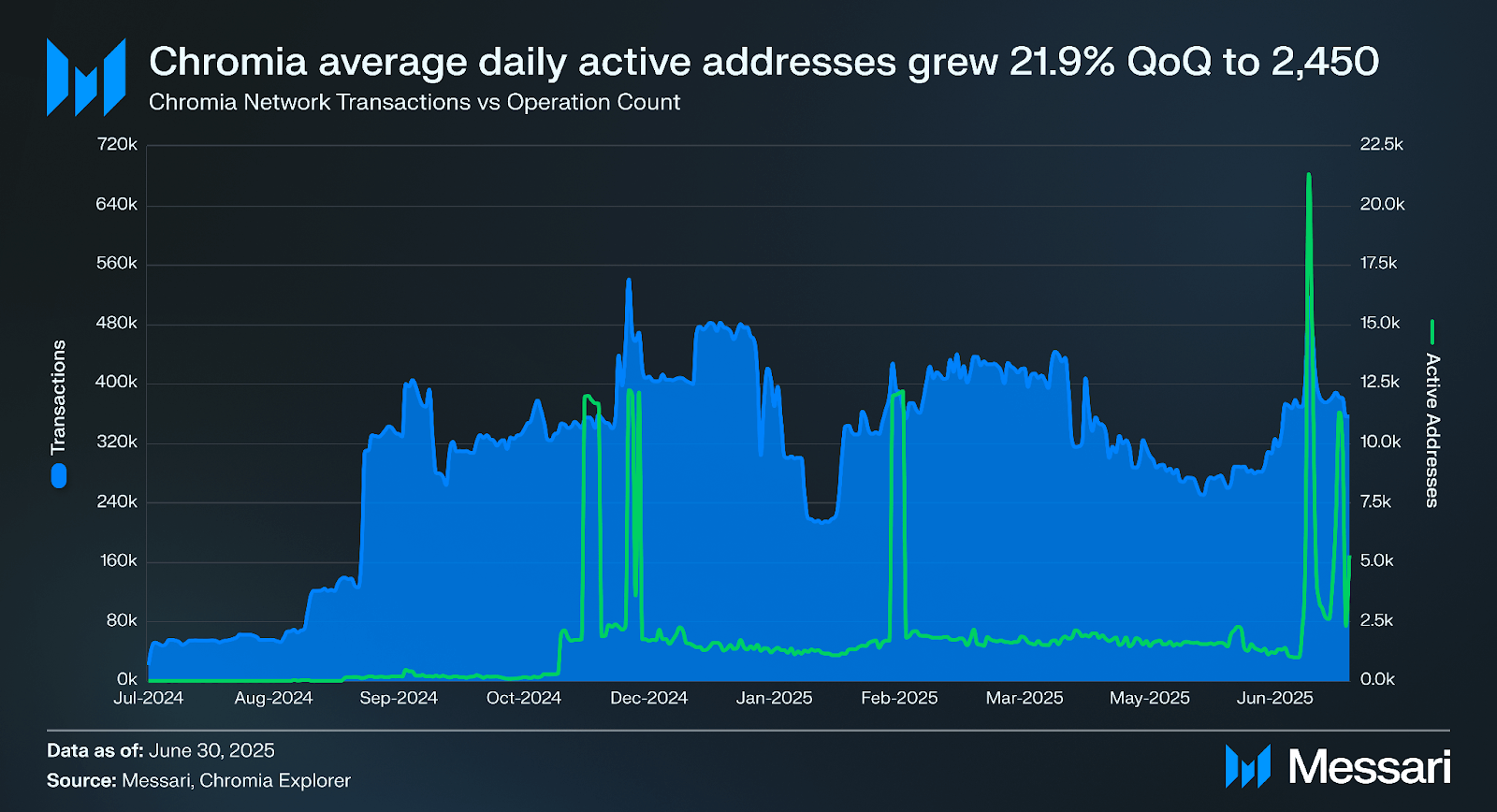
Chromia Network’s activity remained strong in Q2. Average daily active addresses grew 21.9% QoQ to 2,450, while average daily blocks produced grew 12.6% QoQ to 398,700.
Primer
Chromia (CHR) is a Layer-1 network designed for data-intensive decentralized applications. Its architecture is built around a cluster-based design, where different groups of nodes called clusters are responsible for running specific parts of the network. Instead of relying on a single global chain, Chromia delegates execution and state management to independent clusters, each with a consensus group, storage backend, and execution environment. This modular approach isolates workloads, enables application-specific fine-tuning, and allows the network to scale horizontally without causing network congestion as more applications come online.
Clusters are divided into two main types: System Clusters and Application Clusters. System Clusters run the protocol's core infrastructure. Application Clusters are dedicated to running application-specific blockchains. Each application operates in a Standard Container Unit (SCU), a self-contained environment with its own PostgreSQL database server (software that stores application data and allows users run queries against it) and an execution engine for smart contracts. For a full primer on Chromia, refer to our Comprehensive Overview.
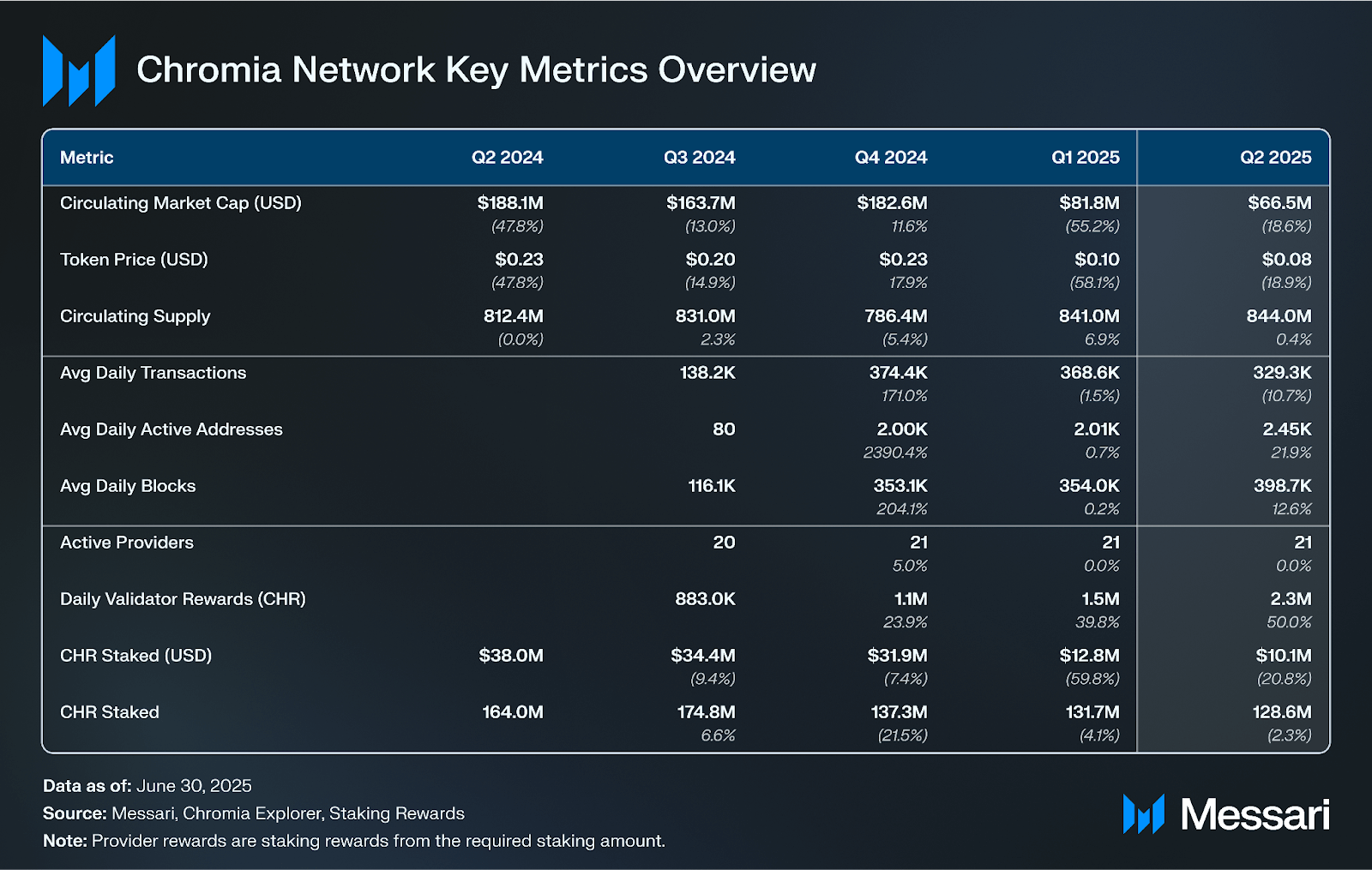
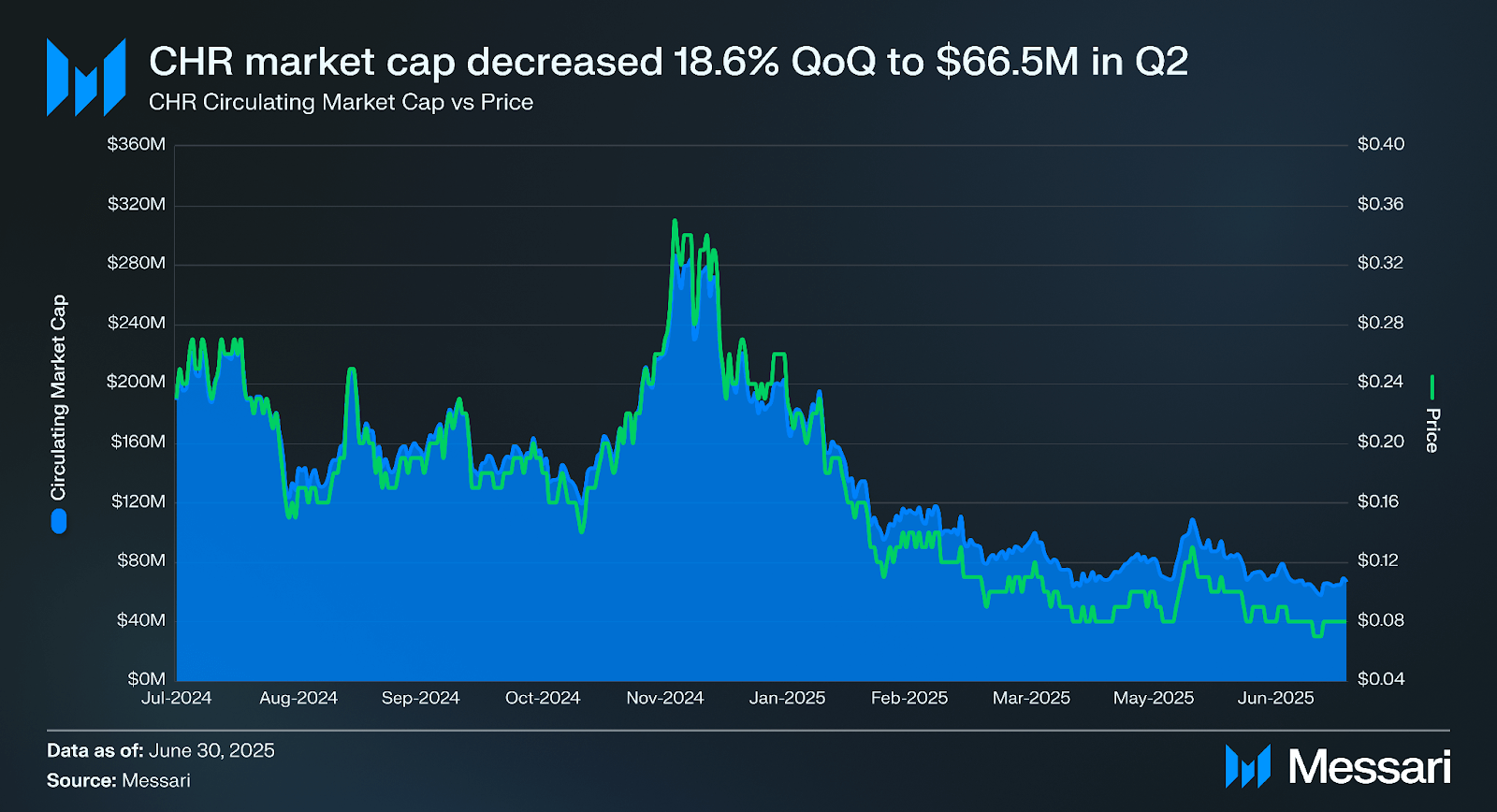
CHR ended Q2 2025 with a circulating market cap (USD) of $66.5 million, an 18.6% QoQ decrease. Similar to market cap, CHR’s price fell 18.9% QoQ from $0.10 to $0.08, while the token’s circulating supply increased 0.4% QoQ from 841 million to 844 million, even though it has been fully vested since December 2024. The only token emissions are from provider rewards which are a flat 3% APR.
Network Analysis
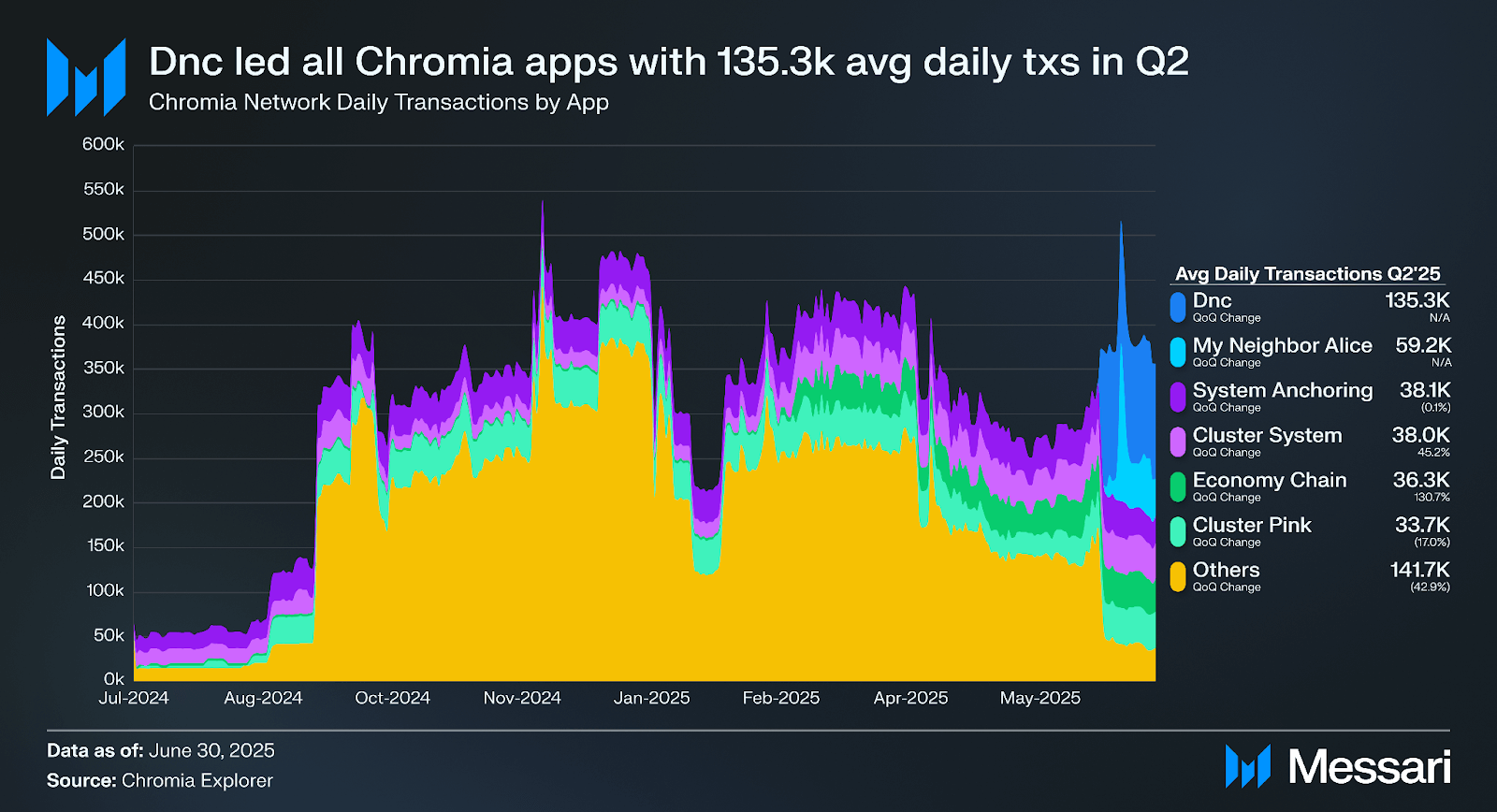
Chromia’s average daily active addresses (DAAs) grew 21.9% QoQ from 2,010 to 2,450. The network’s average daily transactions fell 10.7% QoQ from 368,600 to 329,300. During Q2 2025, the network produced on average 398,700 blocks per day.
Each application on Chromia features its own blockchain. These blockchains are run by a set of nodes using a lightly modified version of Practical Byzantine Fault Tolerance (PBFT) consensus, called eBFT. Each blockchain within Chromia is associated with a set of validators, which are called providers, and is hosted on a subset of nodes that establish consensus on any modifications to the application state. Chromia software runs on nodes controlled by individuals or organizations.
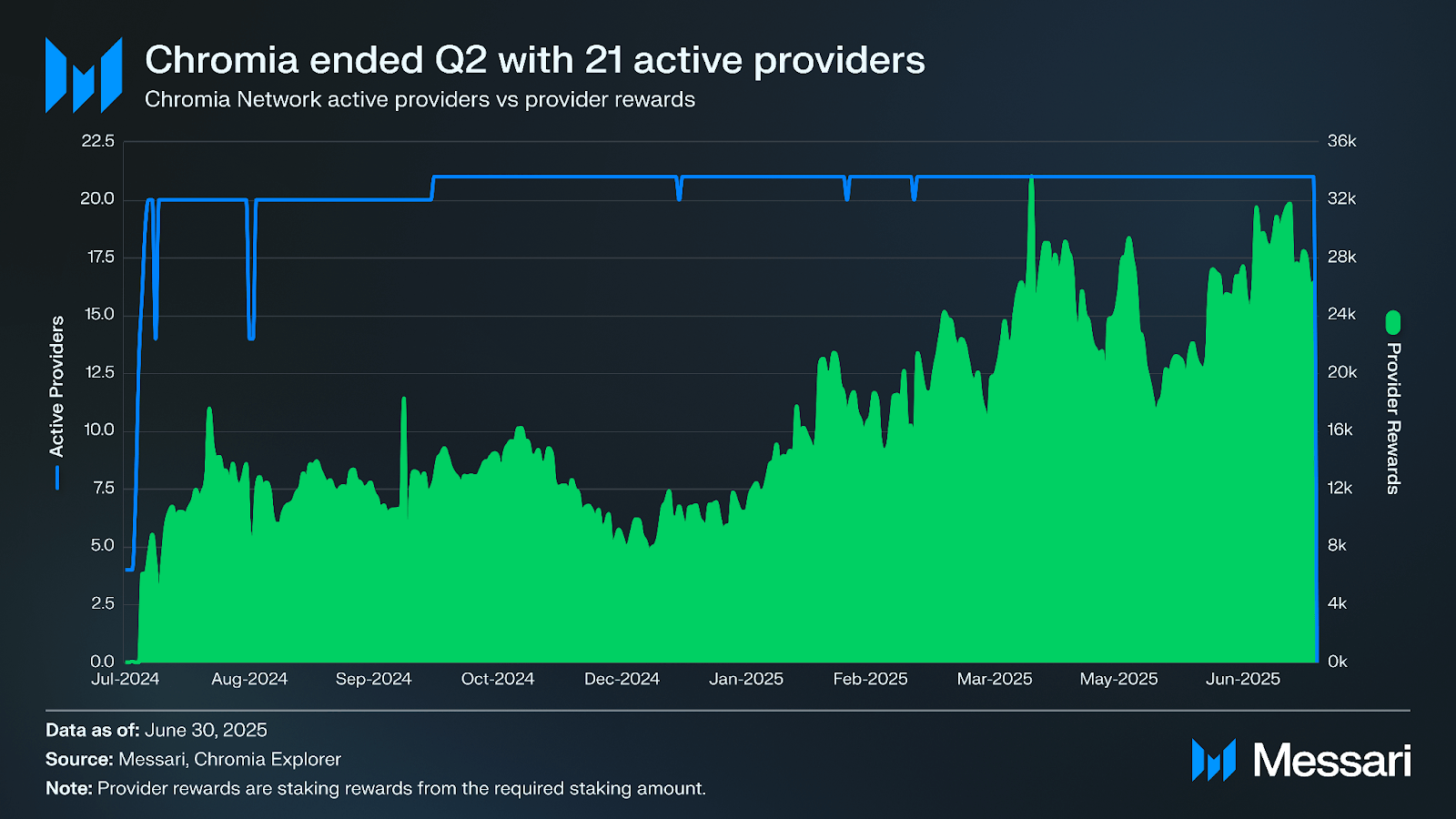
At the end of Q2’25, Chromia had 21 providers and distributed a total of 2.3 million CHR in daily provider rewards throughout the quarter, a 50% QoQ increase. This results in an average of 25,200 CHR being distributed daily to providers.
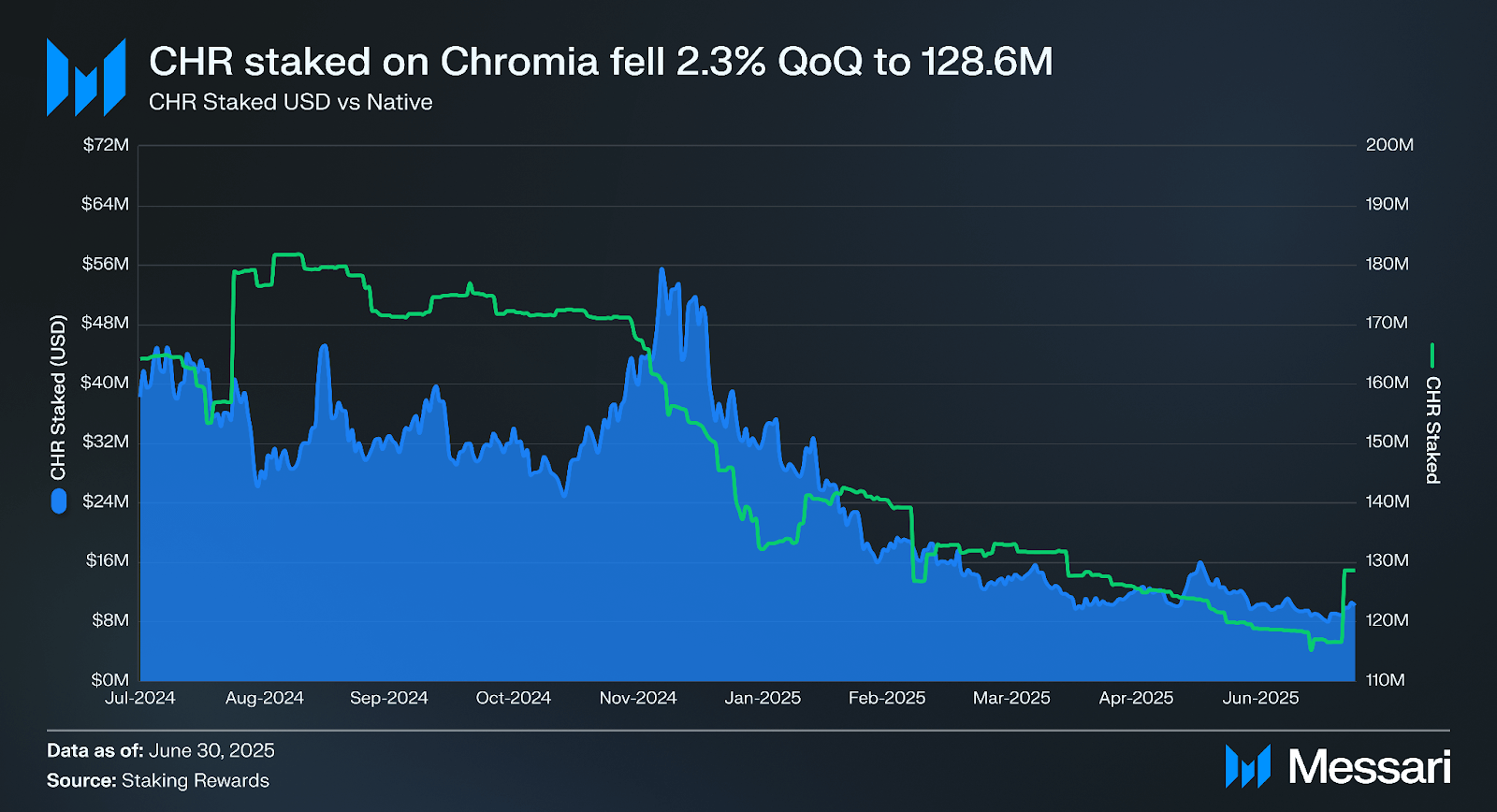
In Q2’25, CHR staked fell 2.3% QoQ from 131.7 million to 128.6 million. CHR staked (USD) fell 20.8% QoQ from $12.8 million to $10.1 million. Chromia incentivizes providers to secure their network by requiring them to stake CHR. Staked CHR acts as collateral that can be forfeited in cases of node misbehavior. Any user can stake CHR to earn an annual reward at a rate of 3% APR, although this is subject to future adjustments through governance. Once staked, CHR tokens are subject to a two week unbonding period.
In Q2’25, the leaders for daily transactions by application are as follows:
Dnc: Launched in June 2025, the Dnc chain averaged 135,300 transactions per day and was the largest app by daily transactions.
My Neighbor Alice: A fully onchain multiplayer game that mixes digital farming and NFT trading. It launched in June 2025 and averaged 59,200 transactions per day in Q2.
System Anchoring Chain: Posts aggregated commitments to external chains like Bitcoin and Ethereum, enabling tamper resistance and external auditability. The System Anchoring Chain averaged 38,100 transactions per day, a 0.1% QoQ decrease.
Qualitative Analysis
Token Chain Architecture Launch
The launch of Chromia's Token Chain represents the network’s most significant technical achievement of Q2 2025, fundamentally enhancing the platform's multichain architecture capabilities. The Token Chain serves as a central hub for asset transfers, token creation, and bridging external assets, effectively reducing the complexity of direct connections between applications.
Currently live on mainnet, the Token Chain primarily holds native CHR tokens while supporting the broader FT4 token standard. This architecture design addresses a critical scalability challenge in multichain ecosystems by providing a standardized approach to token management across various app chains. This infrastructure positions Chromia to support more complex multichain applications and partnerships, as evidenced by its integration with My Neighbor Alice's ALICE token.
Zero-Knowledge Proof Integration
Chromia's integration of zero-knowledge proof (ZKP) capabilities represents a significant advancement in the platform's privacy and scalability infrastructure. The initial ZKP Extension was completed in May 2025 and successfully integrated into the base layer, with the system currently live on testnet and mainnet rollout planned for the future.
This ZKP integration addresses growing demand for privacy-preserving blockchain applications while potentially improving transaction throughput and reducing costs. The successful testnet deployment indicates that Chromia has overcome the technical challenges associated with ZKP implementation, positioning the platform to offer enhanced privacy features that could attract applications requiring confidential data processing.
AI Inference Extension Advancement
Chromia's AI Inference Extension development represents a forward-thinking approach to integrating AI capabilities directly into blockchain infrastructure. During Q2 2025, the extension was upgraded from Java to Python to support newer AI models, with a public testnet demo planned for Q3 2025.
The AI Inference Extension enables the deployment of large language models directly on Chromia nodes, addressing the growing demand for decentralized AI applications. This capability positions Chromia at the intersection of two rapidly growing technology sectors in blockchain and AI. The upgrade to support Python demonstrates the platform's commitment to staying current with AI development trends and supporting the latest model architectures.
Integration with LangChain for AI agent development further enhances the platform's AI capabilities. LangChain is a popular framework for building applications with large language models, and its integration suggests that Chromia is positioning itself to support sophisticated AI applications that require blockchain-based data storage and processing.
Additional Technical Developments
Additional technical developments in Q2 2025 included:
The introduction of the CRC2 NFT standard with EVM-compatible bridging capabilities addresses cross-chain NFT functionality. This standard is already being utilized by My Neighbor Alice, demonstrating real-world application and adoption. Additionally, the development of a Go client for FT4 specifically targets improved centralized exchange integration support.
Tiger Research released a report analyzing Chromia’s vector database implementation. Chromia embeds vector functionality directly into its blockchain environment, so its clusters provide data isolation and onchain anchoring, combining execution and auditability in a single environment. By running vector storage and search onchain, Chromia delivers trustlessness (no third-party dependency), full transparency (all embeddings and queries live on the blockchain ledger), and atomic composability (state transitions or logic execution are triggered based on similar search results in a single transaction).
The tradeoff for running vector storage and search onchain is added latency from consensus, higher infrastructure costs from SCU provisioning versus leaner, pay-as-you-go pods, and throughput limits compared to engines purpose-built for ANN search. For applications requiring auditability and onchain integration, like decentralized recommendation, fraud detection, or governance, Chromia’s model is ideal. For ultra-low-latency or hyperscale workloads, a dedicated offchain vector database may still be preferable. For more on Chromia’s vector database implementation, refer to our Protocol Update on Chromia.
Ecosystem Growth & App Development
ColorPool DEX Launch and DeFi Infrastructure
The ColorPool DEX launched on Chromia on May 26, 2025. The DEX supports trading for CHR, USDC, and COLOR tokens, with USDC bridging capabilities from BNB Chain. Shortly after launch ColorPool had over $400,000 in TVL, powered by the implementation of COLOR staking and an incentivized liquidity farming campaign in June 2025.
Account creation requires a one-time fee of ten CHR for CHR transfers or two USDC for USDC transfers.
Deposit times are estimated at approximately 5 minutes.
Withdrawal delays of up to 72 hours for security purposes.
The credit system allows users to trade without gas fees after initial setup.
Gaming Ecosystem Expansion
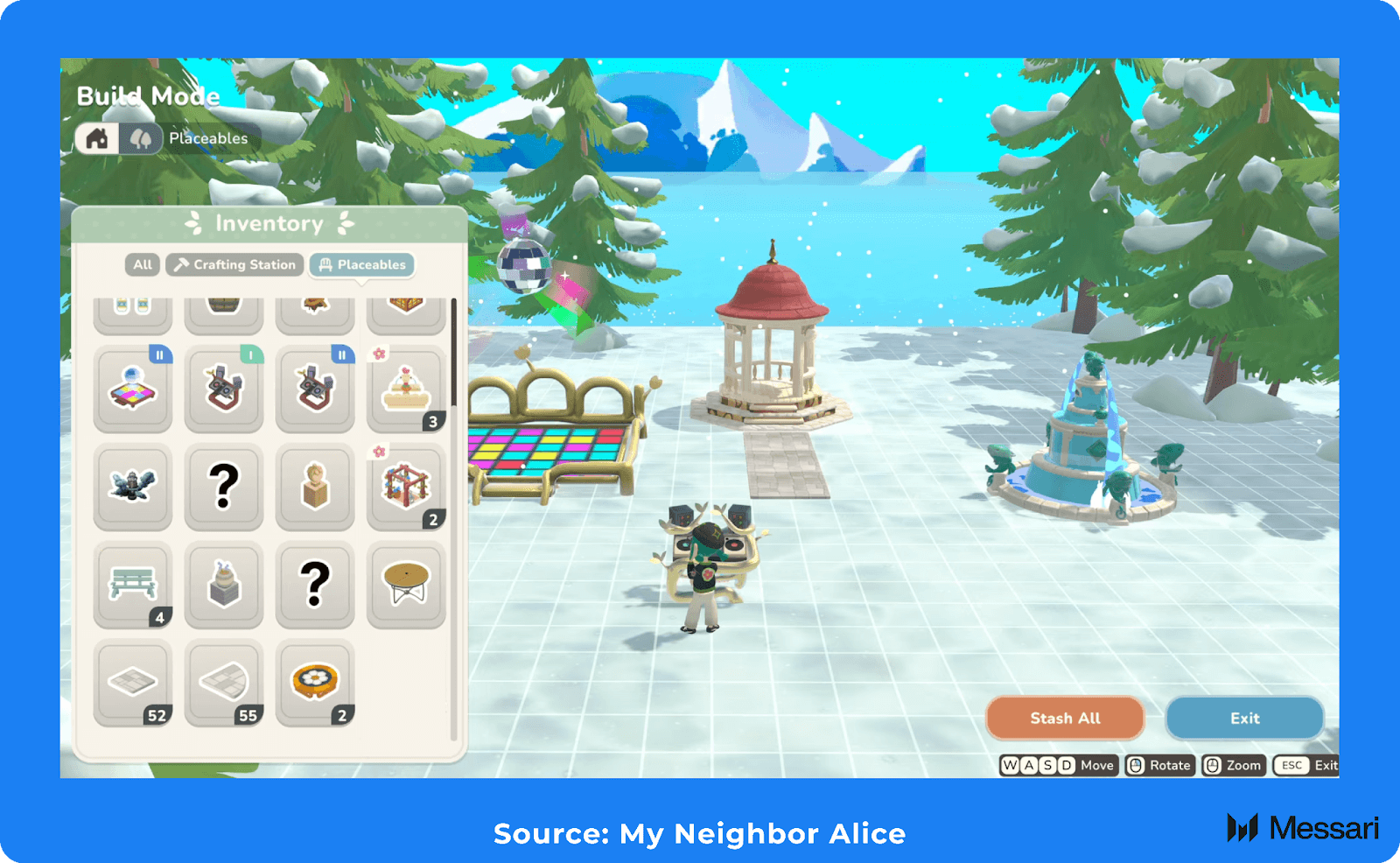
Chromia's gaming ecosystem achieved a major milestone with the launch of My Neighbor Alice's "Chapter One: A New Adventure" on mainnet on June 17, 2025. This launch represents the successful deployment of a major gaming application on Chromia's infrastructure, demonstrating the platform's capability to support complex, user-facing applications. The implementation of WebGPU (a web standard for GPU-accelerated graphics and computation) technology for high-quality 3D browser graphics enables console-quality gaming experiences directly in web browsers without requiring downloads or installations.
The Pudgy Land partnership with Pudgy Penguins NFTs allows users to use their NFT as companions in-game, and could attract users from established NFT communities to the Chromia ecosystem. Marble Rumble's beta version, a telegram-based PvP game featuring onchain logic, launched in April 2025.
Social Agents
The launch of Social Agents as a testnet demo on May 5, 2025, represents an innovative approach to NFT utility expansion. This application allows users to create interactive personalities for NFTs by importing assets from Ethereum-compatible chains and adding a metadata layer on Chromia, effectively transforming static NFTs into evolving, interactive characters.
Social Agents addresses a fundamental limitation of current NFT implementations by adding dynamic, programmable behavior to static digital assets. Users can define personalities, stories, and behaviors for their NFTs, creating potential for new forms of digital entertainment and social interaction. During the testnet phase, users can "adopt" unclaimed NFTs and customize them, with control reverting to original owners upon mainnet deployment.
Strategic Partnerships & Market Expansion
TAC Partnership & Telegram Integration
The partnership announcement with TAC on June 23, 2025, represents a strategic expansion of Chromia's market reach and technical capabilities. This partnership enables Telegram Mini Apps hosted on TAC to enhance their architecture by storing application logic, transactions, and metadata on Chromia's infrastructure.
The technical integration bridges EVM and TON blockchains, positioning Chromia as infrastructure for cross-chain applications that can serve users across multiple ecosystems. This capability is particularly valuable given Telegram's massive user base and the growing popularity of Telegram Mini Apps as a distribution channel for Web3 applications.
XOOB is the first implementation example of this partnership. XOOB, a gamified Telegram Mini App, uses Chromia to store user actions, experience points, and game outcomes on dedicated subchains, providing transparency and verifiability for gameplay data.
Regional & Industry Initiatives
Chromia participated in the European Blockchain Sandbox through Traced System, demonstrating the platform's commitment to regulatory compliance and real-world asset tokenization. The focus on Digital Product Passports aligns with European Union initiatives around supply chain transparency and sustainability reporting, positioning Chromia to benefit from regulatory trends favoring blockchain-based traceability solutions.
Roadmap for Q4
Chromia has the following plans for development in Q4’25:
Base and Arbitrum Integration
AI Cluster with GPU support
VectorDB as a Service
AI Inference Extension v2
ChromBot R&D - Chrombot was released in October 2025 and allows users to access advanced robotics and blockchain data.
Chromia Governance
Dynamic Fee Sharing
Extensions SDK and Marketplace
Closing Summary
Chromia’s Q2 2025 showcased both headwinds and breakthroughs. While CHR’s market cap and token price fell nearly 19% QoQ, core network fundamentals improved as daily active addresses grew while staking rewards increased. On the technical front, Chromia’s Token Chain launch stands out as a major milestone, laying the foundation for scalable multichain asset management. The integration of zero-knowledge proofs and the AI Inference Extension underscores the project’s ambition to merge blockchain with advanced privacy and AI capabilities.
Chromia’s ecosystem was highlighted by the launch of ColorPool DEX and new gaming titles like My Neighbor Alice. Social Agents enabled dynamic NFT utility as users can now define personalities, stories, and behaviors within NFTs. Strategic partnerships, most notably with TAC for Telegram Mini Apps, extended Chromia’s reach into mainstream distribution channels, while European regulatory engagement demonstrated Chromia’s readiness for enterprise adoption. Overall, despite token price fluctuations, Chromia’s Q2 progress reinforced its trajectory as an application-centric Layer-1 building differentiated infrastructure at the intersection of scalability, AI, and consumer use cases.
This report was commissioned by Chromia. All content was produced independently by the author(s) and does not necessarily reflect the opinions of Messari, Inc. or the organization that requested the report. The commissioning organization may have input on the content of the report, but Messari maintains editorial control over the final report to retain data accuracy and objectivity. Author(s) may hold cryptocurrencies named in this report. This report is meant for informational purposes only. It is not meant to serve as investment advice. You should conduct your own research and consult an independent financial, tax, or legal advisor before making any investment decisions. Past performance of any asset is not indicative of future results. Please see our Terms of Service for more information.
No part of this report may be (a) copied, photocopied, duplicated in any form by any means or (b) redistributed without the prior written consent of Messari®.
Matthew is a Research Analyst in Protocol Research. He graduated from MIT with a Master's and Bachelor's in Comp Sci, Economics, and Data Science where he wrote his thesis on DeSoc. Matthew also has previous experience as an Analyst at Goldentree's crypto fund.
Sam was previously a product manager at ether.fi, as well as LifeMed AI. He graduated from Ohio State University, where he founded the Ohio State Blockchain Club. He is now an Enterprise Research Analyst at Messari focused on finding the next best applications and protocols in internet finance.
Matthew is a Research Analyst in Protocol Research. He graduated from MIT with a Master's and Bachelor's in Comp Sci, Economics, and Data Science where he wrote his thesis on DeSoc. Matthew also has previous experience as an Analyst at Goldentree's crypto fund.
Sam was previously a product manager at ether.fi, as well as LifeMed AI. He graduated from Ohio State University, where he founded the Ohio State Blockchain Club. He is now an Enterprise Research Analyst at Messari focused on finding the next best applications and protocols in internet finance.