Cardano DeFi TVL climbed 28.7% QoQ to $423.5 million, its highest level since early 2022.
Midnight partnered with Google Cloud, integrating its privacy layer with Google’s enterprise-grade infrastructure and threat analysis tools from Mandiant.
Cardano transitioned from an interim Constitutional Committee to a fully elected body, marking the shift to community-led governance. Following a DQuadrant audit, seven members took office, replacing interim roles held by Input | Output (IOG), EMURGO, the Cardano Foundation, and others.
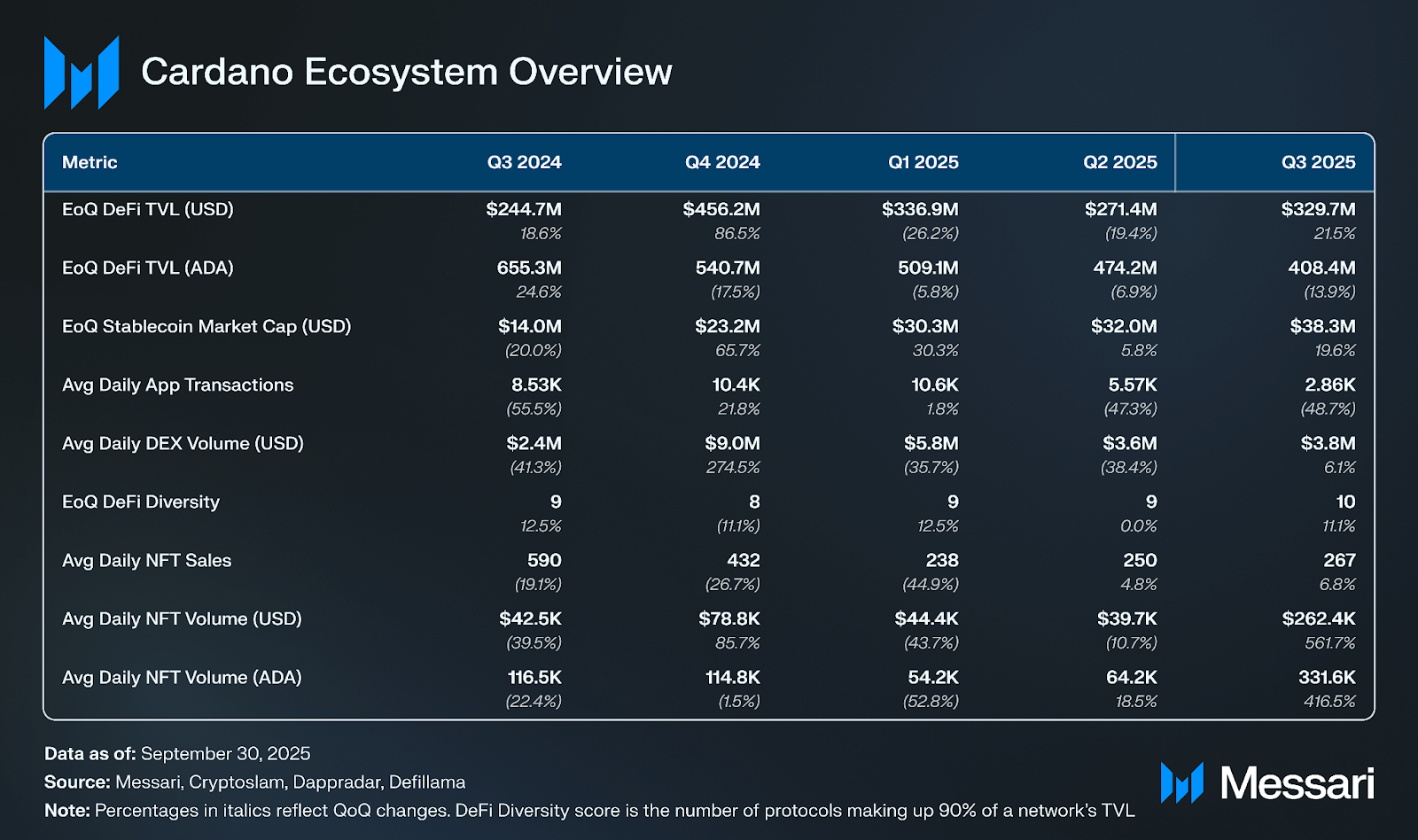
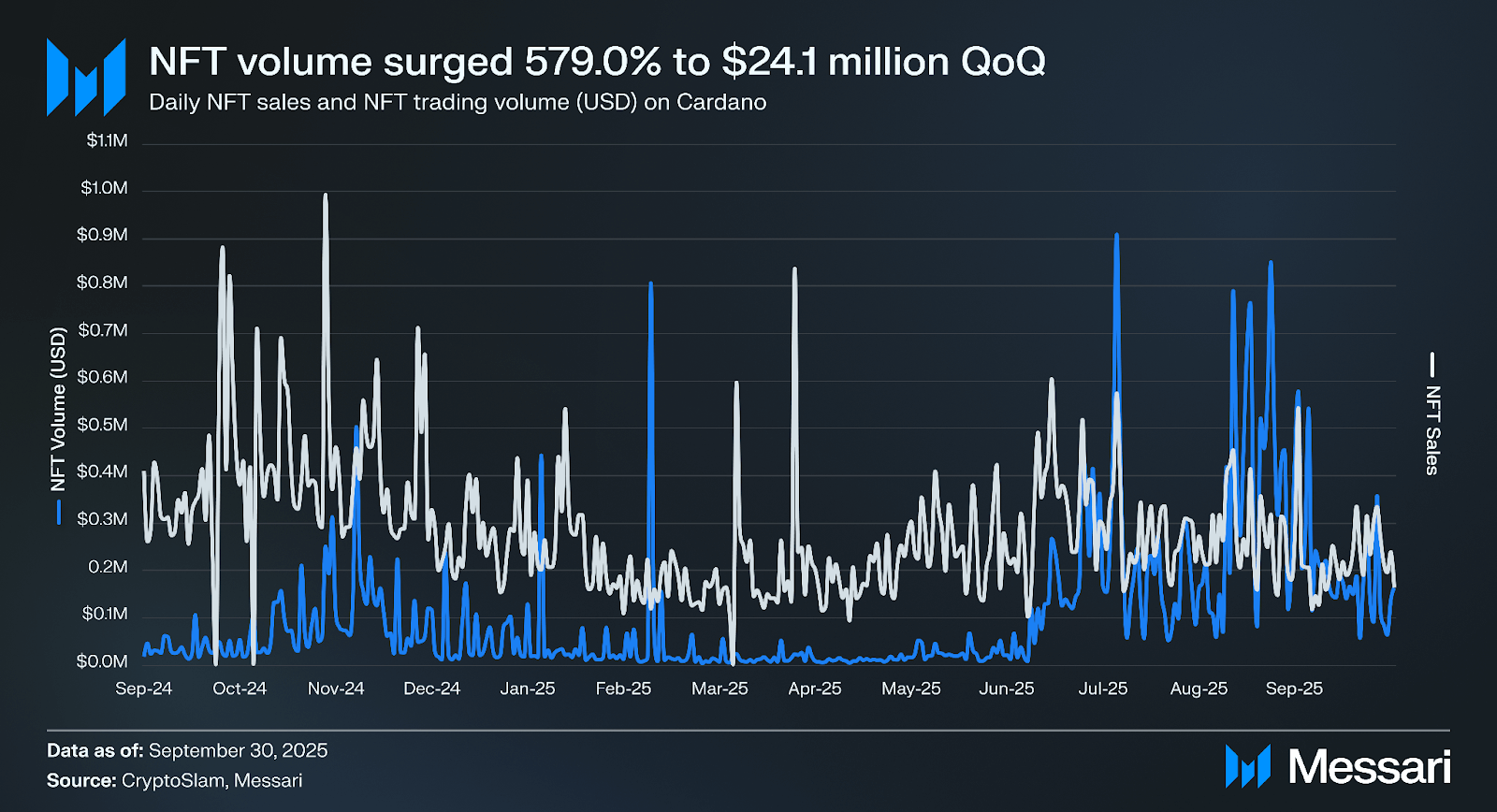
Average NFT trading volume (USD) rose 561.7% QoQ, reaching $262,450 in Q3.
Input | Output Engineering released the Halo2–Plutus verifier, which allows Plutus smart contracts to verify zero-knowledge proofs and enables privacy-preserving applications across Cardano and partner chains like Midnight.
Primer
Cardano (ADA) is a Proof-of-Stake (PoS) Layer-1 blockchain launched in 2017. Cardano aims to provide security, scalability, and functionality to decentralized applications and systems building atop the network. In addition to its community of developers, node operators, and projects, entities like Input | Output, Cardano Foundation, Intersect, EMURGO, Pragma, and others support the network’s development, adoption, and finances. Cardano is in the age of Voltaire (Governance), the final phase of its roadmap. This represents Cardano’s transition from a protocol operated by a few core teams to a community-driven network, where each ADA holder can influence network rules, funding, and protocol upgrades via onchain voting and elected committees. As of September 2025, Cardano governance is fully decentralized, supported by a tripartite ‘government’ consisting of its Constitutional Committee, delegated representatives (DReps) and Stake Pool Operators (SPOs).
With a dedicated community of users and developers, Cardano has demonstrated staying power. After the launch of smart contract support via the Alonzo hard fork in 2021, Cardano began to compete in more traditional crypto markets, such as DeFi and NFTs. For a full primer on Cardano, refer to our Initiation of Coverage report.
ADA is the native currency of Cardano that is used as the primary medium of exchange when transacting on the network. ADA has three primary network-level use cases:
To stake as a stake pool operator or delegator to help secure the network, earn token rewards, and participate in protocol governance.
In Cardano's liquid democracy model, ADA holders delegate their voting power to Delegated Representatives (DReps), who then vote on governance proposals on behalf of the delegators. A DRep's influence is proportional to the total ADA delegated to them. Additionally, the Cardano community allocates treasury funds through onchain governance proposals approved by delegated representatives (DReps) and the Constitutional Committee. In 2025, these votes directed ADA from the Treasury to fundProject Catalyst and other initiatives.
ADA’s circulating token supply inflates until it reaches its maximum supply of 45 billion tokens. After each five-day epoch, 0.3% of ADA reserves (i.e., the ADA not in circulation) are distributed as SPO rewards, allocated in proportion to each pool’s total delegated stake and adjusted for pool performance (uptime and blocks produced) and the operator’s pledged ADA. Inflation trends towards zero as the reserves deplete and the circulating supply approaches 45 billion.
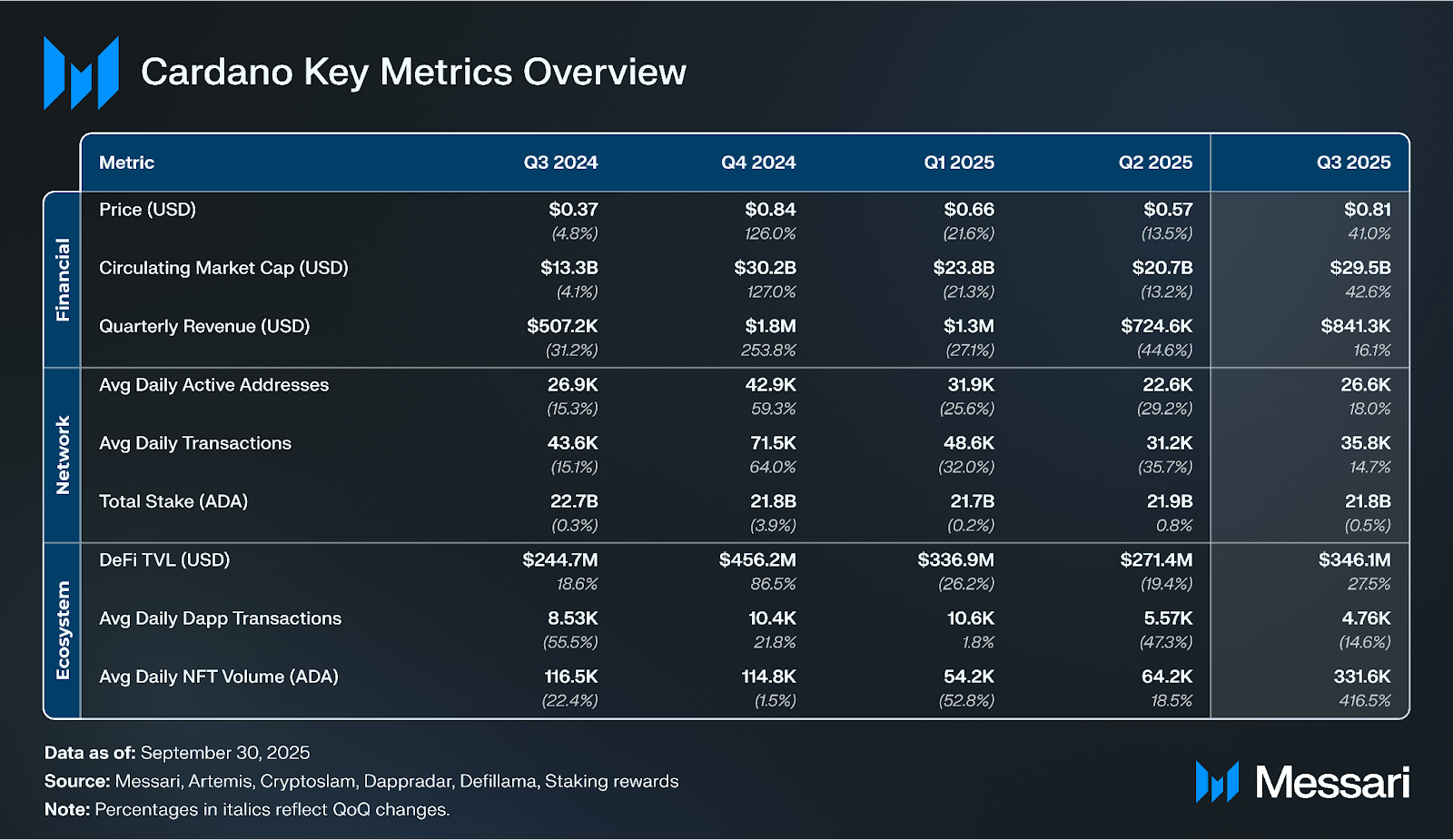
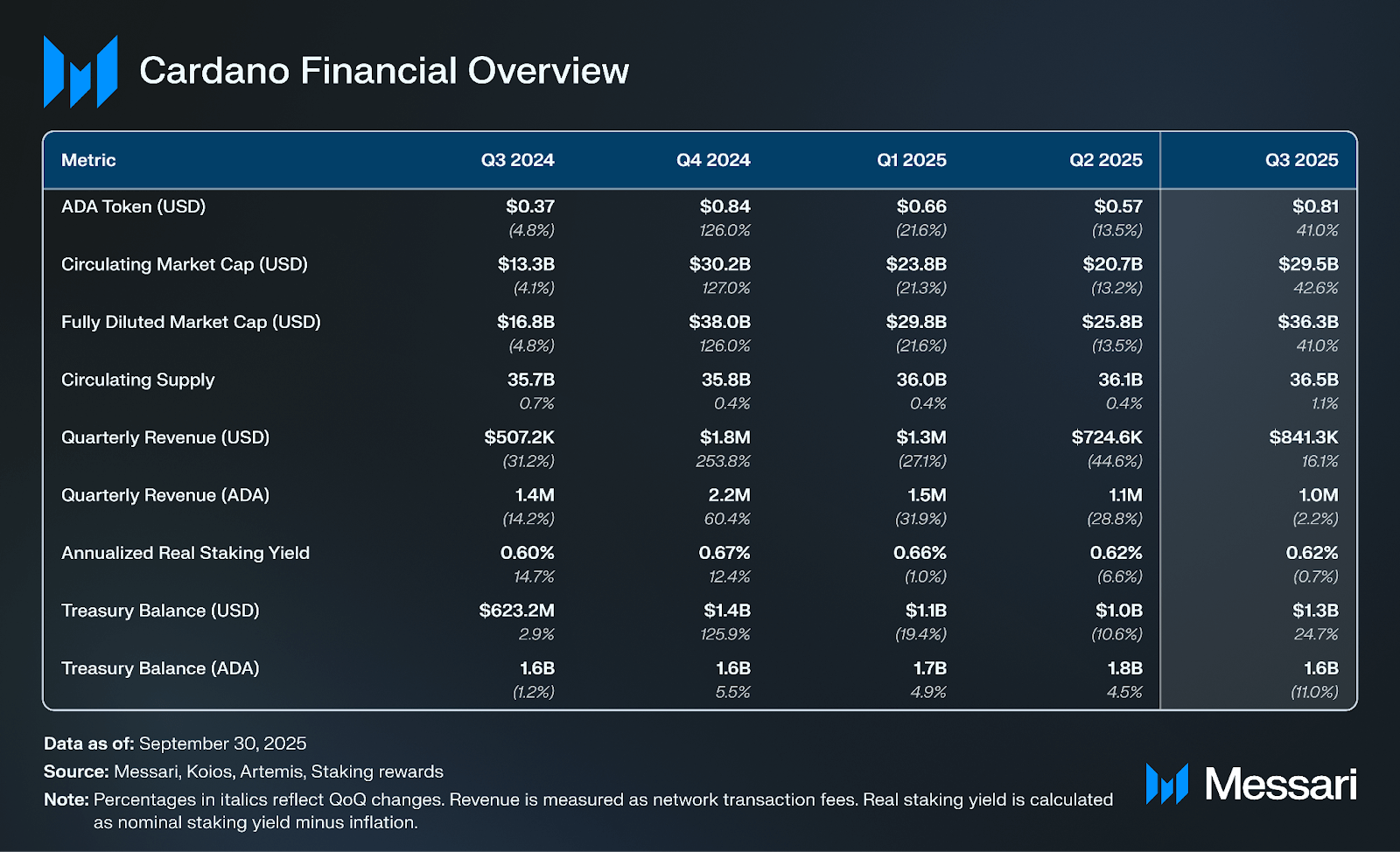
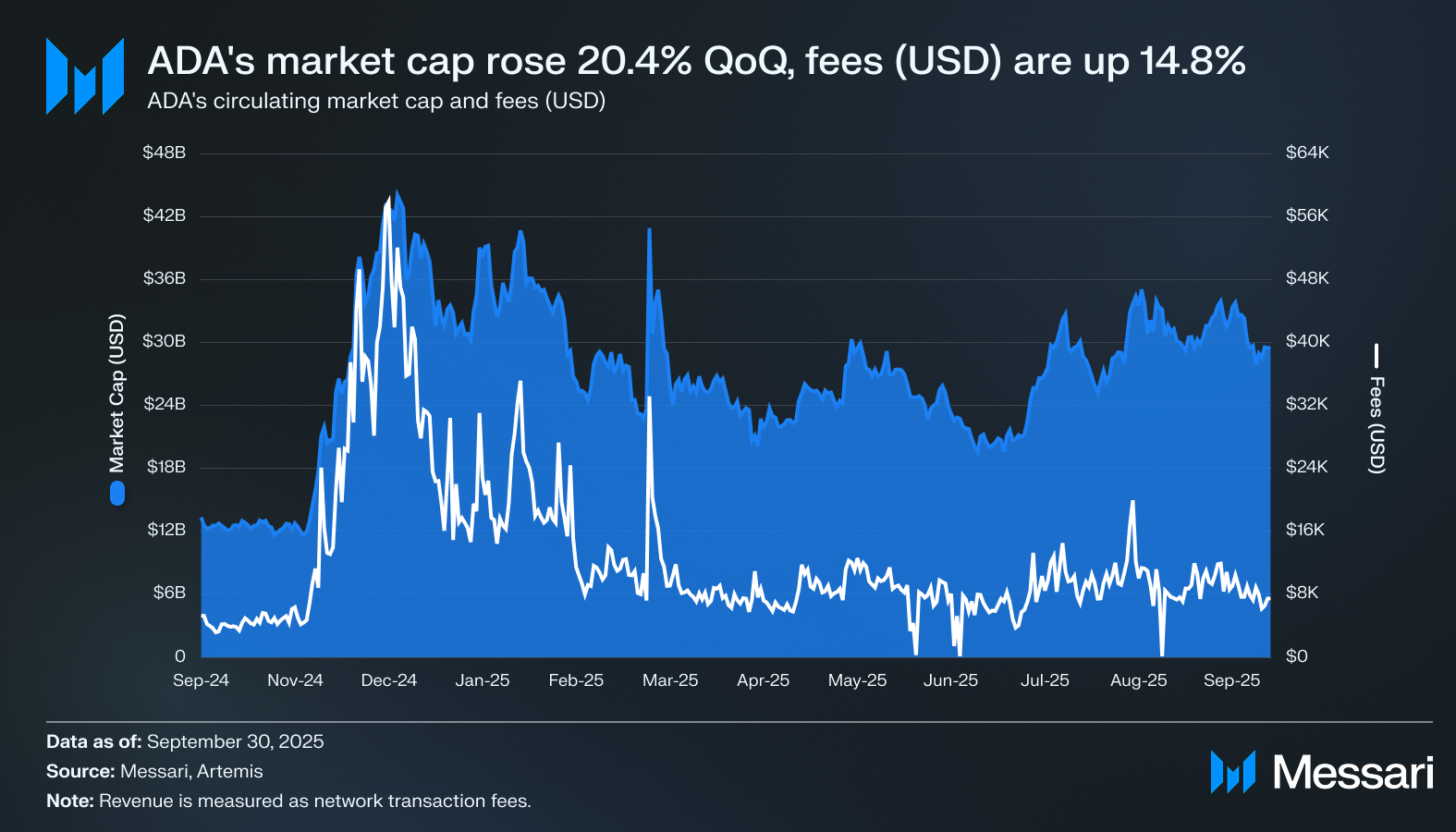
ADA’s price rose 41.0% QoQ to $0.81 in Q3, lifting its market cap 42.5% QoQ from $20.7 billion to $29.5 billion. The modest 1.1% increase in circulating supply accounts for the small difference between price and market cap growth. ADA’s circulating market cap rank remained steady at 10th place at quarter’s end.
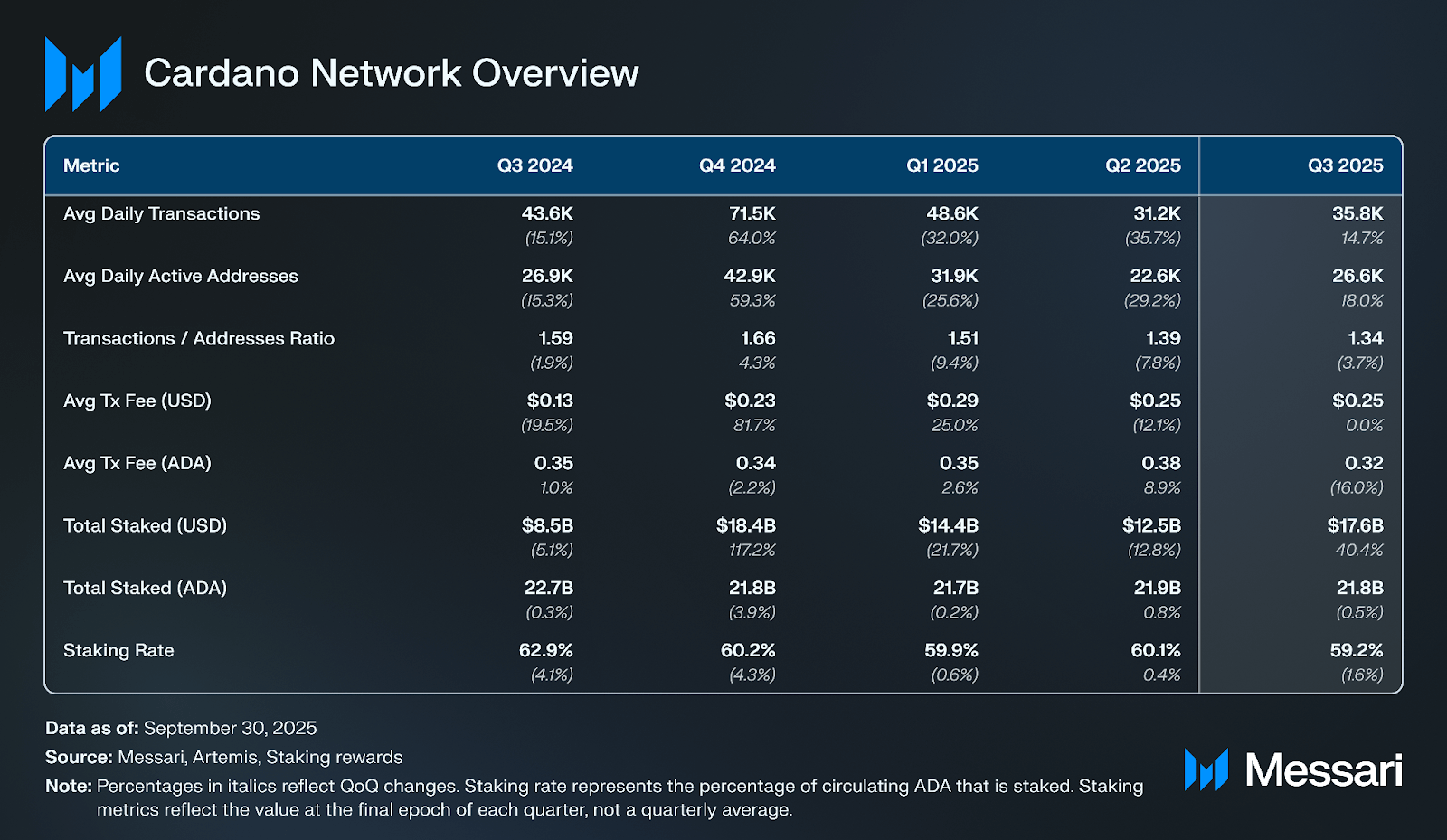
Each transaction on Cardano is accompanied by a network transaction fee for processing transactions and paying storage costs. Fees are calculated by a minimum fee plus a variable fee based on transaction size. Fees (USD) increased 16.1% QoQ to $841,252, while fees (ADA) declined 2.2% QoQ to 1.0 million ADA. The divergence was driven by ADA’s price increase and reduced network activity, with average daily application transactions down 14.6% QoQ to 4,757.
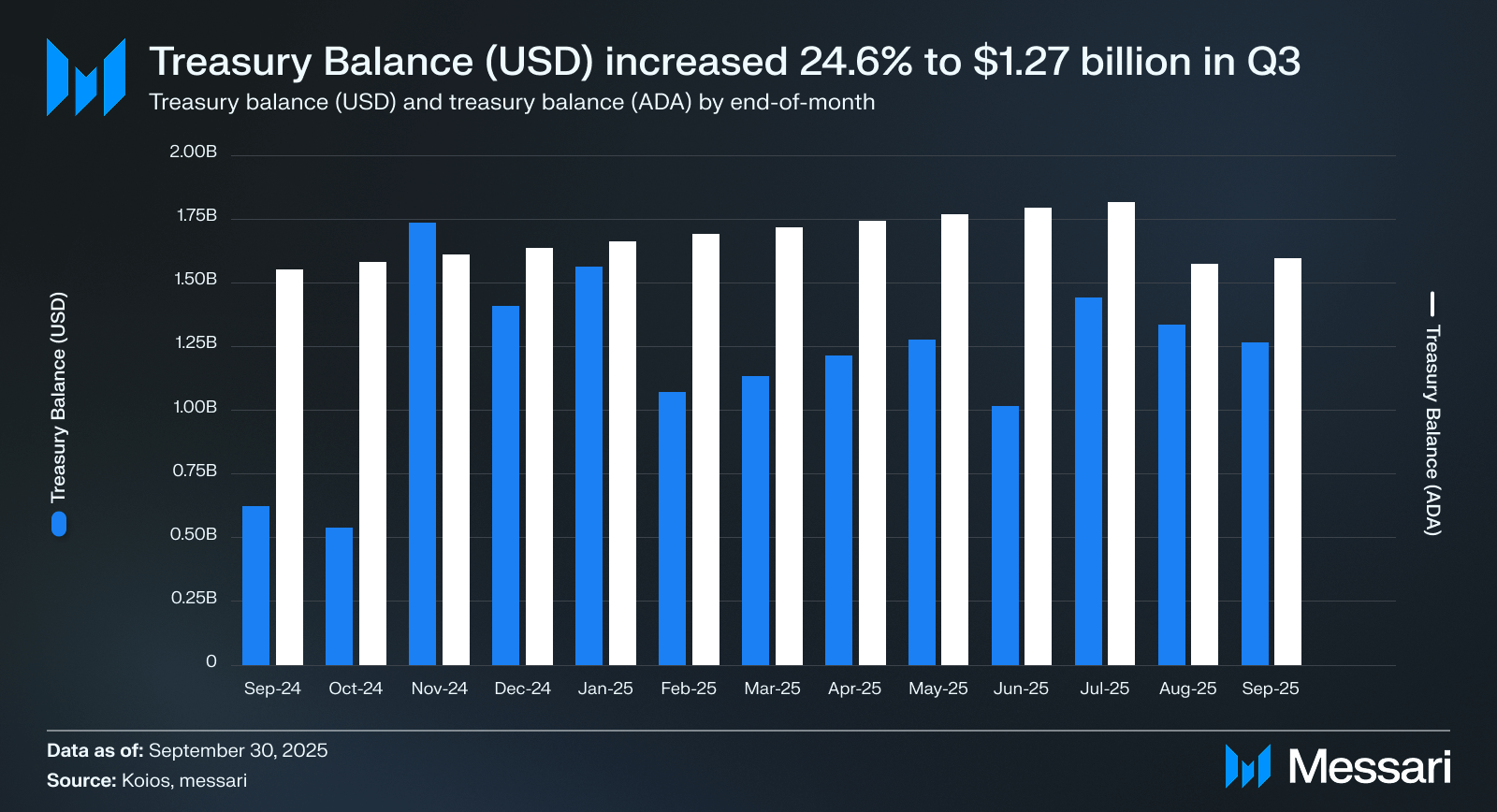
Cardano’s treasury balance (ADA) decreased 10.9% QoQ to 1.6 billion ADA, while its USD value increased 24.6% to $1.3 billion. The treasury provides funds to maintain and develop Cardano, with resources deployed through community governance following the Plomin hard fork in January 2025. Currently, 20% of Cardano’s transaction fees are allocated to the treasury, which can be adjusted through governance.
Network Analysis
Cardano’s average transaction fee (USD) was flat at $0.25, while the average transaction fee (ADA) fell 16% QoQ to 0.32, reflecting ADA’s appreciation during the quarter.
Total staked ADA declined 0.5% QoQ to 21.8 billion, and the staking rate decreased 1.6% QoQ to 59%. In USD terms, total stake rose 40% QoQ to $17.6 billion, supported by higher ADA prices despite the slight decline in staked supply.
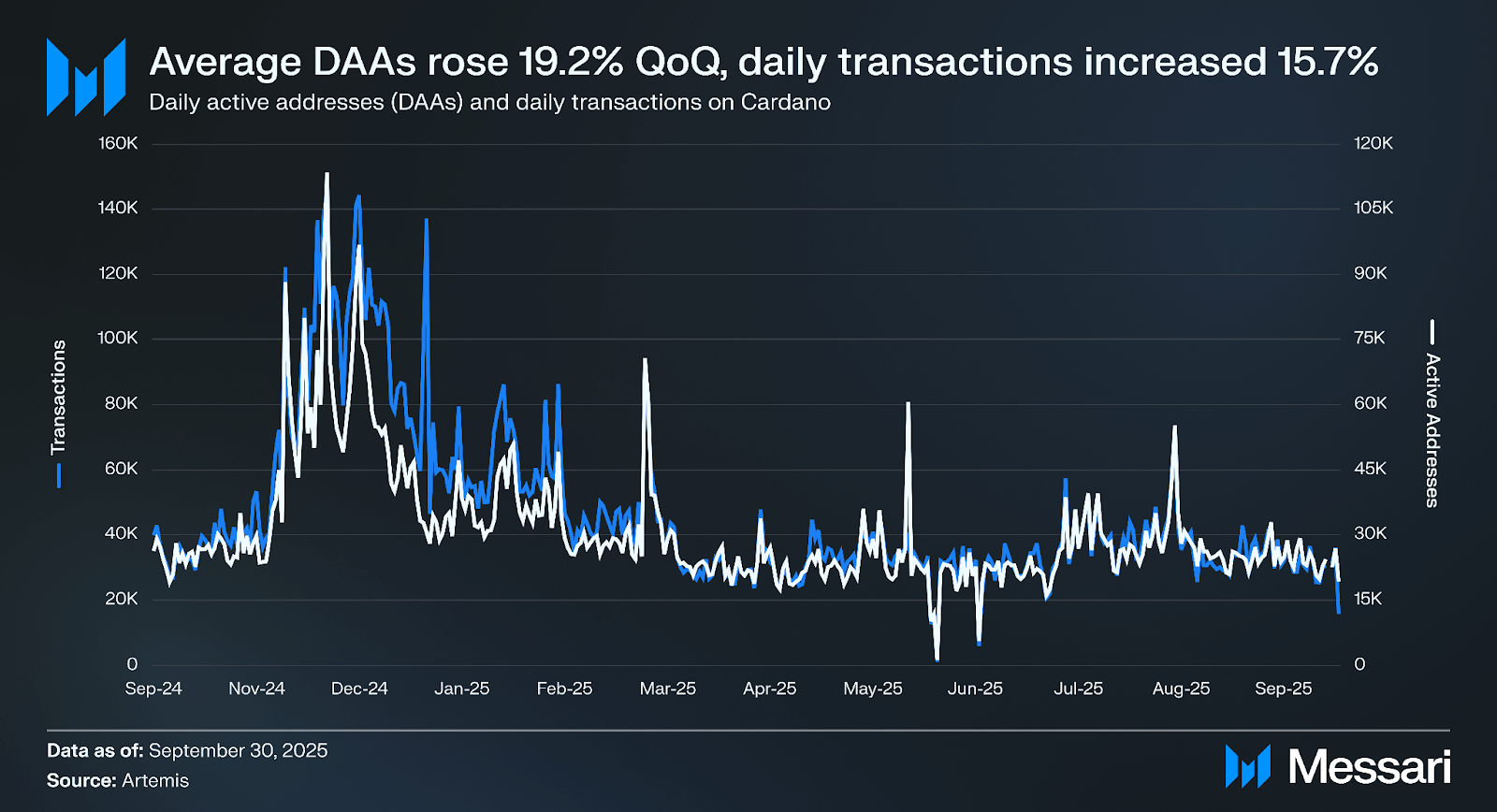
Cardano’s average daily transactions rose 15.7% QoQ to 36,112, while daily active addresses rose 19.2% QoQ to 26,909. The transactions-per-address ratio fell 2.9% QoQ to 1.34, indicating slightly lower activity per address.
Governance Updates
Smart Contract Treasury Framework and Oversight Committee Launch
Cardano advanced its governance architecture this quarter with the launch of a smart contract–based treasury framework and the formation of an independent Oversight Committee to administer funds withdrawn from the Cardano Treasury. This framework ensures spending aligns with community-approved proposals through a transparent and auditable smart contract process. The initiative, led by Intersect, formalizes how withdrawn Treasury funds are deployed and monitored through automated onchain systems rather than manual processes.
The new smart contract framework, developed in collaboration with Sundae Labs, automates disbursements of milestone payments to Cardano Treasury funded projects. Any ADA withdrawn from the Treasury via Intersect is now held transparently onchain and released only through predefined contract logic. This setup replaces trust in administrators with verifiable, auditable code execution.
To add another layer of accountability, Intersect introduced an Oversight Committee comprised of five independent ecosystem organizations: Sundae Labs, Xerberus, NMKR, Dquadrant, and the Cardano Foundation. The committee’s role is to verify data accuracy and ensure that all transactions from the smart contract framework align with community-approved governance outcomes. It does not exercise discretion over funding decisions but instead confirms the technical and procedural correctness of key actions such as vendor contract deployments, disbursements, or contract amendments.
All actions within the framework require multi-signature approval, with two of five committee members authorizing routine operations and three of five required for more sensitive steps. This design distributes responsibility, reduces single-party risk, and ensures that no entity, including Intersect, can unilaterally move funds that originated from the Cardano Treasury. The model is expected to evolve over time as Cardano’s governance infrastructure matures and more ecosystem participants engage in the Treasury process.
Treasury Withdrawal Actions:
Cardano’s governance process matured this quarter with the first full execution of its community budgeting cycle. Treasury withdrawals proceed through three stages: proposal, ratification, and enactment, ensuring transparent and rule-based management of treasury funds. Votes are counted only at epoch boundaries, allowing delegators to adjust their stance mid-epoch before results are finalized. The first treasury withdrawal was completed in July 2025.
Once a proposal meets the 67% ratification threshold and passes a constitutional review, it is marked as ratified by the Cardano ledger. After one additional epoch, the action reaches enactment, and Treasury funds are transferred to the designated stake address.
Once a TWA is ratified, the specified administrator will handle the next steps. If Intersect is the selected administrator, Intersect’s procurement team engages in offchain formalities, including KYC/KYB verification and the signing of a legal contract with proposal owners. These steps are mandatory for constitutional compliance; any failure to complete them may prevent Intersect from administering the proposal. After these checks, the project formally enters the enactment phase.
Intersect’s administration framework was tested at scale for the first time in July 2025, when Intersect submitted 39 Treasury Withdrawal Actions. These proposals represented the first large-scale deployment of Cardano’s smart contract–based Treasury system. The first vendor contracts were enacted in late August. These transactions validated the operational reliability of Cardano’s governance automation, as each payment required signatures from Intersect, the Oversight Committee, and the vendor within a 36-hour coordination window.
In August 2025, the community approved its first core protocol development funding via the Treasury, allocating 96 million ADA (approximately $71 million) toward foundational network maintenance and upgrades. This marked a historic milestone: the first time Cardano’s core infrastructure funding was funded directly through onchain governance. The funds will support key upgrades like Ouroboros Leios, the continued development of Hydra scaling, and Mithril enhancements. The Interim Constitutional Committee (ICC) approved the treasury allocation before the new Constitutional Committee (CC) took office. This sequence ensured the newly elected CC would not be immediately required to vote on these initial 39 proposals.
Constitutional Committee Election Finalized:
Cardano completed its first election of a fully community-elected Constitutional Committee in September 2025, replacing the interim body established through offchain polling. The election marked a milestone in community maturity, as all seven seats were filled through onchain voting and no longer included major institutions such as IOG, Emurgo, the Cardano Foundation, or Intersect.
The members proposed for an onchain vote following a preliminary voting period (which ran from June 10 to July 2, 2025) were:
Per CIP-1694’s process, the action required concurrent majorities from DReps (67%) and SPOs (51%) before ratification. The proposal was ratified on Sept. 1, 2025, and enacted on Sept. 6, 2025, at which point the newly elected CC formally took office.
IOG, EMURGO, the Cardano Foundation, and Intersect stepped back from their roles on the ICC to reinforce community ownership, with Intersect continuing as a neutral coordinator. This transition strengthens the separation of powers in Cardano’s governance and embeds constitutional review within a committee fully selected through community-driven processes.
Ecosystem Analysis
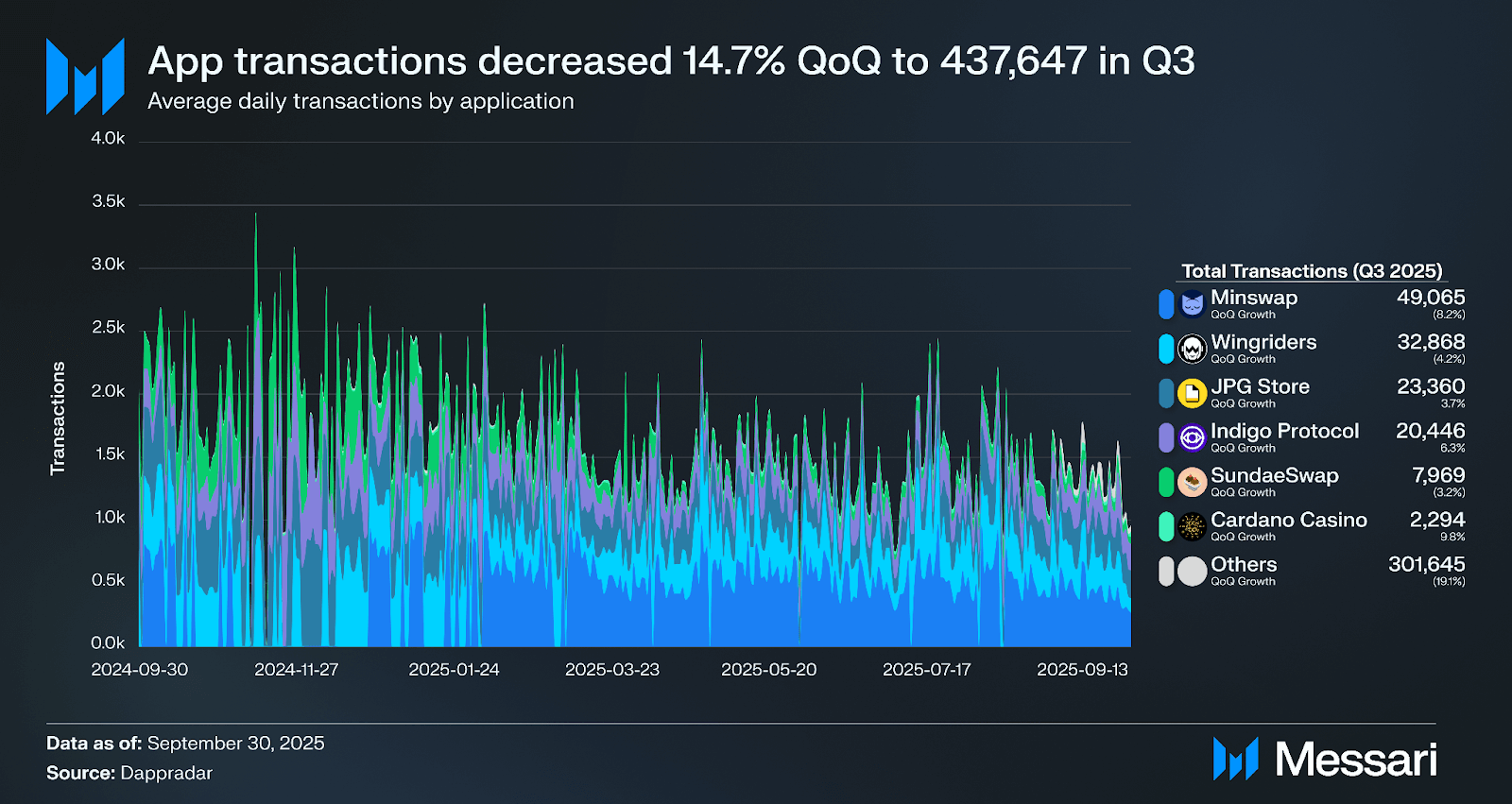
Average daily application transactions declined 14.7% QoQ to 437,647 in Q3, marking a second consecutive quarter of lower onchain activity. DEXs remained the dominant driver of network usage, though NFT marketplaces like JPG Store and gaming apps like Cardano Casino continued to see more transactions this quarter.
Minswap remained the top application with 49,065 transactions (–8.2% QoQ), followed by WingRiders at 32,868 (–4.2% QoQ). JPG Store ranked third with 23,360 (+3.7% QoQ), reflecting a rebound in NFT markets after a weak Q2. Transactions on Indigo Protocol grew 6.3% QoQ to 20,446, indicating consistent demand for synthetic assets and leveraged exposure.
Legacy DEXs, such as SundaeSwap, continued to decline (–3.2% QoQ to 7,969), while smaller platforms, like Cardano Casino, rose 9.8% QoQ to 2,294, indicating a sticky demand for gaming applications. The “Others” category declined 19.1% QoQ, as contraction continued among smaller apps.
DEXs
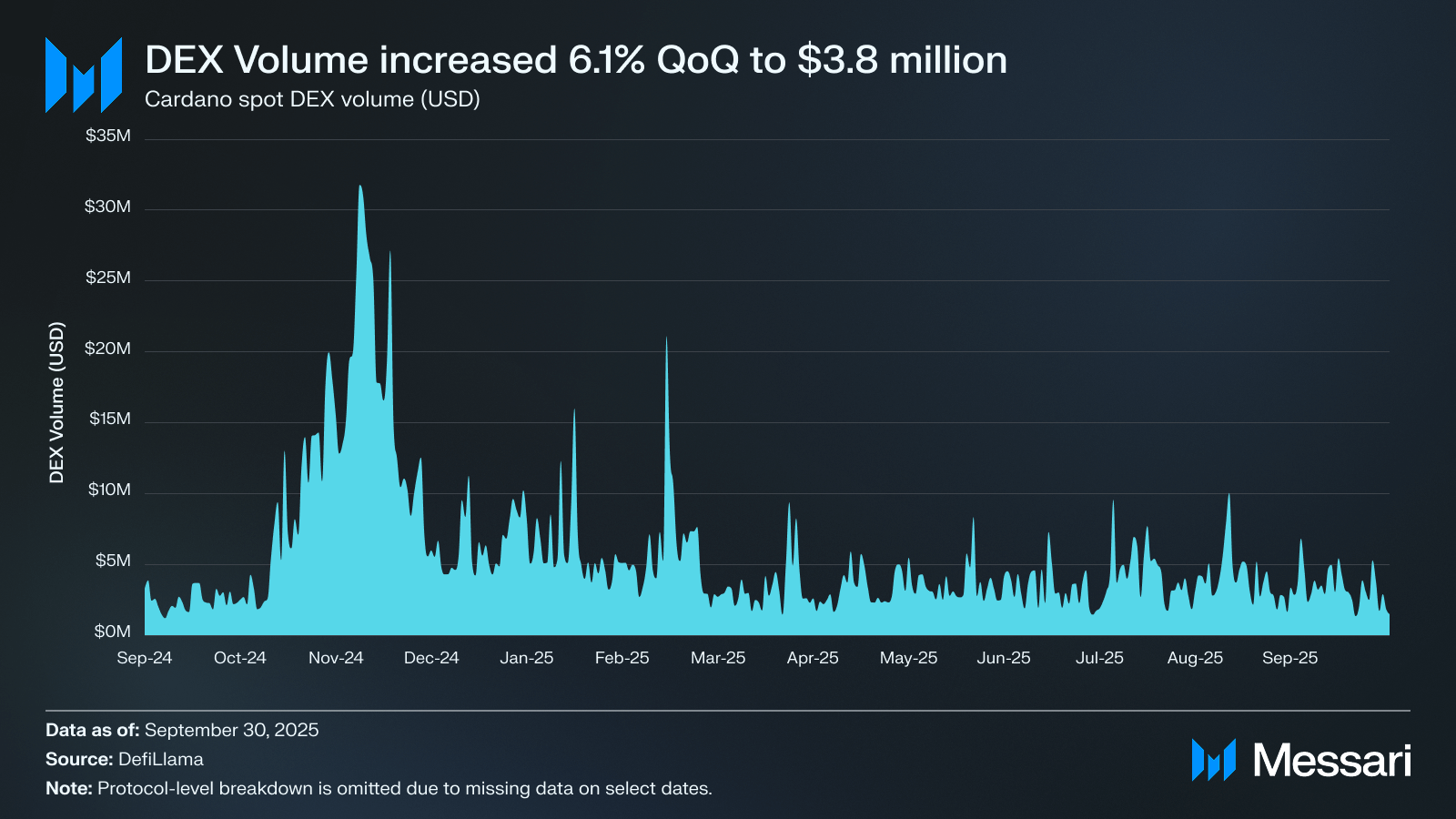
Average daily DEX volume on Cardano increased 6.1% QoQ to $3.8 million in Q3, while stablecoin supply increased 21.48% QoQ to $38.1 million. The Cardano network is home to several DEXs, such as:
CSWAP, one of Cardano’s newest DEXs, aggregates tokens, NFTs, and real-world assets in one seamless trading interface. In September, CWAP introduced V1 of the CSWAP DEX, which offered several UX and swap enhancements. The team has teased plans to release a Web2.5 RWA platform in the near future, which will leverage the DEX for trading and liquidity. At the end of Q3 2025, CSWAP had over $1.6 million in TVL, effectively flat QoQ.
Strike Finance launched the first perpetual futures DEX on Cardano. Strike lets you trade assets like ADA, SNEK, and MIN with up to 20x leverage. The team will soon release Strike V2, which is set to reduce fees and simplify token listings. By the end of Q3 2025, the protocol had $3.3 million in TVL, a 36.5% decrease from $5.2 million in Q2.
SundaeSwap is an automated market maker (AMM) DEX on Cardano. It offers token swaps, liquidity provision, staking, and governance via the SUNDAE token. In Q3, Sundae Labs (the company behind SundaeSwap) collaborated with Intersect to design and implement the smart contract framework now used for Cardano’s Treasury operations. Daily average volume is down 7.4% QoQ.
Splash is a DEX launched in July 2024 after a token sale for SPLASH raised 17.2 million ADA in May. Splash also worked to develop snek.fun, a protocol similar to pump.fun on Solana that allows users to launch and trade tokens easily. Splash Protocol had the highest growth among its DEX peers, growing 42.8% QoQ to roughly $424,833 in average daily volume.
DexHunter is a leading DEX aggregator on the Cardano blockchain, launched in Q2 2023, designed to streamline DeFi trading by intelligently routing swaps across all major Cardano DEXes, such as Minswap, SundaeSwap, and Splash, to secure the best rates, lowest fees, and minimal slippage. With over 250,000 monthly visitors and more than 3 million successful swaps, it handles a significant portion of Cardano’s swap volume. The platform’s native HUNT token incentivizes participation through fee discounts, staking, and DAO governance
VyFinance launched in August 2021, offering a suite of products including its DEX, a redistributive BAR mechanism that shares trading fees among VYFI token holders, a lottery, and token/NFT vaults. The VYFI token, with a 450 million total supply, facilitates governance, lottery entries, and rewards.
WingRiders is a DEX designed to provide automated market-making (AMM) for token swaps, liquidity provision, ADA auto-staking, and yield farming. The WRT token, with a total supply of 100 million, enables governance, yield boosting, discounted NFT and crypto purchases, and collateral use. WingRiders' average daily volume grew 19.9% in Q3, reaching $295,956.
Saturn Swap is a batchless order book DEX offering instant swaps with zero impermanent loss, minimal fees, and advanced trading tools by leveraging Cardano's architecture for near-instant execution without intermediaries. Trading activity has slowed, with average daily volume down 83.18% in Q3 to $2,352.
MuesliSwap launched on Nov. 26, 2021, acting as the first operational DEX post-Alonzo hardfork, featuring an order book model tailored for Cardano's eUTxO architecture to enable limit orders, peer-to-peer trading, and full decentralization without liquidity pools, alongside AMM pools, yield farming, and an NFT marketplace. In Q3 2025, MuesliSwap launched Aggregator V2 and introduced the DevX wallet pilot. Daily average volume is down 4.1% QoQ to $20,881.
DeFi
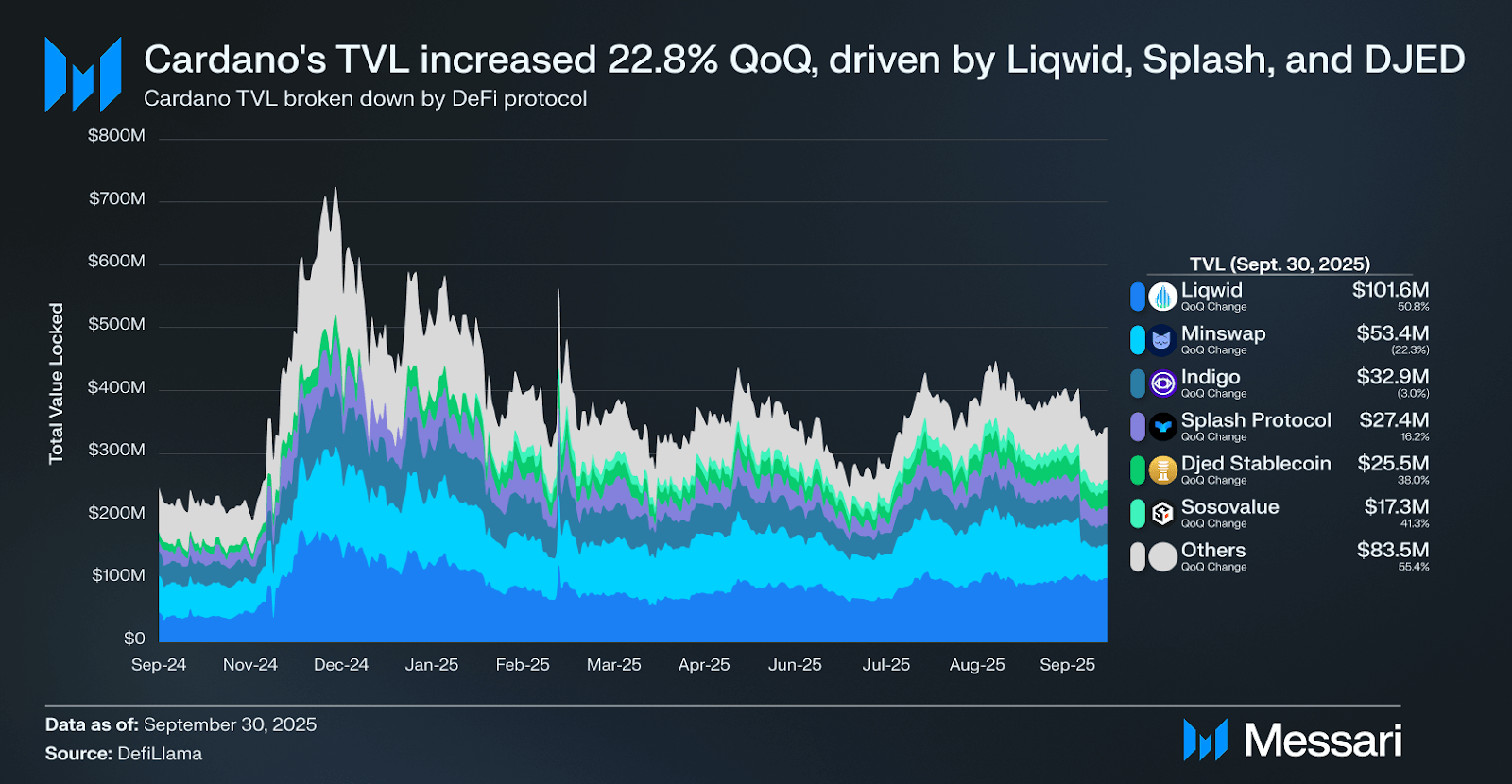
Cardano’s DeFi TVL rose 22.8% QoQ to $341.7 million in Q3, compared to an industry-wide DeFi TVL increase of 41.9%. Cardano’s DeFi diversity score (i.e., the number of protocols making up 90% of a network's TVL) increased from 9 to 10, meaning TVL diversified across more protocols.
Liqwid is a lending and borrowing protocol on Cardano built for Cardano-native assets. The protocol introduced qTokens, which are interest-bearing tokens representing collateral in lending pools. Liqwid overtook Minswap as the network’s largest protocol, with TVL rising 50.8% QoQ to $101.6 million and TVL share increasing to 29.7%. The lending platform benefited from deeper ADA collateral markets and stablecoin integrations.
Minswap, a popular DEX on Cardano, offers low fees, swaps, and yield farming on Cardano-native tokens. Cardano’s DEX ecosystem remains top-heavy, with Minswap alone accounting for 74.7% of total DEX volume in Q3. Minswap’s TVL fell 22.3% QoQ to $53.4 million, trimming its share to 15.6%.
Indigo is a synthetics platform that offers iUSD, iBTC, and iETH. Governance and fee distribution run through the INDY token and the Indigo DAO. Indigo’s TVL decreased by 3.0% QoQ, reaching $32.9 million.
Splash is a DEXlaunched in July 2024 after a token sale for SPLASH raised 17.2 million ADA in May. Splash also worked to develop snek.fun, a protocol similar to pump.fun on Solana that allows users to launch and trade tokens easily. TVL on Splash Protocol grew 16.2% QoQ to $27.4 million, reflecting its rising presence in the Cardano DeFi ecosystem.
DJED is an algorithmic stablecoin protocol that operates like an onchain central bank. It maintains price stability by automatically minting or burning tokens, buying DJED when the price falls below the peg and selling when it rises above, keeping its value close to $1 through reserve-backed market operations. DJED expanded 38.0% QoQ to $25.5 million in TVL as integrations across lending and DEX platforms increased.
SoSoValue’s SSI Protocol offers a spot index framework designed to simplify diversified crypto exposure on Cardano. It tracks baskets of onchain assets to provide users with transparent, secure, and easily accessible index-based investment products. Sosovalue’s TVL rose 41.3% QoQ to $17.3 million.
Infrastructure
In Q3 2025, teams focused on advancing Cardano’s privacy, scalability, and interoperability layers, translating long-running research efforts into tangible infrastructure upgrades across wallets, nodes, and cross-chain protocols.
In August 2025, Input Output Engineering released the open-source Halo2–Plutus verifier, allowing Cardano smart contracts to verify zero-knowledge proofs (ZKPs) directly onchain. Built on the Halo2 proving system, also used in Zcash and other privacy protocols, the verifier lets developers compile Halo2 circuits into Plutus scripts that can check cryptographic proofs natively on Cardano without relying on offchain verification or special precompiles. This marks the first step toward bringing practical ZK functionality to Cardano, enabling applications like privacy-preserving applications and zk-bridges between Cardano and other networks, such as Midnight, Cardano’s privacy-focused sidechain.
In September 2025, Cardano’s Mithril team introduced a major update with the 2537.0 release. The update enhanced compatibility with the latest Cardano node software, introduced support for devices using ARM processors, and simplified the process for stake pool operators to run and manage Mithril nodes.
In September 2025, the Lace team shipped version 1.29, improving hardware wallet reliability by extending Trezor support to all Cardano master key schemes (ICARUS, ICARUS_TREZOR, and LEDGER). The update targets restore and signing mismatches some users hit when moving between hardware and software wallets, making wallet recovery and migrations smoother.
In late September 2025, NEAR Intents began supporting ADA swaps, providing Cardano holders with a simple way to trade across more than 20 chains without relying on traditional bridges. This expands ADA’s reach into a broader liquidity set and aligns with Cardano’s push toward low-friction interoperability.
Stablecoins
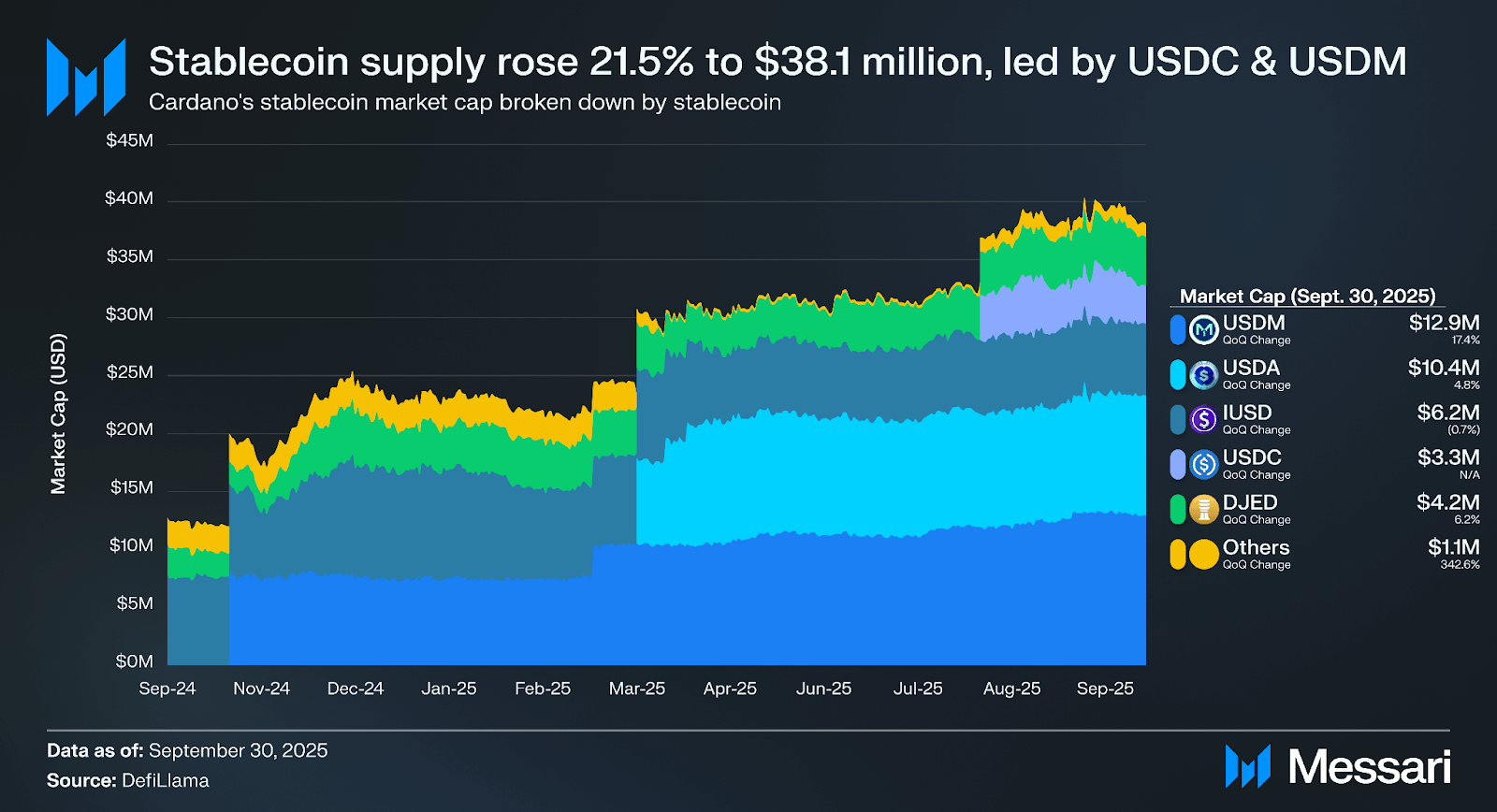
Cardano’s stablecoin market cap rose 21.5% QoQ to $38.1 million in Q3. USDM remained the largest at $12.9 million (+17.4%), with a 33.9% share, while USDA grew to $10.4 million (+4.8%) and held a 27.2% share. IUSD was effectively flat at $6.2 million (–0.7%), maintaining a 16.2% share. DJED advanced to $4.5 million (+6.2%), reaching 11.1%. A notable addition was USDC, which ended its first quarter on Cardano at $3.3 million (8.6% share).
While USDM and USDA both expanded in nominal terms, they ceded market share to new entrants as they gained traction. The long tail of stablecoins, grouped under “Others”, recorded the fastest growth, surging 342.6% QoQ to $1.1 million, highlighting broader experimentation with alternative stablecoins on Cardano.
Moneta’sUSDM launched on March 16, 2024. Like USDA, USDM is collateralized 1:1 with the U.S. dollar and dollar equivalents. In Q3, Moneta expanded beyond Cardano through a new partnership with Sundial, integrating its regulated stablecoin with Sundial’s Bitcoin Layer-2 infrastructure. In Europe, NBX, a regulated Norwegian exchange with a license under the Financial Supervisory Authority, joined as an EU co-issuer of USDM to ensure MiCA compliance.
USDA is a Cardano-native, U.S. dollar-pegged stablecoin issued by Anzens, with EMURGO providing technical expertise for Anzens’s operations. It is fully backed by U.S. dollar reserves and equivalents (e.g., U.S. government treasuries), and pegged 1:1 with the U.S. dollar. USDA launched on Minswap on March 7. By the end of Q3, it achieved over $10.4 million in liquidity. The platform charges no fees to mint/burn USDA, with off-ramps available in 48 countries. In Q3, Anzens announced off-ramp support for users in Japan, enabling users to convert USD directly to JPY for settlement into a fiat bank account.
IUSD is a synthetic, overcollateralized stablecoin issued by Indigo protocol. iUSD is minted when users lock ADA into Collateralized Debt Positions (CDPs), creating a pegged asset that tracks the median price of major stablecoins such as USDC and USDT. This allows iUSD to maintain its peg even if one external reference asset deviates. In Q3, Indigo updated iUSD’s interest model (via Proposal #94) to make the system more adaptive and self-correcting. Borrowing costs now adjust automatically based on the overall health of the protocol’s collateral. When there’s excess collateral in the system, rates rise to slow new minting; when collateral gets thin, rates fall to encourage more deposits. This feedback loop enables the stablecoin to maintain its dollar peg without requiring manual intervention.
USDC had its first quarter of operations on the Cardano blockchain. This was not a native issuance, but rather bridged liquidity, transferred through cross-chain bridges such as Wanchain. These bridges lock USDC on its original chain (typically Ethereum) and mint a wrapped representation on Cardano, enabling users to trade or supply liquidity within Cardano DeFi protocols. While bridged assets introduce added custodial and smart contract risk, they expand access to familiar stablecoin liquidity.
DJED is an overcollateralized stablecoin developed by Input Output that uses SHEN as the reserve coin. SHEN is minted against ADA and represents the reserve’s equity, so when ADA rises, the reserve grows and SHEN appreciates, and when ADA falls, SHEN absorbs the losses. At Rare Evo 2025, COTI announced plans to introduce a private version of DJED. Private DJED extends the core DJED model into a confidential framework that protects transaction details such as wallet addresses and amounts while maintaining regulatory compliance. This allows businesses to operate privately when needed without leaving the Cardano network.
NFTs
Average daily NFT sales on Cardano increased 6.6% QoQ to 266.6, while average daily trading volume (USD) rose 561.7% to $262,447.7 in Q3. jpg.store remained Cardano's top NFT marketplace based on transaction volume. This sustains its position as the network’s NFT hub.
Emerging Applications
Bodega Market is Cardano’s first prediction market. Launched in July 2025, Bodega automates market resolution and payouts, ensuring trustless accuracy and eliminating the risk of manual interference. All wagers are settled in USDM, Cardano’s largest fiat-backed stablecoin by market cap, providing stability and regulatory clarity for participants. Since its V3 launch, Bodega has distributed more than 400,000 ADA in claims and introduced staking rewards paid in ADA, giving users a share of protocol fees. With Mercuryo fiat integrations and cross-chain expansion on the roadmap, Bodega is preparing to transition from a Cardano-native app to a multi-chain prediction market.
Sokosumi is positioning itself as the gateway to the emerging AI agent economy on Cardano. Developed with Serviceplan Group, the platform enables users and enterprises to discover, hire, and integrate autonomous AI agents as easily as hiring freelancers. It connects Masumi (payments and identity), Kodosumi (runtime execution), and Sokosumi (agent discovery) into a unified ecosystem for decentralized AI. Already adopted by companies like BVG, Allianz, Samsung, BMW, and Lufthansa, Sokosumi is one of the first real deployments of agent-to-agent economies, turning AI agents from experimental tools into functional, revenue-generating digital workers.
Development, Growth, and Community
Cardano Card
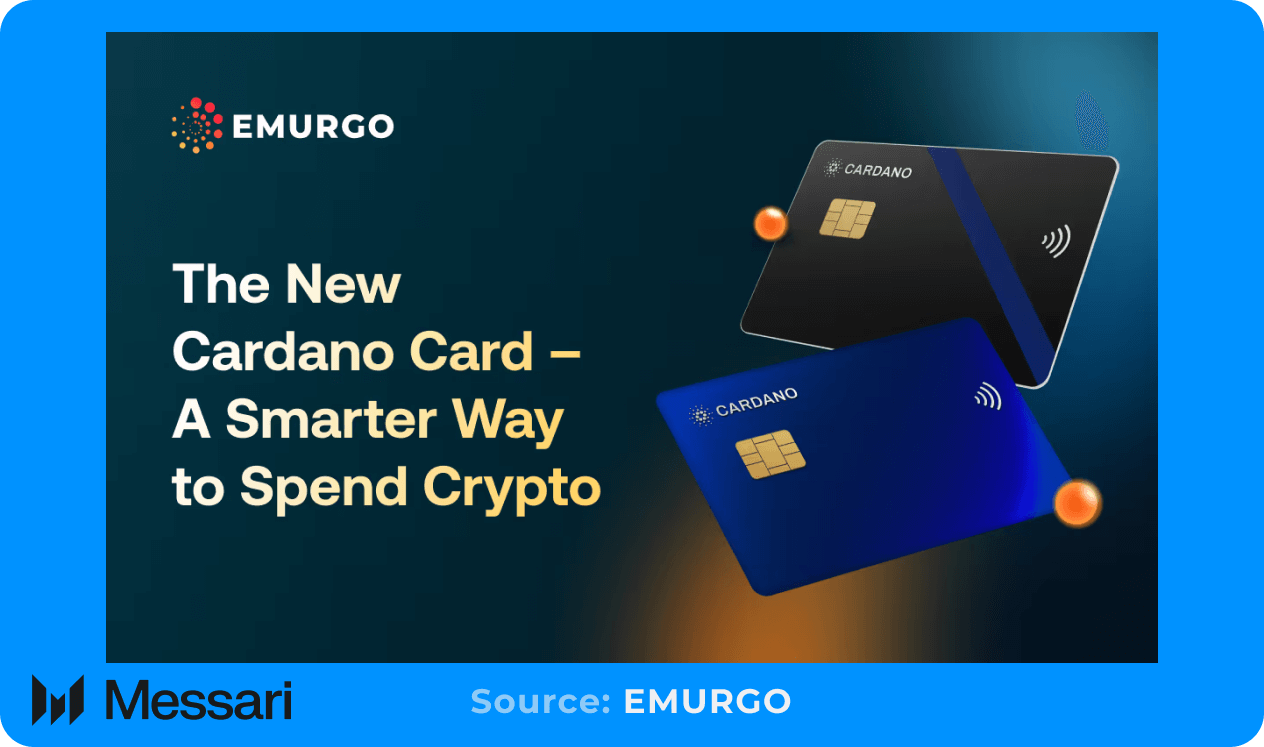
In July 2025, EMURGO, a founding entity of Cardano, opened registrations for the upcoming Cardano Card, a crypto payments product designed to make digital assets usable in everyday life. The card functions as an all-in-one key to onchain finance, allowing users to spend, stake, borrow, and earn rewards directly from a single platform.
At launch, the Cardano Card will operate as a custodial, multi-chain card supporting ADA, BTC, ETH, SOL, USDC, and USDT, with future upgrades planned for self-custody and yield-bearing integrations. Users can stake ADA to earn rewards, access exclusive airdrops, and borrow stablecoins using ADA as collateral. In a uniquely Cardano-native design choice, a portion of the card’s profits will be directed to the Cardano Treasury, linking everyday transactions with network sustainability.
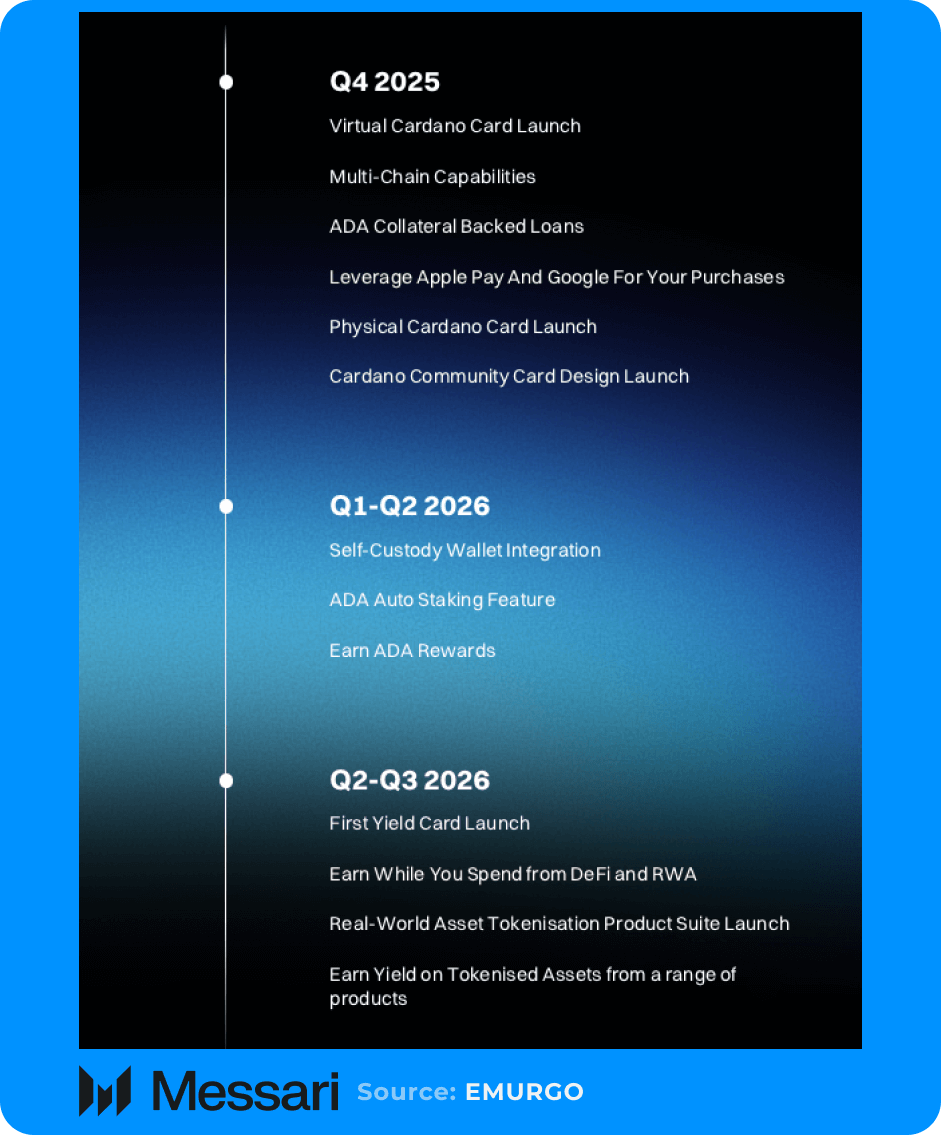
The product roadmap targets a Q4 2025 rollout, including the virtual and physical card launches, multi-chain functionality, ADA-backed loans, and support for Apple Pay and Google Pay. By mid-2026, EMURGO plans to add self-custody wallet integration, auto-staking, and yield card functionality tied to DeFi and tokenized real-world assets (RWAs).
By combining traditional payment convenience with onchain programmability, the Cardano Card aims to extend DeFi into the real world, offering a practical, branded entry point into Cardano’s growing financial ecosystem.
Foundation Roadmap Update
In Q3, the Cardano Foundation unveiled a major update to its roadmap, shifting focus from network maintenance toward ecosystem expansion. The new strategy has six key themes: DeFi liquidity, Web3 adoption, venture development, real-world assets (RWAs), ecosystem marketing, and governance decentralization.
The most immediate change is a stronger commitment to Cardano DeFi. The Foundation plans to inject an eight-figure ADA liquidity package into leading stablecoin projects to strengthen on- and off-ramps and improve market depth. While liquidity provisioning extends beyond its original mandate, the move acknowledges that deeper DeFi liquidity is a prerequisite for sustainable growth. The Foundation also plans to collaborate on community-led initiatives, such as the Stablecoin DeFi Liquidity Budget, to establish longer-term funding frameworks for onchain liquidity.
On the adoption side, the Foundation is expanding its Web3 and RWA teams to improve integrations, listings, and enterprise-grade tokenization. This follows its pilot of the Cardano Venture Hub, which will scale in 2026 to include both startup and enterprise programs. The Foundation will allocate up to 2 million ADA to direct investments, loans, and advisory support, complemented by partnerships with Draper U, Techstars, and CV VC.
Cardano’s RWA initiative also gained momentum through a $10 million launch with MembersCap, highlighting Cardano’s appeal for regulated, tokenized assets. The Foundation will now push for the completion of CIP-0113 and CIP-0143, introducing programmable, interoperable token standards, and will collaborate with Masumi on the x402 payment framework to enable seamless agent-to-agent transactions on Cardano.
The roadmap also reinforces the Foundation’s role as a public advocate for the ecosystem. With a 12% increase in its 2026 marketing budget, the Foundation plans to expand enterprise engagement, developer onboarding, and global awareness through events such as TOKEN2049, Consensus, and the Africa Tech Summit. Its educational initiatives, including the Cardano Academy and masterclass programs, continue to bridge traditional institutions with onchain systems.
Governance remains central to the Foundation’s mission. Building on its initial 140 million ADA delegation to Builder DReps, it will delegate another 220 million ADA to new Adoption and Operations DReps while reducing its own self-delegation to 80 million ADA. After five years, the Foundation’s SPO delegation program will wind down as it consolidates operations under its own pledged pools, freeing resources to focus on ecosystem growth and governance tooling.
The updated roadmap reflects a strategic pivot from operational resilience to economic scalability. With liquidity injections, venture funding, and real-world asset infrastructure now part of its agenda, the Cardano Foundation is positioning itself not just as a steward of network stability, but as an active architect of Cardano’s next phase of adoption
Partner Chains
Partner Chains is an all-encompassing term that can include technically sovereign sidechains or modular networks. These networks include Wanchain, Midnight, and World Mobile.
Midnight is Cardano’s privacy-focused partner chain, built to enable zero-knowledge (ZK) proofs and confidential smart contracts. Designed by Input Output Global (IOG), it introduces selective disclosure capabilities that let developers build applications where users can verify computations without exposing underlying data, a crucial feature for institutional and enterprise-grade use cases.
In Q3 2025, Midnight’s rollout accelerated on both the technical and ecosystem fronts. Phase 1 (The Claim Phase) of the “Glacier Drop” airdrop began on August 5, allowing eligible wallets with at least $100 in assets across eight blockchains (ADA, BTC, ETH, SOL, XRP, BNB, AVAX, and BAT) to claim NIGHT. The claim window, initially set to close on Oct. 4, was extended to Oct. 20 to improve wallet compatibility and maintain cross-chain participation. By Sept. 30, more than 2.7 billion NIGHT tokens had been claimed by over 125,000 wallets, signaling strong early interest in the network.
The team announced a wave of partnerships spanning infrastructure and custodians to help achieve its goal of becoming Cardano’s privacy layer, including:
Google Cloud: Google Cloud joined the Midnight ecosystem to provide enterprise-grade infrastructure and security, including running a validator, confidential computing, and threat monitoring/incident response via Mandiant. Google Cloud will also support developers through the Google for Startups Web3 Program. This is a rare alignment between a major cloud provider and a privacy-focused blockchain. It gives Midnight increased credibility with enterprises that need hardened infrastructure, an audited security posture, and a clear developer on-ramp.
BitGo, Fireblocks, and Copper: Midnight’s partnerships with leading custodians extend institutional support for the NIGHT token, enabling compliant storage, transfers, and airdrop participation. These integrations are a prerequisite for onboarding funds, trading desks, and regulated institutions that require qualified custodians.
Blockchain.com: Integrated the Glacier Drop claim process directly into its wallet interface, giving mainstream crypto users frictionless access to NIGHT without relying on niche DeFi tooling. This expanded token distribution beyond Cardano-native users, positioning Midnight for multichain adoption.
A mainnet launch date has not been announced at the time of writing. Midnight’s distribution of the NIGHT token follows a multi-phase roadmap designed to maximize fairness, transparency, and long-term network alignment:
Phase 1 — Glacier Drop Claim (76 days)
The first claim window, known as the Glacier Drop Claim, opened eligibility across eight blockchains for users holding at least $100 in native assets. (ADA, BTC, ETH, SOL, XRP, BNB, AVAX, and BAT) Rather than simply “airdropping” tokens, Midnight used a gradual thawing model where claims unlocked over time, reducing the risk of short-term dumping and exploitation.
The window was extended by 16 days after feedback from users struggling with wallet integrations.
The same day, 24 billion NIGHT tokens were minted as Cardano native assets, establishing the total supply onchain.
Phase 2 — Glacier Drop Scavenger Mine (21 days starting Oct. 30, 2025):
Following the Glacier Drop Claim, the Glacier Drop Scavenger Mine repurposes 100% of unclaimed tokens from Phase 1. Participants can earn NIGHT by solving computational puzzles that “seed” network infrastructure. Rewards are distributed daily over 21 slots, and allocations scale with each participant’s share of total computational work. A minimum 1% of the total supply is guaranteed to Scavenger Mine participants, with an equal share reserved for Phase 3 (Glacier Drop Lost-and-Found).
Glacier Drop Thawing & Redemption Period (450 days following Scavenger Mine):
The Redemption Period begins at mainnet launch and governs the unlocking of all tokens claimed in earlier phases. Each claim thaws in four equal 25 percent installments over a 90-day period, beginning on a random day between the first and 90th day after launch. This randomized and staggered schedule prevents synchronized sell-offs and stabilizes the circulating supply. Participants can collect each tranche as it unlocks or wait until their full balance is available. A 90-day grace period follows to allow final collections before the portal sunsets.
Phase 3 — Lost and Found (4 years post-mainnet):
The Lost-and-Found phase gives original Glacier Drop-eligible users who missed the initial claim a final opportunity to recover a fraction of their original allocation. Claims are made directly via smart contract on the Midnight network, with no claim portal interface. This phase lasts four years, after which any unclaimed NIGHT reverts to the onchain Treasury.
Closing Summary
Cardano wrapped up Q3 2025 with growth across verticals such as NFTs, DeFi, and Stablecoins. Liquidity deepened as DeFi TVL rose 17.6% QoQ to $341.6 million, led by Liqwid’s expansion and greater protocol diversity. Governance milestones, including the first fully community-elected Constitutional Committee and the full deployment of smart contract–based operations for ADA withdrawn from the Cardano Treasury, marked the shift toward community-centric, auditable management of withdrawn funds and governance proposals.
Despite softer app activity, network participation increased, supported by average daily active addresses (DAAs) increasing 19.2% and the price of ADA rallying 41% QoQ. The Foundation’s updated roadmap signaled a more interventionist stance, emphasizing liquidity support to scale DeFi and venture funding to accelerate network adoption.
Q3 marked tangible progress across technical and governance milestones, as Cardano completed its transition toward decentralized oversight and operational maturity. The network enters Q4 with a stronger financial base, refined coordination systems, and clearer alignment between its founding entities and community stakeholders.
Input Output Global All content was produced independently by the author(s) and does not necessarily reflect the opinions of Messari, Inc. or the organization that requested the report. The commissioning organization may have input on the content of the report, but Messari maintains editorial control over the final report to retain data accuracy and objectivity. Author(s) may hold cryptocurrencies named in this report. This report is meant for informational purposes only. It is not meant to serve as investment advice. You should conduct your own research and consult an independent financial, tax, or legal advisor before making any investment decisions. Past performance of any asset is not indicative of future results. Please see our Terms of Service for more information.
No part of this report may be (a) copied, photocopied, duplicated in any form by any means or (b) redistributed without the prior written consent of Messari®.
Youssef is a Research Analyst on the Protocol Research team. Prior to joining Messari, Youssef was a Product Analyst at Fidelity Digital Assets. Youssef graduated from Northeastern University, where he led the Northeastern Blockchain club as President.
Youssef is a Research Analyst on the Protocol Research team. Prior to joining Messari, Youssef was a Product Analyst at Fidelity Digital Assets. Youssef graduated from Northeastern University, where he led the Northeastern Blockchain club as President.