Cardano continued to roll out governance mechanisms, including community validation of its roadmap and its first onchain election for the Constitutional Committee to transition governance reviews to an elected body under CIP-1694 after the Chang and Plomin hard forks.
Input | Output and Fairgate demoed a new protocol bringing DeFi functionality to Bitcoin at Bitcoin 2025 in May. The approach uses BitVMX and a novel UPLC-to-RISC-V compiler to enable secure smart contracts written in Cardano’s Aiken, Haskell, or Typescript.
Through Intersect, the community approved an onchain budget of 275.3 million ADA. The funds will support ecosystem development, allocating 15 million ADA to the new Builders DAO and 60 million ADA for three Project Catalyst funding cycles.
Midnight, a Cardano partner chain, announced further details on its ‘glacier drop’ across 8 different blockchain ecosystems (Cardano, Bitcoin, Ethereum, Solana, Binance Chain, Brave, Ripple, and Avalanche) and released its tokenomics paper.
The Cardano Foundation launched Veridian and Reeve. Veridian enables decentralized identity management via mobile applications, and Reeve links enterprise resource planning (ERP) platforms to onchain financial records.
Primer
Cardano (ADA) is a Proof-of-Stake (PoS) Layer-1 blockchain launched in 2017. Cardano aims to provide security, scalability, and functionality to decentralized applications and systems building atop the network. In addition to its community of developers, node operators, and projects, entities like Input Output Hong Kong (IOHK), Cardano Foundation, Intersect, EMURGO, and others support the network’s development, adoption, and finances. Cardano is in the age of Voltaire (Governance), the final phase of its roadmap. This represents Cardano’s transition from a protocol operated by a few core teams to a community-driven network, where each ADA holder can influence network rules, funding, and protocol upgrades via onchain voting and elected committees.
With a dedicated community of users and developers, Cardano has demonstrated staying power. After the launch of smart contract support via the Alonzo hard fork in 2021, Cardano began to compete in more traditional crypto markets, such as DeFi and NFTs. For a full primer on Cardano, refer to our Initiation of Coverage report.
ADA is the native currency of Cardano that is used as the primary medium of exchange when transacting on the network. ADA has three primary network-level use cases:
To stake as a stake pool operator or delegator to help secure the network, earn token rewards, and participate in protocol governance.
In Cardano's liquid democracy model, ADA holders delegate their voting power to Delegated Representatives (DReps), who then vote on governance proposals. A DRep's influence is proportional to the total ADA delegated to them. Additionally, ADA rewards voters and funds projects via Project Catalyst.
ADA’s circulating token supply inflates until it reaches its maximum token supply of 45 billion. After each five-day epoch, 0.3% of ADA reserves (i.e., the ADA not in circulation) are distributed as SPO rewards, allocated in proportion to each pool’s total delegated stake and adjusted for pool performance (uptime and blocks produced) and the operator’s pledged ADA. Inflation trends towards zero as the reserves deplete and the circulating supply approaches 45 billion.
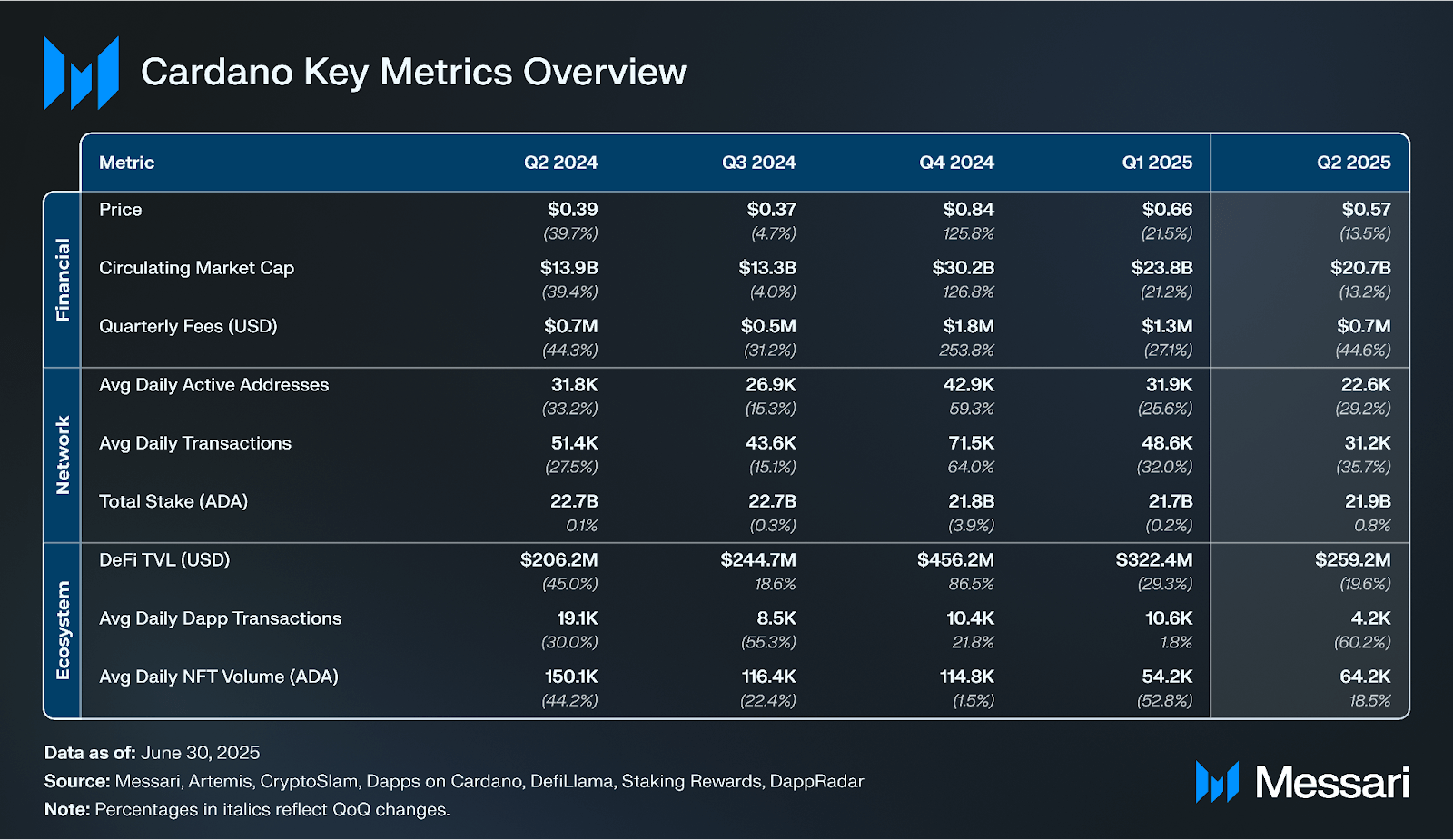
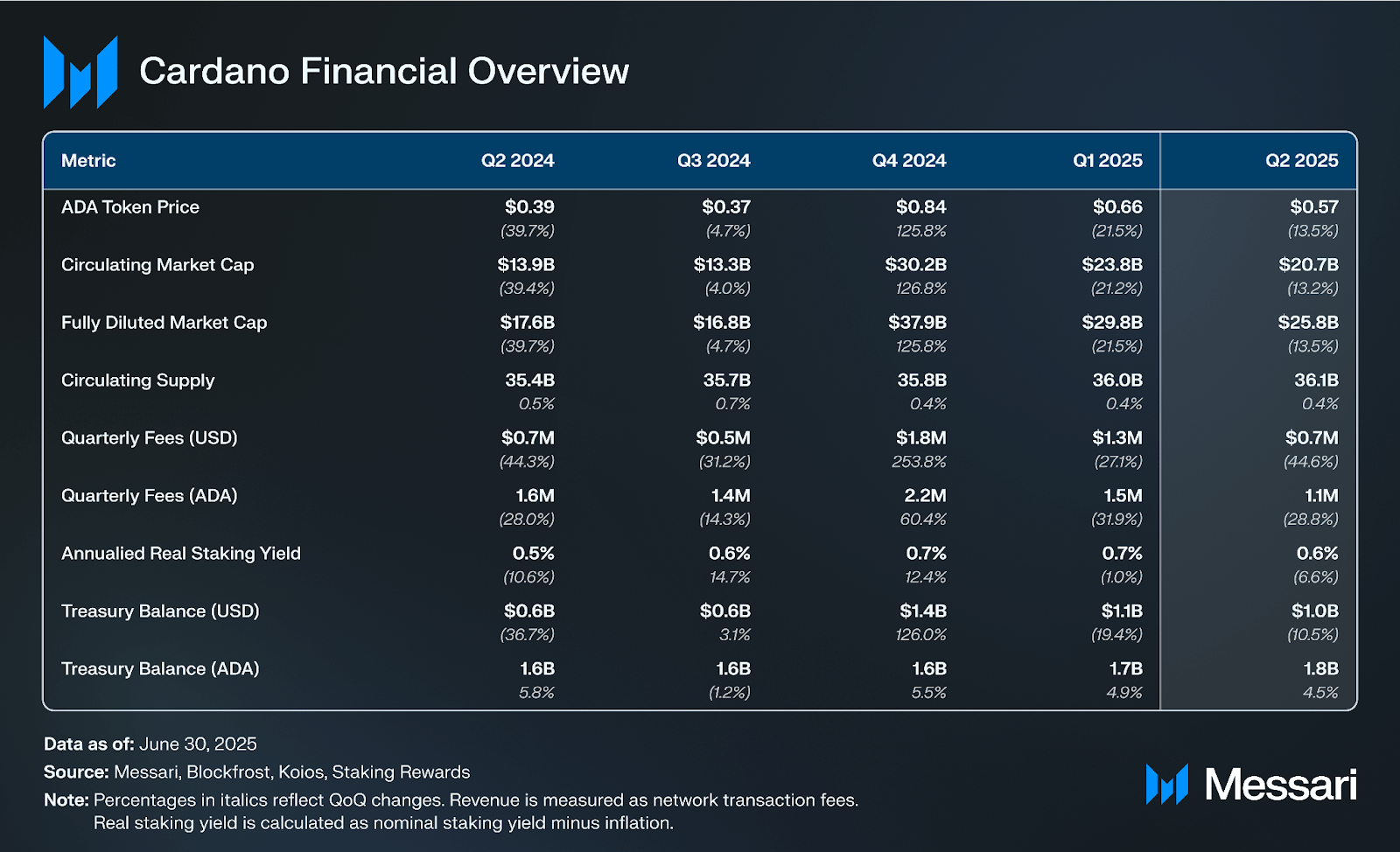
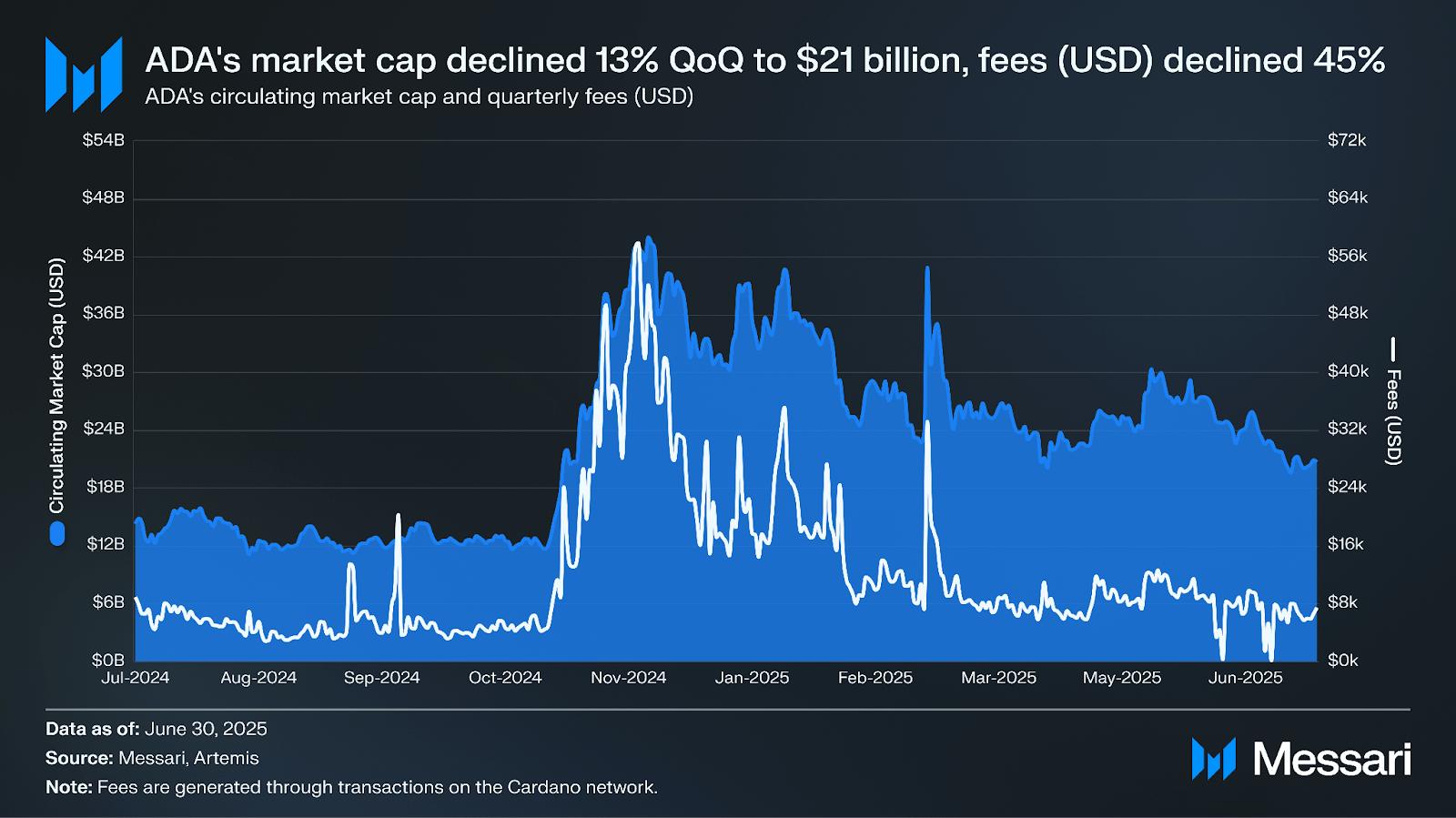
ADA’s price decreased 14% QoQ to $0.57 in Q2, while ADA’s market cap decreased 13% QoQ to $20.7 billion, with a slight discrepancy due to a 0.4% increase in circulating supply. ADA’s circulating market cap rank fell from 9th to 10th at Q2 close. Cardano’s price and market cap performance were below average compared to a measure of Layer-1s (not including Bitcoin), which increased 16% QoQ.
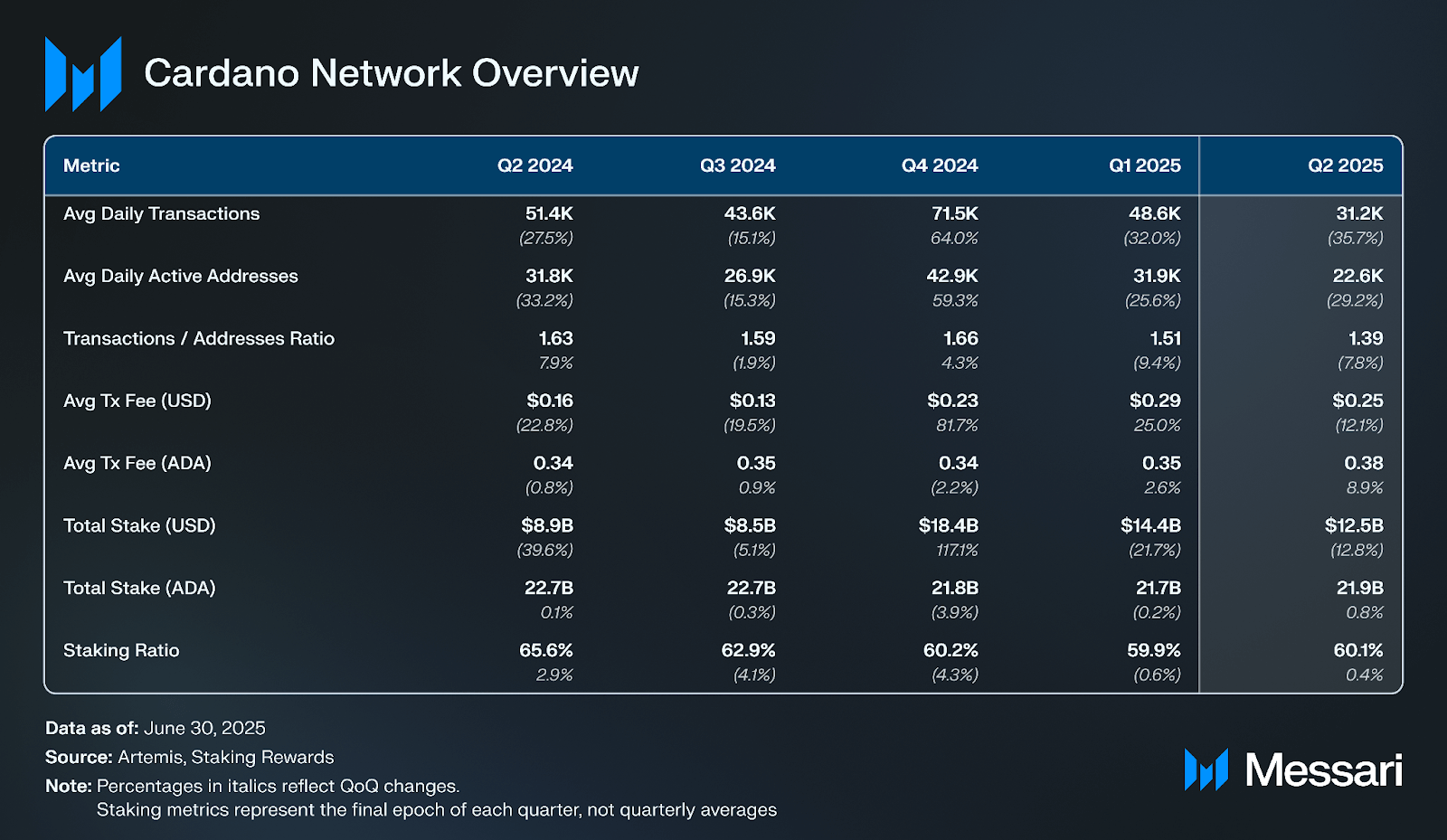
Each transaction on Cardano is accompanied by a network transaction fee for processing transactions and paying storage costs. Fees are calculated by a minimum fee plus a variable fee based on transaction size. Fees (ADA) declined 29% QoQ to 1.1 million, while fees (USD) declined 45% QoQ to 724,600, driven by ADA's price decline and a 36% decrease QoQ in average daily transactions.
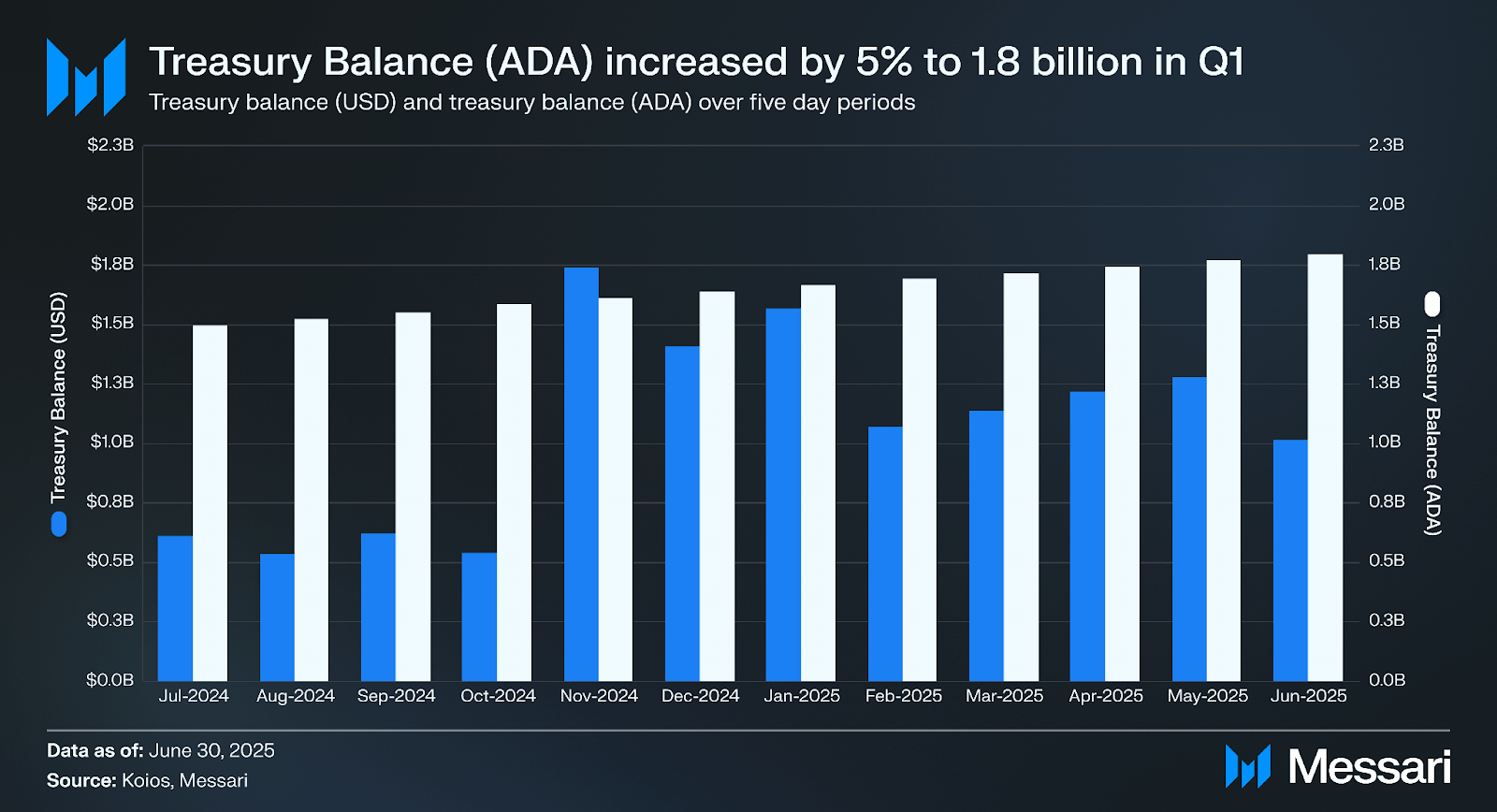
Cardano’s treasury balance (ADA) rose 5% QoQ to 1.8 billion ADA, while its USD value decreased 11% to $1.0 billion. The treasury provides funds to maintain and develop Cardano, with resources deployed through community governance following the Plomin hard fork in January 2025. Currently, 20% of Cardano’s transaction fees go to the treasury, which can be adjusted via governance.
Network Analysis
Cardano’s average transaction fee (USD) fell 12% to $0.25, while the average transaction fee (ADA) rose 9% QoQ to 0.38, highlighting the impact of ADA’s price volatility on network usage costs.
Total staked ADA increased by 0.78% to 21.9 billion, while ADA’s staking rate (the percentage of eligible ADA currently being staked on the network) increased by 0.4% QoQ to 60.1%. However, the total stake (USD) declined 12.8% QoQ to $12.5 billion due to the decrease in ADA's price.
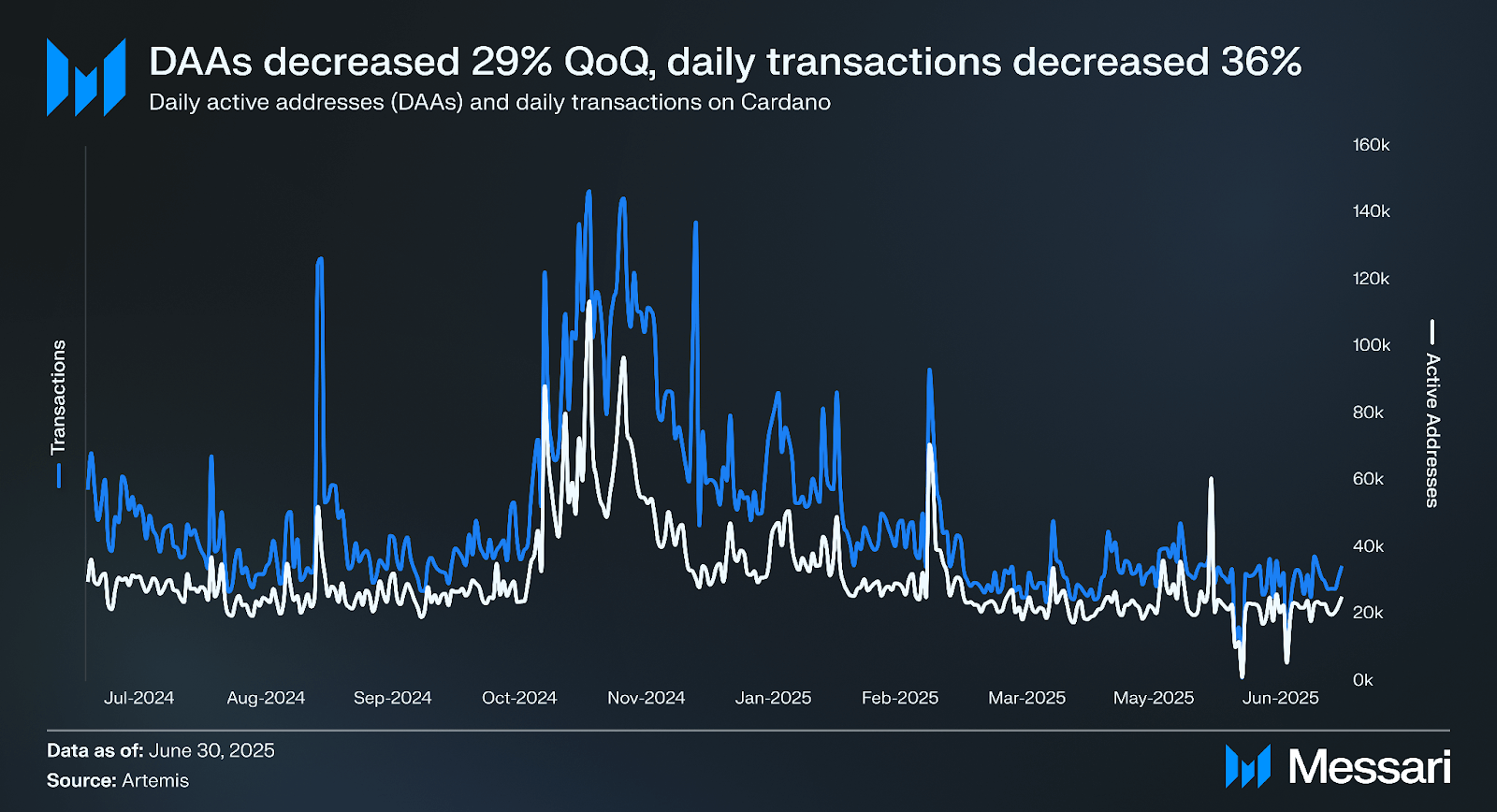
Cardano’s average daily transactions decreased by 29% QoQ to 22,600, while daily active addresses (DAAs) decreased by 36% to 31,200. The ratio of transactions to active addresses decreased by 8% QoQ to 1.4, as activity concentrates across fewer users.
Governance Updates
Net Change Limit:
In April 2025, the Cardano Foundation’s CTO, Giorgio Zinetti, released a blog post analyzing the Net Change Limit (NCL), a constitutional parameter that caps the amount of ADA entering circulation via treasury withdrawals. The foundation’s analysis found that treasury withdrawals negatively affect ADA’s price and recommended matching the NCL to the replenishment rate (the annual inflow of ADA to the treasury), which is 15%, or approximately 315 million ADA. The Cardano Budget Committee set the 2025 NCL at 350 million ADA for Epochs 532–604 (through December 2025) after the community voted in favor of this governance action. The rationale for the 350 million ADA limit was driven by Intersect's analysis of principles from sovereign wealth funds, setting the cap to align with the treasury's projected income for the year.
Constitutional Committee Election:
In June, Intersect facilitated the first full election for a seven‑member Constitutional Committee (CC), a governance body defined under CIP-1694 that evaluates whether proposed actions comply with the Cardano Constitution. It performs constitutional review across categories such as protocol upgrades, parameter changes, and treasury withdrawals. Since the Chang hard fork in Sept 2024, an interim committee has handled this function. On June 27, Cardano held its first onchain election for the permanent seven-member committee, which will replace the temporary council appointed by DReps in February 2025.
The Cardano Foundation, an interim committee member, contributed to governance reviews during the initial phase but chose not to submit itself as a candidate for reelection to preserve community-led government. Input | Output, Intersect, and EMURGO also plan to step back after the initial bootstrap period to make way for a wholly community-elected council.
Instead, it developed and applied an evaluation framework considering each candidate’s technical background, familiarity with Cardano’s governance model, neutrality, commitment duration, and communication capabilities. Based on these criteria, as a DRep, the Foundation cast its votes alongside many other DReps and will continue to serve on the interim committee until the newly elected members assume responsibility onchain in September 2025. Voting concluded on July 2, and results were announced on July 4.
Ecosystem Analysis
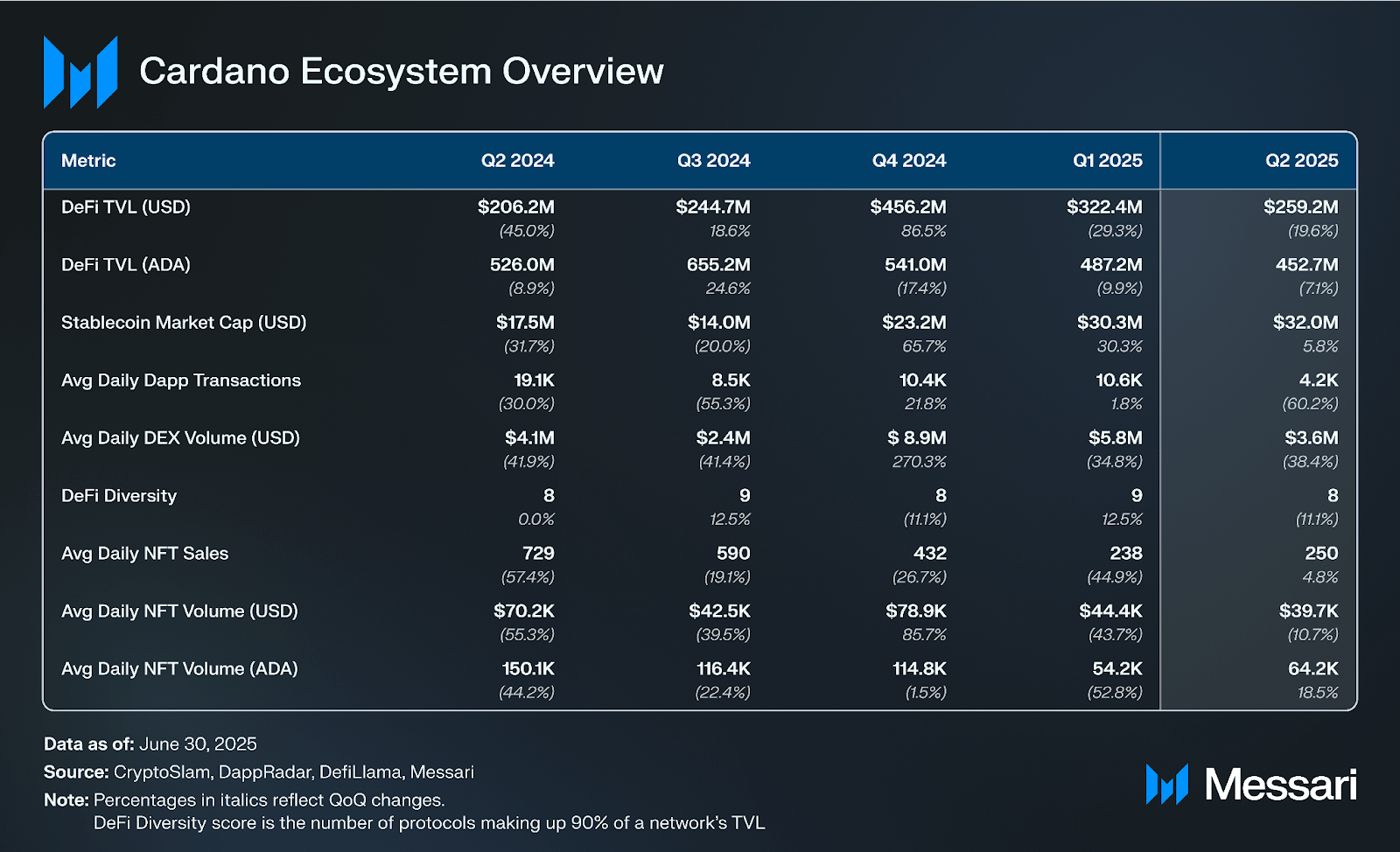
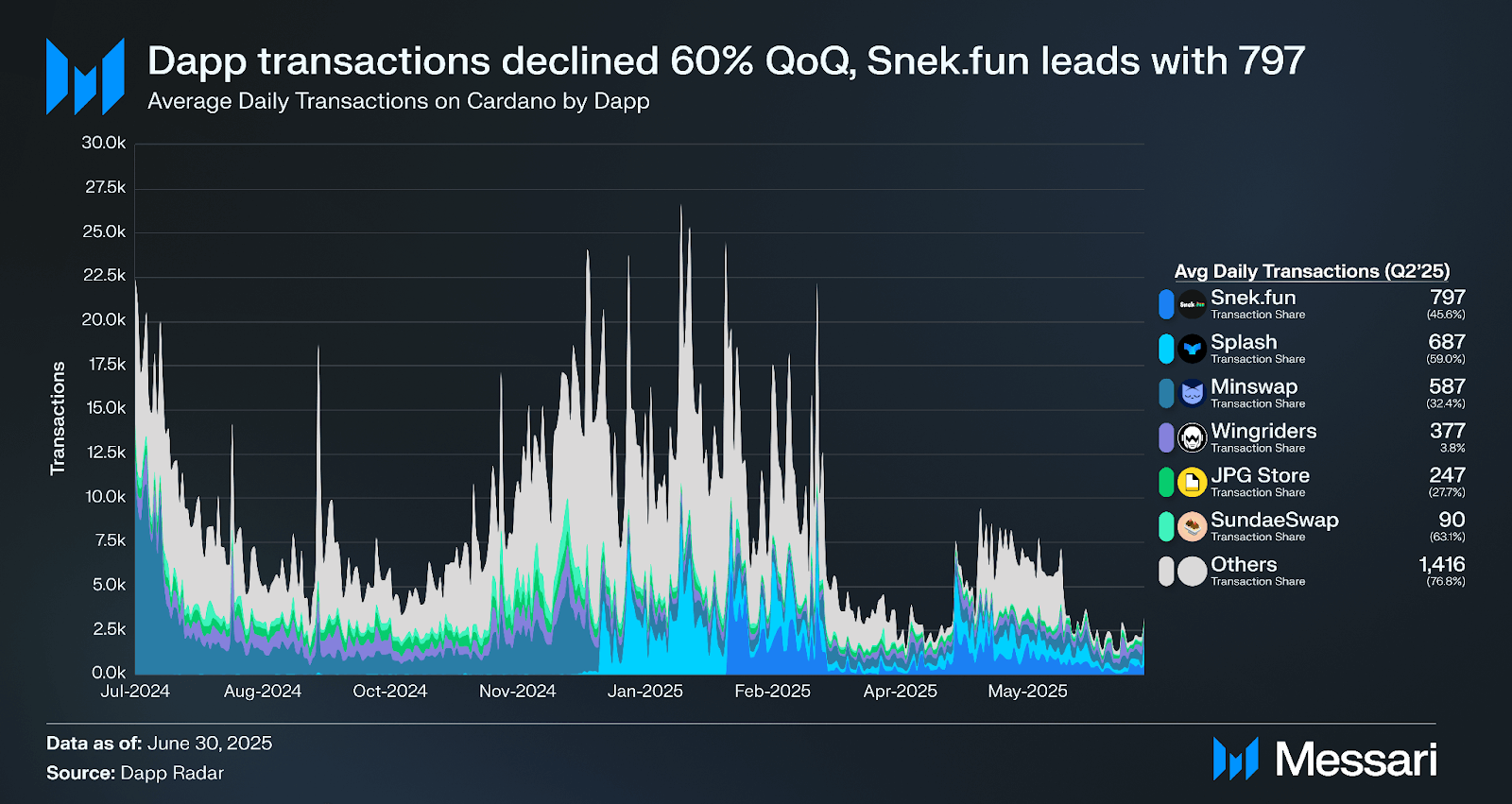
Average daily application transactions decreased by 60% QoQ to 4,200 in Q2. The top applications by volume in Q2 were Snek.fun (down 46% QoQ to 797), Splash Protocol (down 59% QoQ to 687), and Minswap (down 32% QoQ to 587), with DEX activity driving the majority of application usage on Cardano.
Snek.fun is a memecoin launchpad that uses a bonding curve mechanism similar to pump.fun. Snek.fun was launched as a collaboration between SNEK (a standalone memecoin launched in 2023) and Splash, a DEX combining multiple automated market maker (AMM) pools and a Virtual Limit Order Book (VLOB) to enable capital efficient trading on Cardano.
DEXs
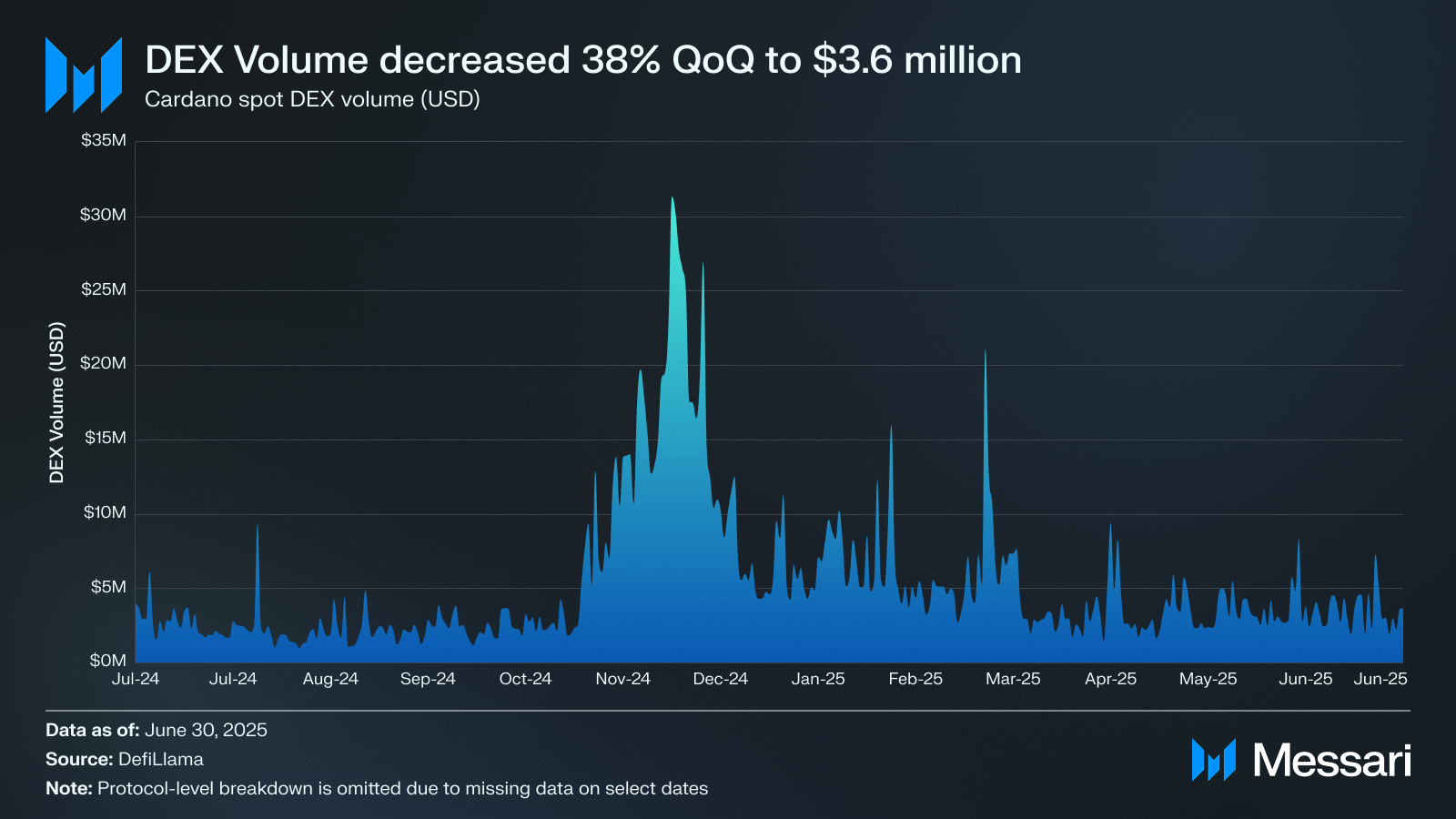
Average daily DEX volume on Cardano decreased by 38% QoQ to $3.6 million in Q2, while stablecoin supply increased 6% QoQ, marking a shift in user behavior from active trading to holding stablecoins.
CSWAP, one of Cardano’s newest DEXs, bridges tokens, NFTs, and real-world assets in one seamless trading ecosystem. By the end of Q2 2025, CSWAP accumulated over $1.5 million in TVL.
Strike Finance launched the first perpetual futures DEX on Cardano. Strike introduced native leverage trading of up to 15x on assets like ADA and SNEK perpetuals, with funding rates, risk management tools, and liquidity incentives tailored to Cardano’s eUTxO architecture. By the end of Q2 2025, the protocol surpassed $5.2 million in TVL.
SundaeSwap is an automated market maker (AMM) DEX on Cardano. It offers token swaps, liquidity provision, staking, and governance via the SUNDAE token. In Q2, Sundae Labs (the company behind SundaeSwap) contributed to the Cardano Blueprint, which aims to provide additional documentation and explanations for how Cardano works.
Splash is a DEXlaunched in July 2024 after a token sale for SPLASH raised 17.2 million ADA in May. Splash also worked to develop snek.fun, a protocol similar to pump.fun on Solana that allows users to launch and trade tokens easily. The application launched in September and recorded 2,230 tokens created and 4.5 million ADA in trading volume in the first 24 hours.
Minswap is a popular DEX on Cardano that offers low fees, swaps, and yield farming on Cardano-native tokens. In Q2, Minswap announced a proposal to incorporate Minswap DAO LLC to enhance compliance and support ecosystem growth. The proposal passed on April 7, 2024.
DexHunter is a leading DEX aggregator on the Cardano blockchain, launched in Q2 2023, designed to streamline DeFi trading by intelligently routing swaps across all major Cardano DEXes, such as Minswap, SundaeSwap, and Splash, to secure the best rates, lowest fees, and minimal slippage. With over 250,000 monthly visitors and more than 3 million successful swaps, it handles a significant portion of Cardano’s swap volume. The platform’s native HUNT token incentivizes participation through fee discounts, staking, and DAO governance
VyFinance launched in August 2021, offering a suite of products including its DEX, a redistributive BAR mechanism that shares trading fees among VYFI token holders, a lottery, and token/NFT vaults. The VYFI token, with a 450 million total supply, facilitates governance, lottery entries, and rewards.
WingRiders is a DEX launched on mainnet in April 2022 following a $4.5 million seed funding round in February 2022, designed to provide automated market-making (AMM) for token swaps, liquidity provision, ADA auto-staking, and yield farming. The WRT token, with a total supply of 100 million, enables governance, yield boosting, discounted NFT and crypto purchases, and collateral use.
Saturn Swap is a batchless order book DEX offering instant swaps with zero impermanent loss, minimal fees, and advanced trading tools by leveraging Cardano's architecture for near-instant execution without intermediaries. Unlike traditional AMM DEXs, it uses a direct peer-to-peer order book model and doesn’t rely on a third-party batcher to group users’ orders, eliminating the 0.95 ADA batcher fee and enabling precise limit orders and real-time trade execution in a single bloc,.
MuesliSwap launched on November 26, 2021, acting as the first operational DEX post-Alonzo hardfork, featuring an order book model tailored for Cardano's eUTxO architecture to enable limit orders, peer-to-peer trading, and full decentralization without liquidity pools, alongside AMM pools, yield farming, and an NFT marketplace. The MILK utility token, with a total supply of 10 million, powers governance, farming incentives, and ecosystem utilities like call options via Muesli Yield Token (MYT). MuesliSwap's call options enable users to create and trade options contracts directly onchain. The MYT serves as a derivative token that represents a right to purchase MILK at a predetermined price within a specified timeframe, functioning as a call option. MuesliSwap’s order book model supports limit orders and peer-to-peer trading without traditional liquidity pools, allowing users to set precise strike prices and expiration dates for these options.
DeFi
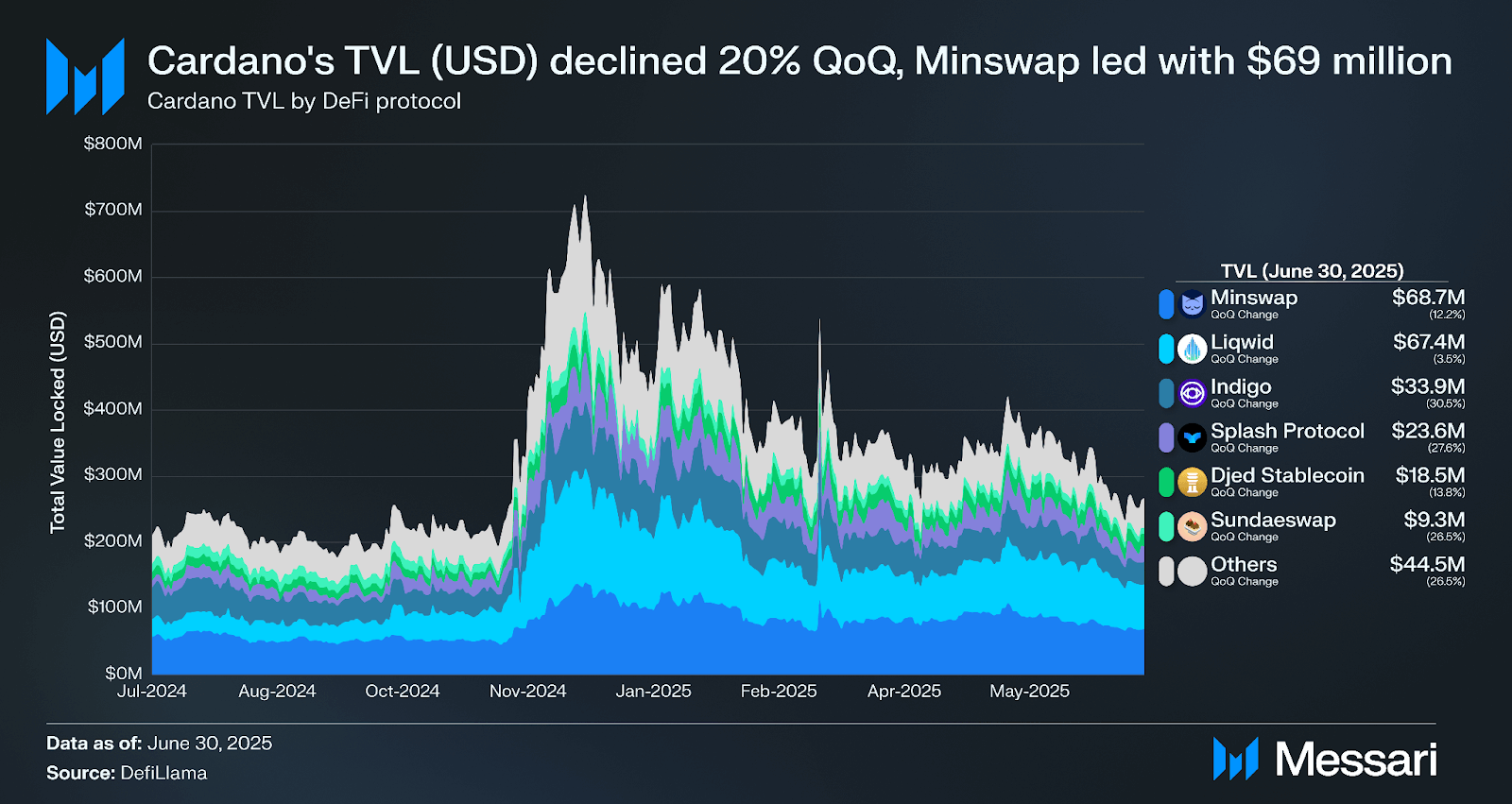
DeFi TVL (USD) on Cardano declined 20% QoQ to $259.2 million in Q2, compared to an industry-wide DeFi TVL increase of 28%. Cardano’s DeFi diversity score (i.e., the number of protocols making up 90% of a network's TVL) decreased from 9 to 8, meaning TVL consolidated across fewer protocols.
Minswap, with $68.7M in TVL (-12% QoQ), retained the top TVL share (26%) for a second straight quarter, as TVL declined QoQ across each of the top six protocols and the ‘Others’ category.
Liqwid is a lending and borrowing protocol on Cardano built for Cardano native assets. The protocol introduced qTokens, which are interest-bearing tokens representing collateral in lending pools. In the first half of 2025, Liqwid’s protocol revenue realized from interest accrued on loans increased from $500,000 to $2.1 million. Liqwid has also implemented programmatic buybacks of its native token, LQ, using protocol revenue. On June 23, Liqwid announced plans to support Bitcoin as a Cardano Native Token (CNT) via an upcoming bridge.
Indigo is a synthetic asset issuer that offers iUSD, iBTC, and iETH. On May 14, the DAO passed a refined treasury management policy. It includes monthly withdrawals, allocates half of treasury income to buybacks using a time-weighted average price model, and commits the rest to reserves and operating expenses. The plan also raises INDY staking rewards per epoch, maintains ADA yields for stakers, and adjusts emission and fee flows to be deflationary.
Bodega Market is an open-source prediction market protocol built on the Cardano blockchain. The platform allows users to create, participate in and trade markets based on the outcomes of future events.
Infrastructure
In Q2 2025, Cardano’s infrastructure evolved through focused advancements in scalability, interoperability, and governance, strengthening its functionality for DeFi and enterprise use cases.
In April 2025, the Cardano Foundation launched Veridian, a mobile app enabling users to manage decentralized identities onchain for secure applications like voting or financial authentication. Veridian enables users and enterprises to manage decentralized identifiers (DIDs), which allow users to prove identity and verifiable credentials securely and privately. The platform uses standards like Key Event Receipt Infrastructure (KERI), a decentralized framework to establish control over identifiers, and Authentic Chained Data Container (ACDC), a model for creating linked, verifiable credentials on top of identifiers. Veridian also includes post-quantum cryptographic protections and integrates optionally with the Cardano blockchain as a trust anchor. Veridian is available on iOS and Android. The Cardano Foundation also launched Reeve, which serves as middleware that links existing ERP systems, such as Oracle or NetSuite, with the Cardano blockchain, enabling organizations to publish tamper-resistant, auditable financial records directly onchain
IO Engineering introduced UTxO-HD, a hybrid database for Ledger State data that reduces memory requirements for node operators, as part of the release of Cardano node v.10.4.1, allowing smaller entities to participate in network validation, thereby enhancing Cardano’s decentralization and censorship resistance.
At Bitcoin 2025 in Las Vegas, Input | Output and Fairgatedemonstrated a protocol using BitVMX and a UPLC-to-RISC-V compiler to run Cardano’s smart contracts (written in Aiken, Haskell, or TypeScript) on Bitcoin’s network without modifying its base layer, expanding Cardano’s DeFi reach by accessing Bitcoin’s liquidity.
IO Engineering advanced Leios, an evolution of the Ouroboros consensus protocol, with its paper accepted in June 2025 for presentation at the International Association for Cryptologic Research’s (IACR) Crypto 2025 conference. Leios introduces a multi-block architecture to increase transaction throughput and support Cardano’s growing DeFi and enterprise workloads.
In June 2025, IO Engineering released Ouroboros Genesis, upgrading Cardano’s consensus mechanism to allow nodes to securely sync from the genesis block without external trust, reducing attack vulnerabilities and ensuring network reliability as adoption scales.
Midnight Network, a privacy sidechain built on Cardano’s Layer 2 Hydra scaling solution, kicked off its Glacier Drop, a multi-phase distribution of its NIGHT token serving as a cross-chain airdrop across eight ecosystems (Cardano, Bitcoin, Ethereum, Solana, Binance Chain, Brave, Ripple, and Avalanche), and released its tokenomics.
Stablecoins
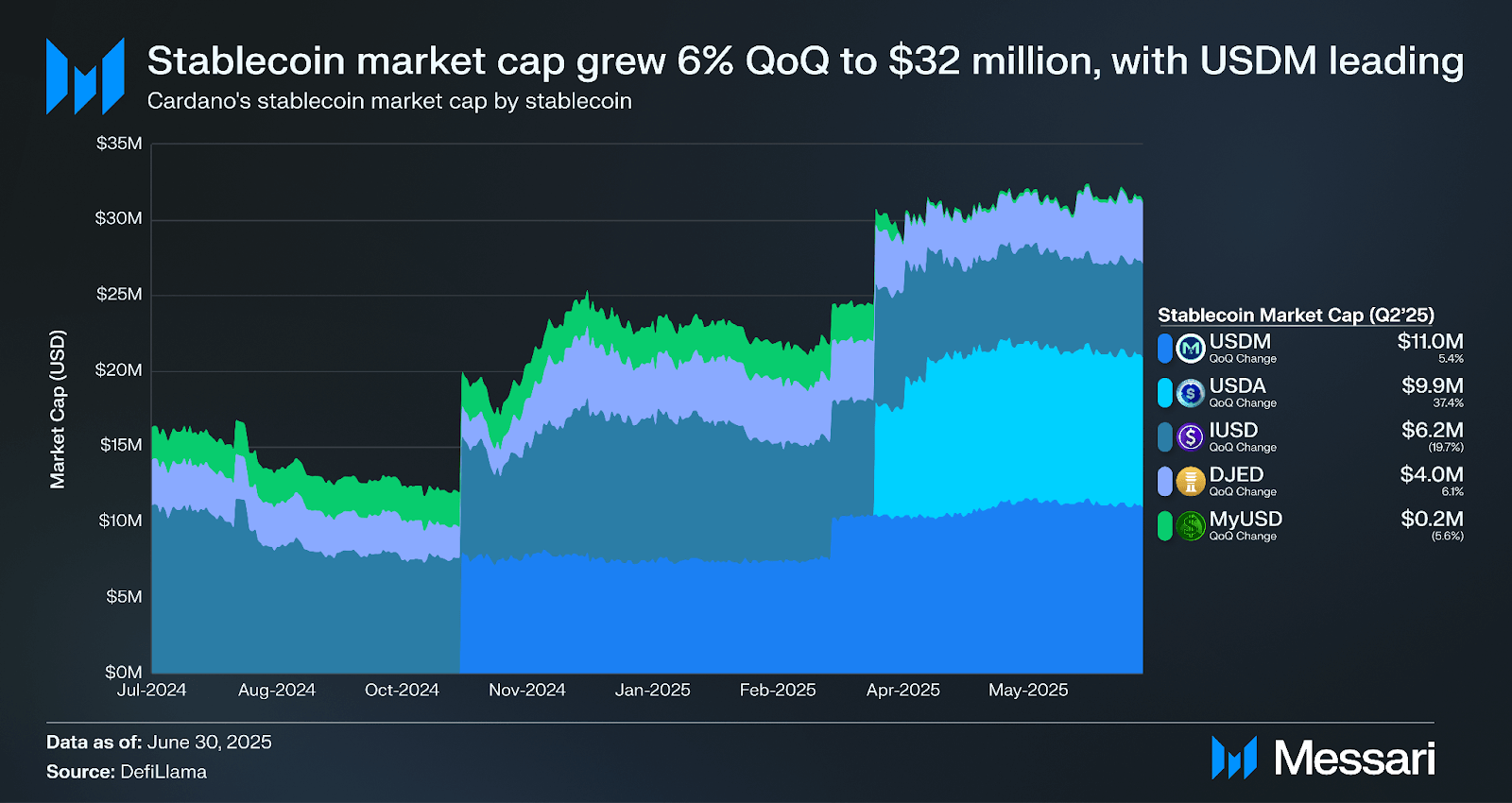
In Q2, Cardano's stablecoin market cap grew 6% to $32.0 million. Cardano’s first stablecoins (IUSD and DJED) were launched in November 2022 as fully overcollateralized stablecoins. USDM, Cardano’s top stablecoin by market cap, grew 5% QoQ to $11.0 million. USDA, which launched at the end of Q1, rose 37% QoQ to $9.9 million, flipping Indigo Protocol’s IUSD, which declined 20% QoQ to $6.2 million.
Moneta’s USDM launched on March 16, 2024. Unlike iUSD, DJED, and MyUSD, USDM is not algorithmic or synthetic. Like USDA, USDM is collateralized 1:1 with the U.S. dollar and dollar equivalents. In early Q2, Moneta launched USDM retail minting in 19 U.S. states, enabling users to exchange USD for USDM 1:1 via bank transfers and KYC verification.
USDA is a Cardano-native, U.S. dollar-pegged stablecoin issued by Anzens, with EMURGO providing technical expertise for Anzens’s operations. It is fully backed by U.S. dollar reserves and equivalents (e.g., U.S. government treasuries), and pegged 1:1 with the U.S. dollar. USDA launched on Minswap on March 7. Within a week, it achieved over $5.5 million in liquidity and 3,400 transactions. On March 19, the platform went live for eligible U.S. retail users in 14 states. In Q2, Anzens worked with the Cardano Foundation to bring Cardano native tokens to CipherBC (a wallet leveraging MPC and TEE technology), starting with ADA and USDA.
DJED is an overcollateralized stablecoin developed by Input | Output that uses SHEN as the reserve coin. SHEN is minted against ADA and represents the reserve’s equity, so when ADA rises the reserve grows and SHEN appreciates, and when ADA falls SHEN absorbs the losses.
Mynth’s MyUSDlaunched in December 2023 and is collateralized by USDC and USDT. In June 2024, Mynth introduced MyUSD staking to earn Mynth’s MNT tokens, driving growth for MyUSD in H2’24. Mynth is a cross-chain stable swap platform powered by Cardano.
NFTs
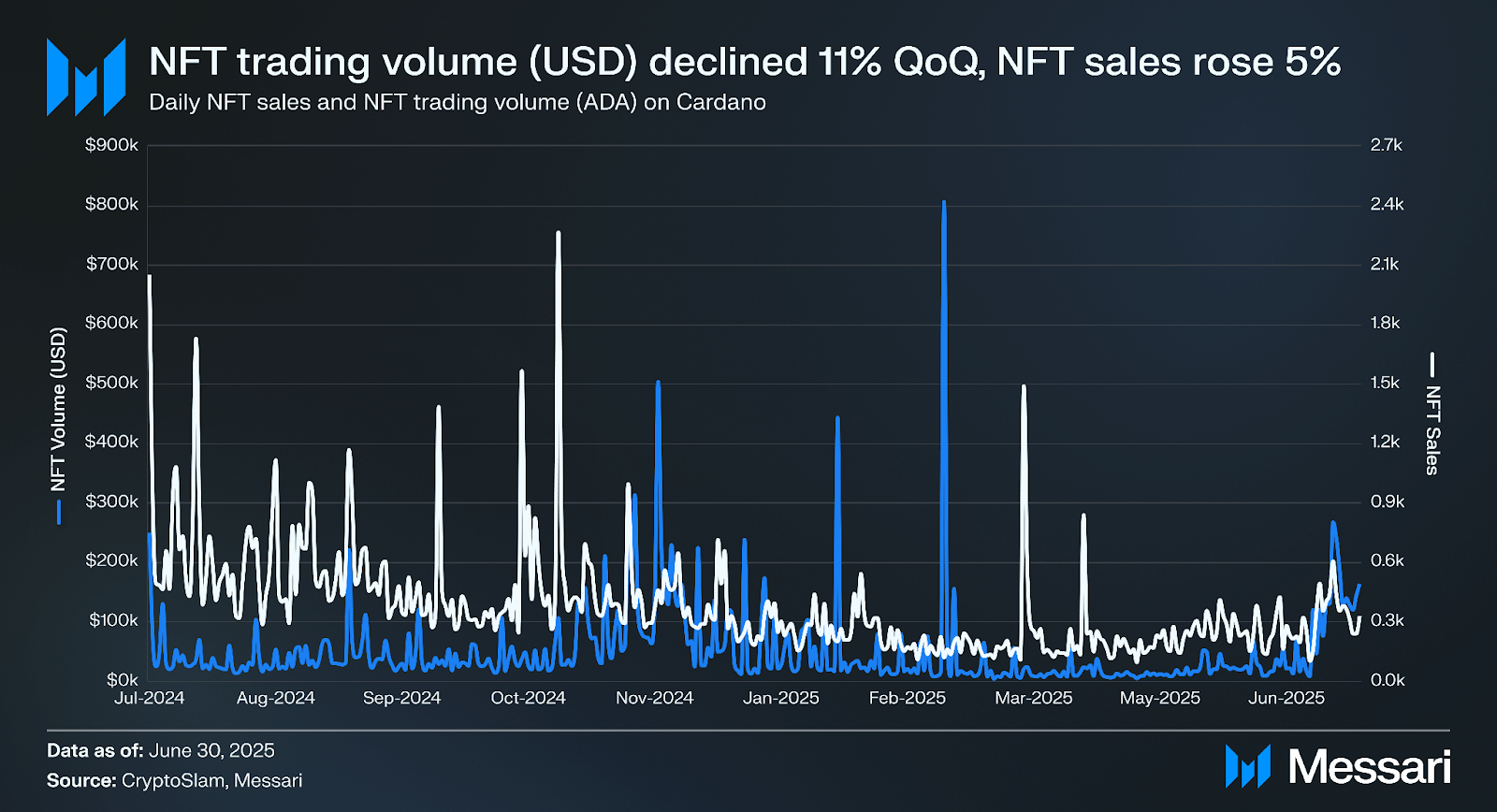
Average daily NFT sales on Cardano increased 5% QoQ to 250 in Q2, while average daily NFT trading volume (ADA) decreased 11% to $39,700. jpg.store remained Cardano's top NFT marketplace based on transaction volume, and was Cardano's fifth most popular protocol in Q2.
In June, jpg.store launched NFT lending and borrowing, enabling NFT holders to borrow assets against their NFTs. In February, jpg.store launchedComet, the first Cardano-native trading application specifically built for mobile. The protocol was in a closed beta for most of Q1 and officially opened to the public on March 18.
Emerging Dapps
SyncAI is an emerging AI-powered Decentralized Physical Infrastructure Network (DePIN), launched in 2024, that facilitates seamless communication between users, Dapps, and blockchains using autonomous AI agents, with a focus on enhancing Cardano governance through tools like an AI dRep agent for automated voting and decision-making. In Q2 2025, SyncAI rolled out a major update to its Governance DRep Search API on June 30, making it 10x faster with zero-lag pagination and AI-powered results
Worldeater is an innovative NFT and governance project on Cardano, functioning as a global escrow system via a fixed "hell wallet" and serving as the blockchain's first electoral college, where badges grant decision-making authority over an expanding ADA pool. The team teased a major update on June 27, 2025, with enhanced NFT variations and leaderboards for earning badges, while seeking 100-120 TB of storage via partnerships like Iagon to support the rollout.
Goldmine Arcade is a retro-style web3 gaming platform on Cardano, part of the Digital Gold Ecosystem, featuring browser-based arcade games where players earn DSLVR (Digital Silver Tokens) through play-to-earn mechanics, including titles like Galaxy Wars and Hydro Rush with crypto rewards and mutant power-ups. In Q2, it released Hydro Rush: OverPowered on May 25 and listed Galaxy Wars on PlayToEarn.com.
Open Djed is an open-source platform on Cardano, launched in 2024 by Artifex Labs, that enables users to mint and burn DJED, an overcollateralized stablecoin pegged to the USD, providing a transparent, 24/7 decentralized alternative to centralized interfaces with a user-friendly UI and support for wallet and Dapp integrations. On June 28 2025, COTI announced plans to introduce a private stablecoin, Private DJED, as well as open-source key infrastructure such as the order API, chain indexer, and frontend. This allows developers to spin up custom frontends, integrate DJED functionality in-app, and run secure backend services.
Development, Growth, and Community
Cardano Blueprint
The Cardano Blueprint is a reference guide published by IOG in June 2025 that compiles specifications for Cardano’s architecture, including consensus, ledger, networking, smart contract execution, and governance. The Blueprint includes technical diagrams, protocol specifications, and test data to support developers building on Cardano, particularly those without experience in Haskell or formal methods.
The Blueprint aligns with the Cardano Improvement Proposal (CIP) process and is designed for community contributions. It reduces ambiguity around protocol behavior and helps standardize development across the ecosystem. The resource also supports the network’s transition into Voltaire by documenting governance and treasury mechanisms with structured references and logic-based flowcharts. This provides a clear foundation for developers and contributors working on core infrastructure or governance tooling.
Partner Chains
Partner Chains is an all-encompassing term that can include technically sovereign sidechains or modular networks. These networks include Wanchain, Midnight, World Mobile, and Milkomeda C1 (which announced it was shutting down following the end of the quarter).
Midnight, developed by Input Output Global (IOG), offers data protection and privacy capabilities using zero-knowledge proofs (ZK Proofs). Its testnet launched on October 1, 2024, and underwent a major upgrade to testnet-02 on May 12, featuring Partner Chains v1.5.0, BLS12-381 proving system, and improved ledger storage. The tokenomics paper was published on June 23, detailing the NIGHT token's role in incentives, governance, and generating DUST for transactions. The NIGHT token became claimable in Phase 1 of the airdrop, known as the Glacier Drop, which opened on August 5, 2025 and runs for 60 days through October 4. Eligibility was based on a June 11, 2025 snapshot of wallets across eight blockchains, requiring a minimum $100 balance in native tokens. (ADA, BTC, ETH, SOL, XRP, BNB, AVAX, or BAT). As of Q2 2025, there has been no announced date for the mainnet launch.
Closing Summary
Cardano’s usage declined in Q2 despite broader strength in crypto markets. ADA’s market cap fell 13% QoQ to $20.7 billion as its price decreased 14% to $0.57, underperforming the Layer-1 sector, which gained 16% over the same period. Quarterly fees dropped 45% to $724,600, and average daily transactions declined 36% to 31,200. Total staked ADA fell 13% to 12.5 billion, while the staking rate held steady at 60.1%. DeFi TVL contracted 20% to $259.2 million, and average daily application transactions dropped 60%, meaning activity consolidated across fewer applications. Stablecoin supply grew 6% to $32 million, driven by increased adoption of USDA and USDM.
Through institutions like Intersect, the network completed its first-ever series of onchain budget approvals to fund future development and growth, approving a budget of 275.3m ADA. Intersect also initiated a proposal to replace the interim Constitutional Committee, paving the way for decentralized governance under CIP-1694. Input | Output continues to contribute to the technical roadmap as well as driving forward new scaling and liquidity initiatives, including Midnight Network, Bitcoin DeFi, and Ouroboros Leios. Although onchain activity declined, Cardano continued to execute long-term initiatives, strengthening its governance, compliance posture, and data infrastructure, thereby positioning the network to compete for institutional use cases and real-world utility in the future.
This report was commissioned by Input Output Global. All content was produced independently by the author(s) and does not necessarily reflect the opinions of Messari, Inc. or the organization that requested the report. The commissioning organization may have input on the content of the report, but Messari maintains editorial control over the final report to retain data accuracy and objectivity. Author(s) may hold cryptocurrencies named in this report. This report is meant for informational purposes only. It is not meant to serve as investment advice. You should conduct your own research and consult an independent financial, tax, or legal advisor before making any investment decisions. Past performance of any asset is not indicative of future results. Please see our Terms of Service for more information.
No part of this report may be (a) copied, photocopied, duplicated in any form by any means or (b) redistributed without the prior written consent of Messari®.
Sam was previously a product manager at ether.fi, as well as LifeMed AI. He graduated from Ohio State University, where he founded the Ohio State Blockchain Club. He is now an Enterprise Research Analyst at Messari focused on finding the next best applications and protocols in internet finance.
Youssef is a Research Analyst on the Protocol Research team. Prior to joining Messari, Youssef was a Product Analyst at Fidelity Digital Assets. Youssef graduated from Northeastern University, where he led the Northeastern Blockchain club as President.
Sam was previously a product manager at ether.fi, as well as LifeMed AI. He graduated from Ohio State University, where he founded the Ohio State Blockchain Club. He is now an Enterprise Research Analyst at Messari focused on finding the next best applications and protocols in internet finance.
Youssef is a Research Analyst on the Protocol Research team. Prior to joining Messari, Youssef was a Product Analyst at Fidelity Digital Assets. Youssef graduated from Northeastern University, where he led the Northeastern Blockchain club as President.