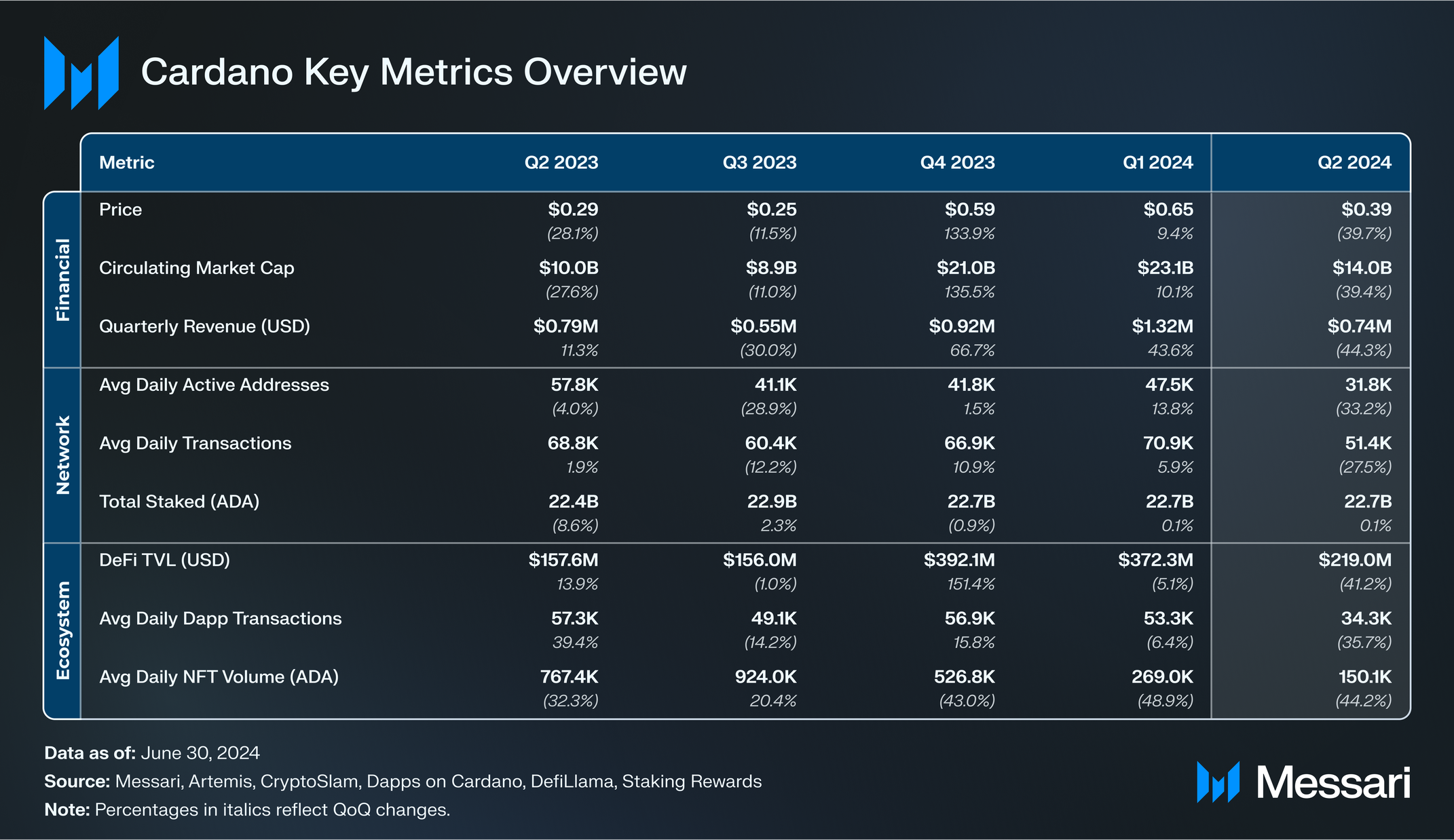
Revenue (USD) decreased 44.3% QoQ to $0.74 million. This was impacted by Cardano’s 27.5% QoQ decrease in average daily transactions, which fell to 31,800.
TVL (USD) fell from the all-time high set in March, down 41.2% QoQ to $219 million.
Stablecoin market cap fell for the first time ever in a quarter, down 26.2% QoQ to $16.4 million. However, USDM and MyUSD emerged as their market caps grew 2,557.6% to $3.2 million, and 694.8% to $2.1 million, respectively.
ADA’s token price decreased 39.7% QoQ to $0.39, with its market cap rank falling from 9th to 10th.
The NFT sector continued a downtrend that has sustained for over a year. Averagedaily NFT sales fell 57.4% QoQ to under 730, while average daily NFT volume (ADA) fell 44.2% to 150,000.
Primer
Cardano (ADA) is a Proof-of-Stake (PoS) Layer-1 network launched in 2017. Cardano aims to provide security, scalability, and functionality to decentralized applications and systems building atop the network. In addition to its community of developers, node operators, and projects, Cardano is supported by entities like Input Output Global (IOG), Cardano Foundation, EMURGO, and others. These entities support the network’s development, adoption, and finances as Cardano moves toward the age of Voltaire, the final phase of its roadmap.
Cardano has taken a unique approach to development when compared to other smart contract networks. The Ouroboros consensus mechanism allows for delegation of stake, while the extended unspent transaction output (eUTXO) accounting model enables native token transfers, scalability, and decentralization.
With a dedicated community of users and developers, Cardano has demonstrated staying power. After the launch of smart contract support via the Alonzo hard fork in 2021, Cardano began to compete in more traditional crypto markets, such as DeFi and NFTs. For a full primer on Cardano, refer to our Initiation of Coverage report.
ADA is the native asset of Cardano and is used as the primary medium of exchange when transacting on the network. It has four primary network-level use cases: (i) settling network transaction fees, (ii) being used to register a stake pool to participate in network consensus as a stake pool operator (SPO), (iii) staking as a stake pool operator or delegator to help secure the network and earn token rewards, and (iv) being used to reward voters and fund projects in Project Catalyst.
ADA’s maximum token supply is 45 billion, and its circulating token supply experiences inflation until it reaches that maximum. After each five-day epoch, 0.3% of ADA reserves (i.e., the ADA not in circulation) are distributed as SPO rewards. This “inflation” trends towards zero as the reserves deplete and the circulating supply approaches 45 billion.
Real yield is calculated as nominal yield minus inflation, accounting for any value dilution due to inflation. In Q2, the average annualized real yield when staking ADA was 0.5%, though this can vary by stake pool.
ADA’s price decreased 39.7% to $0.39 in Q2. ADA’s market cap fell a similar 39.4% QoQ to $14 billion, with the slight discrepancy being due to a 0.5% increase in circulating supply. Due to the QoQ decrease in price, ADA’s circulating market cap rank fell from 9th to 10th.
Each transaction on Cardano is accompanied by a network transaction fee for processing transactions and paying storage costs. Fees are calculated by a minimum fee plus a variable fee based on transaction size. Revenue (USD) decreased 44.3% QoQ to $0.74 million, while revenue (ADA) decreased by a lesser 28.0% QoQ to 1.60 million. This difference was due to the price of ADA falling 39.7% throughout the quarter.
Cardano’s treasury balance (ADA) grew 5.8% QoQ to 1.57 billion ADA, though the treasury’s dollar value fell 36.7% to $604.7 million. Currently, 20.0% of Cardano’s transaction fees go to the treasury, though this parameter can be changed via governance.
Network Analysis
Cardano’s average daily transactions (txs) decreased by 27.5% QoQ to 51,400, while average daily active addresses (DAAs) fell 33.2% to 31,800. Cardano’s average transaction fee (USD) decreased 23.1% QoQ from $0.21 to $0.16. However, the average transaction fee (ADA) dipped just 0.6% QoQ to 0.34.
The ratio of transactions to active addresses (txs/DAAs) increased 8.4% QoQ to 1.62, suggesting an increase in “power users” of Cardano; conversely, a decreasing ratio suggests activity is being distributed more evenly across users.
Total stake (ADA) and ADA’s staking rate increased 0.1% and 2.9% QoQ, respectively. Total stake (USD) decreased 39.6% QoQ to $8.9 billion due to ADA’s price decrease. Total stake (USD) represents the economic security of the network.
Chang Hard Fork
In April, Cardano unveiled the Chang Hard Fork, a two-phase network upgrade that will enable onchain governance and fulfill the core purpose of Cardano’s final roadmap phase (Voltaire). Voltaire takes the final steps toward Cardano’s self-sustainability via onchain voting and offchain mechanisms and institutions like the member-based organization, Intersect.
Phase two will see Cardano’s onchain governance fully online, including a new user role, Delegate Representatives (DReps), and treasury withdrawals. This will empower the community to propose and vote on technical changes and the funding of projects. Furthermore, the Cardano Constitution will be finalized and ratified.
After completion of the Chang Hard Fork, DReps, SPOs, and the Constitutional Committee will govern all areas of the network via an onchain voting and treasury system based on CIP-1694. This would transfer responsibility from IOG, Cardano Foundation, and EMURGO, which combined, have historically held all seven governance (genesis) keys. Governable actions will include those related to the Constitutional Committee, parameter changes, constitution updates, hard fork initiation, protocol parameter changes, and treasury withdrawals.
Although the Chang Hard Fork was initially planned for Q2 2024, this did not happen. Phase one is now expected in Q3, while phase two is expected in Q4. Testing continues on SanchoNet, a testnet network launched in Q3 2023 to serve as a sandbox to test and build out processes and tools for Cardano’s onchain governance. Developers use the testnet to launch new infrastructure (e.g., wallets and vote explorers), SPOs can test voting/proposing, and details on DReps can be hashed out.
SanchoNet and the wider Voltaire rollout is being championed by Intersect, a member-based organization for the Cardano ecosystem, among other community members, SPOs, and project teams. Intersect launched with the aim of bringing ADA tokenholders together behind a shared vision to enable a more transparent, collaborative, and innovative Cardano ecosystem.
Intersect maintains over 60 repositories including the full Cardano Haskell codebase and champions Cardano’s open-source approach. Additionally, Intersect is focusing on creating an open product roadmap, annual budget process, and has been operating a grants program, with projects awarded for working on governance-related areas such as education and DRep platforms.
Ecosystem Analysis
Average daily Dapp transactions on Cardano decreased 35.7% QoQ to 34,300, while average daily DEX volume (USD) fell 42.5% to $4.2 million. Overall Dapp activity is largely affected by Minswap, Cardano’s largest DEX. The next two largest contributors are jpg.store and Liqwid Finance.
Minswap is an automated market maker (AMM) DEX that has been the most popular Cardano Dapp by transactions every month over the past year. Minswap remained the most-used Dapp in Q2, accounting for 53.2% of Dapp transactions at 552,800.
In July, Minswap launched its V2 upgrade, introducing new features like automatic swap routing, advanced order types, adjustable trading fees, increased swap throughput, and more. The protocol has been incentivizing the migration of liquidity to Minswap V2 via reduced farming rewards on V1, decreased transaction fees on V2, and increased MIN token emissions on V2.
jpg.store is Cardano’s top NFT marketplace in terms of transactions and volume (ADA). jpg.store remained the second-most-used Dapp in Q2, accounting for 11.2% of Dapp transactions at 116,700.
In June, jpg.store launched NFT lending and borrowing, allowing NFT holders to borrow assets against their NFTs. The protocol continues to incentivize activity, having distributed JPG tokens to users in July at the end of Season 3. Season 4 is ongoing and provides XP boosts for users of the new lending and borrowing features.
Liqwid Finance is a lending, borrowing, and liquid staking protocol. Liqwid Finance remained the third-most-used Dapp in Q2, accounting for 10.8% of Dapp transactions at 111,900.
In April, Liqwid Finance launched its V2 upgrade, revamping its UI/UX, creating a public API, adding supply and borrow cap parameters, and more. Afterward, the protocol released a 12-month roadmap which includes updates for non-market parts of the protocol.
DeFi
After setting a then-all-time-high of $506 million in March 2024, TVL (USD) on Cardano decreased 41.2% QoQ to $219 million in Q2. This decline doesn’t appear to have been caused by Cardano-specific catalysts. Rather, the decrease was led by a downturn in overall crypto markets as asset prices across Cardano’s ecosystem decreased throughout the quarter.
Minswap overtook Indigo as the largest protocol by TVL in Q2. Meanwhile, SundaeSwap outperformed after the launch of its V3 upgrade and reduced trading fees, managing a 16.3% QoQ increase in TVL (USD) to $12.7 million while other protocols saw TVL fall.
In Q2, Cardano’s DeFi diversity score (i.e., the number of protocols making up 90.0% of a network’s TVL) increased 12.5% QoQ to 9. Synthetic asset-issuer, Indigo, is the oldest and largest of the network’s top protocols. It managed to dethrone Minswap in Q4’23, ending Minswap’s multi-year reign as Cardano’s TVL leader. Indigo remained Cardano’s TVL leader until May 2024, when Minswap overtook it to regain the spot of largest protocol by TVL.
While TVL is a popular metric for measuring an ecosystem’s growth, it should not be the only metric considered. Many protocols won’t meaningfully contribute to TVL in the way that a DeFi protocol can. For example, Iagon (a decentralized storage protocol) and World Mobile (a decentralized wireless protocol) are not TVL drivers because they are infrastructure-based. Even within DeFi, decentralized exchange (DEX) aggregators such as DexHunter and non-custodial platforms such as Axo do not contribute to TVL directly.
Stablecoins are ideal for pairing in liquidity pools, borrowing and lending, creating leverage, and providing quick escapes from volatility. Stablecoin market cap on Cardano had a QoQ decrease for the first time since Cardano’s first stablecoins (iUSD and DJED) were launched in November 2022. Total stablecoin market cap decreased 12.4% QoQ to $19.6 million.
The market caps of iUSD and DJED decreased by 39.6% and 9.5%, respectively, in Q2. However, USDM and MyUSD emerged and await a new competitor in USDA:
USDM’s market cap increased 2,557.6% QoQ to $3.2 million since launching on March 16. Unlike iUSD, DJED, and MyUSD, Moneta’s USDM is not algorithmic or synthetic. USDM is collateralized 1:1 with U.S. Dollars (USD). Indigo’s iUSD has had an inconsistent peg, something that is less likely to happen with 1:1 USD backing as more accessible redemptions create arbitrage opportunities that close price gaps.
MyUSD’s market cap increased 694.8% QoQ to $2.1 million. In June 2024, Mynth’s MyUSD market cap surged 954.2% due to the introduction of MyUSD staking to earn Mynth’s MNT tokens. MyUSD launched in December 2023 and is collateralized by USDC and USDT. While USDC and USDT aren’t natively available on Cardano, they are made available via Wanchain. Wanchain is a Layer-1 EVM-compatible network that doubles as an interoperability protocol, making USDC and USDT available on Cardano through its various bridges.
USDA, is expected to enter the fold in the future. USDA will be launched by Encryptus with technological support from EMURGO and stablecoin issuance performed by Anzens.
NFTs
Average daily NFT sales on Cardano were down 57.4% QoQ to under 730 in Q2, while NFT trading volume (ADA) decreased 44.2% to 150,000. jpg.store remained Cardano’s top NFT marketplace in terms of transactions and volume (ADA), and was even Cardano’s second-most-used Dapp in Q2.
In June, jpg.store launched NFT lending and borrowing, allowing NFT holders to borrow assets against their NFTs. The protocol continues to incentivize activity, having distributed JPG tokens to users in July at the end of Season 3. Season 4 is ongoing and provides XP boosts for users of the new lending and borrowing features.
Development, Growth, and Community
Partner Chains
Partner Chains is an all-encompassing term that can include technically sovereign sidechains or modular networks. Some of these networks include Milkomeda C1, Wanchain, Midnight, and World Mobile. Launched in August, the Alpha v1 Toolkit allows developers to bootstrap the security of Partner Chains by leveraging Cardano’s network of SPOs. The toolkit introduces a committee selection algorithm that integrates Cardano data to form trusted committees capable of producing a predetermined percentage of blocks. By leveraging Cardano’s SPOs, Partner Chains can quickly grow their validator sets, enhancing security.
Notably, in June, Cardano Foundation announced it is working on bringing Inter-Blockchain Communication (IBC) support to Cardano via an IBC Sidechain. This network would allow connectivity between Cosmos-based networks, Cardano, and other Cardano Partner Chains.
Project Catalyst
Project Catalyst is a decentralized fund for projects in the Cardano ecosystem. In this fund, ADA tokenholders decide which proposals receive funding from Cardano’s treasury. Through 12 funding rounds, Project Catalyst has funded 1,891 proposals for $90.5 million worth of ADA.
Voting for the most recent fund, Fund12, concluded in July with 258 funded proposals for 46.5 million ADA. Funding was distributed across six categories, with the highest funded proposals coming from the “Cardano Partners and Real World Integrations” category. Some of these proposals aimed to (i) create various DAOs for local governance and social use-cases in Shikoku, Japan, (ii) tokenize real world assets (RWAs) in the Nairobi Securities Exchange, (iii) assist in Web3 thread detection for one of Israel’s largest cyber security companies (Check Point Software Security), and (iv) tokenize gold alongside a large asset manager (Apex Group).
Other notable projects funded include those aiming to make Cardano transaction exploring more human-readable, develop a Layer-2 network called Hydrozoa, develop a a Cardano sidechain to support oracle services, create a yield-bearing stablecoin called OUSD, develop a Layer-2 network called Midgard.
Over its two-week voting period, Fund12 received just over 290,000 votes, a decrease of about 15,000 from Fund11. Over the coming months, funded projects must complete several onboarding steps including onboarding forms, submitting milestones, getting milestones approved by Milestone Reviewers, undergoing a formal due diligence process, and finally, validate wallet access by performing test transactions.
Notably, in July, the Project Catalyst team at IOG published their inaugural Catalyst Horizons report to illustrate Project Catalyst's global reach and highlight various data-driven insights.
Argentina Partnerships
In June, Cardano formalized various partnerships in Argentina, such as those with the province of Entre Rios, the University of Buenos Aires, and the Universidad Tecnológica Nacional (UTN). These partnerships aim to expand the education of Cardano in the area and explore opportunities to use the network for Argentinian use cases.
Closing Summary
Cardano saw decreases in most financial, network, and ecosystem metrics in Q2 2024. Revenue (USD) decreased 44.3% QoQ to $0.74 million and was impacted by a 27.5% decrease in average daily transactions, which fell to 31,800. ADA’s token price decreased 39.7% QoQ to $0.39, with its market cap rank falling from 9th to 10th.
Within Cardano’s ecosystem, TVL (USD) contracted 41.2% QoQ to $219 million, while average daily DEX volume (USD) fell 42.5% to $4.2 million. Despite these decreases, Cardano’s ecosystem continued to develop and mature in Q2. The USDM and MyUSD stablecoins emerged as their market caps grew 2,557.6% to $3.2 million, and 694.8% to $2.1 million, respectively. Many protocols launched V2 versions, including SundaeSwap, which outperformed and managed a 16.3% QoQ increase in TVL (USD) to $12.7 million.
In the coming quarters, the Cardano community can expect the Chang Hard Fork which will introduce onchain governance for the first time. This will bring the network closer to fulfilling the core purpose of its final roadmap phase (Voltaire), and achieving long-term self-sustainability through democratic decision-making driven by Cardano’s various stakeholders.
This report was commissioned by Intersect MBO. All content was produced independently by the author(s) and does not necessarily reflect the opinions of Messari, Inc. or the organization that requested the report. The commissioning organization may have input on the content of the report, but Messari maintains editorial control over the final report to retain data accuracy and objectivity. Author(s) may hold cryptocurrencies named in this report. This report is meant for informational purposes only. It is not meant to serve as investment advice. You should conduct your own research and consult an independent financial, tax, or legal advisor before making any investment decisions. Past performance of any asset is not indicative of future results. Please see our Terms of Service for more information.
No part of this report may be (a) copied, photocopied, duplicated in any form by any means or (b) redistributed without the prior written consent of Messari®.
During his 3.5-year tenure at Messari, Patryk contributed across Messari's Diligence, Protocol, and Enterprise research teams. As Research Manager, his primary focus was on Layer-1 and Layer-2 infrastructure and the DeFi ecosystems atop them.
During his 3.5-year tenure at Messari, Patryk contributed across Messari's Diligence, Protocol, and Enterprise research teams. As Research Manager, his primary focus was on Layer-1 and Layer-2 infrastructure and the DeFi ecosystems atop them.