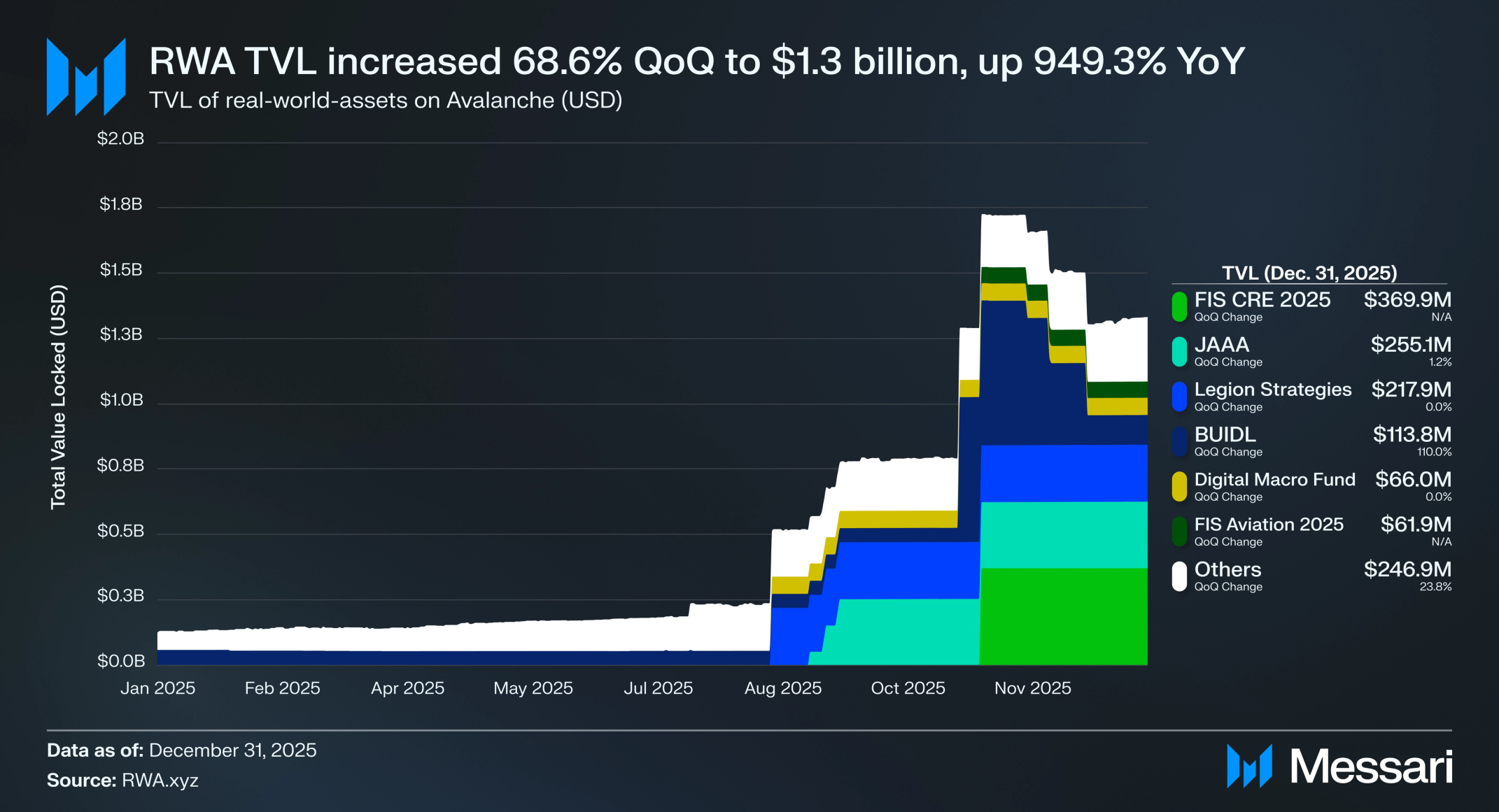
BlackRock tokenized $500 million on Avalanche through BUIDL, its onchain money market fund. This deployment increased RWA TVL 68.6% QoQ and 949.3% YoY to $1.33 billion at year's end.
The Avalanche ETF race accelerated as Bitwise and VanEck incorporated staking into their S-1 filings. Bitwise’s BAVA proposal notably includes plans to stake up to 70% of holdings, marking a significant shift in how regulated investment vehicles approach native network yield.
TIS Inc., one of Japan's largest payment firms, launched a multi-token platform on Avalanche via AvaCloud. The platform enables Japanese banks to issue and manage stablecoins, tokenized deposits, and digital securities.
The Granite upgrade officially activated on Nov. 19, 2025, introducing dynamic block times and native biometric authentication. These technical milestones allow for sub-two-second transaction settlement and let users sign transactions via FaceID or TouchID, drastically lowering the friction for mainstream adoption.
Avalanche’s DeFi ecosystem showed resilience as TVL denominated in AVAX rose 41.9% QoQ to 102.8 million AVAX. This indicates a "sticky" liquidity base, as users maintained stablecoin and non-native positions in DeFi protocols on Avalanche instead of bridging value elsewhere.
Primer
Avalanche (AVAX) is a high-performance, Proof-of-Stake (PoS) smart contract blockchain designed for sub-second transaction finality and scalability. Launched in September 2020 by Ava Labs, the network utilizes a unique multi-chain framework and a novel “Avalanche consensus” family to support a highly decentralized ecosystem of interoperable, application-specific blockchains.
Avalanche consensus employs repeated random subsampling. When a node observes a transaction, it queries a small, random subset of validators; as these nodes reach a quorum, the decision ripples through the network like a "snowball" until reaching irreversible certainty. This leaderless process allows the network to support thousands of concurrent validators while achieving finality.
The Primary Network is composed of three integrated blockchains, each optimized for a distinct function:
Contract Chain (C-Chain): An Ethereum Virtual Machine (EVM) compatible environment. It is the destination for the vast majority of DeFi activity, NFTs, and smart contract execution.
Platform Chain (P-Chain): The orchestration layer. it coordinates validators and manages the creation and monitoring of Avalanche Layer-1s (L1s).
Exchange Chain (X-Chain): A specialized chain for the creation and exchange of digital assets, utilizing a Directed Acyclic Graph (DAG) for high-volume asset transfers.
Avalanche is designed as a "platform of platforms." Through Avalanche L1s (formerly Subnets), developers can launch sovereign blockchains with customized Virtual Machines (VMs) and specific validator requirements (e.g., geographic location or KYC compliance). This architecture isolates high-traffic applications from the Primary Network, preventing gas spikes from other applications and allowing enterprises and gaming studios to scale without competing for blockspace on the C-Chain. To stay up-to-date with all things Avalanche, visit the Avalanche Portal.
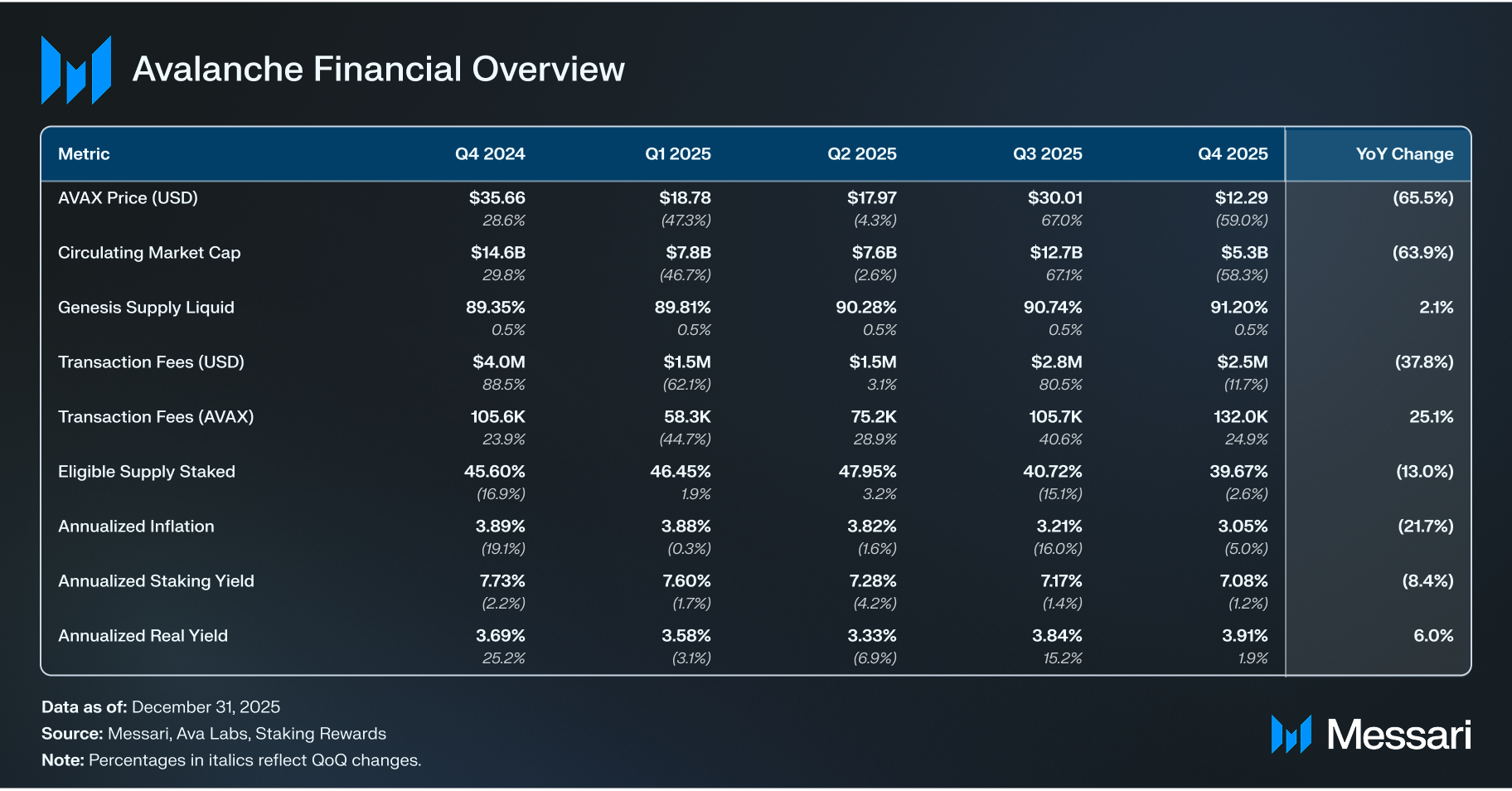
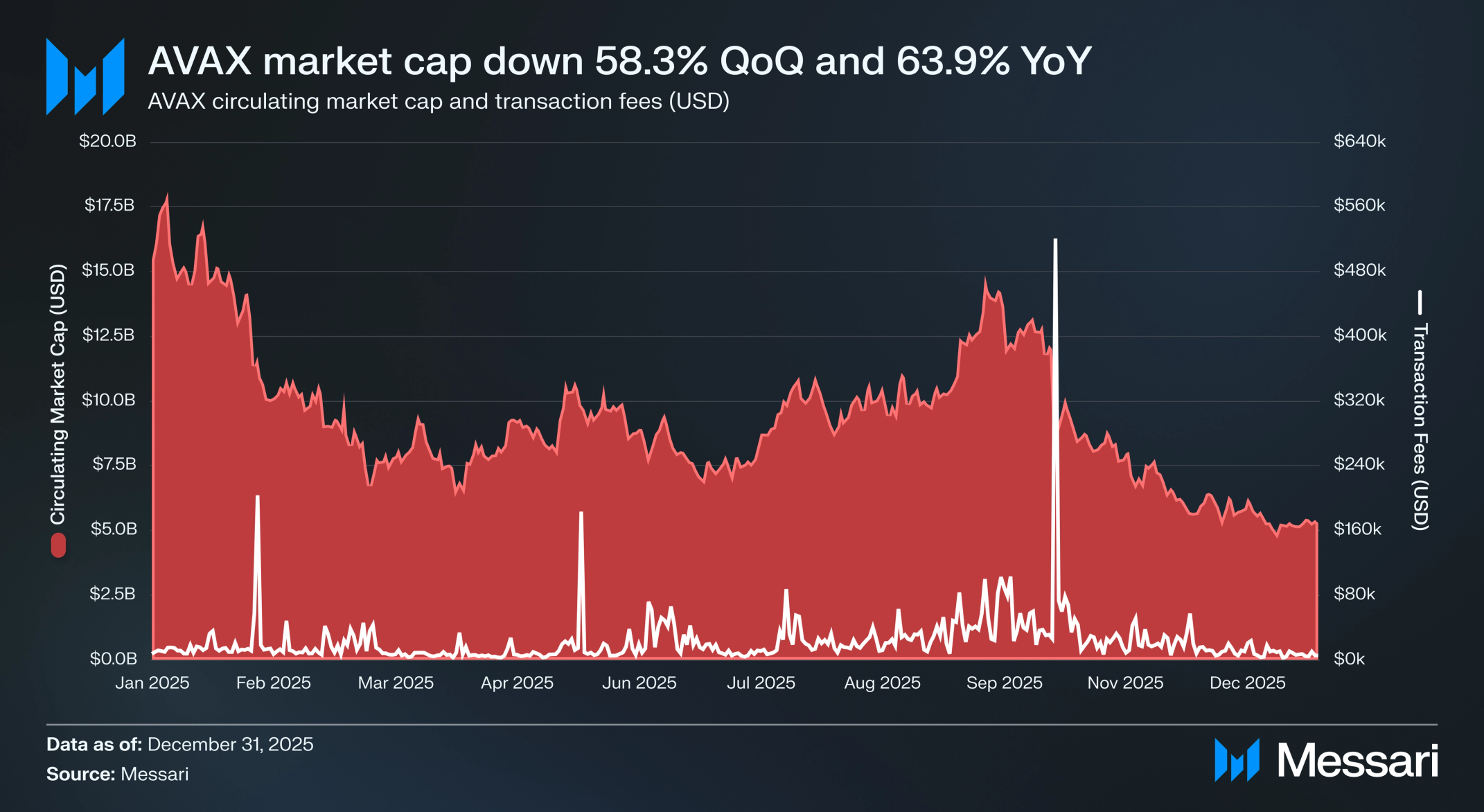
AVAX fell 59.0% QoQ and 65.5% YoY, dropping from $30.0 end of Q3 in September to $12.3 at the end of Q4. The circulating market cap declined 58.3% QoQ and 63.9% YoY from $12.7 billion to $5.3 billion over the past quarter. This decline follows a period of growth in Q3 and reflects broader market volatility during the final months of 2025.
Market Cap and Transaction Fees
AVAX fell from 14th to 21st QoQ in relative rank among all tokens by circulating market cap. Despite the price decrease, network usage grew in Q4, effectively decoupling fees from the downward trend in the price of AVAX. Total fees in USD fell by 11.7% QoQ, despite a steeper 59.0% decline in the price of AVAX over the same period.
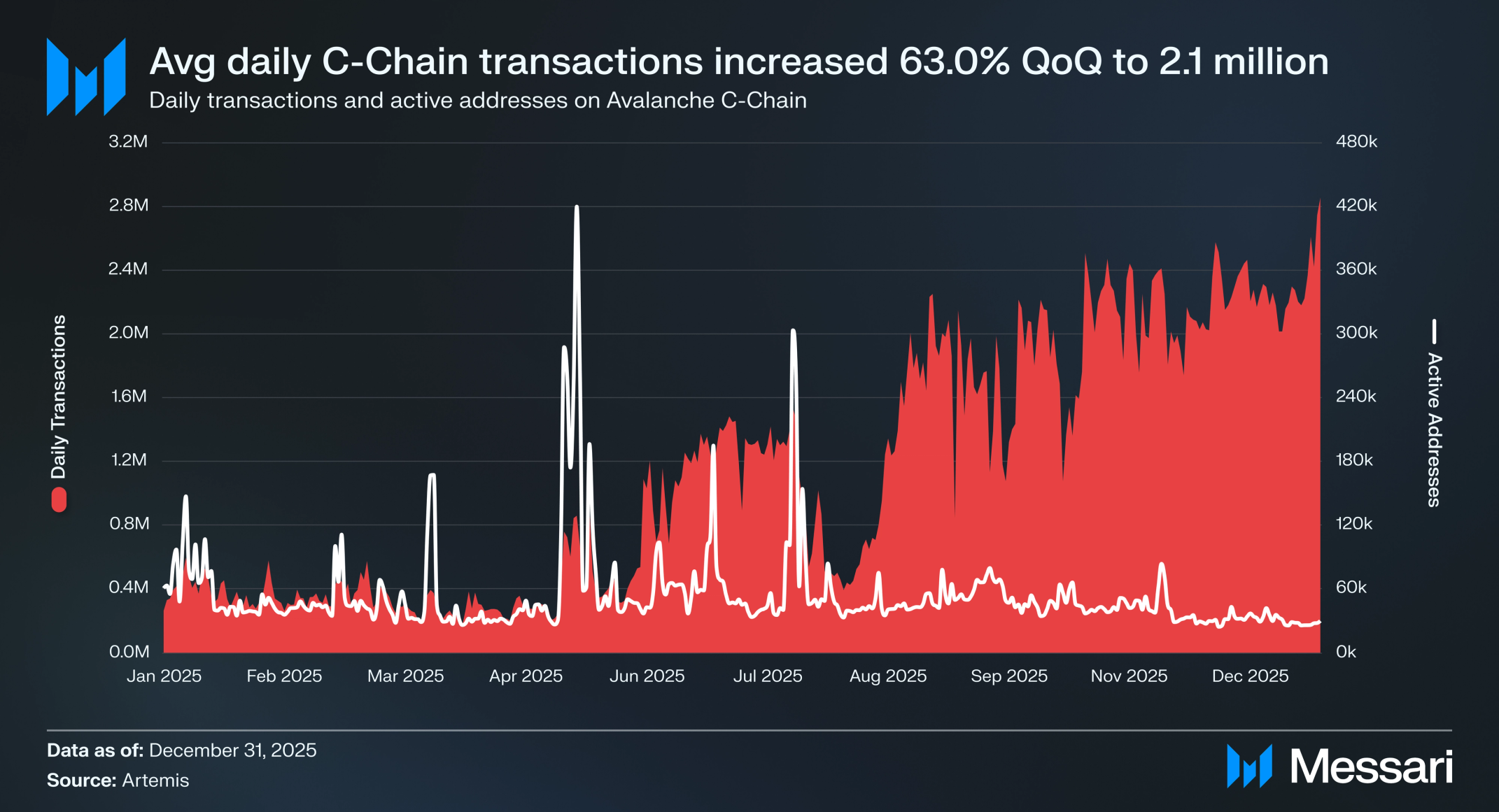
Fees paid in AVAX rose 24.9% QoQ from 105,719 to 132,016 AVAX. This growth was driven by a combination of sustained network activity and a surge in volatility in October. Average daily transactions on the C-Chain surged 63% to 2.1 million, while a spike in liquidations during the Oct. 10, 2025 market crash generated $520,715 in transaction fees. This marked the highest single-day fee revenue for the network since February 2024.
Supply Dynamics
AVAX has a fixed supply of 720.0 million. At the genesis block, 360.0 million AVAX or 50% of the total supply was minted. This genesis supply was distributed to various allocations over differing vesting periods. During Q4 2025, the liquid genesis supply increased from 90.0% to 91.0% with 327.7 million AVAX being distributed to date. The Genesis supply is projected to be fully vested by December 2030, when the Foundation’s allocation is fully vested. A full breakdown of AVAX vesting schedules can be found on Messari’s Token Unlock page in the Avalanche Messari Portal.
Unlike many other PoS chains, all transaction fees on Avalanche are burned, and instead, validators and stakers are rewarded with inflationary staking rewards from the other half of the initial supply (360.0 million AVAX) that was not minted at launch. The rate of Inflation is determined by a dynamic schedule depending on the total amount of AVAX staked and the length of time staked. Longer lock-up periods increase individual validator returns, but do not directly expand total issuance, which remains governed by the protocol’s dynamic schedule. The annualized inflation rate fell 5.0% QoQ and 21.7% YoY to 3.0%. Simultaneously, the amount of eligible supply staked decreased from 40.7% (188.9 million AVAX) at the end of Q3 to 39.7% (184.0 million AVAX) at the end of Q4.
Network Analysis
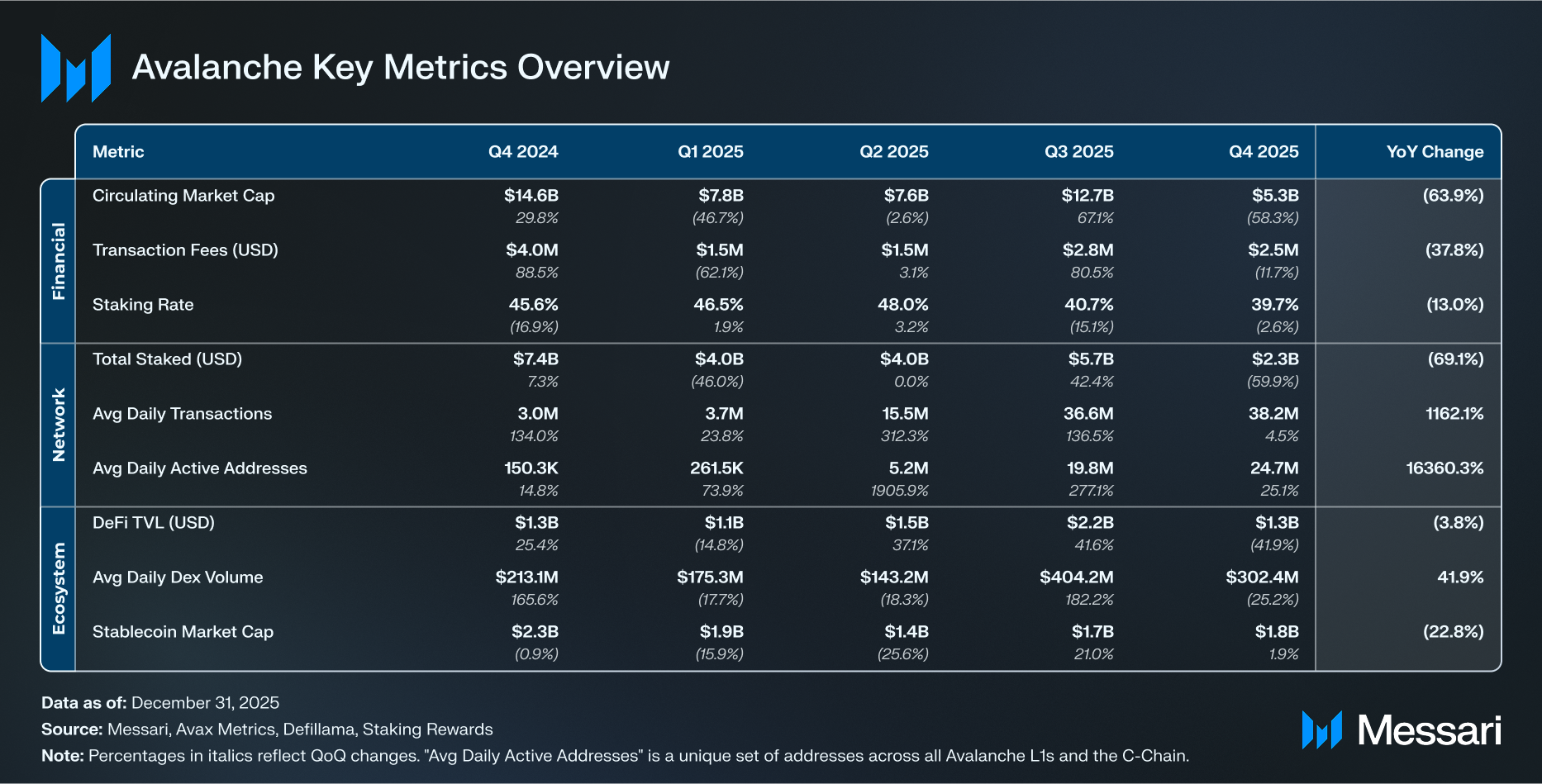
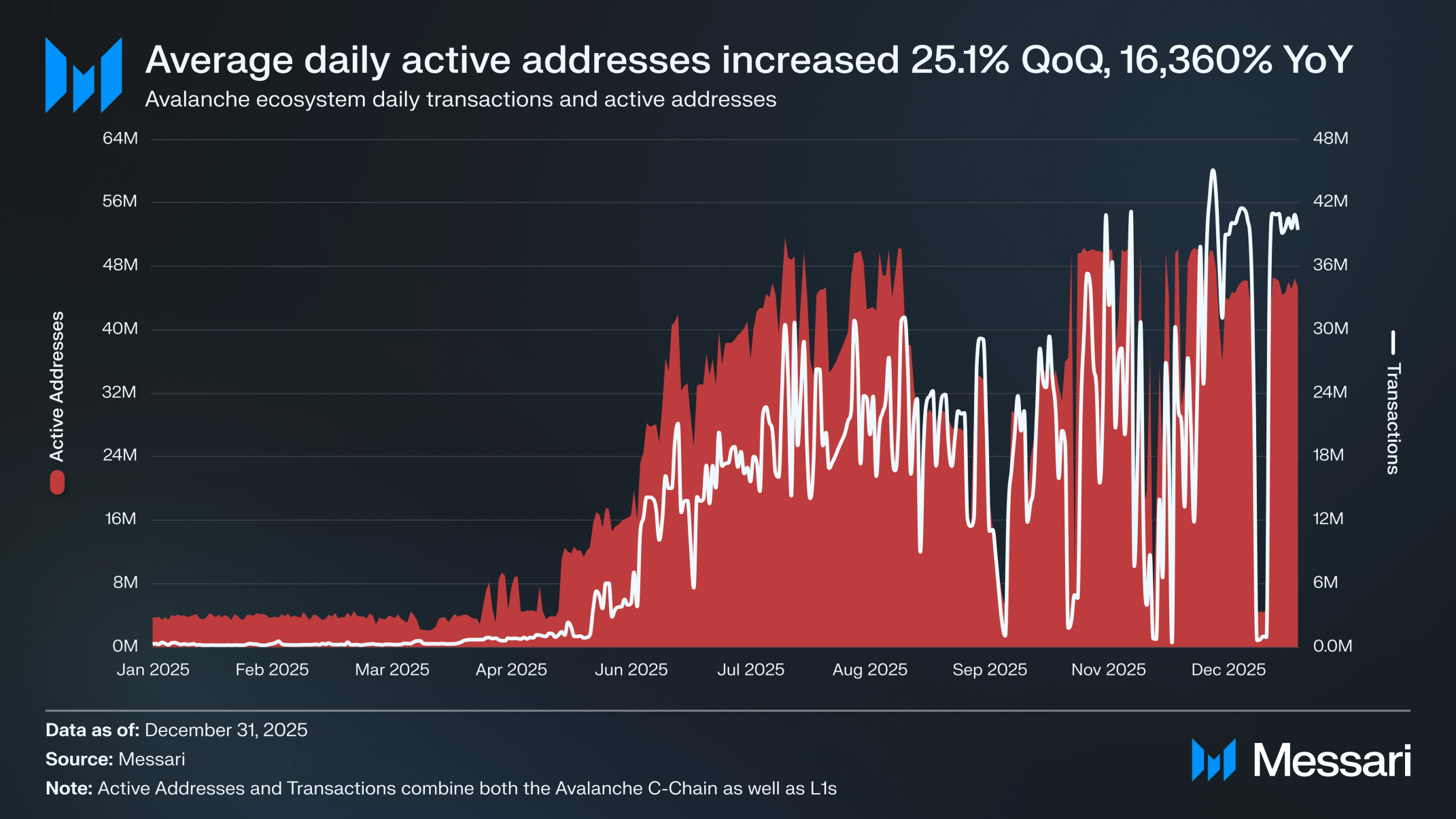
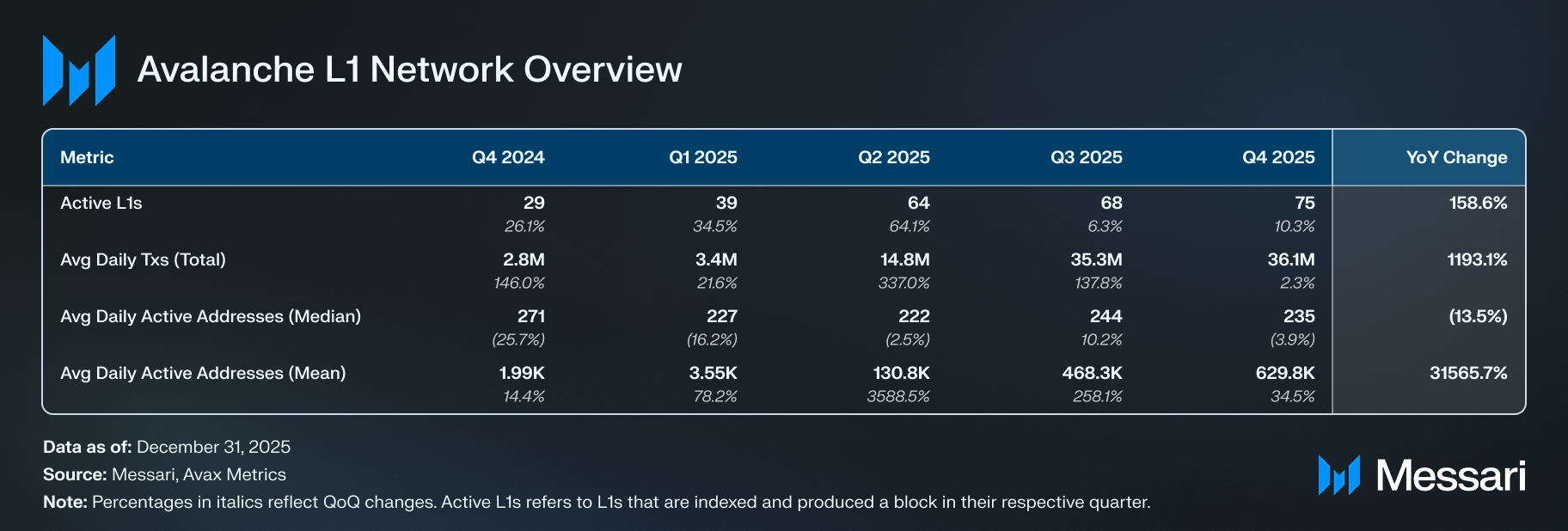
In Q4 2025, aggregate activity across the C-Chain and all Avalanche L1s reached new highs. Average daily transactions grew 4.5% QoQ and 1,162.1% YoY to 38.2 million. During the same period, average daily active addresses (DAAs) increased 25.1% QoQ and 16,360.3% YoY to 24.7 million. This sustained growth followed the continued proliferation of dedicated Avalanche L1s. The total number of active L1s increased 10.3% QoQ and 158.6% YoY to 75 networks at year's end.
Avalanche C-Chain
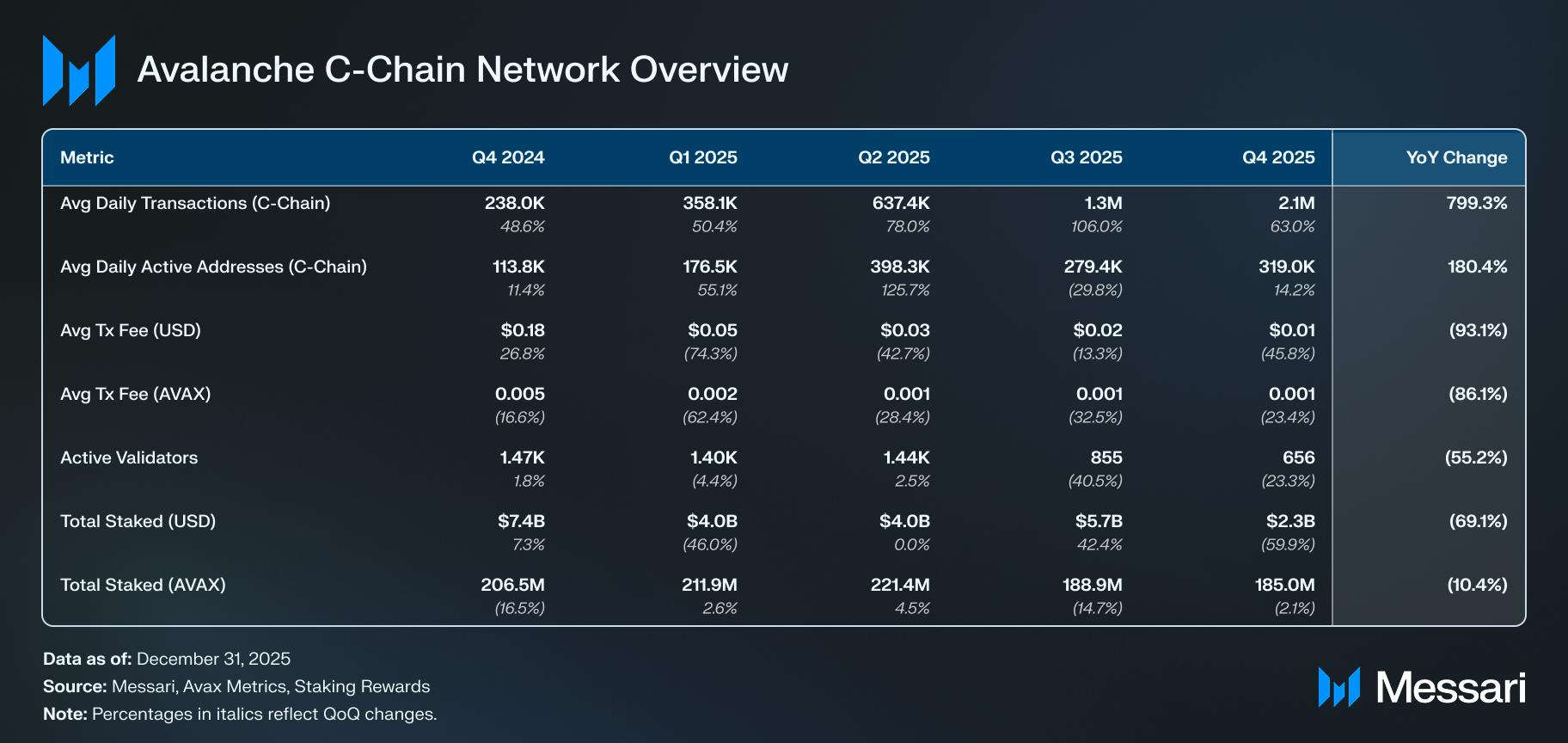
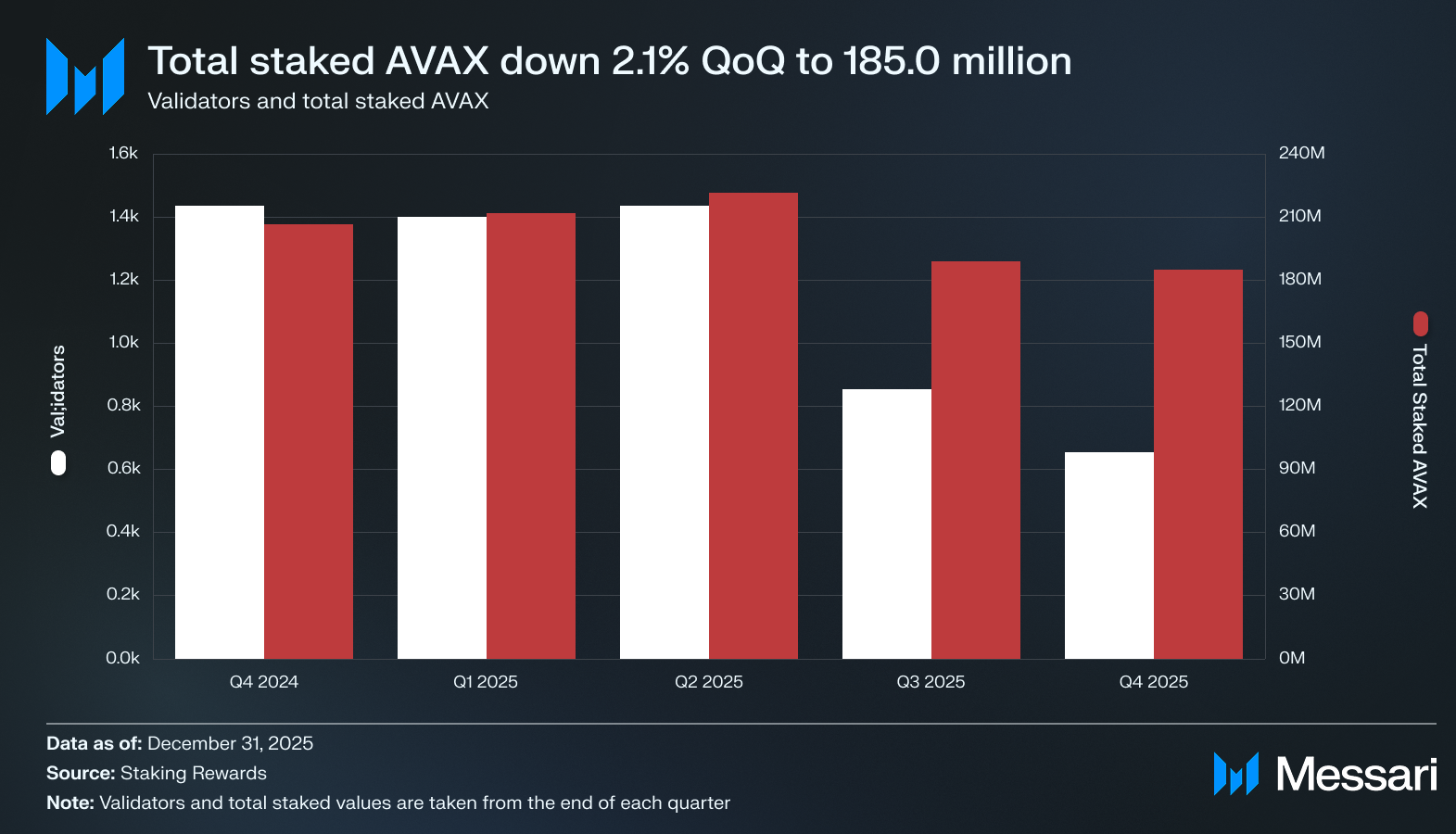
As of the end of Q4 2025, average daily transactions on the C-chain increased 69.0% QoQ and 799.3% YoY. This was the highest quarter on record for transactions. The total USD value of staked AVAX decreased 59.9% QoQ and 69.1% YoY to $2.3 billion. This decline reflects the 59.0% decrease in the price of AVAX during the quarter. In native terms, the total amount of AVAX staked decreased 2.1% QoQ and 10.4% YoY to 185.0 million AVAX at year's end.
Usage
Avalanche C-Chain usage metrics trended upward throughout the final quarter of the year. Average daily transactions rose 63.0% QoQ and 799.3% YoY to 2.1 million. User participation followed a similar trajectory as average daily active addresses increased 14.2% QoQ and 180.4% YoY to 319,010. Network activity surged toward the end of the year, with daily active addresses reaching 436,783 on Dec. 31, 2025.
Security and Decentralization
Avalanche uses a Proof-of-Stake (PoS) consensus mechanism known as “Avalanche Consensus.” Avalanche’s P-Chain is responsible for validator coordination and staking operations. Both the C-Chain and X-Chain utilize the P-Chain validator set for consensus. To determine if a transaction is valid, validators on Avalanche use repeated sub-sampling voting of a minor, random subset of all validators. Consensus occurs once a sufficient majority of validators agree over consecutive rounds. Both the necessary majority and consecutive rounds are configurable. Additionally, the more tokens staked/delegated to a validator, the more influential that validator is in the consensus process.
As of the end of Q4 2025, the active validator count decreased 23.3% QoQ and 55.2% YoY, falling from 855 to 656. Total staked AVAX also declined, dropping 2.6% QoQ and 10.4% YoY to 185.0 million. Validator participation continued to retreat from the levels recorded in 2024.
Technical Developments
Granite Upgrade
Building on its Q3 testnet debut, the Granite upgrade officially activated on the Avalanche Mainnet on November 19, 2025. The upgrade is designed to enhance network speeds, improve cross-chain reliability, and increase user security.
The Granite upgrade is defined by three key Avalanche Community Proposals (ACPs):
ACP-226: Dynamic Block Times – Introduces a mechanism that allows validators to adjust block times in real-time based on network demand. This can reduce transaction settlement times to less than two seconds, enabling near-instant confirmations during peak activity.
ACP-204: Biometric Authentication – Adds native support for the secp256r1 elliptic curve, allowing users to sign blockchain transactions using FaceID, TouchID, or passkeys. This eliminates the need for complex seed phrases or passwords for daily use.
ACP-181: P-Chain Epoched Views – Improves the reliability and cost-effectiveness of Interchain Messaging (ICM). By "freezing" validator sets into short epochs (5–10-minute windows), it prevents cross-chain messages from failing when the validator set changes between blocks.
Retro9000
In Q4, the Avalanche Foundation announced the third cohort for Retro9000, a $40 million retroactive grant program designed to bootstrap the technical development of the "Etna" era. Retro9000 is a critical developer initiative that incentivizes builders to utilize the new L1 architecture.
The third cohort focuses heavily on infrastructure that abstracts the complexity of launching L1s. This ensures that the more than 100 new L1s launched in 2025 have access to standardized tooling for interoperability and security. By rewarding builders who deliver functional code on the new Granite/Etna standards, Retro9000 serves as a "stress test" for new features like Teleporter (cross-L1 messaging) and the P-Chain's new governance capabilities.
Ecosystem Analysis
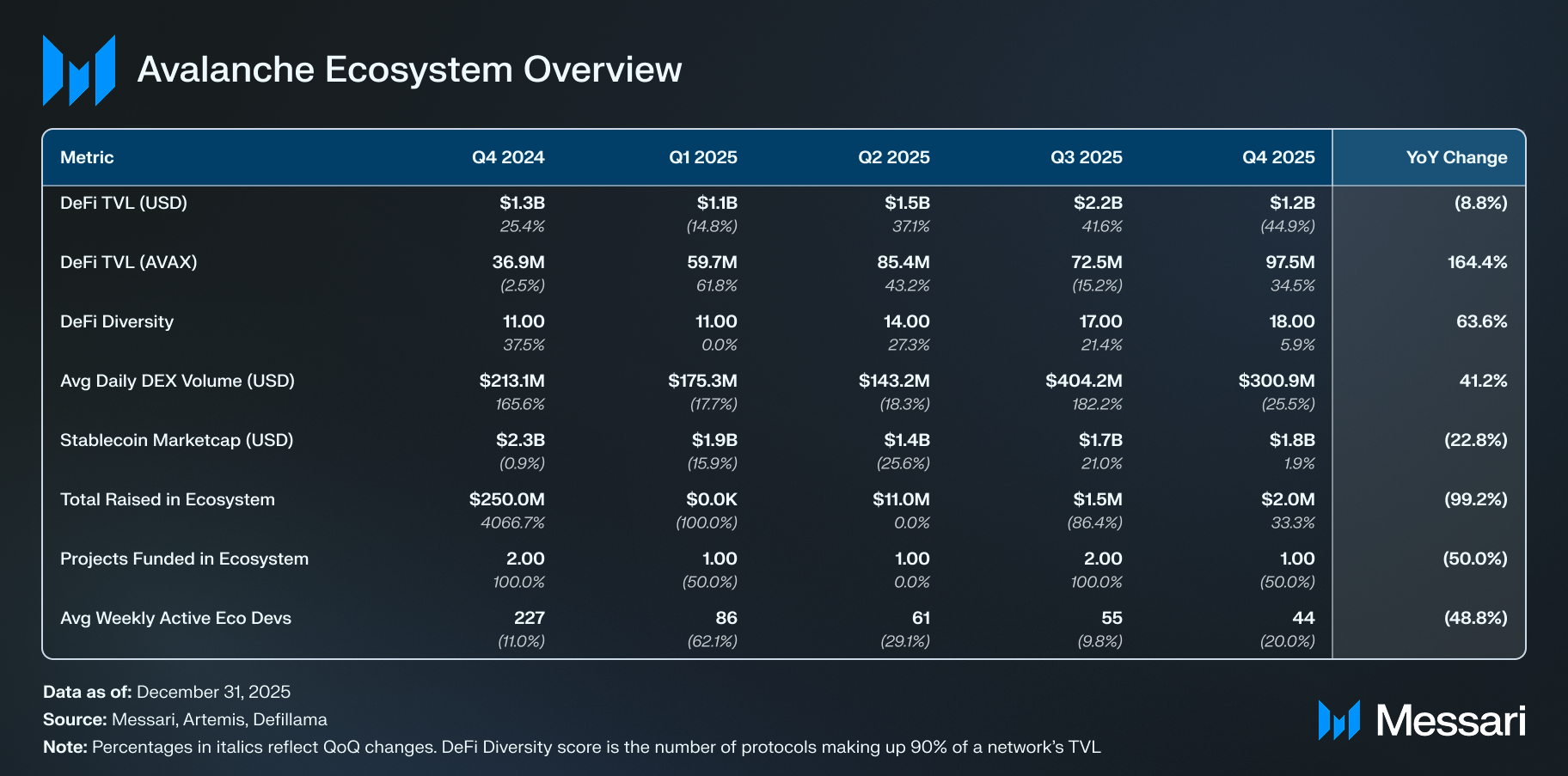
In Q4 2025, Avalanche’s DeFi ecosystem continued to broaden. The DeFi Diversity Score, a metric that measures how many DeFi protocols collectively make up 90% of an ecosystem's TVL, rose 5.9% QoQ and 63.6% YoY from 17.0 to 18.0. Total DeFi TVL across Avalanche L1s and the C-Chain fell 41.9% QoQ and 3.8% YoY from $2.2 billion to $1.3 billion. Simultaneously, the stablecoin market cap on the network grew 1.7% QoQ and 24.3% YoY, moving from $1.7 billion to $1.8 billion. Growth in the quarter was supported by an increase in the USDT supply, which overtook USDC to become the network's dominant stablecoin.
DeFi
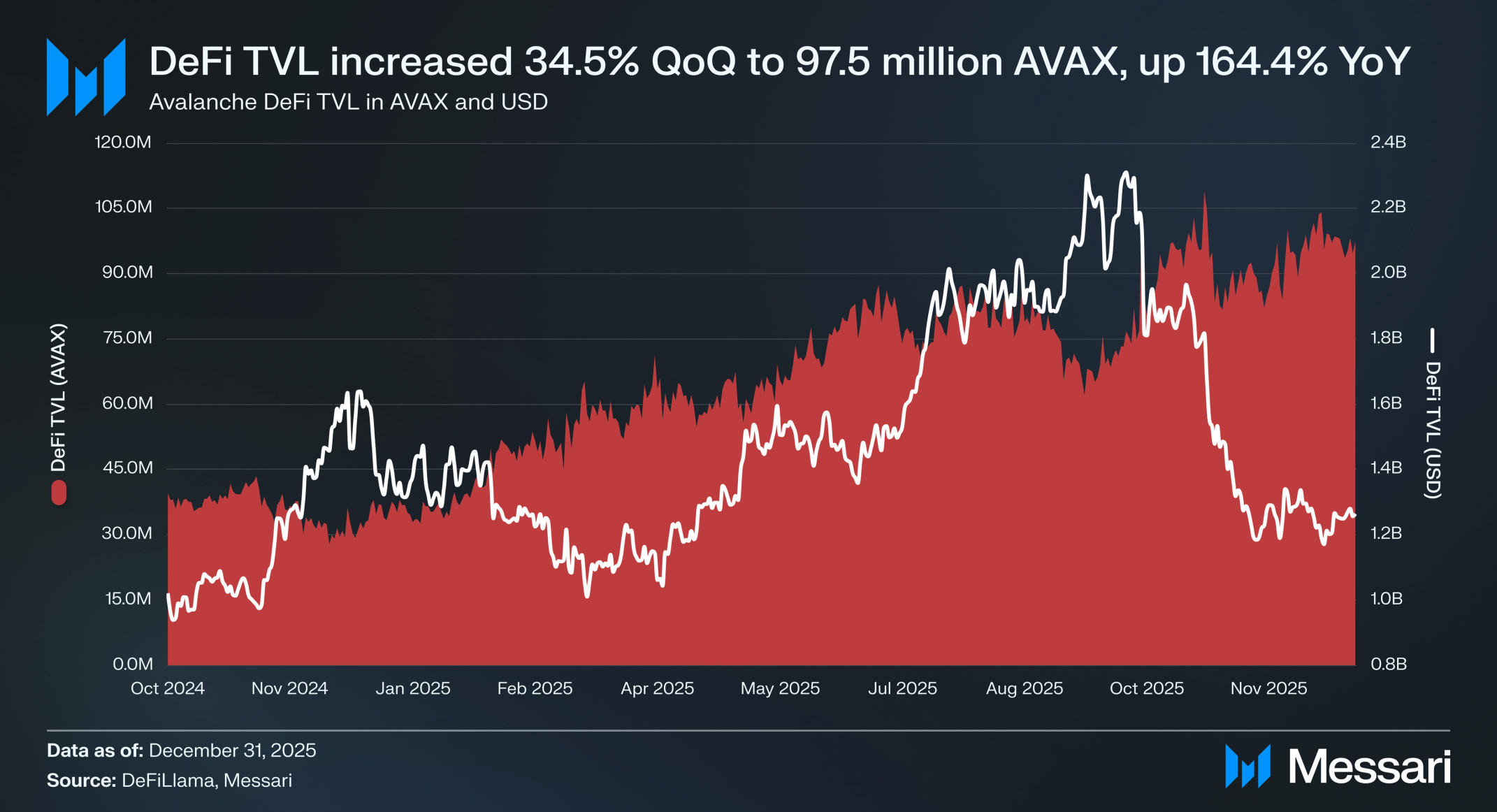
Native DeFi TVL denominated in AVAX rose 34.5% QoQ (to 97.5 million) despite a 44.9% decline in USD TVL. This divergence occurred because the price of AVAX fell significantly faster (-59.0%) than the actual dollar value held within DeFi protocols.
Because USD TVL was "stickier" (retaining 55% of its value) than the AVAX price (retaining only 41%), the ratio of AVAX-denominated value mathematically increased (0.55/0.41 ≈ 1.34). This indicates a "sticky" liquidity base, as users maintained stablecoin and non-native positions in DeFi protocols on Avalanche instead of bridging value elsewhere.
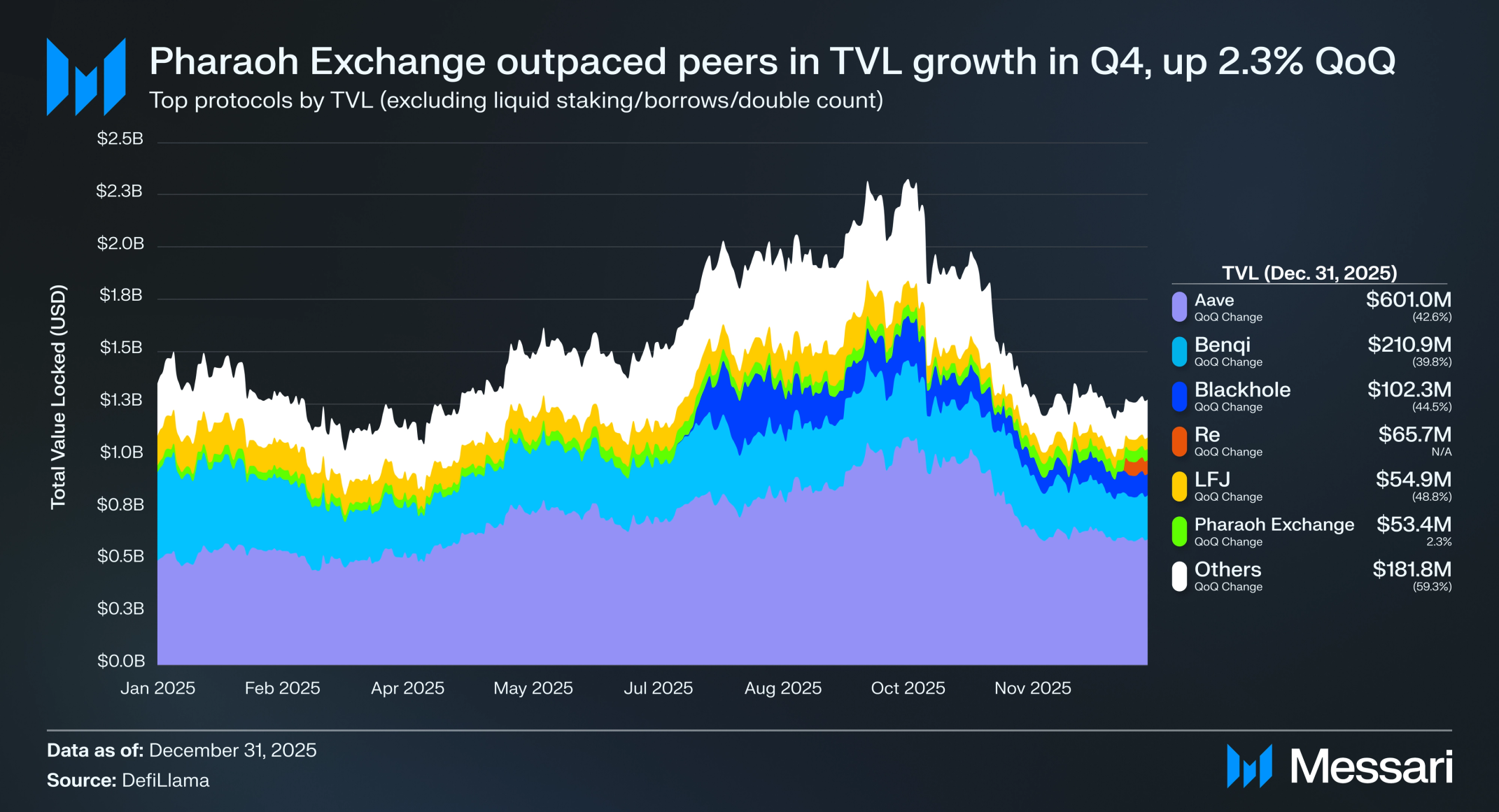
Pharaoh Exchange was a standout performer in Q4, as it was the only major DeFi protocol to show positive growth in both QoQ and YoY metrics, rising 2.3% and 66.9% respectively. Pharoah hit an all time high in daily fees, generating $284,210 in revenue on Nov. 21, 2025. The top three protocols by TVL on the Avalanche C-Chain accounted for 72.0% of the total C-Chain TVL in Q4 2025:
Aave: Maintained its market-leading position with a 47.3% share, despite declining 42.6% QoQ to $601.0 million. TVL increased 20.6% YoY from $498.3 million at Q4’24 end.
Benqi: TVL fell 39.8% QoQ from $350.6 million to $210.9 million. DeFi TVL decreased 50.1% YoY from $422.8 million.
Blackhole: TVL dropped 44.5% this quarter, falling from $184.3 million to $102.3 million. The platform now holds an 8.1% market share.
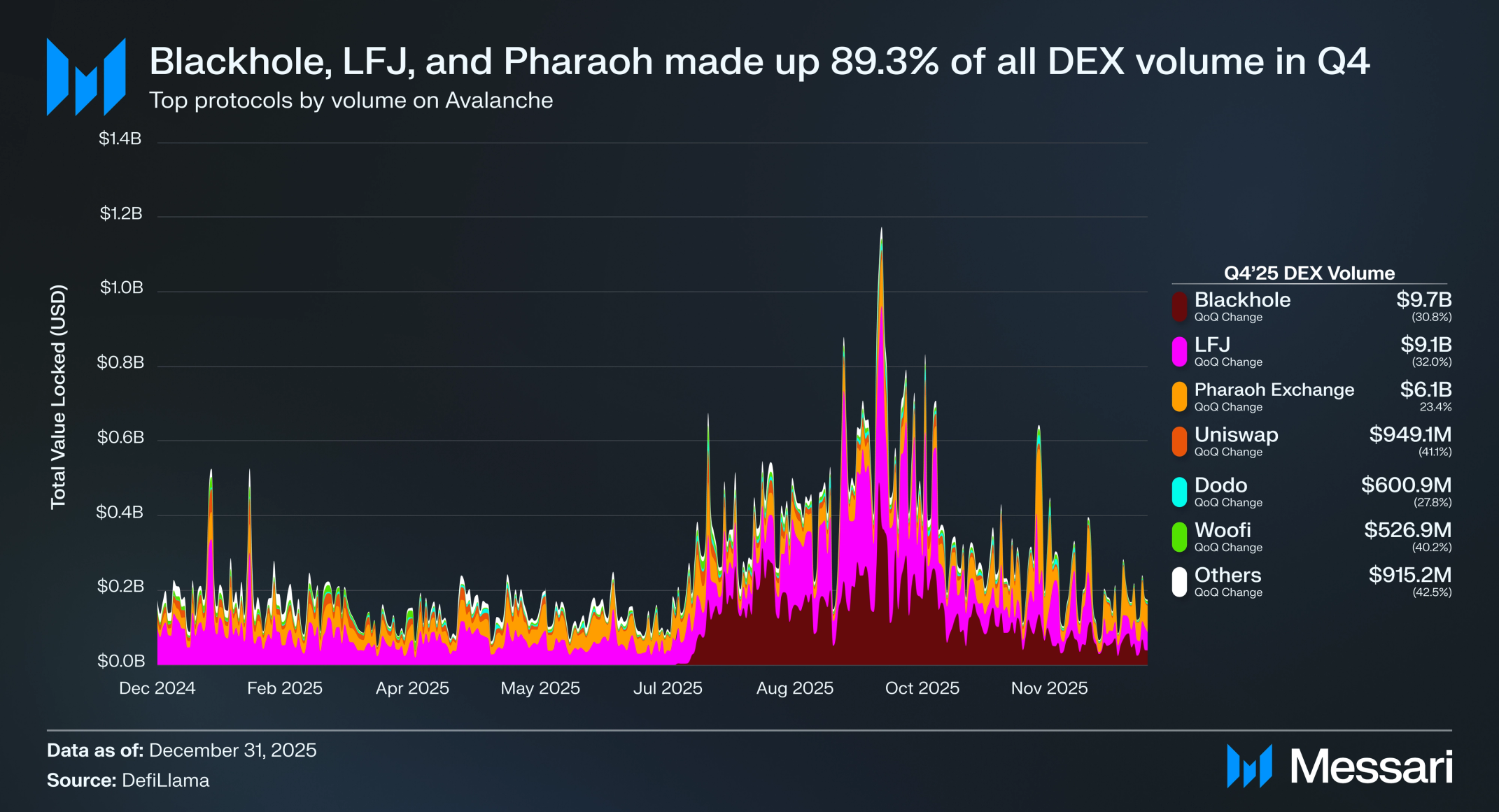
Average daily DEX volume fell 28.1% QoQ to $302.6 million in Q4 2025. Despite this short-term decline, DEX volume grew 74.1% YoY, driven by the relative expansion of Uniswap and LFJ over the year.
Blackhole remained the leading DEX by volume, capturing 34.7% of total trading volume with $105.0 million in Q4, despite a 37.6% decrease from its Q3 peak. LFJ followed closely, recording $98.5 million in average daily volume with a 32.6% market share, a significant increase from its late 2024 levels. Pharaoh Exchange was the quarter’s standout performer, as its volume grew 23.3% QoQ to $66.6 million, with 22.0% of the total volume across DEXs on Avalanche.
The top five DEXs by average daily trading volume in Q4 were:
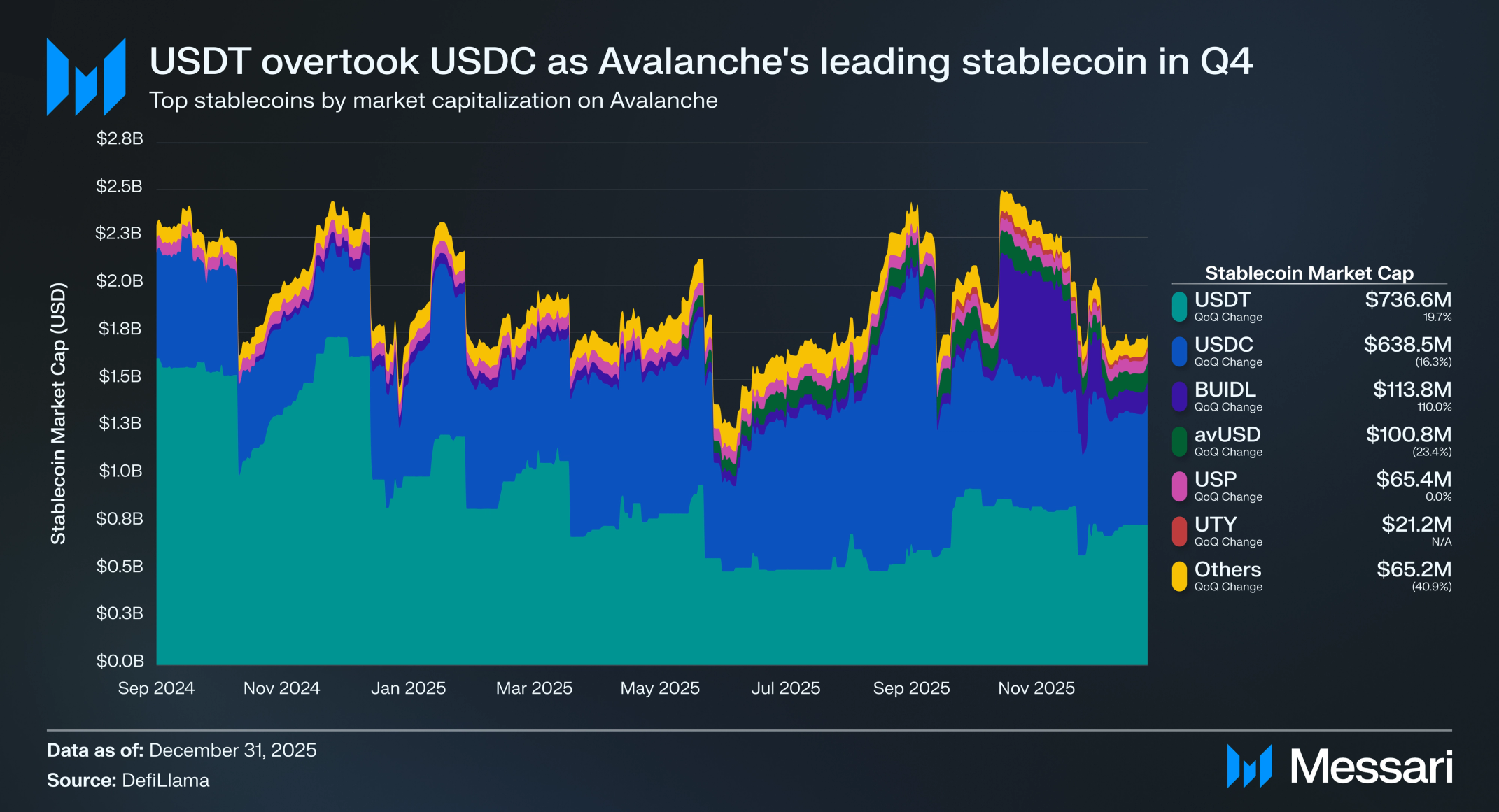
The total stablecoin market cap on the Avalanche C-Chain remained relatively flat in Q4, growing 0.1% QoQ but falling 24.1% YoY, from $1.740 billion at the end of Q3 to $1.741 billion at the end of Q4 2025. USDT overtook USDC to become the dominant stablecoin, accounting for 42.3% of the total supply, with $736.6 million in circulation after a 19.7% QoQ increase, although it closed Q4 down 54.6% YoY. USDC followed with $638.5 million, representing 36.7% of the total stablecoin market cap after a 16.3% QoQ decrease and a 39.4% YoY increase.
RWA
RWA TVL on Avalanche grew 68.6% QoQ and 949.3% YoY, rising from $789.8 million at the end of Q3 to $1.33 billion at the end of Q4 2025. Growth during the quarter was bolstered by significant institutional activity and the launch of high-profile tokenized products, including benchmark indices, real estate, and collateralized loan obligations. Notable partnerships, announcements, and developments include:
In October 2025, BlackRock tokenized $500 million in the BlackRock USD Institutional Digital Liquidity Fund (BUIDL), its onchain money market fund, on Avalanche.
Fortune 500 fintech FISpartnered with Intain to launch a tokenized loan marketplace on Intain’s Avalanche L1 in November 2025. The platform enables 2,000 U.S. banks to buy, sell, and securitize over $6 billion in loans with sub-second settlement and AI-driven transparency. In Q4, FIS tokenized a pool of commercial real estate loans under FIS CRE 2025 and a pool of aviation-finance loans originated by FDIC-member commercial banks under FIS Aviation 2025.
S&P Dow Jones partnered with Dinari to launch the S&P Digital Markets 50 Index, a benchmark combining 35 crypto-linked equities and 15 digital assets into a single tokenized index on Avalanche. The index maintains a fixed 70% equity and 30% crypto allocation. Equities are selected from the S&P Global BMI based on Theia Insights’Concept2Universe, while digital assets are selected by market cap and must meet strict institutional custody and security standards.
Securitize received regulatory approval to launch a tokenized securities platform on Avalanche under the EU’s DLT Pilot Regime. This expansion allows Securitize to issue and trade regulated digital securities in European markets, leveraging Avalanche's infrastructure for compliant capital market activity.
Progmat, the Japanese digital asset platform founded by MUFG and backed by major financial institutions, migrated over $1.1 billion in tokenized securities to a dedicated Avalanche L1 via AvaCloud.
CruTradelaunched a wine tokenization platform on Avalanche, aiming to unlock the $9 billion fine wine market. The platform enables fractionalized ownership and digital trading of investment-grade vintages, providing transparency and liquidity to a traditionally illiquid asset class.
Glim, a global savings app, partnered with OpenTrade to integrate yield into its platform. Built on Avalanche, the collaboration allows Glim users to earn a yield on USD payroll balances automatically, simplifying access to USD-backed yields for retail users.
EVOLVE is scaling institutional RWA pools across Southeast Asia on Avalanche, starting with over $50 million and targeting hundreds of millions in private credit and infrastructure assets. The platform utilizes Avalanche for its sub-second finality and EVM compatibility to drive institutional adoption in the region.
Enterprise, ETFs, DATs, and Stablecoins
In November 2025, Bitwise became the first to incorporate staking into its S-1 filing for the Bitwise Avalanche Trust (BAVA), proposing a 0.34% fee (with a waiver for the first $500 million AUM) and plans to stake up to 70% of holdings. This was followed in December by VanEck, which updated its filing for its Nasdaq-listed ETF (VAVX) with a 0.30% management fee and Coinbase as its staking partner.
TIS Inc., one of Japan's largest payment firms with $2T in annual volume, launched a multi-token platform on the Avalanche blockchain (using AvaCloud) in late October 2025, enabling banks to issue and manage stablecoins, tokenized deposits, and digital securities.
JPYC Inc. launched Japan’s first legally recognized yen-denominated stablecoin (JPYC) following its registration with the Financial Services Agency, utilizing the "JPYC EX" platform to issue and redeem JPYC on Avalanche. Fully backed by 100% reserves in yen deposits and Japanese government bonds, the stablecoin integrates the national "My Number" ID system for mandatory KYC and has set a circulation target of 10 trillion yen ($65.4 billion) within three years.
Thailand’s second-largest bank, KBank, is integrating StraitsX to power cross-border payments between Thailand and Singapore. StraitsX is the regulated issuer of XSGD, a Singapore dollar-pegged stablecoin. All Singapore side settlement in this corridor takes place on the dedicated StraitsX L1 chain.
NH NongHyup Bank is piloting an initiative using the Avalanche network for instant VAT refunds for foreign tourists in South Korea, replacing slow paper processes with smart contracts for stablecoin settlements, in collaboration with Mastercard, Fireblocks, and Worldpay, aiming to boost tourism efficiency through faster, digital transactions.
In October 2025, JPYC officially launched the first legally recognized yen-backed stablecoin on Avalanche.
Record Financial and 11am brought music royalties onchain, leveraging Avalanche to settle payments instantly in USDC for artists like A$AP Ferg and Lil Tjay, transforming a legacy process that typically takes months into one that settles in seconds.
In November 2025, Sparkexpanded to Avalanche with the launch of Spark Savings USDC (sUSDC). This partnership provides users with fixed stable yields and deep cross-chain liquidity, with plans to integrate sUSDC as collateral on lending protocols like Euler and Benji and enable direct spending via the Avalanche Card.
In December 2025, LuLuFin, which handled over $19B in remittance volume in 2024, partnered with Ava Labs to launch a purpose-built Avalanche L1 in 2026, aiming to bring one of the world’s largest remittance networks onchain.
Gaming and others
MyPrize, a social casino platform with over $1.15B in total player winnings to date, is bringing prize redemptions, game resolution, and tracking natively to the Avalanche C-Chain to provide transparent, provable outcomes and real-time onchain payouts. Players can utilize the Core app for onchain transactions alongside fiat options like Apple Pay.
NEXPACE announced a $50 million fund to accelerate the growth of the MapleStory Universe (MSU) ecosystem. This provides a significant boost to its dedicated Avalanche-based Henesys L1, which surpassed 100 million transactions in 2025. The fund is designed to scale the "Infinite IP" vision by supporting builders, AI-powered applications, and financial infrastructure within the L1.
In October 2025, YOM partnered with the Avalanche Foundation to deploy its decentralized cloud gaming network. By launching on Avalanche, YOM significantly reduces cloud hosting costs for studios while providing low-latency gaming experiences directly through the blockchain.
In November 2025, Apertum successfully completed a security audit for its sovereign Avalanche L1. The audit, conducted by CertiK, found zero security vulnerabilities, clearing the way for the high-performance network to launch its enterprise-grade infrastructure.
In December 2025, Avalanche powered a live pilot at NYC’s Union Square Holiday Market, one of the city’s largest and most iconic seasonal markets, in partnership with Urbanspace. The initiative enabled shoppers to pay local vendors instantly via USDC through the Urbanspace app, leveraging Avalanche’s fast finality to demonstrate how blockchain can replace traditional payment rails in high-volume retail environments.
Developed by Wrathtank, Disco’s Inferno launched its testnet on Avalanche. The stylized first-person shooter (FPS) showcases the network's ability to handle fast-paced, real-time gaming interactions with low-latency performance.
GG Deck launched on the Eclipse L1 testnet, with plans to enable gamers to purchase Steam and Web3 titles using any token from any chain. The platform’s core feature is an instant cashback engine that rewards users with USDC or other digital assets immediately after a purchase is settled onchain.
Avalanche L1s
In Q4, Avalanche saw a steady expansion of its L1 ecosystem, increasing the number of active L1s by 10.3% QoQ from 68 to 75. Notable launches included consumer and gaming L1s such as streaming platform Blaze and the Grotto, an indie gaming hub.
It was also the strongest quarter for FIFA since the launch of its Avalanche L1, driven by anticipation for the 2026 World Cup. The network processed 272,297 transactions during the quarter, a 16.2% QoQ increase since Q3, while average daily active wallets surged by 162.0% QoQ to 3,362 addresses. This spike in activity was primarily fueled by users converting World Cup "Right to Buy" (RTB) tickets into real match tickets.
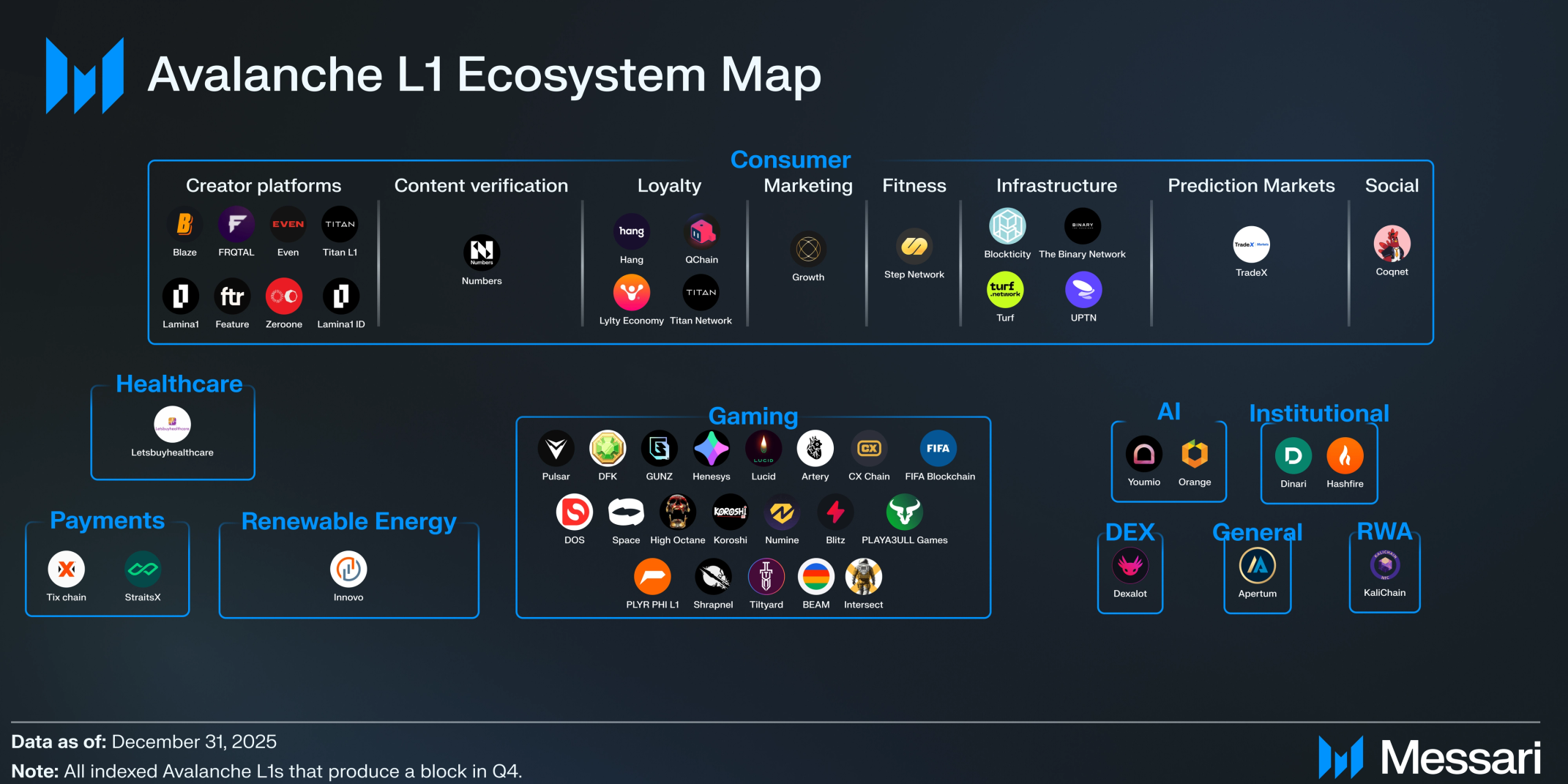
There were 75 indexed Avalanche L1s that produced a block in Q4 2025.
In Q4’25, four new L1s were indexed, launched, and produced a block:
Titan Content: A Los Angeles-based K-pop entertainment firm that launched the TITAN L1 via AvaCloud to power its 2GATHR fan engagement application. The network facilitates the issuance of verified digital collectibles and coordinates artist-to-fan interactions onchain, providing a transparent framework for artist development and community reward structures.
Blaze: An Avalanche L1 dedicated to decentralized content streaming, designed to redistribute revenue and ownership from centralized platforms directly to creators. The protocol incorporates a BLAZE-denominated streamer tier system and utilizes a native bridge to the Avalanche C-Chain to support a community-governed content delivery infrastructure.
Lylty: Developed by FanHub, Lylty is an Avalanche L1 that formalizes a decentralized sports economy by recording fan engagement and transactional data onchain. By abstracting the blockchain layer for end users, the network enables seamless value exchange among brands, teams, and fans through transparent loyalty-tracking and reward mechanisms.
Orange Web3: A purpose-built L1 optimized for AI-native creators and developers. The network provides the infrastructure to transition AI-assisted concepts into production-ready decentralized products, leveraging an integrated user ecosystem and onchain reward incentives to streamline the deployment of AI-driven applications.
Transactions
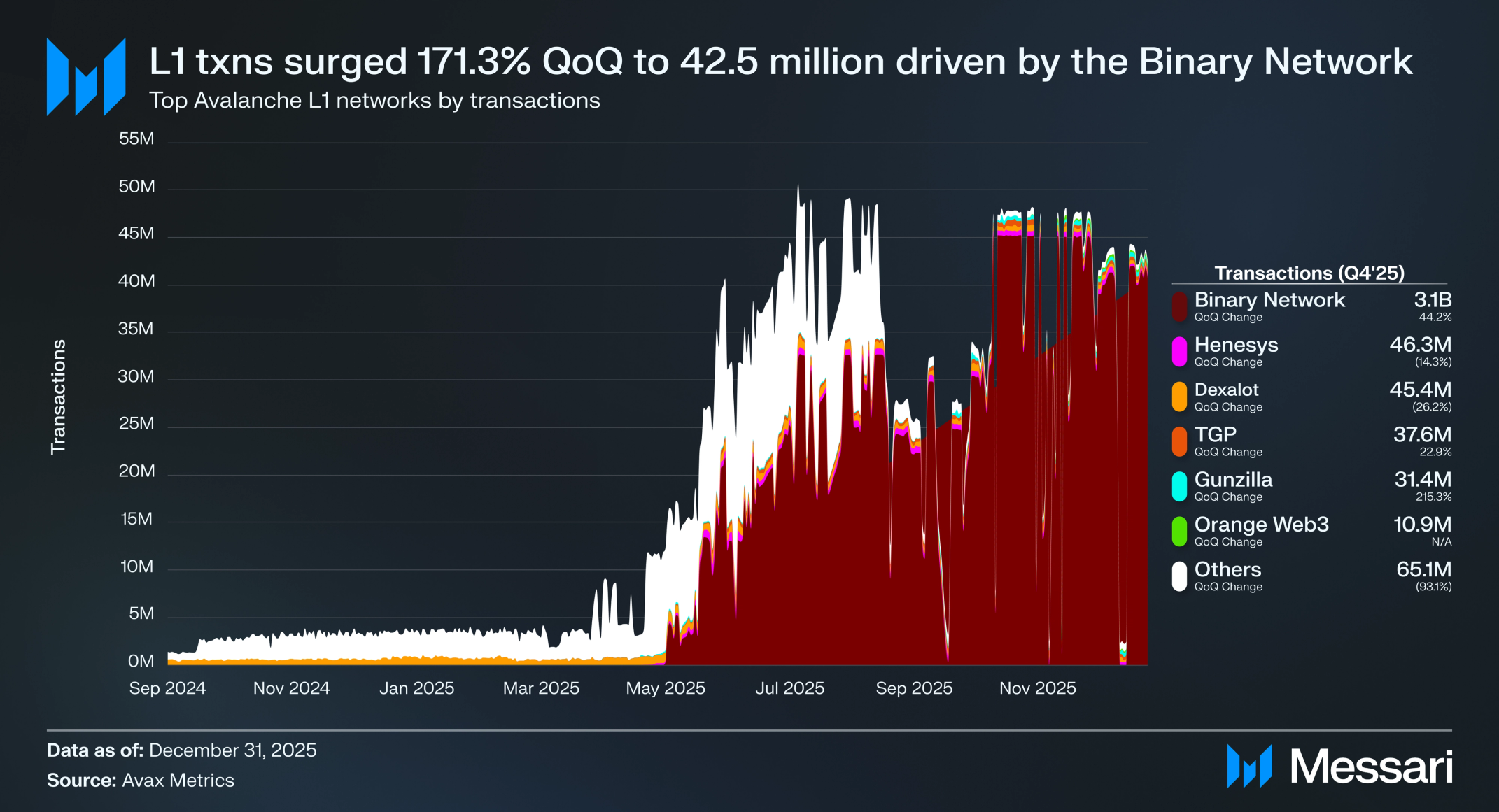
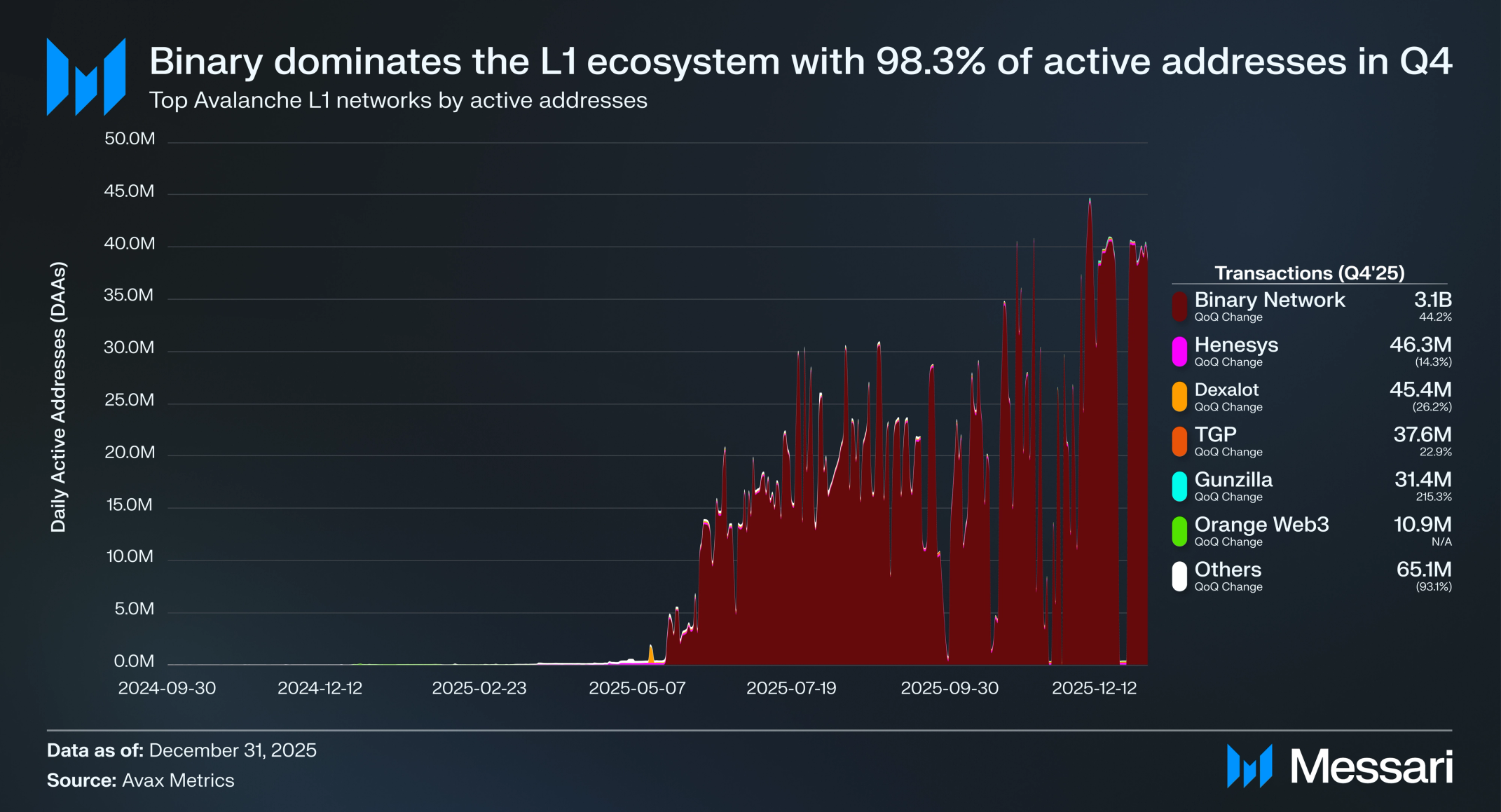
Transactions on Avalanche L1s increased significantly in Q4 2025. Daily L1 transactions reached 42.5 million on the final day of Q4 2025, representing a 1,334% YoY increase from the 2.96 million transactions recorded in Q4 2024. The Binary Network continued to dominate the ecosystem, increasing its market share by 27 percentage points from 65.9% in Q3 to 92.9% of all L1 transactions in Q4. Binary processed 3.11 billion total transactions in Q4, a 45.7% QoQ increase from 2.14 billion in Q3 2025.
This dominance is a direct result of the network’s successful onboarding of massive telco user bases within the APAC region, which shifted the scale of Avalanche L1 adoption from thousands to tens of millions of active users over the course of the year. Through its "OneWave" platform, Binary embeds Web3 applications directly into the loyalty programs of major telecom providers across Southeast Asia and Africa. This gives the app immediate access to a pre-existing user base of over 385 million monthly active users.
The L1 ecosystem is beginning to diversify as well. 21 L1s reached all-time high quarterly transaction volumes (excluding new chains that did not have transactions in the prior quarter). New entrants and specialized L1s like Gunzilla and Orange Web3 began to carve out their own niches, contributing 37.6 million and 10.9 million total transactions, respectively, by the end of December.
Active Addresses
Average daily active addresses (DAAs) across Avalanche L1s surged in Q4 2025, with the ecosystem-wide average reaching 24.4 million. This represents a staggering 66,695% YoY increase from the 36,569 average DAAs recorded in Q4 2024, and a 25.3% QoQ increase from the 19.5 million average in Q3 2025.
The Binary Network remained the overwhelming leader in user activity, accounting for 98.3% of all active addresses across the L1 ecosystem.
Closing Summary
Avalanche concluded 2025 with record-breaking network activity. Average daily transactions surged to 38.2 million, a staggering 1,162% increase YoY, while average daily active addresses reached a record 24.7 million. This growth was driven by the Binary Network, which leveraged telco and banking partnerships in APAC to onboard tens of millions of users, accounting for 98.3% of all active addresses across the Layer-1 ecosystem.
Institutional mindshare continues to grow, evidenced by the network's double-digit QoQ growth in RWA TVL. High-profile activity from BlackRock. tokenizing $500 million in assets through its BUIDL fund and the introduction of the first directly investable S&P Digital Markets 50 Index onchain signals a maturing landscape for regulated capital. This was further reinforced by updated ETF filings from Bitwise and VanEck, which notably propose including staking to offer investors native yield.
With 75 active L1s and the Granite upgrade enabling a fast, seamless UX, the network has the potential in 2026 to become critical infrastructure for institutional use cases, such as tokenization, and consumer applications, such as gaming.
This report was commissioned by Ava Labs. All content was produced independently by the author(s) and does not necessarily reflect the opinions of Messari, Inc. or the organization that requested the report. The commissioning organization may have input on the content of the report, but Messari maintains editorial control over the final report to retain data accuracy and objectivity. Author(s) may hold cryptocurrencies named in this report. This report is meant for informational purposes only. It is not meant to serve as investment advice. You should conduct your own research and consult an independent financial, tax, or legal advisor before making any investment decisions. Past performance of any asset is not indicative of future results. Please see our Terms of Service for more information.
No part of this report may be (a) copied, photocopied, duplicated in any form by any means or (b) redistributed without the prior written consent of Messari®.
Youssef is a Research Analyst on the Protocol Research team. Prior to joining Messari, Youssef was a Product Analyst at Fidelity Digital Assets. Youssef graduated from Northeastern University, where he led the Northeastern Blockchain club as President.
Youssef is a Research Analyst on the Protocol Research team. Prior to joining Messari, Youssef was a Product Analyst at Fidelity Digital Assets. Youssef graduated from Northeastern University, where he led the Northeastern Blockchain club as President.