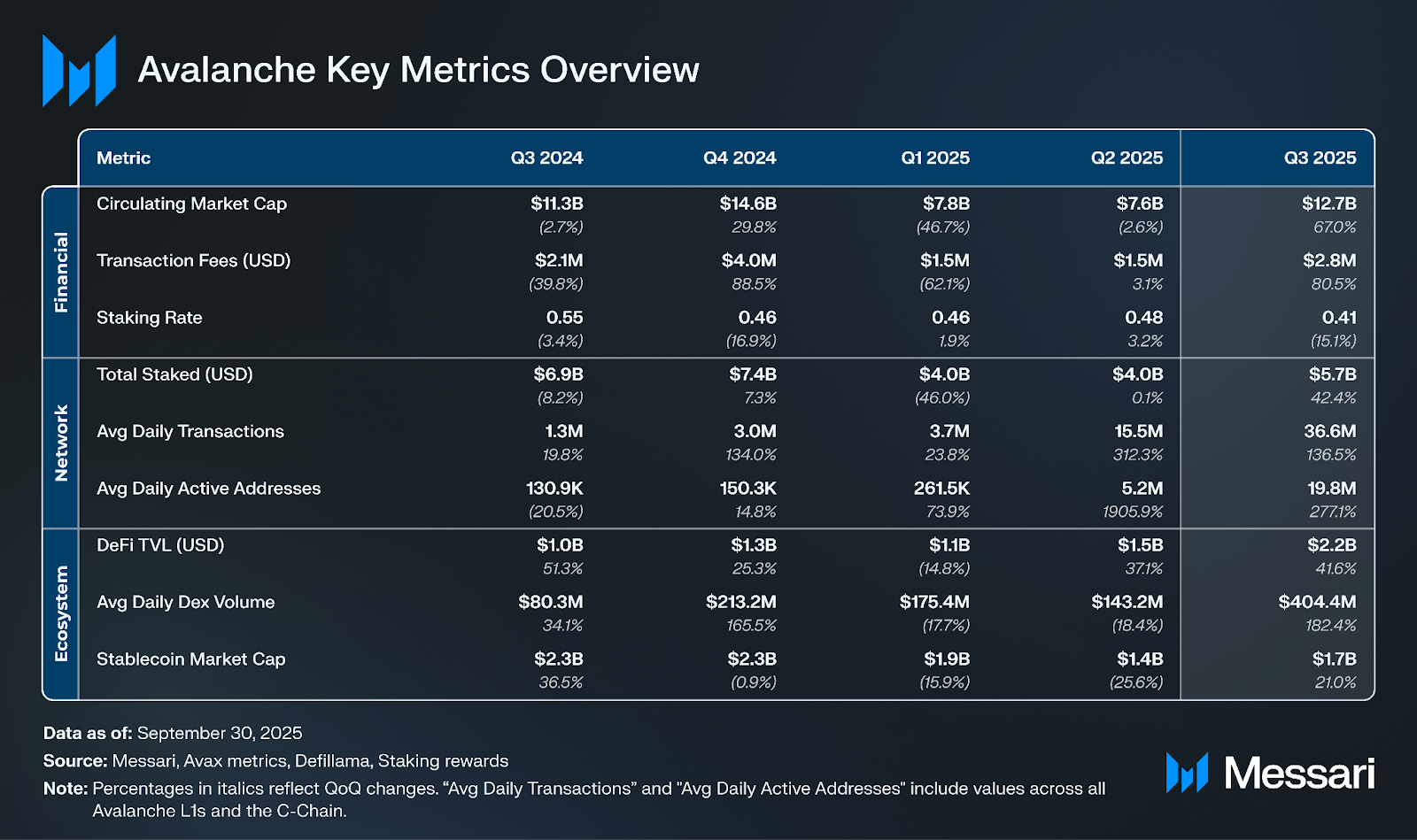
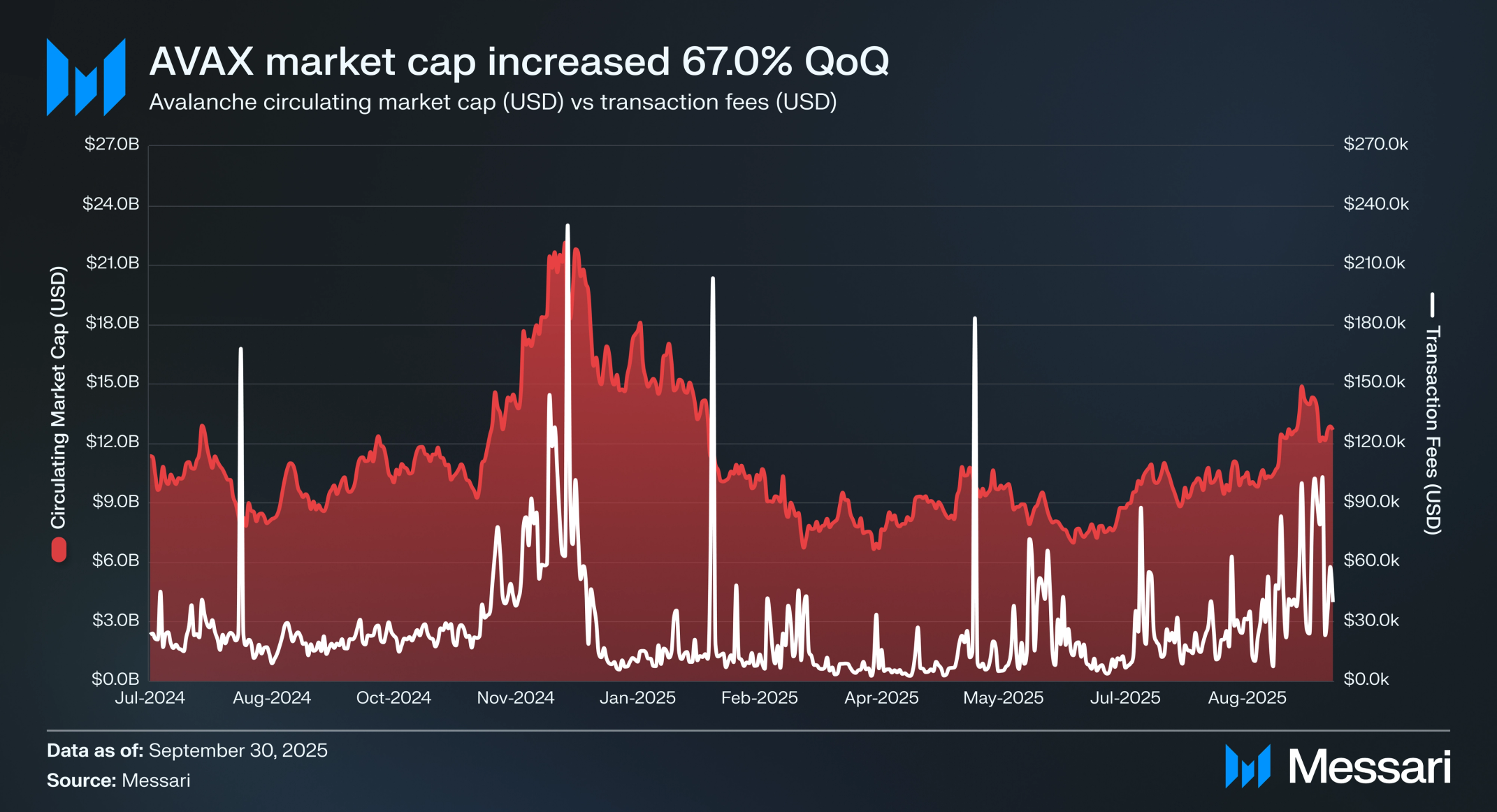
Avalanche's circulating market cap increased 67.0% QoQ, reaching $12.7 billion in Q3. This is the first time this year that Avalanche has reached a market cap above $10.0 billion, largely driven by its institutional initiatives.
In Q3, two Avalanche digital asset treasuries were announced: Avalanche Treasury Co. (AVAT) and AVAX One. Both entities aim to acquire AVAX, with a combined $1.10 billion in committed capital and a long-term target of $1.70 billion in total AVAX holdings.
Grove Finance launched on Avalanche with a $250.0 million real-world asset (RWA) deployment strategy. The institutional credit protocol partnered with Centrifuge and Janus Henderson to introduce onchain credit products such as JAAA and JTRSY.
South Korea’s first Won-backed stablecoin, the KRW1, launched on Avalanche. KRW1 is backed 1:1 by Korean Won escrowed at Woori Bank.
The JPYC corporation launched the Japanese Yen stablecoin (JPYC) on Avalanche, following approval under the revised Payment Services Act. The JPYC stablecoin is fully backed by Japanese yen held in deposits and government bonds.
Primer
Avalanche (AVAX) is a Proof-of-Stake (PoS) smart contract platform for decentralized applications. Avalanche differentiates itself by creating and implementing a consensus family known as "Avalanche consensus."
Following years of research, the Avalanche mainnet was launched in September 2020, featuring the release of a multichain framework that utilizes three chains: the P, X, and C chains. Each chain plays a critical and unique role within the Avalanche ecosystem, and when combined, they create the Primary Network. Avalanche consensus and the Primary Network are designed to support sovereign, interconnected blockchains known as Avalanche Layer-1s (L1s).
Avalanche L1s run the same Virtual Machines (VMs) with their own customizations. L1s enable different properties of reliability, efficiency, and data sovereignty. They enable the creation of custom networks for various use cases, while isolating high-traffic applications from congested activity on the Primary Network. To stay up-to-date with all things Avalanche, visit the Avalanche Portal.
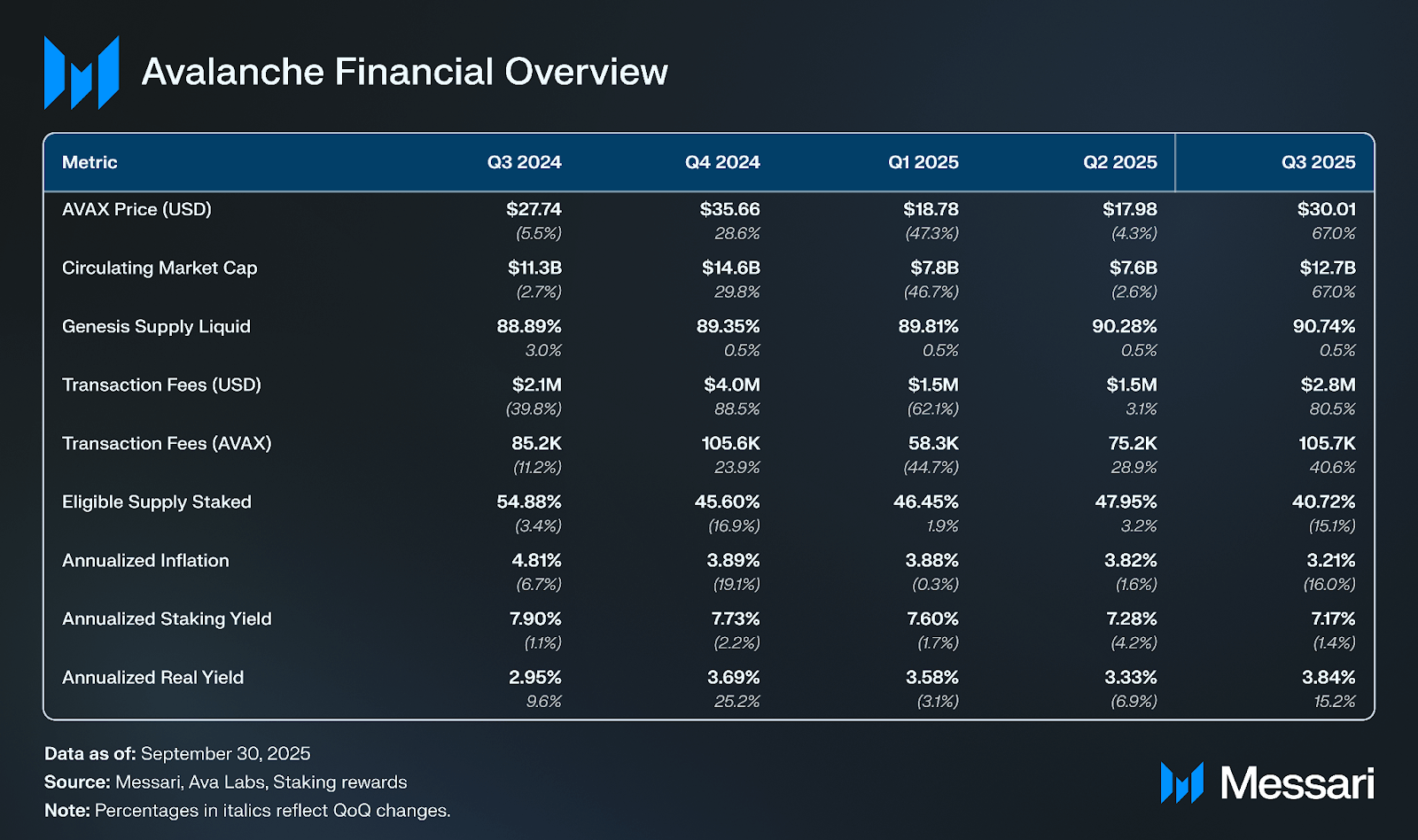
AVAX rose 67.0% QoQ, climbing from $17.98 in Q2 to $30.01 in Q3. The circulating market cap grew in tandem, increasing 67.0% from $7.6 billion to $12.7 billion, reflecting a strong rebound after two consecutive quarters of decline.
Market Cap and Transaction Fees
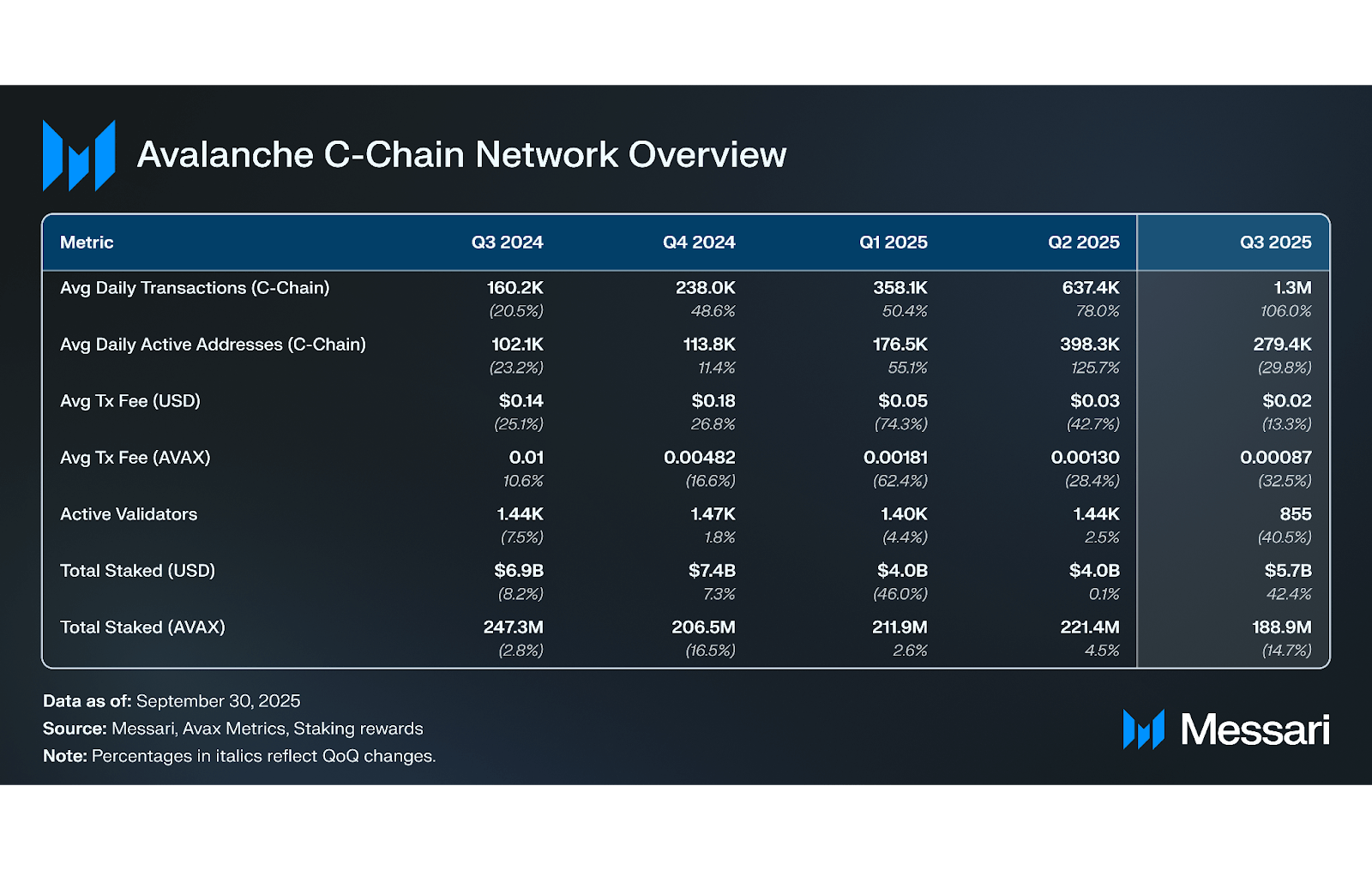
AVAX’s circulating market cap rose in relative rank among all tokens, moving from 16th in Q2 to 14th in Q3. Network activity strengthened over the same period, with transaction fees paid in AVAX up 40.6% QoQ from 75,170 to 105,700. In USD terms, total fees grew 80.1% QoQ from $1.5 million to $2.8 million, likely driven by increased activity onchain with average daily transactions increasing 106.0% going from 637,446 in Q2 to 1.3 million in Q3.
Supply Dynamics
AVAX has a fixed supply of 720.0 million. At the genesis block, 360.0 million AVAX or 50% of the total supply was minted. This genesis supply was distributed to various allocations over differing vesting periods. Over Q3 2025, the liquid genesis supply increased from 90.0% to 91.0% with 326.66 million AVAX being distributed to date. The Genesis supply is projected to be fully vested by December 2030, when the Foundation’s allocation is fully vested. A full breakdown of AVAX vesting schedules can be found on Messari’s Token Unlock page in the Avalanche Messari Portal.
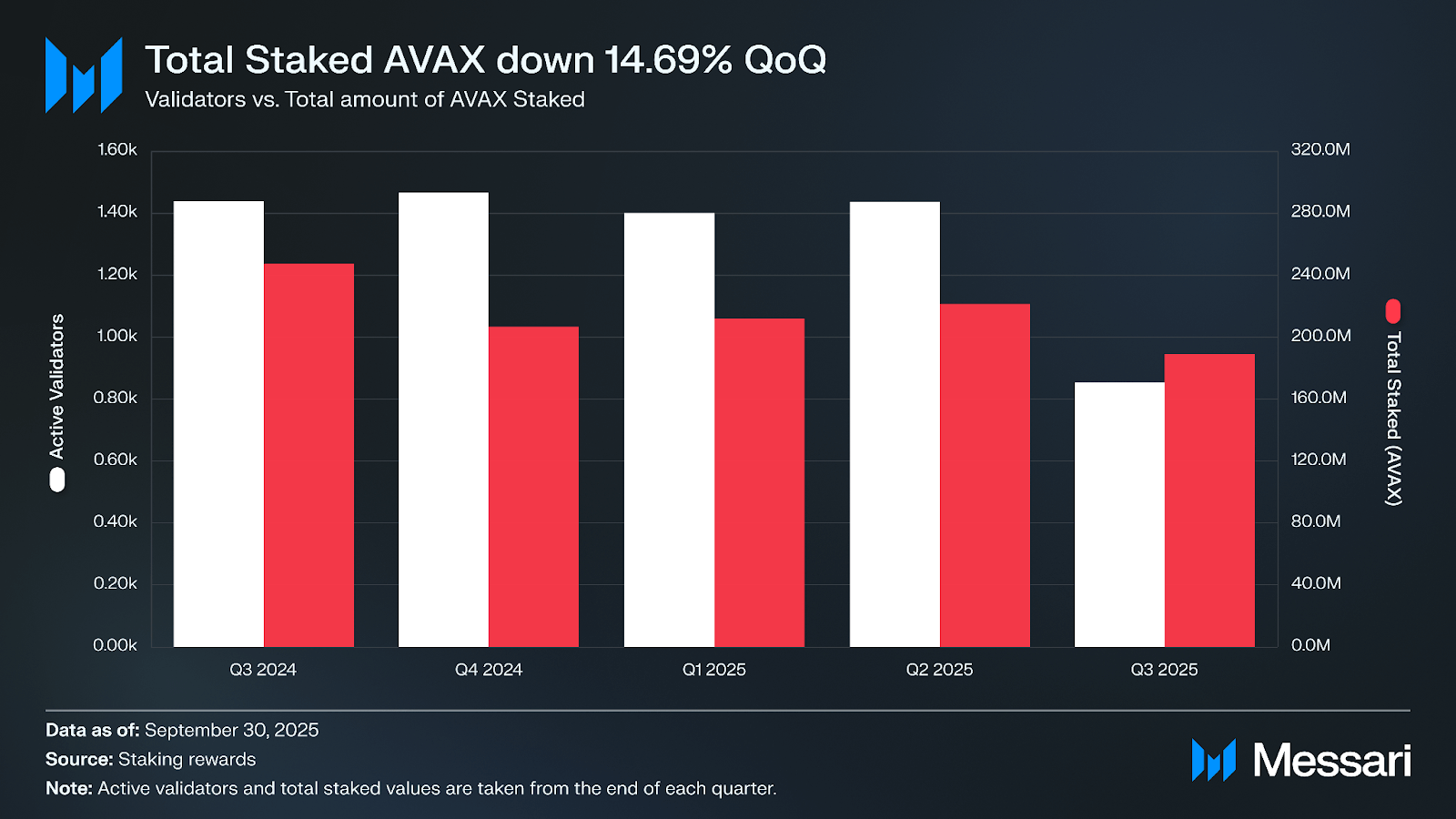
Unlike many other PoS chains, all transaction fees on Avalanche are burned, and instead, validators and stakers are rewarded with inflationary staking rewards from the other half of the initial supply (360.0 million AVAX) that was not minted at launch. The rate of Inflation is determined by a dynamic schedule depending on the total amount of AVAX staked and the length of time staked. Longer lock-up periods increase individual validator returns, but do not directly expand total issuance, which remains governed by the protocol’s dynamic schedule.] The annualized inflation rate in Q3’25 stayed relatively flat at 3.2% down from its 3.8% in Q2’25, while the amount of eligible supply staked declined from 47.9% to 40.7% going from 221.4 million AVAX in Q2 down to 188.9 million AVAX in Q3.
Network Analysis
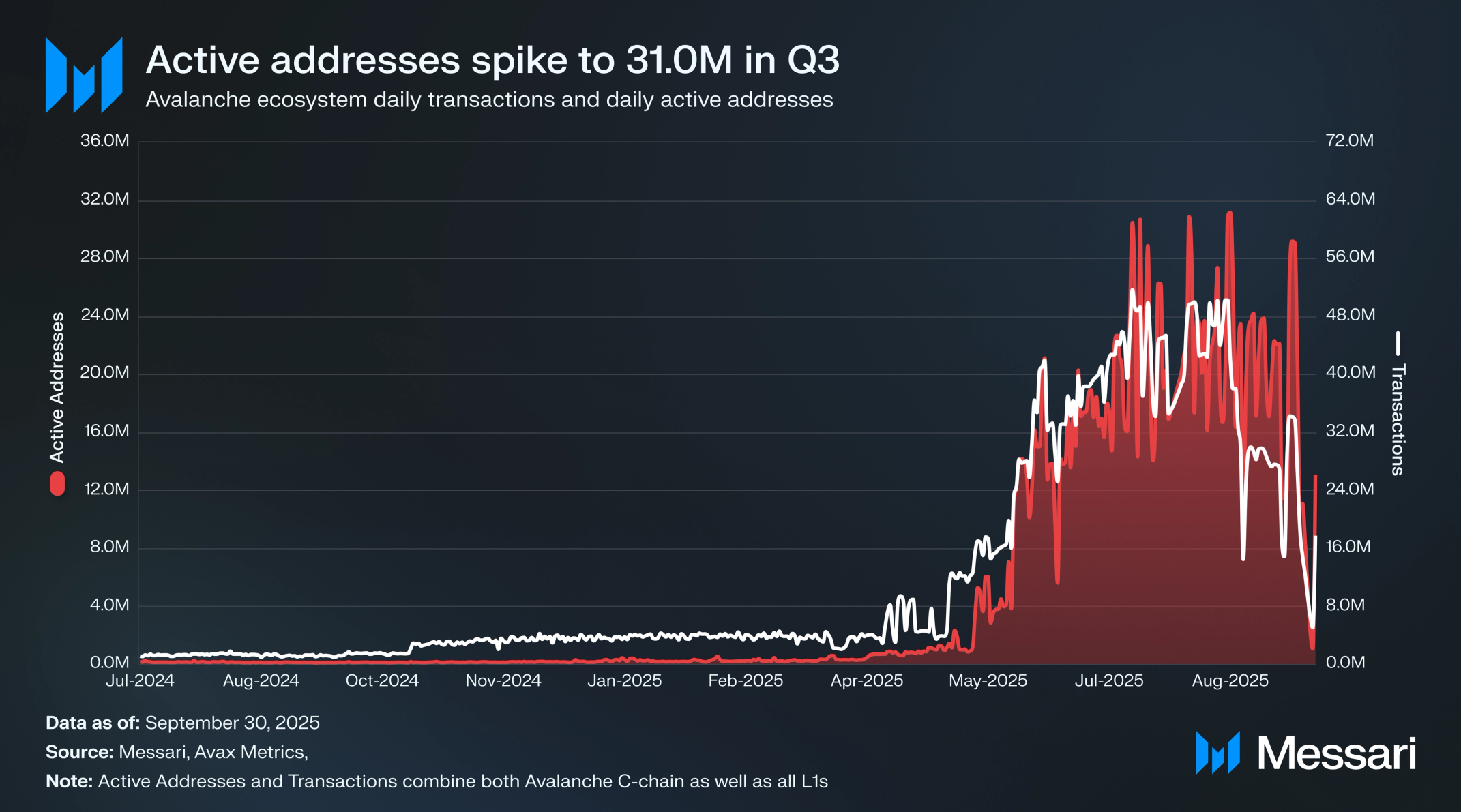
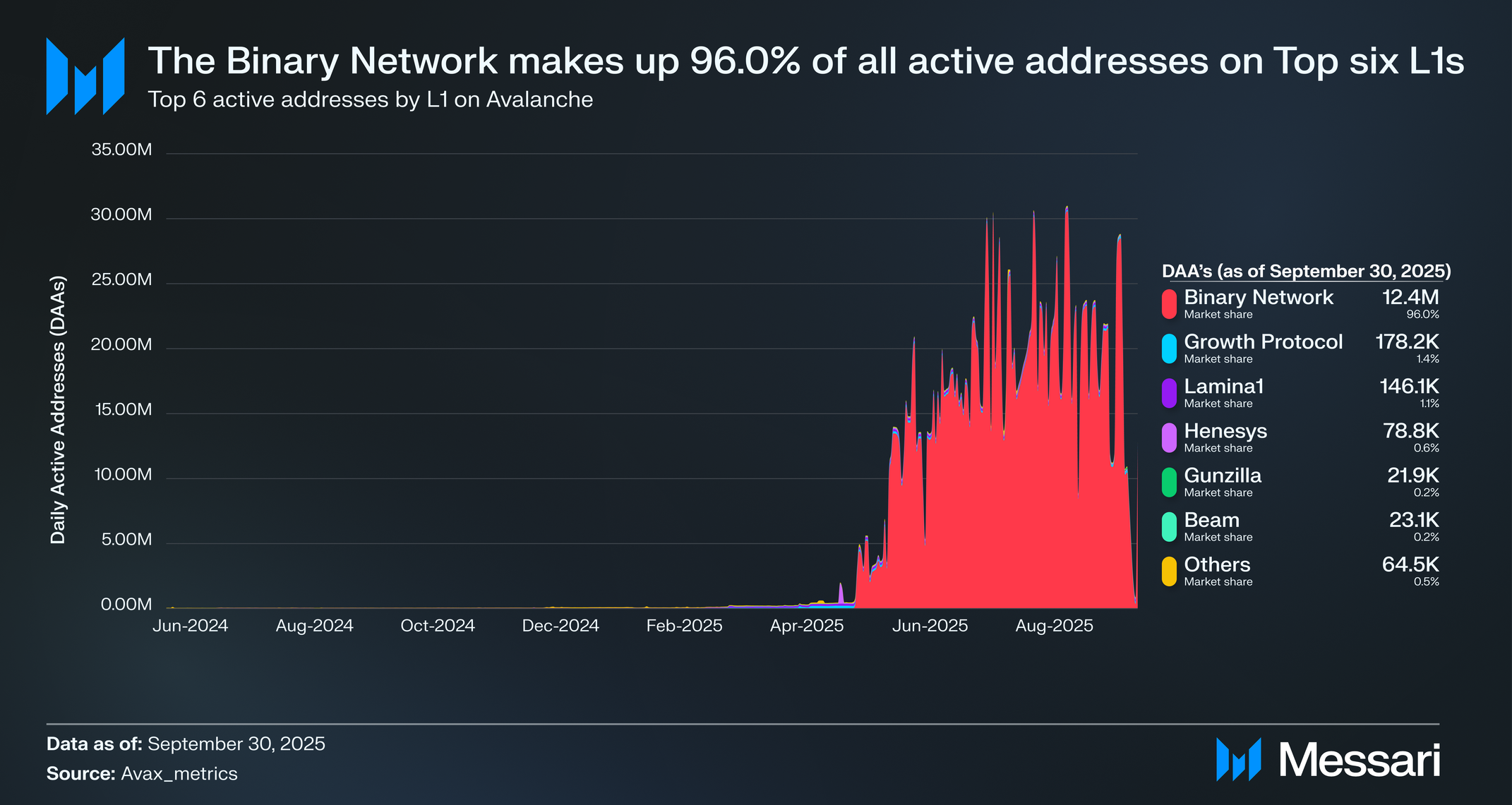
In Q3 2025, when aggregating transactions across the C-Chain and all Avalanche L1s, average daily transactions grew 136.51% QoQ to 36.5 million, up from 15.4 million in Q2’25. Over the same period, average daily active addresses (DAAs) grew by 277.0% QoQ to 19.78 million, up from 5.24 million in Q2’25. The surge in network activity was primarily driven by the launch of the Binary Network, an Avalanche L1 designed to integrate Web3 applications directly within telco and banking ecosystems across the APAC region. With access to over users through existing telco partnerships, the Binary Network significantly expanded Avalanche’s onchain activity.
Avalanche C-Chain
In Q3 2025, the USD value of the total AVAX staked increased by 42.4%, rising from $4.00 billion to $5.70 billion; however, the total AVAX staked declined QoQ from 221.4 million in Q2 to 188.9 million in Q3. The discrepancy between the USD value of the total AVAX staked and the total amount of AVAX staked can likely be attributed to the price of AVAX increasing by over 67.0% QoQ from $17.98 in Q2 to $30.01 in Q3.
Usage
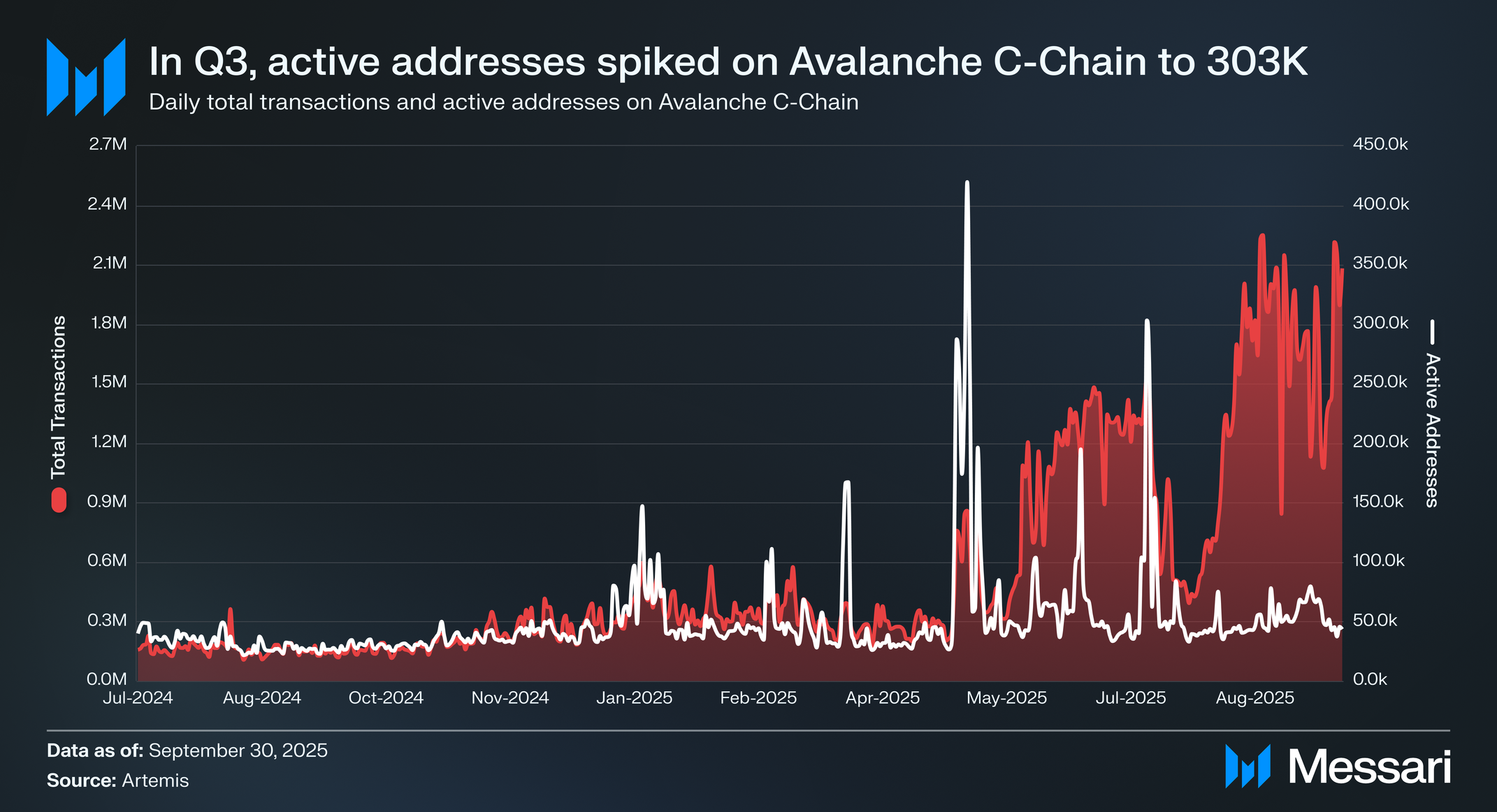
In Q3 2025, Avalanche’s C-Chain recorded mixed usage growth. Average daily transactions rose 106.3% QoQ, from 637,446 at the end of Q2 to 1.3 million at the end of Q3. However, daily active users declined, dropping 16.4% QoQ from 67,813 to 56,645. Notably, daily active addresses spiked to 303,264 on July 18, likely driven by users' increased activity during the Avalanche Summit in London and the announcement that the Detroit Pistons would bring their fan experience onchain to Avalanche with Uptop.
Security and Decentralization
Avalanche uses a Proof-of-Stake (PoS) consensus mechanism known as “Avalanche Consensus.” Avalanche’s P-Chain is responsible for validator coordination and staking operations. Both the C-Chain and X-Chain utilize the P-Chain validator set for consensus. To determine if a transaction is valid, validators on Avalanche use repeated sub-sampling voting of a minor, random subset of all validators. Consensus occurs once a sufficient majority of validators agree over consecutive rounds. Both the necessary majority and consecutive rounds are configurable. Additionally, the more tokens staked/delegated to a validator, the more influential that validator is in the consensus process.
In Q3, Avalanche’s active validator count fell 40.5% QoQ, declining from 1,436 to 855, while total staked AVAX decreased 14.7% from 221.7 million to 189.2 million. Both metrics reached their lowest levels in over a year, reflecting a notable cooldown in validator participation.
Technical Developments
Granite Upgrade
The Granite upgrade, which went live on Avalanche’s testnet on October 30, 2025, will focus on performance and usability improvements across validator operations, transaction speed, and user authentication mechanisms. The upgrade plans to implement the following ACPs:
ACP-181: This proposal modifies the way interchain message (ICM) verification is handled by stabilizing the validator set over a fixed epoch period (5–10 minutes) rather than updating it every block. By maintaining consistent P-Chain heights during each epoch, the change is intended to lower verification costs and reduce the risk of ICM message invalidation.
ACP-204: This proposal introduces support for the secp256r1 elliptic curve, enabling dApps to use biometric authentication systems such as FaceID and TouchID. This update adds compatibility for biometric-secured transactions and passwordless identity verification, providing an alternative to traditional key-based signatures.
ACP-226: This proposal allows validators to dynamically adjust minimum block times without requiring network upgrades. The modification supports sub-second block times, faster transaction confirmations, and improved responsiveness as part of Avalanche’s broader scaling roadmap, incorporating the upcoming SAE and Firewood technologies.
ACP-194: A proposal that would focus on increasing Avalanche’s capabilities to scale. Allowing blocks to be processed in parallel would increase throughput, reduce latency, and keep the network resilient during heavy load.
Firewood: An announced upgrade for Avalanche, Firewood is a next-generation database built by Ava Labs to optimize how blockchains store and manage Merkleized state. Written in Rust, it eliminates the inefficiencies of traditional key-value databases, such as LevelDB or RocksDB, by utilizing the trie structure directly on disk, enabling faster, more scalable, and compact state management.
Ecosystem Analysis
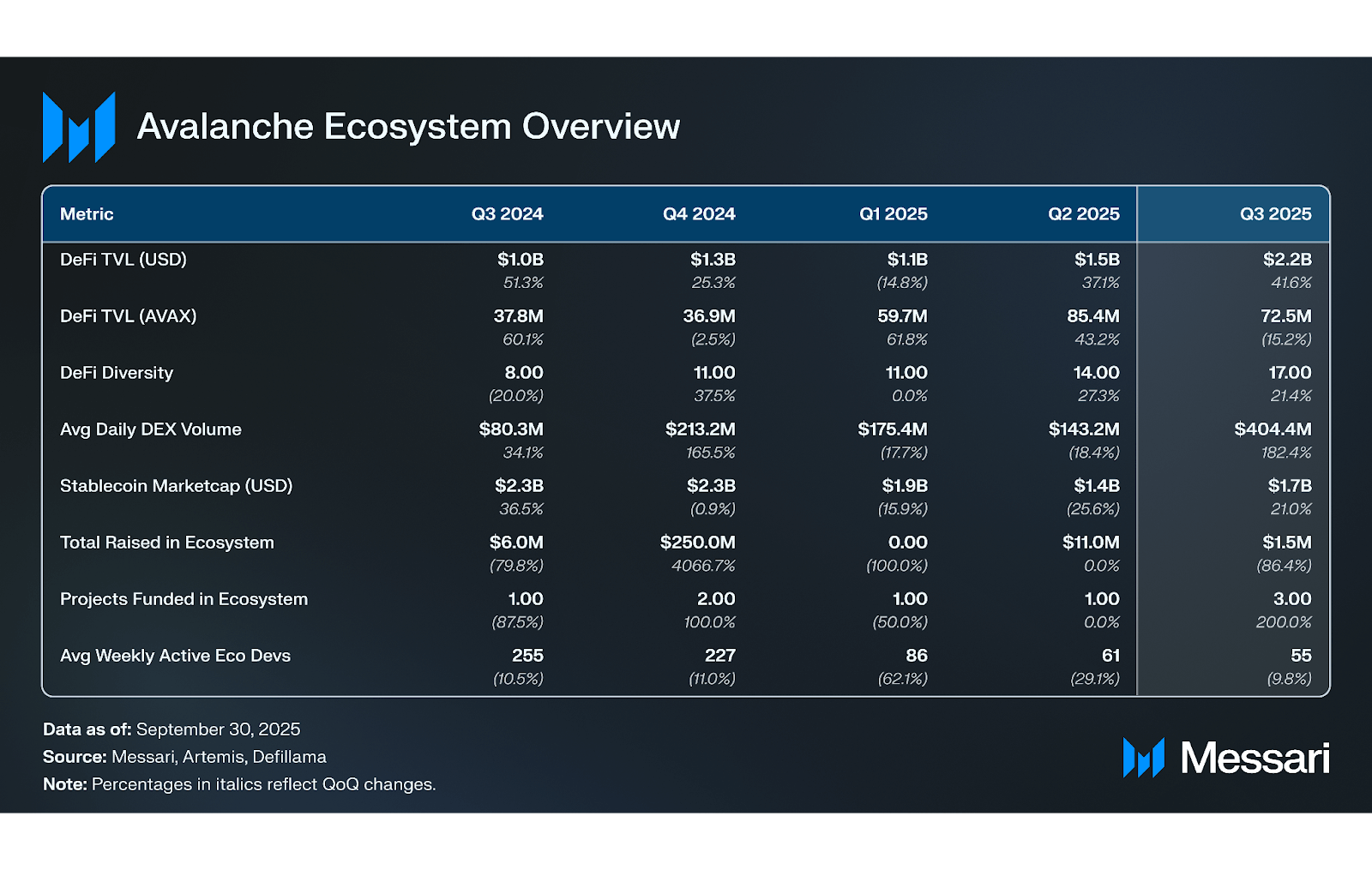
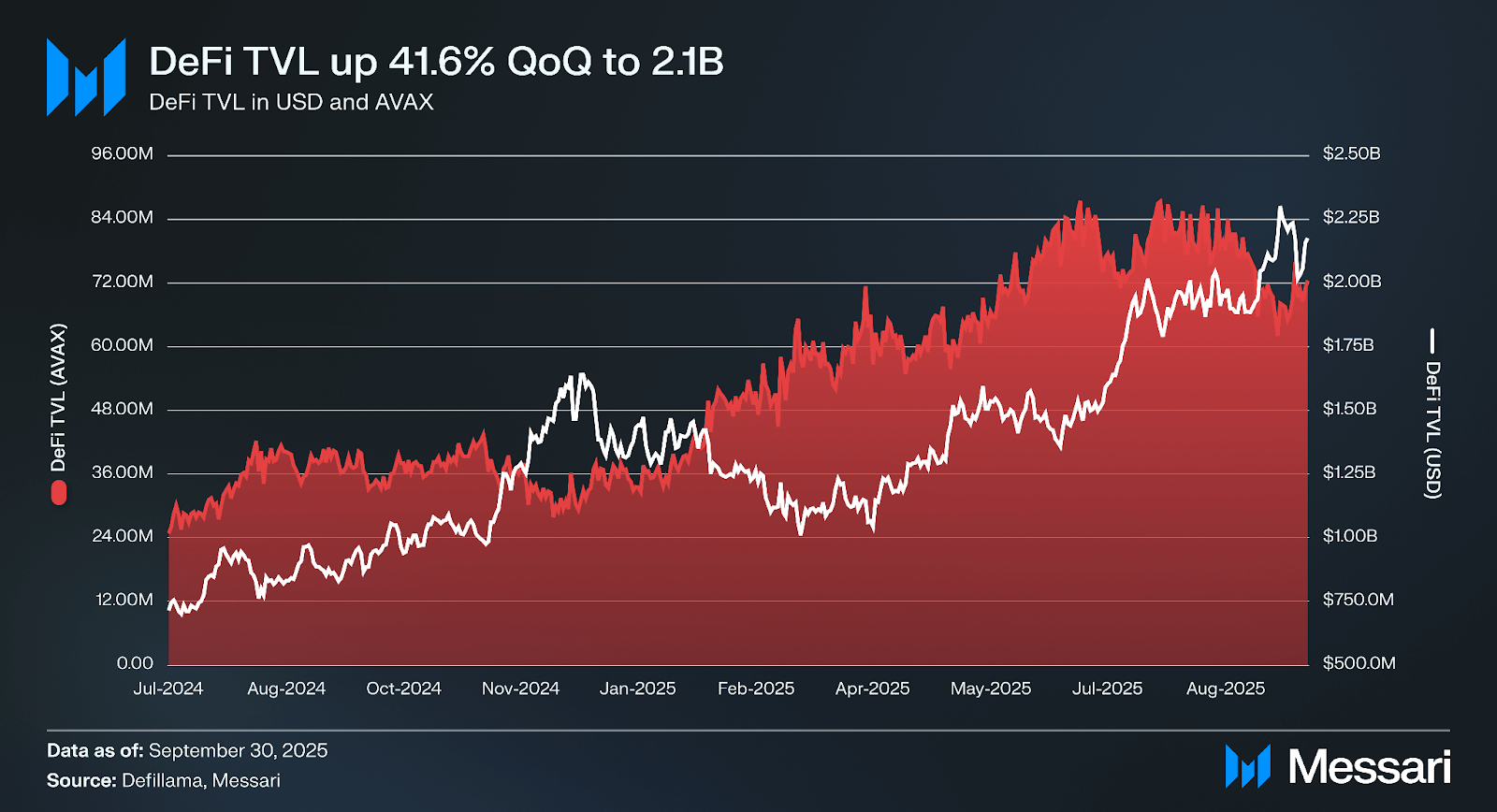
In Q3 2025, Avalanche’s DeFi ecosystem continued to diversify, with its DeFi Diversity Score rising 21.4% QoQ from 14 to 17, indicating a broader set of protocols contributing to 90% of TVL on the network. At the same time, DeFi TVL across Avalanche L1s and the C-Chain rose 41.6% QoQ from $1.53 billion to $2.20 billion, while the network’s stablecoin market cap increased 21.0% from $1.43 billion to $1.74 billion. Growth in the quarter was supported by the launch of new RWA protocols such as Grove Finance, which deployed over $250.0 million in tokenized assets on Avalanche.
DeFi
In Q3’25, Avalanche’s DeFi TVL denominated in AVAX declined 15.1% QoQ from 85.4 million to 72.4 million, reflecting reduced AVAX collateralization across protocols. The decline suggests that while capital inflows to Avalanche’s DeFi ecosystem remained healthy, much of the growth was driven by price appreciation of the AVAX token. Still, ecosystem activity remained robust, supported by new protocol launches such as Blackhole, which continue to expand Avalanche’s DeFi landscape.
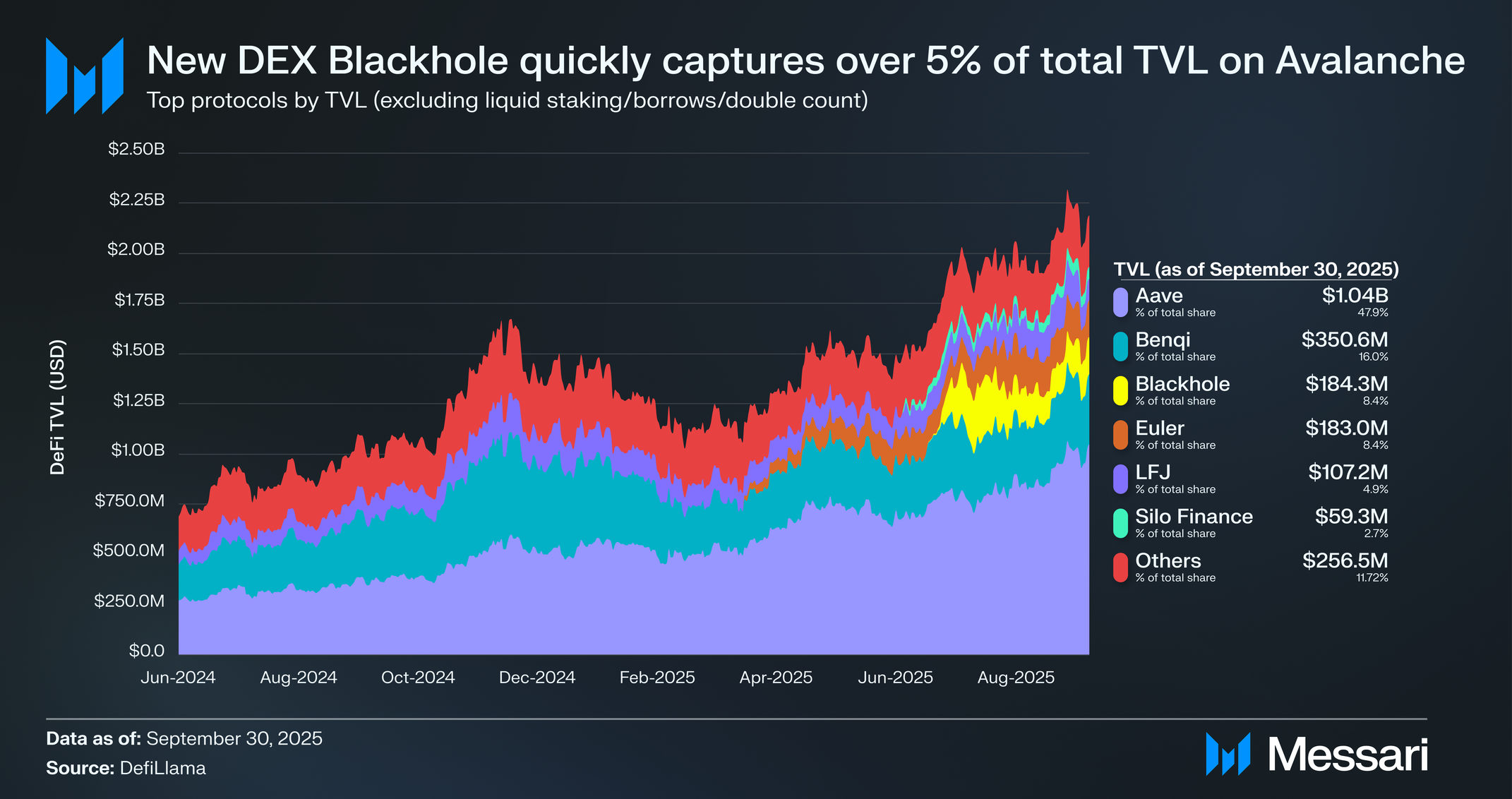
The top three protocols by TVL on Avalanche C-Chain represent over 70% of the TVL in Q3’25:
Aave: The largest protocol by TVL, saw an increase of 46.5% QoQ from $714.4 million to $1.04 billion. Additionally, Aave’s TVL dominance increased again this quarter from 46.2% in Q2 to 47.9% in Q3.
Benqi: The second-largest protocol by TVL increased 22.1% QoQ from $287.0 million to $350.6 million. By the end of Q3’25, Benqi’s TVL dominance decreased from 18.5% in Q2’25 to 16.0% marking the second quarter in a row of dominance decline.
Blackhole: The third-largest TVL protocol, Blackhole, launched in July and ended the quarter with $184.3 million in TVL, which was 8.4% of the entire TVL on Avalanche. Blackhole overtook Euler Finance, the previous holder, to secure the third spot.
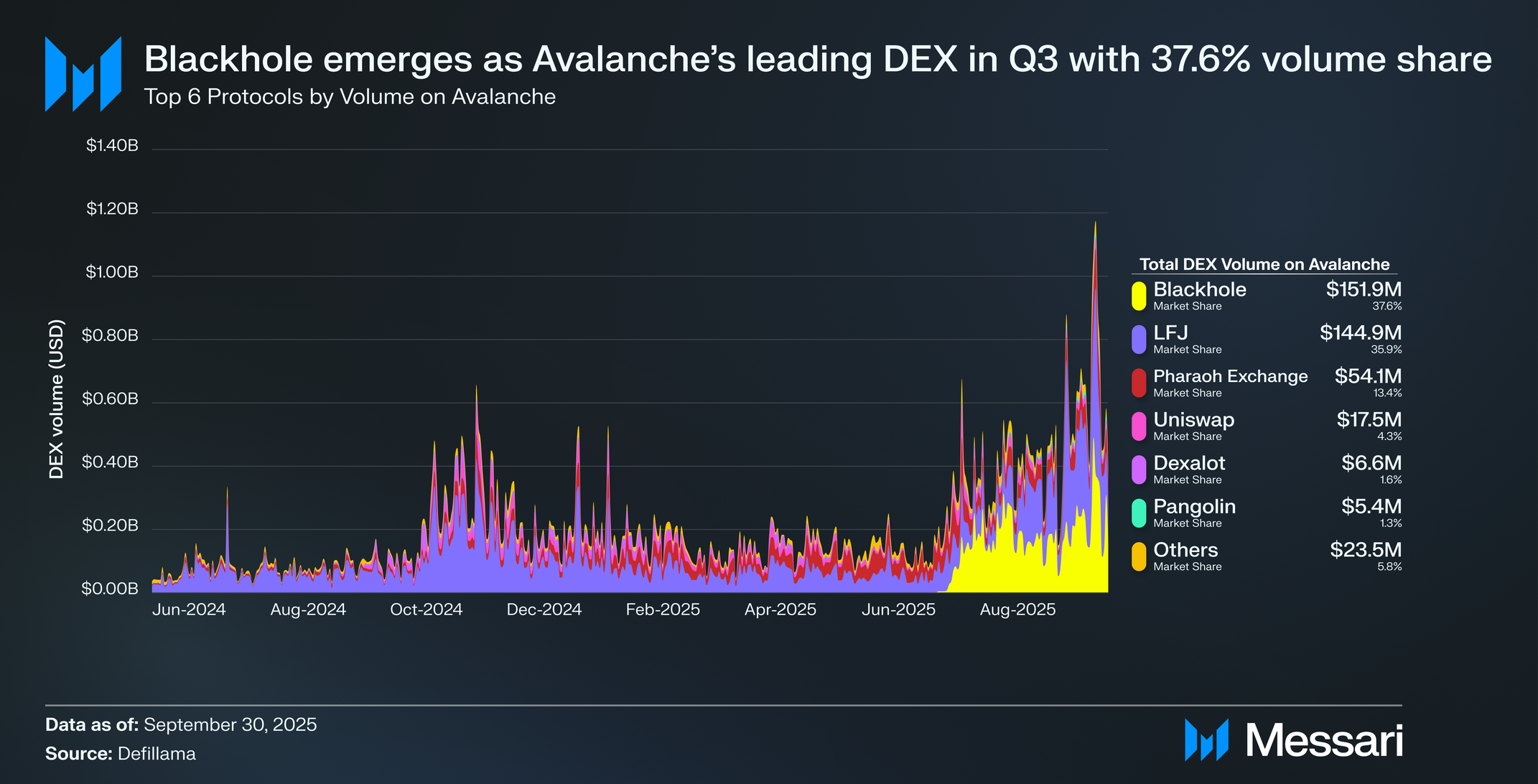
Average daily DEX volume on Avalanche’s C-Chain rose 182.4% QoQ in Q3 2025, increasing from $143.2 million to $404.4 million. Growth was primarily driven by the launch of Blackhole, which rapidly became the leading DEX on Avalanche, capturing 37.6% of total trading volume with $151.9 million in Q3. LFJ, the network’s longest-standing DEX, also recorded strong growth, with volume rising 168.2% QoQ from $54.0 million in Q2 to $144.9 million in Q3, making up 35.8% of the total volume across DEXs on Avalanche. The top five DEXs by average daily trading volume in Q3 were:
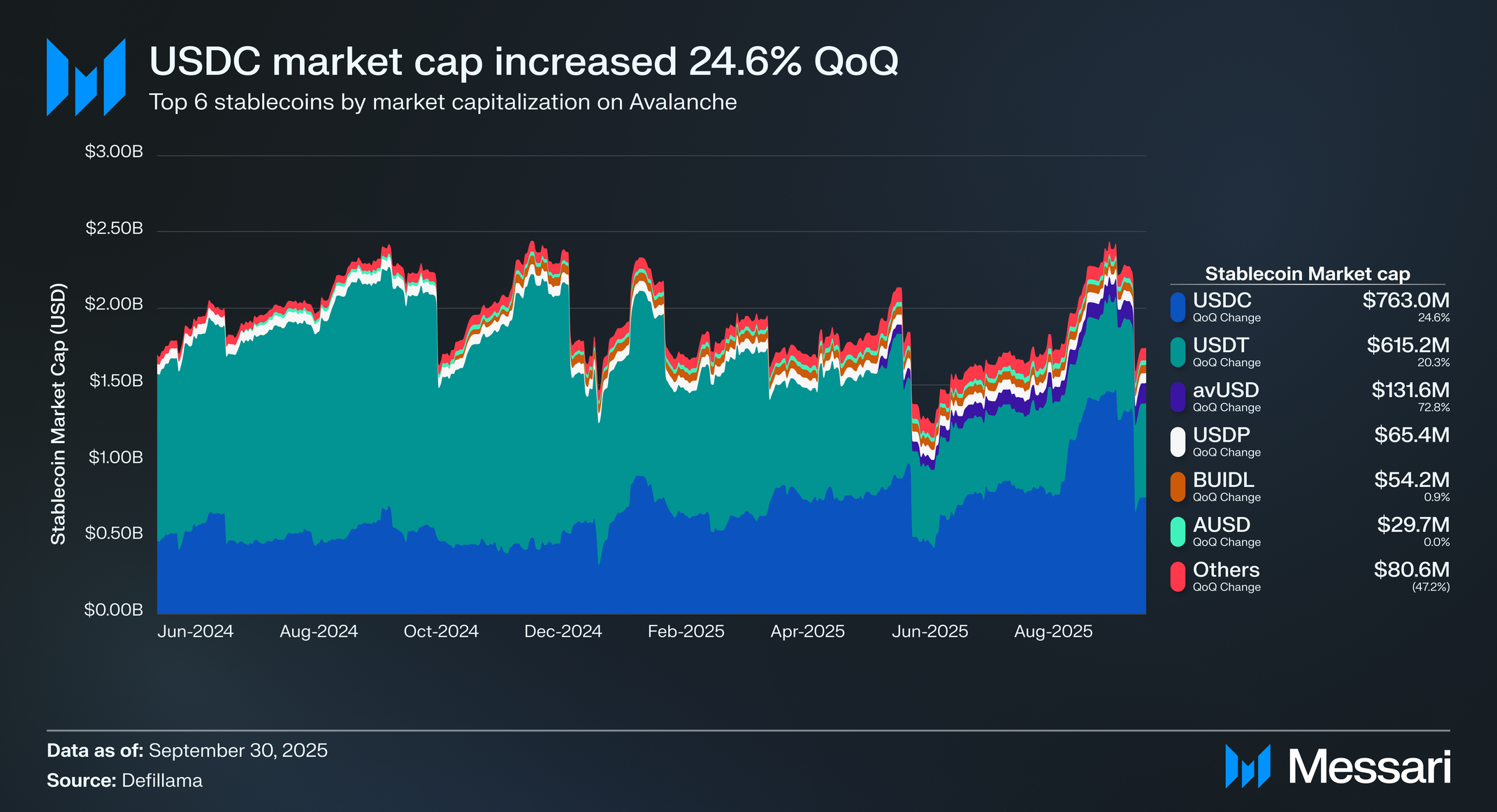
Avalanche C-Chain’s total stablecoin market cap increased 21.0% QoQ in Q3’25, climbing from $1.43 billion to $1.70 billion. Despite the growth, Avalanche underperformed other networks and fell one spot to the tenth-largest chain by stablecoin market cap, trailing Polygon. Within the Avalanche network, stablecoin composition remained largely consistent, with USDC continuing to lead at 43.8% of the total stablecoin supply at $763.0 million, up 24.6% QoQ from $612.2 million in Q2. USDT followed, representing 35.3% of the stablecoin market with $615.2 million, a 20.3% increase from last quarter’s $511.5 million in Q2.
RWA
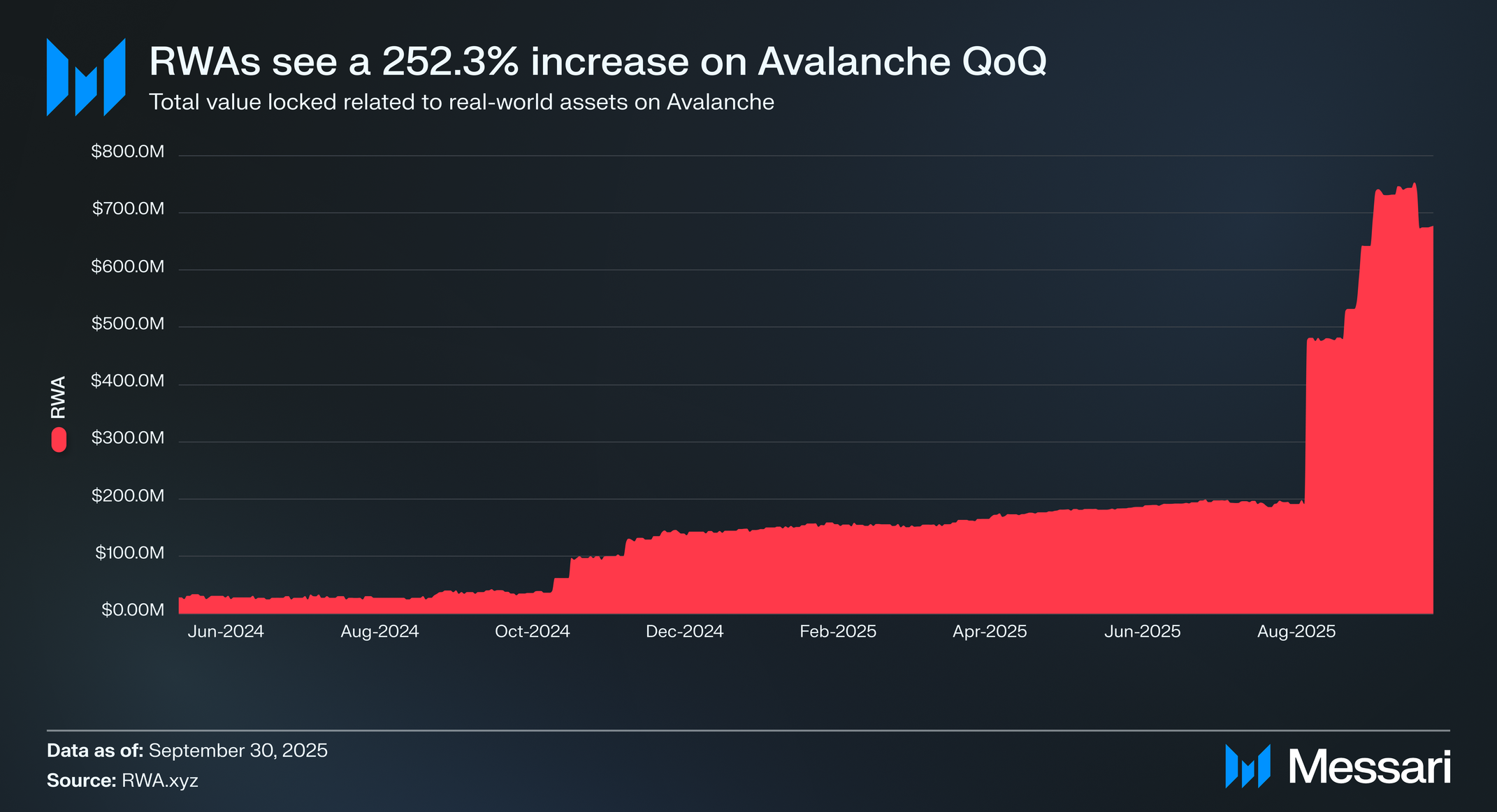
RWA TVL on Avalanche grew 252.3% QoQ, rising from $192.1 million in Q2 to $677.0 million in Q3. TVL briefly exceeded $700.0 million in mid-September before closing the quarter at $677.0 million, reflecting sustained institutional inflows throughout the period. The primary drivers for this growth were the nearly $300.0 million from SkyBridge Capital, which was tokenized by Tokeny and Apex, as well as Grove Finance’s deployment of its $250.0 million capital deployment initiative. The Grove Finance funds were deployed via Centrifuge’s tokenization infrastructure, which significantly expanded institutional participation in Avalanche’s RWA ecosystem. Following this deployment, Avalanche became the fourth-largest network by RWA TVL, underscoring its growing role in the onchain credit and institutional asset space. Notable partnerships, announcements, and developments include:
In July 2025, institutional credit protocol Grove Finance launched on Avalanche with a capital deployment strategy targeting up to $250.0 million in RWAs. Grove allocated this capital into tokenized funds such as JAAA and JTRSY through Centrifuge’s infrastructure, in collaboration with Janus Henderson, further expanding Avalanche’s institutional RWA footprint.
In August 2025, Re, a decentralized reinsurance infrastructure platform, expanded its institutional offerings on Avalanche with two new onchain yield products, reUSD (Basis-Plus) and reUSDe (Insurance Alpha), alongside the launch of the Re Points Program. The products provide compliant, fully collateralized exposure to insurance-linked yields and traditional market strategies through Avalanche’s high-performance network.
In August 2025, Dinari launched the Dinari Financial Network, a Layer-1 omni-chain orderbook built on Avalanche and powered by AvaCloud, to enable compliant, global trading of tokenized U.S. equities. The network supports dShares, 1:1-backed, programmable equities representing over 150 U.S. stocks. In October, S&P Global partnered with Dinari to launch the S&P Digital Markets 50 Index, the first benchmark to combine blockchain-native tokens and publicly traded equities in a single investable product, tokenized via dShares on Avalanche.
In August 2025, Bowmore, one of Scotland’s oldest distilleries, partnered with Avalanche to launch its first collection of tokenized whisky bottles on nft.suntory.com. Each bottle, minted as an NFT on Avalanche’s C-Chain, links physical ownership with digital proof and redemption capability. The limited release includes the Bowmore 30-Year-Old Collector’s Edition priced at $5,500 and the Bowmore 12-Year-Old priced at $180.
In August 2025, SkyBridge Capital announced that it would partner with Tokeny and the Apex Group to tokenize $300.0 million of its flagship hedge funds and deploy them on Avalanche. The initiative uses the ERC-3643 standard through Apex’s Digital 3.0 platform to modernize fund creation, issuance, and distribution.
Enterprise, ETFs, DATs, and Stablecoins
In August 2025, the State of Wyoming launched FRNT, the first U.S. state-issued stablecoin, on Avalanche during the SALT Blockchain Symposium. Fully backed by short-term U.S. Treasuries and held to a 102% reserve requirement, FRNT enables real-world payments through Rain-issued Visa cards and will soon be spendable anywhere Visa is accepted.
In August 2025, JPYC became the first licensed money transfer business in Japan authorized to issue a yen-backed stablecoin under the revised Payment Services Act. Backed 1:1 by yen held in deposits and government bonds, JPYC is classified as an electronic payment instrument and will launch on Avalanche to enable compliant cross-border payments, DeFi participation, and digital commerce using a fully regulated, onchain yen.
In September 2025, Kite AI raised $18.0 million from investors including the Avalanche Foundation, PayPal, and General Catalyst. The project is developing a Layer-1 network designed to enable autonomous agents to authenticate, transact, and coordinate securely without the need for intermediaries. The funding will support the build-out of infrastructure for an emerging agentic internet, with a focus on native stablecoin payment systems and secure agent-to-agent coordination.
In September 2025, Avalanche and Toyota Blockchain Lab unveiled plans for the Mobility Orchestration Network (MON), a blockchain-based infrastructure designed to power autonomous robotaxi fleets and tokenized mobility services. MON enables secure data sharing for financing, ride sharing, insurance, and carbon tracking.
In September 2025, Mirae Asset Global Investments, South Korea’s largest asset manager with $316.00 billion AUM, signed a memorandum of understanding (MOU) with Ava Labs to explore tokenized funds on Avalanche. The collaboration will pilot the funding of tokenization to enhance investor reporting, distributions, and transfer operations.
In September 2025, Multiple initiatives were announced related to South Korea’s stablecoin market advancement. Companies like Woori Bank’s KRW1, INEX’s onchain merchant settlement pilot, and Danal Fintech’s regulatory-compliant L1 all leverage Avalanche’s infrastructure to deliver programmable, bank-backed KRW stablecoins designed for real-world payments and financial applications.
In September 2025, Avalanche further strengthened its position as a trusted infrastructure for South Korea’s digital economy. WeBlock partnered with Ava Labs to co-develop RWA and stablecoin frameworks, while NHN Cloud began offering finance-grade validator services, enabling banks and government agencies to operate Avalanche networks with full compliance and enterprise-level reliability.
In September 2025, Avalanche Treasury Co. (AVAT) announced a $675 million merger with Mountain Lake Acquisition Corp., marking one of the largest crypto-focused SPAC transactions to date. The deal includes $460.0 million in projected treasury funding and a $200.0 million discounted AVAX purchase allocation through the Avalanche Foundation, with an 18-month priority window for future treasury sales. The merged entity is expected to trade on Nasdaq in early 2026 and aims to grow its digital asset treasury to exceed $1.00 billion. AVAT plans to serve as a public institutional vehicle for AVAX exposure, deploying capital into protocol investments, validator infrastructure, and ecosystem partnerships.
In September 2025, AgriFORCE Growing Systems rebranded as AVAX One, launching a $550.0 million fundraising initiative to acquire and stake AVAX tokens, becoming the first Nasdaq-listed company dedicated to Avalanche’s ecosystem. Backed by Hivemind Capital and Anthony Scaramucci, who will co-lead the advisory board with Coinbase Institutional’s Brett Tejpaul, AVAX One plans to accumulate over $700.0 million in AVAX holdings and expand into fintech and insurance acquisitions on Avalanche.
Gaming and others
In July 2025, Akave launched on Avalanche. Akave is a decentralized physical infrastructure (DePIN) protocol. Akave launched its Akave cloud, the first decentralized data layer deployed on an Avalanche L1. Designed for decentralized AI, decentralized physical infrastructure network (DePIN), and enterprise Software as a Service (SaaS), Akave enables encrypted, programmable, and verifiable storage.
In July 2025, Uptop announced the expansion of its fan rewards and loyalty program to the NBA’s Detroit Pistons. This marks the second addition to the fan rewards program, following the Cleveland Cavaliers' inaugural edition earlier this year.
In July 2025, Youmio selected Avalanche as its preferred platform for building its chain of AI agents. Youmio will create an L1 on Avalanche built to be the world’s leading agent chain, supporting intelligent software agents as core network participants. The chain introduces foundational infrastructure that enables autonomous agents to operate across various apps, games, and digital environments.
In August 2025, Suzaku, a restaking protocol built on Avalanche, launched to help new Avalanche L1s decentralize and secure their validator networks. Suzaku connects L1s, node operators, and stakers in a permissionless model, allowing projects to scale decentralization at their own pace.
In August 2025, Uptop continued its growth with Avalanche by partnering with LSU Athletics to launch Geaux Rewards, a fan engagement and loyalty program built on the Avalanche platform. The initiative marks Uptop’s first entry into collegiate sports and expands Avalanche’s presence in consumer-facing rewards infrastructure.
In August 2025, Helika, in partnership with Avalanche, launched a joint gaming accelerator program to support studios building blockchain-integrated games. The three-month program offers up to $150,000 in funding, mentorship from industry experts, analytics tools, and technical integration support for teams developing on Avalanche.
In August 2025, Gunzilla began its migration from testnet to its Gunz L1, marking a key milestone in the platform’s shift toward onchain asset ownership. The first 21,000 users were transitioned from testnet, with plans to eventually migrate all 16.8 million wallets. Mainnet activity reached over 413,000 in-game asset decodings and is supported by more than 10,000 active validator NFTs securing the network. Alongside these developments, its flagship game Off The Grid is set to launch on Steam.
In August 2025, EXIT Festival and Tixbase expanded their partnership on Avalanche to launch the Bridge Festival App, introducing onchain ticketing, payments, and fan engagement tools.
In August 2025, the Avalanche Foundation announced the second cohort of Retro9000 grantees, awarding over $250,000 in retroactive funding to eight projects building Avalanche Layer 1s and developer tooling. The selected teams include Artery Chain, CodeNekt, Tixbase, zeroone, NUMINE, Letsbuyhealthcare, Bango, and Quboid. The program, backed by a $40.0 million pool, rewards builders who deliver measurable onchain impact.
In August 2025, Suzaku raised $1.5 million through seed funding, public sales, and grants to expand its validator infrastructure network. Suzaku offers restaking and validator management tools that facilitate the transition of L1s from permissioned to permissionless systems.
In September 2025, Particle Network announced the launch of the Particle Chain on Avalanche, introducing a universal transaction layer that unifies users, liquidity, and applications across Web3. The new Layer 1 enables Universal Accounts, allowing users to transact, pay gas, and interact across chains with a single balance and login.
In September 2025, Titan Content launched 2GATHR, a fan engagement app built on the TITAN platform. The platform lets fans of K-pop group AtHeart earn collectibles, complete missions, and engage directly with artists through blockchain-verified interactions.
Avalanche L1s
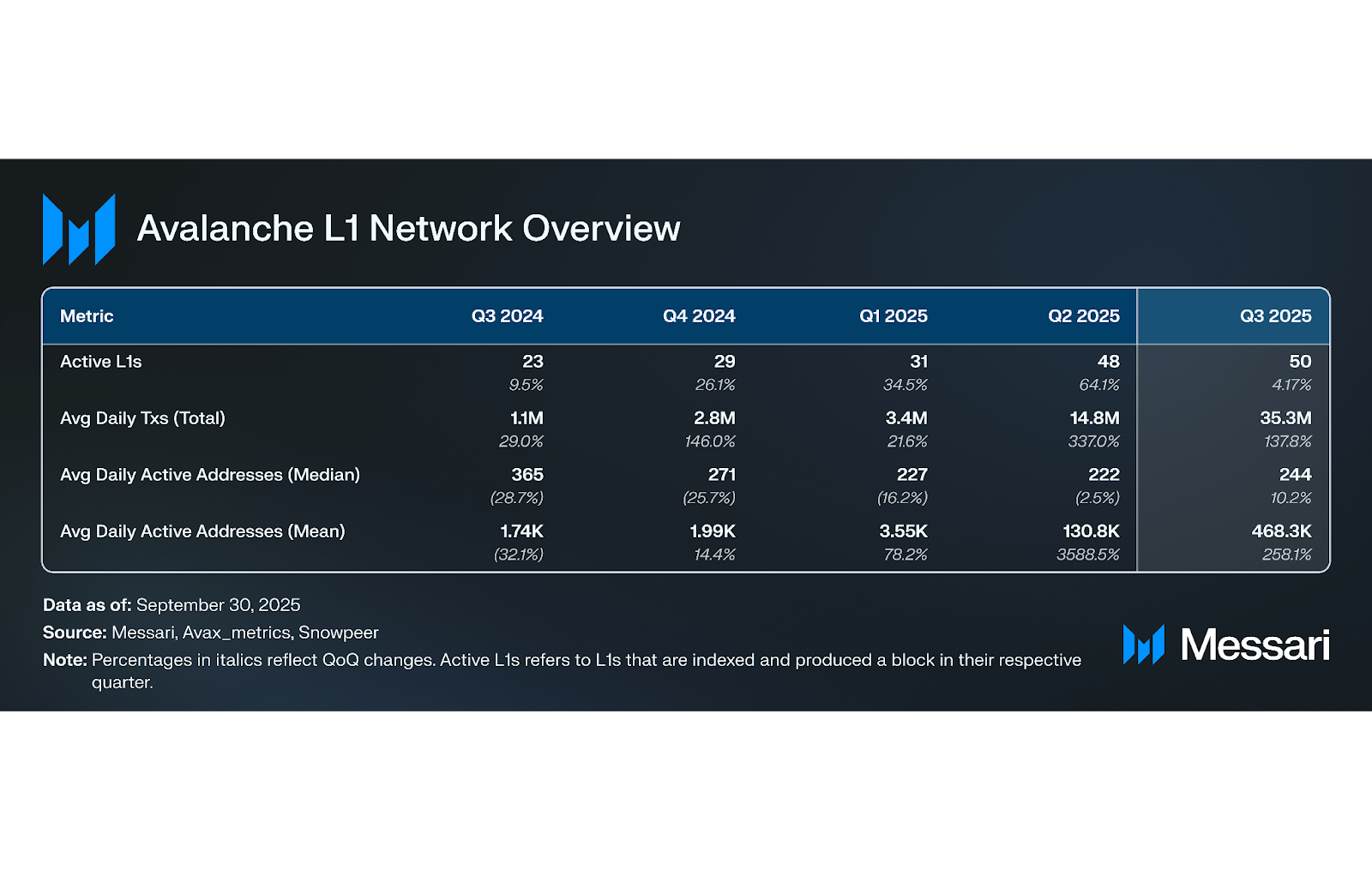
In Q3, Avalanche continued to support an active L1 ecosystem, increasing the number of L1s by 4.17% QoQ from 48 to 50. Notable launches included institutional L1s such as Dinari and Hashfire.
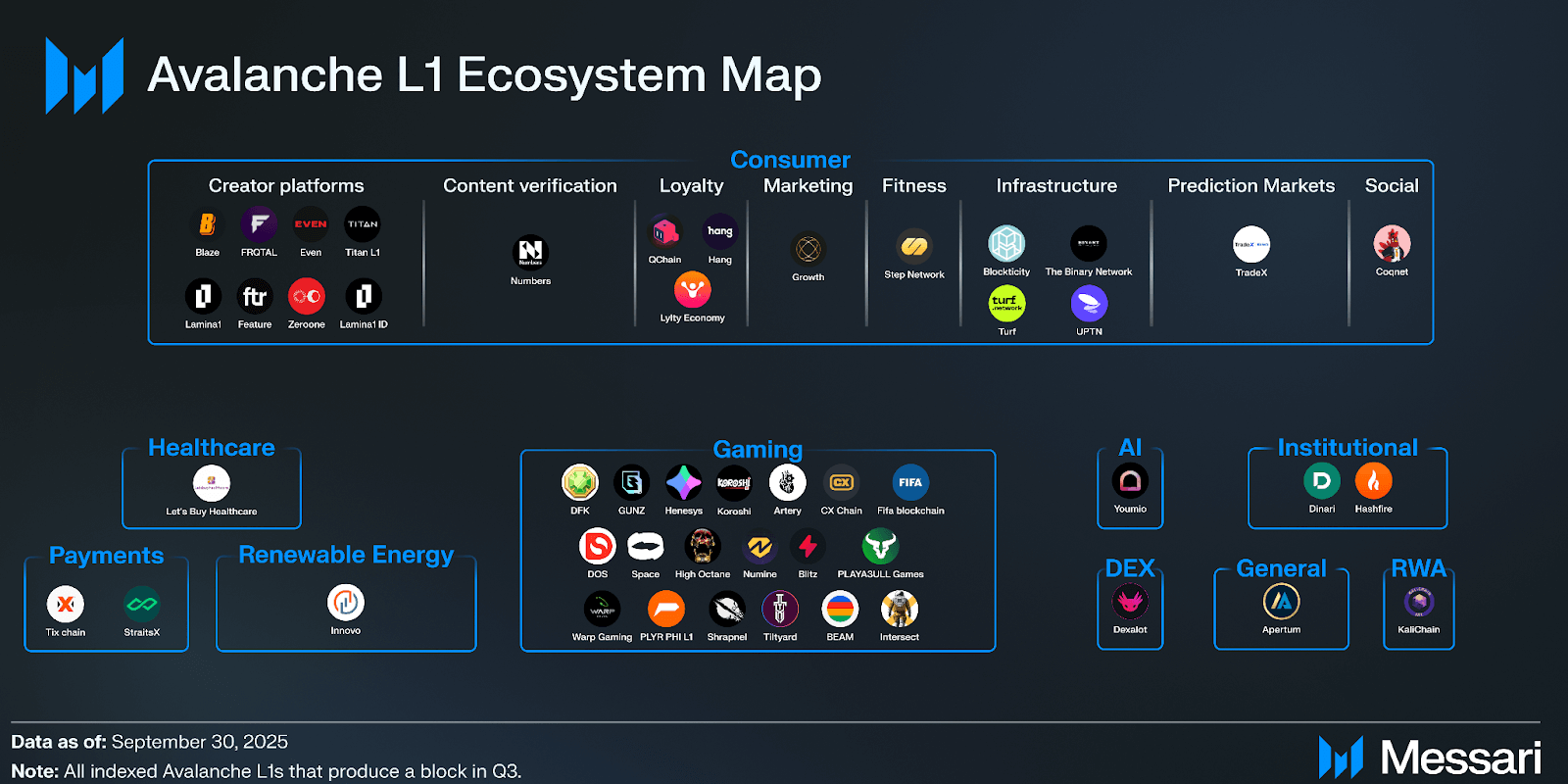
There were 50 indexed Avalanche L1s that produced a block in Q3 2025.
In Q3’25, over eight new L1s were indexed, launched, and produced a block:
Dinari: Dinari is a regulated tokenization platform that has launched its Dinari Financial Network, an L1 blockchain built on Avalanche, to enable omni-chain liquidity and compliant settlement for tokenized U.S. equities. Dinari allows investors to access, trade, and settle U.S. securities 24/7 with institutional-grade compliance.
Hashfire: Hashfire is an enterprise-grade infrastructure platform built on an Avalanche-based subnet that automates agreement workflows, embeds payment logic into contracts, and enables near-instant vendor payments using state-issued stablecoins. The protocol underpinned Wyoming Stable Token (FRNT)’s pilot on Avalanche.
Let’s Buy Health: An Avalanche L1 purpose-built to provide individuals a fast and affordable way to access and prepare for the cost of private healthcare.
Turf: Turf Network is a data infrastructure L1 that serves as a real-time “intelligent data layer,” enabling AI systems, Web3 applications, and decentralized protocols to pull the exact datasets they need.
Warp Gaming: Warp Gaming is a Web3 game publisher and accelerator that discovers and supports emerging studios, helping them scale through blockchain-enabled infrastructure and shared economic models.
Youmio: Youmio is the first L1 blockchain purpose-built for AI agents. It enables verifiable, autonomous agents to operate across apps, games, and digital environments, anchoring trust, privacy, and composability in the emerging agent economy.
Hang: Hang is a dedicated Avalanche L1 purpose-built to modernize customer engagement and loyalty. By unifying data, AI personalization, and onchain transparency, Hang enables brands to run verifiable, automated promotions across partner ecosystems while maintaining full control over customer data and privacy.
The Binary Network: An L1 that focuses on integrating Web3 applications directly with telco and banking ecosystems within the APAC region.
Transactions
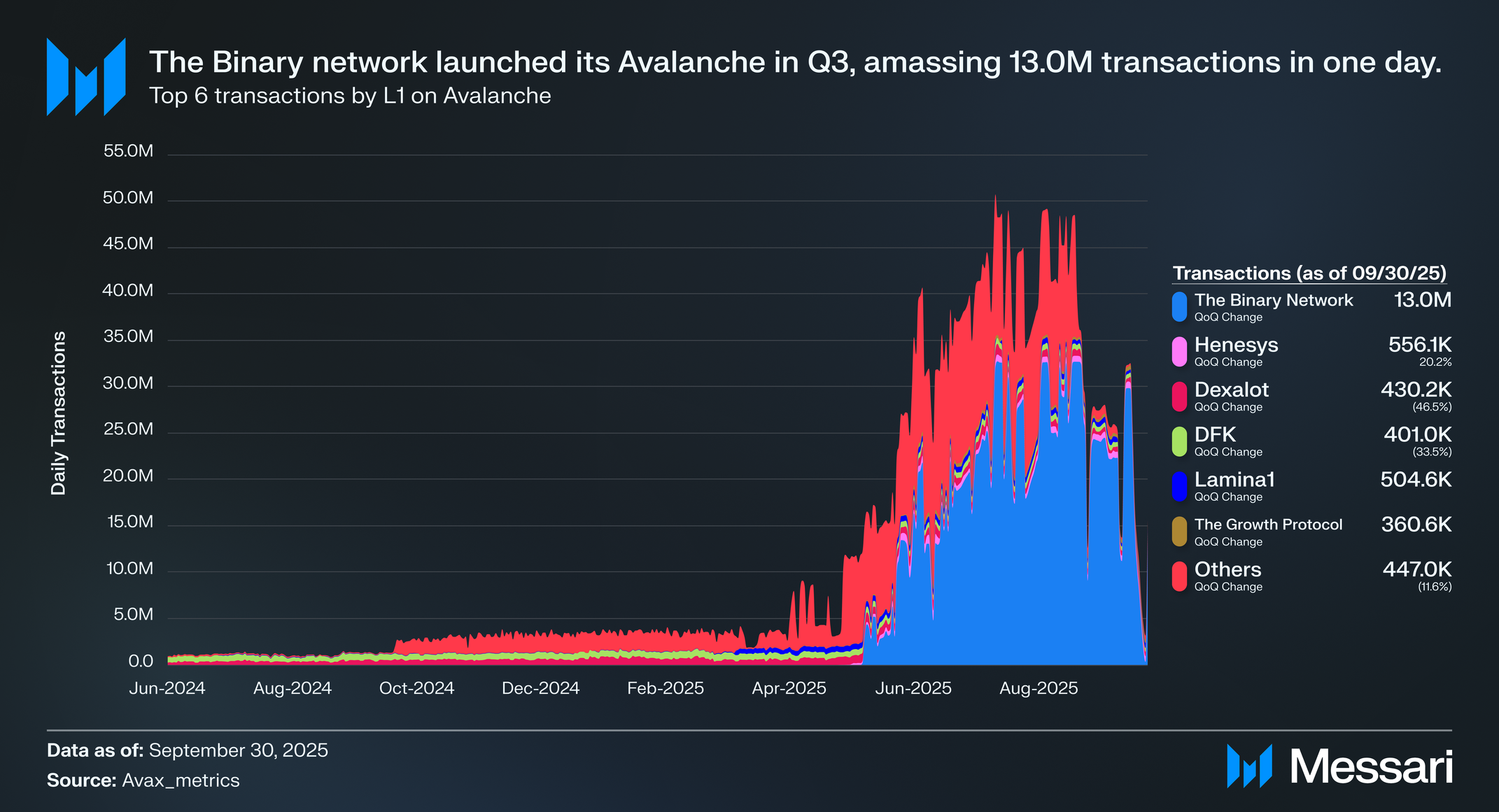
In Q3 2025, Avalanche L1s exhibited varied transaction trends. The Binary Network dominated activity, accounting for 82.4% of total L1 transactions with over 13.0 million transactions by quarter-end. Binary’s rapid traction stemmed from its established telecom partnerships and existing user base, which migrated onto its new Avalanche L1 at launch. In contrast, Dexalot activity declined 46.5% QoQ, from 804,114 transactions in Q2 to 430,171 in Q3, while the Henesys L1 recorded a 20.2% QoQ increase, rising from 462,636 in Q2 to 556,099 in Q3.
556,099 in Q3..
Active Addresses
Daily active addresses (DAAs) across Avalanche L1s rose significantly in Q3’25, with the average DAA increasing 258.1% QoQ from 130,768 to 468,294. The largest L1 by active addresses was The Binary Network, which accounted for 96.0% of the total active addresses on Avalanche L1s.
Closing Summary
Avalanche recorded a strong rebound in Q3 2025, posting broad-based growth across core network and financial metrics. Market capitalization rose 67% QoQ from $7.6 billion to $12.7 billion, while DeFi TVL increased 41.6% to $2.2 billion. The launch of two AVAX DATs, collectively targeting over $1.0 billion in AVAX accumulation, marked a significant development in institutional participation and treasury infrastructure. These trends reflect the growing traction of Avalanche’s ecosystem strategy, particularly across DeFi and real-world asset verticals. Entering Q4, Avalanche’s strengthened fundamentals and expanding institutional engagement position it for continued growth heading into the year-end.
This report was commissioned by Ava Labs. All content was produced independently by the author(s) and does not necessarily reflect the opinions of Messari, Inc. or the organization that requested the report. The commissioning organization may have input on the content of the report, but Messari maintains editorial control over the final report to retain data accuracy and objectivity. Author(s) may hold cryptocurrencies named in this report. This report is meant for informational purposes only. It is not meant to serve as investment advice. You should conduct your own research and consult an independent financial, tax, or legal advisor before making any investment decisions. Past performance of any asset is not indicative of future results. Please see our Terms of Service for more information.
No part of this report may be (a) copied, photocopied, duplicated in any form by any means or (b) redistributed without the prior written consent of Messari®.
Gunkan is a Research Analyst at Messari with a focus on gaming, DeFi, and memecoins. He began working in crypto in 2022, with prior experience at Crypto.com and Cointelegraph.
Gunkan is a Research Analyst at Messari with a focus on gaming, DeFi, and memecoins. He began working in crypto in 2022, with prior experience at Crypto.com and Cointelegraph.