State of ApeCoin Q2 2024

Key Insights
- ApeCoin DAO committed $7.8 million to fund governance proposals in Q2’24, a 47% QoQ decrease in funding.
- AIP-395, accounting for 35% of committed funds, awarded $2.8 million to D3 to acquire and manage rights to a ".APE" top-level domain (TLD) for ApeCoin DAO.
- The APE market cap and token price dipped by 51% QoQ, in line with the general market decline in Q2.
- The APE daily average token transfer volume and average DEX swap size declined by 50% QoQ after a slight recovery in Q1.
- Q2’24 was an election quarter for ApeCoin DAO as Two Special Council members (one new) and four new Stewards were elected into respective working groups.
Primer
ApeCoin (APE) is an ERC-20 token used to govern the ApeCoin DAO, encompassing Ecosystem Fund distribution, governance rules, partnerships, and more.
APE is the adopted token of the APE Foundation, a legal entity that administers the decisions of the ApeCoin DAO. The APE Foundation also has a Special Council, called the DAO’s Board, to perform certain functions within the governance process. The operations of the APE Foundation are run by transient administrative entities elected by members of the ApeCoin DAO.
The ApeCoin DAO and the APE Foundation are separate entities from Yuga Labs, the Bored Ape Yacht Club (BAYC) creator, and associated NFTs. Below is a breakdown of the relevant entities related to the APE token.
- ApeCoin DAO — A decentralized autonomous organization (DAO) made up of APE holders that create and vote on AIPs.
- APE Foundation — A legal entity that administers the decisions of the ApeCoin DAO.
- Special Council (the DAO’s Board) — Five individuals who oversee the APE Foundation’s administrators, can approve grants outside the AIP process, and perform certain functions within the ApeCoin DAO governance process. The current Special Council members are Bored Ape G, Waabam, mo_ezz14, Hazel, and Airvey.
- WebSlinger — Current administrator of the APE Foundation.
- Yuga Labs — A Web3 company responsible for creating the Bored Ape Yacht Club (BAYC). Yuga Labs contributes to ApeCoin and plans to use APE as the primary token in future projects like Otherside.
The APE Foundation, the DAO’s Board, and WebSlinger are the primary entities that ensure the implementation of relevant passed ApeCoin DAO proposals (AIPs).
Website / X (Twitter) / Snapshot
Key Metrics
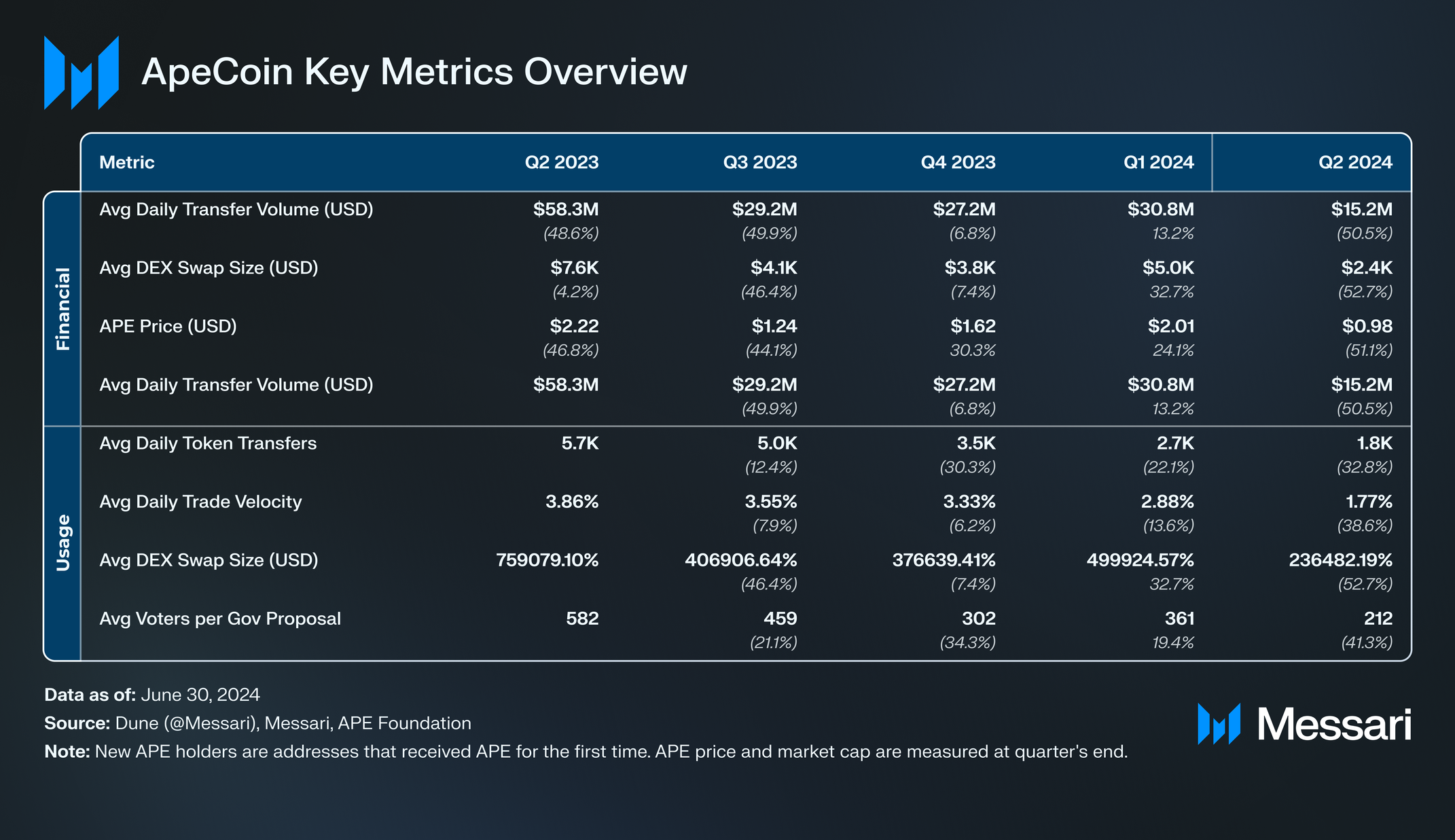
Performance Analysis
Market Cap
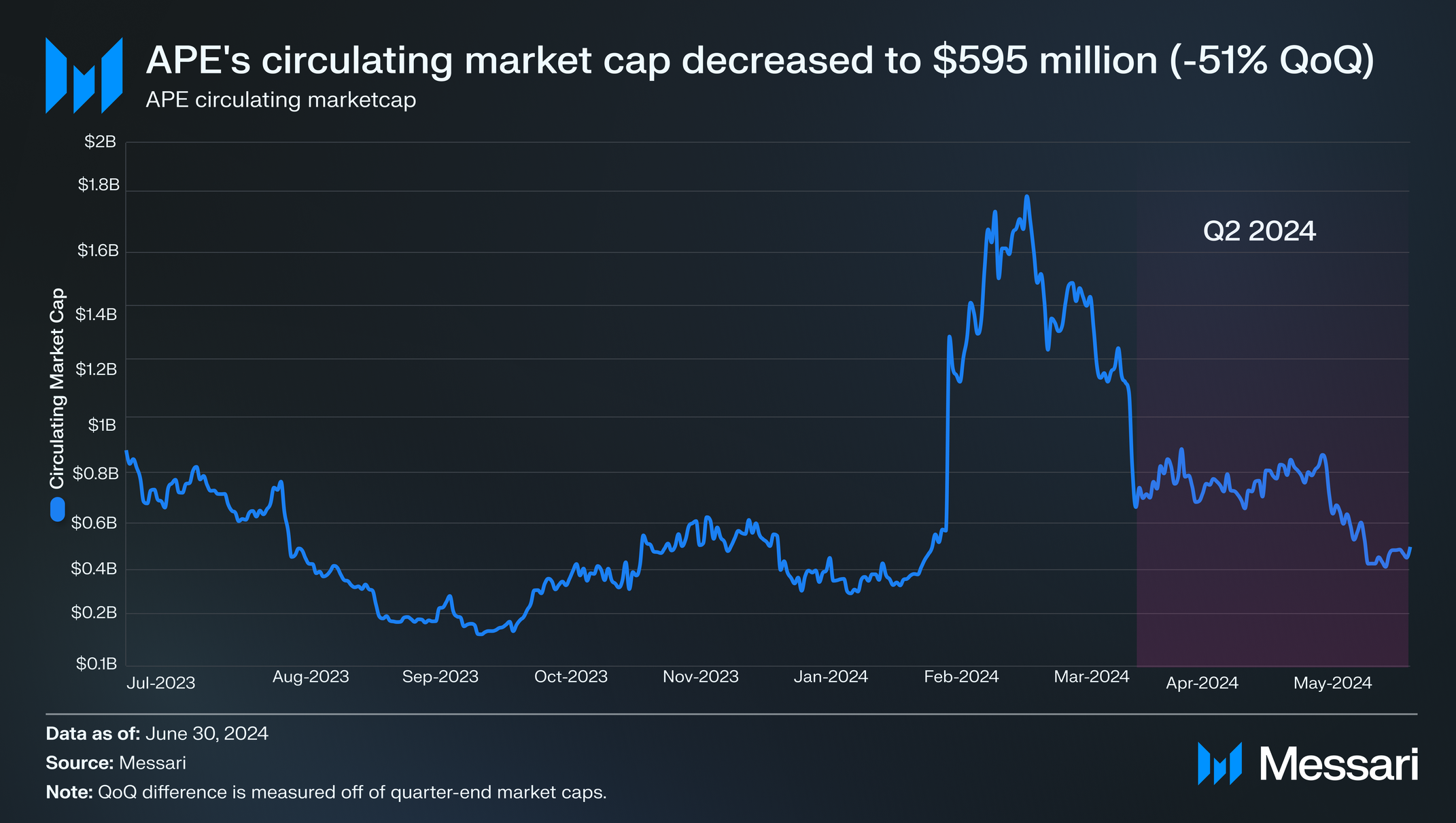
In Q2’24, APE's market capitalization declined 51% QoQ. After peaking at nearly $1.7 billion in March, it fell below the $1 billion market cap floor for the first time in 2024. This followed a period of growth for the overall crypto market from Q2 2023 to Q1 2024. However, broader market corrections in the face of an overall Q2’24 market decline contributed to APE’s market cap decline. The unlock of 48.6 million APE tokens in Q2 increased sell pressure, potentially adding to the downward price movement throughout the quarter.
APE Liquid Supply
Liquid supply curves help determine when an increase in sell pressure may occur for certain assets (or when tokens may get dumped onto unsuspecting buyers). Specifically, they show when tokens unlock and to whom.
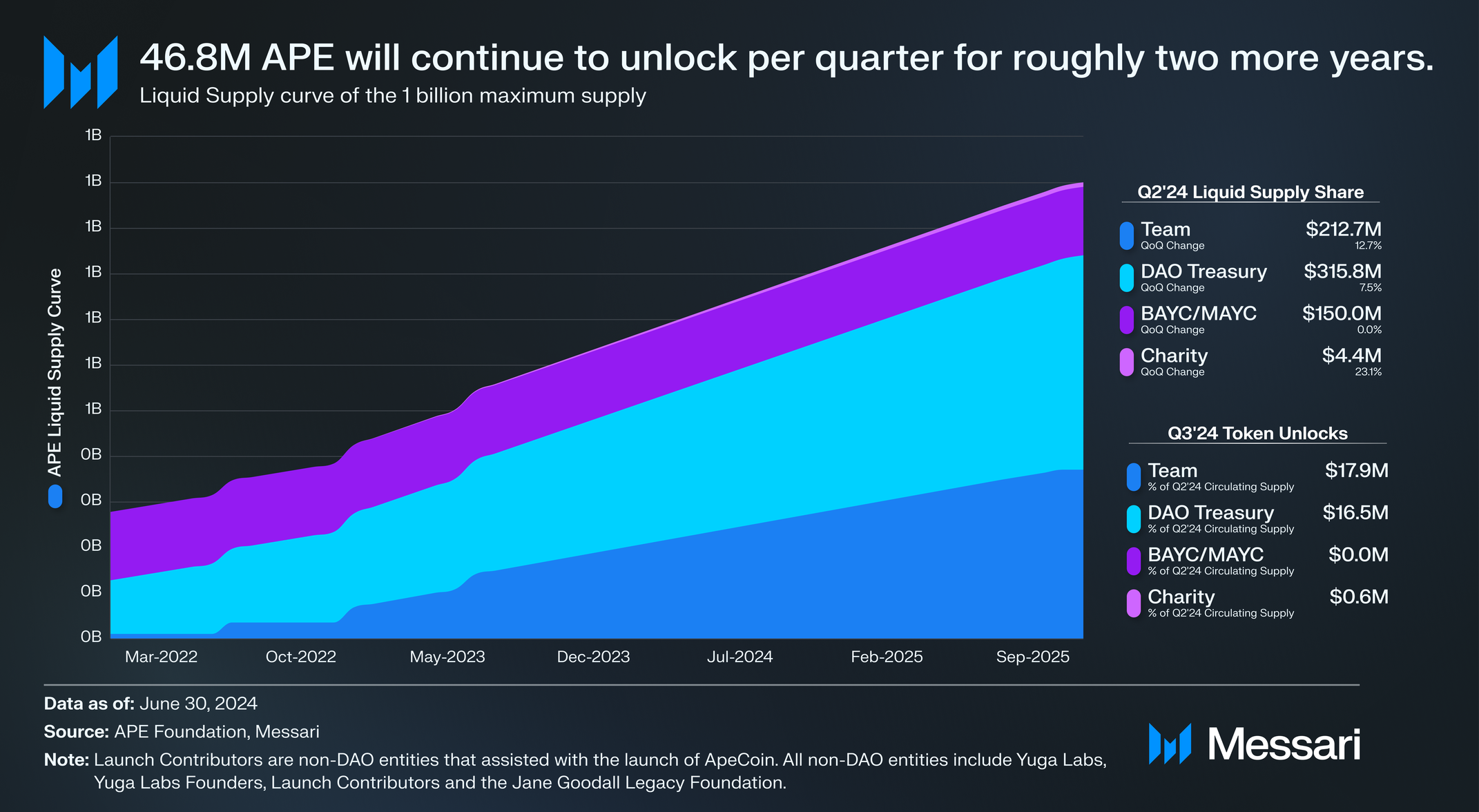
An additional 46.8 million APE (7.4% of the Q1 circulating supply) was unlocked in Q2’24. Of this, 22 million APE went to the DAO Treasury, and 25 million APE went to non-DAO entities. The DAO plans to issue or sell APE to fund DAO proposals contingent on them being passed. Alternatively, non-DAO entities are free to sell once their funds are unlocked. In Q2’24, roughly $7.8 million (7.9 million APE at $0.98/APE) was committed to passed proposals. As of the quarter’s end, 68.3% of the maximum supply (683 million APE) was in circulation, up 7.4% QoQ.
Claimed Staking Rewards
ApeCoin DAO started issuing staking rewards in Q4’22 after passing AIP-21 and AIP-22, which finalized staking parameters. APE holders and Yuga Labs’ ecosystem projects like Bored Ape Yacht Club (BAYC), Mutant Ape Yacht Club (MAYC), and Bored Ape Kennel Club (BAKC) received staking allocations.
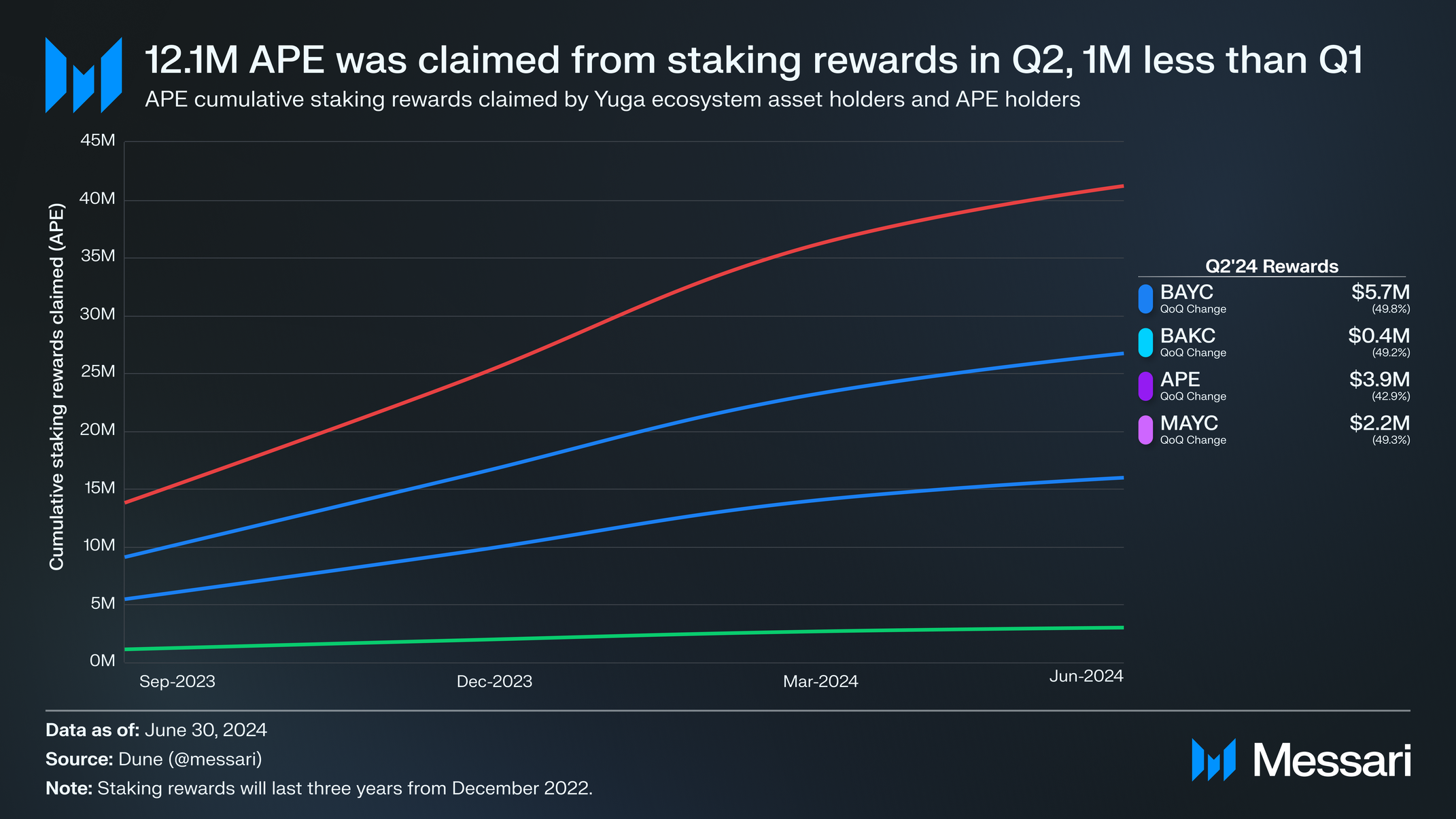
Staking was implemented in early December 2022 and will last for three years. It will ultimately distribute 175 million APE (17.5% of the max supply) to holders of Yuga ecosystem assets and APE tokens. Due to the emissions curve, the amount of APE claimed has decreased every quarter. In Q2, 12.1 million APE was claimed, 7.6% less than the previous quarter. This trend will continue until December 2025.
Claimed APE compounds the selling pressure from unlocks to non-DAO entities and governance commitments. Along with the APE price decreasing by 51% QoQ, transfer volume and the average APE swap size also declined by 50% QoQ, respectively. These movements signal less trading and peer-to-peer activity with the APE token.
Volume by Trade Size
Volume by trade size shows the percentage of the trading volume corresponding to various trade sizes. For example, if the total volume were $200 million and two wallets traded $50 million each (a total of $100 million), then the two wallets with a volume of $50 million each (a combined $100 million) would account for 50% of the trading volume.
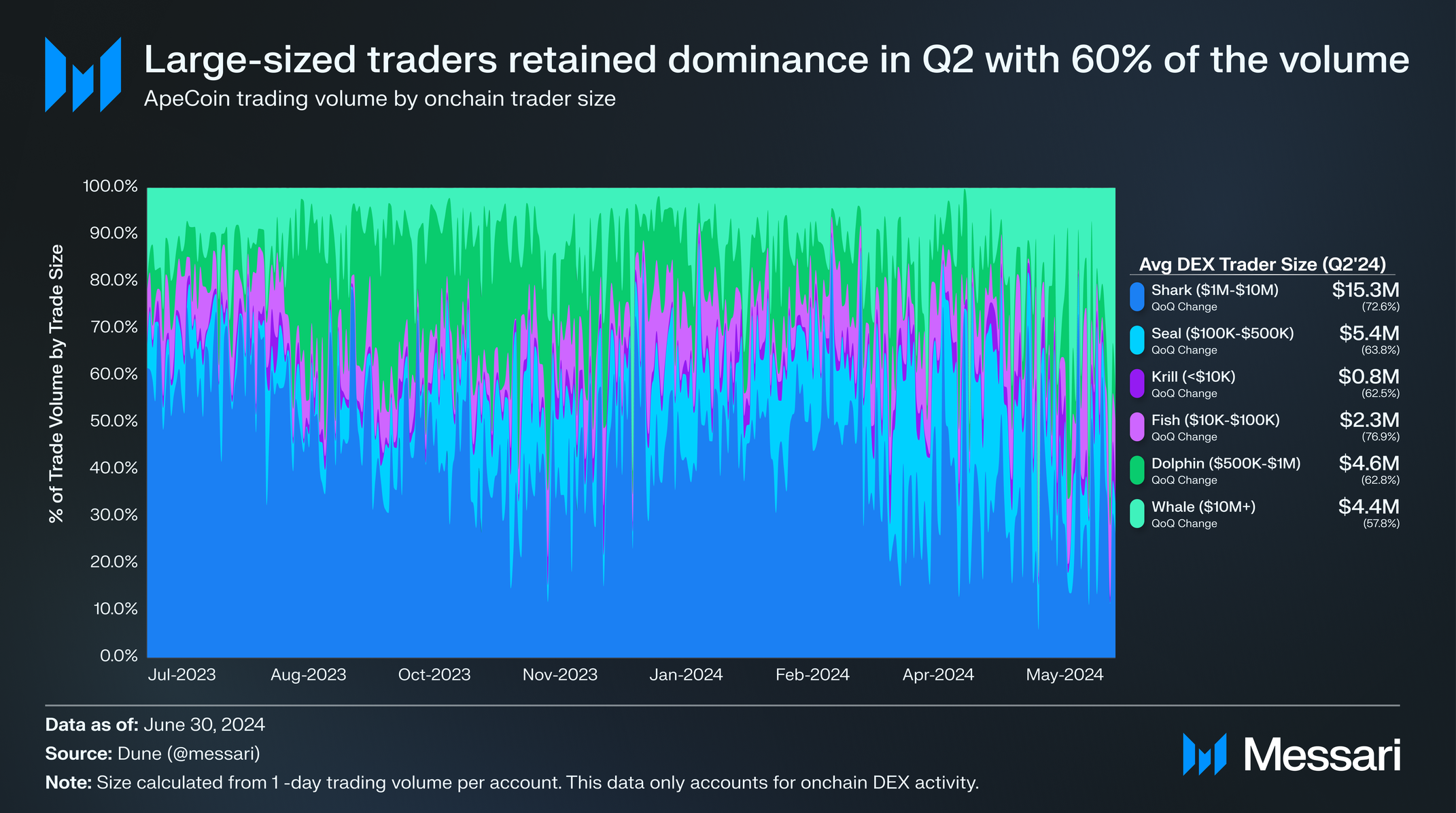
Trade volume across all trade categories dipped 69% QoQ, reflecting an overall decrease in trade activity in Q2 and in line with a general market decline. Large volume traders (accounts with 1-day trading volumes greater than $1 million) retained dominance in Q2, though their combined share slightly decreased to 60% from 63% in Q1. Whales (greater than $10 million) maintained a stable presence with 13% of the trade volume, while sharks (between $1 million and $10 million) saw the most reduction, although contributing 47% to Q2’s trade volume. This shift may indicate a slight redistribution of trade volume, with medium-sized traders like dolphins (between $500,000 and $1 million) and seals (between $100,00 and $500,000) slightly increasing their share towards the end of Q2.
The above data only includes onchain activity, not CEX trades. As such, its metrics may show a partial picture, given that higher volume traders may be more inclined to use CEX platforms because they usually offer assurances, protections, and incentives.
Token Velocity
Token velocity shows the frequency through which an asset changes accounts. A change in token velocity can show a few things depending on the asset. If the asset can be used beyond trading, such as a token used within a game, an increase in token velocity may imply that the game encourages the adoption/use of the asset. If the asset is more speculative, a decrease may mean that users are more interested in holding it or that it has low demand. The chart below calculates token velocity by dividing the circulating supply by the seven-day moving average (7DMA) transfer volume.
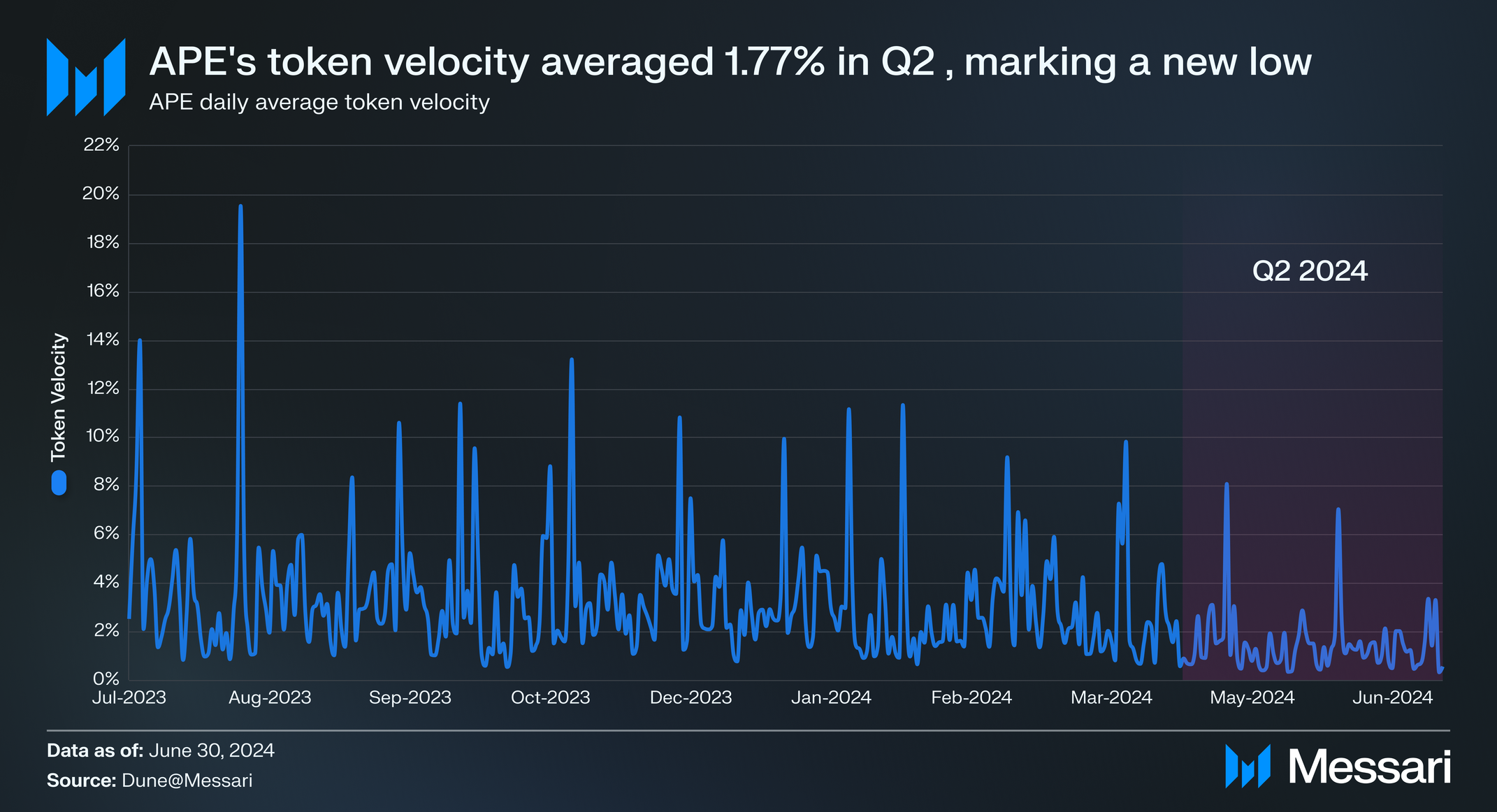
APE’s average transfer velocity fell from 2.9% to 1.7% QoQ, marking a new low. The steady decline and low volatility may be indicative of existing holders actively using the asset for governance or less overall activity (trading and transfers), possibly due to the market correction in Q2. Compared to Q1, Q2 saw more pronounced spikes throughout the quarter, particularly in early May 2024. These spikes suggest periods of heightened activity, potentially due to larger isolated transfers in response to Q2’s overall market sell pressure. Until the pending launch of the Otherside game, which will use APE as an in-game currency, the use cases for APE remained unchanged in Q2.
Token velocity will increase as Otherside launches and APE is used for in-game transfers. As the ApeCoin DAO seeks more economical alternatives to Ethereum in launching its chain, it also anticipates increasing token movement after introducing lower gas costs for users.
New APE Holders
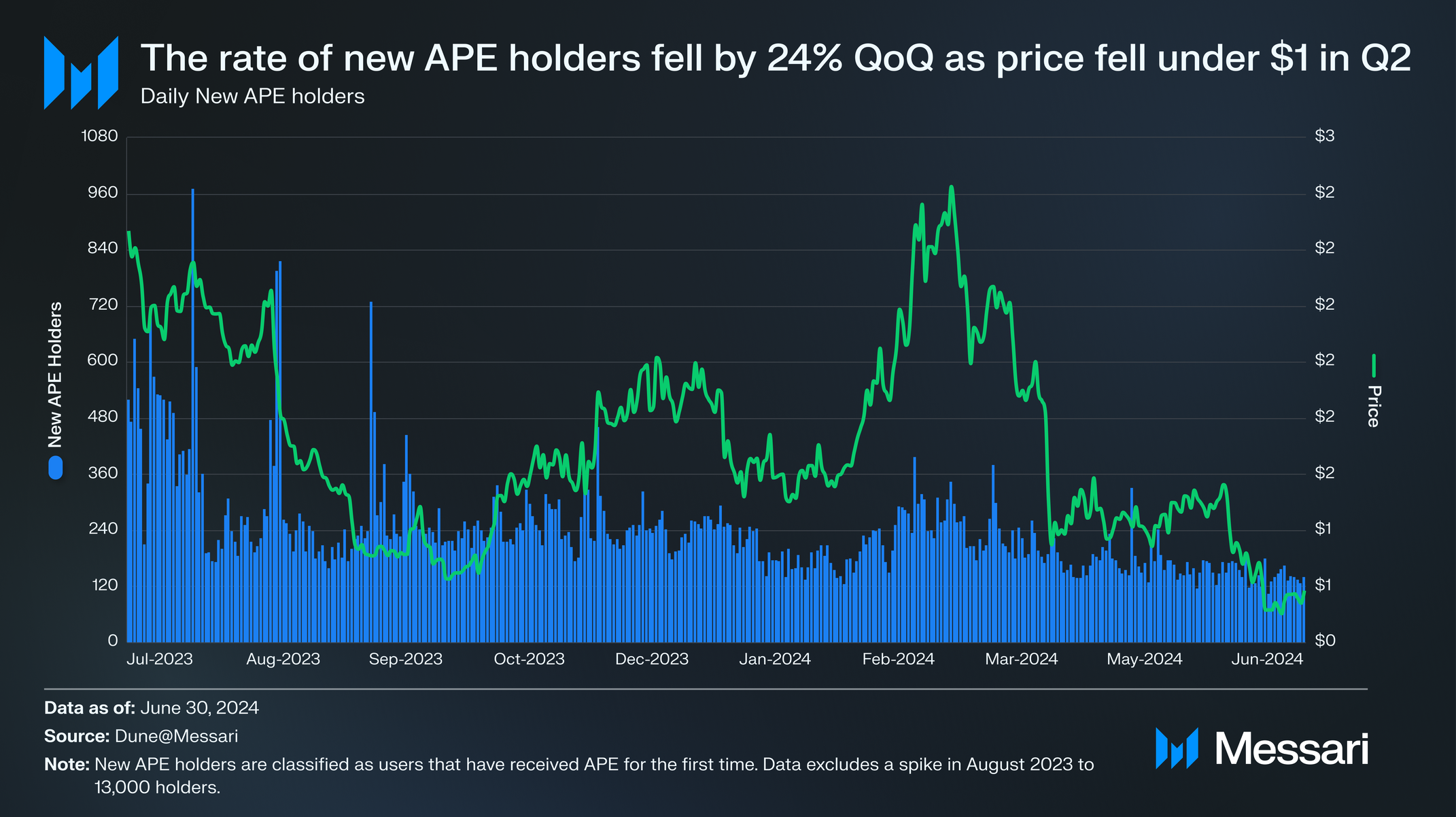
New APE holders are defined as addresses receiving APE for the first time. This metric excludes new holders using centralized exchanges to custody their assets. The inflow of new APE holders fell to 24% QoQ, a new low from its peak in Q3 2023, as APE price fell below $1.
Despite the ongoing decline, ApeCoin DAO approved initiatives in Q2 to attract new holders and provide additional exposure for the ecosystem. Notably, AIP-395 awarded 3 million APE ($2.8 million at Q2 average APE price) to D3 to acquire and manage rights to a ".APE" top-level domain (TLD). In addition to creating revenue opportunities for the DAO, this initiative aims to expose the ApeCoin ecosystem to non-crypto internet users. ApeCoin DAO also approved proposals such as AIP 402 and AIP 411 to drive community awareness and engagement for the DAO.
Unique Votes per Proposal
Unique votes per proposal measure the number of individuals participating in governance. If new voters only hold small amounts of an asset, then the impact of their unique votes would be marginal on proposal outcomes in token-weighted governance systems like ApeCoin DAO. However, aggregating unique votes conveys governance interest, diversity of the active holder base, and decentralization of the active holder base.
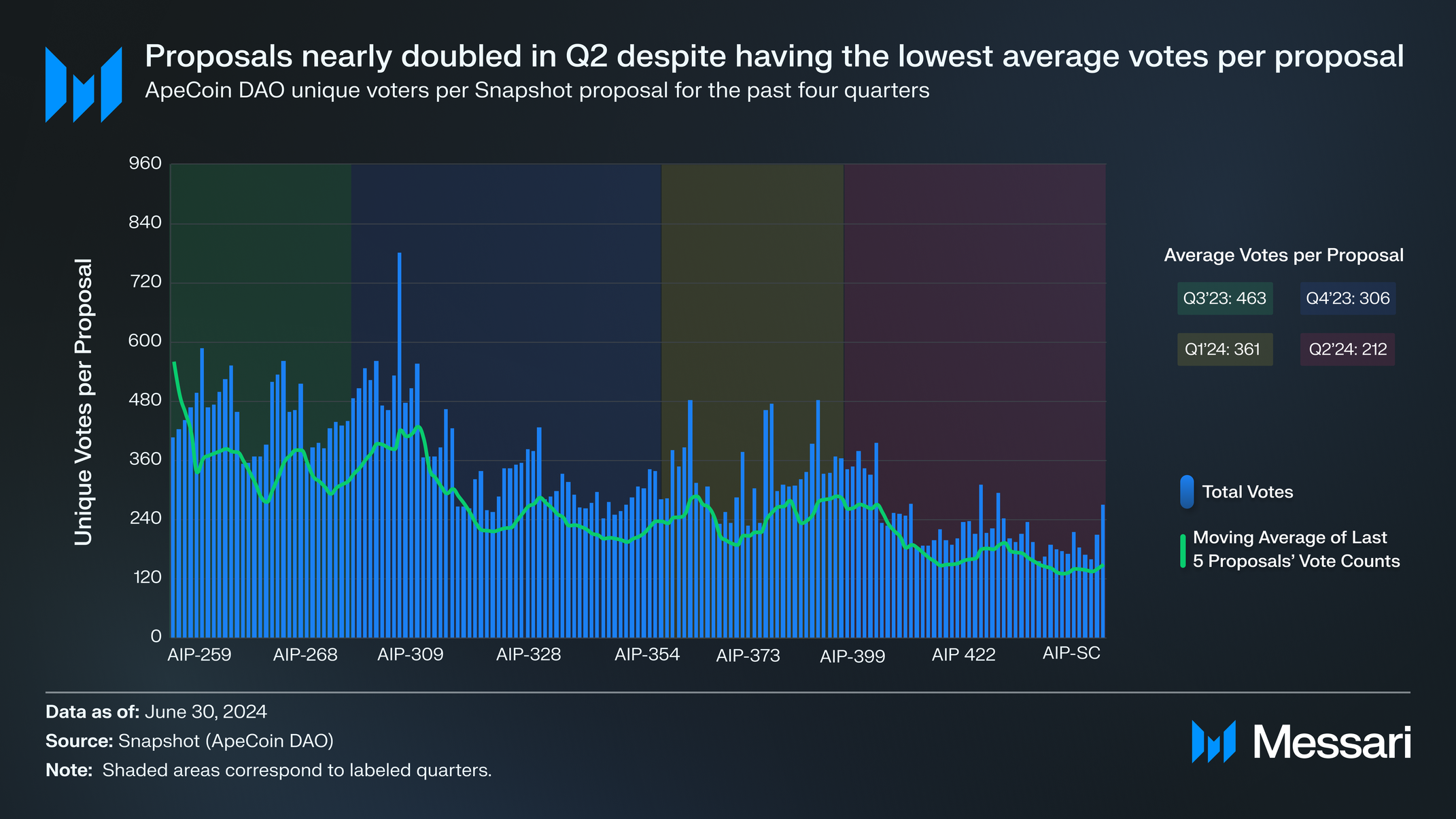
Q2’24 saw more proposals published (95% QoQ) and passed (50% QoQ) compared to Q1. Although, Q2 witnessed the lowest average vote per proposal (down 41% QoQ). The decline in votes per proposal may be due to the nature of proposals, as less compelling proposals may have attracted fewer votes.
In the future, ApeCoin DAO plans to move more of the voting process onchain. Doing so would remove central points of failure (like the reliance on Snapshot) and add to the governance structure’s decentralization. With ApeChain being built on the Arbitrum technology stack, it will be inexpensive to participate in governance when migrated onchain. Given that the current system is free, the potential bridging and added gas costs may deter some from participating in governance. However, the prospects of a more scalable and useful ecosystem may encourage more holders to participate in guiding the direction of the ecosystem.
Governance Analysis
Throughout Q2’2024, ApeCoin DAO voted on 39 proposals: 19 passed and 13 failed, with the remaining 7 being elections for the Special Council and Working Groups. If the failed AIPs had passed, the implementation costs would have been $9.6 million. The total value of passed proposals and elections was $7.8 million. The DAO's implementation costs vary for each approved proposal and are spent monthly upon reaching project milestones or when the project is fully completed.
The election proposals determined the following positions and compensation where applicable:
- Two Special Council members (one new) (compensated monthly at $10,416 each)
- Two new Governance Working Group Stewards (compensated monthly at $9,000 each)
- Two new Web3 Development Working Group Stewards
- A new Marketing and Communications Working Group Steward
- A new Metaverse Working Group Steward
Below are five proposal highlights from Q2’24, listed from newest to oldest. For a complete overview of ApeCoin governance, including preliminary discussions, see the Messari Governor page on ApeCoin.
ApeCoin DAO Special Council Elections - Term Beginning July 2024
June 20, 2024
The Special Council Election followed the Special Council Nomination, which determines five nominees to vote on in the subsequent election. The top two candidates from the Special Council Election then become Special Council members, compensated by the ApeCoin DAO at $10,416 (in APE) each on a monthly basis. The terms begin at the start of July 2024 and last for one year. The total compensation approved for the new Special Council members amounts to $125,000. Existing Special Council member Waabam was re-elected while CaptainTrippy transitioned from the Council, replaced by the newly elected Mo Ezeldin (mo_ezz14).
ApeCoin DAO - Working Group Elections
June 20, 2024
All four ApeCoin DAO working groups enacted across AIP-239, AIP-347, and AIP-412 re-elected stewards for the annual term beginning in July 2024:
- Governance Working Group—ALL CITY was reelected as a steward of the Governance Working Group, while Tiger is fine was replaced by the newly elected DeSmart. As stated in the working group’s approved Q2/Q3 2024 budget (AIP-408), each elected steward is entitled to an approved compensation of $9,000 monthly for the duration of the term.
- Web3 Development Working Group - JohnnyLee and romantik were elected as stewards for this working group.
- Marketing and Communication Working Group - Following a nomination vote by APE holders, Yumi was elected as the steward for this working group. Before the election, APE holders approved AIP-403, a six-month budget worth $494,500 to fund the working group’s operational needs from January through June 2024.
- Metaverse Working Group—Phil Watkins was elected as the steward for this working group. Prior to the election, APE holders approved AIP-404, a six-month budget to fund the working group's operational needs from January through June 2024.
As of quarter end, approved budgets for the Web3 Development Group, Marketing and Communication Group, and Metaverse Working Group, stating steward compensations from July 2024 have yet to be published or approved. With the introduction of AIP-415, election candidates can only run for up to one position in an election cycle. With this move, ApeCoin DAO aims to attract competitive candidates and encourage specialization among candidates.
AIP-411-JNRY Gallery Promotions
May 1, 2024
APE holders approved AIP-411 as one of a few other promotional initiatives launched to drive community engagement, exposure, and awareness for the ApeCoin ecosystem. Through AIP-411, JRNY Crypto requested 400,000 APE ($376,000 at $0.98 APE price) to deliver a one-year promotional package for the DAO that would include:
- Two full gallery walls within JNRY Gallery, a Las Vegas-based physical NFT gallery
- Promotional campaigns and events, including discounted access for APE holders
- Community outreach and educational programs, among others.
AIP-395-Acquisition of a “.APE” Top-Level Domain
April 13, 2024
AIP-395 was ApeCoin DAO's most expensive approved proposal in Q2, accounting for 35% of committed funds. The proposal awarded 3 million APE in grants ($2.8 million at $0.98 quarter-end APE price) to D3 to acquire rights to and manage a ".APE" top-level domain (TLD). AIP-395 is intended to generate future revenue opportunities for ApeCoin DAO and to position ApeCoin DAO as a bridge between Web3 and non-crypto internet users. The grant funding will cover the application and operational costs of acquiring the TLD.
D3 will also launch a tokenized version of the TLD as an onchain identifier solution in anticipation of the TLD license acquisition which is projected to be finalized by 2025. Upon launch, ApeCoin DAO will receive 50% of the gross revenues generated from both the tokenized APE name tokens and the .APE domains.
AIP-402: Dookey Dash Campaign Grant
April 3, 2024
With ~92% support, APE holders voted to approve AIP-402. Superfine and Faraway proposed AIP-402 to solicit $150,000 in grant funding (paid in APE) to promote Dookey Dash Game, a potential mainstream mobile game developed by Faraway. The proposal aimed to expose APE to a broader audience of traditional gamers through the implementation of promotional campaigns distributing APE rewards with the launch of Dookey Dash.
Closing Summary
In Q2’24, ApeCoin DAO allocated $7.8 million to fund approved proposals, a 47% decrease from the previous quarter. Although the number of proposals nearly doubled, average votes per proposal dropped, likely due to voter fatigue and fewer controversial issues. APE's market capitalization and token price fell by 51% QoQ, with daily average token transfer volume and average DEX swap size declining by 50%. This period of reduced activity and funding indicates a cautious approach adopted by APE holders amid broader market declines. Meanwhile, the DAO's governance structure continues evolving with new elections and ongoing strategic initiatives to expand the ApeCoin ecosystem.

Jennifer Obem is a Research Analyst at Messari. Previously, she worked full-time as a corporate finance professional in the Nigerian fintech industry. She enjoys dissecting concepts relating to Blockchain Interoperability and Web3 Infrastructure.