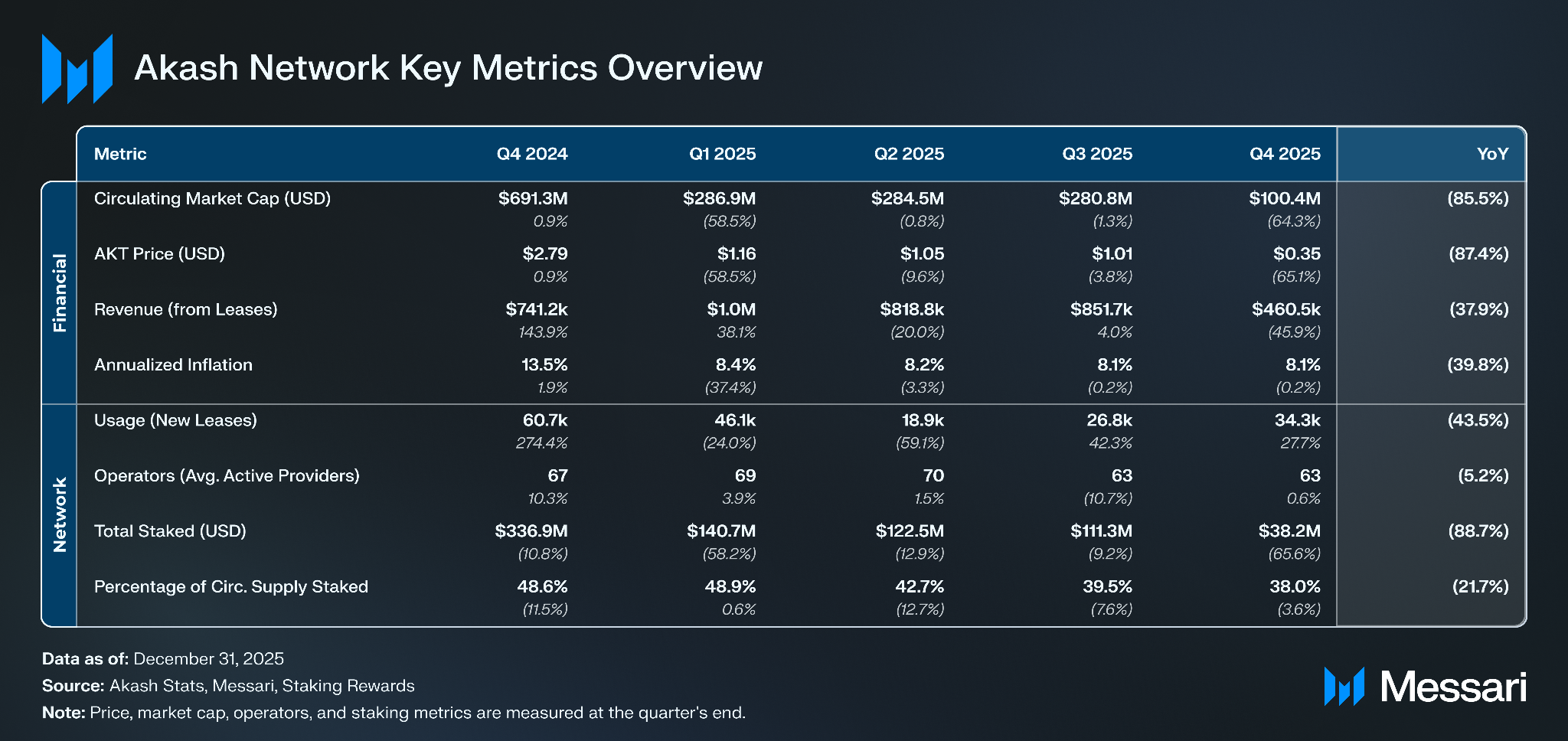
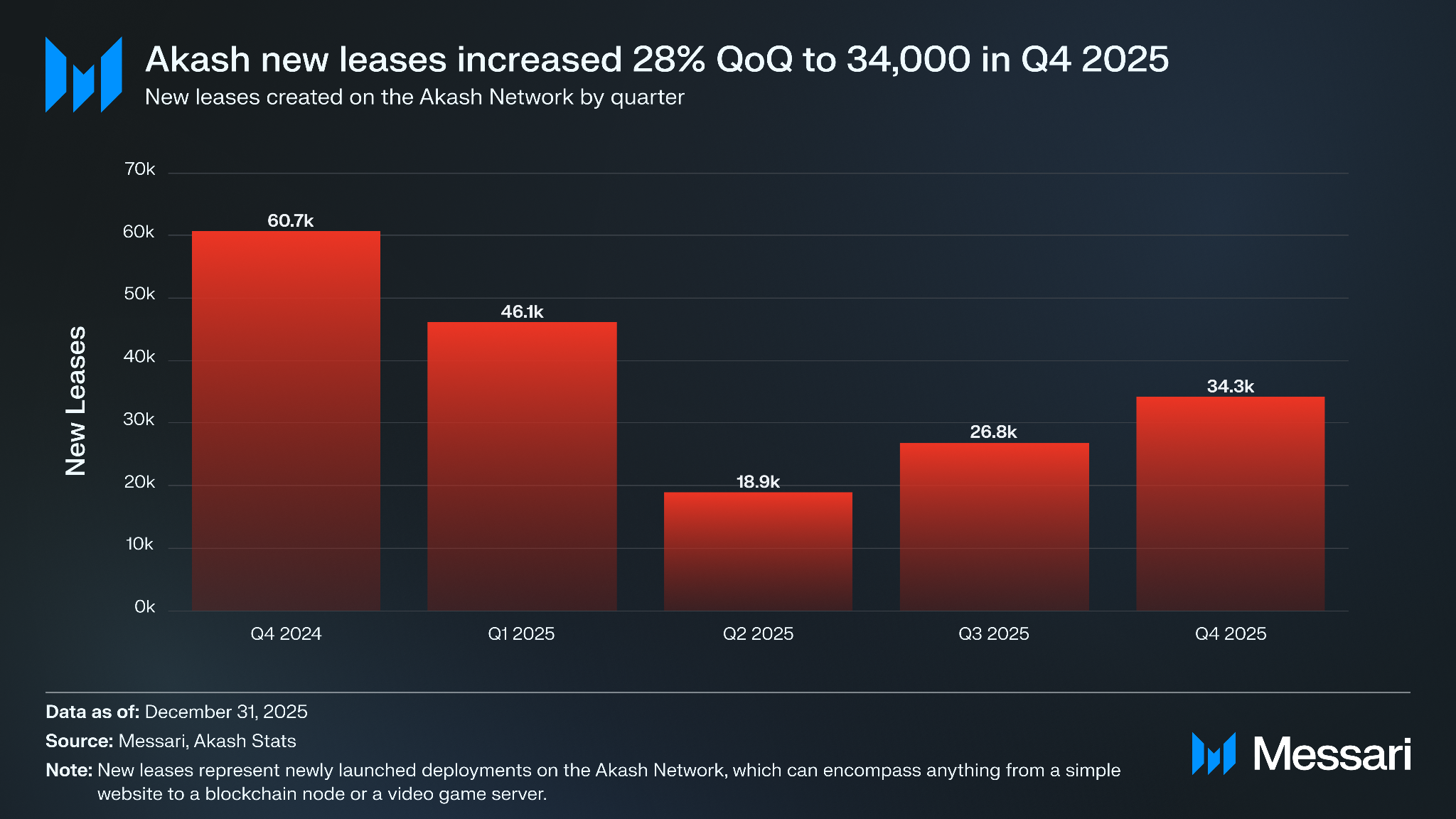
New leases increased 28% QoQ, rising from 26,800 to 34,300, extending the recovery in deployment activity after earlier declines in the year.
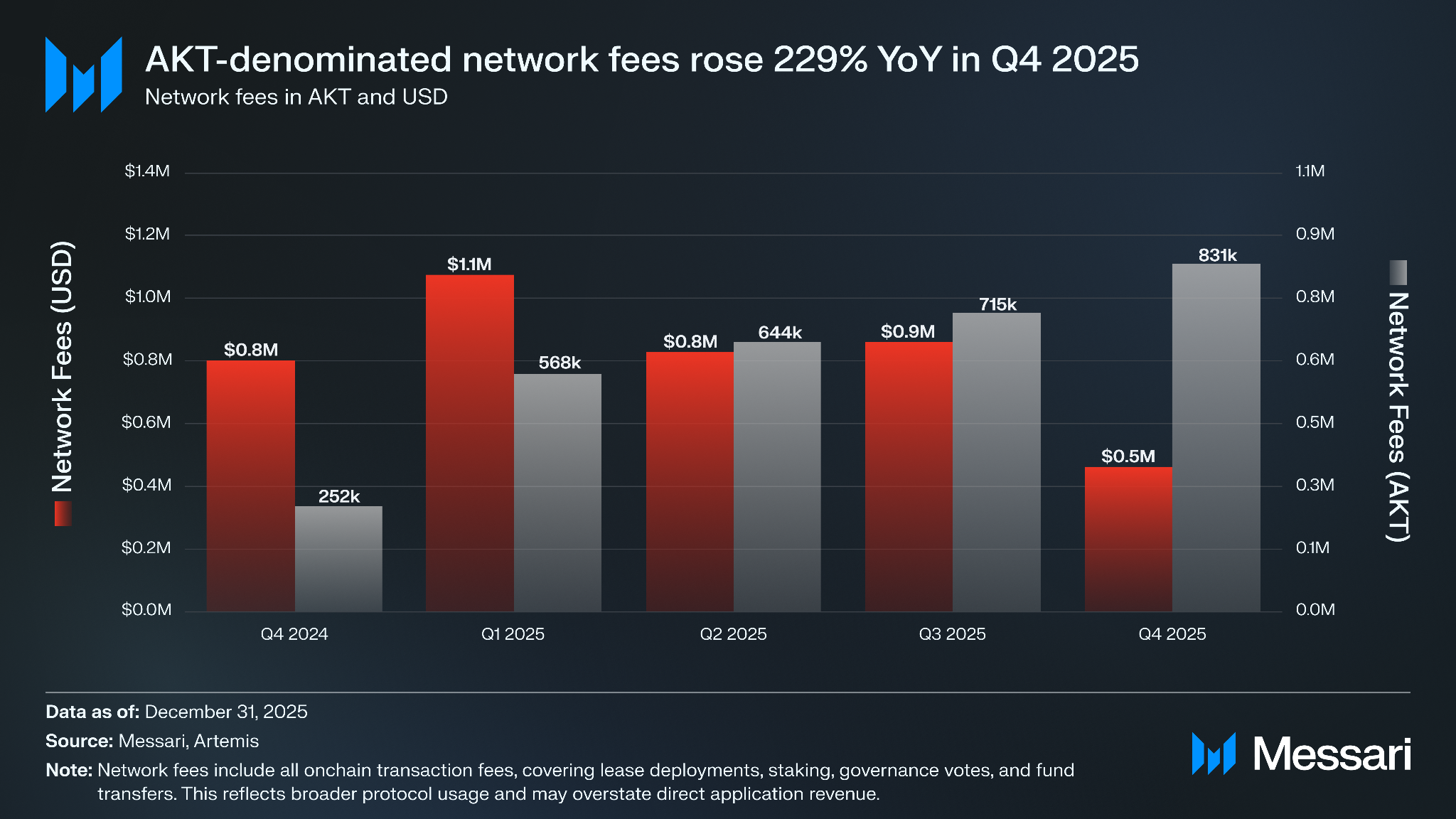
Network revenue fell 46% QoQ in USD due to the 65% drop in AKT’s price, but AKT-denominated revenue increased 16% QoQ and 229% YoY, indicating continued network activity.
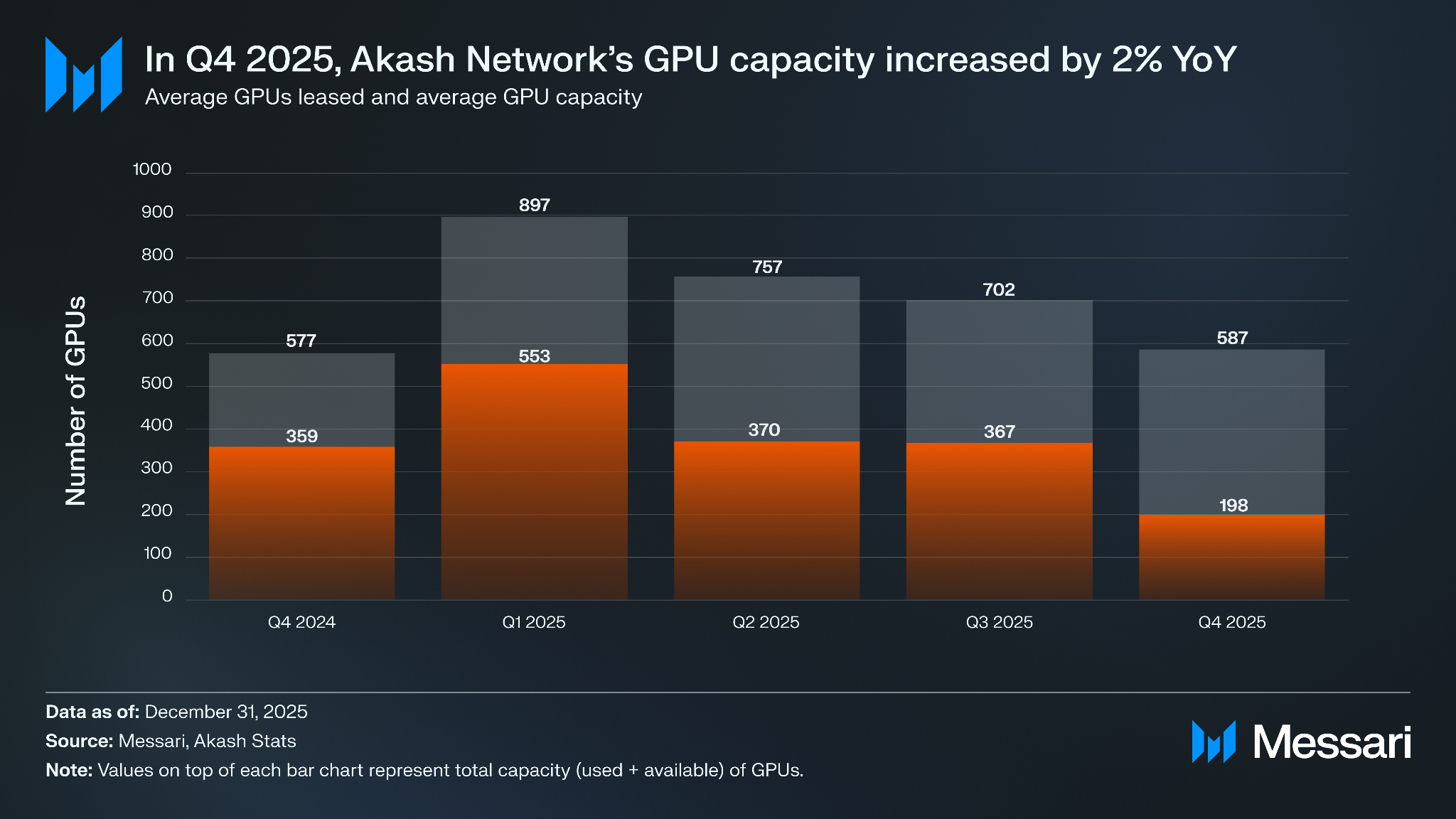
GPU usage declined 46% QoQ, while capacity fell 16% QoQ to 587 GPUs. However, GPU capacity remained 1.7% higher YoY, indicating stable long-term infrastructure growth.
The Mainnet 14 upgrade migrated Akash to Cosmos SDK v0.53, while AkashML introduced a managed inference layer to simplify AI deployment on decentralized GPUs.
A total of seven governance proposals were approved in Q4. Governance proposals during the quarter funded protocol upgrades, engineering development, and operational support, including coordination of the Mainnet 14 migration and subsequent upgrades.
Primer
Akash (AKT) is a decentralized cloud computing marketplace that facilitates the buying and selling of compute resources. It is an open-source, permissionless protocol that provides an alternative to today’s centralized cloud services (i.e., AWS, Azure, and Google Cloud). Akash aims to leverage underutilized server capacity, which can range from 5% to over 30%. Akash is a Tendermint-based, Layer-1 network built using the Cosmos SDK. Marketplace activity (requests, bids, lease details, etc.) is stored onchain, and payments are settled with Akash’s native token, AKT.
The Akash marketplace functions via a reverse auction, giving users the ability to name a price and describe the resources they want for deployments. Akash’s decentralized network of compute providers runs its open-source software and competes to provide resources, often at a fraction of the cost of big cloud providers. Specifically, Akash hosts containers where users can run any cloud-native application (e.g., AI workloads, gaming servers, blockchain nodes, and websites). Akash offers extensive cloud management services like Kubernetes, which can be used for hosting and managing containers. Additionally, Akash supports decentralized AI applications such as Venice.ai, AkashChat, and AkashGen, reflecting its role in enabling AI infrastructure. For a full primer on Akash, refer to our Initiation of Coverage report.
Akash’s marketplace uses a reverse auction, in which users propose a bid that describes the resources they’d like to use for a deployment. When accepted, a lease is opened onchain, managing the activity of this relationship.
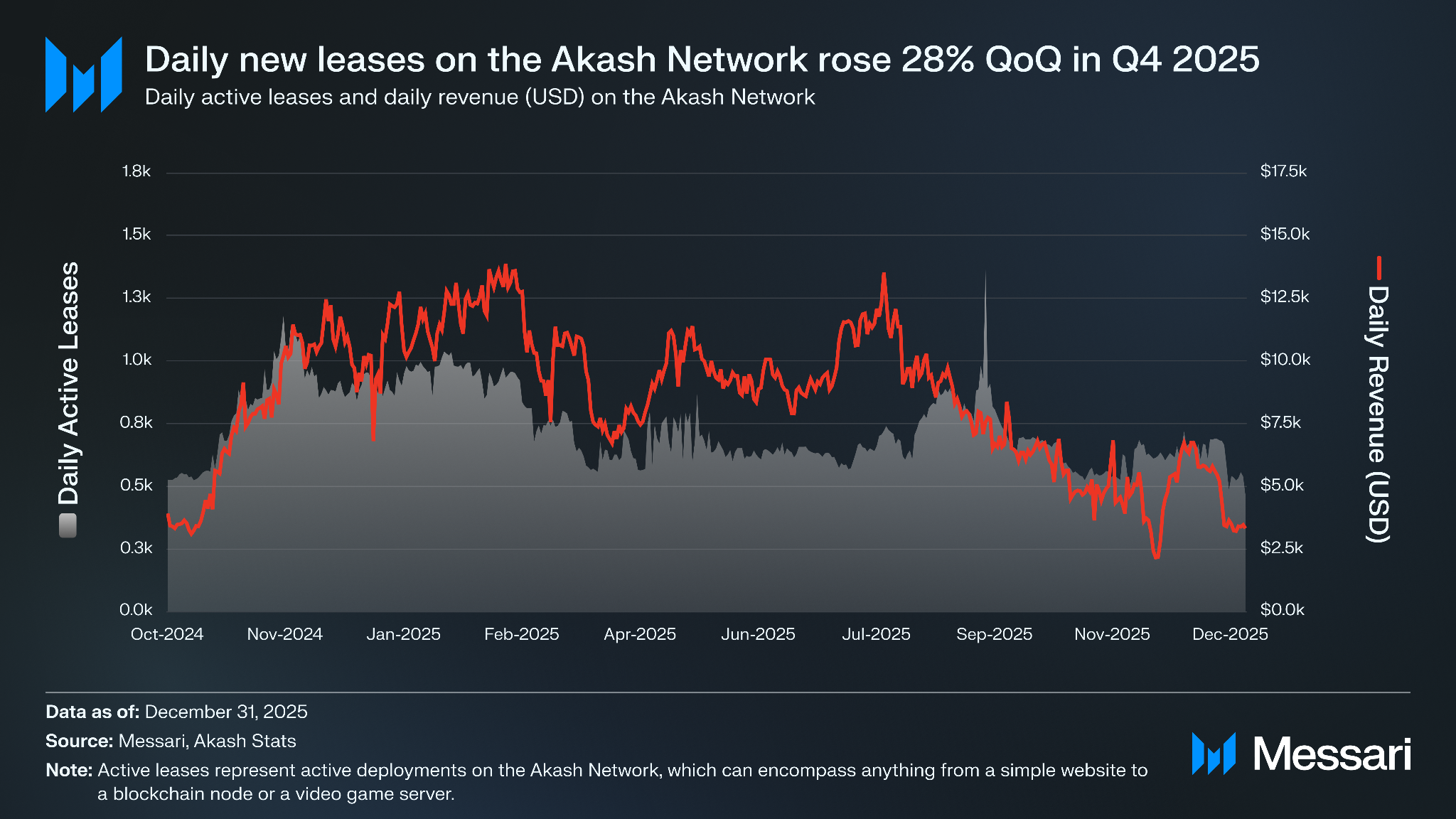
New leases on Akash Network represent agreements between users and providers for renting computational resources. New leases increased 28% QoQ, rising from 26,800 in Q3 2025 to 34,300 in Q4 2025, continuing the recovery in network usage following the sharp contraction earlier in the year.
The increase in new deployments occurred alongside several network developments during the quarter. These included the Mainnet 14 upgrade, which introduced infrastructure improvements and protocol updates, as well as the launch of AkashML, a managed inference layer designed to simplify access to decentralized GPU resources. Additional developer tooling improvements, such as the Chain SDK, console onboarding updates, and automatic credit reloading, reduced operational friction for deploying workloads on the network.
Active leases on Akash represent ongoing agreements in which users consume and manage computational resources on the network. Leases remain active as long as workloads continue running and terminate once deployments are closed. While new leases increased 28% QoQ in Q4, rising from 26,800 to 34,300, this growth did not translate proportionally into higher revenue. Lease revenue declined 46% QoQ, falling from $851,700 to $460,500 in Q4 2025.
Revenue generated from network transaction fees, which includes base fees, provider take rates, and other transaction-level costs associated with lease activity, declined significantly in USD terms during Q4 2025. Total network revenue fell 46% QoQ, decreasing from $860,100 in Q3 2025 to $463,200 in Q4 2025.
However, this decline was primarily driven by the sharp drop in AKT’s market price, which fell from $1.01 in Q3 to $0.35 in Q4, significantly reducing the USD value of fees paid on the network. In native terms, network revenue increased 16% QoQ, rising from 714,562 AKT to 831,486 AKT, indicating that overall economic activity and fee generation on the network continued to grow despite the token price decline. The increase in new lease creation during the quarter likely contributed to the higher AKT-denominated revenue, even as USD-reported revenue fell due to market conditions.
On a YoY basis, the divergence between USD and native-denominated revenue is even more pronounced. Total network revenue declined 42% YoY in USD terms, falling from $801,000 in Q4 2024 to $463,000 in Q4 2025. Over the same period, AKT-denominated revenue increased 229%, rising from 252,406 AKT to 831,486 AKT. This divergence reflects the substantial decline in AKT’s price, which fell 87% YoY, from $2.79 to $0.35, significantly reducing the USD value of network fees despite strong growth in native fee generation.
Resource Compute
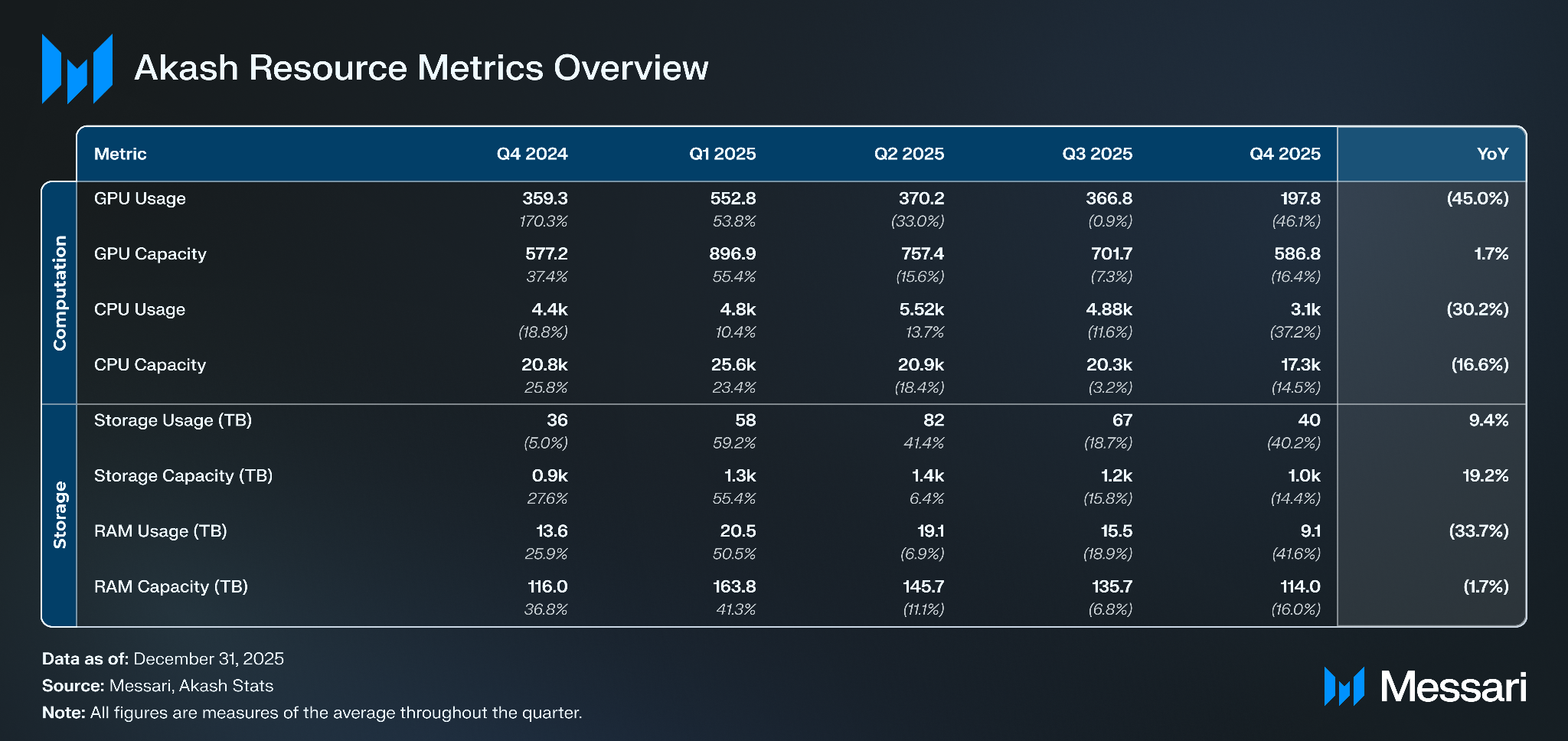
CPU Usage and Capacity: CPU usage declined 37.2% QoQ, falling from an average of 4,880 vCPUs in Q3 to 3,060 in Q4 2025, marking a sharper contraction than in the previous quarter. CPU capacity also decreased 14.5% QoQ, falling from 20,300 vCPUs to 17,300 vCPUs. The larger drop in usage relative to capacity suggests that a portion of available compute resources remained underutilized during the quarter. On a YoY basis, CPU usage declined 30.2%, while CPU capacity decreased 16.6%.
Storage Usage and Capacity: Storage usage declined 40.2% QoQ, dropping from 67 TB in Q3 to 40 TB in Q4. Storage capacity also decreased 14.4% QoQ, falling from 1,210 TB to 1,030 TB. Similar to CPU metrics, the sharper contraction in usage relative to capacity indicates that a larger share of available storage resources remained unused during the quarter. However, on a YoY basis, storage usage increased 9.4% and storage capacity expanded 19.2%, indicating overall growth in storage infrastructure relative to the previous year.
RAM Usage and Capacity: RAM usage decreased 41.6% QoQ, falling from 15.5 TB in Q3 to 9.1 TB in Q4, while RAM capacity decreased 16.0% QoQ, from 136 TB to 114 TB. On a YoY basis, RAM usage declined 33.7%, while RAM capacity remained relatively stable, decreasing slightly by 1.7%.
GPU Compute
GPU usage declined 46.1% QoQ, falling from an average of 367 GPUs in Q3 to 198 in Q4 2025, representing the largest contraction among compute resources during the quarter. GPU capacity also decreased 16.4% QoQ, declining from 702 to 587 GPUs as some providers reduced available infrastructure or temporarily exited the network.
The larger decline in usage relative to capacity indicates that available GPU resources were utilized less intensively during the quarter. While infrastructure supply contracted moderately, the sharper decline in utilization suggests that a greater share of GPU capacity remained idle compared to the previous quarter.
On a YoY basis, GPU usage declined 45.0%, while GPU capacity increased slightly by 1.7%, rising from 577 GPUs in Q4 2024 to 587 in Q4 2025.
Active Providers
Akash’s permissionless network allows resource providers to join from anywhere in the world, creating a geographically diverse and resilient infrastructure. This global distribution enhances the network’s ability to withstand regional disruptions, such as natural disasters, power outages, or political instability. It also improves performance by enabling workloads to be processed closer to end users, reducing latency and improving data transfer efficiency.
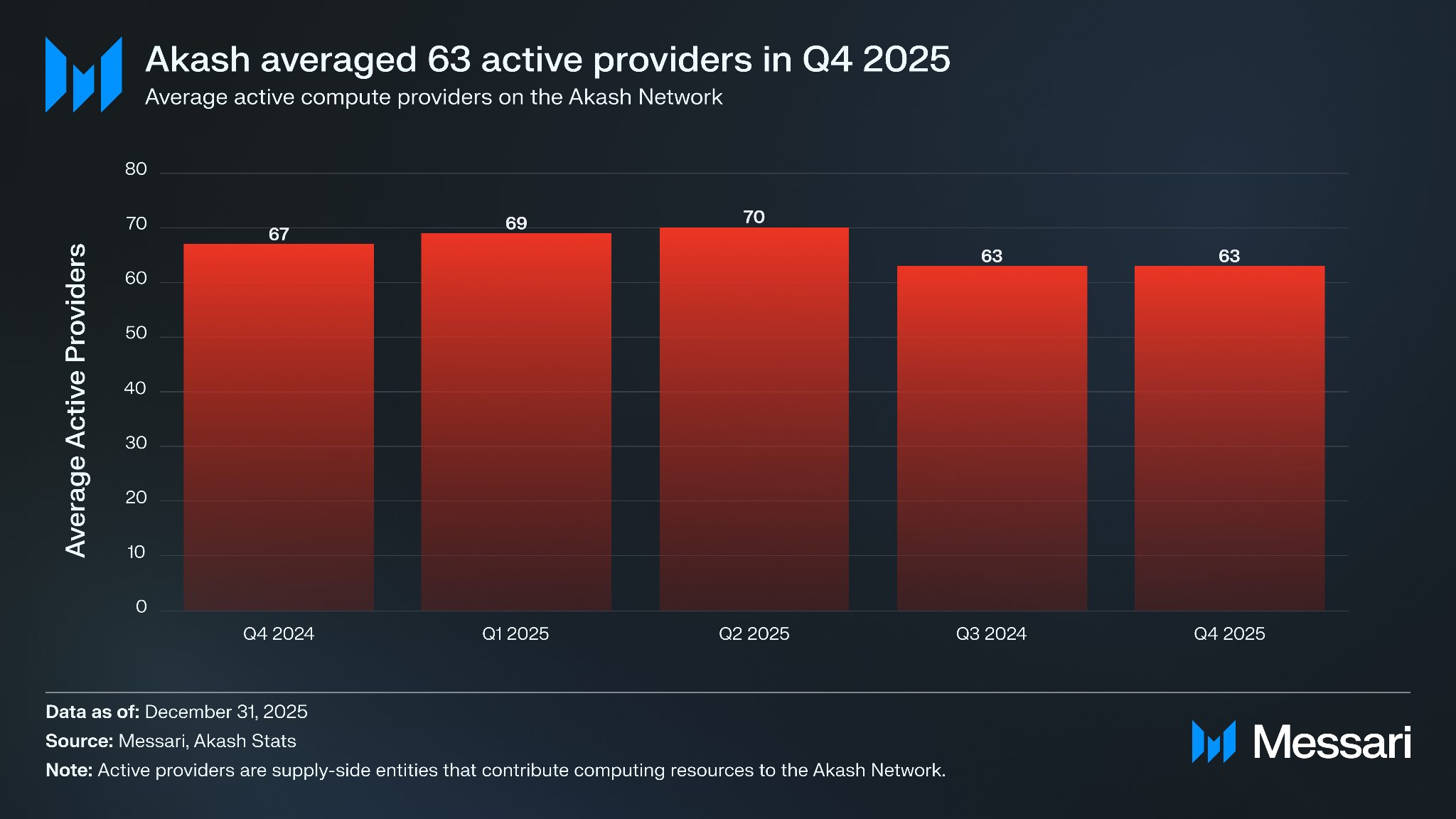
Average active providers remained relatively stable in Q4 2025, increasing slightly from 62.9 in Q3 to 63.3, representing a 0.6% QoQ increase. This stabilization followed the contraction observed in Q3, when the number of active providers declined after several quarters of expansion.
Despite relatively stable provider participation, both infrastructure capacity and resource utilization declined during the quarter, with GPU, CPU, RAM, and storage capacity contracting modestly. However, usage across these resources fell significantly faster than capacity, indicating that a larger share of available infrastructure remained unused compared to the previous quarter.
This divergence suggests that infrastructure supply remained relatively stable while overall network utilization declined during the quarter.
Token Analysis
Market Cap
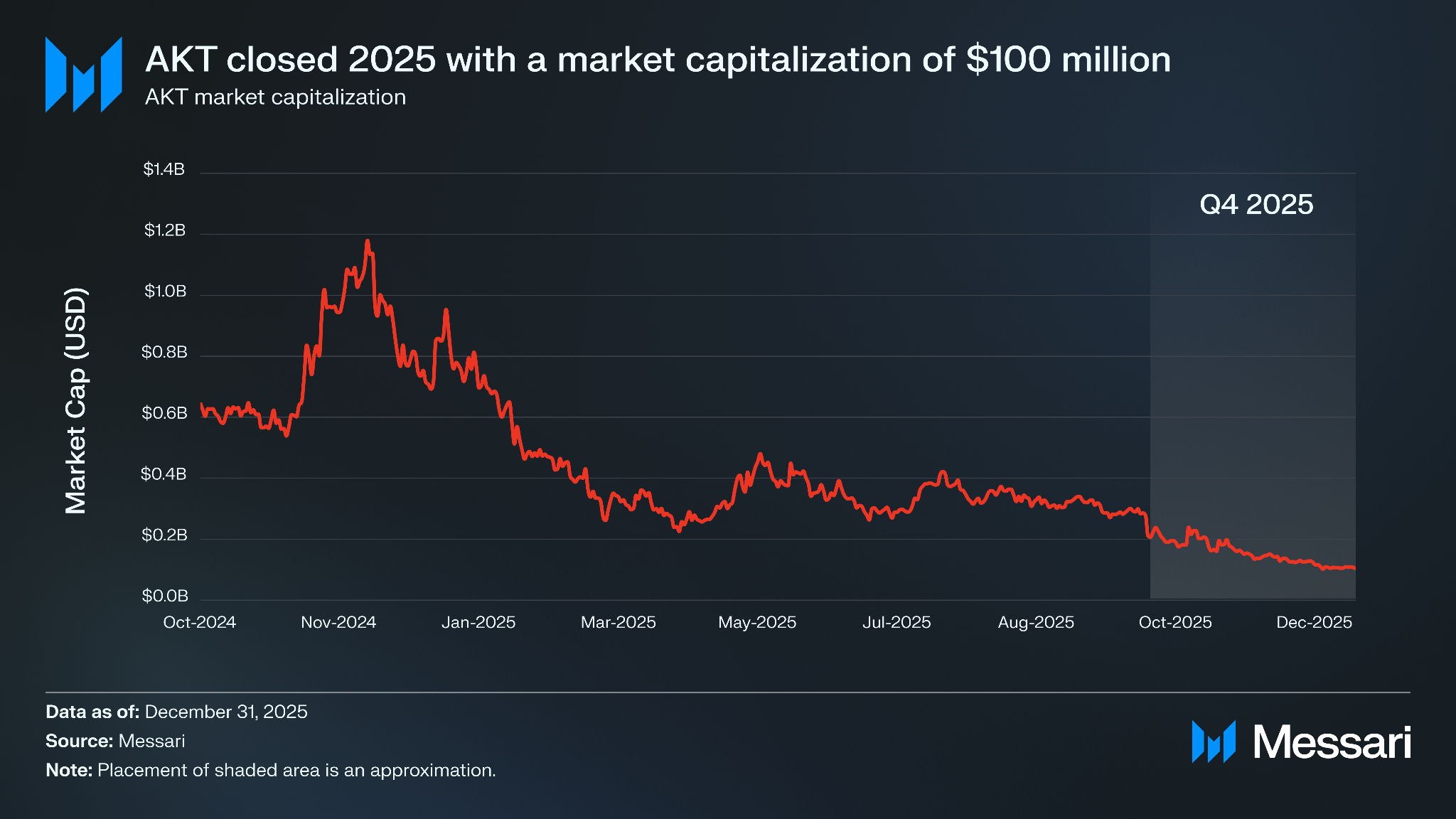
Akash’s circulating market capitalization declined in Q4 2025, falling 64.3% QoQ from $280.8 million to $100.4 million. The decline closely mirrored the movement in the AKT token price, which dropped 65.1% over the same period, falling from $1.01 to $0.35. The contraction in market value was therefore primarily driven by token price depreciation rather than changes in circulating supply.
Staking participation also declined during the quarter. The staking ratio fell from 39.5% to 38.0%, representing a 3.6% QoQ decrease, while the USD value of staked tokens declined alongside the broader market correction. The reduction in staking participation likely reflects weaker token price performance and reduced staking incentives during the quarter.
Qualitative Analysis
Partnerships and Developments
During Q4 2025, Akash focused on executing major protocol upgrades, improving developer infrastructure, and formalizing operational governance structures.
Mainnet 14 Upgrade
Akash executed Mainnet 14 on Oct. 28, 2025, upgrading the network to version v1.0.0 and migrating from Cosmos SDK v0.45 to v0.53. This upgrade represented one of the most significant architectural changes to the protocol since the introduction of GPU marketplace functionality. The migration modernized the underlying codebase, improved validator performance, and reduced several years of accumulated technical debt. Operating on older Cosmos SDK versions had begun to limit upgrade flexibility and maintenance efficiency as the network expanded. By adopting the newer SDK architecture, Akash aligned with current ecosystem standards while improving long-term maintainability and upgradeability.
Mainnet 14 incorporated several Akash Enhancement Proposals (AEPs) and protocol improvements aimed at improving usability, security, and operational flexibility.
Managed Wallets / Credit Card API (AEP-63): AEP-63 introduced programmatic payment flows that allow deployments to be funded through credit cards and managed wallets rather than exclusively through crypto-native funding methods. Previously, running workloads on Akash required users to acquire and manage AKT tokens directly, which created friction for enterprise users unfamiliar with crypto-based payment flows. The new API allows applications and organizations to deploy workloads using conventional billing infrastructure while still settling payments on-chain. This reduces onboarding friction for traditional developers and enterprises evaluating decentralized compute services.
JWT Authentication for Providers (AEP-64): AEP-64 introduced JSON Web Token (JWT) authentication for provider APIs. Earlier provider interactions relied primarily on certificate-based authentication tied directly to blockchain infrastructure, which added operational complexity and limited integration flexibility. JWT authentication allows clients to generate short-lived signed tokens using wallet keys, which providers verify using public keys retrieved from the blockchain. This model improves security, reduces reliance on blockchain availability during authentication, and enables more granular permission controls for deployment management.
Provider Lease Termination Reasons (AEP-39): AEP-39 introduced structured metadata for lease termination events. Previously, deployments could close without clearly indicating the underlying cause, making troubleshooting difficult for tenants and providers. The addition of standardized termination reasons improves observability across deployment lifecycles and allows users to determine whether leases ended due to provider failures, insufficient escrow balances, manual shutdowns, or other operational events.
IAVL Storage Improvements: The Cosmos SDK upgrade introduced improvements to the IAVL state storage system used by Akash. These changes improved block processing efficiency and reduced storage overhead in the network’s state tree. Improved state management reduces computational load for validators and increases responsiveness for network operations, particularly as transaction volume and deployment activity increase.
Expedited Governance Paths: Mainnet 14 also introduced expedited governance paths for certain types of low-risk proposals. Previously, governance proposals required full voting periods even when addressing urgent fixes or operational adjustments. Expedited governance allows the network to respond more quickly to issues such as software bugs or parameter updates while maintaining validator oversight. This mechanism was utilized shortly after the upgrade to execute Mainnet 15.
Multi-Depositor Escrow (AEP-75): AEP-75 introduced a major redesign of Akash’s escrow system. Prior to this upgrade, deployments could only be funded by a single depositor account, and that depositor could not be changed after the deployment was created. The new escrow architecture allows deposits to be sourced from multiple accounts or authorization grants. This enables more flexible funding structures, including multi-wallet treasury management, DAO-funded deployments, and automated escrow replenishment systems. The redesign significantly improves payment flexibility and supports more sophisticated billing workflows required by enterprise users.
AkashML Launch: Managed Inference Layer on Decentralized GPUs
Akash launched AkashML on Nov. 22, 2025, introducing a managed AI inference layer built on the network’s decentralized GPU infrastructure. AkashML provides developers with an OpenAI-compatible API, allowing applications to access AI models without directly managing GPU infrastructure or deployment orchestration. The system automatically routes inference workloads across available GPU providers within the network.
At launch, the service supported several open-source models, including Llama 3.3-70B, DeepSeek V3, and Qwen3-30B-A3B, and offered free developer credits alongside automated scaling across multiple datacenters participating in the network.
By abstracting underlying model-serving infrastructure such as vLLM and Text Generation Inference (TGI), AkashML simplifies deployment workflows while maintaining the cost advantages of decentralized compute infrastructure.
Developer and Console Infrastructure Improvements
Several developer tooling and console improvements were introduced during Q4 to improve onboarding and operational reliability.
Chain SDK (AEP-56): Akash completed a unified Chain SDK in October 2025, providing a standardized TypeScript library for interacting with both blockchain nodes and provider APIs. The SDK consolidates REST and gRPC interfaces, certificate management utilities, and deployment tooling, simplifying integrations for developers building applications and infrastructure on Akash.
Terraform Provider Improvements: The Akash Terraform provider received performance optimizations that improved deployment execution speeds by approximately three times. These improvements help streamline infrastructure automation for developers using infrastructure-as-code workflows to manage Akash deployments.
Console Onboarding Improvements (AEP-72): Akash redesigned the Console onboarding experience to improve user conversion and resource utilization. Key changes included increasing trial credits from $10 to $100, introducing credit-card verification for new users, and implementing limits on trial deployment duration. The previous open trial model sometimes resulted in abandoned deployments or unused resource allocations. The updated onboarding flow aims to improve tenant quality, reduce idle resource consumption, and increase the likelihood that trial users convert into long-term deployments.
Auto Credit Reload (AEP-77): Later in Q4, Akash introduced automatic credit reloading, allowing users to replenish escrow balances automatically when funds fall below predefined thresholds. This feature reduces the risk of deployment interruptions caused by insufficient escrow balances and improves reliability for long-running workloads.
Governance
Alongside technical upgrades and product launches, Governance activity during the quarter focused on coordinating protocol upgrades and funding engineering and operational initiatives supporting network development.
Proposal 306 – Decentralized Cloud Foundation Operational Expenses (Oct. 13): Approved funding to support operational activities of the Decentralized Cloud Foundation (DCF), which manages treasury administration, compliance processes, and governance coordination for the ecosystem. The funding supports financial operations, legal services, and operational infrastructure.
Proposal 308 – Mainnet 14 Upgrade (Oct. 20): Authorized the execution of Mainnet 14, which migrated the network from Cosmos SDK v0.45 to v0.53 and introduced several protocol improvements, including JWT authentication (AEP-64), multi-depositor escrow (AEP-75), and improved lease termination metadata (AEP-39). The proposal coordinated validator upgrades and ensured network-wide adoption of the new protocol version.
Proposal 310 – Zealy Distribution Fix (Nov. 4): Approved a corrective action to resolve a distribution issue affecting rewards from a previous Zealy incentive campaign. The issue resulted from an upgrade-related edge case that prevented some participants from receiving rewards.
Proposal 311 – Mainnet 15 Upgrade (Nov. 23): Authorized an expedited upgrade to Mainnet 15 (v1.1.0) to address escrow accounting inconsistencies discovered after the Mainnet 14 migration. The upgrade restored proper settlement behavior for affected deployments and demonstrated the effectiveness of the expedited governance process introduced earlier in the quarter.
Proposal 312 – Core Engineering Funding (Nov. 25): Allocated funding to reimburse engineering work associated with the Cosmos SDK migration and other protocol infrastructure improvements implemented during the Mainnet 14 upgrade.
Proposal 313 – Client Engineering Funding (Nov. 25): Approved funding for client-side improvements including console functionality, deployment management tools, billing interfaces, and developer tooling designed to improve the developer experience.
Proposal 314 – Support Services Funding (Dec. 10): Approved funding for operational services supporting the ecosystem, including DevOps infrastructure management, provider coordination, financial operations, and community management.
Community Programs and Ecosystem Support
Akash Community Contribution Program: On Nov. 3, 2025, Akash introduced a structured community contribution program to formalize open-source collaboration within the ecosystem. The program establishes a tiered contributor pathway that enables developers to progress from smaller contributions to leading larger community-driven projects. Early outputs from the program included a community-built Akash VPN service and an Akash Transaction Explorer designed to visualize provider activity and deployment events.
Student Ambassador Program: On Dec. 4, 2025, Akash launched a Student Ambassador Program, onboarding students from universities such as Princeton, Cornell, USC, and UT Austin to promote decentralized compute education and organize developer-focused campus events.
Closing Summary
During Q4 2025, Akash saw deployment activity continue to recover, with new leases increasing 28% QoQ to 34,300following the contraction earlier in the year. Despite the increase in deployments, infrastructure utilization declined across compute resources, with GPU usage falling 46% QoQ, CPU usage 37%, RAM 42%, and storage 40%, while capacity across these resources contracted more modestly.
From a financial perspective, USD-denominated network revenue declined during the quarter, largely due to the 65% QoQ drop in AKT’s price, which reduced the dollar value of fees paid on the network. In native terms, however, network revenue increased, indicating continued transaction activity and lease creation on the network.
On the development side, the quarter included the Mainnet 14 upgrade, which migrated the network to Cosmos SDK v0.53, and the launch of AkashML, a managed inference layer designed to simplify access to decentralized GPU infrastructure. Additional developer tooling improvements also reduced deployment friction.
Overall, Q4 2025 focused on infrastructure upgrades and developer tooling, while network utilization moderated amid broader market volatility. These developments reflect continued investment in the protocol’s compute and developer infrastructure, positioning Akash to support greater AI and cloud workload adoption heading into 2026.
This report was commissioned by Overclock Labs. All content was produced independently by the author(s) and does not necessarily reflect the opinions of Messari, Inc. or the organization that requested the report. The commissioning organization may have input on the content of the report, but Messari maintains editorial control over the final report to retain data accuracy and objectivity. Author(s) may hold cryptocurrencies named in this report. This report is meant for informational purposes only. It is not meant to serve as investment advice. You should conduct your own research and consult an independent financial, tax, or legal advisor before making any investment decisions. Past performance of any asset is not indicative of future results. Please see our Terms of Service for more information.
No part of this report may be (a) copied, photocopied, duplicated in any form by any means or (b) redistributed without the prior written consent of Messari®.
Armita is a protocol researcher with a robust background in technology and blockchain. Before her role at Messari, she distinguished herself as a tech entrepreneur, executive, and advisor for various blockchain startups. Armita holds two master's degrees, one in Computer Engineering and another in Business Management, as well as a double major undergraduate degree in Physics and Pure Mathematics.
Armita is a protocol researcher with a robust background in technology and blockchain. Before her role at Messari, she distinguished herself as a tech entrepreneur, executive, and advisor for various blockchain startups. Armita holds two master's degrees, one in Computer Engineering and another in Business Management, as well as a double major undergraduate degree in Physics and Pure Mathematics.