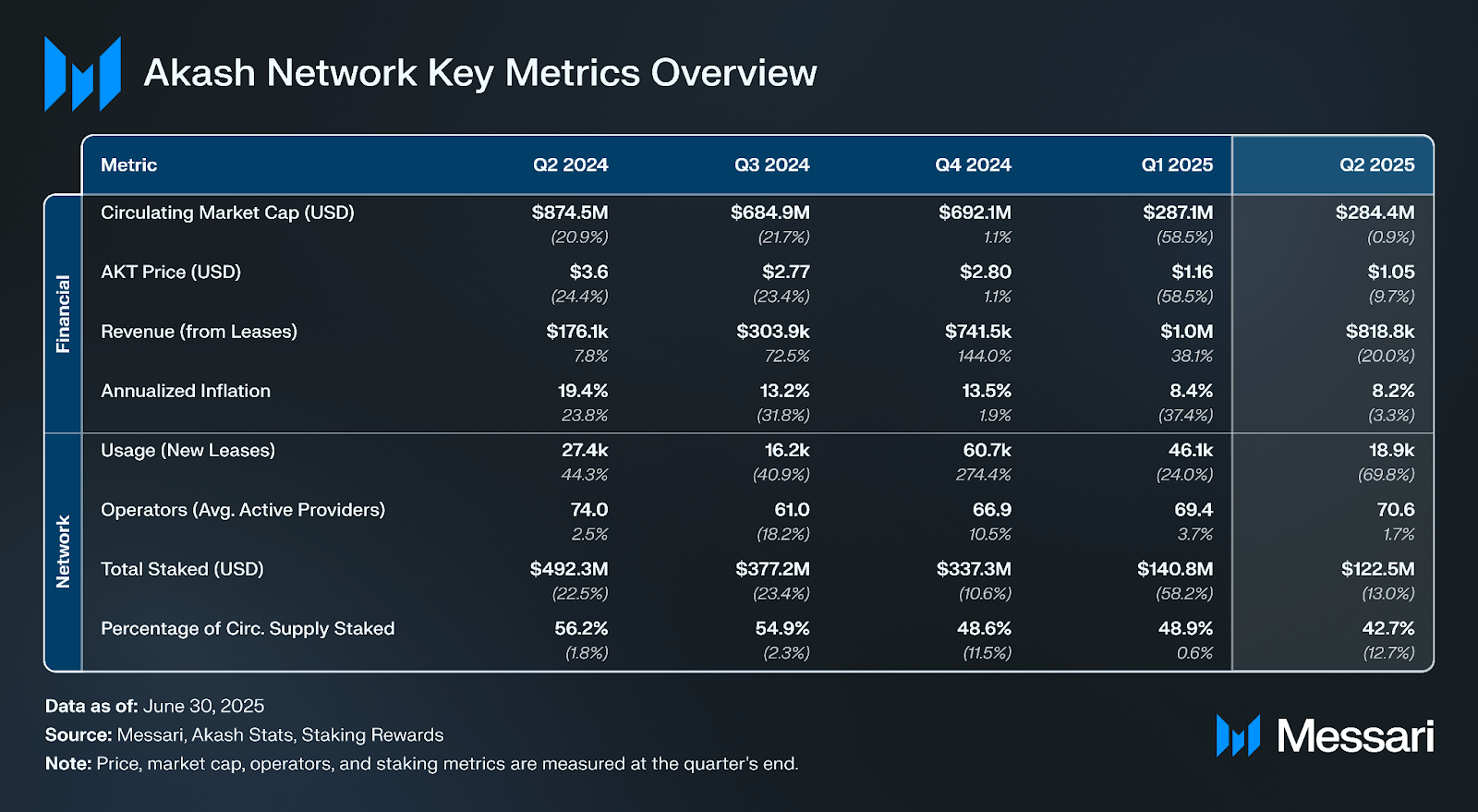
Fee revenue in AKT terms grew 13% QoQ, while total lease revenue declined 20% to $820,000.
CPU usage rose 14% QoQ to 5,500 units, showing steady demand from non-AI workloads and smaller tenants even as providers reallocated resources toward GPUs.
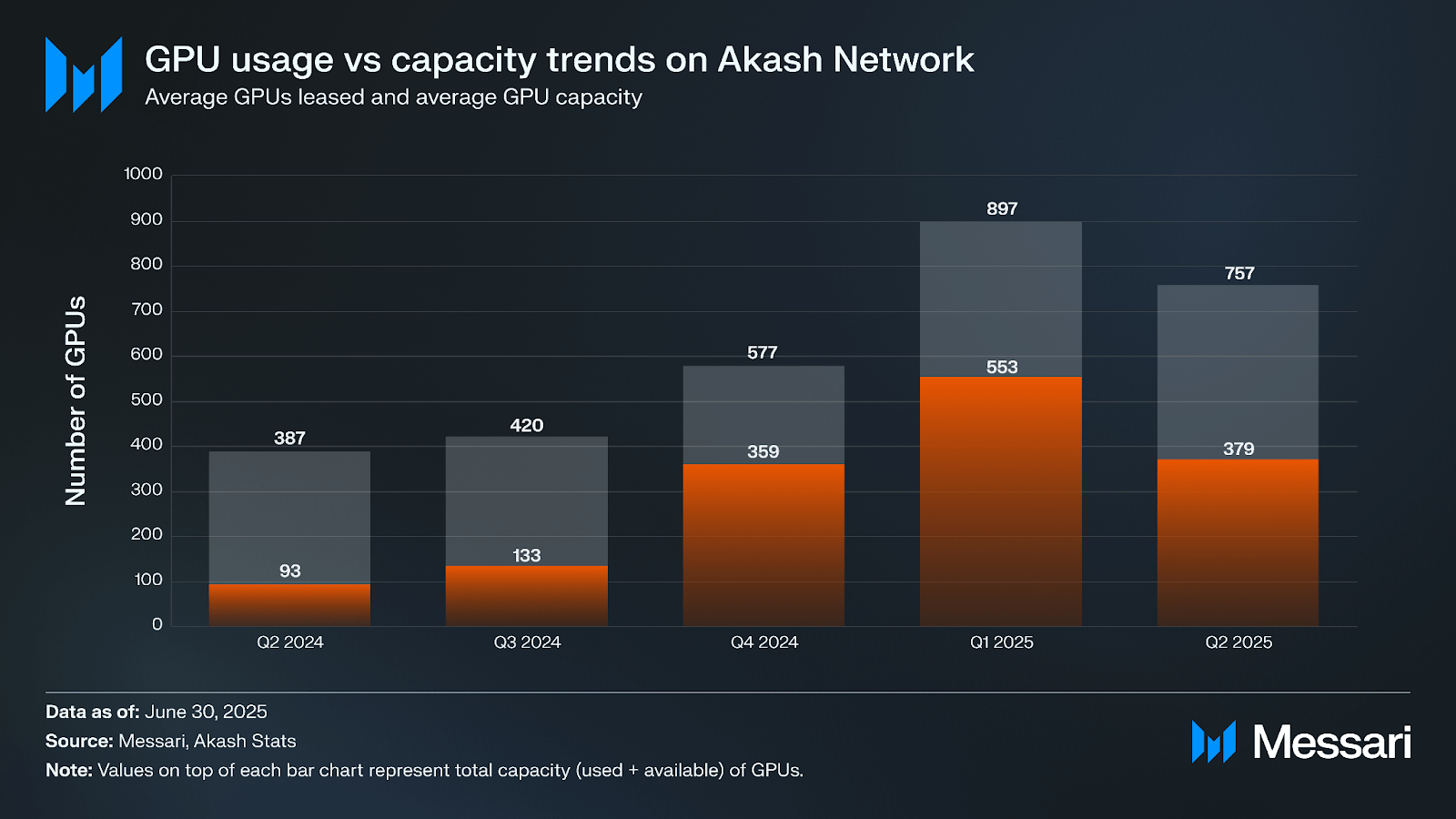
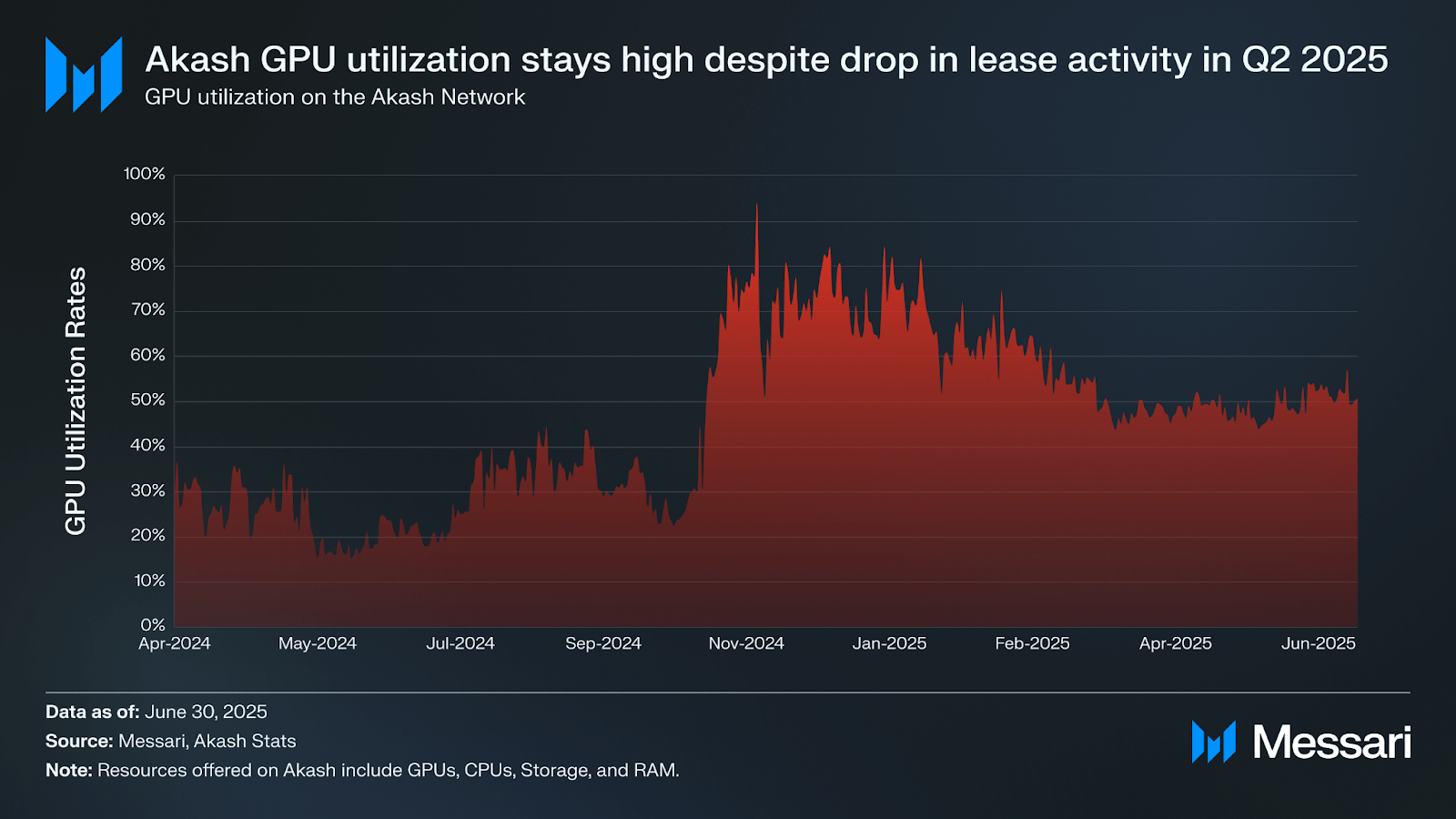
GPU usage contracted 33% alongside a 16% drop in capacity, though utilization efficiency remained steady at 50%, peaking at 57% in late June.
Eight governance proposals passed in Q2 2025, covering community programs, event funding, provider tooling, and infrastructure support, including $1.33M allocated for Overclock Labs’ H1 2025 services.
Akash expanded its AI ecosystem through integrations with Morpheus, Gensyn, Saga, VPS AI, and Envision Labs, while AKT was added to Grayscale’s “AI Tools & Resources” index and the Coinbase 50 Index.
Primer
Akash (AKT) is a decentralized cloud computing marketplace that facilitates the buying and selling of compute resources. It is an open-source, permissionless protocol that provides an alternative to today’s centralized cloud services (i.e., AWS, Azure, and Google Cloud). Akash aims to leverage underutilized server capacity, which can range from 5% to over 30%. Akash is a Tendermint-based, Layer-1 network built using the Cosmos SDK. Marketplace activity (requests, bids, lease details, etc.) is stored onchain and payments are settled with Akash’s native token, AKT.
The Akash marketplace functions via a reverse auction, giving users the ability to name a price and describe the resources they want for deployments. Akash’s decentralized network of compute providers runs its open-source software and competes to provide resources, often at a fraction of the cost of big cloud providers. Specifically, Akash hosts containers where users can run any cloud-native application (e.g., AI workloads, gaming servers, blockchain nodes, and websites). Akash offers extensive cloud management services like Kubernetes, which can be used for hosting and managing containers. Additionally, Akash supports decentralized AI applications such as Venice.ai, AkashChat, and AkashGen, reflecting its role in enabling AI infrastructure. For a full primer on Akash, refer to our Initiation of Coverage report.
Akash’s marketplace uses a reverse auction, in which users propose a bid that describes the resources they’d like to use for a deployment. When accepted, a lease is opened onchain managing the activity of this relationship.
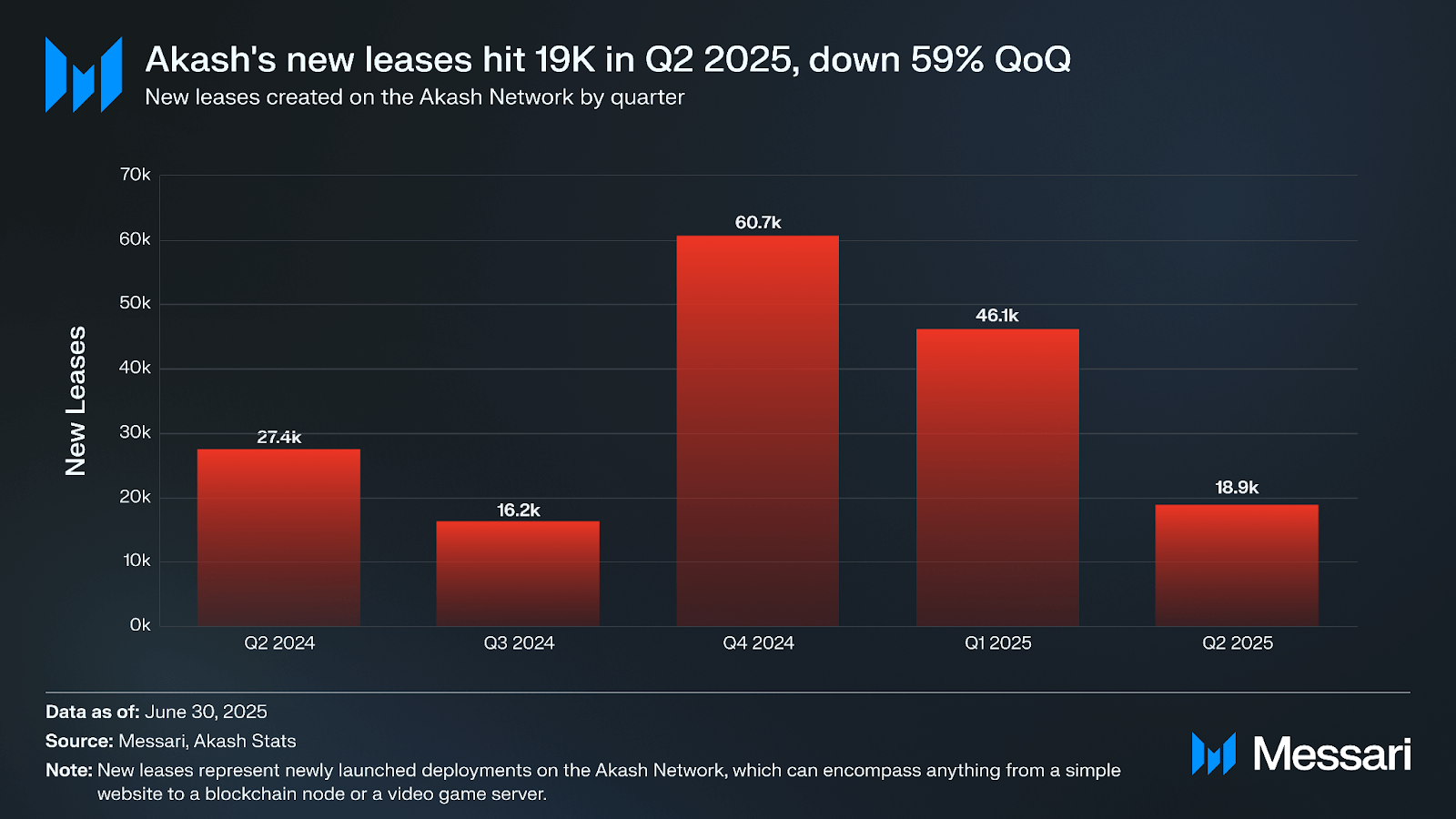
New leases on Akash Network represent agreements between users and providers for renting computational resources. New leases on Akash declined 59% QoQ, from 46,000 in Q1 2025 to 19,000. This drop reflects a shift in usage patterns rather than weaker demand for compute. Q2 activity concentrated on high-density GPUs such as H100s, with utilization peaking at 57% on June 26. As workloads consolidated onto fewer, more powerful machines, lease counts fell even as revenue in AKT and utilization remained strong. Integrations with Saga, Gensyn, Morpheus, and VPS AI reinforced this trend by supporting longer-lived, resource-intensive deployments.
Another factor contributing to the decline was a spam attack on March 29, 2025, when Akash experienced a surge of malicious transactions targeting both the blockchain and the Console. The attack caused network congestion and temporarily prevented new deployments for several hours. To mitigate the issue, validators raised fees and Console signups were temporarily restricted. While these measures restored network operations, several legitimate users were also affected, creating short-term disruptions visible in usage statistics.
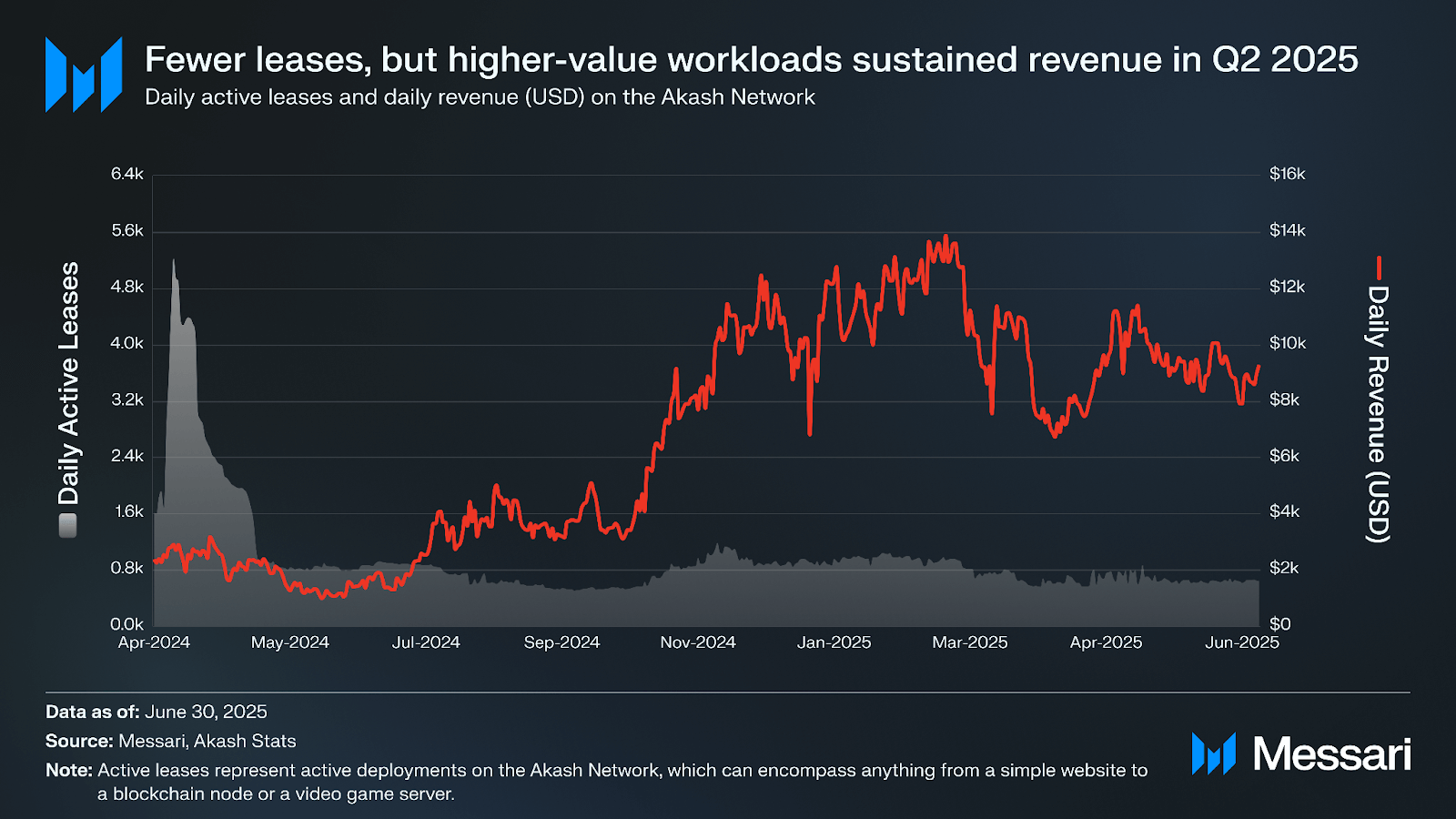
Active leases on Akash represent ongoing agreements where users utilize and manage computational resources on the network. Leases remain active as long as they are in use and cease once closed.
Despite the sharp decline in lease count, revenue from leases proved more resilient. The average number of daily active leases decreased 24% from 868 in Q1 2025 to 659, while total lease revenue fell 20% from $1 million to $820,000 and daily revenue decreased 21%, from $11,300 to $9,000 in Q2 2025. This discrepancy shows that activity concentrated on fewer but larger leases, particularly enterprise and AI workloads that consumed sustained GPU capacity.
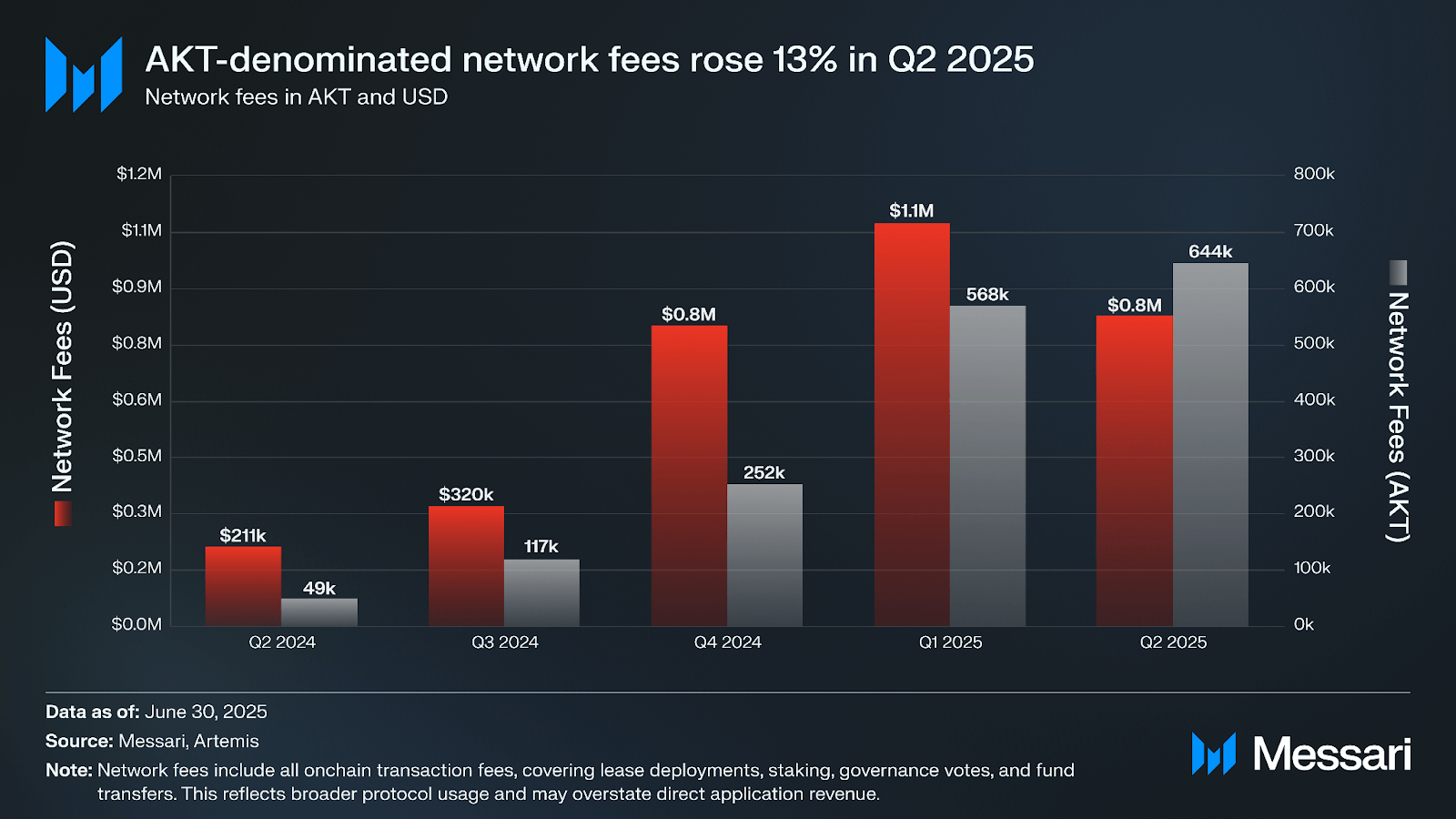
Revenue from network transaction fees: which includes base fees, provider take rates, and other transaction-level costs, increased 13% QoQ in AKT terms. In contrast, revenue measured in USD declined from $1.1 million in Q1 to $0.8 million in Q2 2025, a 27% QoQ decrease.
This divergence reflects two dynamics:
Fees are natively paid in AKT, so growth in high-value leases sustained revenue in token terms despite fewer overall deployments.
A 9.7% drop in AKT’s average price (from $1.16 to $1.05) reduced the USD-equivalent revenue, even as activity in AKT terms increased.
Overall, the data shows that underlying demand for compute strengthened in native terms, while USD revenues were more sensitive to market price movements.
Resource Compute
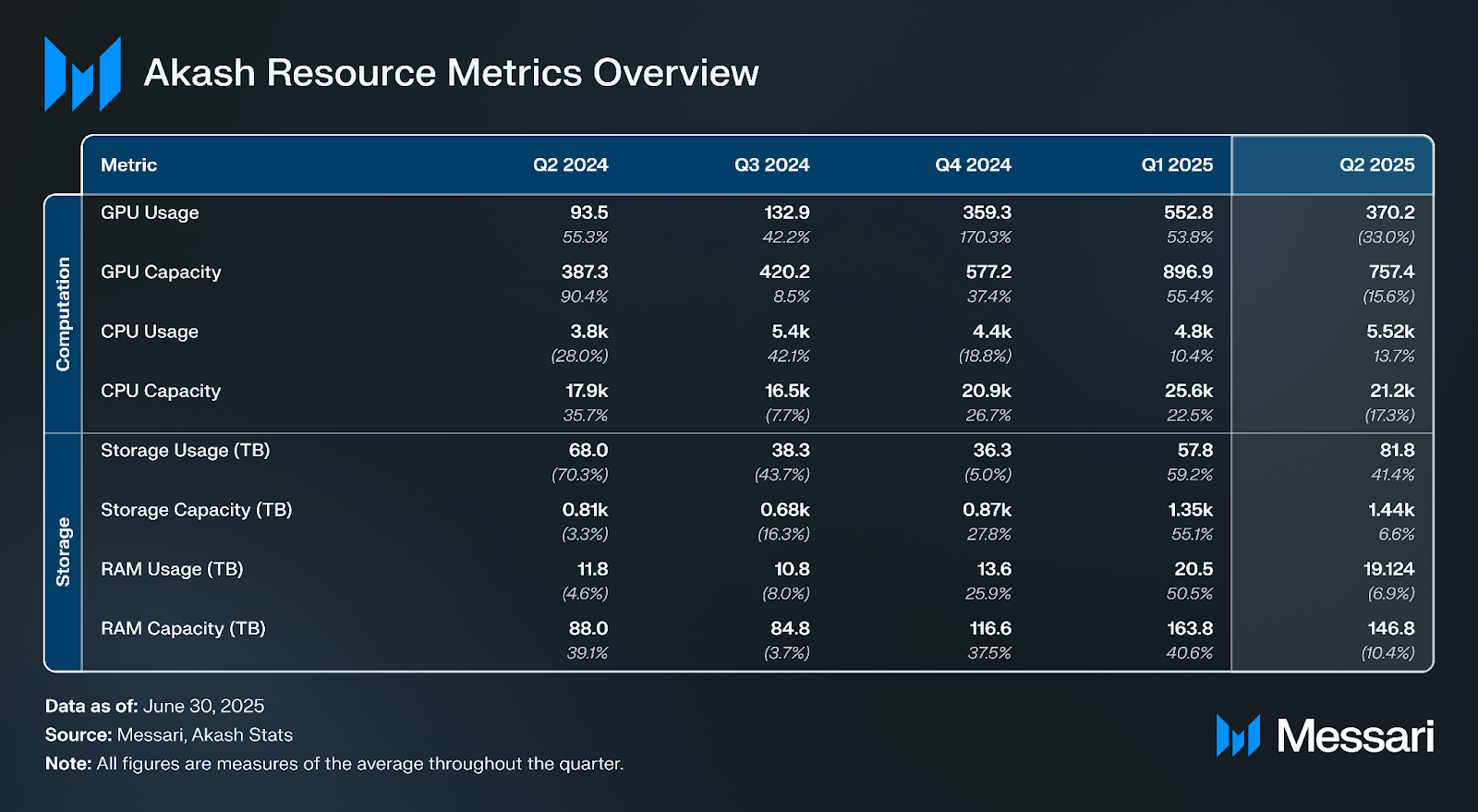
CPU Usage and Capacity: CPU usage increased 14% QoQ, from 4,800 to 5,500, even as GPU usage declined. This indicates that while GPU-heavy AI workloads consolidated, CPU demand increased, supported by non-AI deployments and smaller-scale tenant activity. CPU capacity decreased 17% QoQ, from 25,600 to 21,200, likely tied to provider adjustments following the Q2 spam attack and realignment of resources toward GPUs.
Storage Usage and Capacity: Storage usage grew 41% QoQ, from 57.8 TB to 81.8 TB in Q2 2025. Storage demand expanded alongside integrations like Envision Labs and Codex Storage, which require persistent data for generative AI and decentralized storage use cases. Capacity growth was more modest at 7% QoQ, suggesting utilization efficiency improved as demand scaled faster than supply.
RAM Usage and Capacity: RAM usage declined 7% QoQ, from 20.5 TB to 19.1 TB, after three straight quarters of growth. This mirrors the GPU usage decline and points to fewer large-scale AI model runs in Q2 relative to Q1. RAM capacity also contracted 10% QoQ, from 163.8 TB to 146.8 TB, consistent with the pullback in provider supply observed across GPU and CPU metrics.
GPU Compute
GPU usage declined 33% QoQ, from 552.8 to 370.2 units, while capacity fell 16% QoQ, from 896.9 to 757.4. This was the first contraction after four quarters of growth. The pullback reflects providers scaling back capacity after Q1’s surge, as well as disruption from the spam attack that discouraged smaller providers.
While raw GPU usage declined in Q2 2025, utilization efficiency remained high, averaging around 50% for the quarter and peaking at 57% on June 26. This indicates that workloads were consolidating into fewer, longer-running leases on high-performance GPUs (e.g., H100s), driven by integrations with Saga, Gensyn, and Envision Labs, and increasingly focused on higher-value AI and enterprise deployments.
Active Providers
Akash’s permissionless network allows resource providers to join from anywhere in the world, creating a geographically diverse and resilient infrastructure. This global distribution enhances the network’s ability to withstand regional disruptions, such as natural disasters, power outages, or political instability. It also improves performance by enabling tasks to be processed closer to end users, reducing latency and optimizing data transfer efficiency.
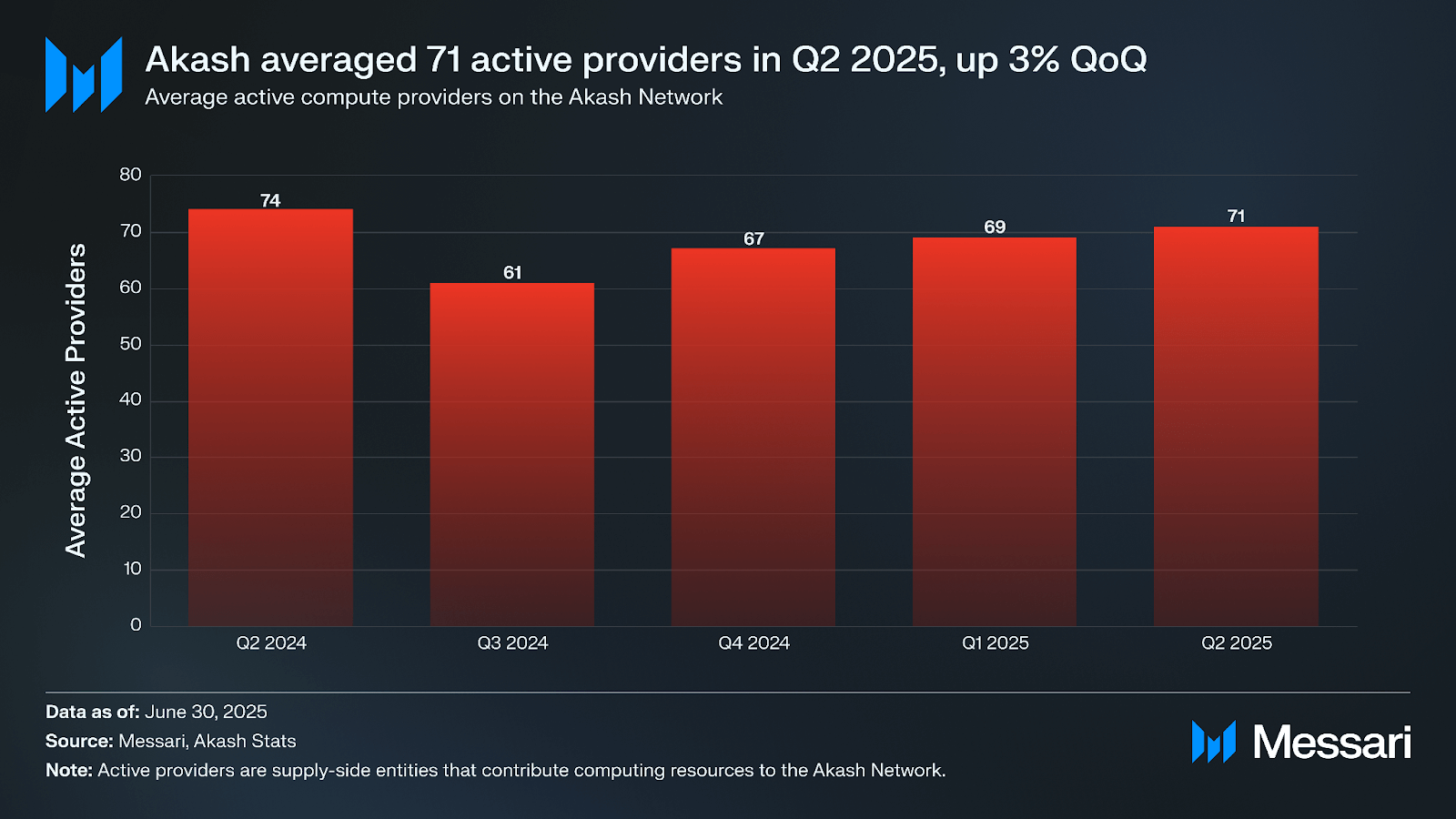
In Q2 2025, the number of active providers increased from 69 to 71, a modest 3% QoQ increase. Growth was supported by lower onboarding barriers from the Provider Console, which automated setup and management for data center operators. Tokenized infrastructure experiments, such as Silicon.net’s GPU NFT pilot with $58,000 in payouts, also validated real earnings distribution and reinforced incentives for new entrants.
Token Analysis
Market Cap
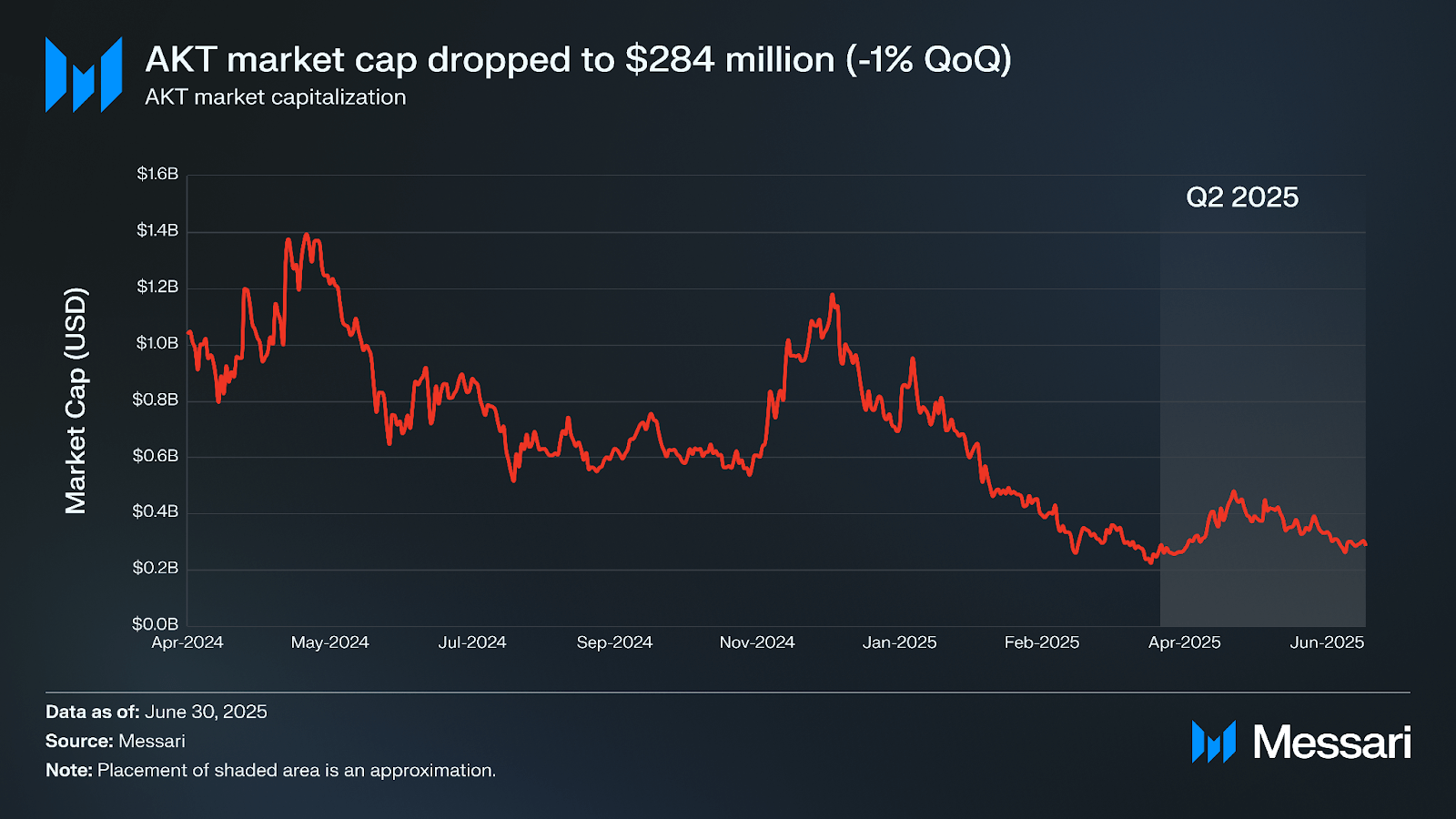
Akash’s circulating market capitalization declined 1% QoQ, from $287 million to $284 million, while the token price fell 9.7%, from $1.16 to $1.05. On May 27, 2025, Grayscale added AKT to its new “AI Tools & Resources” sector index, and on June 2, 2025, Coinbase included AKT in its Coinbase 50 (COIN50) index, a market-cap-weighted benchmark of the top 50 digital assets listed on the exchange.
Qualitative Analysis
Partnerships and Developments
AI Agent Infrastructure Expansion: Akash deepened its role in the emerging Agentic Age during Q2 2025 by supporting multiple frameworks and integrations that enable autonomous AI agents. On May 18–27, 2025, Nous Research hosted an RL Environments Hackathon with NVIDIA and xAI to demonstrate decentralized reinforcement learning on Akash. Levangie Labs, first integrated in Q1, continued showcasing their frameworks with live demos at Accelerate in June.
Morpheus Integration: On April 3, 2025, Akash launched a one-click Console template for Morpheus, a Smart Agent Builder framework that lets developers create autonomous agents capable of purchasing compute and inference services. The integration allowed providers to supply inference resources directly to Morpheus Builder Subnets, streamlining agent deployment.
Gensyn Testnet Deployment: On May 12, 2025, Akash added support for Gensyn RL-Swarm nodes on NVIDIA H100 GPUs, enabling decentralized reinforcement learning training directly on the Supercloud. Gensyn, a distributed machine learning compute network, marked a significant expansion of Akash into reinforcement learning workloads.
VPS AI Integration: On May 28, 2025, Akash integrated with VPS AI, a decentralized compute platform focused on AI/ML workloads, to support on-chain bidding and GPU-powered inference. The collaboration extended Akash’s role as a permissionless backend for distributed AI compute markets.
Saga Integration: On May 29, 2025, Akash compute was integrated into Saga’s chainlets to power decentralized AI agent “super swarms.” Saga, a network that enables developers to spin up sovereign application-specific chains (“chainlets”), leveraged Akash to showcase lower-cost access to open-source AI models and scalable agent deployments.
Silicon.net Collaboration: On May 30, 2025, Silicon.net reported $58,000 USDC in payouts to GPU NFT holders from Akash rentals over a five-month pilot. As a platform experimenting with tokenized GPU ownership, Silicon.net validated a new model for real earnings distribution and reinforced Akash’s provider economics.
AkashChat Model Deployments: In Q2 2025, AkashChat, the network’s conversational AI platform, added several flagship models:
On April 8, 2025, AkashChat integrated Llama 4 Maverick, Meta’s state-of-the-art model with Voice Input and Branching Conversations.
On April 29, 2025, AkashChat deployed Qwen3, a 235B-parameter model surpassing o1 and DeepSeek benchmarks, made freely available via chat and API.
On May 30, 2025, AkashChat launched DeepSeek-R1-0528, an open-source model approaching OpenAI’s o3 performance, deployed with full chat and API access.
Developer & Console Upgrades: MCP Server: On April 3, 2025, Akash integrated with Anthropic’s Model Context Protocol (MCP), enabling AI agents to deploy and manage workflows directly on Akash.
Governance
Akash Network’s governance in Q2 2025 remained highly active, with eight proposals passed covering network upgrades, contributor programs, event funding, ecosystem expansion, and core infrastructure support.
Community Programs and Ecosystem Support
Proposal 286– Q2 Community Programs Funding (April 7): Allocated $92,500 in AKT to continue funding structured community roles including Vanguards (support), Navigators (technical onboarding), Alchemists (educational content), and Ringmasters (regional event organizers). These programs sustain Akash’s contributor pathways, formalizing leadership roles and fostering ecosystem growth.
Proposal 287– Q2 Community Activities and Bounties (April 10): Approved $158,575 in AKT to support hackathons, community bounties, and local meetups. This included continued funding for the Community Bounty Program Manager role piloted in Q1, with oversight of technical and non-technical bounty scoping to ensure targeted contributions across the ecosystem.
Proposal 291– De-AI Hub (June 18): Funded $205,685 in AKT (50/50 split with Manifold Labs) to maintain a physical DeAI workspace in Austin, Texas, from March 2025 to March 2026. The hub serves as a collaboration center for Akash contributors, hosting hackathons, industry events, and acting as a focal point for decentralized AI and DePIN activity in one of the U.S.’s most active tech communities.
Events and Ecosystem Growth
Proposal 285– Q2 Events Resourcing (April 2): Approved $325,277 in AKT to fund Q2 events, including Yale Blockchain Conference, Austin DeAI Week, Cornell Blockchain Conference, NY Tech Week, Permissionless (Tier-2 flagship sponsorship), AI Engineer World Fair, and Token2049 Dubai. The budget also covered a shortfall from Q1 event liquidations and reimbursements for Q1 hackathon participation.
Proposal 289– Akash Accelerate 2025 (April 28): On April 28, 2025, Proposal 289 allocated $340,768 in AKT for Akash’s second annual Accelerate conference, held in Brooklyn on June 23, 2025. The event targeted ~500 attendees and ~1,800 RSVPs, with programming centered on AI, decentralized compute, and energy infrastructure.
Network Upgrades and Core Infrastructure
Proposal 288– AEP 32 Provider Console (April 16): Allocated $398,072 in AKT to fund the Provider Console, a graphical interface designed to simplify provider onboarding and management. The tool complements the Deployment Console, allowing individuals and data centers to manage providers through a GUI rather than CLI. Features include dashboards for leases, earnings, compute resources, and observability, with additional upgrades planned over time.
Proposal 290– AEP 62, 63 & 64 (June 11): Approved $161,225 in AKT for a package of upgrades, including:
AEP-62: Node management interface for providers.
AEP-63: Managed wallet/credit card Console API.
AEP-64: JWT authentication for provider APIs.
Proposal 292– H1 2025 AEP Support Services (June 24): Allocated $1.33 million in AKT from the community pool to fund Overclock Labs’ support services for H1 2025. The budget covered Deploy and Provider Console enhancements, DevOps for provider incentive pilots, core technical support, and administrative functions (SIGs, community events, brand management). This ensured continuity of essential ecosystem and infrastructure support beyond specific development AEPs.
Ecosystem and Recognition
Community Growth: During Q2 2025, the Akash Insiders Program expanded to 61 contributors across 18 countries, with structured roles (Navigators, Ringmasters, Alchemists, Vanguards) scaling grassroots engagement.
Media Recognition: On May 13, 2025, Greg Osuri appeared on the Crypto 101 Podcast to discuss DeAI, energy, and the Supercloud, and On May 20, 2025, Forbes profiled Akash’s decentralized compute model.
Closing Summary
In Q2 2025, Akash Network’s new leases declined 59% QoQ to 19,000, but revenue proved more resilient, falling 20% to $820,000 as activity consolidated into fewer, longer-lived, high-value deployments. GPU usage contracted 33% alongside a 16% drop in capacity, though utilization efficiency remained steady at 50%, peaking at 57% in late June.
The number of active providers rose slightly from 69 to 71, supported by the Provider Console and tokenized infrastructure pilots. Governance was active, with eight proposals passed across community, events, and core upgrades. Key integrations with Morpheus, Gensyn, Saga, VPS AI, and Envision Labs highlighted Akash’s role in powering AI agents and reinforcement learning, while institutional recognition expanded with AKT’s inclusion in Grayscale’s AI index and the Coinbase 50 Index.
Overall, Q2 2025 underscored a transition toward higher-value, enterprise, and AI-driven usage on Akash. While lease counts contracted, utilization and revenue in AKT terms highlighted consistent underlying demand for decentralized compute, even as USD revenues were pressured by token price declines.
This report was commissioned by Overclock Labs. All content was produced independently by the author(s) and does not necessarily reflect the opinions of Messari, Inc. or the organization that requested the report. The commissioning organization may have input on the content of the report, but Messari maintains editorial control over the final report to retain data accuracy and objectivity. Author(s) may hold cryptocurrencies named in this report. This report is meant for informational purposes only. It is not meant to serve as investment advice. You should conduct your own research and consult an independent financial, tax, or legal advisor before making any investment decisions. Past performance of any asset is not indicative of future results. Please see our Terms of Service for more information.
No part of this report may be (a) copied, photocopied, duplicated in any form by any means or (b) redistributed without the prior written consent of Messari®.
Armita is a protocol researcher with a robust background in technology and blockchain. Before her role at Messari, she distinguished herself as a tech entrepreneur, executive, and advisor for various blockchain startups. Armita holds two master's degrees, one in Computer Engineering and another in Business Management, as well as a double major undergraduate degree in Physics and Pure Mathematics.
Armita is a protocol researcher with a robust background in technology and blockchain. Before her role at Messari, she distinguished herself as a tech entrepreneur, executive, and advisor for various blockchain startups. Armita holds two master's degrees, one in Computer Engineering and another in Business Management, as well as a double major undergraduate degree in Physics and Pure Mathematics.