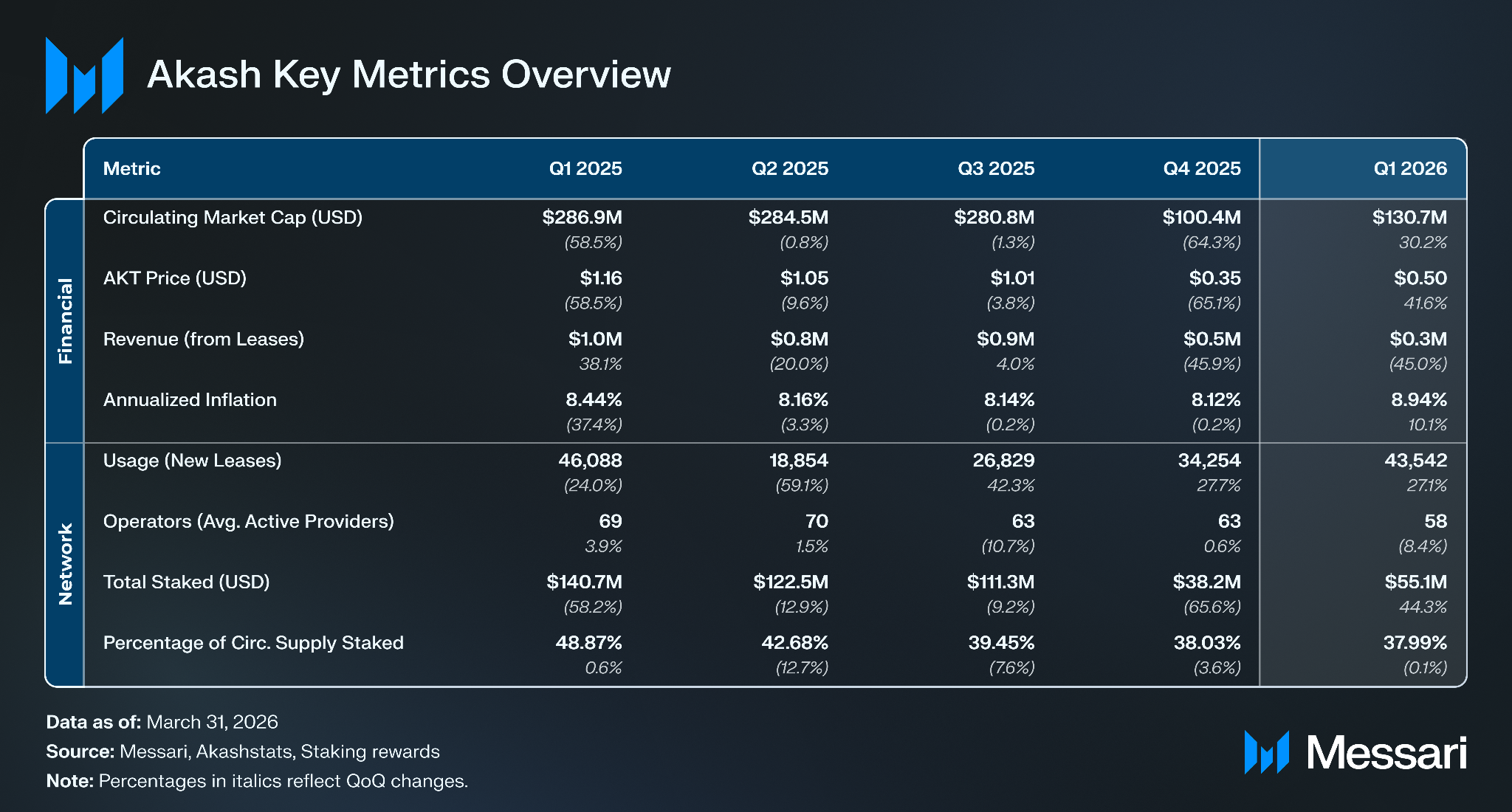
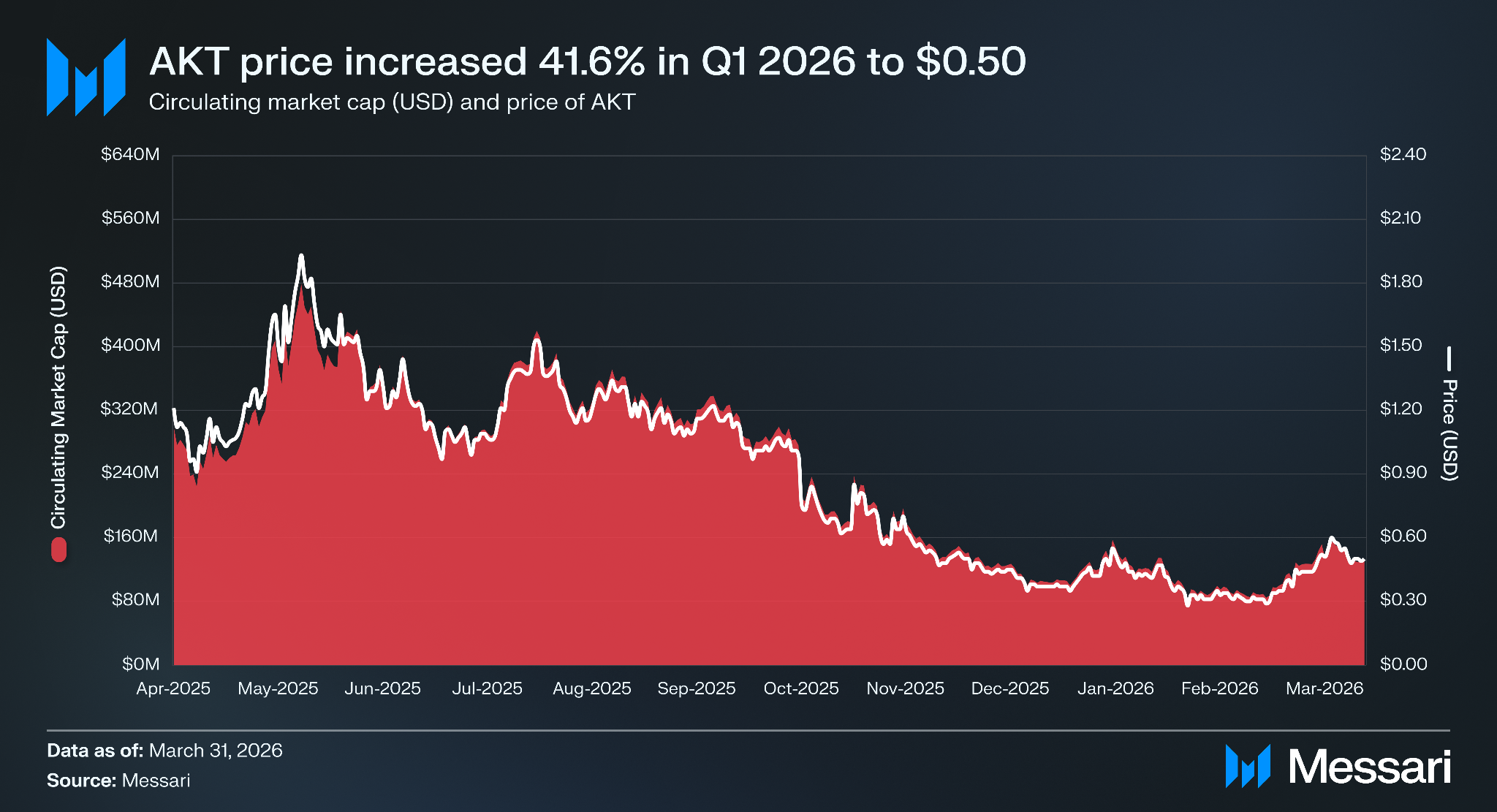
The Burn-Mint Equilibrium (BME) framework was activated on March 23, 2026, via Mainnet 17, tying every onchain compute workload to an AKT market buy and creating the first deflationary mechanism in the network’s history. AKT rallied 41.6% QoQ to $0.50, with the move concentrated around the activation date, marking a structural shift in what drives AKT price formation going forward.
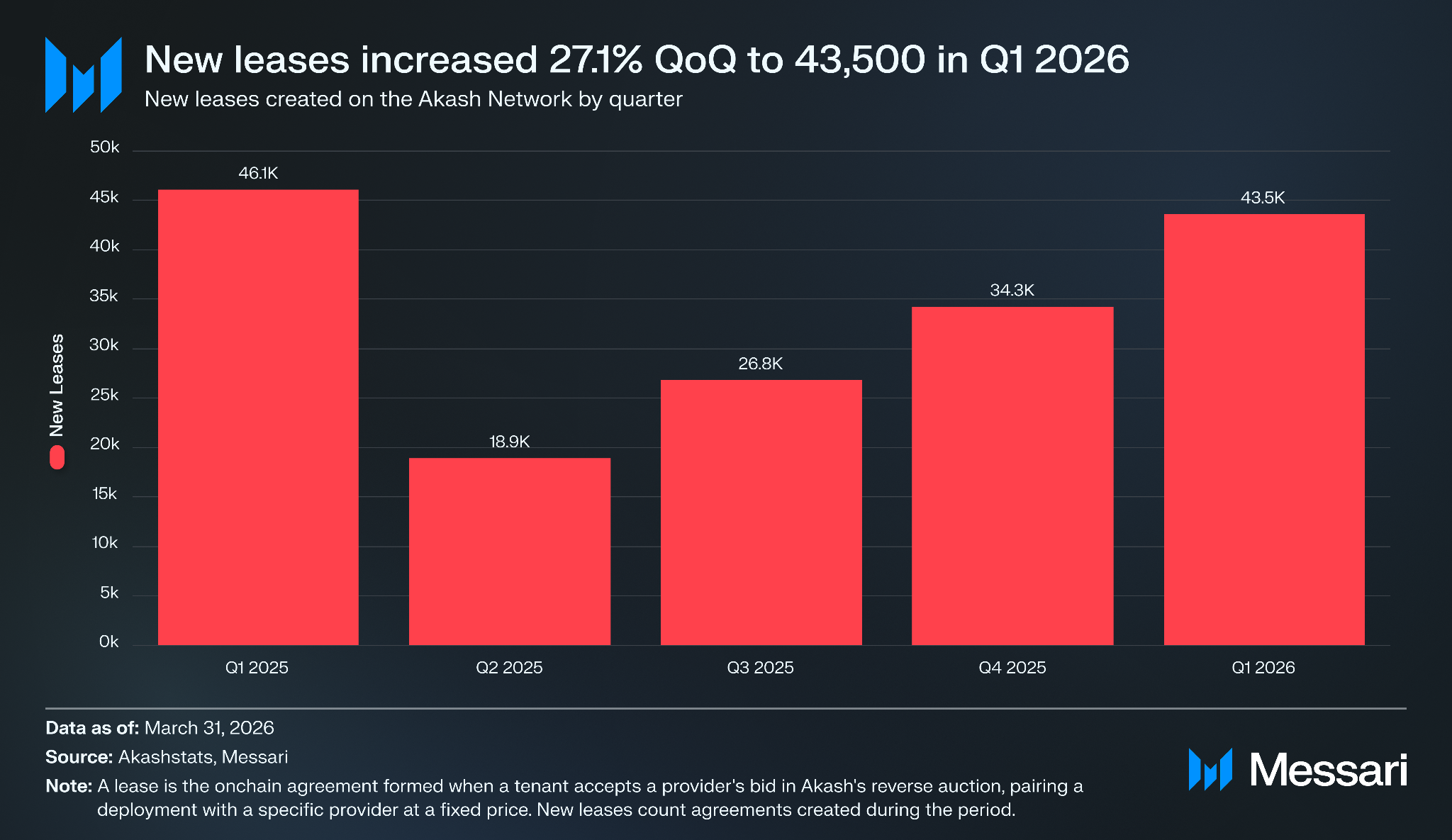
New leases increased 27.1% QoQ to 43,540, the third consecutive quarter of sequential growth, while lease revenue compressed 45% QoQ to $253,245, due to continued rotation toward lower-cost workload types.
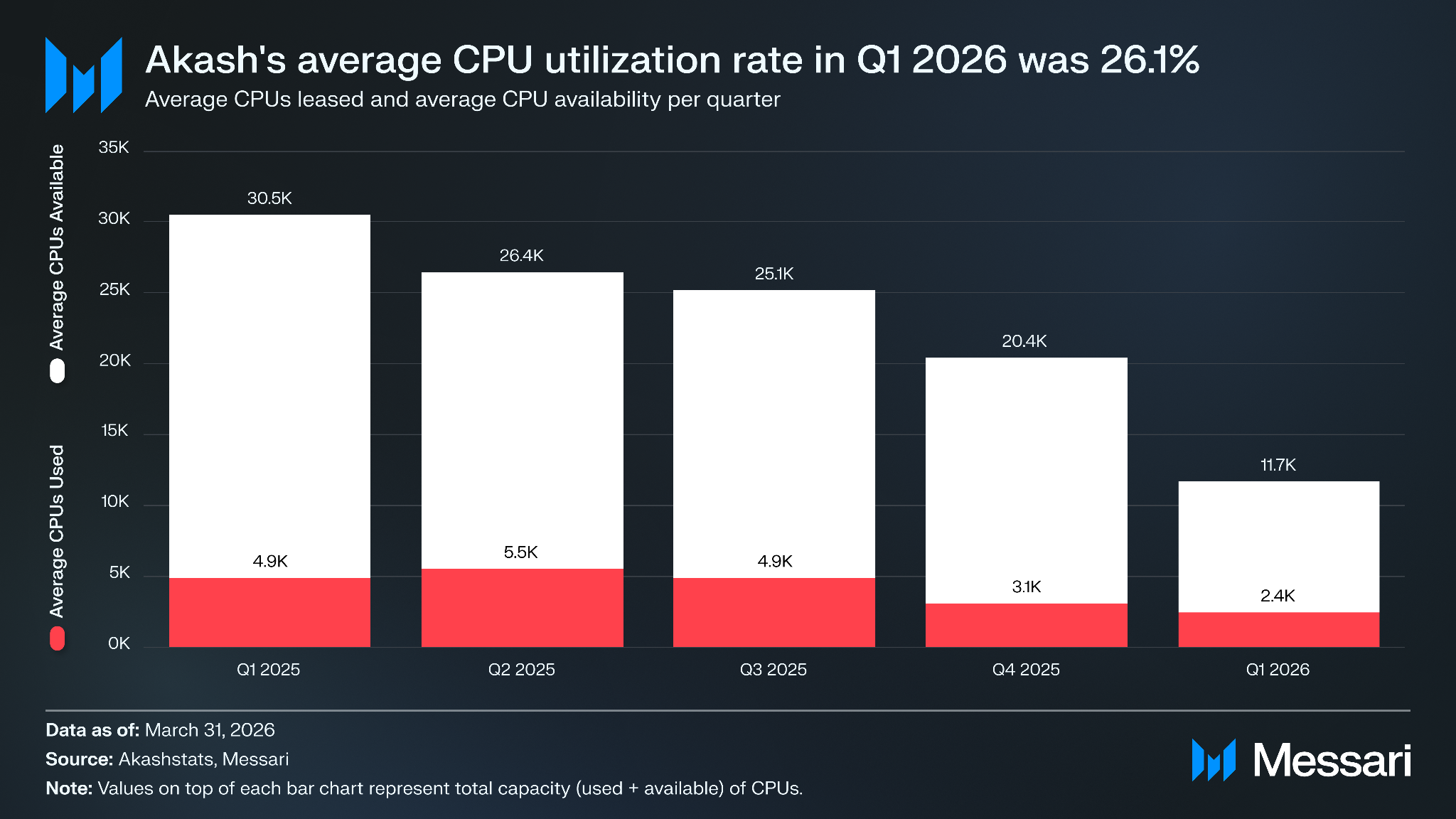
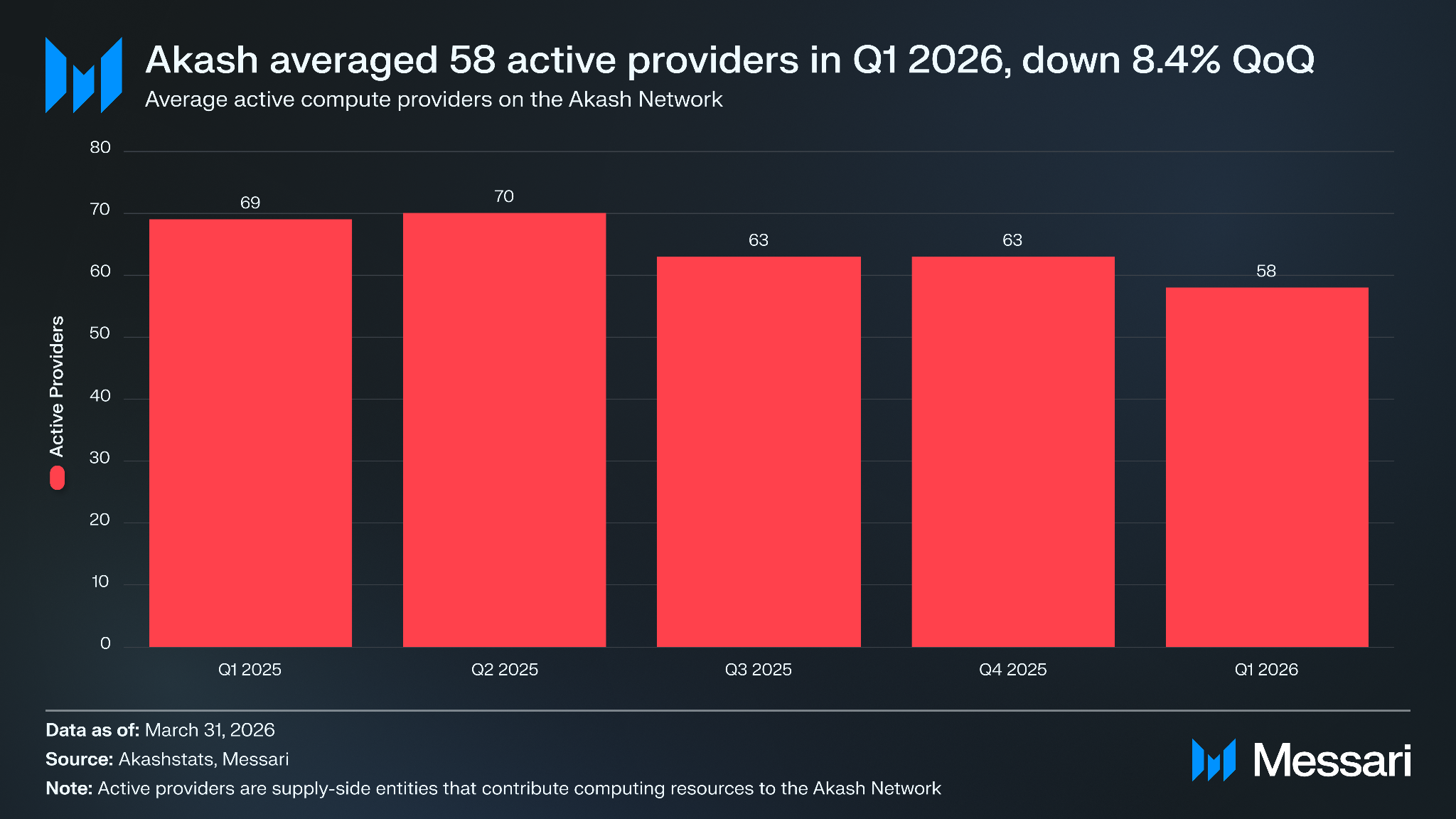
Average active providers fell 8.4% QoQ to 58, the lowest quarterly count in recent history, while compute capacity contracted across all four resource categories. CPU utilization rose 8.4% to 26.1% as providers cut idle capacity faster than usage declined.
Akash launched two strategic AI infrastructure products during the quarter: Akash Homenode, which democratizes GPU contribution by enabling individual hardware owners to earn from network compute demand, and the Akash Agents platform, which provides one-click AI agent deployment on decentralized compute. The additions broaden the network’s addressable market by extending supply beyond datacenter operators and lowering the deployment barrier for the fastest-growing AI workload category, positioning Akash to capture structural AI infrastructure demand through 2026.
Primer
Akash (AKT) is a decentralized cloud computing marketplace that facilitates the buying and selling of compute resources. It is an open-source, permissionless protocol that provides an alternative to today’s centralized cloud services (i.e., AWS, Azure, and Google Cloud). Akash creates an open marketplace for that excess supply, letting hardware operators monetize unused servers while tenants access compute outside the centralized cloud. Akash is a Tendermint-based, Layer-1 network built using the Cosmos SDK. Marketplace activity (requests, bids, lease details, etc.) is stored onchain, and payments are settled with Akash’s native token, AKT.
The Akash marketplace operates via a reverse auction, allowing users to set a price and specify the resources they want for deployments. Akash’s decentralized network of compute providers runs its open-source software and competes to provide resources, often at a fraction of the cost of big cloud providers. Specifically, Akash hosts containers where users can run any cloud-native application (e.g., AI workloads, gaming servers, blockchain nodes, and websites). Akash offers extensive cloud management services, including Kubernetes, which can be used to host and manage containers. Additionally, Akash supports decentralized AI applications such as Venice.ai, AkashChat, and AkashGen, reflecting its role in enabling AI infrastructure. For a full primer on Akash, refer to our Initiation of Coverage report.
AKT’s circulating market cap rose 30.2% QoQ, from $100.4 million at the end of Q4 2025 to $130.7 million at the close of Q1 2026. Over the same period, AKT climbed 41.6%, from $0.35 to $0.50. The recovery partially reversed the 64.3% contraction in circulating market cap recorded in Q4 2025 from $280.8 million to $130.7 million.
AKT had a volatile Q1 2026. On Jan. 1, 2026, AKT was $0.37, then bottomed at $0.28 on Feb. 5, 2026, and rallied through the back half of the quarter, peaking at $0.60 on March 21, 2026. The late-quarter rally tracked with governance progress on the Burn-Mint Equilibrium (BME) upgrade, a redesign of AKT’s economic loop that routes every dollar of compute spend through a market buy of AKT.
BME is the most consequential change to AKT’s tokenomics since network launch. Under the prior AEP-23 framework, tenants paid for compute in axlUSDC, and providers settled in stable terms, which drove enterprise adoption but progressively weakened AKT’s role as the network’s economic unit. Usage scaled while native-token demand did not. BME closes that gap without reintroducing price volatility for parties transacting on the network.
Each AKT buy is burned to mint ACT (Akash Compute Token), a non-transferable settlement token denominated in USD that sits in the BME vault for the duration of the compute lease and pulls corresponding supply out of circulation. Providers receive ACT as payment and can redeem it back to AKT at the current market price when the lease settles. When AKT appreciates between tenant top-ups and provider payouts, the system burns net AKT, making the token deflationary and tying the burn magnitude directly to network activity. Buyers and providers transact at USD-denominated prices while the AKT market absorbs the compute-demand signal.
The BME framework was activated on March 23, 2026, through Mainnet 17, the v2.0.0 protocol upgrade. Four Akash Enhancement Proposals (AEP) shipped in that upgrade to operationalize the design. AEP-76 defined the BME loop itself, specifying how ACT-denominated settlements translate into AKT burns and mints. AEP-78 enabled CosmWasm smart contracts on Akash, allowing BME to execute as auditable, upgradable contract code rather than hardcoded protocol logic. AEP-80 added a native Cosmos SDK oracle module that aggregates prices from authorized sources, computes a time-weighted average over a configurable window with staleness and deviation guardrails (defaulting to 1.5% deviation tolerance and a 60-block staleness ceiling), and exposes the resulting price feed to consuming modules via keeper queries. All oracle parameters, including authorized sources and guardian sets, sit under Akash governance control rather than external dependencies. AEP-81 brought Pyth's AKT-USD feed onchain through a two-contract design: a Wormhole verifier validating signatures from a 13-of-19 guardian quorum, and a Pyth relay parsing the verified payload before submitting to the oracle module. An offchain Hermes client relays VAA-signed price data on a configurable interval, keeping the onchain contracts stateless and minimizing attack surface. The dual-feed medianization, paired with Osmosis TWAP, eliminates the risk of single-source manipulation in the price input feeding into every BME settlement.
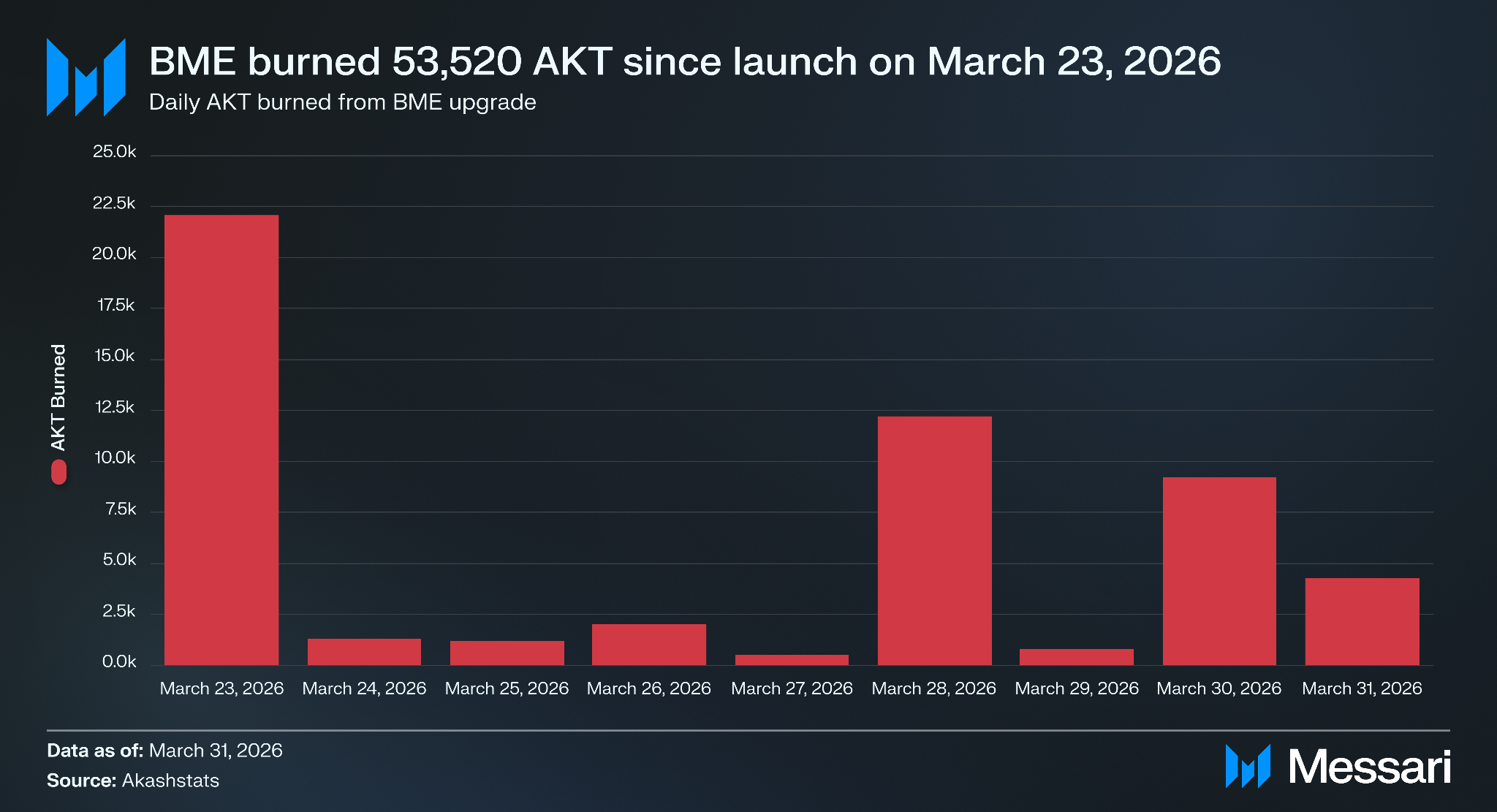
The governance process throughout the quarter was straightforward. BME ran an incentivized testnet starting Feb. 17, 2026, covering more than 10 test categories with up to 250 participants and over $10,000 in distributed incentives. Proposal 318 (Mainnet 17, v2.0.0) cleared governance between March 6 and March 13, 2026, with 99.7% YES, and the network executed the upgrade at block 26063777 on March 23, 2026. The legacy x/take module was retired in the process, and the take-rate logic now resides in BME. Existing deployments migrated to the ACT denomination during the upgrade block, with axlUSDC converting 1:1 and uAKT phasing through the EndBlocker afterward. As of March 31, 2026, 53,520 AKT have been burned because of BME.
The rally’s concentration around March 23, 2026, indicates the market has already begun repricing AKT against the new demand pathway. The extent of the follow-through will hinge on how quickly compute spend compounds against a now-shrinking circulating supply of AKT.
Usage and Provider Analysis
Leases and Revenue
A lease is the onchain agreement that forms when a tenant accepts a provider’s bid in Akash’s reserve auction, pairing the tenant’s deployment with that provider until the deployment closes. New leases reached 43,540 in Q1 2026, up 27.1% QoQ from 34,250 in Q4 2025, though still down 5.5% YoY against the 46,080 leases recorded in Q1 2025. The result marks the third consecutive quarter of sequential growth in new leases.
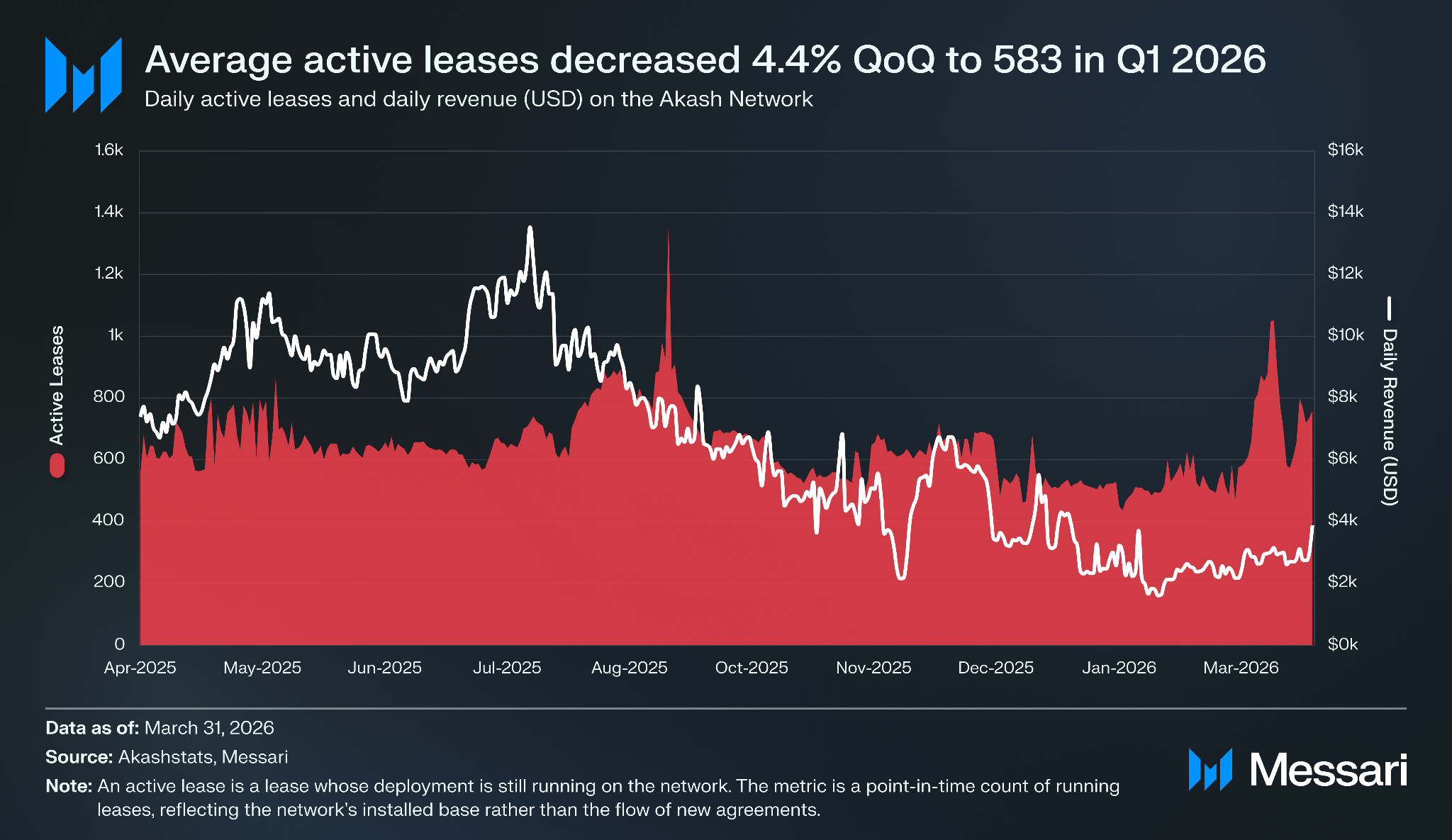
Active leases represent ongoing agreements in which tenants consume and manage computational resources on the network. Leases remain active as long as workloads continue running and terminate once deployments close, making the metric a real-time proxy for the network’s installed workload base rather than a proxy for the flow of new agreements.
The average number of active leases on Akash in Q1 2026 was 583, down 4.4% QoQ from 610 in Q4 2025 and 32.9% below the 868 average recorded in Q1 2025. Lease revenue compressed 45% QoQ from $460,510 to $253,250. The gap between the modest drop in average active leases and the steeper revenue decline reflects tenants continuing to run cheaper, smaller deployments on the network.
The quarterly average masks a late-quarter inflection point, with daily leases surging after the launch of the Akash Agents platform on March 26, 2026. The launch enabled one-click deployment of AI agents, including OpenClaw, an open-source agent built by Peter Steinberger, and Hermes, built by Nous Research. The momentum carries into Q2 2026, where a lower-friction environment, paired with expanding demand for AI agent infrastructure, gives the network a credible path to convert that interest into sustained compute consumption.
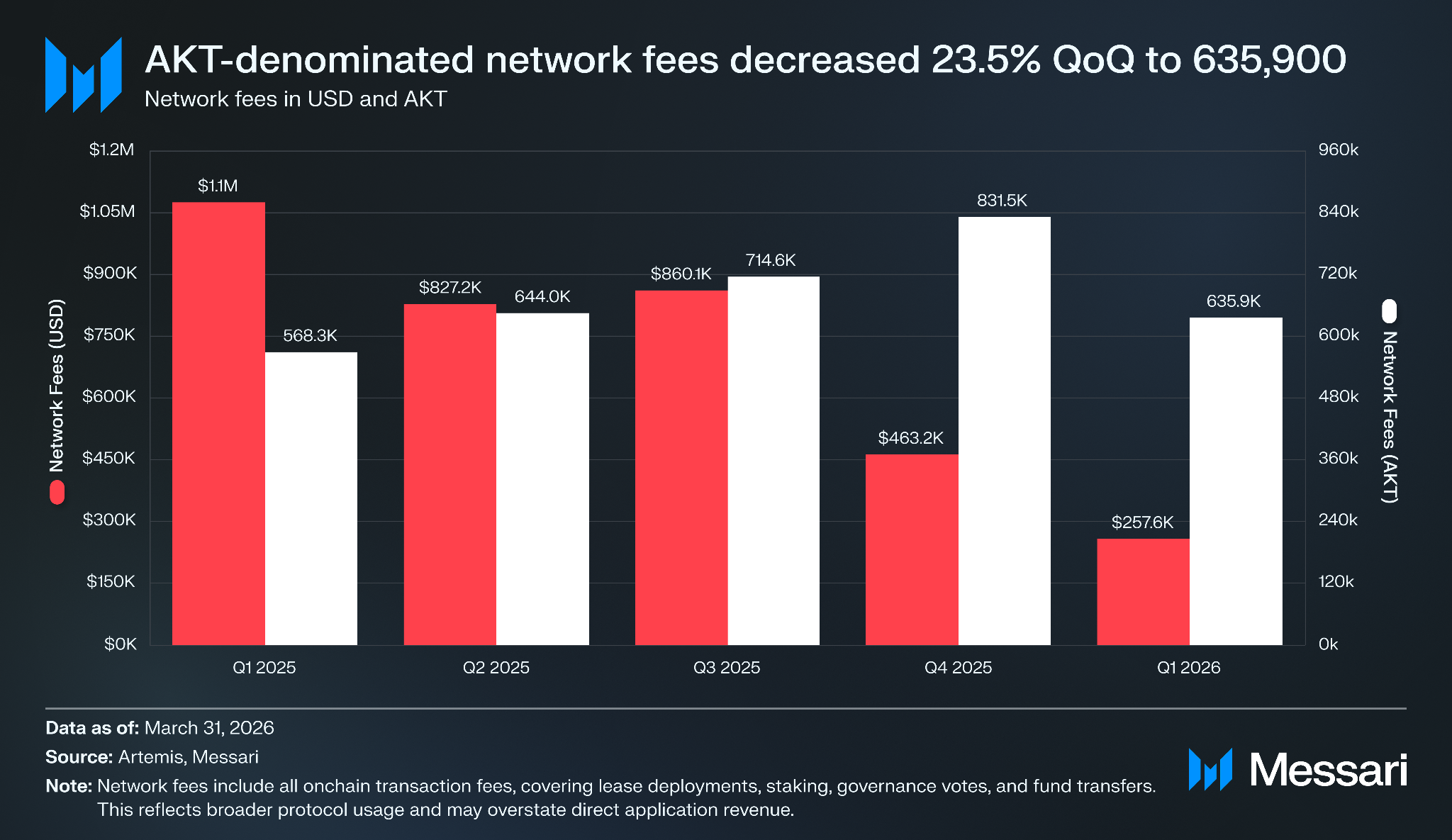
Lease revenue is the dominant component of Akash’s network fees. In Q1 2026, lease revenue of $253,250 accounted for 98% of the $257,580 in total network fees. The remainder came from network transaction fees, including base fees, provider take rates, and other transaction-level costs associated with lease activity. Total network fees declined 44% QoQ from $463,220 in Q4 2025.
Resource Compute
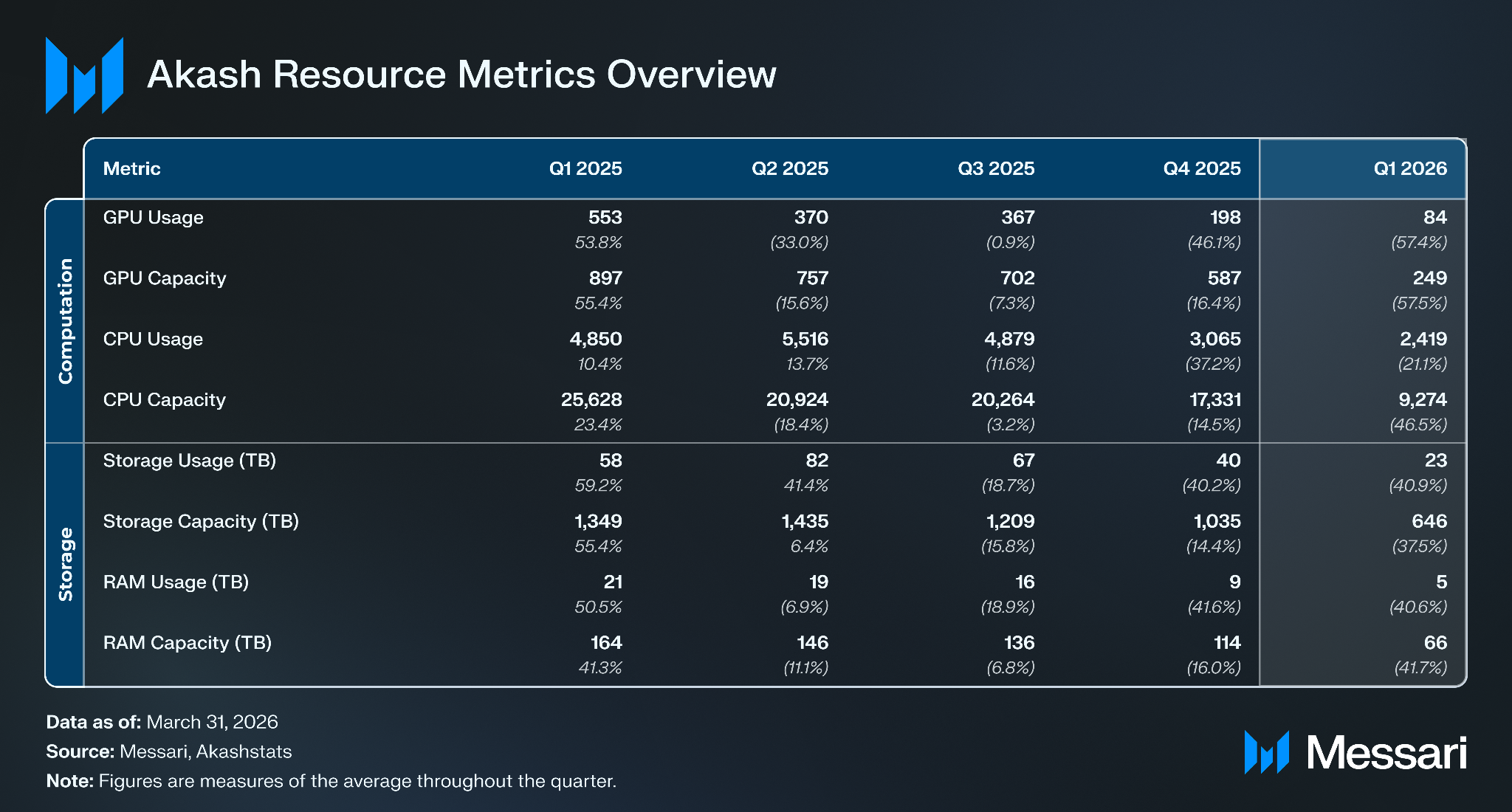
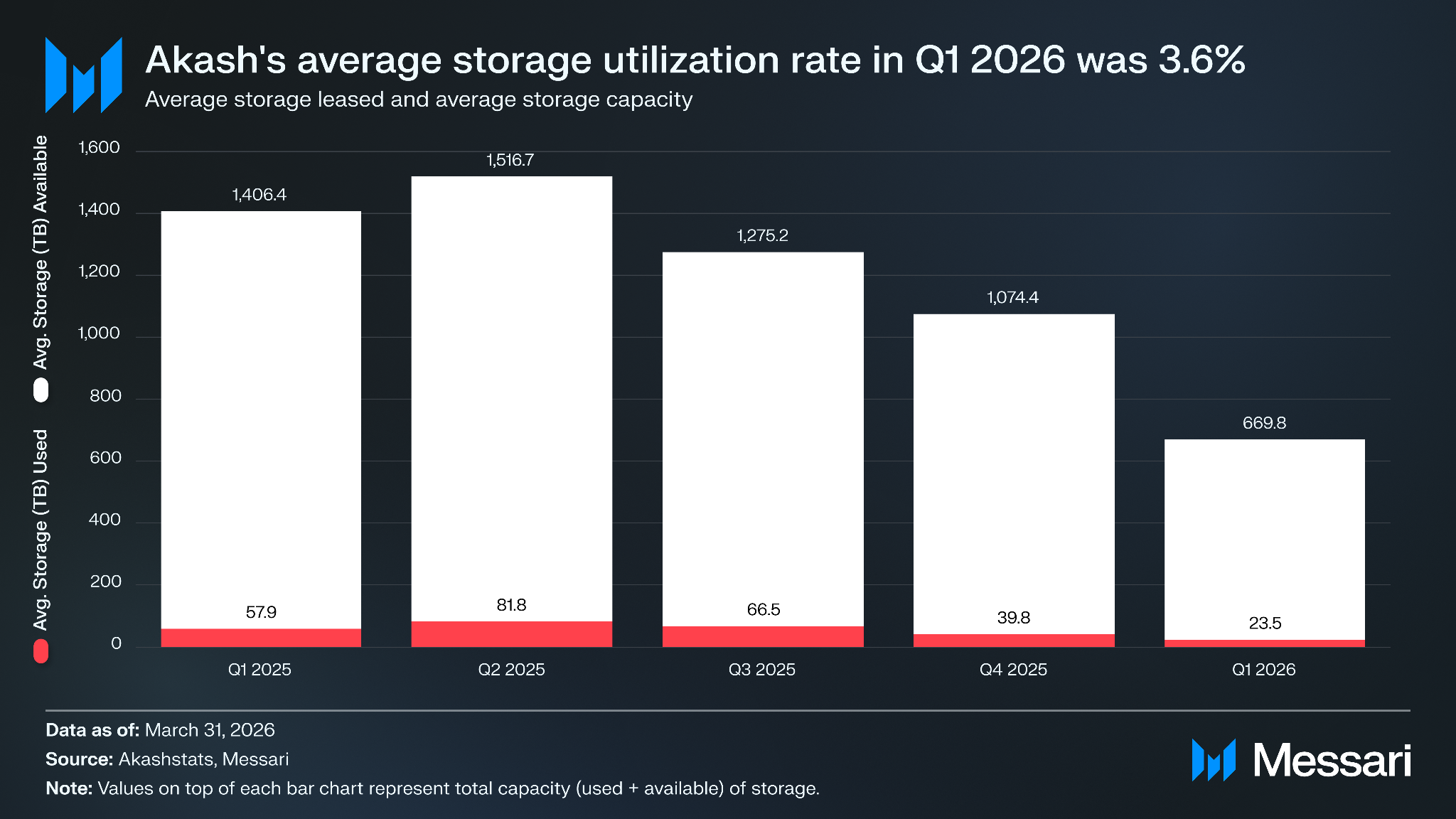
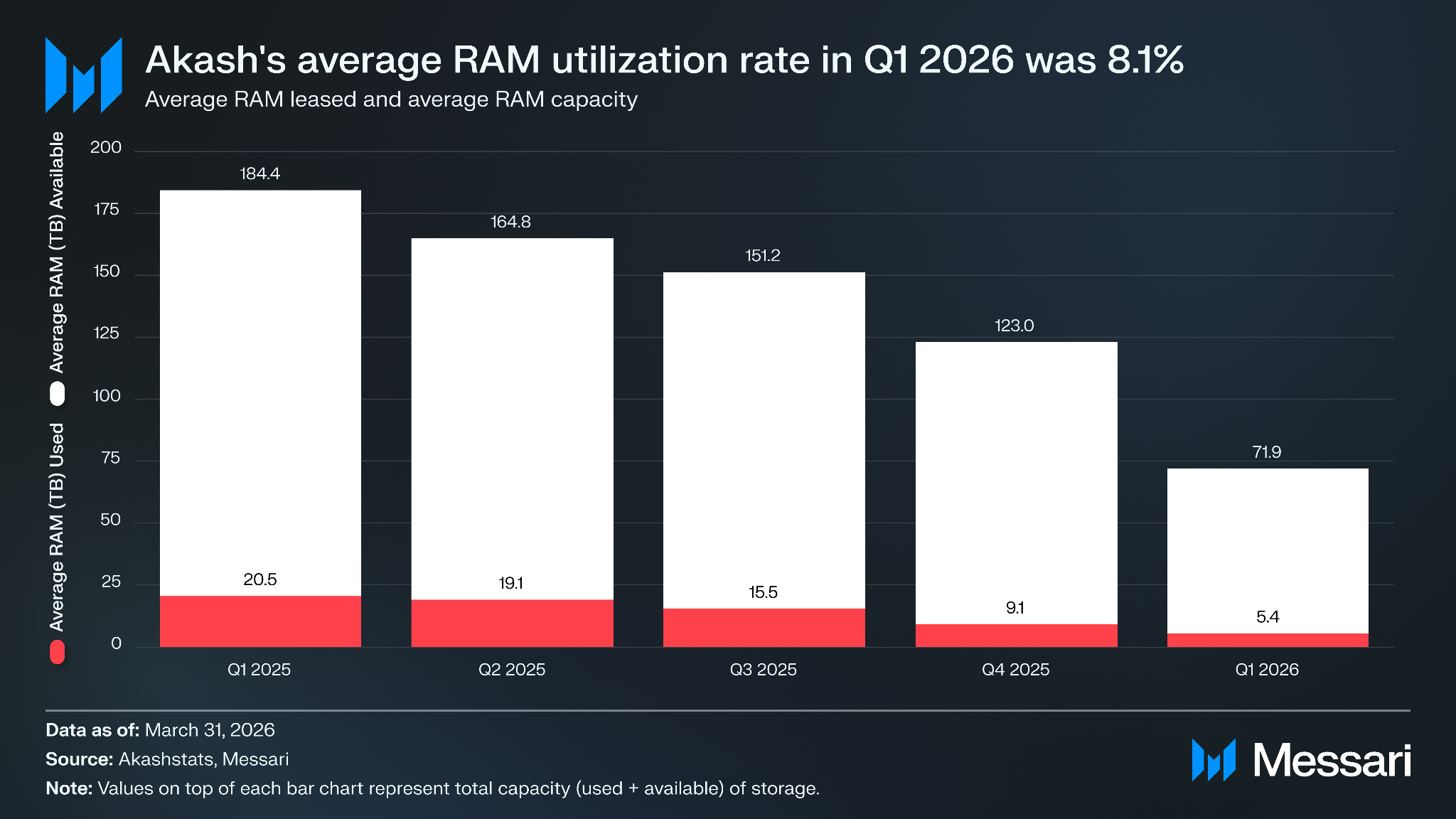
GPU, CPU, storage, and RAM all declined in Q1 2026. Both the capacity providers offer, and the usage tenants consume fell QoQ. Utilization rates were broadly steady: GPU, RAM, and storage held flat, while CPU utilization rose because providers cut capacity faster than usage dropped.
GPU Usage and Capacity
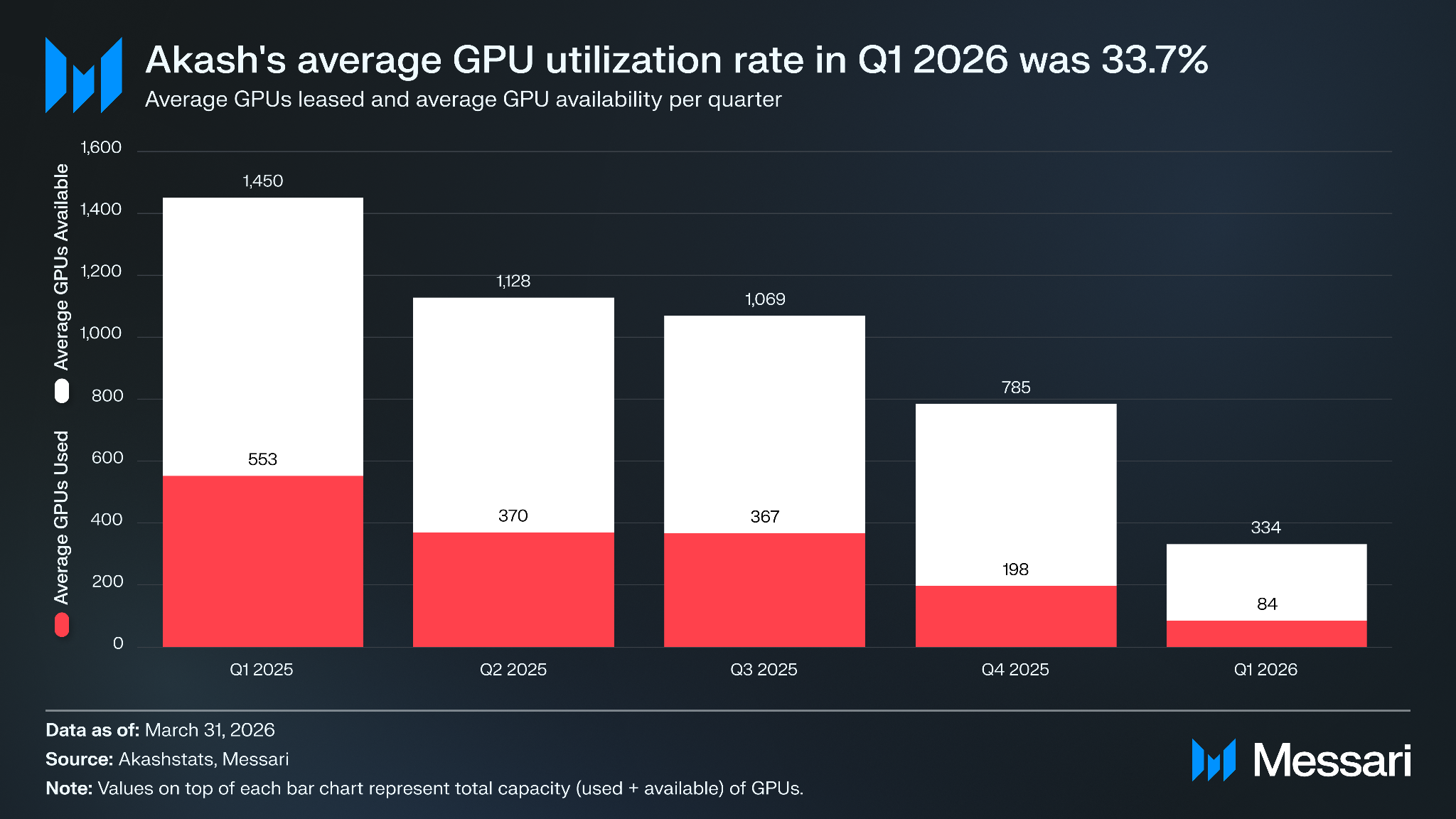
Average GPU usage fell 57.4% QoQ to 84 GPUs in Q1 2026, while average GPU availability contracted 57.5% QoQ to 334 units. The near-symmetric decline held average utilization at 33.7%, unchanged from Q4 2025 and the highest utilization rate across the four resource classes. GPU remains the most productively loaded resource on the network, with providers cutting capacity at the same rate demand is falling rather than letting it sit idle.
A GPU count alone doesn’t tell the full story because not all GPUs are created equal. Akash supports a range of models, from datacenter-tier H100s, H200s, and A100s used by enterprise providers down to consumer and prosumer cards like the RTX 4090, RTX 5090, and Quadro RTX 6000 Ada now eligible through Akash Homenode. Each tier carries materially different performance, pricing, and revenue per lease, so a single-GPU shift in supply can represent anything from a few thousand dollars of consumer hardware to tens of thousands of dollars of datacenter capacity.
CPU Usage and Capacity
Average CPU usage declined 21.1% QoQ to 2,420 vCPUs, while average CPU capacity fell more sharply by 46.5% QoQ to 11,690 vCPUs. The asymmetric contraction pushed average CPU utilization from 17.7% in Q4 2025 to 26.1% in Q1 2026, the largest utilization gain among the four resources.
Akash providers run a range of CPU architectures and generations, from modern AMD EPYC and Intel Xeon Scalable cores to older datacenter chips. Performance per vCPU varies materially across these tiers, so a single vCPU change in supply can represent a meaningful difference in compute power and revenue depending on which provider added or removed capacity.
Storage Usage and Capacity
Storage on Akash is the persistent disk space providers make available for tenant deployments. Average storage usage fell 40.9% QoQ to 23.5 TB, and average storage capacity contracted 37.5% QoQ to 646.3 TB. Average utilization edged down to 3.6%, essentially flat against Q4 2025’s 3.8% and the lowest utilization rate on the network. Storage continues to sit well below available supply, reflecting its secondary role relative to GPUs and CPUs in the AI workloads driving current lease activity.
RAM Usage and Capacity
RAM on Akash is the working memory providers make available for tenant deployments while they’re running. Average RAM usage declined 40.6% QoQ to 5.4 TB, while average RAM capacity fell 41.7% QoQ to 66.5 TB. Average utilization held at 8.1%, nearly unchanged from Q4 2025’s 7.9%. RAM contracted roughly in lockstep with the broader provider footprint, tracking capacity reductions elsewhere on the network without a meaningful shift in the usage-to-capacity ratio.
Active Providers
Akash’s permissionless network allows resource providers to join from anywhere in the world, creating a geographically diverse and resilient infrastructure footprint. This global distribution enhances the network’s ability to withstand disruptions such as natural disasters, power outages, or political instability, and improves performance by enabling workloads to be processed closer to end users.
Average active providers declined 8.4% QoQ from 63 in Q4 2025 to 58 in Q1 2026. The quarterly decrease reverses the stabilization that occurred in Q3 2025 and Q4 2025. It marks the lowest quarterly provider count in the network’s recent history, continuing a multi-quarter trend of consolidation among the active provider set.
Fewer active providers means less total compute available on the network, which is the same dynamic behind the capacity declines. The continued consolidation reflects datacenter operators cutting back capacity that doesn’t fit the AI deployments now driving network demand. Whether the active provider count stabilizes in subsequent quarters depends on how quickly BME's onchain demand mechanics translate into improved unit economics for participating providers, drawing enterprise-grade capacity back onto the network.
Qualitative Analysis
Partnerships and Developments
During Q1 2026, Akash focused on operationalizing the BME tokenomics overhaul, expanding into agentic AI infrastructure, and broadening the network's supply side with a new class of distributed providers. The major build of the quarter, Burn-Mint Equilibrium activation through Mainnet 17, is detailed in the Token Analysis section. The remaining developments outlined below shaped the network’s products, its compute providers, and the AI applications it can host entering Q2 2026.
Mainnet 16 Upgrade
Akash executed Mainnet 16 on March 4, 2026, an interim chain upgrade authorized by Proposal #317, which introduced three substantive changes ahead of the BME activation later in the quarter. The upgrade rolled out the CometBFT Tachyon security fix (CSA-2026-001) to public networks following an earlier binary-only distribution to validators, migrated the deployment and market module stores from hand-rolled key-value storage to typed indexed maps with secondary indexes on State, Owner, and Provider, and added onchain recording of lease close reasons via MsgCloseBid.
The store migration enables efficient filtered queries across deployments and market state, which underpins more responsive Console and indexer experiences as transaction volume scales. The lease close reason logging serves as the onchain prerequisite for AEP-39’s transparency improvements, allowing tenants and providers to determine whether a lease ended due to provider failures, escrow exhaustion, manual shutdown, or other operational events.
Akash Homenode
Akash opened early access sign-ups for Akash Homenode on Feb. 25, 2026, introducing a new participation model that democratizes GPU contribution to the network. Where Akash’s existing provider set consists of datacenter-class operators running enterprise infrastructure, Homenode allows individual hardware owners to contribute consumer and prosumer GPUs from their homes and earn revenue when those GPUs are leased through the network. The product is purpose-built for AI inference workloads. GPU owners register on the website, connect their hardware, and begin earning from compute demand without operating enterprise-grade infrastructure or managing Kubernetes orchestration. The program launched accepting RTX 4090, RTX 5090, and Quadro RTX 6000 Ada GPUs, with broader hardware support planned based on community participation.
By distributing compute across consumer hardware in homes across multiple jurisdictions, Homenode converts an architectural constraint of centralized cloud computing and concentrated data center risk into a structural advantage. A grid disruption, regional outage, or facility-level disruption no longer removes meaningful network capacity. The model also creates a privacy substrate for the next generation of AI agents, where workloads can run on hardware physically located near the end user rather than aggregated in remote data centers.
Governance
Akash governance activity in Q1 2026 centered on coordinating major protocol upgrades, funding the engineering work delivered through those upgrades, and replenishing market-making capital following the AKT price drawdown of the prior quarter. Seven proposals were approved during the quarter, reflecting alignment among AKT holders on the network’s strategic direction.
Proposal 315 - PIP3.5 GPU Capacity Maintenance (Feb. 3, 2026): Approved $789,768 to extend 12-month contracts on 24 H100s, 64 H200s, and 32 A100s instead of deploying B200s under PIP03, citing limited B200 availability and elevated pricing. The original B200 line item was zeroed out.
Proposal 316 - Market Making Replenishment (March 6, 2026): Approved a 1 million AKT loan from the Community Pool to restore two-sided market depth that compressed alongside the Q4 2025 AKT drawdown. The loan-call option structure introduces no net sell pressure and restores depth across four counterparties.
Proposal 317 - Mainnet 16 Upgrade (v1.2.0) (March 3, 2026): Authorized the expedited upgrade executed March 4, 2026, delivering the CometBFT Tachyon security fix, store migration to typed indexed maps, and onchain lease close reason recording.
Proposal 318 - Mainnet 17 Upgrade (v2.0.0) (March 13, 2026): Authorized Mainnet 17, executed March 23, 2026, at block 26063777, which activated the BME tokkenomics framework, shipped AEPs 76, 78, 80, and 81, seeded the BME Vault with 300,000 AKT from the Community Pool, and removed the legacy x/take module.
Proposal 319 - Core Engineering Funding (Part I) (March 26, 2026): Approved $405,350, representing 50% of a $648,552 budget plus a 25% volatility buffer, to reimburse Overclock Labs for the four interlocking AEPs that activated BME (76, 78, 80, and 81). Part II expected in Q2 2026.
Proposal 320 - Client Engineering Funding (Part I) (March 26, 2026): Approved $287,650, representing 50% of a $460,242 budget, for client-side AEPs weighted approximately 70% toward AEP-60 (Homenode MVP). Additional funding covers AEP-74 (auto credit reload), AEP-34 (Workload log forwarding to external services such as Datadog and Grafana via a sidecar container architecture, with a target delivery of late Q1 2026), and AEP-39 (lease termination reasons).
Proposal 321 - AEP Support Services Funding (Part I) (March 26, 2026): Approved $605,334, representing 50% of a $968,540 budget, for operational services supporting console infrastructure, customer support, provider DevOps during the chain upgrade and Homenode onboarding, community programs, FinOps, and market maker relationship management.
Community Programs and Ecosystem Support
Q1 2026 community activity centered on developer hackathons, ambassador-led campus programs, and direct collaboration events that put Akash infrastructure in front of builders working on AI and decentralized compute.
AI Agent Build Night (Jan. 14, 2026): Developer event focused on building AI agents on Akash.
Continual Learning Hackathon (Feb. 6, 2026): Hackathon centered on AI training and continual learning workflows.
Let’s Merge Cowork Event (Feb. 18, 2026): Open coworking session for developers building alongside the Akash core team.
Open Agents Hackathon (Feb. 25, 2026): Co-hosted with VeniceAI in San Francisco, focused on agents deployed on permissionless compute.
Lone Star Hackathon (Feb. 27, 2026): Texas-based hackathon featuring decentralized compute use cases.
Q1 2026 marks the most significant economic milestone in Akash's history through the BME activation, which now routes every dollar of compute spend into an onchain AKT buy and pulls the purchased token out of circulation. This closes the demand gap that opened under the prior AEP-23 stablecoin settlement framework, when network usage scaled while AKT itself carried no compute-driven demand. The rally in AKT price during the final weeks of Q1, concentrated around the March 23, 2026, activation date, suggests the market has begun to price in the structural shift, though sustained price action will depend on how quickly compute spend compounds against the now-shrinking circulating float.
Underlying network metrics showed mixed signals during the quarter, with new lease creation extending its recovery trajectory for the third consecutive quarter while lease revenue, active providers, and compute capacity continued to compress. The strategic infrastructure layered on top of BME, including Akash Homenode opening consumer GPU contribution as a new supply-side category and the Akash Agents platform reducing the technical barrier for agentic workload deployment, positions the network to convert broader AI compute demand into sustained network activity in Q2 2026 and beyond.
This report was commissioned by Overclock Labs. All content was produced independently by the author(s) and does not necessarily reflect the opinions of Messari, Inc. or the organization that requested the report. The commissioning organization may have input on the content of the report, but Messari maintains editorial control over the final report to retain data accuracy and objectivity. Author(s) may hold cryptocurrencies named in this report. This report is meant for informational purposes only. It is not meant to serve as investment advice. You should conduct your own research and consult an independent financial, tax, or legal advisor before making any investment decisions. Past performance of any asset is not indicative of future results. Please see our Terms of Service for more information.
No part of this report may be (a) copied, photocopied, duplicated in any form by any means or (b) redistributed without the prior written consent of Messari®.
Eric is a research analyst at Messari and an ambassador for Maple Finance. He previously was a Product Manager for FINTRX and is passionate about DeFi and AI.
Eric is a research analyst at Messari and an ambassador for Maple Finance. He previously was a Product Manager for FINTRX and is passionate about DeFi and AI.