State of 1inch Q4 2025

Key Insights
- 1inch rebranded to prioritize 1inch Business as institutional infrastructure while positioning 1inch Personal for advanced onchain traders. 1inch’s transition toward API-driven execution infrastructure positions it to power institutional integrations and emerging agentic trading systems.
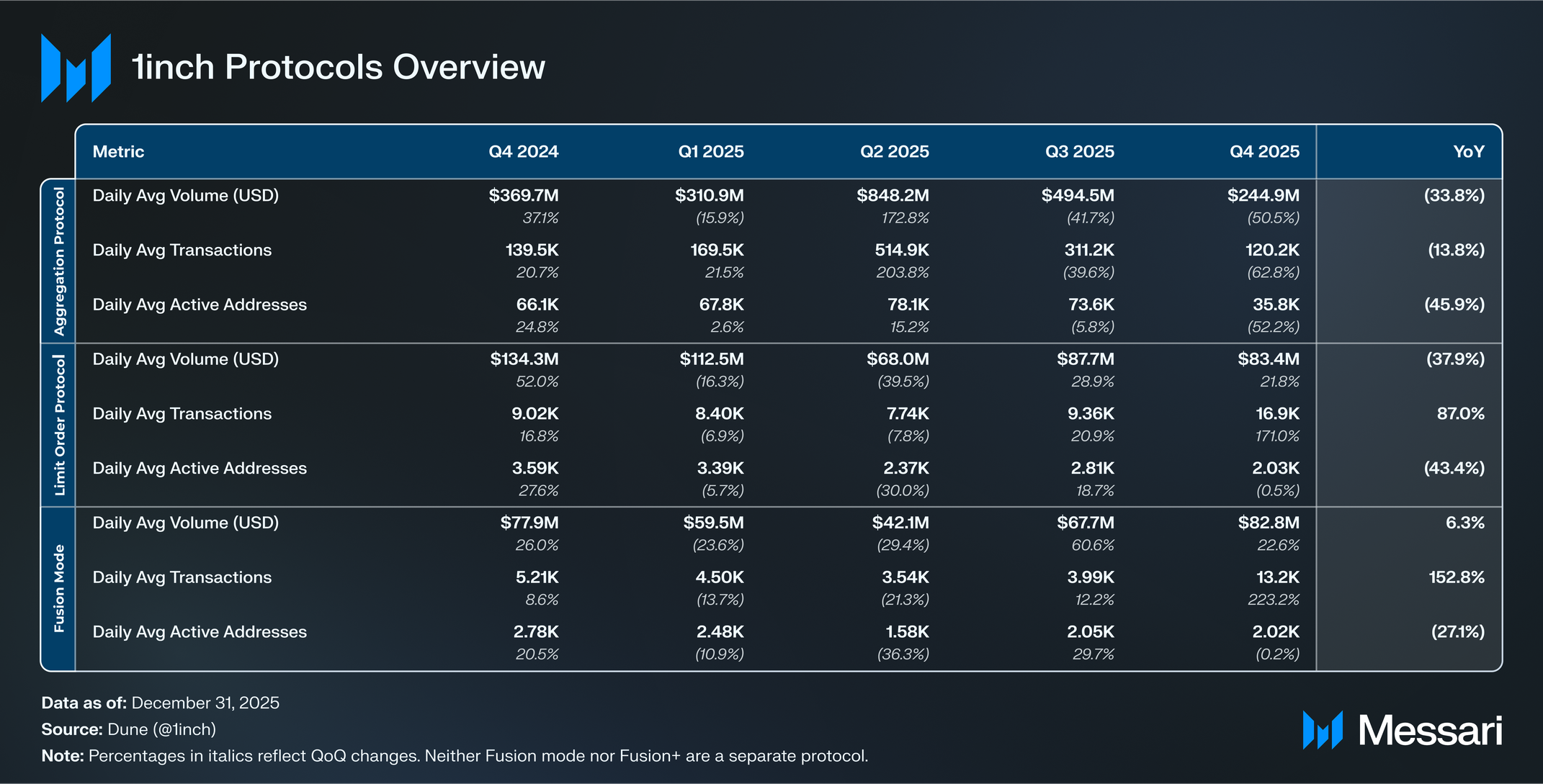
- Fusion execution expanded in Q4, with daily average volume increasing 22.6% QoQ to $82.8 million, while active wallets remained flat (-0.2% QoQ), indicating higher execution intensity rather than broader user growth.
- Limit Order activity expanded, with daily average volume rising 19.9% QoQ to $104.4 million and orders increasing 131.4% QoQ to 22,775 per day. Growth was concentrated on BNB Chain, where orders climbed 1,149.9% QoQ, coinciding with new RWA routing activity via the 1inch Swap API.
- Aggregation Protocol activity continued to normalize in Q4, with daily average routed volume falling 50.5% QoQ to $244.9 million. BNB Chain volumes fell, while Ethereum remained the most stable liquidity source amid a market slowdown.
- 1inch introduced Aqua, a shared liquidity architecture that allows the same capital to back multiple strategies without locking assets. The Q4 developer release opened SDKs, contracts, and bounties, with a full frontend launch expected in 2026.
Primer
1inch (1INCH) is a decentralized finance (DeFi) DEX aggregator and intent-order protocol operating on Ethereum, Arbitrum, Optimism, Polygon, zkSync Era, Unichain, Base, Linea, Solana, Sonic, Avalanche, BNB Chain, and Gnosis. Launched in 2019, the 1inch Aggregation Protocol (AP) allows users to route trades across various markets and realize the best available rate compared to any individual decentralized exchange (DEX).
The second product, the 1inch Limit Order Protocol (LOP), was introduced in June 2021 to support conditional limit orders. In late December 2022, the intent-based swaps were introduced, whereby approved registered addresses called Resolvers compete via a Dutch auction mechanism to fulfill orders with a specified price and time range, and do not need native tokens for network gas fees. In November 2024, 1inch fully released cross-chain swaps (Fusion+), which build upon the 1inch Fusion technology and Limit Order protocol. In Q3 2025, Fusion+ expanded to support native Solana to EVM execution, making Solana a full endpoint in 1inch’s cross-chain intent architecture.
All four protocols are governed by the 1inch DAO using the network’s native 1INCH token.
In Q4 2025, 1inch introduced Aqua, a shared liquidity architecture that allows the same capital to back multiple strategies simultaneously without locking assets, expanding the protocol’s scope beyond aggregation into capital efficiency infrastructure. During the same quarter, 1inch rebranded its ecosystem into 1inch Business and 1inch Personal, reflecting a strategic shift toward API-driven execution infrastructure for institutions and agentic trading systems, alongside advanced non-custodial tools for onchain users.
Note: This report includes data from Ethereum, BNB Chain, Polygon, Base, Optimism, Arbitrum, Avalanche, Solana, Sonic, Gnosis Chain, zkSync, Unichain, and Linea.
Website / X (Twitter) / Telegram
Key Metrics
Protocol Analysis
Aggregation Protocol
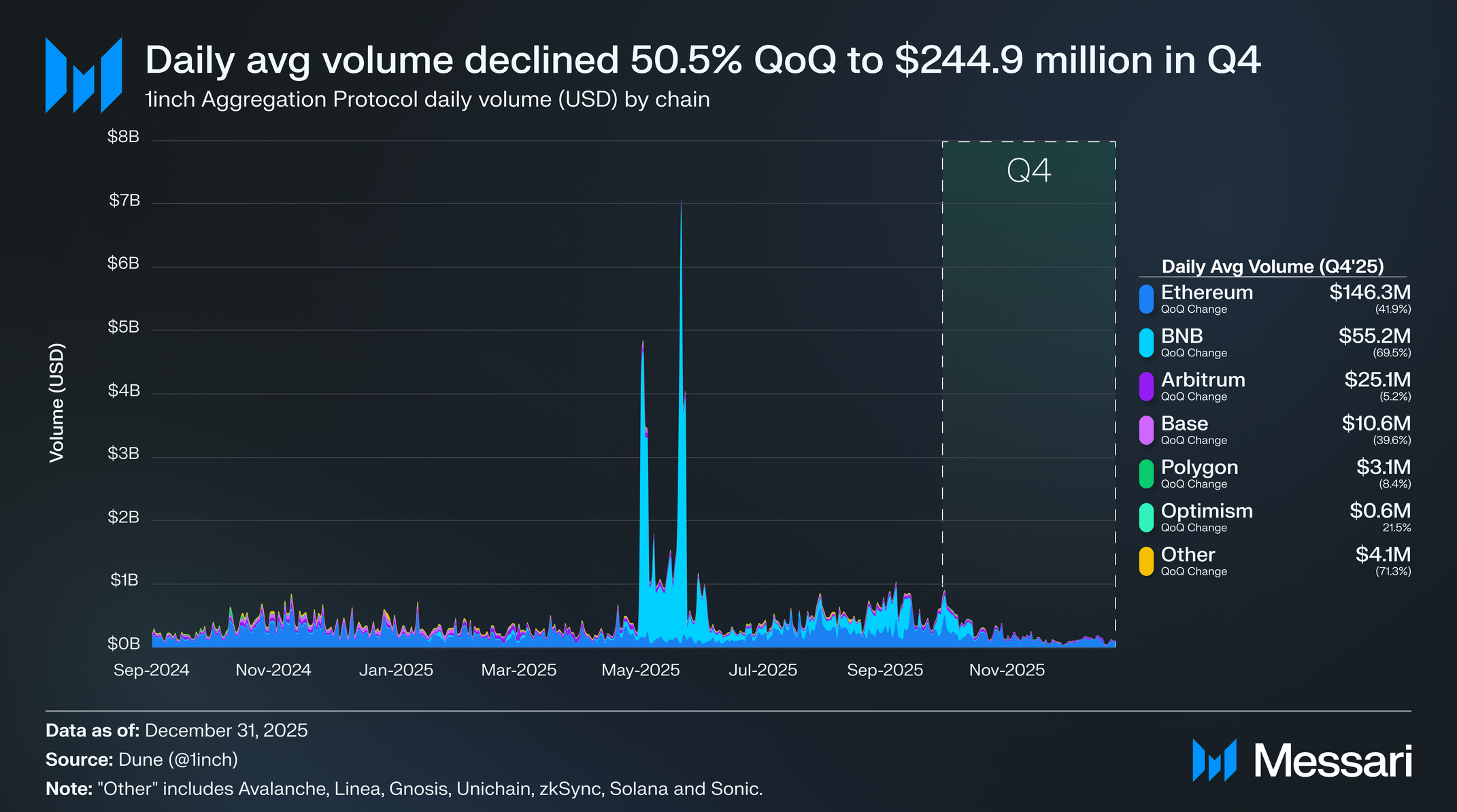
Of 1inch’s four protocols, the Aggregation Protocol is responsible for most volume routed through 1inch. Daily average volume declined 50.5% QoQ to $244.9 million, as broader market activity continued to cool from the elevated levels recorded in Q2. Similar to Q3, BNB Chain volume continued to retrace, falling 69.5% QoQ from $180.7 million to $55.2 million. However, unlike Q3’s decline, which was primarily driven by the unwinding of BNB Chain’s Binance Alpha airdrop activity, Q4’s contraction was broad-based. Volumes on Ethereum and Base declined 41.9% and 39.6% QoQ, respectively, reflecting a market-wide reduction in on-chain trading activity.
Arbitrum’s and Polygon’s daily average routed volume also declined, falling 5.2% and 8.4% QoQ to $25.1 million and $3.1 million, respectively. Routed volume on Optimism actually increased 21.5% QoQ in Q4, but remained modest at $630,000 per day.
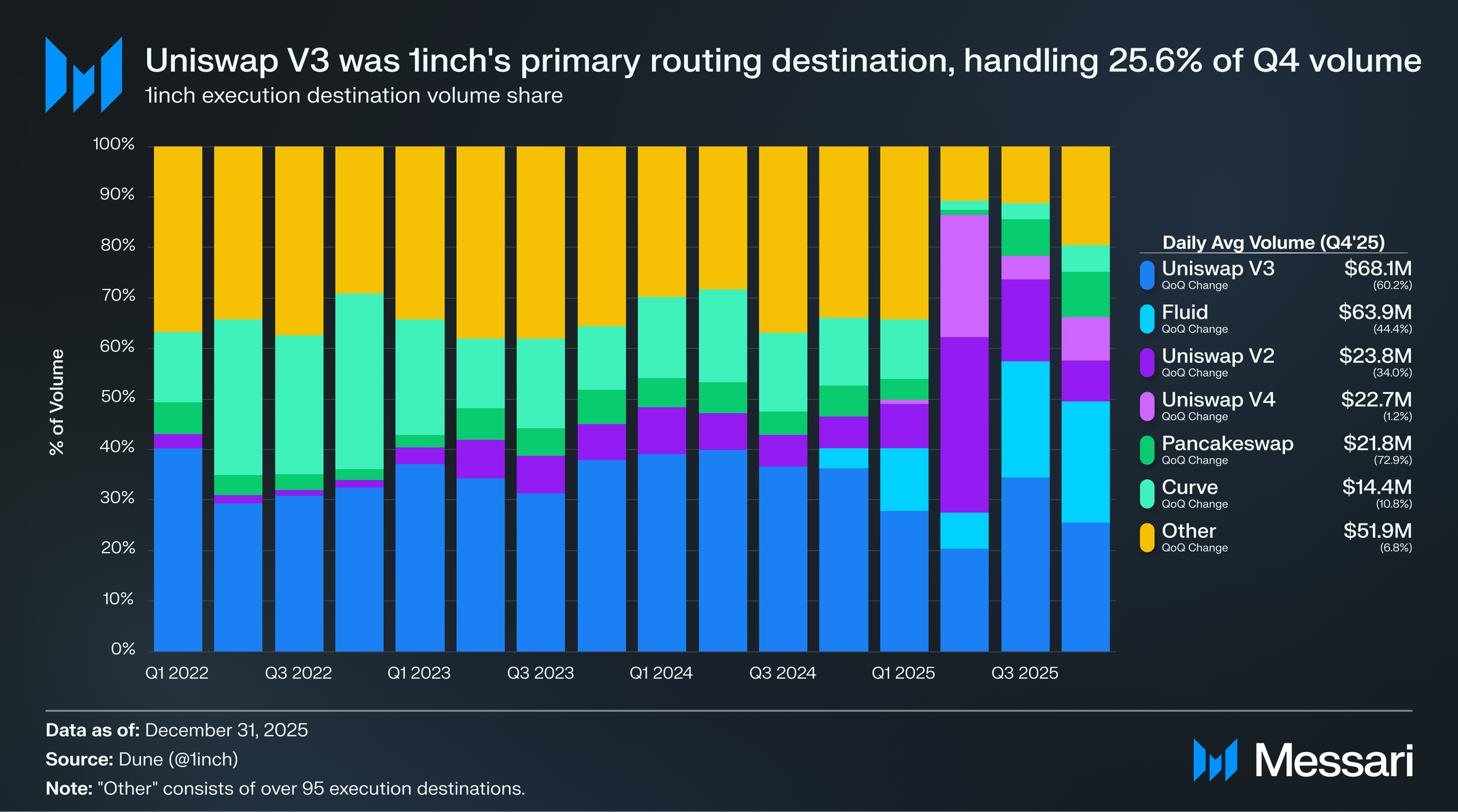
In Q4, Uniswap V3 retained its position as 1inch’s primary routing destination, handling 25.6% of routed volume with $68.1 million in average daily volume, though volume declined 60.2% QoQ. Fluid held its position as the second-largest execution destination, processing $63.9 million in daily average volume, a decline of 44.4% QoQ. The gap between Uniswap V3 and Fluid narrowed considerably in Q4, with Fluid closing to within two percentage points of the top position.
Uniswap V2 moved into third place at $23.8 million in daily average volume, down 34.0% QoQ. Uniswap V4 held steady at $22.7 million (−1.2% QoQ), declining less than most major venues during the quarter. PancakeSwap fell further to $21.8 million (-72.9% QoQ), extending the decline that began with the normalization of BNB Chain activity. Curve decreased 10.8% to $14.4 million, while the “Other” category of 95+ execution destinations collectively fell 6.8% to $51.9 million.
Concentration among the top three routing destinations, Uniswap V3, Fluid, and Uniswap V2, declined in Q4, accounting for 58.4% of all routed volume, down from 64.4% in Q3. The decrease indicates that the routed flow was distributed more broadly across execution venues during the quarter.
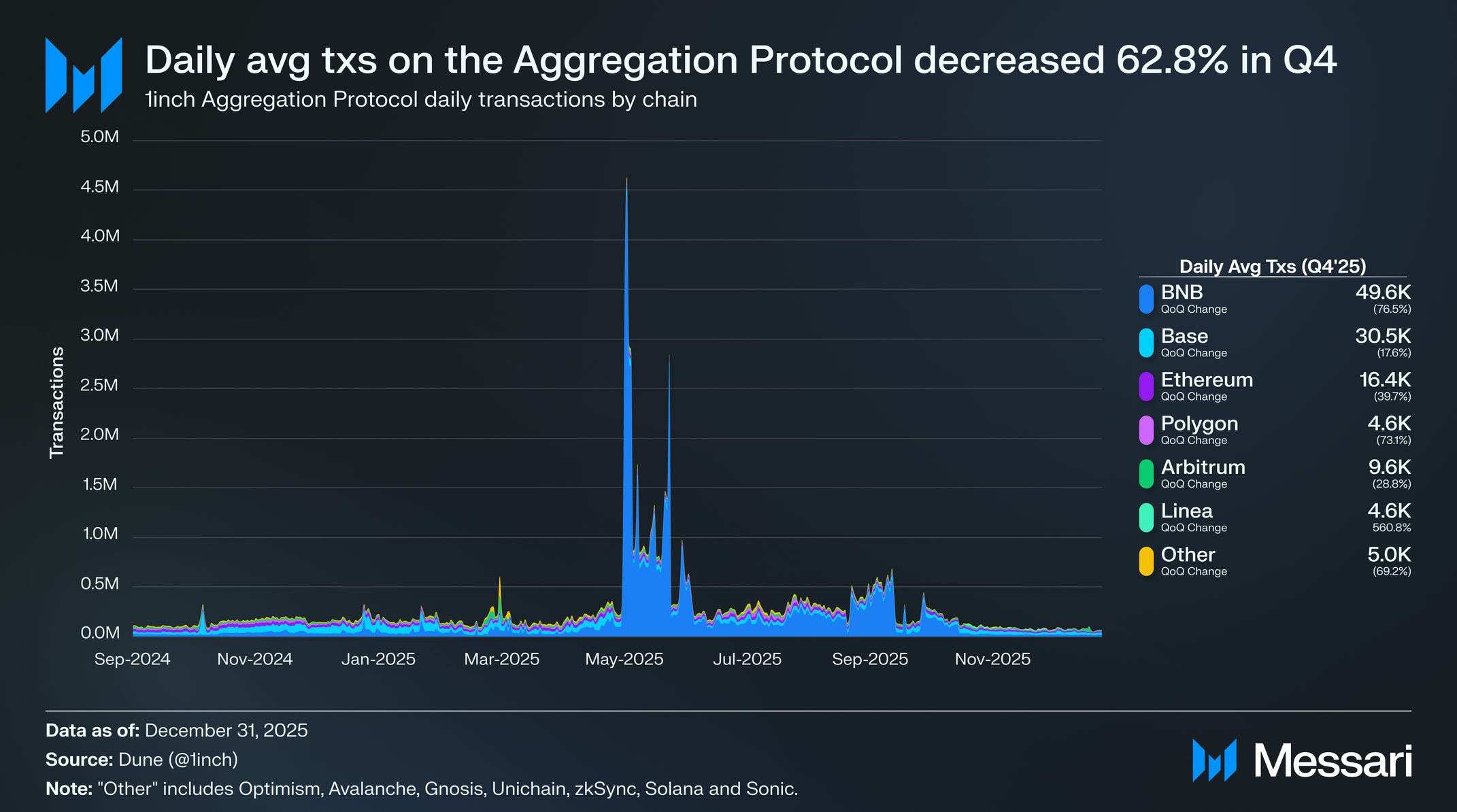
Daily average transactions on the Aggregation Protocol decreased 62.8% QoQ to 120.2k in Q4. The decline outpaced the contraction in routed volume, indicating a compression in average transaction size across the protocol.BNB Chain remained the largest source of throughput in Q4 but saw transactions fall 76.5% QoQ to 49.6k swaps per day. Base recorded 30.5k daily swaps, down 17.6% QoQ, while Ethereum declined 39.7% QoQ to 16.4k daily transactions. Arbitrum processed 9.6k swaps daily, a decrease of 28.8% QoQ. Polygon fell 73.1% QoQ to 4.6k swaps, while Linea increased sharply to 4.6k daily transactions (+560.8% QoQ) from a low Q3 base. Other supported networks collectively averaged 5.0k daily transactions, down 69.2% QoQ, and represented a relatively small share of total activity.
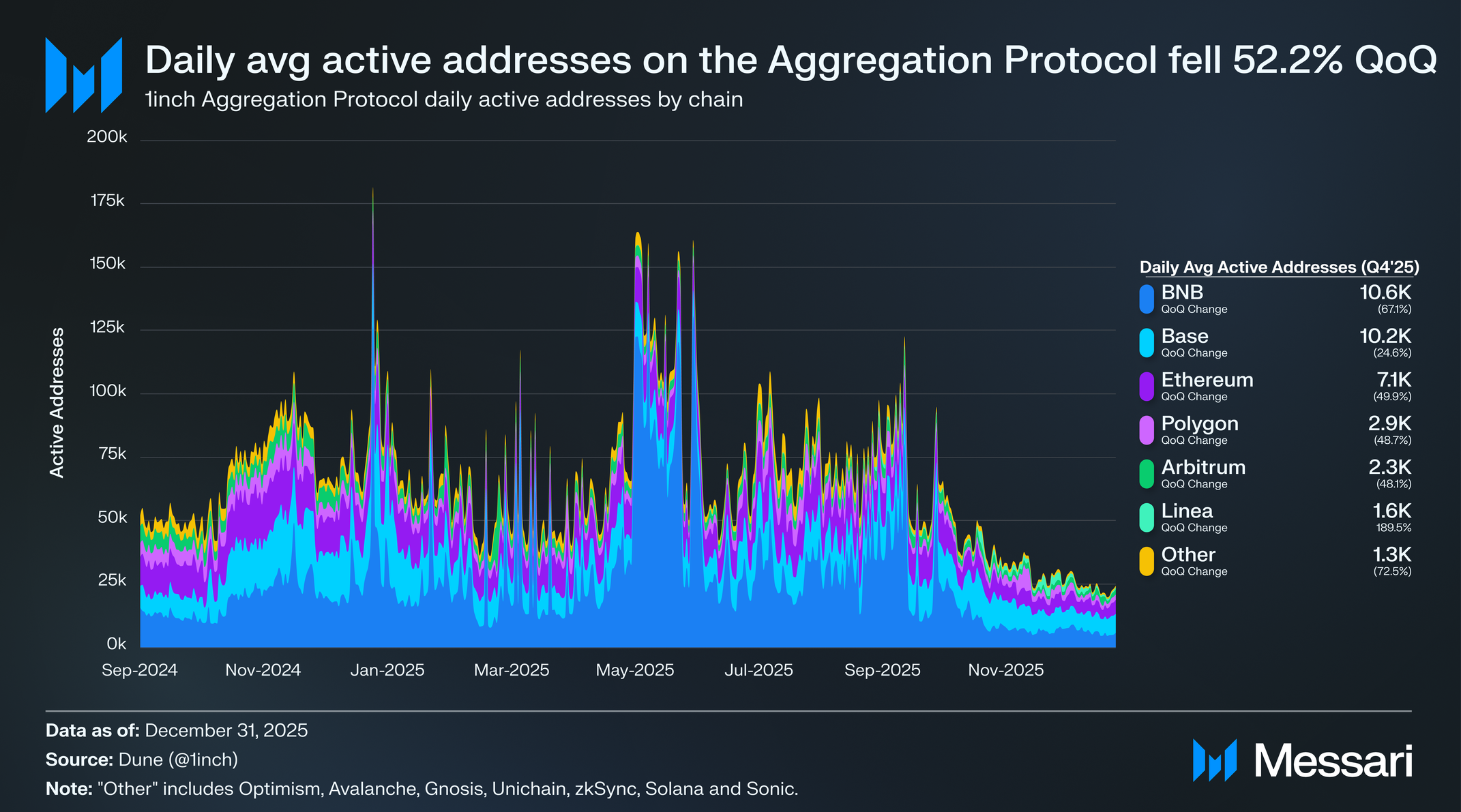
Daily average active addresses on the Aggregation Protocol fell 52.2% QoQ to 35.8k in Q4. BNB Chain remained the largest source of users but declined sharply by 67.1% QoQ to 10.6k daily active addresses. Base recorded 10.2k daily active addresses, down 24.6% QoQ, while Ethereum fell 49.9% QoQ to 7.1k. Polygon averaged 2.9k active addresses per day, a decline of 48.7% QoQ, and Arbitrum decreased 48.1% QoQ to 2.3k. Linea increased to 1.6k daily active addresses (+189.5% QoQ) from a low Q3 base, while other supported networks collectively averaged 1.3k active addresses, down 72.5% QoQ and accounting for a small share of total usage. The decline was broad-based across major networks, indicating reduced retail participation.
Limit Order Protocol
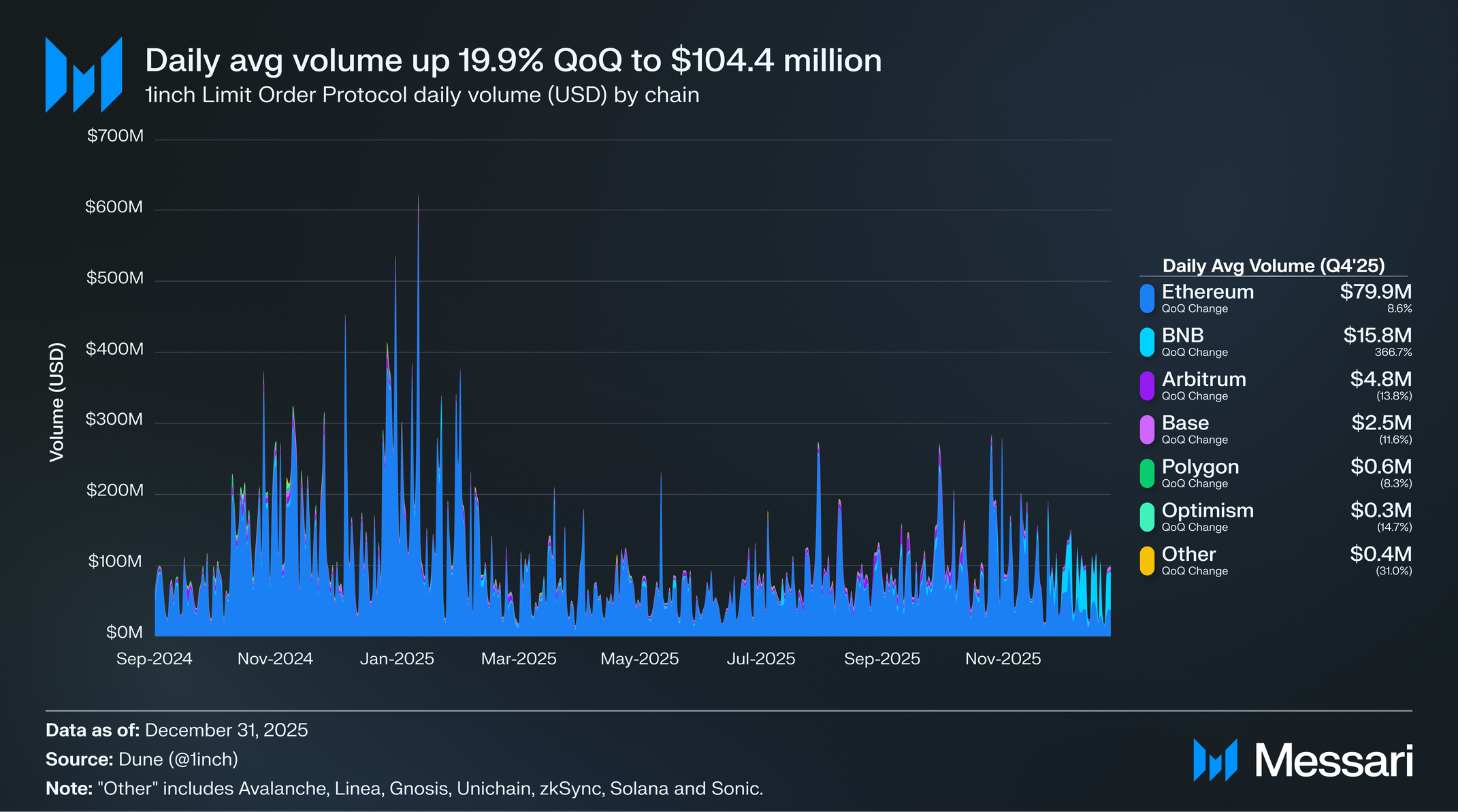
Daily average volume on the Limit Order Protocol increased 19.9% QoQ from $87.1 million to $104.4 million, extending the recovery that began in Q3. Ethereum maintained its dominant position with approximately 76.6% market share, as daily average volume rose 8.6% QoQ to $79.9 million. BNB Chain climbed sharply to $15.8 million in daily volume (+366.7% QoQ), representing the largest absolute increase among deployments. Arbitrum declined 13.8% QoQ to $4.8 million, while Base decreased 11.6% QoQ to $2.5 million. Polygon fell 8.3% QoQ to $600,000, and Optimism declined 14.7% to $0.3 million. Other supported networks collectively averaged $426,153 in daily volume (-31.0% QoQ), remaining a small portion of overall activity. The quarter’s increase in aggregate volume was driven primarily by renewed activity on BNB Chain, while most other networks saw moderate retracements from Q3 levels. The concentration of growth on BNB Chain indicates that the Q4 expansion in limit order volume was driven by a narrow set of deployments rather than broad-based adoption across networks.
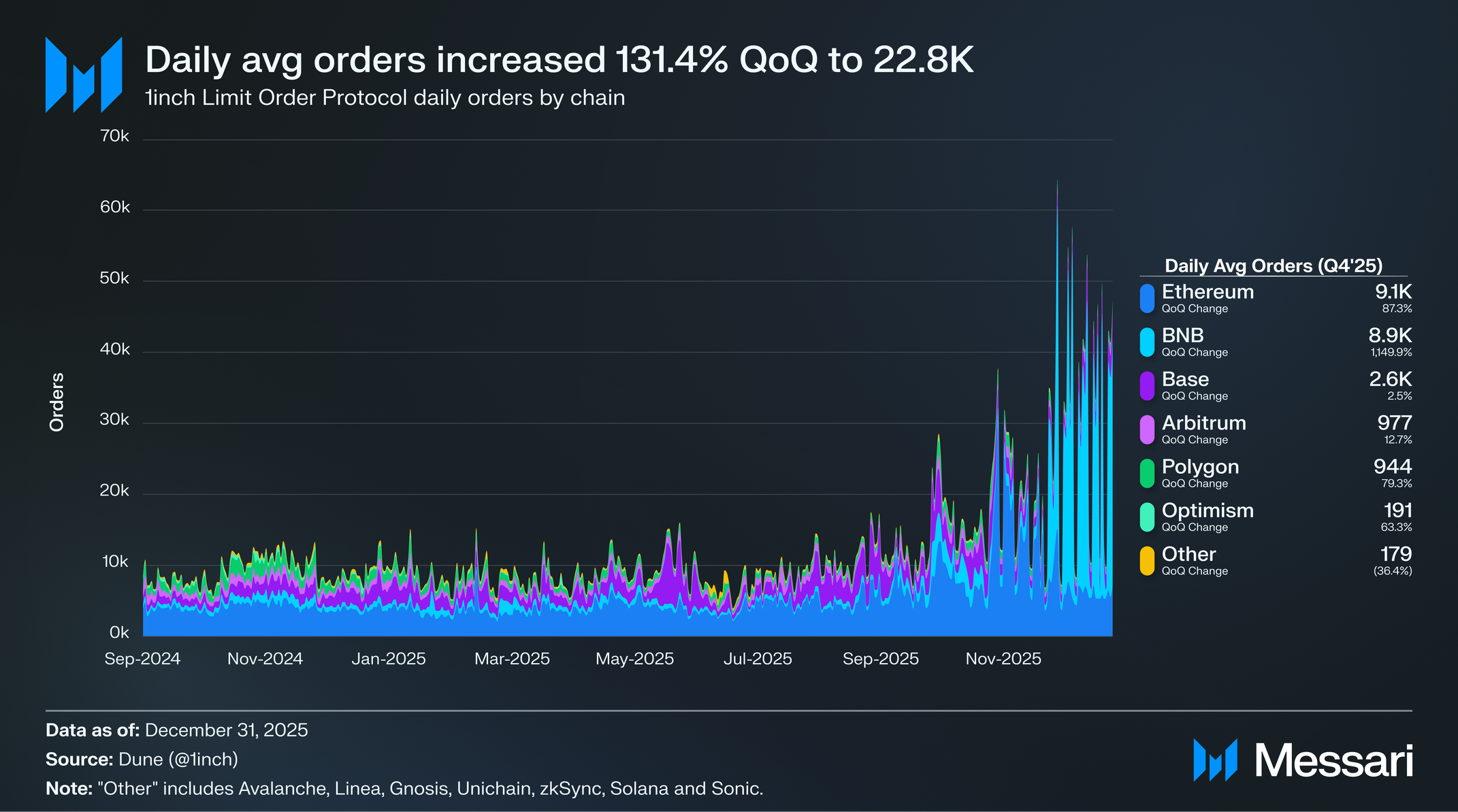
Daily average orders on the Limit Order Protocol increased 131.4% QoQ from 9,840 to 22,775. Ethereum daily average orders increased 87.3% QoQ from 4,837 to 9,060, lowering its share of total orders to 39.8%. BNB Chain posted the fastest growth among major deployments, rising 1,149.9% QoQ from 709 to 8,859 daily orders, with the surge coinciding closely with 1inch’s rollout of tokenized RWA routing on BNB Chain via the Swap API in partnership with Ondo Finance.
In contrast, growth was more moderate across other networks in Q4. Polygon’s daily average orders increased 79.3% from 526 to 944. Arbitrum grew 12.7% QoQ from 867 to 977, while Base rose 2.5% QoQ from 2,503 to 2,564. Optimism increased 63.3% QoQ from 117 to 191 daily orders, and other supported networks collectively averaged 179 orders (–36.4% QoQ). The increase in order count materially outpaced volume growth, indicating smaller average order sizes during the quarter.
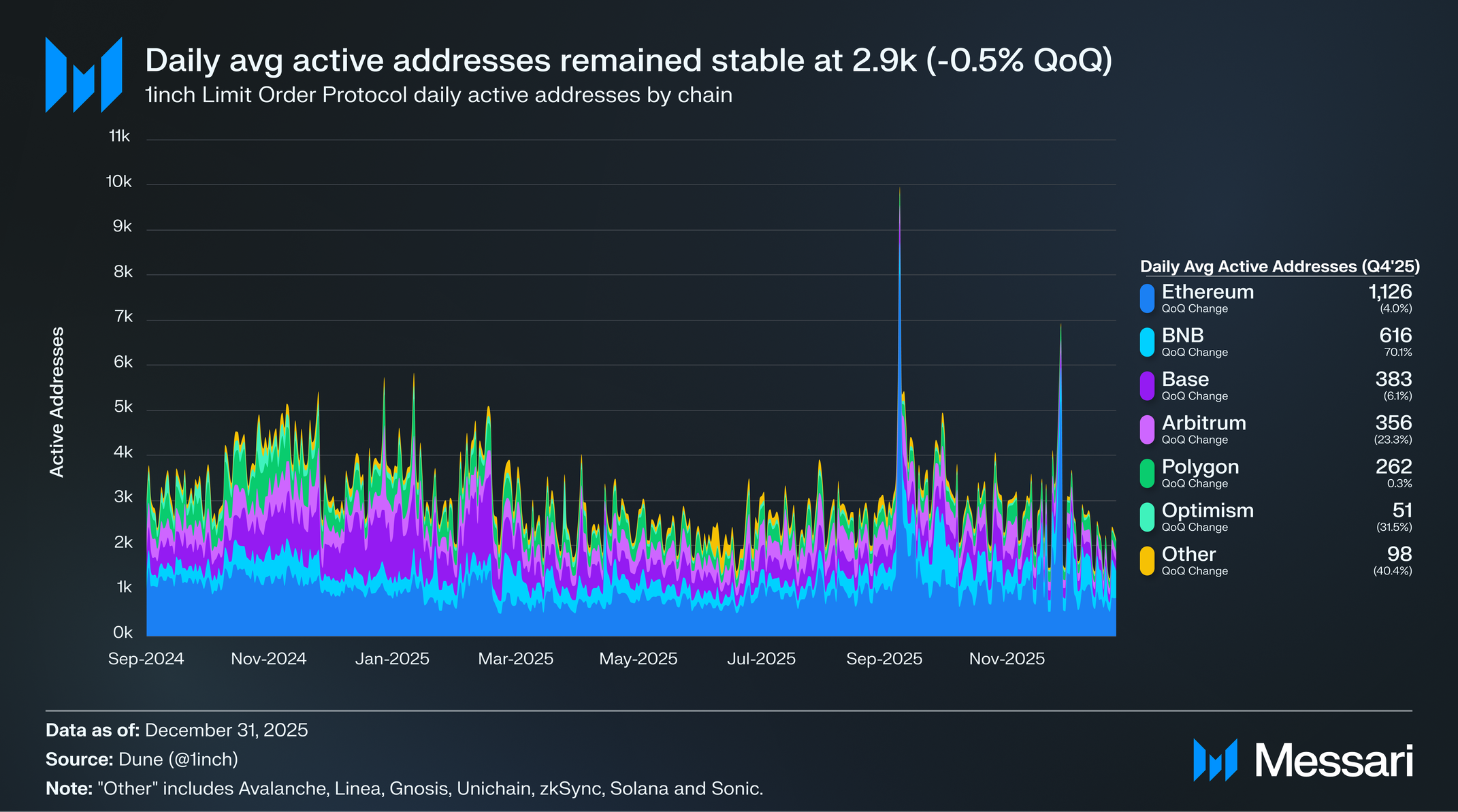
Daily average active addresses on the Limit Order Protocol decreased 0.5% QoQ from 2,907 to 2,892 in Q4. Ethereum declined 4.0% QoQ to 1,126 daily active addresses. Arbitrum fell 23.3% QoQ to 356, while Base decreased 6.1% to 383. In contrast, BNB Chain expanded 70.1% QoQ to 616 daily active addresses, and Polygon held largely steady at 262 (+0.3% QoQ). Other supported networks averaged 98 daily active addresses (–40.4% QoQ), and Optimism declined 31.5% to 51. The stability in active addresses, alongside sharp growth in order volume, suggests increased usage intensity among existing limit order users rather than an expansion of the participant base.
Intent-based swaps (Fusion)
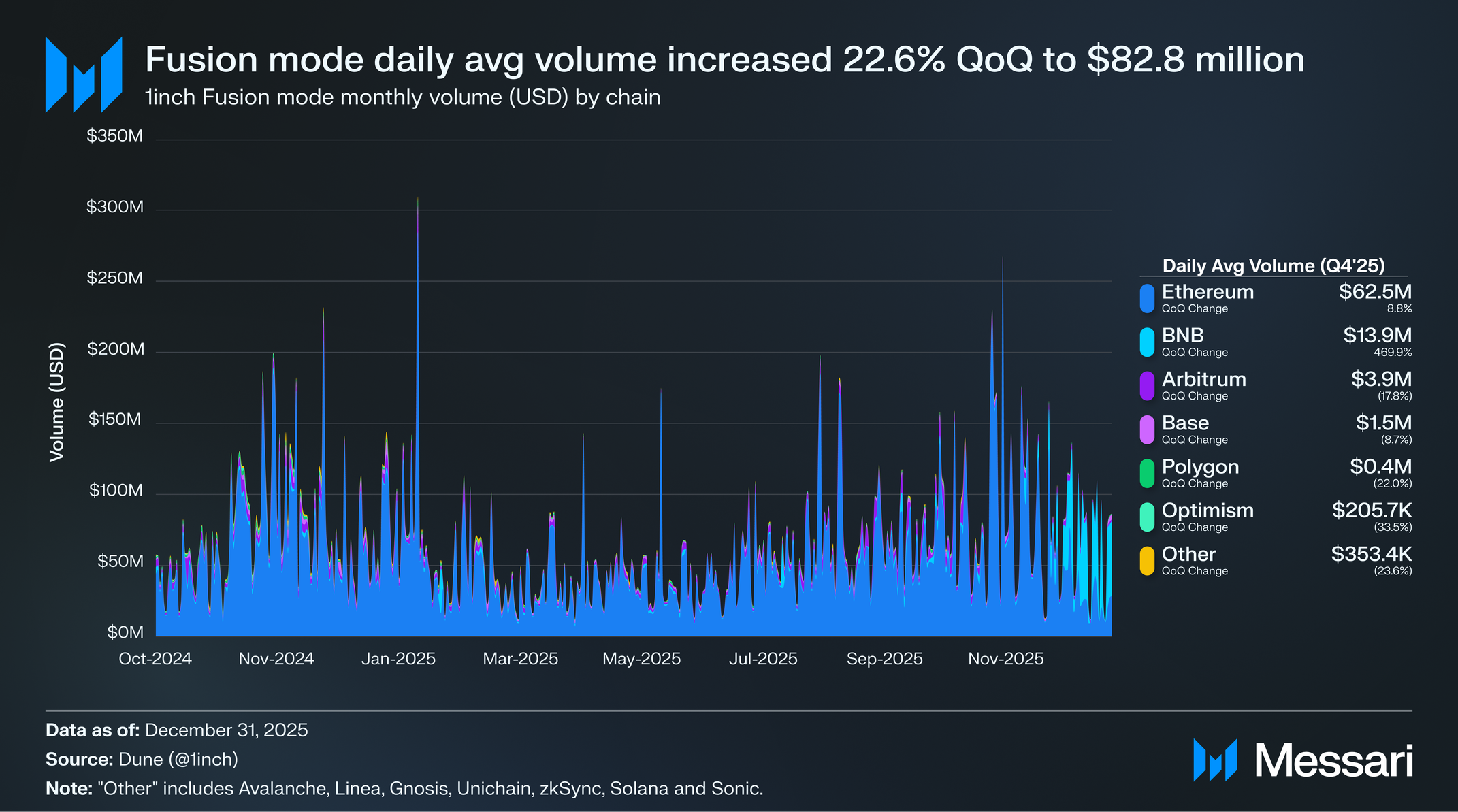
Fusion sits on top of 1inch’s Aggregation and Limit Order rails: users post intents with price-and-time presets, market makers called resolvers cover the gas. A Dutch auction curve lowers the rate until the order is executed. That architecture keeps swaps gas-free for traders and shields them from MEV. Fusion activity expanded further in Q4, with daily average volume increasing 22.6% QoQ from $67.6 million to $82.8 million. The quarter’s growth was driven primarily by BNB Chain rather than Ethereum, resulting in a decline in Ethereum’s share of Fusion volume from 84.8% in Q3 to 75.5% in Q4.
Ethereum remained the dominant execution environment, processing $62.5 million in daily average volume, up 8.8% QoQ. BNB Chain recorded the fastest growth, surging 469.9% QoQ from $2.4 million to $13.9 million, materially increasing its share of Fusion volume. Arbitrum declined 17.8% QoQ to $3.9 million, while Base fell 8.7% to $1.5 million. Polygon decreased 22.0% QoQ to $0.4 million, and Optimism contracted 33.5% to $205,718. Other supported networks collectively averaged $353,433 in daily volume, down 23.6% QoQ, and continued to represent a minor portion of overall Fusion activity.
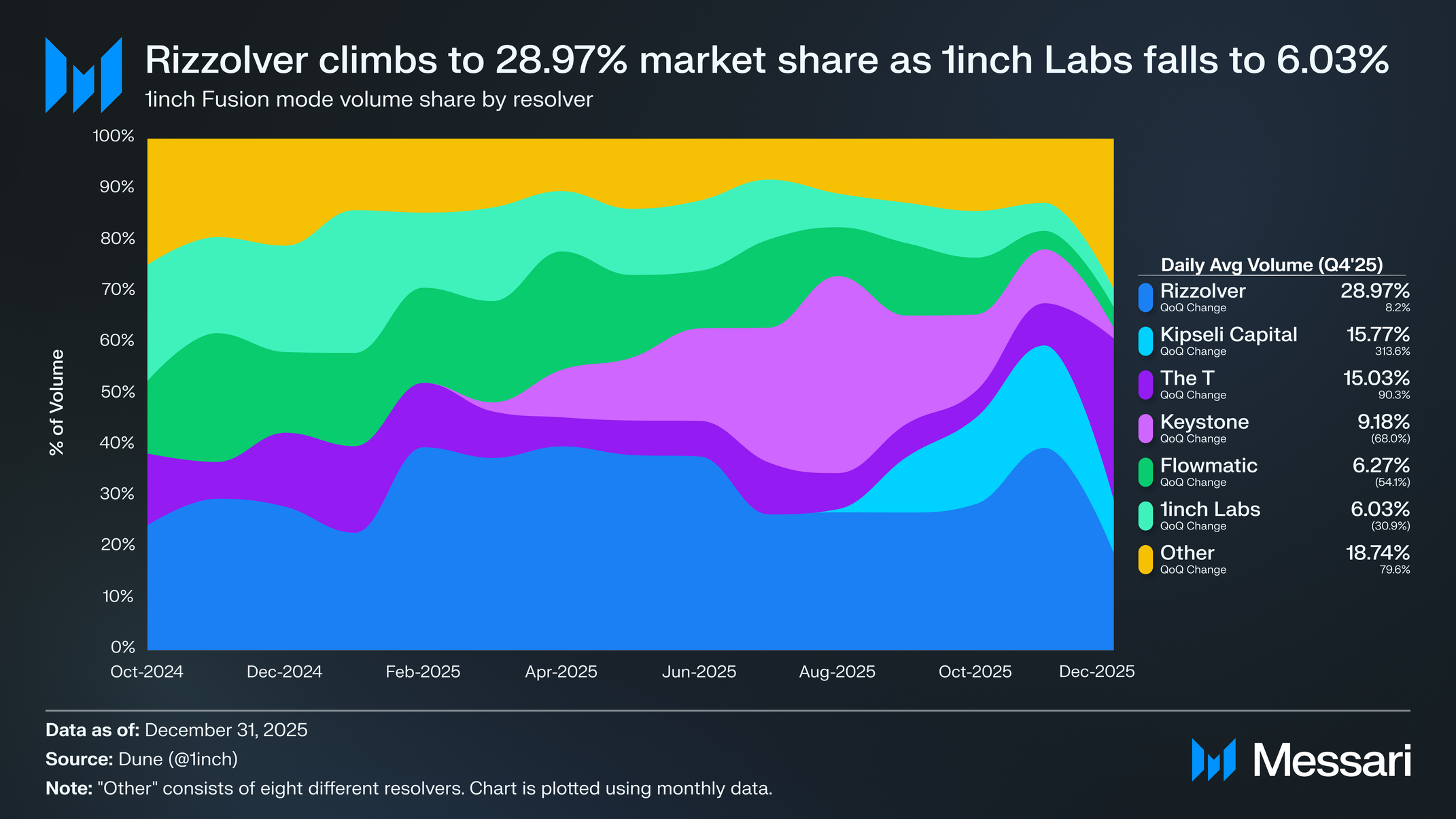
Resolvers are approved registered addresses that compete via a Dutch auction mechanism to fulfill 1inch Fusion and Fusion+ orders. Q4 saw another reshuffling among leading resolvers, with Rizzolver moving into the top position, capturing 29.0% of Fusion volume after increasing its share by 8.2% QoQ. Kipseli Capital climbed to second place at 15.8%, posting the fastest growth among major resolvers with a 313.6% QoQ increase in share. The T ranked third at 15.0%, up 90.3% QoQ, reflecting continued gains in execution share.
Keystone’s share declined materially to 9.2%, down 68.0% QoQ, marking the largest contraction among top resolvers. Flowmatic also saw its share fall to 6.3% (–54.1% QoQ). 1inch Labs’ resolver share continued to contract, declining to 6.0%, down 30.9% QoQ, as independent resolvers captured a larger portion of order flow. The “Other” resolver group expanded to 18.7% of Fusion volume (+79.6% QoQ), indicating broader participation across a growing set of smaller resolvers. Collectively, the top three resolvers accounted for approximately 59% of Fusion volume in Q4, down from roughly 69% in Q3, signaling a continued dispersion of execution across a wider resolver set.
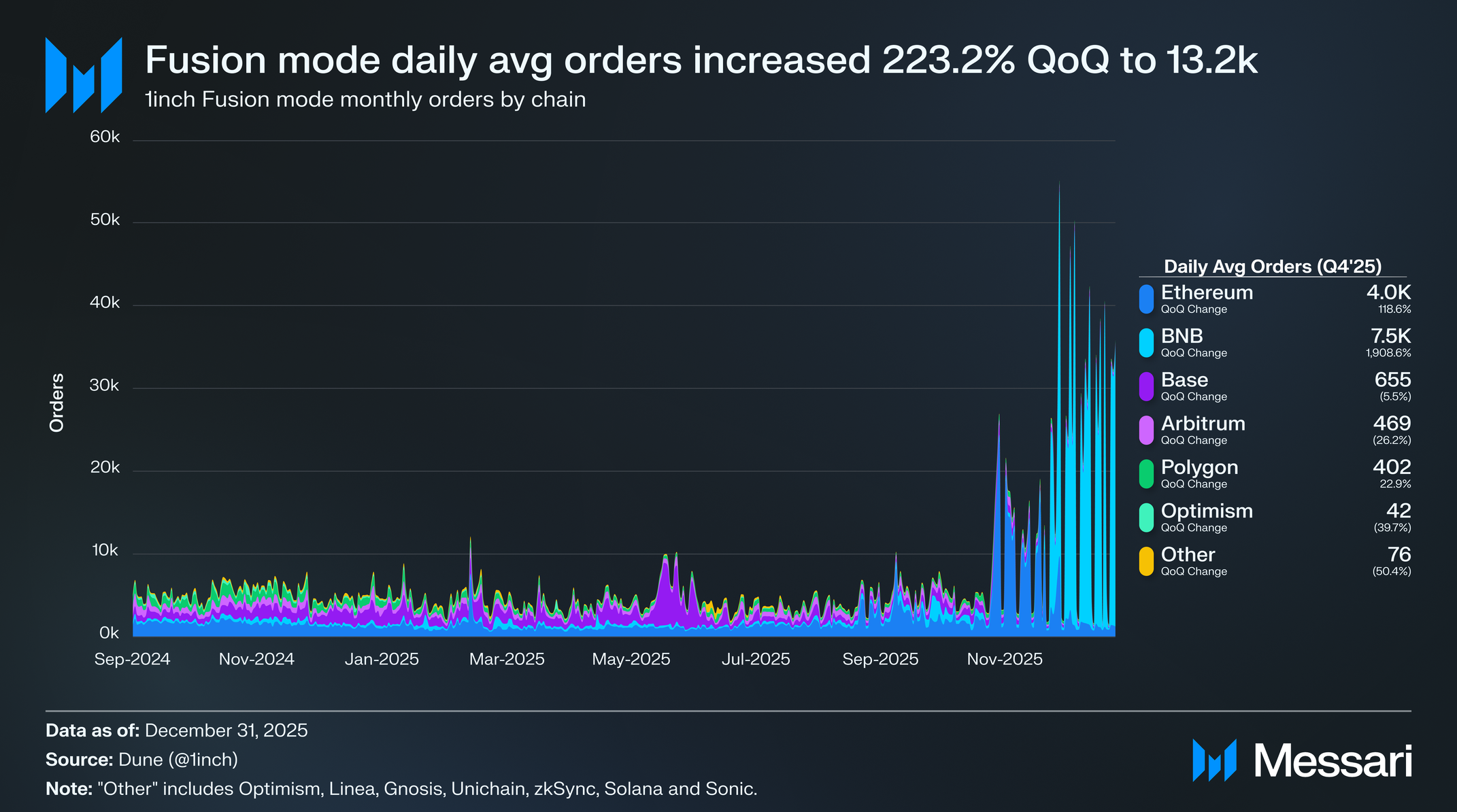
Daily average orders in Fusion mode increased 223.2% QoQ from 4,078 to 13,179. BNB Chain recorded the largest increase, surging 1,908.6% QoQ from 376 to 7,549 daily orders, making it the leading source of Fusion order flow in Q4. Notably, this acceleration again coincided with 1inch’s announcement that it began routing partner RWA tokens on BNB Chain via the 1inch Swap API, powered by Ondo Finance, expanding access to tokenized assets for eligible users. Ethereum daily orders more than doubled, rising 118.6% QoQ from 1,823 to 3,986.
In contrast, several other networks saw declines. Base daily orders fell 5.5% QoQ from 693 to 655, while Arbitrum declined 26.2% from 635 to 469. Polygon increased 22.9% QoQ from 327 to 402 daily orders. Optimism fell 39.7% from 70 to 42, and other supported networks averaged 76 daily orders, down 50.4% QoQ. BNB Chain and Ethereum together accounted for 87.5% of all Fusion mode orders in Q4, up from 53.9% in Q3, indicating a sharp concentration of order activity on the two largest deployments.
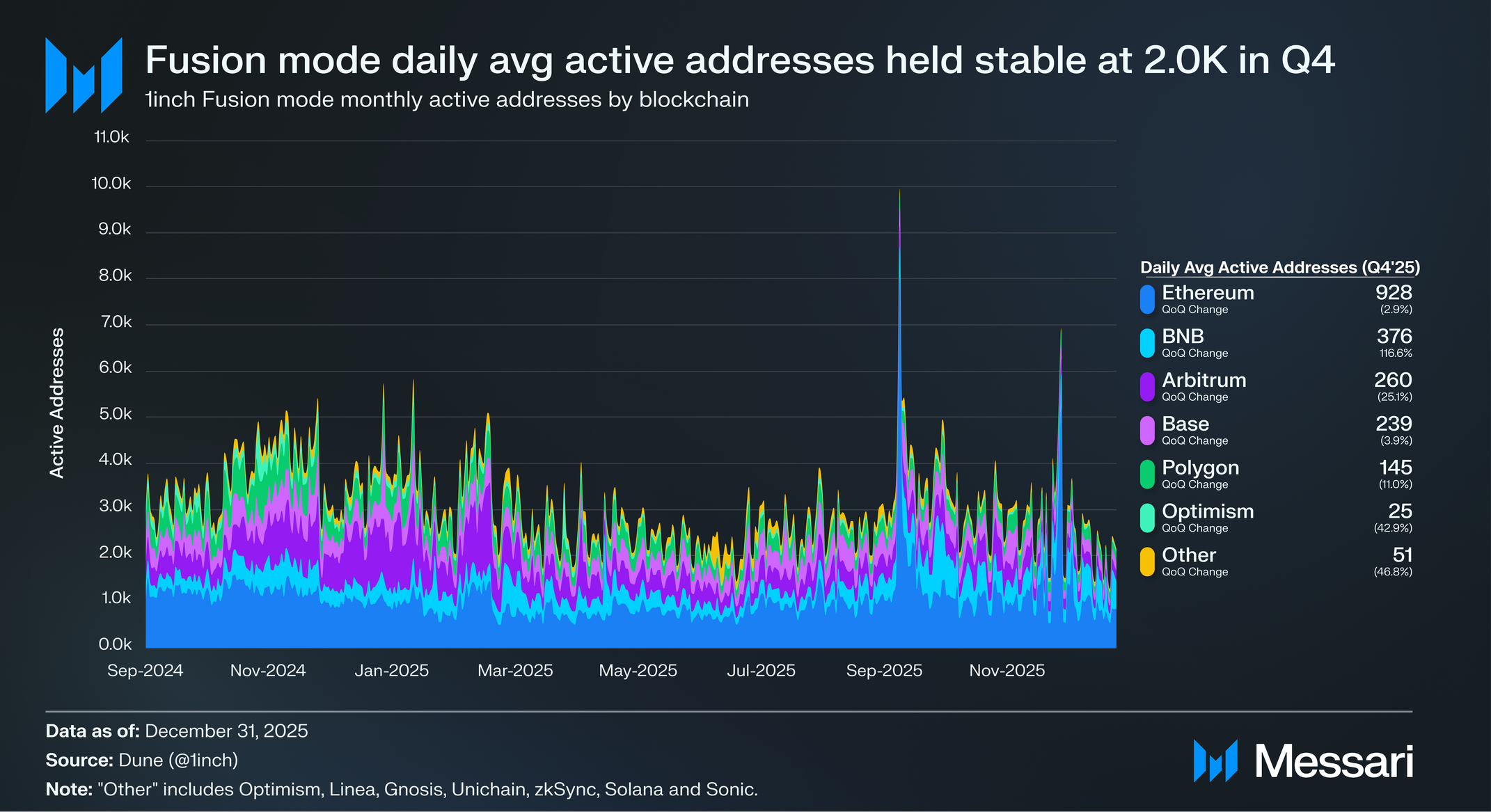
Fusion mode daily average active addresses held largely stable in Q4, declining only 0.2% QoQ from 2,027 to 2,024. Ethereum remained the largest source of users, with daily active addresses decreasing 2.9% from 956 to 928, while Arbitrum fell 25.1% QoQ from 347 to 260, and Base declined 3.9% from 249 to 239. BNB Chain recorded strong growth, increasing 116.6% QoQ from 174 to 376 daily active addresses. Polygon decreased 11.0% from 163 to 145, and Optimism fell 42.9% from 44 to 25. Other supported networks averaged 51 daily active addresses, down 46.8% QoQ. Ethereum and BNB Chain were the two largest sources of Fusion activity in Q4, together accounting for 64.4% of active addresses, up from 55.7% in Q3.
Cross-chain swaps (Fusion+)
Fusion+ is 1inch’s intent-based protocol for cross-chain swaps. Users sign offchain orders that resolvers compete to fill via Dutch auctions, with execution coordinated through Hashed Timelock Contracts (HTLCs). This structure eliminates the need for users to pay gas, protects against MEV, and enables partial fills across multiple chains. Resolver participation, auction logic, and trade parameters are governed by the 1inch DAO, making Fusion+ a modular framework for secure, gasless, and efficient cross-chain execution.
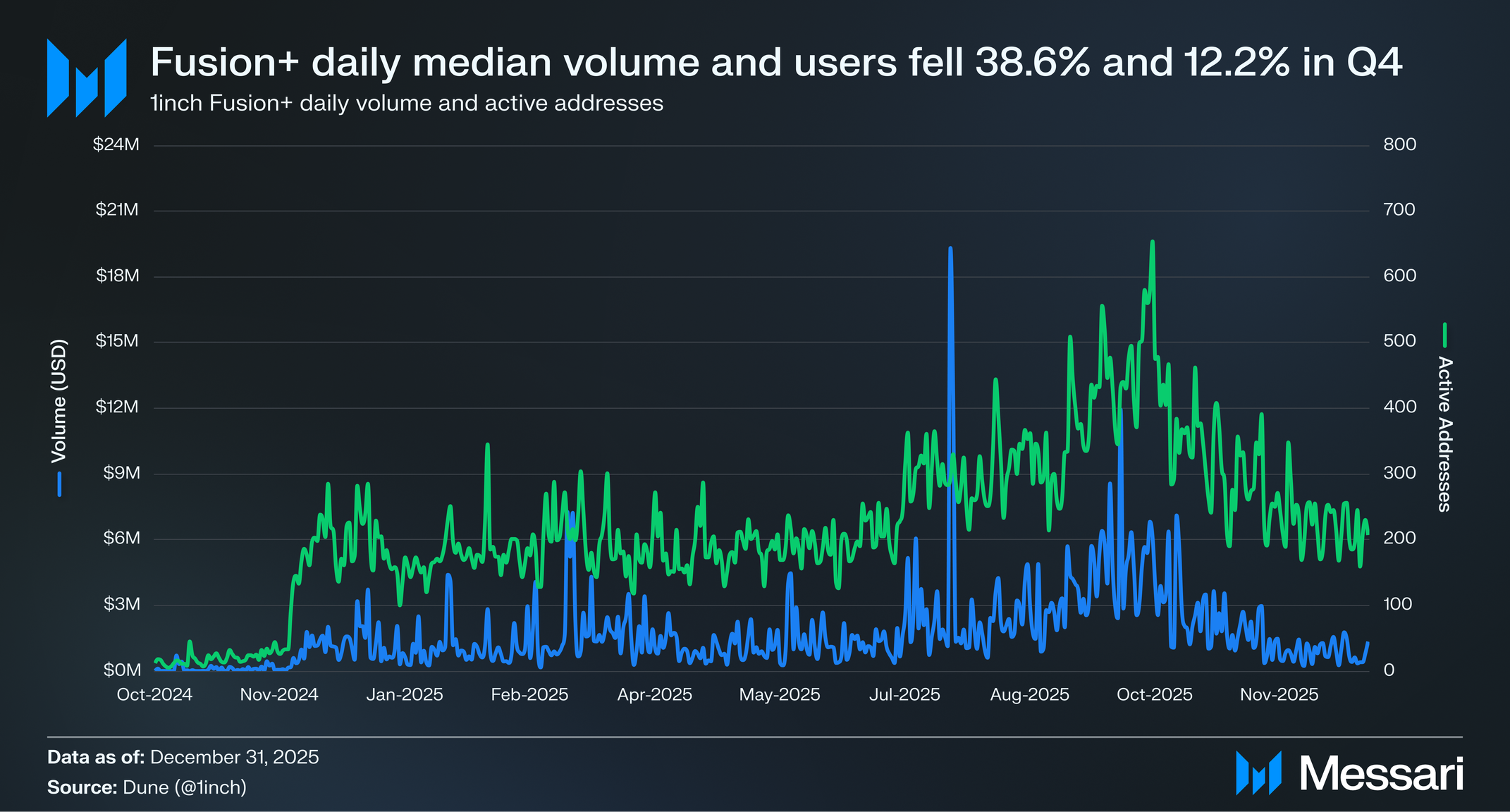
Fusion+ median daily volume declined 38.6% QoQ from $2.39 million to $1.47 million in Q4. Median daily active addresses also decreased 12.2%, falling from 315.5 to 277.0. Following the sharp expansion observed in Q3, Fusion+ activity cooled in Q4 as both transaction volume and user participation retraced from prior peaks. Despite the pullback, median activity levels remained above those recorded earlier in the year, indicating that Fusion+ usage stabilized at higher baseline levels after the Q3 surge.
Market Analysis
Market Cap and Staking
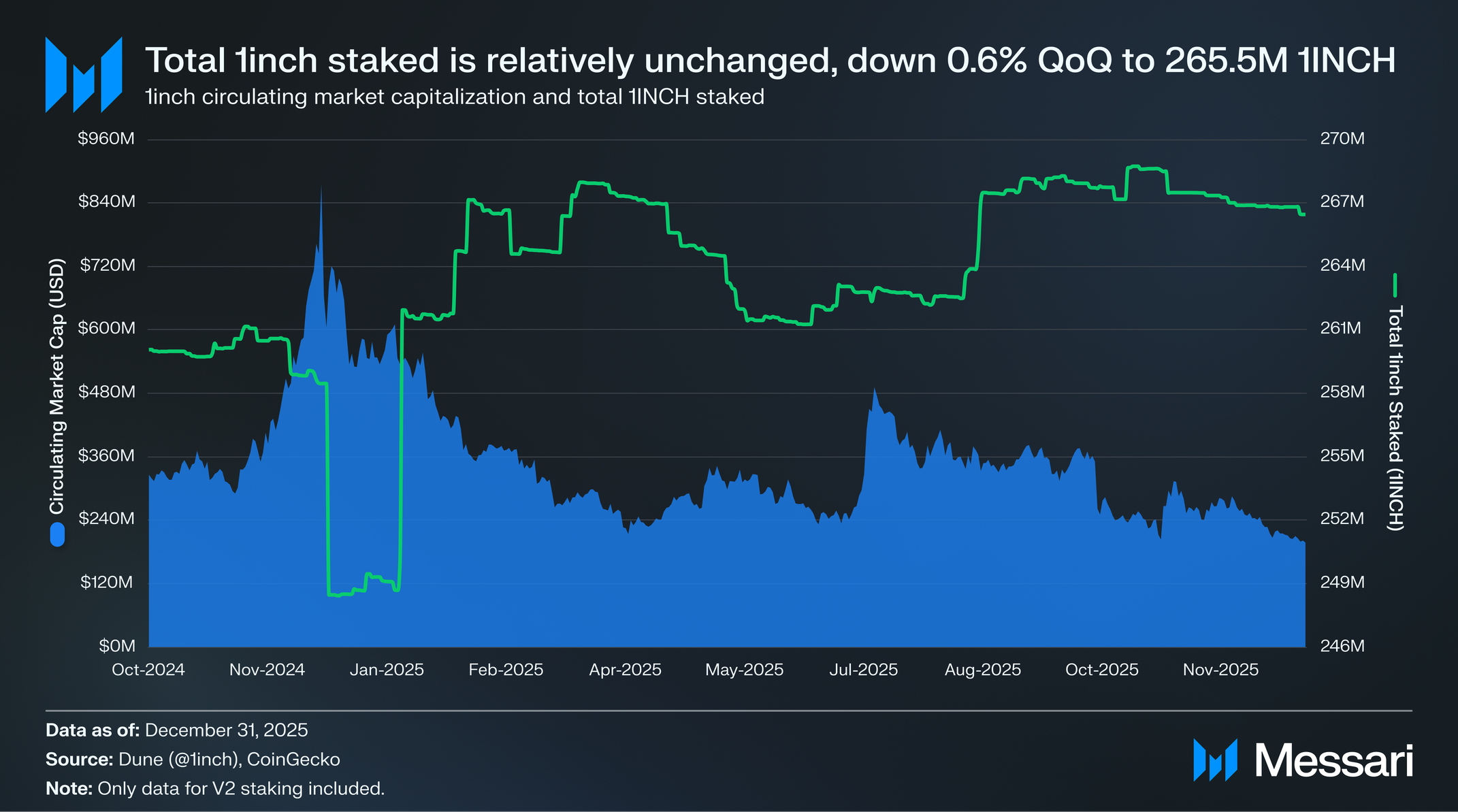
Staking 1INCH gives Unicorn Power (UP), which can be used for governance participation and delegation to resolvers. Delegation historically played a central role in Fusion, as resolvers distributed 1INCH incentives to attract UP and improve their competitiveness in completing auctions, creating a direct value pathway for the token.
In Q4, the DAO removed the 5% UP staking threshold previously required for resolvers to access Fusion's exclusive order flow. Access is now determined by completing due diligence and owning a Resolver NFT, reducing the direct link between UP concentration and resolver eligibility while maintaining verification standards.
Treasury & Governance
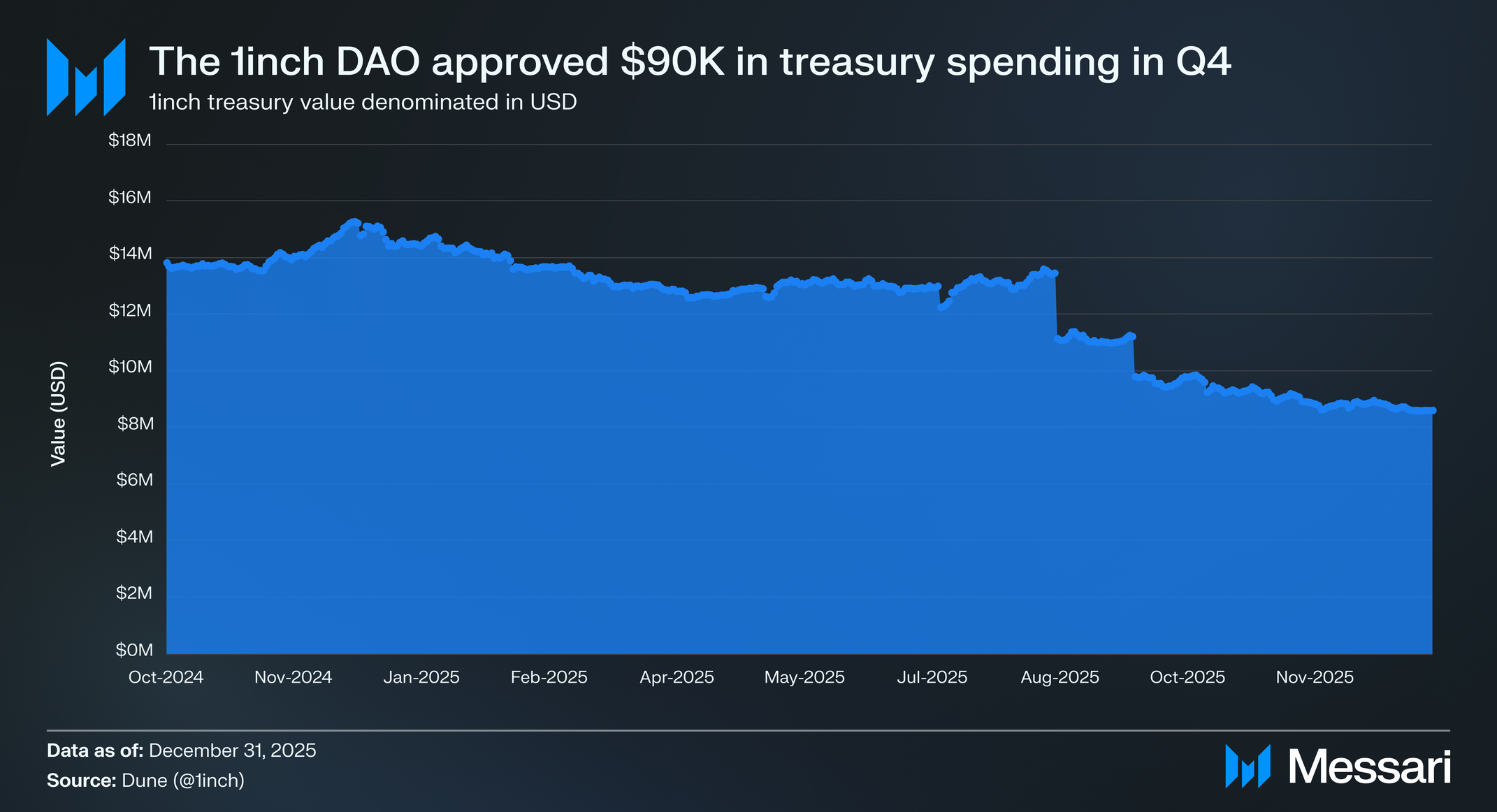
The 1inch DAO remained conservative in its use of treasury funds in Q4 2025 while advancing several structural and operational initiatives. During the quarter, the DAO approved four 1inch Improvement Proposals, totaling $90,000 in explicit treasury commitments:
- [1IP-88] Transfer of Control of the 1inch dApp to 1inch/Degensoft Group; Domain Separation and Brand Alignment (September 2025) – Approved the transfer of operational control of the 1inch dApp to 1inch/Degensoft Group and formalized domain separation across the ecosystem, clarifying responsibilities between the DAO, the Foundation, and the dApp operator. The proposal did not include a defined treasury expenditure.
- [1IP-89] Update to Resolver Access Requirements for Fusion Order Flow (October 2025) – Removed the 5% Unicorn Power staking requirement for resolvers to access Fusion exclusive order flow, shifting eligibility to a due diligence and Resolver NFT-based framework. The proposal did not authorize direct treasury spending but reaffirmed that resolver access fees remain a DAO-configurable mechanism.
- [1IP-90] Eliminate PriorityFee Restrictions in Fusion Settlement Extension (Nov 2025) – Approved the removal of priority fee caps in Fusion settlement contracts to reflect prevailing low-gas conditions and improve resolver competitiveness. The proposal focused on execution-layer changes and did not request a treasury allocation.
- [1IP-91] 1inch × Messari Protocol Services – Quarterly Research Proposal (2025) (Nov 2025) – Authorized $90,000 for a 12-month research engagement covering four quarterly reports at $22,500 each, providing ongoing third-party analysis and public reporting for the 1inch ecosystem.
At the end of Q4, the DAO treasury was estimated at approximately $8.5 million, down from $9.6 million at the end of Q3, with the decline largely attributable to market movements rather than discretionary spending.
Market Share
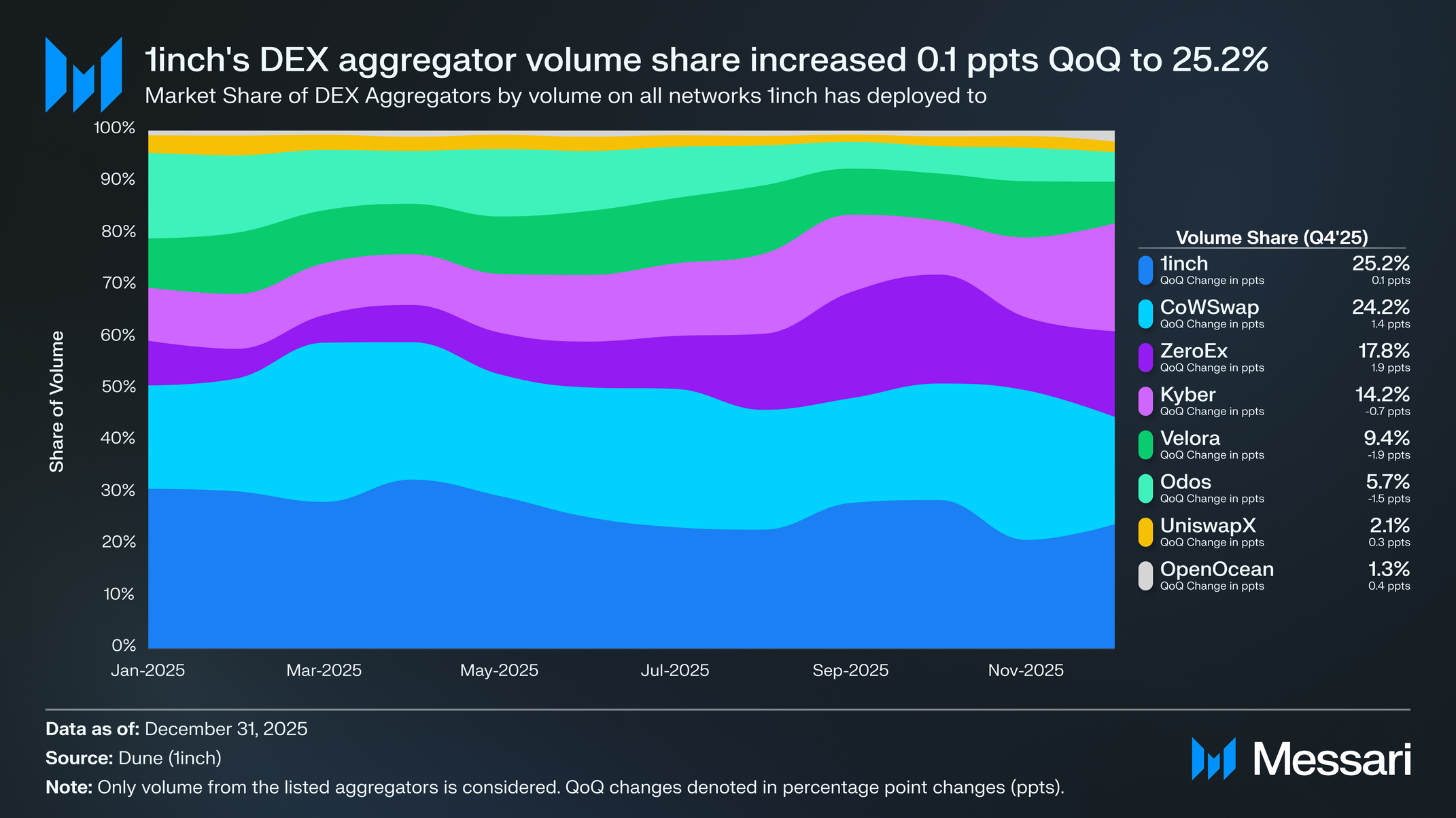
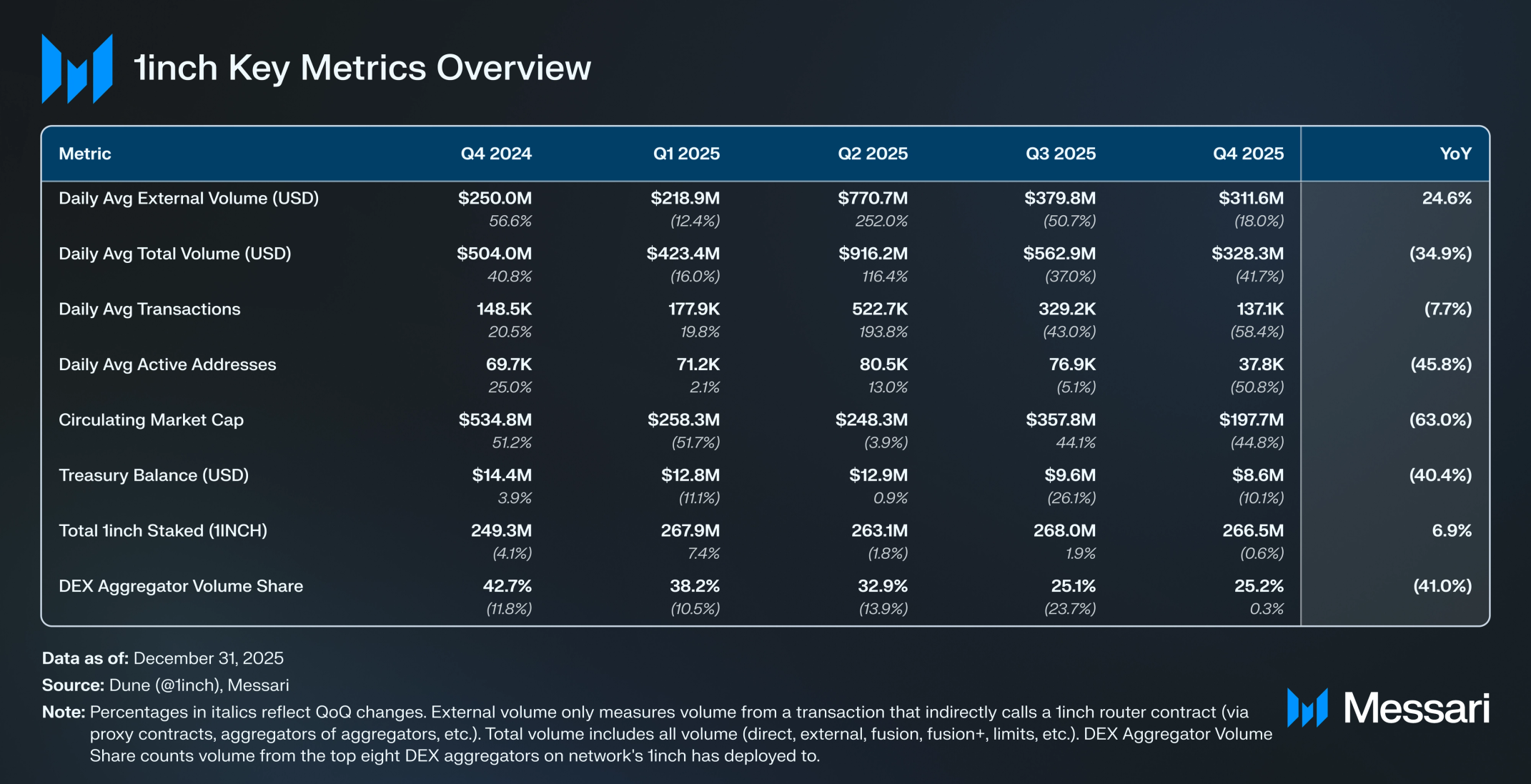
1inch’s DEX aggregator market share remained stable in Q4 despite a broad contraction in routed volumes across the sector. The protocol averaged $9.38 billion in monthly routed volume, down 27.1% QoQ, yet its share of total aggregator volume increased 0.1 percentage points QoQ to 25.2%, indicating that the decline was largely market-wide rather than specific to 1inch.
Competitive dynamics at the top of the aggregator landscape tightened meaningfully. CoWSwap continued to gain share, averaging $9.01 billion in monthly volume and increasing its market share by 1.4 percentage points QoQ to 24.2%, leaving the two protocols effectively tied for leadership. ZeroEx recorded the strongest share gains among major competitors, lifting its share by 1.9 percentage points QoQ to 17.8%, while Kyber maintained a relatively stable position at 14.2% despite lower absolute volumes.
Mid-tier aggregators experienced the largest relative share losses in Q4. Velora, formerly Paraswap, and Odos ceded 1.9 percentage points and 1.5 percentage points of market share, respectively, as their routed volumes declined more sharply than the category average. UniswapX and OpenOcean remained smaller contributors, though both modestly increased their share to 2.1% and 1.3%, respectively.
Despite lower aggregate volumes, market concentration remained high. The five largest aggregators, 1inch, CoWSwap, ZeroEx, Kyber, and Velora, collectively accounted for approximately 90.9% of routed volume in Q4, slightly higher than in Q3. This suggests that competitive shifts during the quarter were driven primarily by redistribution among established players rather than by fragmentation toward smaller venues.
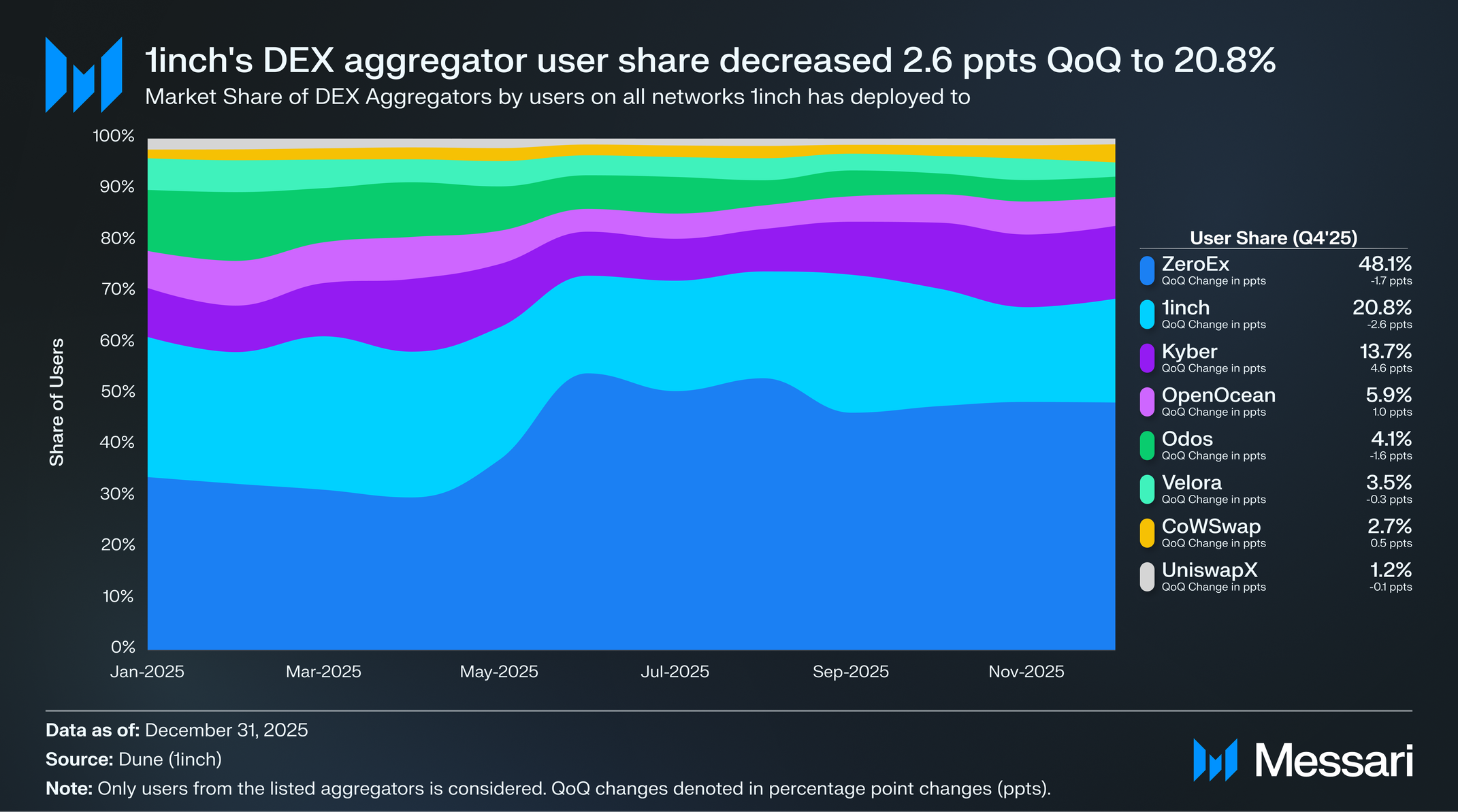
Similarly to routed volume, 1inch’s share of aggregator users declined in Q4. The protocol averaged 393.6k monthly users, down 22.9% QoQ, and its user share fell from 23.4% to 20.8%.
ZeroEx remained the largest aggregator by users despite a 16.2% QoQ decline to 910.6k monthly users. Its user share decreased modestly from 49.8% to 48.1%, maintaining a wide lead over competitors. Kyber recorded the strongest expansion among major aggregators, with monthly users increasing 31.1% QoQ to 258.9k, lifting its share from 9.1% to 13.7%. OpenOcean also grew, rising 5.2% QoQ to 111.2k users and increasing its share to 5.9%.
Other platforms contracted in Q4. Odos declined 37.3% QoQ to 77.6k users, reducing its share to 4.1%. Velora fell 19.8% QoQ to 66.4k users and a 3.5% share. CoWSwap increased 9.0% QoQ to 50.3k users, raising its share to 2.7%, while UniswapX decreased 18.1% QoQ to 23.5k users, representing 1.2% of total aggregator users. Together, the three largest platforms by users, ZeroEx, 1inch, and Kyber, accounted for 82.6% of aggregator users in Q4, largely unchanged from Q3.
Qualitative Analysis
Integrations, Partnerships, Upgrades, & More
The 1inch ecosystem continued to expand in Q4 2025 through major API integrations, security upgrades, infrastructure launches, and institutional partnerships:
- Coinbase Swap API Integration (Oct. 2, 2025) – Coinbase integrated the 1inch Swap API into its decentralized trading feature, making Coinbase the largest U.S. API client for 1inch to date. The integration enables non-custodial, onchain token swaps within the Coinbase app and represents a major milestone for 1inch Business as an institutional and CeFi gateway to DeFi liquidity.
- 1inch Pro Launch (Oct. 3, 2025) – 1inch launched 1inch Pro, a trading interface geared toward advanced users with market and limit orders, TradingView charting, watchlists, live market trades, and portfolio and trade-history widgets. The release also streamlined execution flows by enabling two-way order entry, quick sizing shortcuts, and native token handling without manual wrapping, positioning 1inch’s dApp closer to a CEX-style trading experience while remaining non-custodial.
- 1inch Business Platform Upgrade (Oct. 17, 2025) – 1inch rebranded its Developer Portal as 1inch Business, positioning it as an enterprise-grade infrastructure platform with a redesigned interface, clearer documentation, and streamlined pricing across Startup, Professional, and Business tiers. All APIs are now bundled under standard plans, with the Swap API granting access to classic, intent-based, and cross-chain swaps, while maintaining 99.99% uptime, sub-100ms latency, SLA-backed performance, and seamless migration for existing users.
- Institutional Stablecoin Routing via Flowdesk and SG-FORGE (Oct. 21, 2025) – 1inch onboarded Flowdesk as a resolver to support EURCV and USDCV, MiCA-compliant stablecoins issued by Société Générale-FORGE. The integration enables institutional-grade euro- and dollar-denominated stablecoin liquidity across Ethereum and Solana.
- Ledger Deep Integration and Multisig Routing (Oct. 23, 2025) – 1inch integrated directly with Ledger’s signer and Ledger Multisig, enabling clear-signed, MEV-resistant swaps executed via the 1inch Swap API. The integration eliminates blind signing for treasury and multisig users, positioning 1inch as a preferred execution layer for secure onchain treasury management.
- Innerworks AI Security Integration (Oct. 27, 2025) – 1inch partnered with Innerworks to integrate predictive AI-based threat detection, advanced device intelligence, and RedTeam ethical hacking capabilities into its security stack. The collaboration introduces real-time synthetic threat intelligence designed to proactively identify and neutralize AI-driven fraud, bot attacks, and emerging exploit vectors before execution, strengthening 1inch’s defensive perimeter and raising the standard for proactive security across DeFi.
- ISO 27001 Certification & SOC 2 (Oct. 30, 2025) – 1inch achieved ISO 27001 certification and SOC 2 Type 1 attestation, validating its information security, data protection, and threat intelligence processes. The milestone strengthens its positioning as an enterprise-ready, compliant DeFi infrastructure provider for institutional and regulated partners.
- Aqua Developer Release (Nov. 17, 2025) – 1inch launched the developer release of Aqua, a new LP-centric shared liquidity layer that enables capital to back multiple strategies simultaneously without locking assets. The release includes SDKs, smart contracts, documentation, and bounties of up to $100,000, allowing developers to build on Aqua’s open architecture ahead of its planned frontend launch in 2026.
- Additional API and Wallet Integrations (Dec. 2025) – 1inch expanded Swap API adoption across wallets and platforms, including Hashport Wallet, LF Wallet, TopNod (for Ondo GM assets), and additional RWA routing on BNB Chain, extending 1inch’s reach across retail, institutional, and cross-chain environments.
- Industry recognition at BeInCrypto Awards 2025 (Dec. 11, 2025) – 1inch was named “Best DEX” at the BeInCrypto Awards 2025, recognizing its continued leadership in DEX aggregation, execution quality, and ecosystem development.
- BlockscanHQ swap scanner launch (Dec. 15, 2025) – BlockscanHQ, developed by the Etherscan team, launched a swap scanner with native support for decoding and analyzing 1inch cross-chain transactions, improving transparency and post-trade analysis for aggregator activity.
- AI-powered smart contract security with SavantChat (Dec. 23, 2025) – 1inch began testing SavantChat’s AI-based auditing tools for smart contract pre-audits, adding automated vulnerability detection, gas optimization checks, and CI/CD-integrated security reviews. Early results from Aqua and SwapVM pre-audits supported expanding AI-assisted security workflows to complement traditional audits and strengthen continuous development security.
Closing Summary
In Q4 2025, 1inch activity continued to normalize alongside broader market conditions, with Aggregation Protocol volumes declining 50.5% QoQ as onchain trading cooled. Despite lower volumes, market share held steady at 25.2%, indicating sector-wide contraction rather than protocol-specific weakness. Limit Order Protocol usage strengthened, with daily average volume rising 19.9% and order counts more than doubling, driven primarily by renewed BNB Chain activity following the rollout of tokenized RWA routing via the Swap API. Fusion volume increased 22.6% QoQ, and order counts surged over 200%, with BNB Chain emerging as a second major execution hub alongside Ethereum. Fusion+ activity retraced from Q3 highs but stabilized at elevated baseline levels.
Strategically, Q4 marked a transition toward greater institutional alignment and infrastructure maturity. The rebrand of the Developer Portal into 1inch Business formalized its positioning as enterprise-grade DeFi infrastructure, while major integrations with Coinbase and Ledger expanded 1inch’s role as a preferred execution layer for both CeFi platforms and onchain treasuries. The launch of 1inch Pro enhanced the trading interface for advanced users, and Aqua’s developer release introduced a new shared-liquidity architecture. Security investments accelerated through ISO 27001 certification, SOC 2 attestation, Innerworks AI monitoring, and AI-assisted audits via SavantChat. Governance activity focused on structural refinements rather than material treasury outlays, with explicit spending limited to $90,000. Overall, 1inch exited Q4 positioned as a more institutionally aligned, cross-chain liquidity and execution layer with expanding exposure to RWAs, enterprise integrations, and agentic trading infrastructure.

Hayden is a Research Analyst specializing in the intersection of crypto-economic incentive mechanisms and their role in DeFi, DePIN, and AI ecosystems. Prior to joining Messari, Hayden worked as a Research Analyst at The Block and as a Venture Associate at a crypto-native venture capital fund.