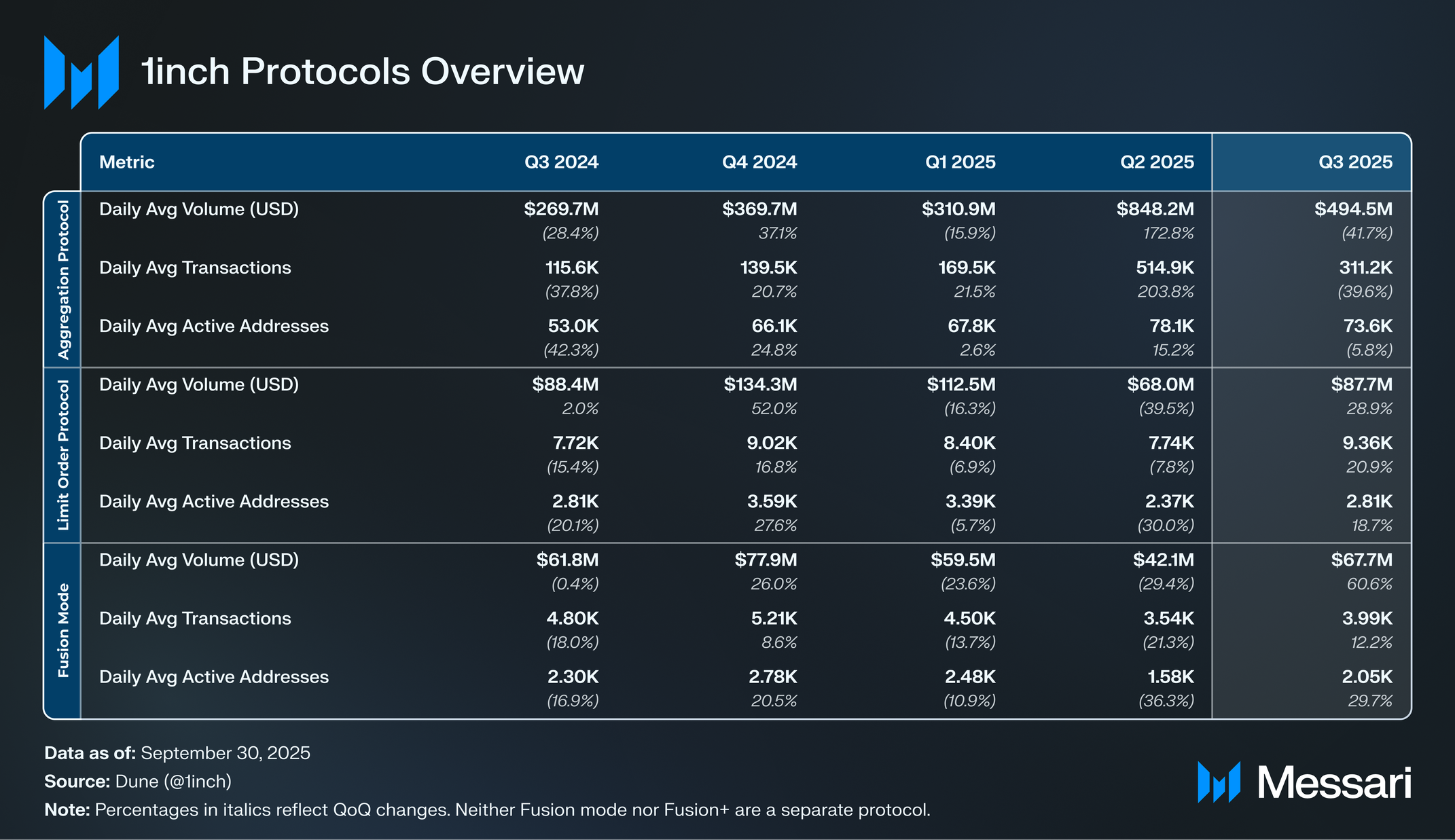
Fusion execution accelerated, as daily average volume grew 60.6% QoQ and active wallets rose 29.7%, supported by stronger resolver competition and broader chain-level participation.
Fusion+ posted its strongest quarter to date, with median daily volume climbing 129.1% QoQ and active wallets increasing 76.5%, driven by expanding cross-chain coverage and the introduction of native Solana–EVM execution.
Limit Order Protocol activity rebounded, with daily average volume rising 29.7% QoQ. Major chain participation strengthened across major chains, signaling a shift back toward scheduled execution after Q2’s preference for immediate routing.
Aggregation Protocol volume normalized, with daily averages falling 41.3% QoQ to $494.5 million. BNB Chain activity retraced from Q2’s incentive-driven peak, while Ethereum regained its position as the largest source of stable, high-liquidity routing.
Trustless Solana–EVM swaps went live, marking a major expansion of 1inch’s cross-chain intent architecture. This upgrade advances the protocol’s long-term strategy for unified, bridge-free liquidity.
Primer
The 1inch Network (1INCH) is a decentralized finance (DeFi) DEX aggregator and intent-order protocol operating on Ethereum, Arbitrum, Optimism, Polygon, zkSync Era, Unichain, Base, Linea, Solana, Sonic, Avalanche, BNB Chain, and Gnosis. Launched in 2019, the 1inch Aggregation Protocol (AP) allows users to route trades across various markets and realize the best available rate compared to any individual decentralized exchange (DEX). In late 2020, the 1inch Liquidity Protocol introduced a native automated market maker (AMM) to the network, which enables users to provide liquidity and earn liquidity mining rewards.
The network’s second product, the 1inch Limit Order Protocol (LOP), was introduced in June 2021 to support conditional limit orders. In late December 2022, the 1inch Swap Engine enabled Fusion mode, whereby approved registered addresses called Resolvers compete via a Dutch auction mechanism to fulfill orders with a specified price and time range, and do not need native tokens for network gas fees. In November 2024, 1inch fully released Fusion+, which builds upon the 1inch Fusion and Limit Order protocols to enable cross-chain atomic swaps. In Q3 2025, Fusion+ expanded to support native Solana to EVM execution, making Solana a full endpoint in 1inch’s cross-chain intent architecture.
All four protocols are governed by the 1inch DAO using the network’s native 1INCH token.
Note: This report includes data from Ethereum, BNB Chain, Polygon, Base, Optimism, Arbitrum, Avalanche, Solana, Sonic, Gnosis Chain, zkSync, Unichain, and Linea.
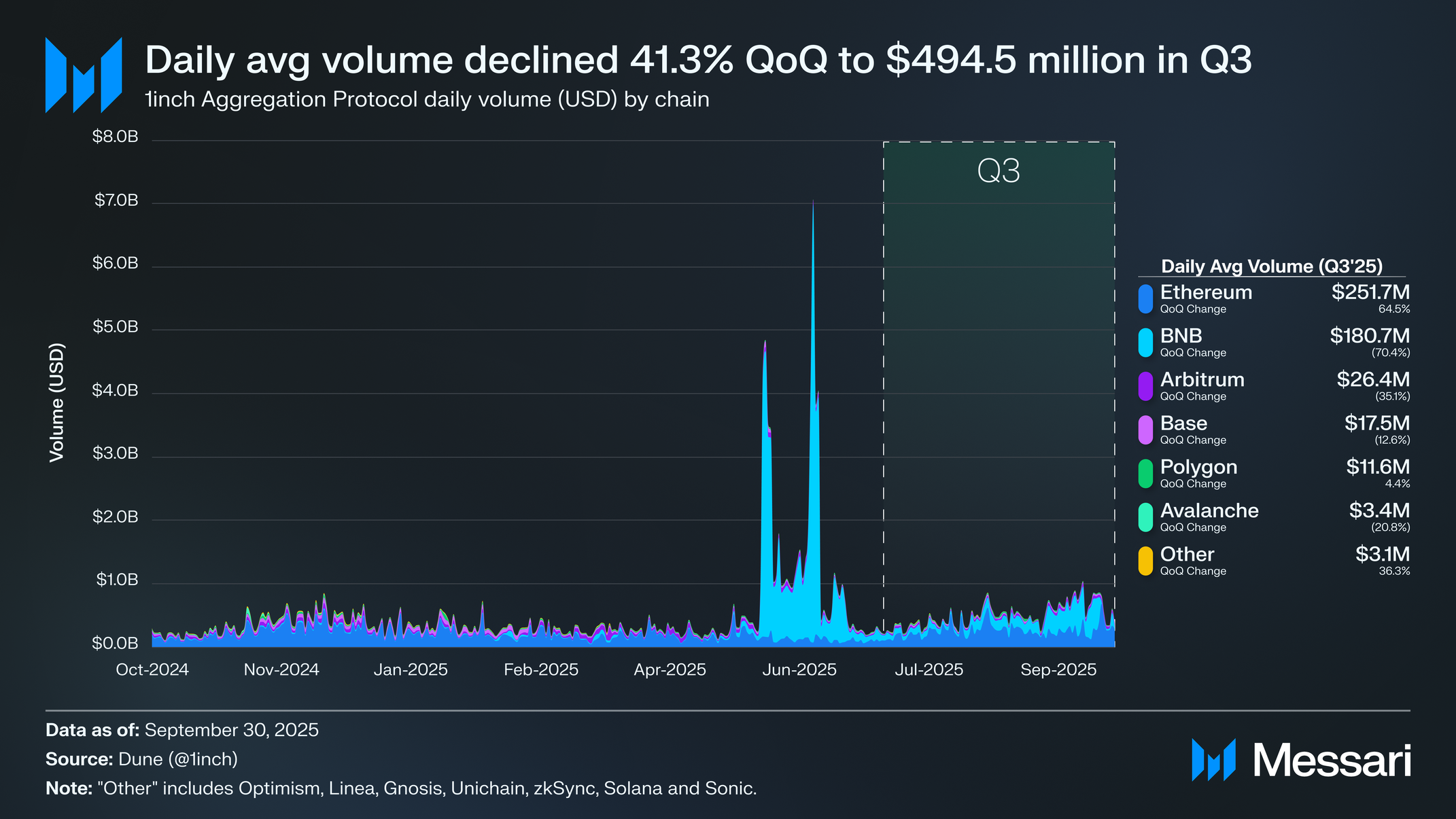
Of 1inch’s four protocols, the Aggregation Protocol is responsible for most volume routed through 1inch. Daily average volume declined 41.3% QoQ to $494.5 million from the unusually high levels recorded in Q2, when BNB Chain activity was elevated by Binance Alpha airdrop incentives, but remained above pre-airdrop baselines. The decline in Q3 was primarily driven by the normalization of BNB Chain flows as routed volume on BNB fell 70.4% QoQ as airdrop-related activity subsided, reducing its share of total execution after briefly dominating the Aggregation Protocol in Q2’25.
With BNB activity cooling, Ethereum regained market share and re-established itself as the most stable high-liquidity 1inch-supported network. It became the largest chain by volume in Q3, supported by deeper liquidity and more consistent organic order flow.
Arbitrum’s routed volume also declined, falling 35.1% QoQ to $26.4 million and reducing its share to 5.4%. Base saw a more moderate pullback, with daily average volume down 12.6% QoQ to $17.5 million, positioning it at 3.6% of total routed flow. Polygon posted a slight increase, rising 4.4% to $11.6 million, while Avalanche decreased 20.8% to $3.4 million. Other supported networks collectively grew 36.3% QoQ to $3.1 million, though they continued to represent a small portion of total activity.
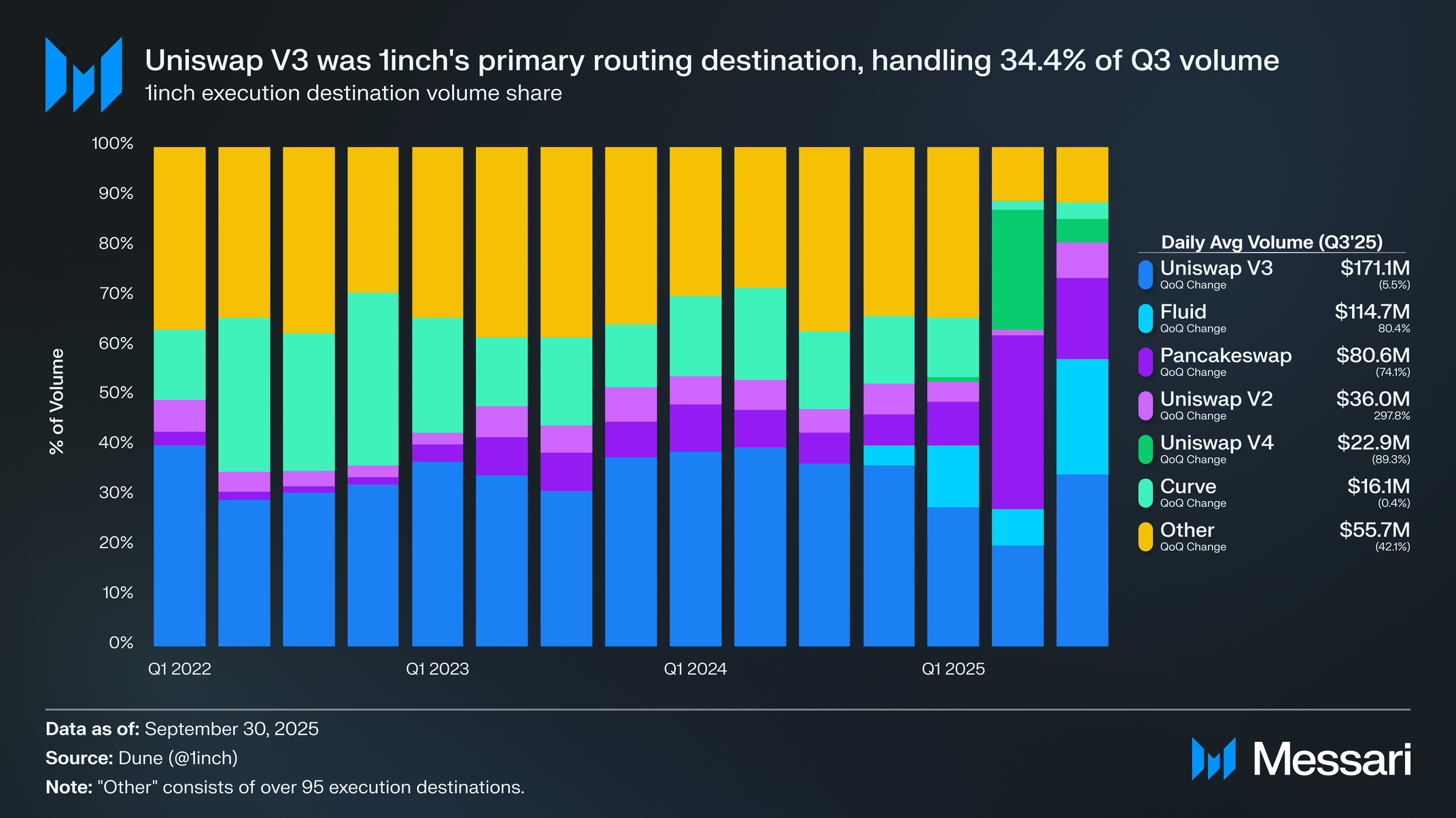
In Q3, Uniswap V3 maintained the top slot on 1inch. It captured 34.4% of the routed volume with $171.1 million in average daily volume, representing a decline of 5.5% QoQ. Fluid maintained its place as the second-largest DEX handling volume routed through 1inch. Fluid grew its market share by processing $114.7 million in daily average volume in Q3, an increase of 80.4% QoQ. PancakeSwap ranked third at $80.6 million. Volume routed through PancakeSwap declined 74.1% QoQ as BNB Chain activity normalized.
Uniswap V2 experienced the fastest growth, with average daily volume increasing 297.8% QoQ to $36.0 million, lifting its market share to 7.3%. Uniswap V4 posted $22.9 million per day after an 89.3% QoQ increase. Curve remained stable at $16.1 million (down 0.4% QoQ), while the “Other” category of 95+ destinations collectively fell to $55.7 million, down 42.1% QoQ.
Execution flow continued consolidating around major venues. Concentration among the top three DEXs declined in Q3 as Uniswap V3, Fluid, and PancakeSwap together accounted for 73.7% of all routed volume in Q3, down from 79.2% in Q2.
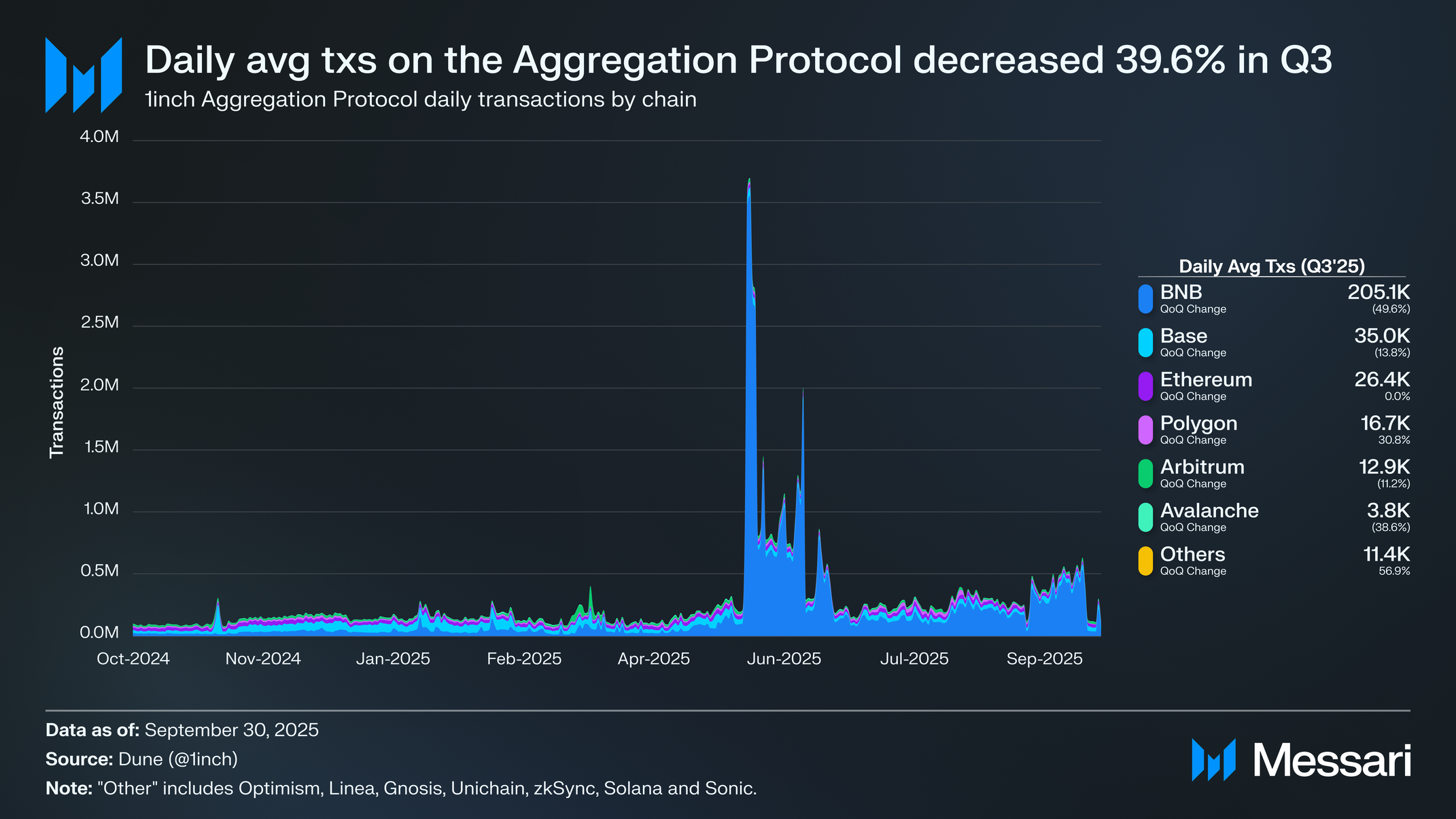
Daily average transactions on the Aggregation Protocol decreased 39.6% QoQ to 311k in Q3 as activity normalized from the incentive-driven surge observed on BNB Chain in Q2. BNB remained the largest source of throughput but saw transactions fall 49.6% QoQ to 205.1k swaps per day as Binance Alpha airdrop activity subsided.
Base recorded 35.0k daily swaps, up 13.8% QoQ, while Ethereum held steady at 26.4k transactions, in line with Q2 2025. Arbitrum processed 12.9k swaps daily, a decline of 11.2% QoQ. Polygon rose 30.8% QoQ to 16.7k swaps, and Avalanche decreased 38.6% QoQ to 3.8k. Other supported networks collectively averaged 11.4k transactions, up 56.9% QoQ, though they remained a relatively small portion of total activity.
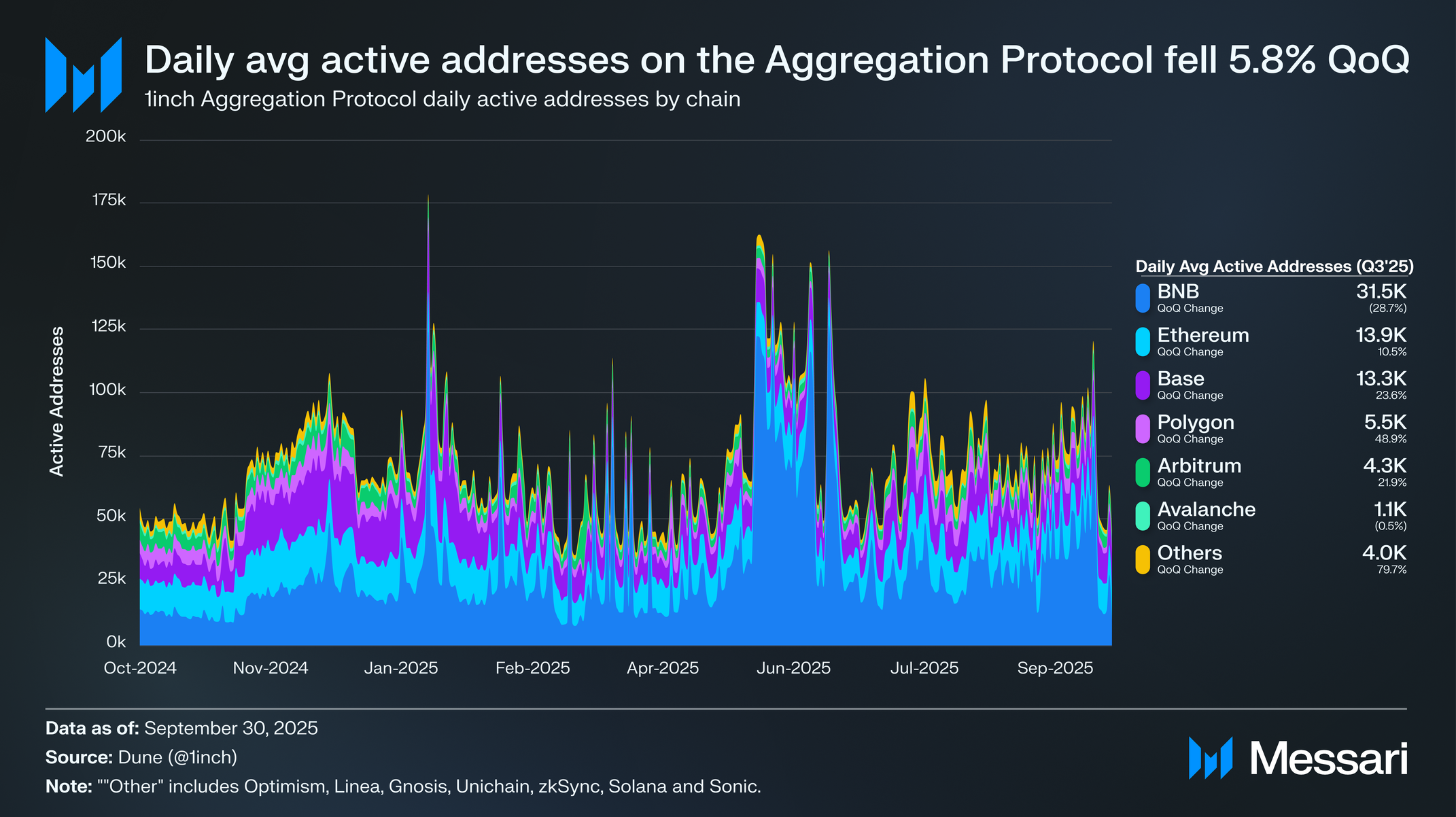
Daily average active addresses on the Aggregation Protocol fell 5.8% QoQ from 78,135 to 73,232. BNB remained the largest source of users but declined 28.7% QoQ to 31,549 daily active addresses. Ethereum grew 10.5% to 13,914, while Base rose 23.6% to 13,278. Polygon increased 48.9% QoQ to 5,494, and Arbitrum climbed 21.9% to 4,289. Avalanche held steady at 1,139 (-0.5% QoQ). Other supported networks averaged 3,958 daily active addresses, up 79.7% QoQ but still a small share of total usage.
Limit Order Protocol
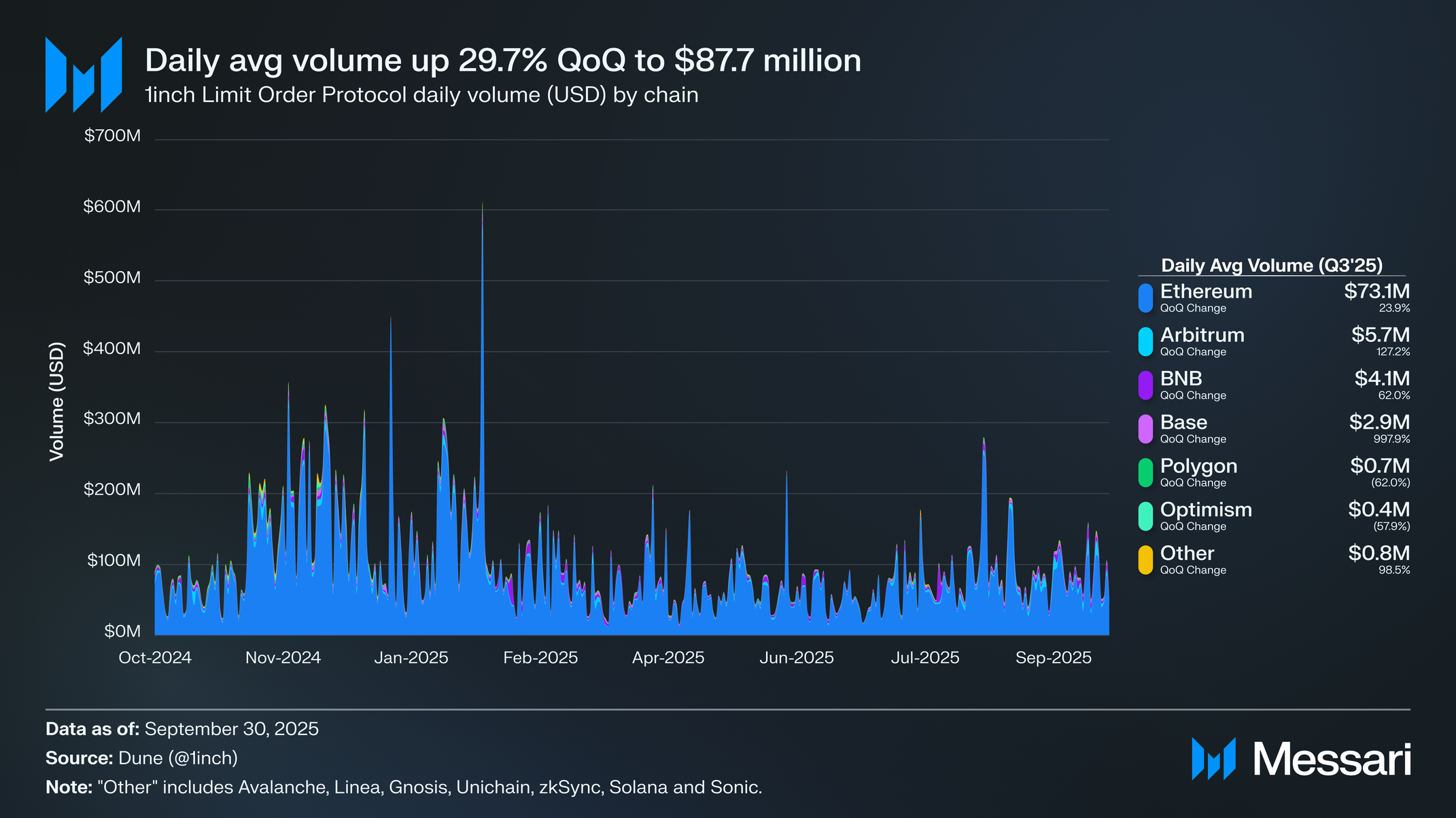
Daily average volume on the Limit Order Protocol increased 29.7% QoQ from $68.0 million to $87.7 million, marking a sharp reversal from the contraction seen in Q2. Ethereum maintained its dominant position with an 83.4% market share, as daily average volume rose 23.9% QoQ to $73.1 million. BNB Chain climbed to $4.1 million in daily volume (+62.0% QoQ), while Arbitrum more than doubled to $5.7 million (+127.3% QoQ), making it the fastest-growing deployment in Q3. Base also expanded meaningfully, reaching $2.9 million in daily average volume (+65.6% QoQ). Optimism grew to $0.4 million (+43.6% QoQ), whereas Polygon was the only major chain to contract, declining 26.0% QoQ to $0.7 million. Other supported networks collectively rose to $0.8 million (+98.5% QoQ), though they remained a small part of overall activity. The quarter’s increase in activity suggests traders were more willing to place limit orders in Q3, contrasting with Q2’s environment, where immediate execution through the Aggregation Protocol absorbed most directional flow.
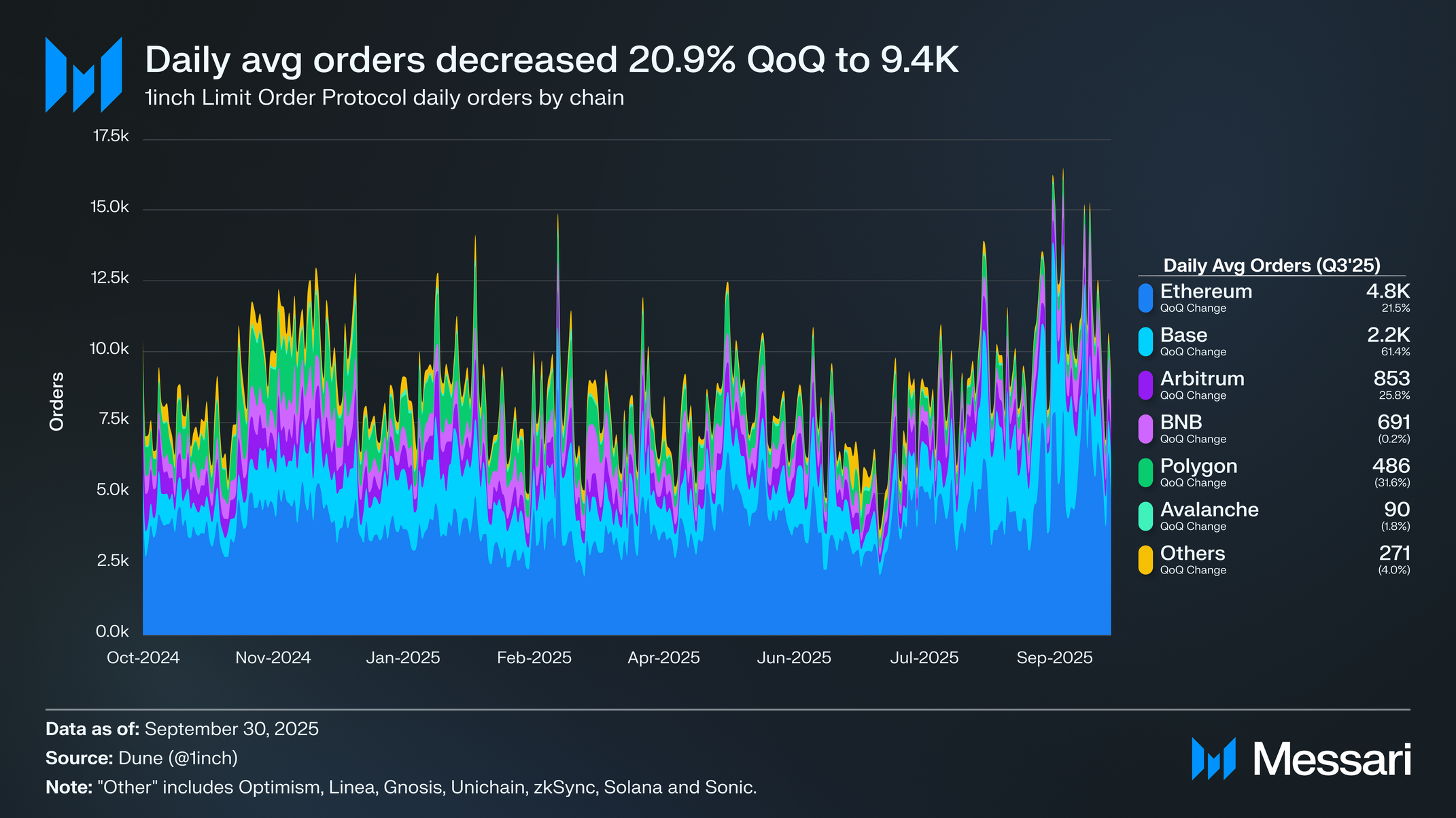
Daily average orders on the Limit Order Protocol increased 20.9% QoQ from 7,744 to 9,360. Ethereum daily average orders increased 21.5% QoQ from 3,923 to 4,765, raising its share of total orders to 50.9%. Base posted the fastest growth among major deployments, rising 61.4% QoQ from 1,365 to 2,203 daily orders.
In contrast, several other networks declined in Q3. Polygon's daily average orders fell 31.6% from 711 to 486, the steepest drop among major chains. BNB Chain remained largely unchanged at 691 daily orders (–0.2% QoQ), while Arbitrum grew 25.8% QoQ to 853. Avalanche held steady at 90 daily orders (–1.8% QoQ), and other supported networks collectively averaged 271 orders (–4.0% QoQ). Ethereum’s growth, coupled with declines on several chains, indicates order flow continued to concentrate on Ethereum even as overall activity trended lower.
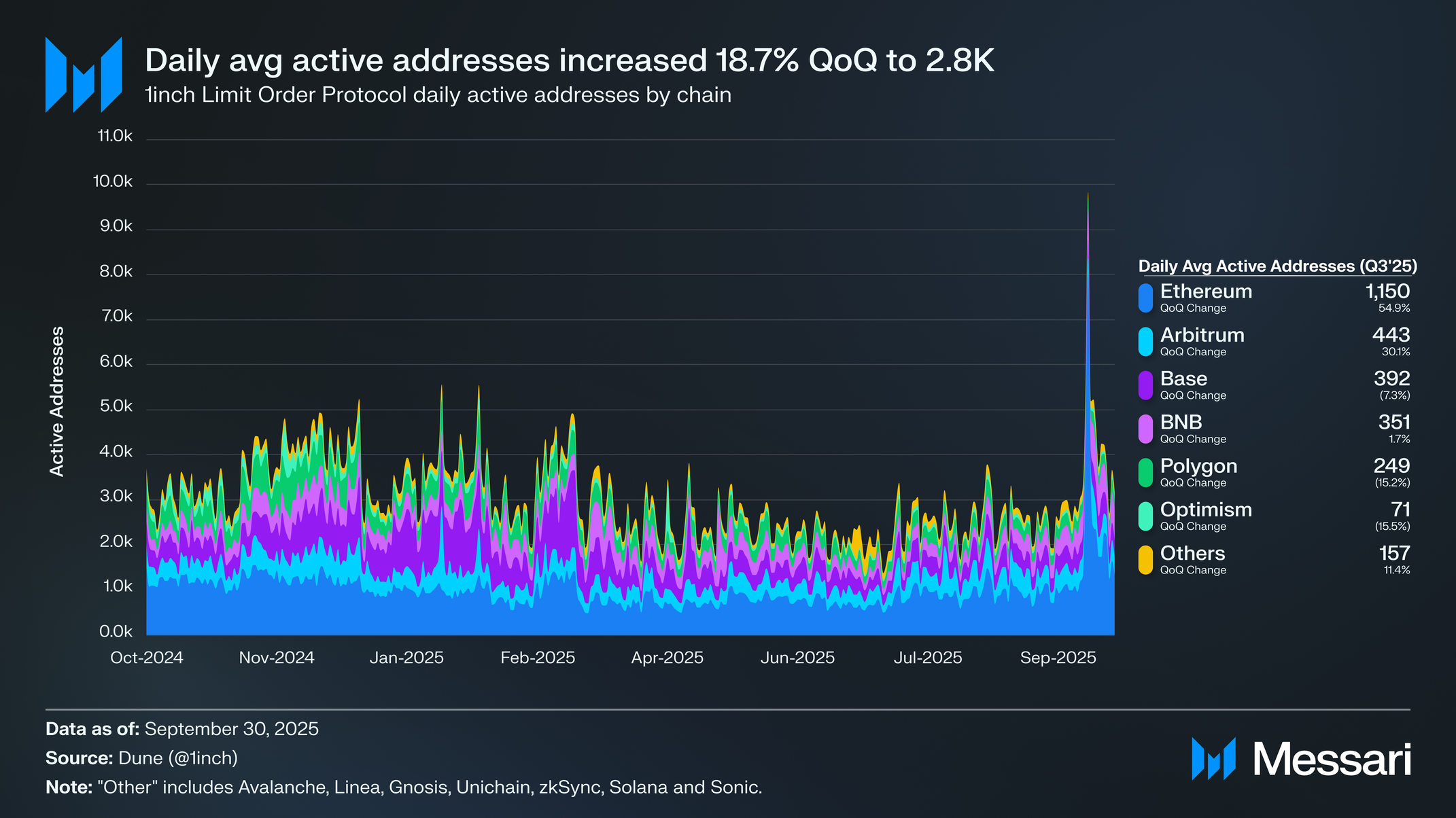
Daily average active addresses on the Limit Order Protocol increased 18.7% QoQ from 2,369 to 2,811 in Q3. Ethereum saw the strongest growth among major deployments, rising 54.9% QoQ to 1,150 daily active addresses. Arbitrum also expanded, increasing 30.1% QoQ to 443, while Polygon fell 15.2% to 249. BNB Chain held steady at 351 (+1.7% QoQ), and other supported networks averaged 157 daily active addresses (+11.4% QoQ). In contrast, Base declined 7.3% QoQ to 392 daily active addresses, and Optimism fell 15.5% to 71.
Fusion Mode
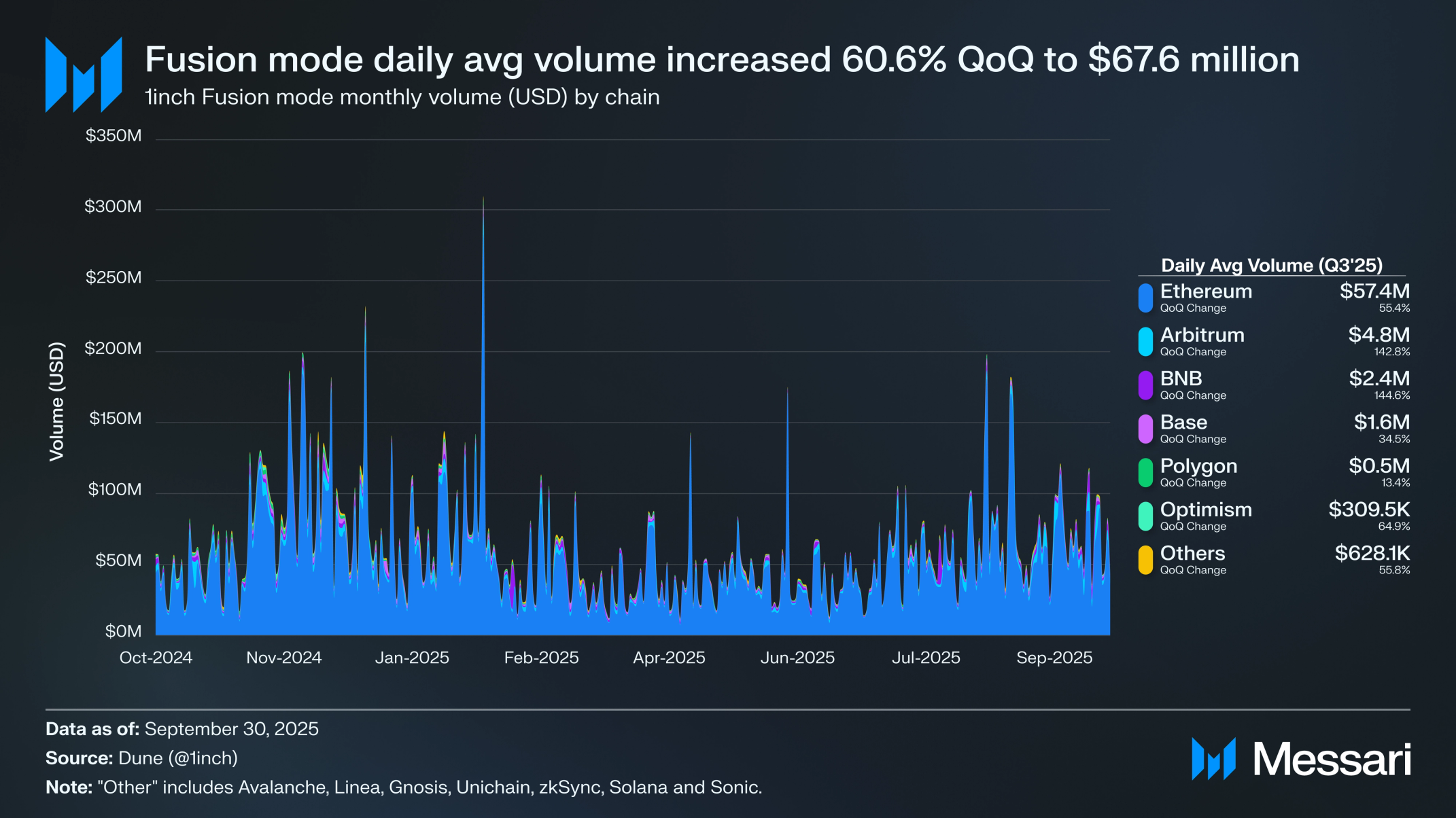
Fusion sits on top of 1inch’s Aggregation and Limit Order rails: users post intents with price-and-time presets, market makers called resolvers cover the gas. A Dutch auction curve lowers the rate until the order is executed. That architecture keeps swaps gas-free for traders and shields them from MEV. However, activity rebounded sharply as Fusion's daily average volume increased 60.6% QoQ from $42.1 million to $67.6 million, reversing the contraction seen in Q2.
Ethereum continued to dominate Fusion execution, processing $57.4 million in daily average volume, an increase of 55.4% QoQ, and accounting for 84.8% of all Fusion flow. Arbitrum followed at $4.8 million, up 142.8% QoQ, making it one of the fastest-growing deployments this quarter. BNB Chain also expanded meaningfully, rising 144.6% QoQ to $2.4 million, while Base reached $1.6 million (+34.5% QoQ). Polygon saw moderate growth to $0.5 million (+13.4% QoQ), and Optimism increased to $309.5k (+64.9% QoQ). Other supported networks collectively averaged $628.1k, up 55.8% QoQ, though they remained a small share of overall Fusion activity.
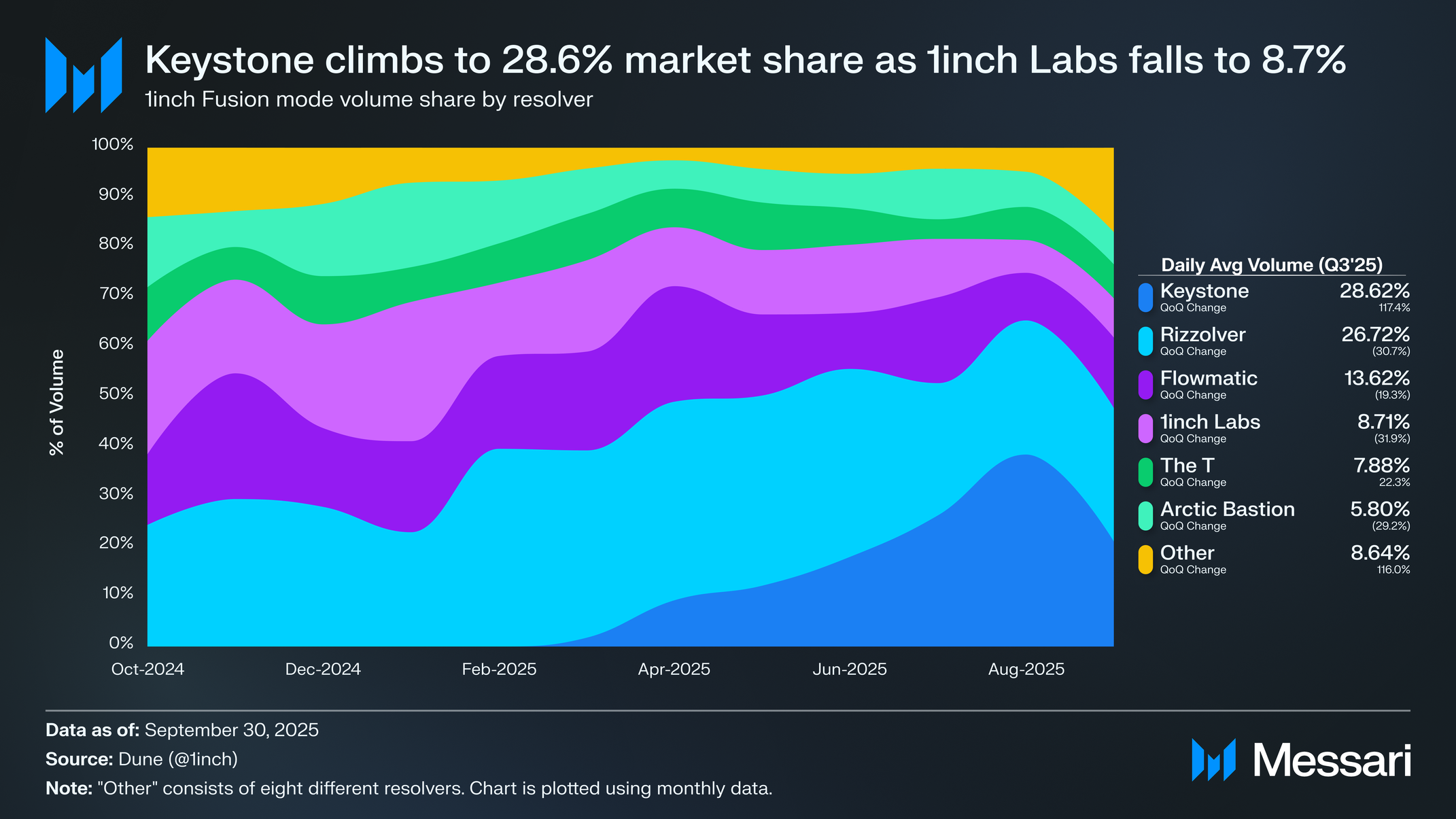
Resolvers are approved registered addresses that compete via a Dutch auction mechanism to fulfill 1inch Fusion and Fusion+ orders. Q3 saw a reshuffling among the top resolvers as Keystone emerged as the new leader, capturing 28.6% of Fusion volume after growing 117.4% QoQ. Rizzolver moved to second place with 26.7%, down from 38.5% in Q2, while Flowmatic ranked third at 13.6%, declining 19.3% QoQ.
1inch Labs’ resolver share contracted to 8.7%, a 31.9% QoQ decrease, as newer entrants gained traction. The T climbed to 7.9%, up 22.3% QoQ, while Arctic Bastion fell to 5.8%, down 29.2% QoQ. The “Other” resolver group expanded meaningfully, rising to 8.6% (+116.0% QoQ), indicating broader participation across smaller resolvers. Altogether, the top three resolvers accounted for nearly 69% of Fusion volume, a similar proportion to prior quarters but with a significantly different composition, driven by Keystone’s rapid ascent.
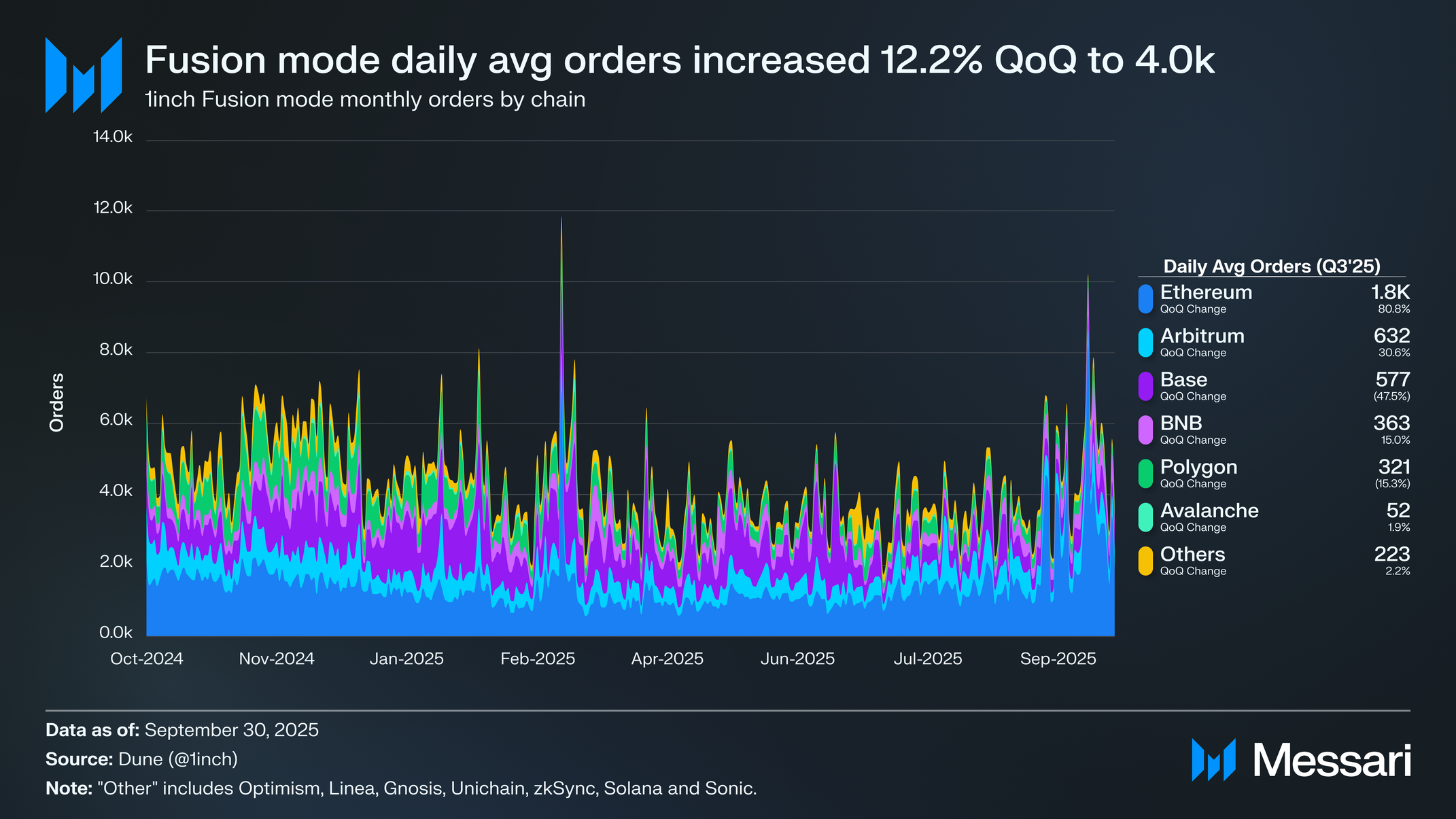
Daily average orders in Fusion mode increased 12.2% QoQ from 3,556 to 3,991. Base daily orders fell 47.5% from 1,100 to 577, while Ethereum rose 80.8% from 1,008 to 1,822. Arbitrum also expanded, up 30.6% from 484 to 632 daily orders. Polygon declined 15.3% QoQ from 379 to 321, while BNB Chain increased 15.0% from 316 to 363. Avalanche posted a slight increase of 1.9% from 51 to 52. Other supported networks averaged 223 daily orders, up 2.2% QoQ. Ethereum and Arbitrum, the top two networks in Q3 by Fusion mode orders, together accounted for 61.5% of all Fusion mode orders in Q3, up from 56.3% in Q2.
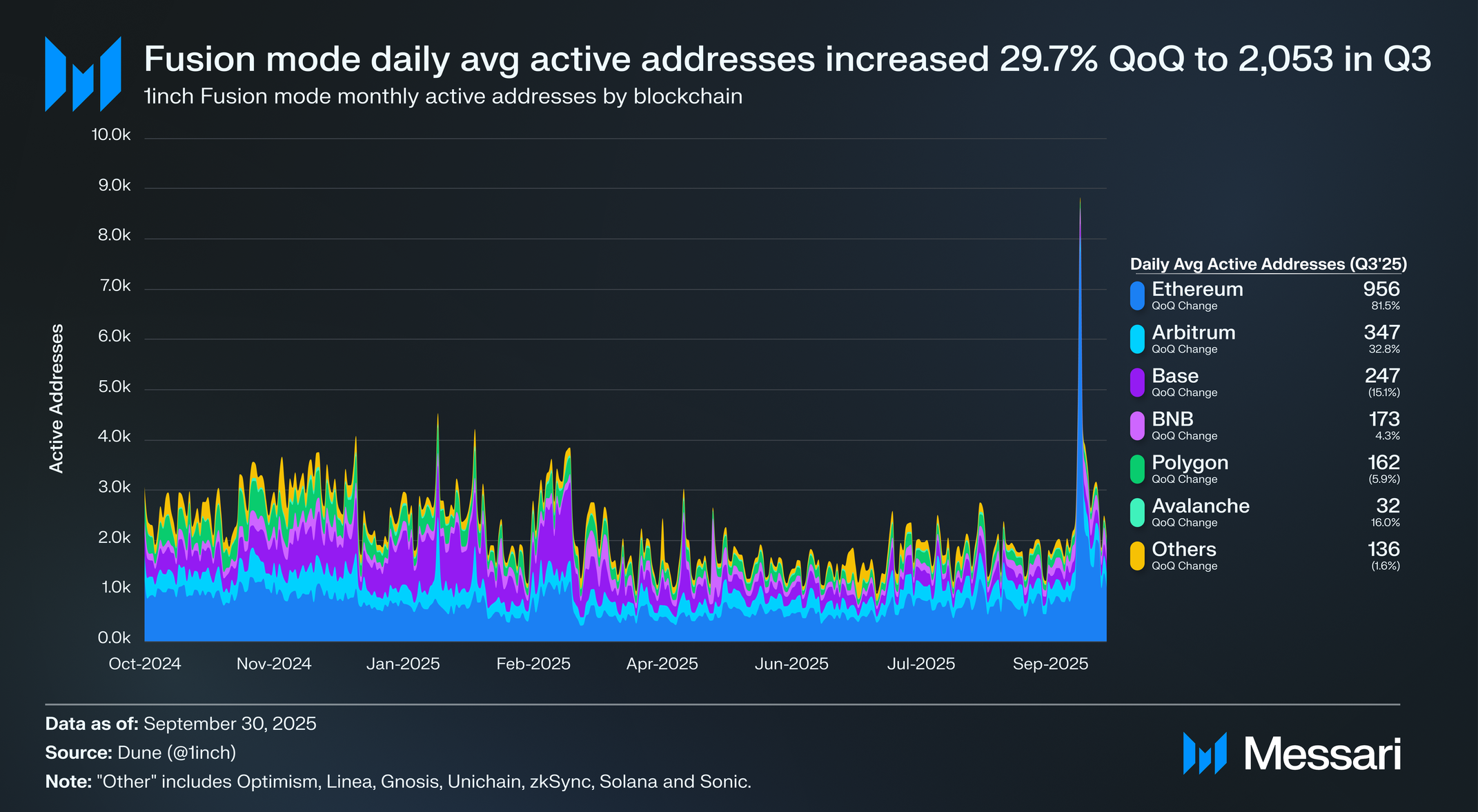
Fusion mode daily average active addresses increased 29.7% QoQ from 1,584 to 2,053 in Q3. Activity expanded across most major chains. Ethereum remained the top chain by user count, with daily active addresses rising 81.5% from 527 to 956. Arbitrum also grew, increasing 32.8% from 261 to 347, while BNB Chain rose 4.3% from 166 to 173. Avalanche increased 16.0% from 28 to 32. In contrast, Base daily active addresses declined 15.1% from 291 to 247, and Polygon fell 5.9% from 173 to 162. Other supported networks averaged 136 daily active addresses, down 1.6% QoQ. Ethereum and Arbitrum remained the most significant sources of Fusion activity, accounting for 63.4% of active addresses in Q3, up from 49.2% in Q2.
Fusion+ Mode
Fusion+ is 1inch’s intent-based protocol for cross-chain swaps. Users sign offchain orders that resolvers compete to fill via Dutch auctions, with execution coordinated through Hashed Timelock Contracts (HTLCs). This structure eliminates the need for users to pay gas, protects against MEV, and enables partial fills across multiple chains. Resolver participation, auction logic, and trade parameters are governed by the 1inch DAO, making Fusion+ a modular framework for secure, gasless, and efficient cross-chain execution.
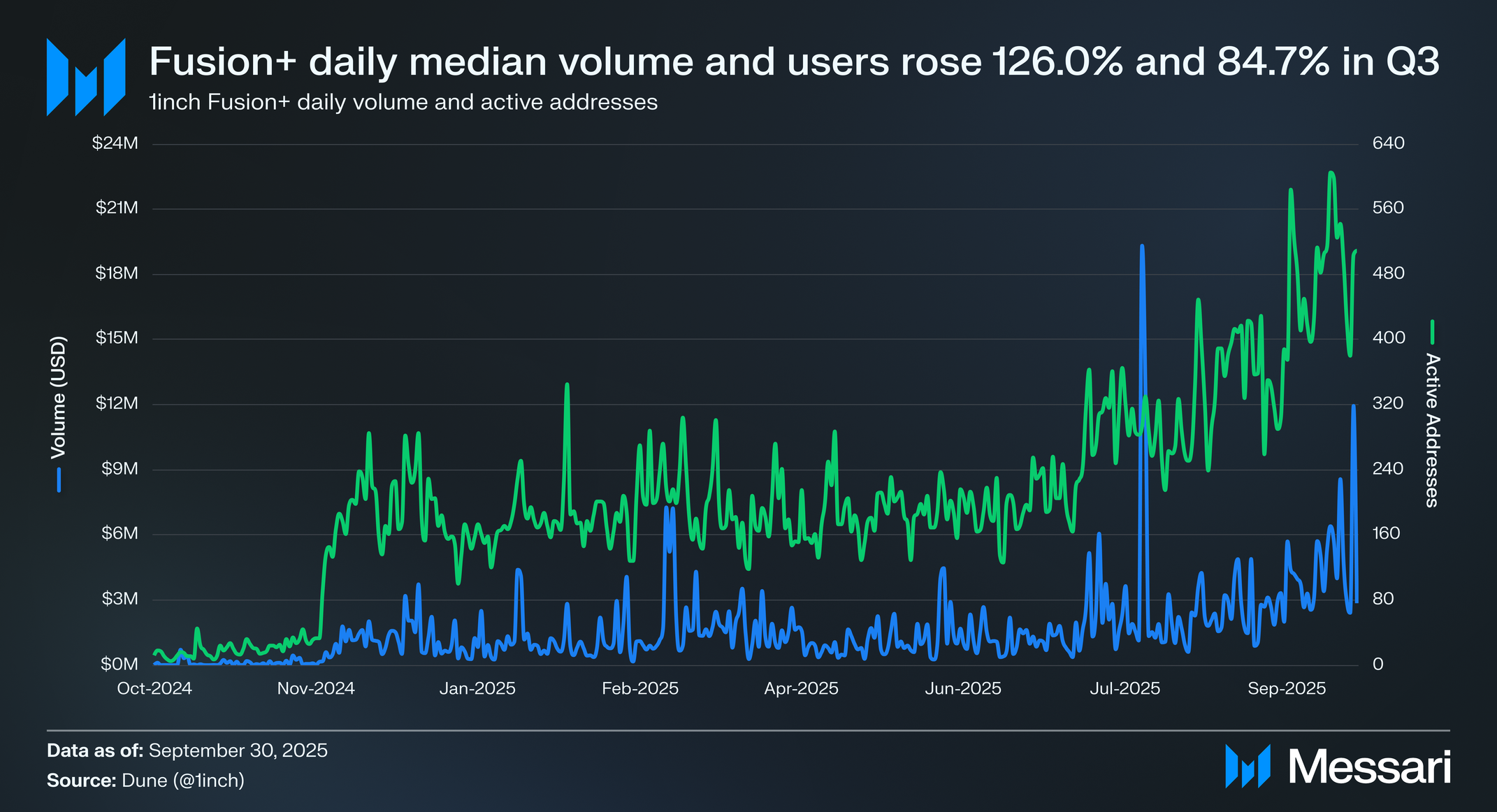
Fusion+ median daily volume increased 129.1% QoQ from $1.06 million to $2.42 million in Q3. Median daily active addresses rose 76.5%, from 187.0 to 330.0. After two quarters of more moderate growth, Fusion+ activity accelerated meaningfully in Q3 as both user participation and resolver coverage expanded. The uptick suggests Fusion+ is transitioning from its early stabilization phase toward stronger, sustained usage driven by broader cross-chain execution and deeper integration across supported networks.
Market Analysis
Market Cap and Staking
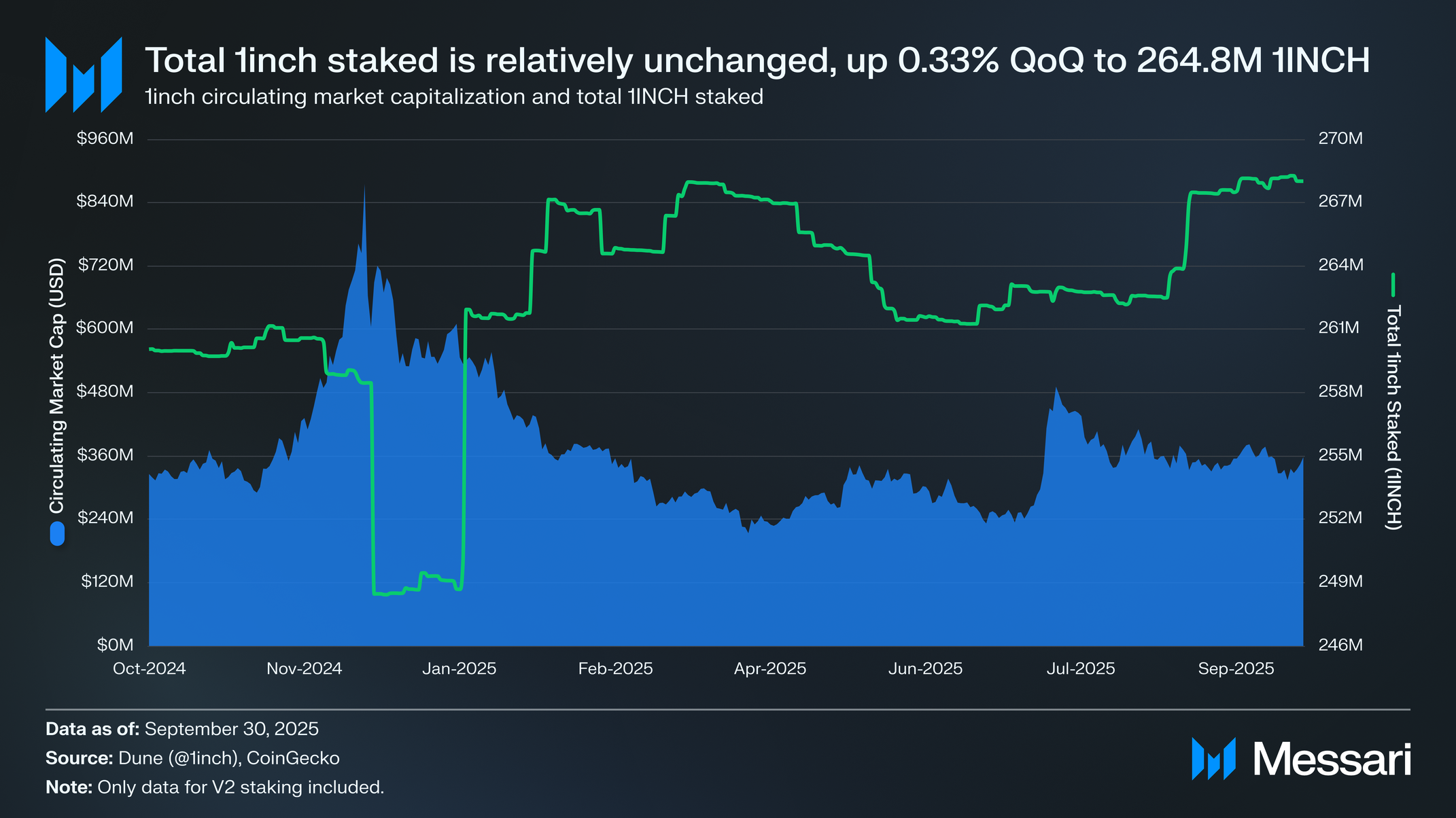
Staking 1INCH gives Unicorn Power (UP), which can be used to vote in governance and delegate to resolvers. Staking and delegating to resolvers create an important value accrual pathway for the token: resolvers give 1INCH rewards to attract delegates so the resolvers can compete in completing Fusion transactions.
Treasury
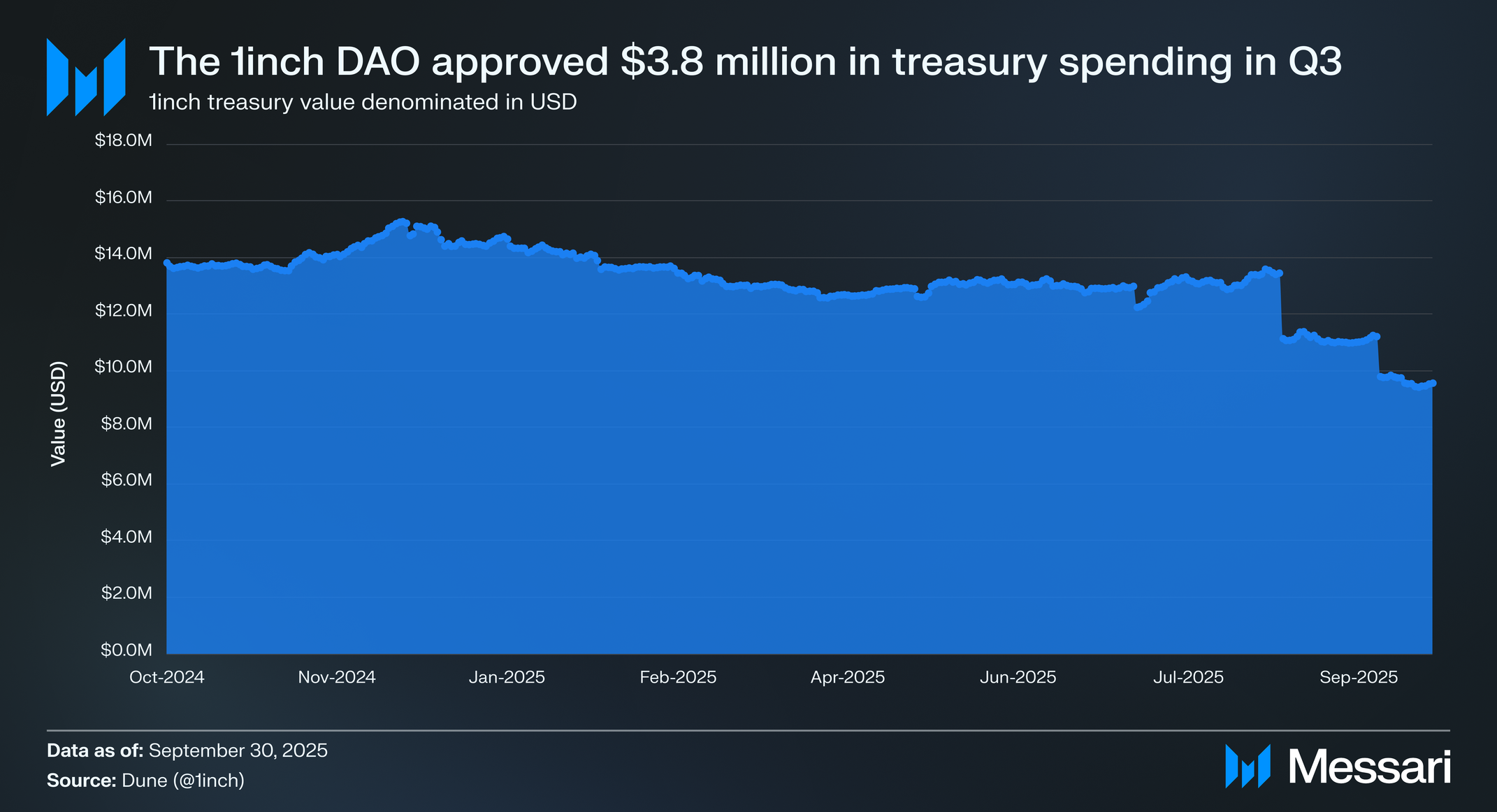
The 1inch DAO continues to be mindful of spending while allocating growth opportunities for all 1inch users and participants. In Q3, the DAO approved eight payments totaling $3,789,093:
[1IP-81] Next Phase of the Alternative Interface: Solana, Security & P2P (Jul 2025) – Allocated 87,000 USDC over six months to support maintenance, security hardening, WebTorrent-based update delivery, QA testing, and Solana network integration for the alternative 1inch interface.
[1IP-82] Cross-Chain Exchange Research: Secret Swaps (Jul 2025) – Approved 25,000 USDC for a three-week research engagement to assess native Bitcoin-to-EVM swap feasibility and produce a system requirements document for trustless cross-chain swap design.
[1IP-83] Events Grant for Q3-Q4 2025 (Jul 2025) – Authorizes 1,883,093 USDC to fund 1inch participation in nine ecosystem events, including ETHCC, Token2049, DevConnect, ETHGlobal hackathons, and Solana Breakpoint, covering sponsorships, production, travel, and community activation.
[1IP-84] Unite DeFi Hackathon Title Sponsorship (Jul 2025) – Allocates 300,000 USD equivalent in 1INCH tokens to sponsor ETHGlobal’s Unite DeFi hackathon and support developer engagement, prize pools, and ecosystem-driven integrations.
[1IP-84] DAO Forum Migration to Discourse (Aug 2025) – Approves 19,000 USDC for the first-year costs of moving the 1inch governance forum from Commonwealth to Discourse, including a Business Plan subscription and migration services.
[1IP-85] Regulatory Engagement & Risk Management Initiative (Aug 2025) – Sets aside 110,000 USDC to support institutional outreach, participation in policy forums, and educational initiatives aimed at strengthening 1inch’s presence in regulatory and academic circles.
[1IP-86] Smart-Contract Security Audits for 2025 (Sep 2025) – Allocates 1,359,000 USDC to fund independent security audits for all new and upgraded 1inch protocol components planned for 2025, with reports to be published prior to deployment.
[1IP-87] Snapshot Pro Subscription (Sep 2025) – Authorizes 6,000 USDC for a one-year Snapshot Pro subscription to maintain the DAO’s delegation-based voting mechanism after it moved behind a paywall.
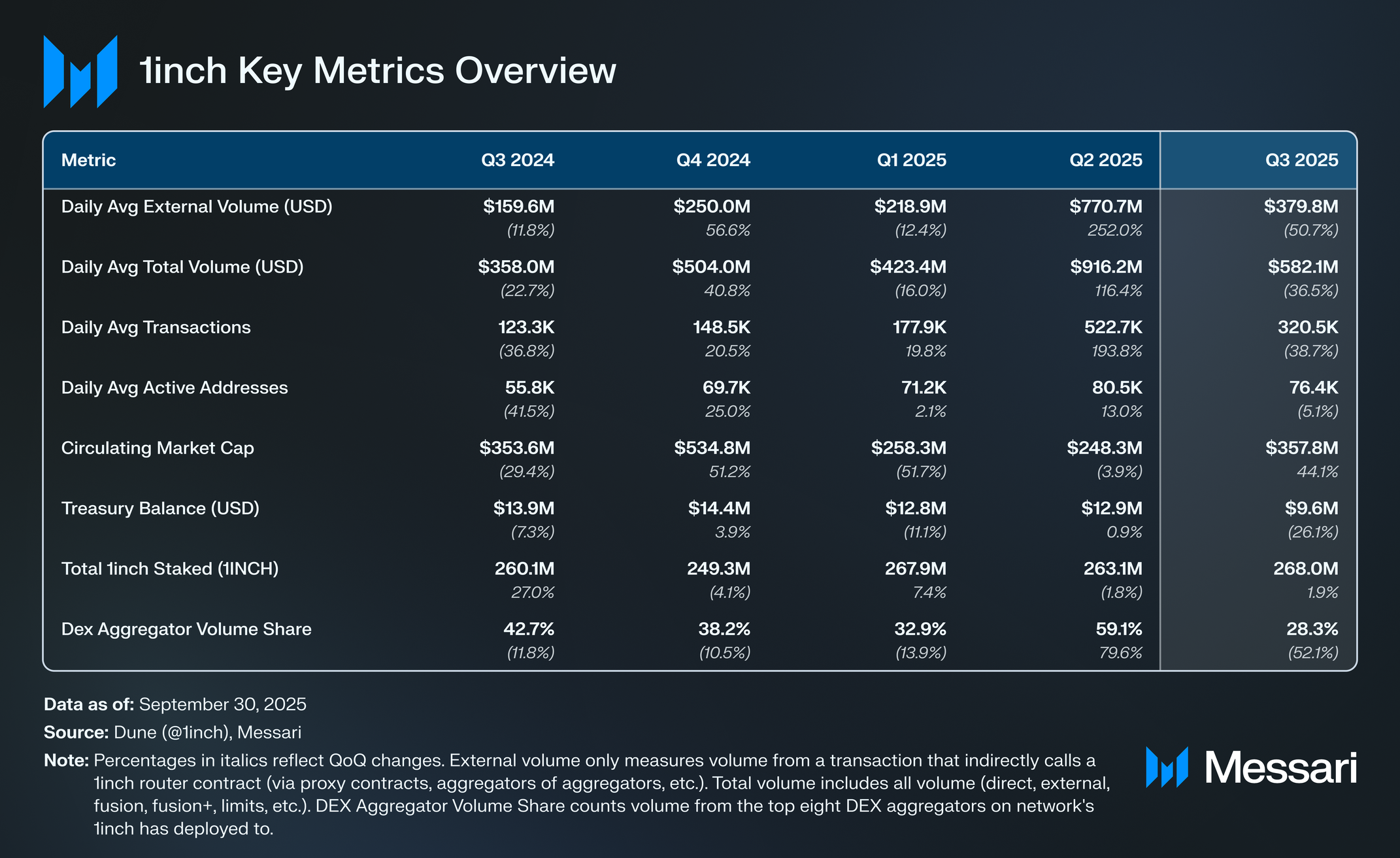
At the end of Q3, the treasury was valued at $9.6 million, down 27.1% QoQ from $13.1 million.
Market Share
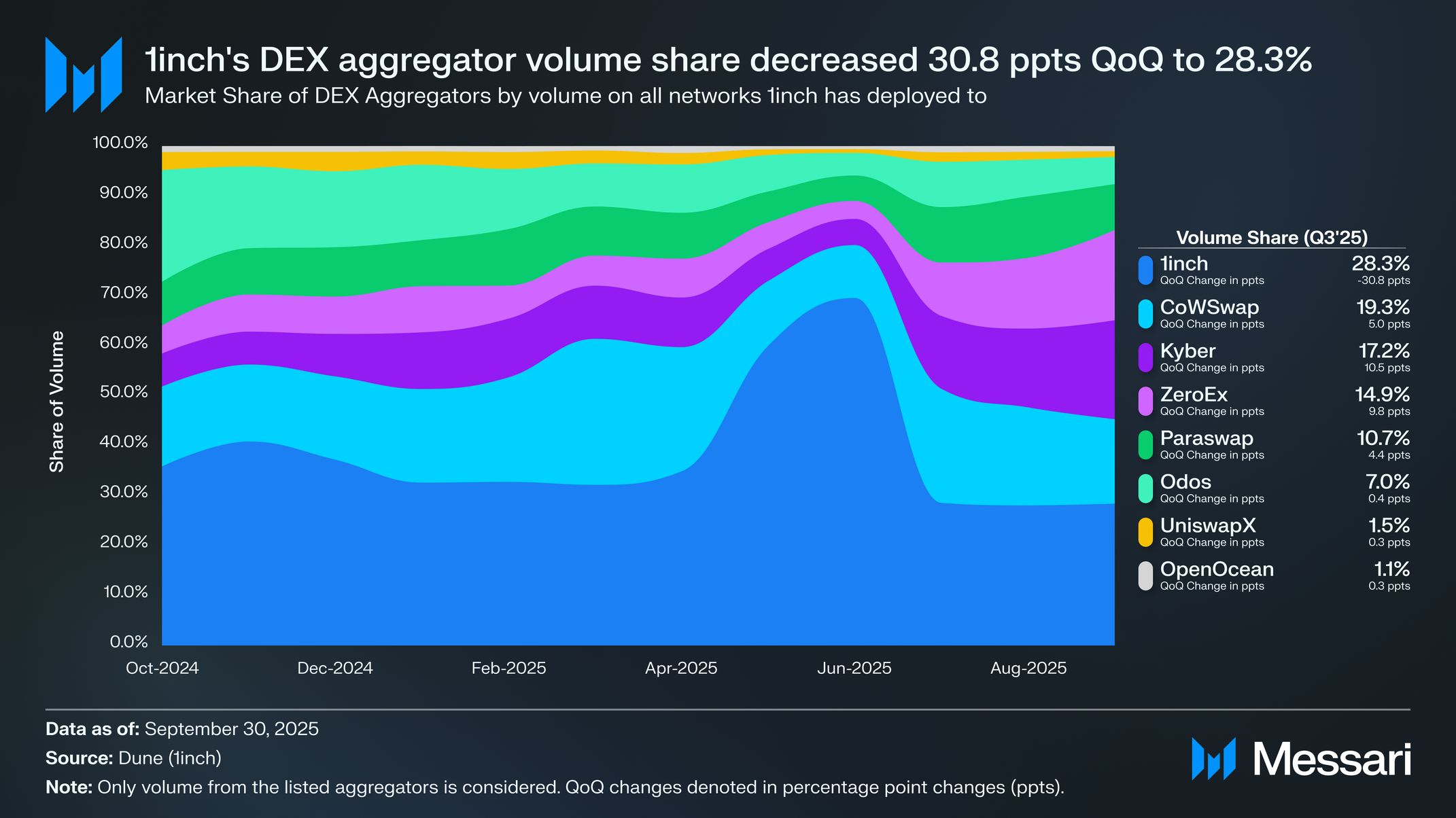
1inch’s market share contracted sharply in Q3 as volumes normalized from the incentive-driven surge on BNB Chain in Q2. In Q3, 1inch averaged $17.46 billion per month in routed volume, down from Q2’s $28.59 billion, reducing its share of aggregator activity from 59.1% to 28.3%. CoWSwap strengthened its position as a leading competitor, averaging $11.88 billion in routed volume per month, an increase of 71.5% QoQ, lifting its market share to 19.3%.
Kyber and ZeroEx posted the largest relative gains among major aggregators. Kyber averaged $10.58 billion per month, raising its market share to 17.2% after 230.7% QoQ growth. ZeroEx followed with $9.22 billion per month, increasing its share to 14.9% after a 273.6% surge. Paraswap and Odos also expanded to 10.7T and 7.0% market share on monthly averages of $6.63 billion and $4.30 billion, respectively.
UniswapX and OpenOcean remained smaller relative contributors, averaging $909.7 million and $689.2 million in monthly routed volume. Despite shifting competitive dynamics, market concentration stayed high in Q3, with the five largest aggregators, 1inch, CoWSwap, Kyber, ZeroEx, and Paraswap, collectively capturing 90.4% of routed volume.
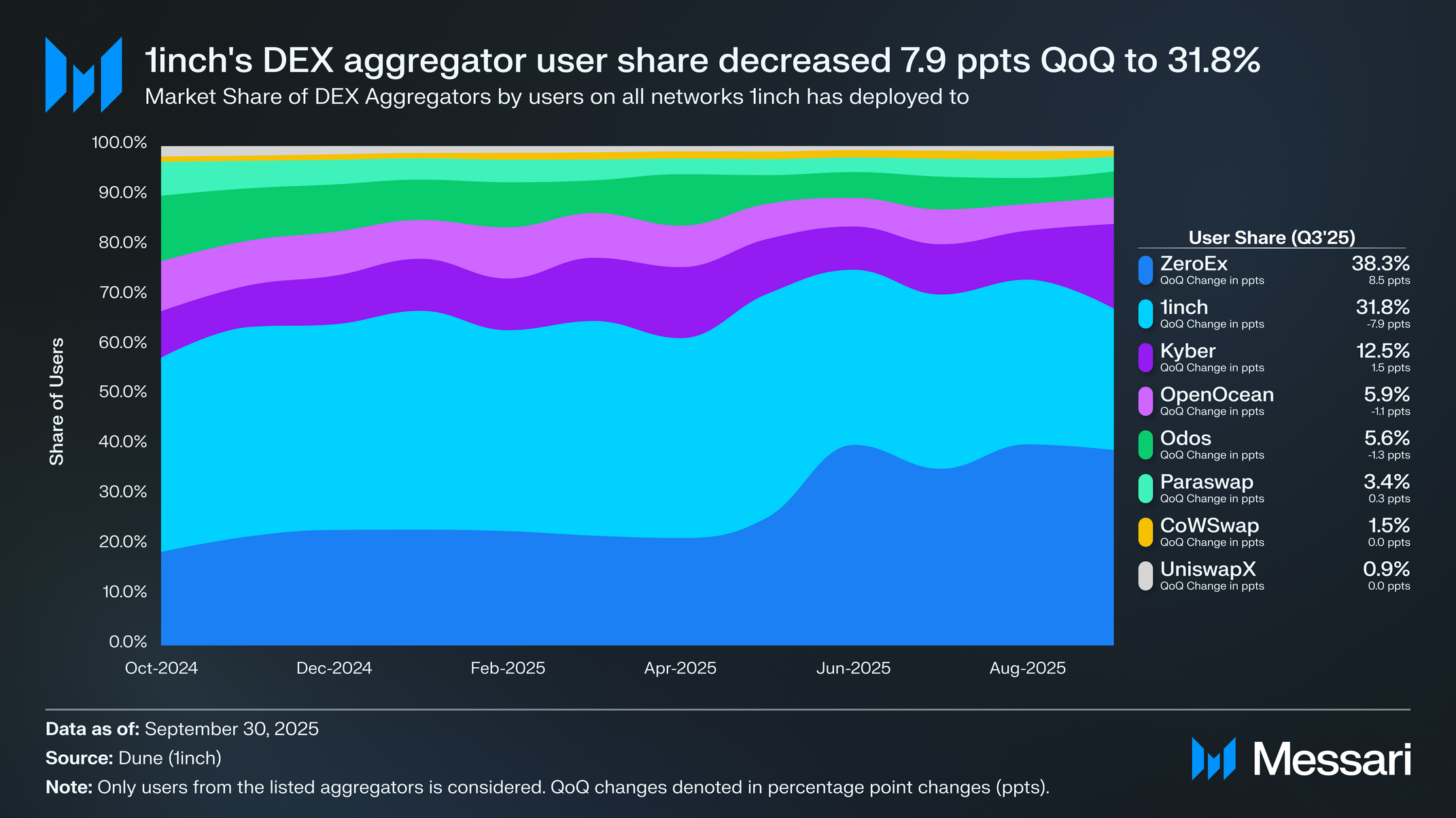
Similarly to routed volume, 1inch’s share of aggregator users contracted in Q3. The protocol averaged 967.5k monthly users, down 0.6% QoQ, and its user share slipped from 39.8% to 31.8%.
ZeroEx recorded the strongest expansion in Q3. Monthly users increased 59.5% to 1.16 million, making it the largest aggregator by users with a 38.3% share. Kyber also grew, rising 40.4% to 381.4k monthly users and lifting its share to 12.5%. CoWSwap posted steady growth, increasing 27.8% to 46.2k users and maintaining a 1.5% share. UniswapX also expanded, up 19.6% to 28.7k users for a 0.9% share.
Other platforms saw mixed results. OpenOcean declined 1.1% to 178.3k users and a 5.9% share. Odos decreased 1.3% to 170.7k users and a 5.6% share. Paraswap grew modestly to 102.0k monthly users, accounting for 3.4% of the user base.
Together, the three largest platforms by users, ZeroEx, 1inch, and Kyber, accounted for 82.7% of aggregator users in Q3, slightly above the 80.6% recorded in Q2.
Qualitative Analysis
Integrations, Partnerships, Upgrades, & More
The 1inch protocol continued to expand its ecosystem and strengthen its infrastructure through a series of product releases, integrations, governance actions, and partner initiatives during Q3 2025:
Blackhole DEX integration (July 30, 2025) - Blackhole, a DEX on Avalanche, officially integrated with 1inch.
Enhanced Token Warning System (Aug. 6) – 1inch upgraded its token warning framework in the dApp, introducing interactive risk categories powered by 1inch Shield and Web3 Antivirus. The system provides clearer alerts and blocks transactions involving high-risk or malicious tokens, adding an additional layer of protection for users during swaps.
Unite DeFi Hackathon Winners Announced (Aug. 11, 2025) – 1inch and ETHGlobal selected top projects from 403 submissions across cross-chain swaps, Limit Order Protocol extensions, and API-powered applications. Winners delivered implementations on chains such as Sui, Bitcoin, Aptos, Tron, Starknet, Tezos, Cardano, TON, NEAR, and ICP, highlighting strong developer engagement across the ecosystem.
eToro U.S. Listing Expansion (Aug. 12, 2025) – eToro added 1INCH as part of a 27-asset expansion for U.S. users and announced upcoming staking support in eligible states.
Ecosystem Integrations via 1inch APIs (Aug. 14, 2025) –Multiple platforms integrated the 1inch Swap API, including Talos for institutional trading, Rango Exchange for cross-chain routing, Trezor for hardware-wallet swaps, Okto and SafePal for wallet-native execution, DeFi Saver for automated portfolio management, and Lympid for EUR-to-DeFi access. These integrations strengthened 1inch’s role as shared liquidity infrastructure across wallets, trading systems, and institutional tools.
1inch Chard Launch ( Aug. 15, 2025) - 1inch introduced the 1inch Card, enabling users to spend cryptocurrency in-store or online with tap-to-pay support and up to 2% cash back on every purchase. The product is powered by Crypto Life and expands the utility of 1inch-managed assets across retail payment rails.
New Resolver Onboarding: jpegtrading (Aug. 18, 2025) – 1inch added jpegtrading as a resolver, expanding the competitive set of market makers fulfilling Fusion and Fusion+ intents.
Solana–EVM Cross-Chain Integration (Aug. 19, 2025) – 1inch released its first trustless cross-chain integration between Solana and EVM networks through the 1inch Developer Portal. The integration allows developers to enable secure cross-chain swaps without bridges, expanding cross-ecosystem routing capabilities.
DeFi Saver Routing Milestone (Aug. 25, 2025) – DeFi Saver reported that users routed $1.1 billion in volume through the 1inch Swap API, reflecting increasing reliance on 1inch routing for automation flows.
Open Letter to U.S. Senate on DeFi Rules (Aug. 29, 2025) – 1inch joined over 100 industry leaders in urging Congress to provide nationwide protections for software developers and non-custodial service providers, emphasizing that regulatory clarity is essential for U.S. DeFi innovation.
New Resolver Onboarding: Barter (Sept. 1, 2025) – 1inch partnered with Barter, adding a seasoned resolver focused on efficient, MEV-aware execution. Barter brings experience in intent-based routing and aims to enhance execution quality across 1inch swaps.
RWA Support via Upgraded Swap API (Sept. 3, 2025) – 1inch enabled intent-based swaps for tokenized RWAs through an integration with Ondo Finance, with Trust Wallet becoming the first major partner to adopt the upgraded API.
Wallet API Integrations: Bitget Wallet, Trust Wallet, OKX Wallet, and THORWallet (September 2025) – Bitget Wallet, Trust Wallet, OKX Wallet, and THORWallet integrated the 1inch Swap API, enabling gas-free and MEV-protected swaps for their users.
1inch Joins Blockchain Association (Sept. 3, 2025) – 1inch became a member of the Blockchain Association, expanding its presence in U.S. policy and regulatory discussions.
Closing Summary
In Q3, 1inch saw Aggregation Protocol activity normalize as BNB Chain volumes retraced from Q2’s incentive-driven peak. Daily average routed volume fell 41.3% to $494.5 million, with Ethereum re-emerging as the most stable high-liquidity network. At the same time, 1inch’s Limit Order Protocol usage recovered, rising 29.7%, while Fusion activity strengthened meaningfully, with daily average volume rising 60.6%. Fusion+ recorded its strongest quarter to date, with median daily volume and active wallets increasing 129.1% and 76.5%, supported by broader cross-chain execution and the introduction of native Solana–EVM swaps.
Alongside these protocol-level improvements, 1inch advanced its multichain roadmap through new integrations, resolver onboarding, security upgrades, and ecosystem partnerships. Notable developments included trustless Solana–EVM cross-chain support, expanded wallet and API integrations, an enhanced token-warning system, and the launch of the 1inch Card. Governance activity remained high, with the DAO funding interface development, protocol research, global events, regulatory engagement, and extensive security audits. Together, these initiatives reinforced 1inch’s position as a core liquidity and intent execution layer while continuing to strengthen the network’s long-term infrastructure.
This report was commissioned by the 1inch Foundation. All content was produced independently by the author(s) and does not necessarily reflect the opinions of Messari, Inc. or the organization that requested the report. The commissioning organization may have input on the content of the report, but Messari maintains editorial control over the final report to retain data accuracy and objectivity. Author(s) may hold cryptocurrencies named in this report. This report is meant for informational purposes only. It is not meant to serve as investment advice. You should conduct your own research and consult an independent financial, tax, or legal advisor before making any investment decisions. Past performance of any asset is not indicative of future results. Please see our Terms of Service for more information.
No part of this report may be (a) copied, photocopied, duplicated in any form by any means or (b) redistributed without the prior written consent of Messari®.
Hayden is a Research Analyst specializing in the intersection of crypto-economic incentive mechanisms and their role in DeFi, DePIN, and AI ecosystems. Prior to joining Messari, Hayden worked as a Research Analyst at The Block and as a Venture Associate at a crypto-native venture capital fund.
Hayden is a Research Analyst specializing in the intersection of crypto-economic incentive mechanisms and their role in DeFi, DePIN, and AI ecosystems. Prior to joining Messari, Hayden worked as a Research Analyst at The Block and as a Venture Associate at a crypto-native venture capital fund.