1inch's Limit Order Protocol daily average volume on BNB Chain grew 52.7% QoQ to $24.0 million from $15.8 million in Q4 2025. On Dec. 5, 2025, Ondo Finance partnered with 1inch to route tokenized stock and ETF swaps on BNB Chain through the 1inch Swap API, which fueled this growth. 1inch's role as execution infrastructure for tokenized RWA trading could attract additional RWA issuer partnerships in future quarters.
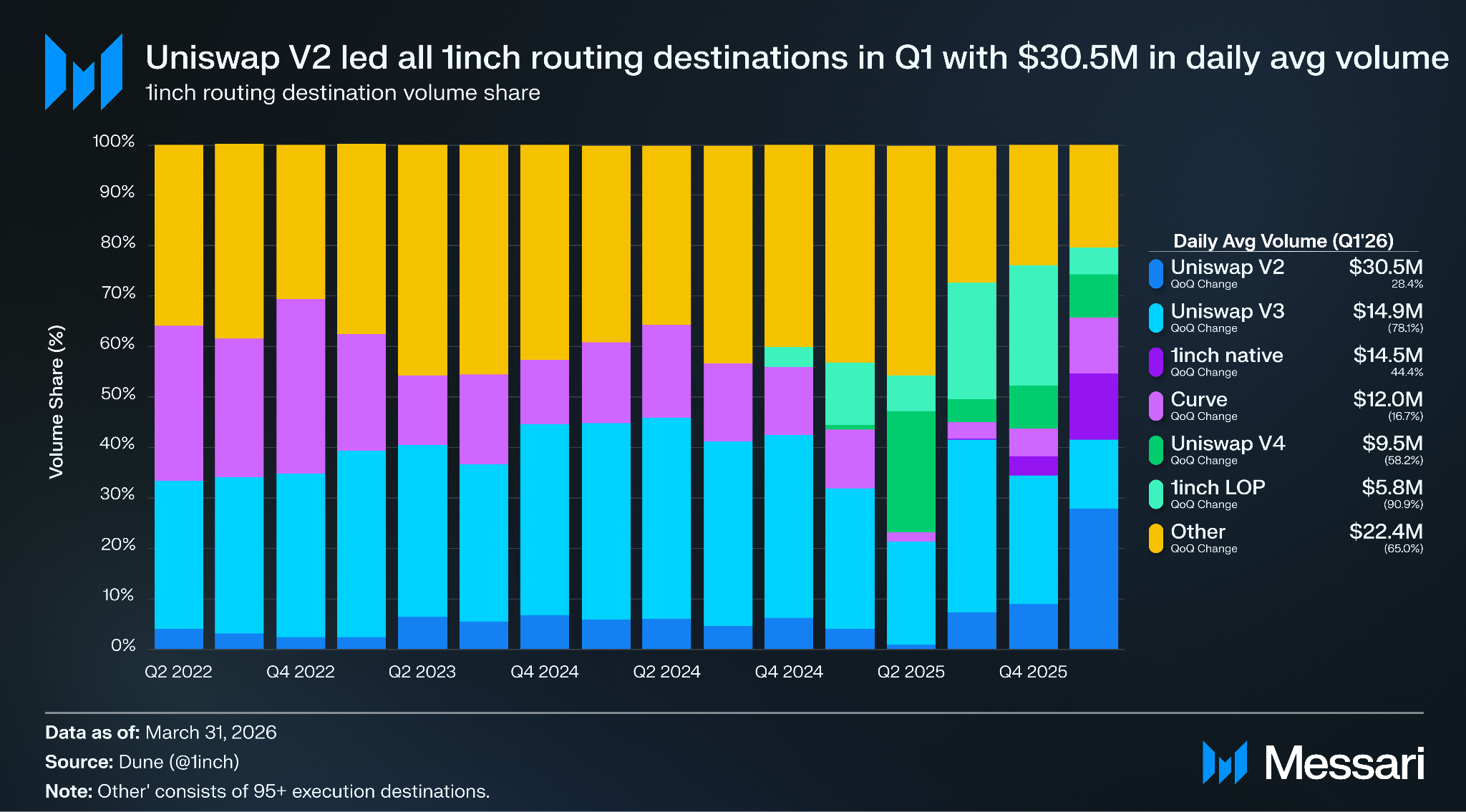
Uniswap V2 was 1inch's primary routing destination, which processed $30.5 million in daily average volume, up 28.4% QoQ from $23.8 million in Q4 2025. 1inch native execution grew 44.4% QoQ from $10.0 million to $14.5 million and became the third-largest execution destination. The growth in native execution reduced 1inch's dependency on third-party DEXs.
On March 9, the 1inch DAO approved a $400,000 fund [1IP-93] for external teams building revenue-generating strategies on 1inch Aqua. Teams that receive funding will share a portion of revenue with the 1inch DAO treasury.
On March 3, 1inch launched Trade Mode, an updated trading interface with configurable execution settings, integrated price charts, and per-trade gas and slippage controls for aggregator swaps. The update also reduced the median execution time for intent-based swaps (via the 1inch Fusion protocol) from 26 seconds (s) to 14s.
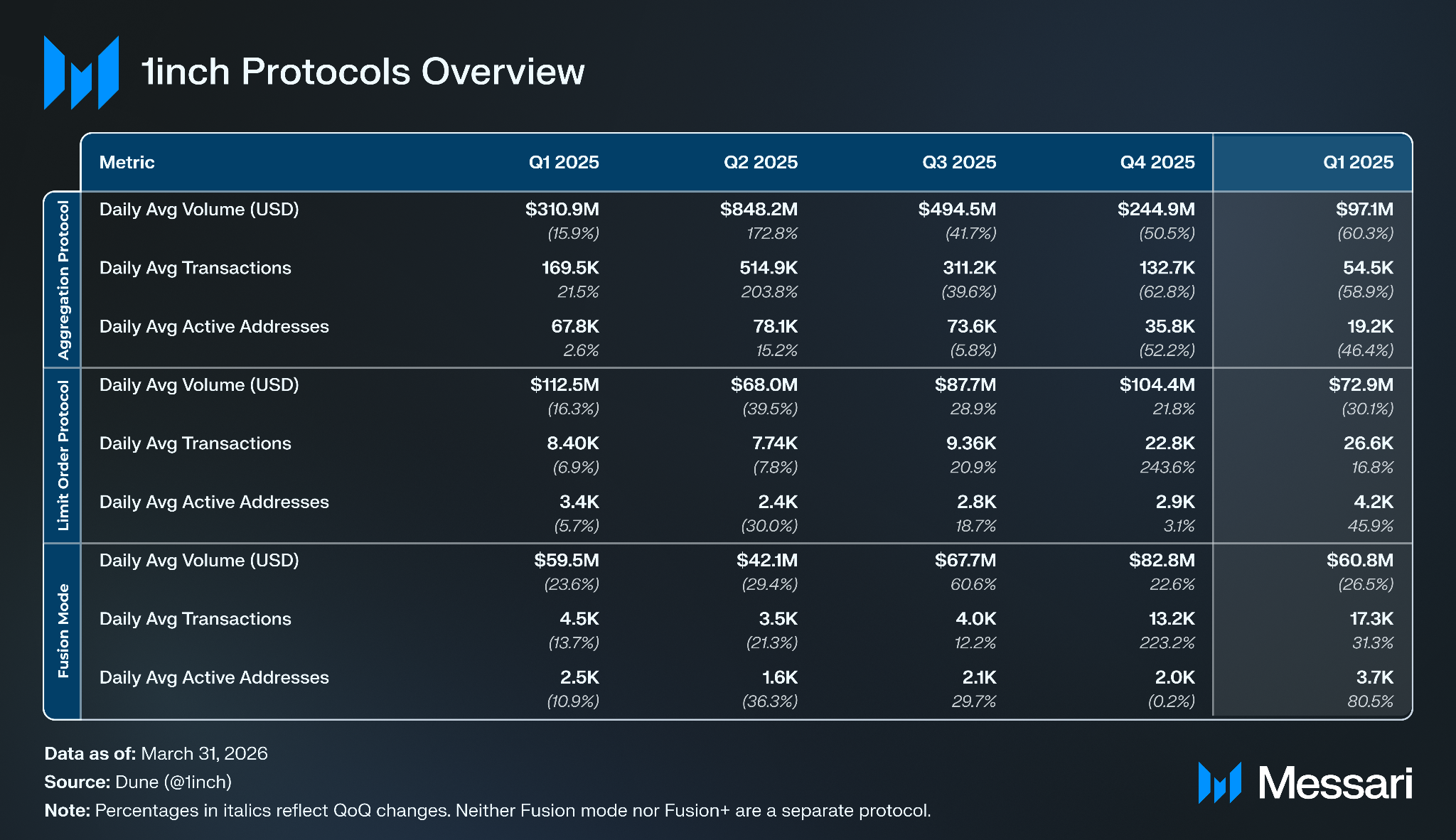
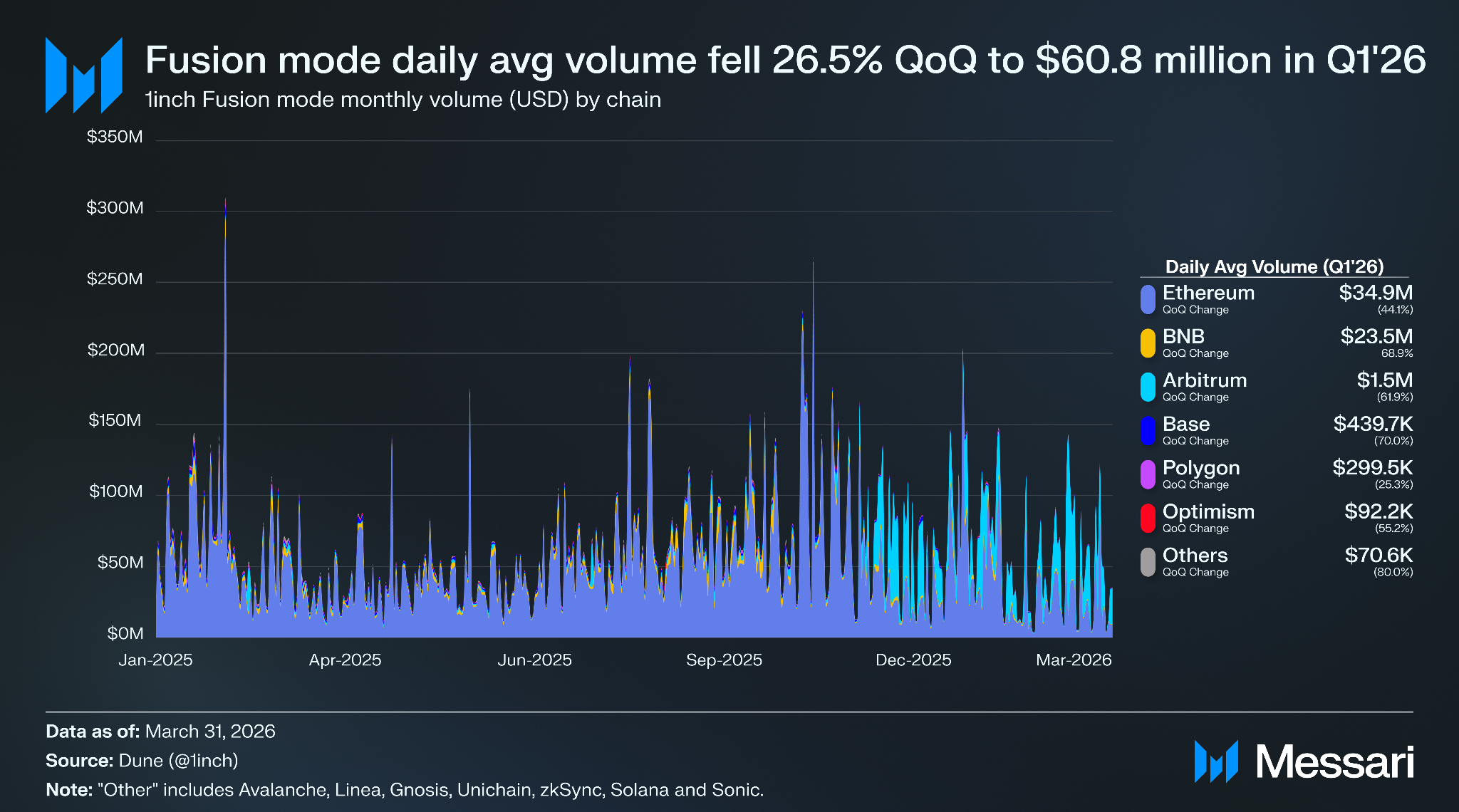
Daily average volume on the 1inch Fusion Protocol fell 26.5% QoQ from $82.8 million in Q4 2025 to $60.8 million, the smallest decline among 1inch's three single-chain protocols. Fusion's Intent-based swaps with gasless execution and Dutch auction MEV protection likely led to its relative outperformance, as users shifted toward cost-efficient execution during the broader crypto market downturn.
All four protocols are governed by the 1inch DAO using the network’s native 1INCH token.
The 1inch team has built a suite of products that integrate these protocols for both DeFi users and developers. 1inch Personal comprises:
1inch Swap web application, where users can connect a wallet to swap tokens across networks supported by 1inch and place offchain limit orders
1inch Wallet mobile application, users can execute 1inch Swap functions while using the wallet to manage EVM-compatible assets, and
1inch Portfolio, which provides a dashboard for wallet and asset tracking
In Q4 2025, 1inch introduced 1inch Aqua, a shared liquidity layer protocol that allows liquidity providers to allocate virtual balances across multiple trading strategies with a single token approval.
1inch Business (previously the 1inch Developer Portal) is a SaaS platform that allows developers to build on top of 1inch’s APIs.
Note: This report includes data from Ethereum, BNB Chain, Polygon, Base, Optimism, Arbitrum, Avalanche, Solana, Sonic, Gnosis Chain, zkSync, Unichain, and Linea.
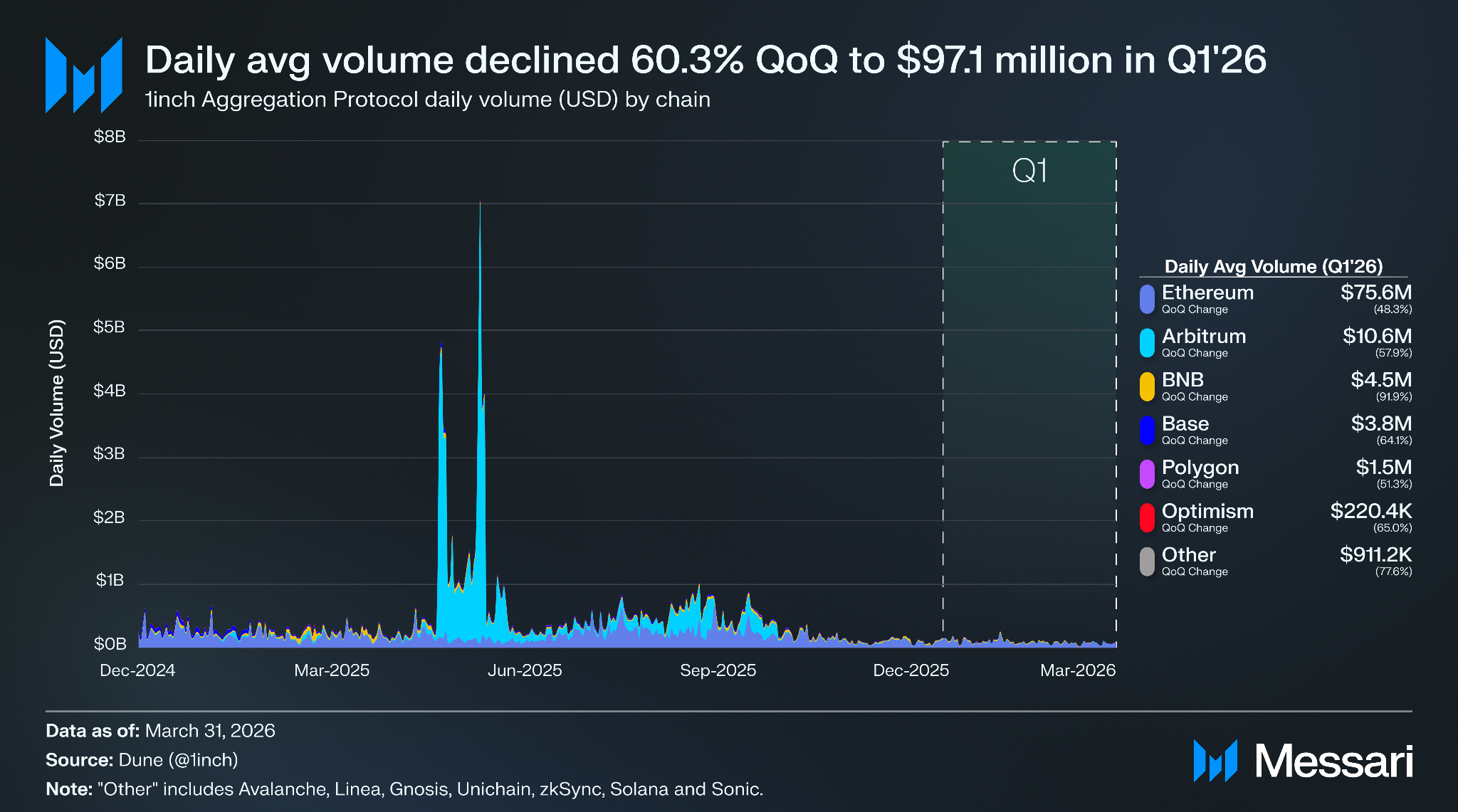
The Aggregation Protocol has historically processed the largest volume of 1inch’s four protocols. In Q1 2026, daily average volume declined 60.3% QoQ to $97.1 million from $244.9 million in Q4 2025. All supported chains posted lower volumes during the quarter. The decline tracked a broader contraction in DEX aggregator trading activity, as daily average DEX aggregator volume fell 40.0% QoQ from $4.6 billion in Q4 2025 to $2.7 billion in Q1 2026. 1inch's Aggregation Protocol contracted at a faster rate, likely due to its higher relative exposure to BNB Chain, where post-airdrop normalization continued to weigh on aggregation protocol volumes. BNB Chain recorded the largest relative decline, falling 91.9% QoQ to $4.5 million from $55.2 million in Q4. The drop continued the normalization that began in Q3 2025 after the Binance Alpha airdrop activity unwound, and pushed BNB Chain from the second-largest volume source in Q4 (22.5% share) to the third in Q1 (4.6% share).
Ethereum's daily average volume fell 48.3% QoQ from $146.3 million in Q4 to $75.6 million, but led total volume share at 77.9% in Q1, up from 59.7% in Q4, which reflected resilience in a contracting market. Arbitrum declined 57.9% QoQ from $25.1 million in Q4 to $10.6 million, yet processed the second-highest volume share in Q1 at 10.9%.
In Q1 2026, Uniswap V2 replaced Uniswap V3 as 1inch's primary routing destination, processing $30.5 million in daily average volume, up 28.4% QoQ from $23.8 million in Q4 2025. Uniswap V2’s share of total routed volume increased from 8.9% in Q4 to 27.9% in Q1. Uniswap V3 was the top destination in Q4 with $68.1 million (25.6% share) in average daily volume, but fell 78.1% QoQ to $14.9 million in Q1 (13.6% share).
Fluid recorded the largest contraction among execution destinations, falling from $63.9 million in daily average volume in Q4 (23.9% share) to $4.7 million in Q1 (4.3% share). The decline coincided with Fluid's shift toward bundling its liquidity into its own products. On Feb. 26, Fluid and Venus (lending) launched Venus Flux, a liquidity layer on BNB Chain for DEX trading, lending, and borrowing. As Fluid directs more liquidity into its own native DEX infrastructure, less will remain available for external aggregators to route through, which likely caused the decrease in Q1 share.
1inch native execution, where 1inch's own infrastructure fulfills swaps rather than being routed to external DEXs, grew 44.4% QoQ from $10.0 million in Q4 to $14.5 million in Q1. Its share increased from 3.2% to 13.2% over the same period, which made it the third-largest execution destination in the quarter. Curve declined 16.7% QoQ from $14.4 million in Q4 to $12.0 million in Q1 but increased its share from 5.4% to 11.0%.
The 1inch Limit Order Protocol (LOP) declined 90.9% QoQ from $63.9 million in Q4 to $5.8 million in Q1, reducing its share from 23.9% to 5.3% over the same time period. Uniswap V4 fell 58.2% QoQ from $22.7 million in Q4 to $9.5 million in Q1, while the "Other" category of 95+ execution destinations collectively declined 65.0% QoQ to $22.4 million in Q1.
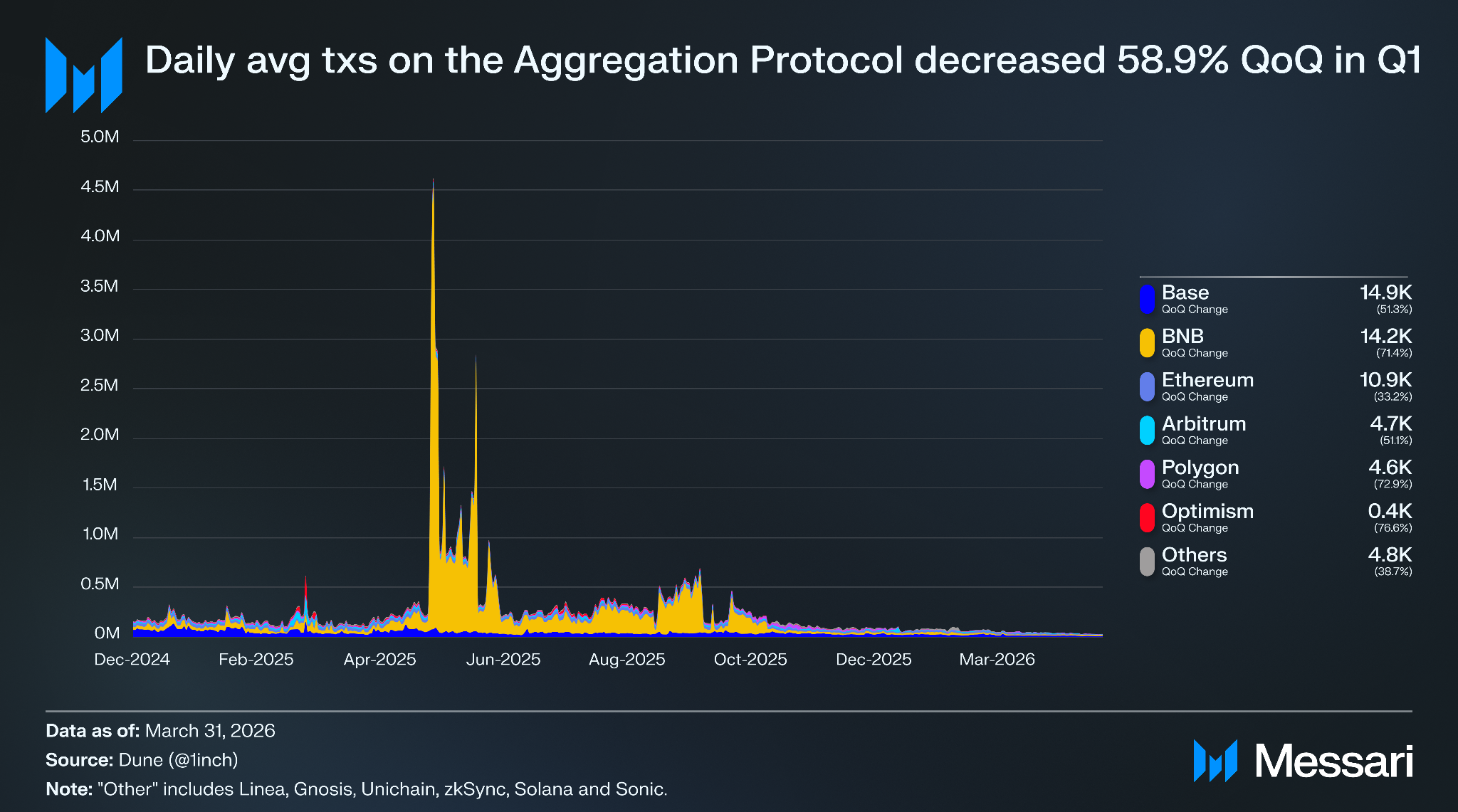
In Q1 2026, daily average transactions on the Aggregation Protocol declined 58.9% QoQ to 54,500 from 132,700 in Q4 2025, and average transaction size declined 3.4% QoQ from $1,846 in Q4 to $1,782 in Q1.
Base replaced BNB Chain as the most active network by daily average transactions, falling 51.3% QoQ from 30,500 in Q4 to 14,900 in Q1. Its share increased from 23.0% in Q4 to 27.3% in Q1. BNB Chain declined 71.4% QoQ from 49,600 in Q4 to 14,200 in Q1, dropping from 37.4% share to 26.1%, consistent with the broader BNB Chain volume decrease. In Q1, Base processed more daily average transactions than BNB Chain (14,900 vs. 14,200) but generated less daily volume ($3.8 million vs. $4.5 million), resulting in a smaller average transaction size on Base ($255) compared to BNB Chain ($317).
Ethereum daily average transaction count fell 33.2% QoQ from 16,400 in Q4 to 10,900 in Q1, the smallest decline among major chains, and its Q1 transaction share rose from 12.3% to 20.0%.
Arbitrum declined 51.1% QoQ from 9,600 in Q4 to 4,700 in Q1, and its share rose from 7.2% to 8.6%. Polygon fell 72.9% QoQ to 4,600 over the same period, dropping from 12.9% share to 8.5%, and Optimism declined 76.6% QoQ to 414.
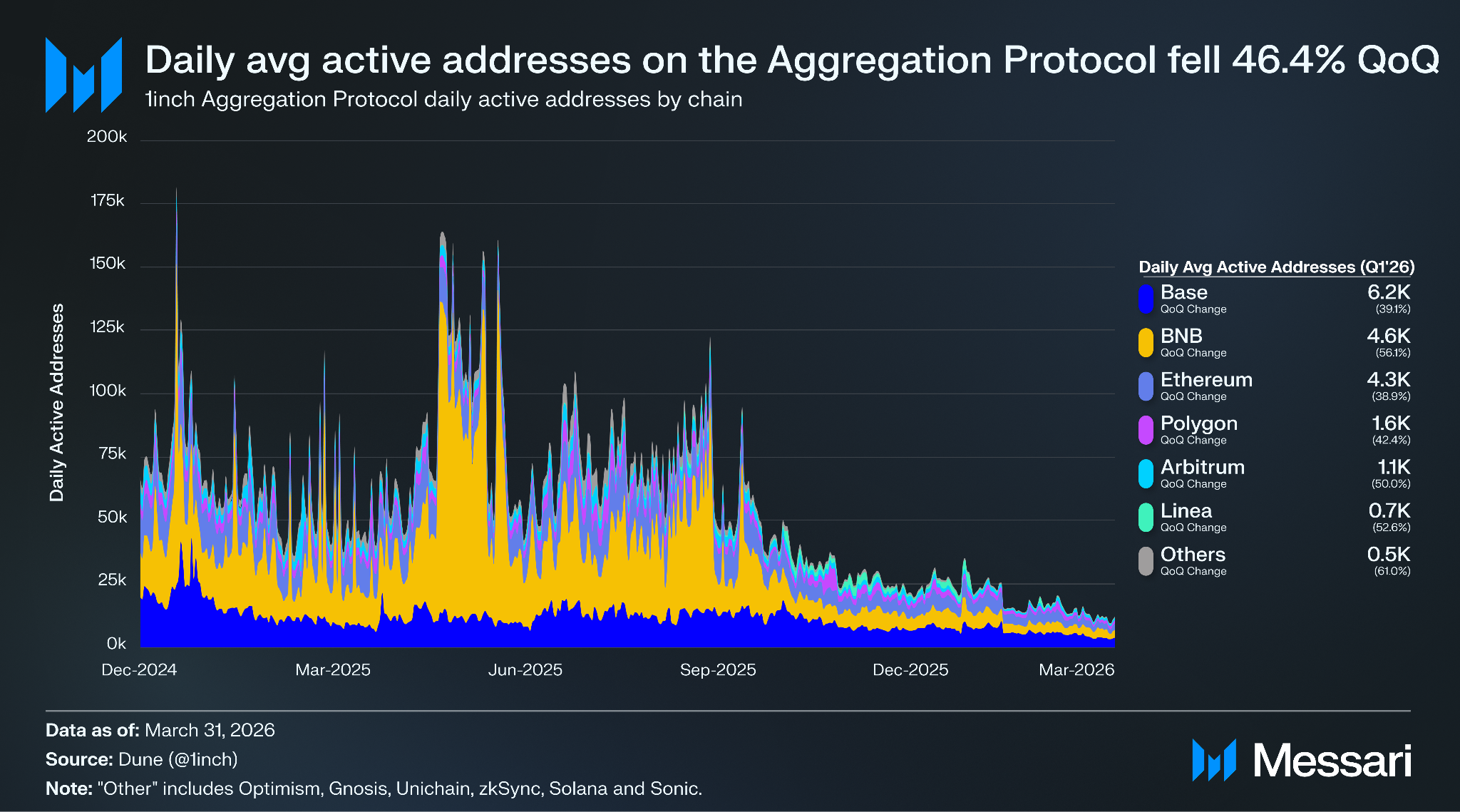
In Q1 2026, daily average active addresses on the Aggregation Protocol fell 46.4% QoQ from 35,800 in Q4 2025 to 19,200. Active addresses declined at a slower rate than volume (60.3%) and transactions (58.9%), meaning the addresses that churned were disproportionately high-frequency, high-volume participants such as bots and arbitrageurs that generate outsized activity per address. The remaining user base is more organic but trades less frequently and in smaller sizes.
Base replaced BNB Chain as the largest source of active addresses, falling 39.1% QoQ from 10,200 in Q4 to 6,200 in Q1. Its share rose from 28.5% in Q4 to 32.4% in Q1. BNB Chain declined 56.1% QoQ from 10,600 in Q4 to 4,600 in Q1, dropping from 29.5% share to 24.2%. Ethereum fell 38.9% QoQ from 7,100 in Q4 to 4,300 in Q1, with its share increasing from 19.7% to 22.5%.
Limit Order Protocol
In Q1 2026, daily average volume on the Limit Order Protocol fell 30.1% QoQ from $104.4 million in Q4 2025 to $72.9 million. The decline was smaller than the Aggregation Protocol's 60.3% drop over the same period.
BNB Chain grew 52.7% QoQ from $15.8 million in Q4 to $24.0 million in Q1, increasing its share from 15.1% to 33.0%, and was the only chain to grow in Q1. On Dec. 5, 2025, Ondo Finance (tokenized real-world assets) partnered with 1inch to route tokenized RWA swaps on BNB Chain via the 1inch Swap API. As of March 5, Ondo tokenized stocks routed through 1inch surpassed $2.5 billion in cumulative volume, which shows continued demand in the RWA sector despite the broader crypto market contraction. 1inch’s integration with Ondo demonstrates that it can serve as execution infrastructure for tokenized RWA trading, a track record that could attract partnerships with additional RWA issuers as tokenized asset demand continues to grow, which operates independently of crypto market cycles.
Ethereum declined 43.3% QoQ from $79.9 million in Q4 to $45.3 million in Q1, dropping from 76.5% share to 62.2%. Together, Ethereum and BNB Chain accounted for 95.2% of all Limit Order Protocol volume in Q1, up from 91.6% in Q4.
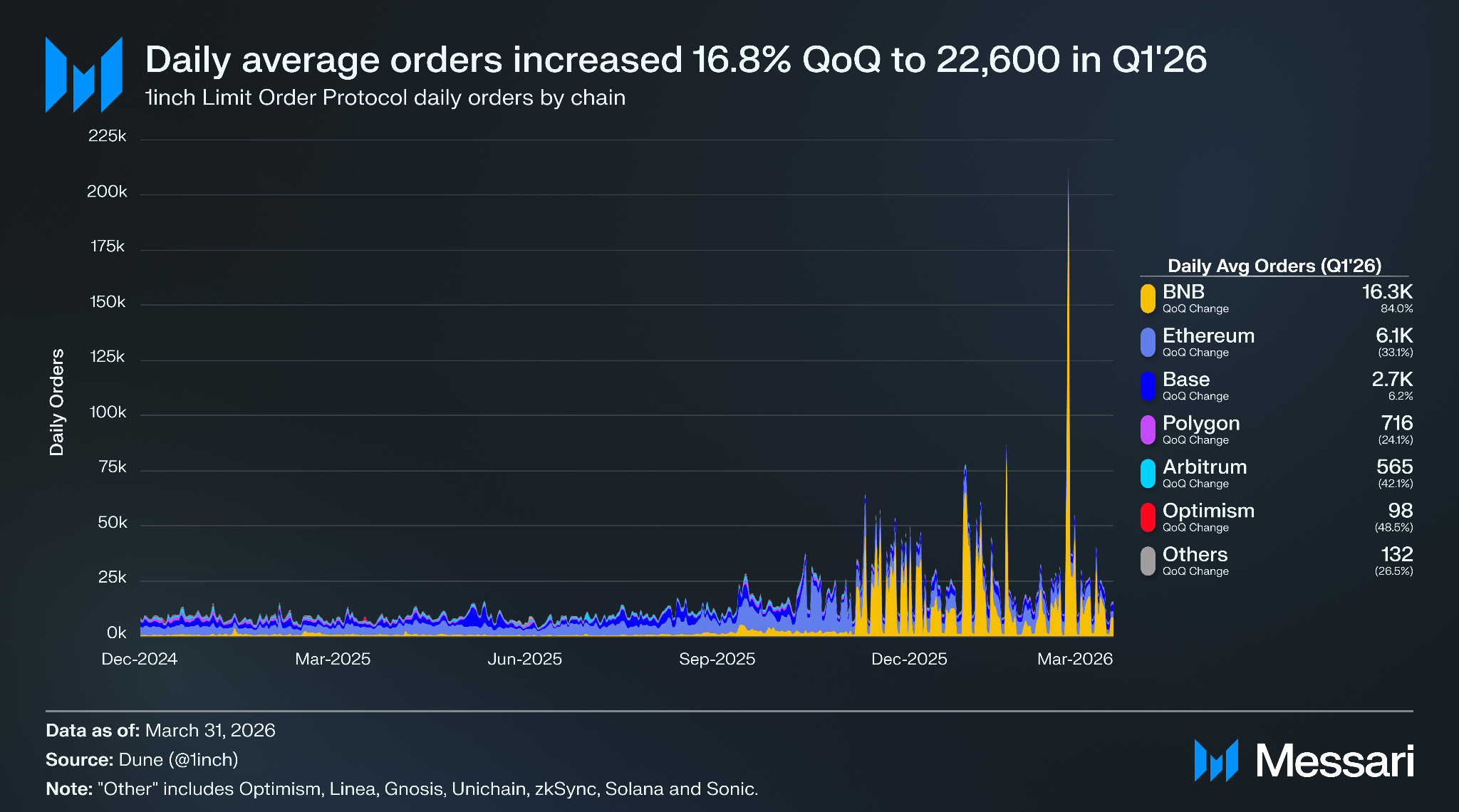
In Q1 2026, daily average orders on the Limit Order Protocol increased 16.8% QoQ to 26,600 from 22,800 in Q4 2025. Average order size decreased 40.2% QoQ from $4,600 in Q4 to $2,700 in Q1, driven primarily by BNB Chain, where the Ondo Finance RWA integration continued to generate high-frequency, smaller orders for tokenized RWAs. In Q1, average order size on BNB Chain was $1,500, compared to $7,500 on Ethereum.
BNB Chain orders grew 84.0% QoQ from 8,900 in Q4 to 16,300 in Q1, increasing its share from 38.9% to 61.3% and making it the dominant source of limit order activity. Ethereum declined 33.1% QoQ from 9,100 in Q4 to 6,100 in Q1, dropping from 39.8% share to 22.8%. Base grew 6.2% QoQ to 2,700 orders in Q1 from 2,600 in Q4.
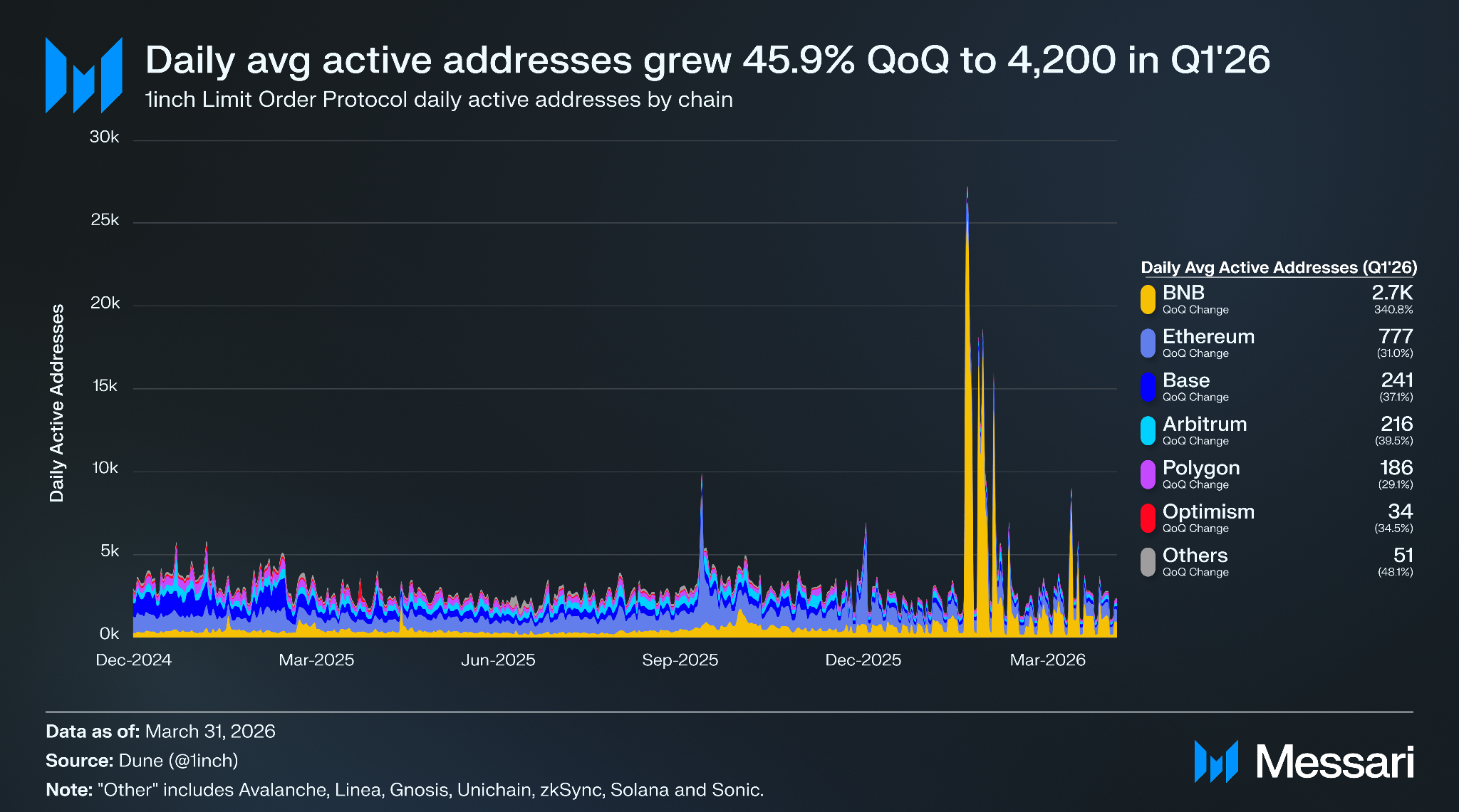
BNB Chain active addresses grew 340.8% QoQ from 600 in Q4 to 2,700 in Q1, increasing its share from 21.3% to 64.4%. Active address growth outpaced the 84.0% increase in BNB Chain daily orders over the same period, which suggests that new users on BNB Chain are less frequent traders than the existing base. Ethereum declined 31.0% QoQ from 1,126 in Q4 to 777 in Q1, dropping from 38.9% share to 18.4%.
Intent-based swaps (Fusion)
Fusion mode routes volume through both the Aggregation Protocol and the Limit Order Protocol, in which users post intents with price-and-time presets, and market makers, called Resolvers, compete via a Dutch auction mechanism to fulfill orders.
In Q1 2026, daily average Fusion volume fell 26.5% QoQ from $82.8 million in Q4 2025 to $60.8 million. The decline was the smallest among 1inch's three single-chain protocols, as Aggregation Protocol volume fell 60.3% and Limit Order Protocol fell 30.1% over the same period. Fusion swaps are gasless for users because Resolvers cover execution costs, and the Dutch auction mechanism protects users from MEV extraction. Both advantages become more valuable in a declining market because gas fees consume a larger share of each trade's value when average trade sizes shrink, and MEV risk tends to increase in volatile markets.
BNB Chain grew 68.9% QoQ from $13.9 million in Q4 to $23.5 million in Q1, increasing its share from 16.8% to 38.6%. Ethereum declined 44.1% QoQ from $62.5 million in Q4 to $34.9 million in Q1, dropping from 75.5% share to 57.4%. Together, Ethereum and BNB Chain accounted for 96.0% of all Fusion volume in Q1, up from 92.3% in Q4.
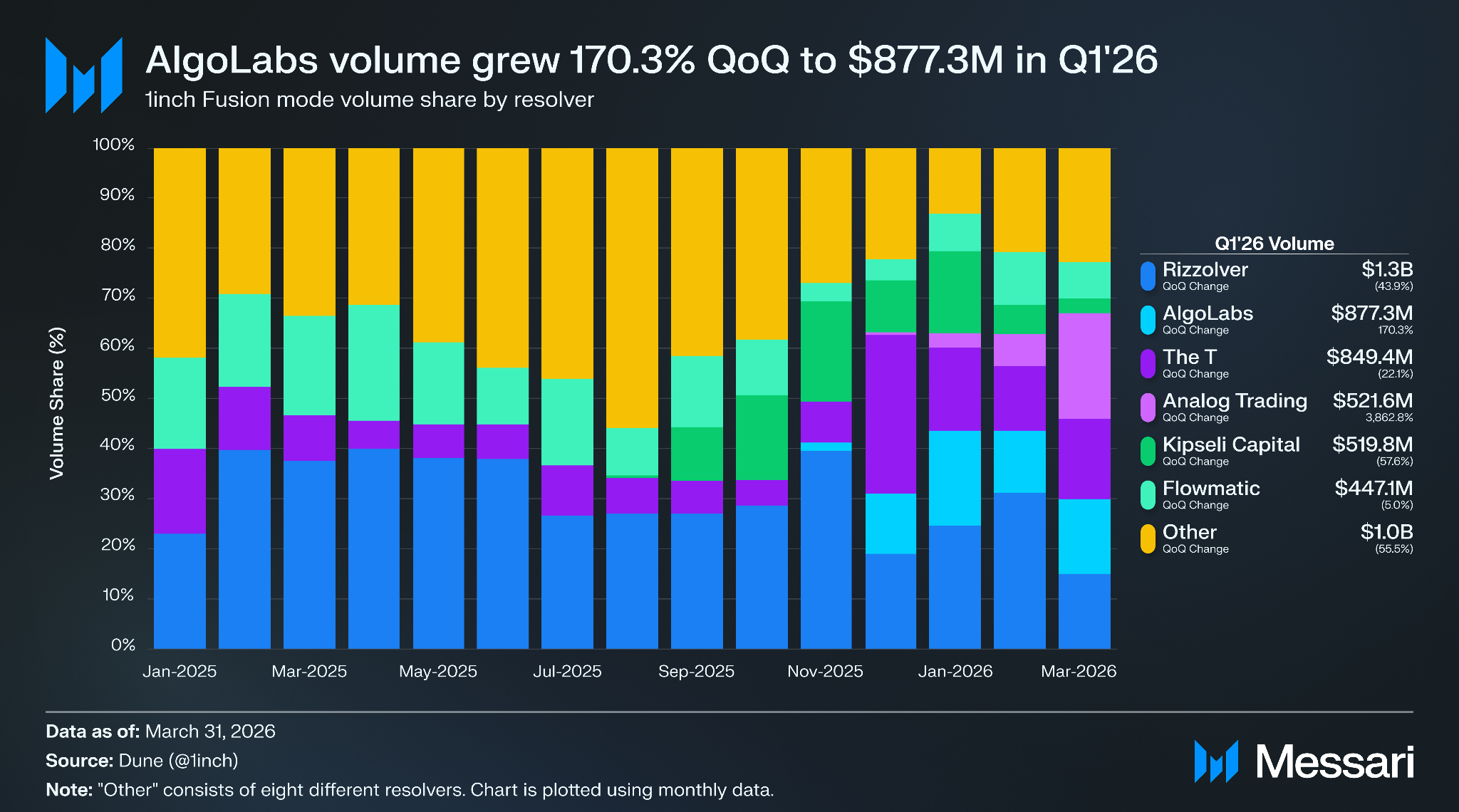
Resolvers are approved registered addresses that compete to fulfill both Fusion and Fusion+ orders. Among resolvers in the top six of Q4 2025 market share, AlgoLabs posted the largest gain in Q1 2026, growing 170.3% QoQ from $324.6 million (4.3% share) in Q4 to $877.3 million (16.0% share) in Q1, moving from a minor participant to the second-largest resolver. Analog Trading emerged as a new top-five entrant, growing 3,862.8% QoQ from $13.2 million (0.2% share) in Q4 to $521.6 million (9.5% share) in Q1.
The top three resolvers (Rizzolver, AlgoLabs, and The T) accounted for 54.7% of Fusion volume in Q1, down from 59.8% in Q4 and 69.0% in Q3. The continued decline in concentration, combined with the rise of new entrants like AlgoLabs and Analog Trading, shows that the resolver market has become more competitive, with no single entity maintaining dominance for more than a few quarters.
Rizzolver retained the top position with $1.3 billion in volume (23.2% share), down 43.9% QoQ from $2.3 billion (29.7% share) in Q4. The T held steady at $849.4 million (15.5% share) in Q1, down from $1.1 billion (14.3% share) in Q4, and Kipseli Capital fell from $1.2 billion (16.1% share) in Q4 to $519.8 million (9.5% share) in Q1, reversing its Q4 gains.
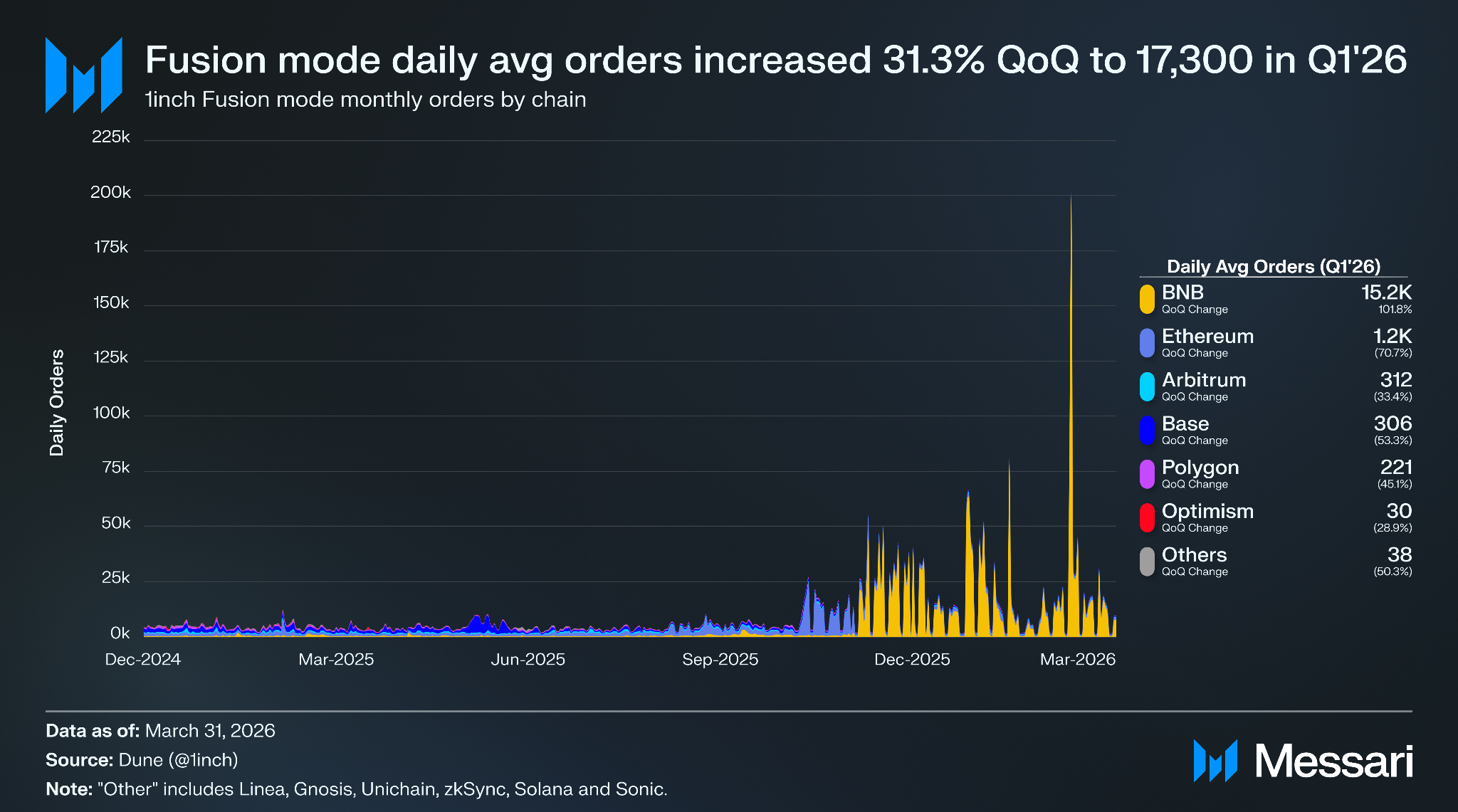
In Q1 2026, daily average Fusion orders increased 31.3% QoQ from 13,200 in Q4 2025 to 17,300. Orders grew while volume fell 26.5% over the same period, compressing the average Fusion order size 44.1% from $6,300 in Q4 to $3,500 in Q1. The pattern mirrors the Limit Order Protocol, where BNB Chain's smaller tokenized RWA orders through the Ondo Finance integration drove order counts higher even as total volume declined.
BNB Chain orders doubled, rising 101.8% QoQ from 7,500 in Q4 to 15,200 in Q1, increasing its share from 57.3% to 88.0%. Ethereum declined 70.7% QoQ from 4,000 in Q4 to 1,200 in Q1, dropping from 30.2% share to 6.7%. Average Ethereum Fusion order size grew 90.4% QoQ from $15,700 in Q4 to $29,900 in Q1, meaning the remaining Ethereum Fusion activity skewed toward larger-value trades. The divergence shows increasing segmentation within Fusion, in which BNB Chain is becoming the high-frequency retail venue for smaller tokenized RWA trades, while Ethereum handles fewer but larger-value swaps.
Cross-chain swaps (Fusion+)
Fusion+ is 1inch's intent-based protocol for cross-chain swaps. Users sign offchain orders that Resolvers compete to fill via Dutch auctions, with execution coordinated through Hashed Timelock Contracts (HTLCs). The structure eliminates the need for users to pay gas, protects against MEV, and enables partial fills across multiple chains.
In Q1 2026, Fusion+ median daily volume fell 50.0% QoQ from $1.5 million in Q4 2025 to $734,800. Median daily active addresses declined 24.9% QoQ from 277 in Q4 to 208 in Q1. Addresses fell at half the rate of volume as cross-chain users remained on the platform but executed less volume per day as crypto market conditions weakened throughout the quarter.
Market Analysis
Market Cap and Staking
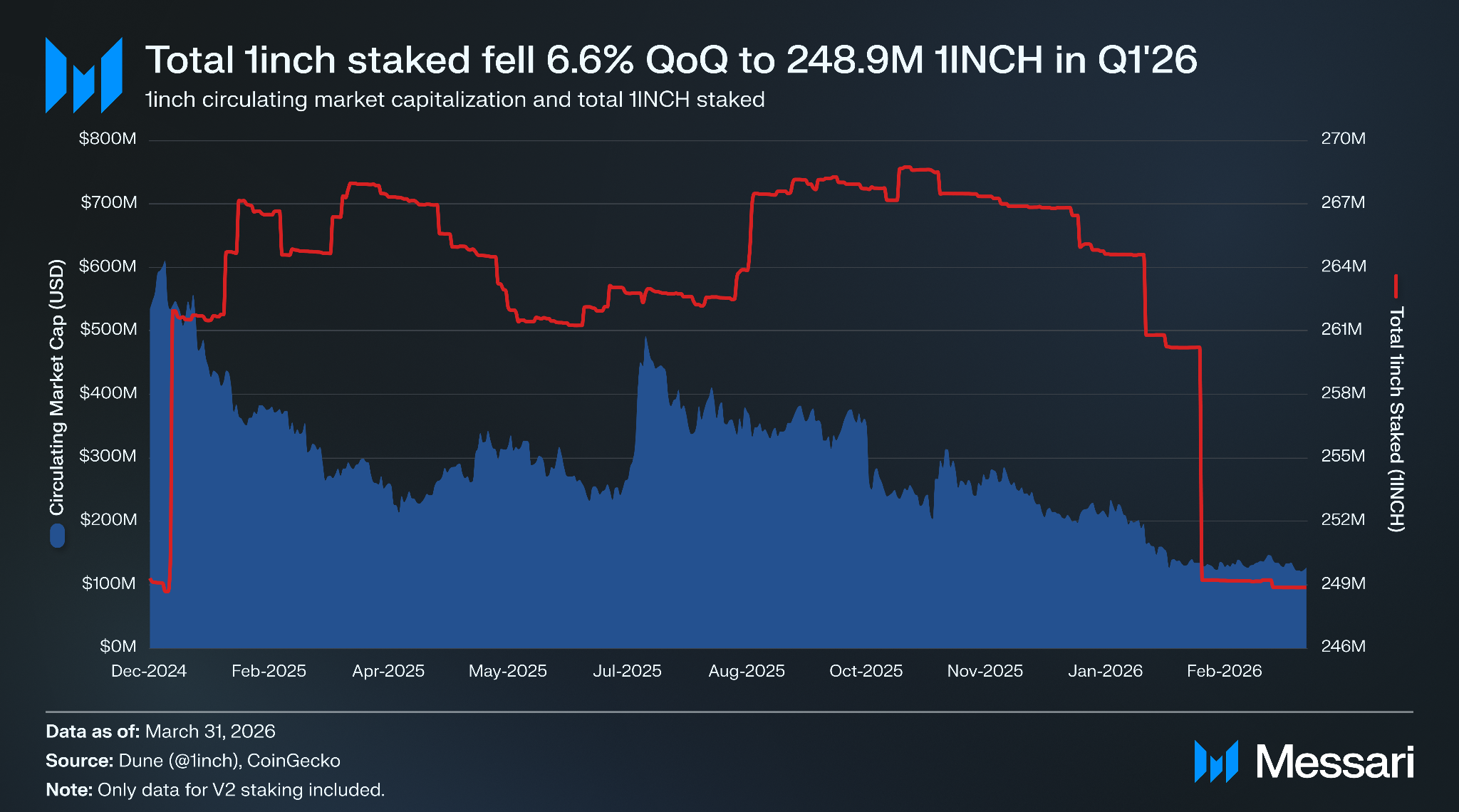
Staking 1INCH gives Unicorn Power (UP), which is used for governance participation and delegation to resolvers. Unicorn Power delegation historically played a central role in Fusion, as resolvers distributed 1INCH staking rewards for tokenholders who delegated UP to them.
On Oct. 21, 2025, the DAO removed the 5% UP staking threshold previously required for resolvers to access Fusion's exclusive order flow. Access is now determined by completing due diligence and owning a Resolver NFT, reducing the direct link between UP concentration and resolver eligibility.
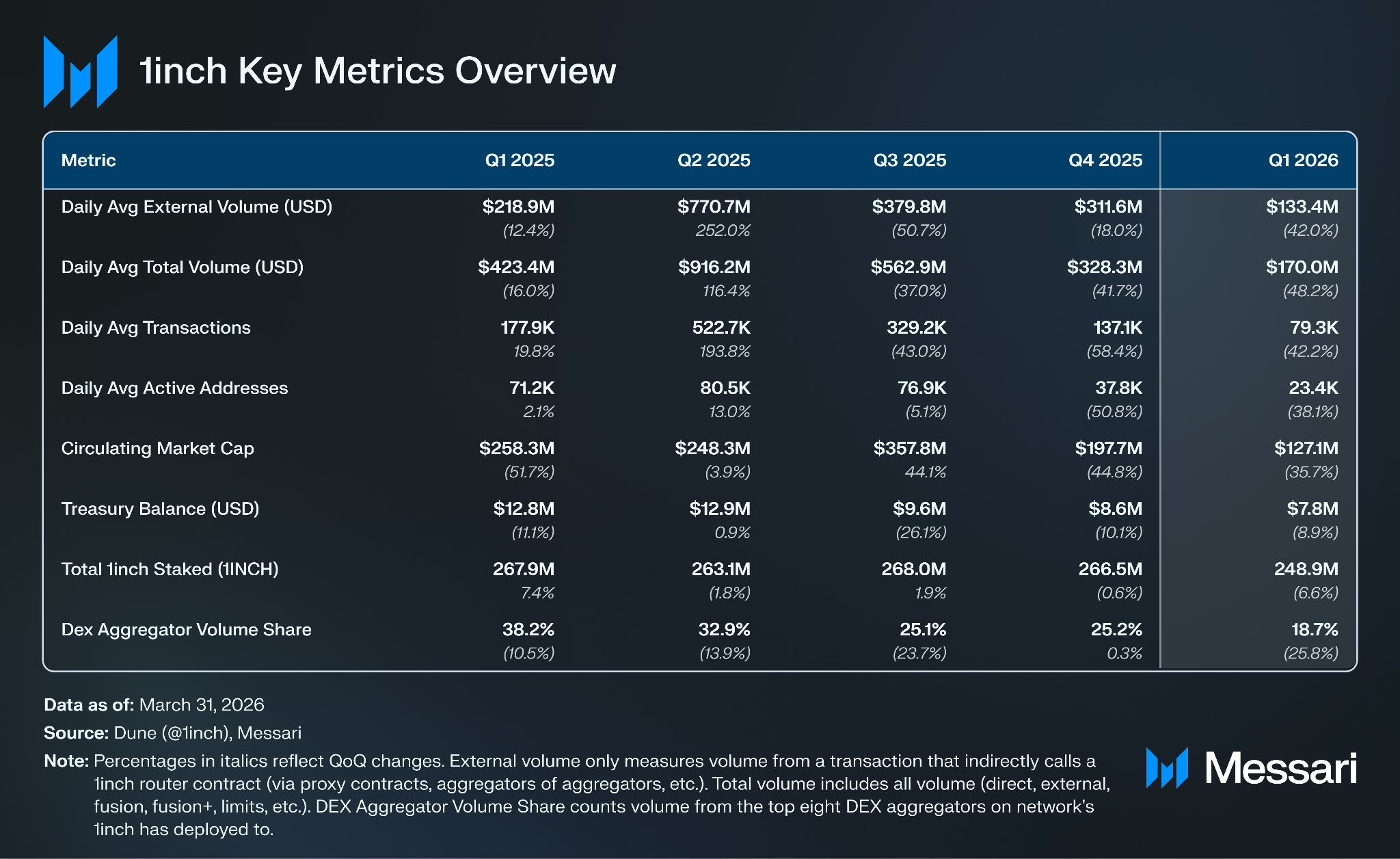
Total 1INCH staked fell 6.6% QoQ from 266.5 million on Dec. 31 to 248.9 million on March 31. The threshold removal likely contributed, as it weakened the direct incentive for tokenholders to stake.
In Q1 2026, 1INCH's circulating market cap fell 35.7% QoQ from $197.7 million on Dec. 31 to $127.1 million on March 31. On Jan. 27, 14 million 1INCH tokens were sold, which contributed to short-term price pressure, but the team stated that no 1INCH was sold from wallets controlled by the 1inch team, entity, or treasury multisig. On Jan. 28, the team also stated plans to review the protocol's tokenomics in 2026 to improve resilience during periods of low liquidity.
Treasury & Governance
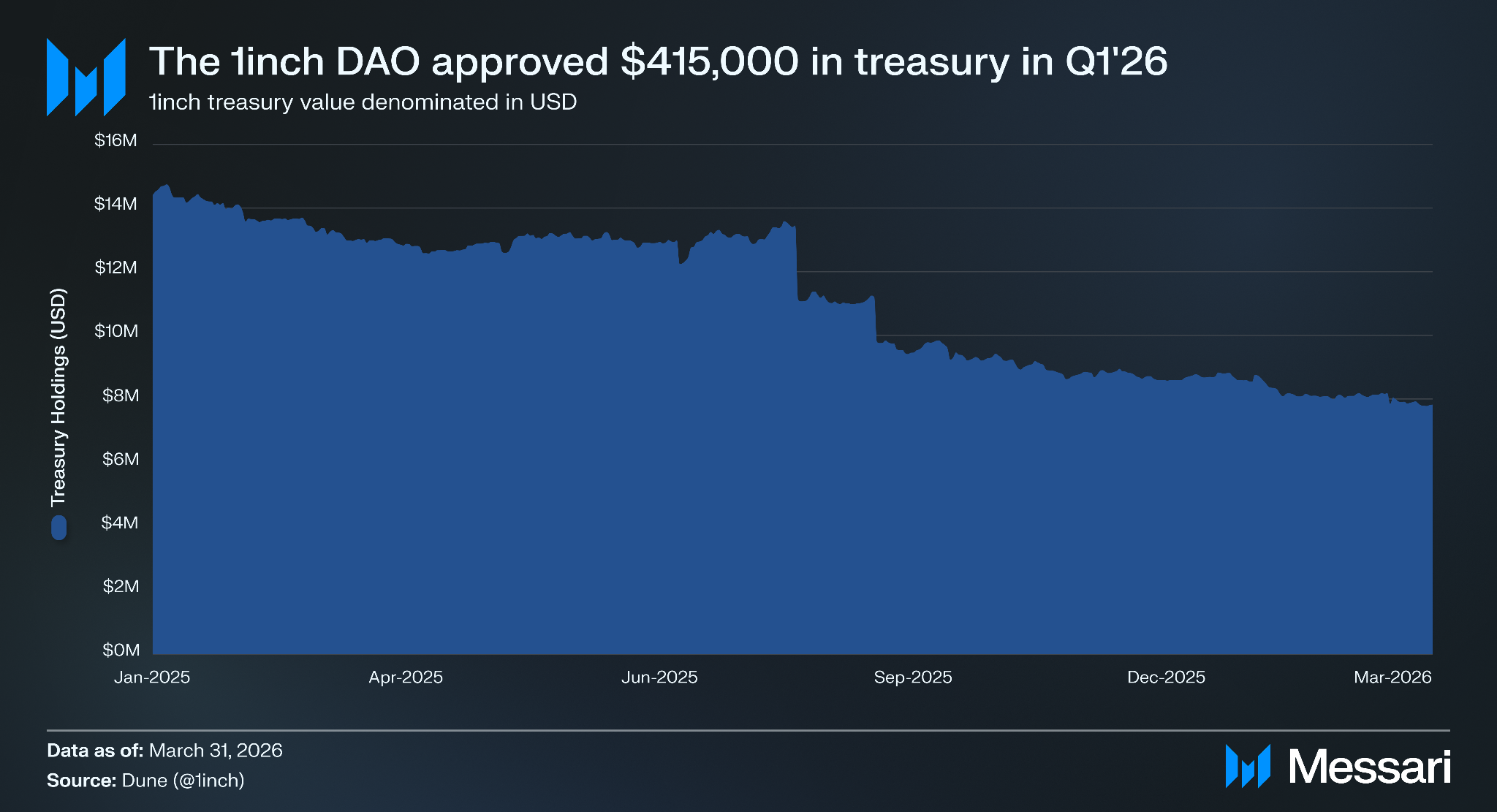
The 1inch DAO approved four 1inch Improvement Proposals in Q1 2026, all in March, totaling approximately $415,000 in explicit treasury commitments alongside a $2.0 million USDC yield allocation:
[1IP-92] Treasury Yield Optimization (March 9) - Approved the allocation of $2.0 million USDC from the DAO treasury to the Aave V3 USDC market on Ethereum to generate yield on idle stablecoin reserves. The proposal introduced a framework for deploying treasury assets into DeFi strategies while maintaining liquidity for operational needs.
[1IP-93] 1inch DAO Revenue Stream Incubator (March 9) - The 1inch DAO Revenue Stream Incubator Program will deploy a total investment of $400,000 (max $50,000 per team) into teams that develop 1inch Aqua strategies approved by the Grant Reviewers and the 1inch Core Team. 1inch DAO will release funding for protocols upon completion of specified milestones, such as proof of concept, working implementation, and integration into the 1inch app. Teams that receive DAO funding are expected to share a portion of revenue with the DAO treasury.
[1IP-94] Legal Counsel Renewal (March 16) - Renewed the DAO's $15,000 retainer with MME, a Swiss-based legal firm, for ongoing legal advisory services.
[1IP-95] Hardware Wallet Team (HWLT)/ERA Wallet Dispute Resolution (March 30) - Resolved a dispute involving ERA Wallet source code and the HWLT, formalizing terms for the release of disputed intellectual property.
As of March 31, the DAO treasury held $7.8 million, down 8.9% QoQ from $8.6 million on Dec. 31, 2025. The $768,000 QoQ decline exceeded the $415,000 in explicit treasury commitments because the treasury holds ETH, wBTC, and 1INCH, which declined in price alongside the broader crypto market in Q1.
Market Share
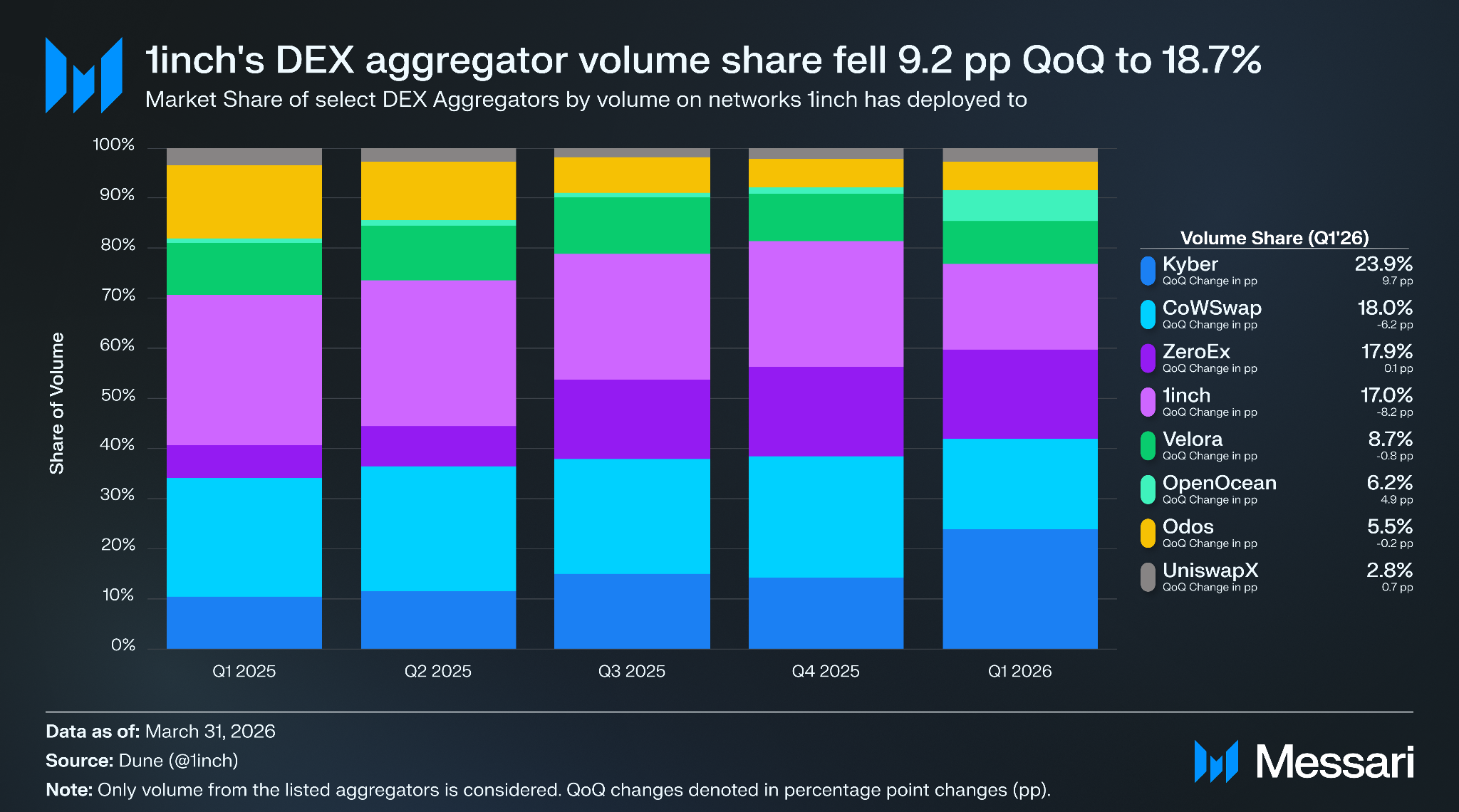
1inch's share of select DEX aggregator volume on networks it has deployed to fell 8.2 percentage points QoQ from 25.2% in Q4 2025 to 17.0% in Q1 2026, moving the protocol’s share from first to fourth among tracked aggregators. The decline was not isolated to 1inch, as CoWSwap also fell 6.2 percentage points from 24.2% in Q4 2025 to 18.0% in Q1 2026.
Kyber emerged as the leading aggregator by volume share, rising 9.7 percentage points from 14.2% in Q4 2025 to 23.9% in Q1 2026. From Dec. 17, 2025, to March 11, 2026, Kyber launched a liquidity mining program with 500,000 KNC in rewards. The program's overlap with Q1 2026 likely inflated Kyber's volume share during the quarter, and its expiration on March 11 will be worth monitoring as a potential headwind to sustained share retention in Q2.
OpenOcean grew 4.9 percentage points from 1.3% in Q4 2025 to 6.2% in Q1 2026. ZeroEx held steady at 17.9%, up 0.1 percentage points from 17.8% in Q4 2025, making it the most stable among the top four. Despite the reshuffling at the top, market concentration remained high, as the top five aggregators accounted for over 85% of routed volume on networks where 1inch is deployed, consistent with Q4 2025.
Qualitative Analysis
Integrations, Partnerships, Upgrades, & More
The 1inch ecosystem continued to expand in Q1 2026 through infrastructure upgrades, wallet integrations, RWA partnerships, and a US educational initiative:
Alvara Partnership - On Feb. 10, 1inch partnered with Alvara to integrate the 1inch Swap API into Alvara's Liquidity Expansion Layer (LEL). Alvara uses the ERC-7621 Basket Token Standard, which enables users to create a single token representing a portfolio of multiple ERC-20 tokens, functioning as an onchain index fund. The 1inch integration provides the routing and liquidity aggregation needed to buy, sell, and rebalance the underlying tokens in those baskets.
xStocks Integration - On March 5, xStocks, a tokenized equities platform, integrated the 1inch Swap API to reduce liquidity fragmentation and improve distribution of their tokenized RWAs.
1inch Trade Mode Launch - On March 3, 1inch launched Trade Mode, an updated trading interface with configurable execution settings, integrated price charts, and per-trade gas and slippage controls. In addition to the interface changes, 1inch reported a reduction of median intent-based swap execution time from 26s to 14s.
Rewardy Wallet Integration - On Jan. 22, Rewardy Wallet integrated the 1inch Swap API, enabling token swaps across Ethereum, BNB Chain, Base, Arbitrum, and Optimism, which allows users to pay gas fees in Rewardy's native RWD token instead of native network tokens (i.e., ETH, BNB, MATIC).
OneKey Wallet Integration - On Jan. 8, OneKey, an open-source self-custody hardware wallet provider, integrated the 1inch Swap API to route trades across multiple liquidity sources while maintaining user control of private keys.
1inch Forward US Campus Tour - On March 18, 1inch launched 1inch Forward, a DeFi educational campaign targeting US business and law schools. The campus tour began at the University of Pennsylvania on March 27, with subsequent stops planned for Yale, Cornell Tech, Harvard, and Stanford.
1inch Business MCP for AI Agents - On March 30, 1inch released a Model Context Protocol (MCP) integration for its Business API suite, allowing AI agents to access 15 APIs, including the Swap API, to query market data and execute onchain trades. The integration standardizes how automated agents interact with 1inch infrastructure.
Closing Summary
In Q1 2026, 1inch's trading volumes declined across all three single-chain protocols as the broader crypto market contracted. Fusion volume fell 26.5% QoQ from $82.8 million to $60.8 million, the smallest decline among 1inch's three single-chain protocols. Fusion's gasless execution and Dutch auction MEV protection likely led to its relative outperformance, as users shifted toward cost-efficient execution during the broader crypto market downturn. The Limit Order Protocol’s daily average volume on BNB Chain grew 52.7% QoQ to $24.0 million from $15.8 million in Q4 2025, driven by tokenized stock and ETF swaps routed through the Dec. 5, 2025, Ondo Finance partnership.
On March 3, 1inch launched Trade Mode and reduced the median Fusion execution time from 26s to 14s. On March 9, the DAO approved a $400,000 Revenue Stream Incubator (1IP-93) to fund external teams building strategies on Aqua, with participating teams expected to share revenue with the 1inch DAO treasury. 1inch's share of select DEX aggregator volume on networks it has deployed to fell 9.2 percentage points QoQ from 27.8% in Q4 2025 to 18.7% in Q1 2026, moving the protocol’s share from first to fourth among tracked aggregators.
The Ondo partnership routed over $2.5 billion in cumulative tokenized stock volume through 1inch by March 5. That track record positions 1inch to attract additional RWA issuers seeking onchain execution infrastructure. If the Aqua incubator converts funded teams into revenue-generating strategies that share proceeds with the treasury, the DAO will enter Q2 2026 with two new sources of operating income: Aqua revenue sharing and annual yield from the $2.0 million of USDC deployed on Aave V3 under 1IP-92.
This report was commissioned by the 1inch Foundation. All content was produced independently by the author(s) and does not necessarily reflect the opinions of Messari, Inc. or the organization that requested the report. The commissioning organization may have input on the content of the report, but Messari maintains editorial control over the final report to retain data accuracy and objectivity. Author(s) may hold cryptocurrencies named in this report. This report is meant for informational purposes only. It is not meant to serve as investment advice. You should conduct your own research and consult an independent financial, tax, or legal advisor before making any investment decisions. Past performance of any asset is not indicative of future results. Please see our Terms of Service for more information.
No part of this report may be (a) copied, photocopied, duplicated in any form by any means or (b) redistributed without the prior written consent of Messari®.
Austin is a Sr. Research Analyst for Messari’s Protocol Services team. He focuses on Prediction Markets, DeFi, & Interop. protocols. He previously worked on PwC's Digital Assets team.
Austin is a Sr. Research Analyst for Messari’s Protocol Services team. He focuses on Prediction Markets, DeFi, & Interop. protocols. He previously worked on PwC's Digital Assets team.