Stacks: The Difficulties of Scaling Bitcoin

The rise of inscriptions and the Ordinal Theory, which gives users the ability to inscribe individual Satoshis with arbitrary data, has sparked a renewed interest in innovations leveraging Bitcoin. With the next Bitcoin halving less than a year away, many investors are looking for the best way to gain high beta exposure to BTC amidst the growing narrative. STX, the native token of the Bitcoin L2 called Stacks, has seen an increasing amount of investor interest and has the potential to be one of the primary beneficiaries of this trend with its Nakamoto upgrade slated for the back half of 2023. However, the recent woes experienced on the network as well as the nascency of Bitcoin scaling solutions are enough to warrant investor caution.
Bitcoin Scaling Overview
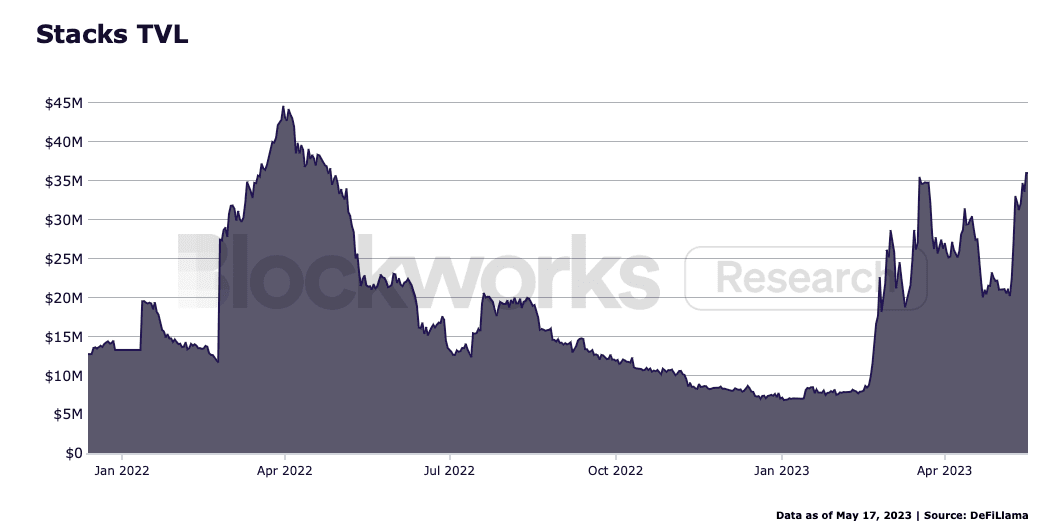
Stacks is a smart contract platform that inherits certain security properties from Bitcoin while providing Bitcoin-centric users an environment to interact with DeFi applications, NFTs, and more. The project launched in 2021 and supports a programming language called Clarity, Bitcoin-settled transactions, and atomic swaps between BTC and other digital assets on the Stacks chain. Stacks now secures over $35M of TVL, but ~95% of the capital is on a single DEX called ALEX. It will be important for Stacks to attract a large ecosystem of developers to build out a rich set of dapps in order to attract users.
In Stacks’ defense, Bitcoin is not able to support traditional L2 architectures without underlying changes being made to Bitcoin at the opcode level, which has proven to be a slow and highly debated process throughout history. Additionally, bootstrapping a chain with a new programming language takes years of iteration to build out developer tooling, block explorers, a robust validator set, etc. Stacks differentiates itself from other Bitcoin scaling solutions with its novel consensus mechanism, ambitious plans for subnets, and a unique BTC bridge. RSK is the main competitor attempting to bring smart contract development to Bitcoin, but the bridge relies on a trusted set of signers through what is called a ‘Federated Multisig’ approach.
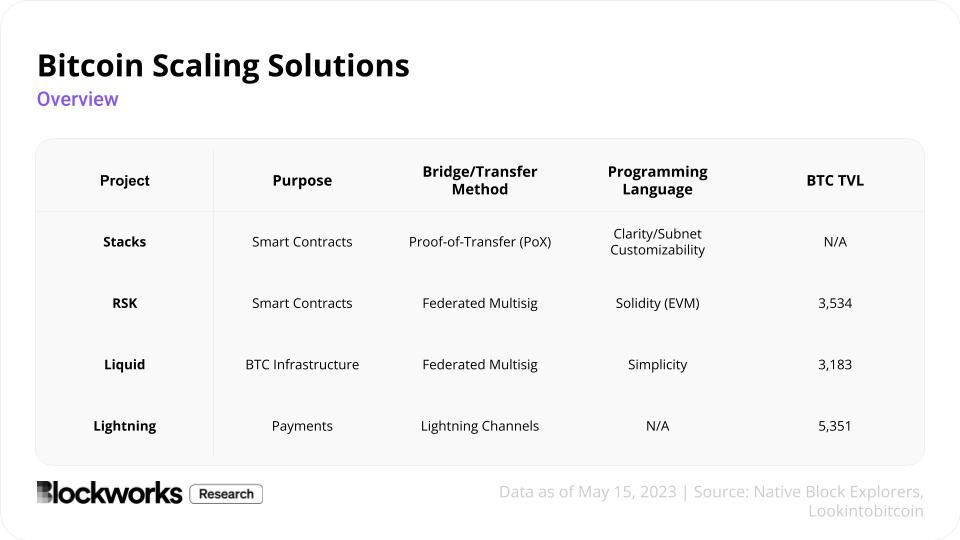
The Lightning Network is arguably the most widely adopted Bitcoin scaling solution given its integration with projects like Strike, Nostr, and others, but it focuses solely on cheaper payments using BTC. Liquid secures a notable amount of capital, but chose to focus on financial infrastructure with trust assumptions over the permissionless deployment of smart contracts that inherit some of Bitcoin’s security properties. That leaves us with RSK and Stacks as the leading projects tackling smart contracts on Bitcoin. However, RSK also relies on a trusted set of signers (Federated Multisig) for BTC peg-ins/outs e.g. mints and burns of sBTC when traveling between Bitcoin and Stacks.

Sam leads coverage on Ethereum, L2s, Aave, Compound, as well as NFTs and gaming. Previously worked on a hedge desk at UGC.