Stablecoin Predictions & Trends for 2020

From our Crypto Theses for 2020 - download the full report here.
1 Tether (USDT) Let’s start in order of historical importance. Tether was one of crypto’s early killer apps because it emerged as the reserve currency of crypto to crypto trading and inter-exchange global liquidity. It rose to prominence in an era when most exchanges struggled to maintain banking relationships and process deposits and withdrawals in local currencies. Tether fits my mental model of technically illegal, but not necessarily unethical innovations, and its management has been an exercise in survival via obfuscation.
In spite of the banking issues at partner Bitfinex (recounted earlier), allegations of fraud and inappropriate account commingling with the exchange, and an ongoing cat-and-mouse game securing banking relationships via shell corporations, Tether’s market cap doubled in the past year, even as more “trustworthy” competitors emerged. It remains the most liquid, stable, and censor-resistant stablecoin in crypto, with a coterie of powerful supporters (the exchanges) whose success today still largely depends on Tether.
It is an order of magnitude larger than its next closest fully-reserved competitor USD Coin (managed by Coinbase and Circle), and 40x larger than MakerDao’s crypto-collateralized stablecoin, Dai.
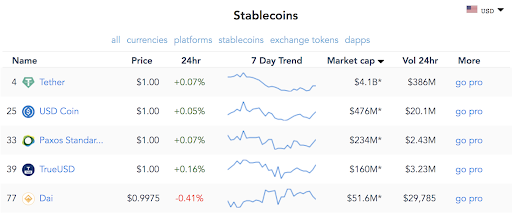
(Note: “Dai” here refers to single-collateral Dai vs. multi-collateral Dai. More on that below.)
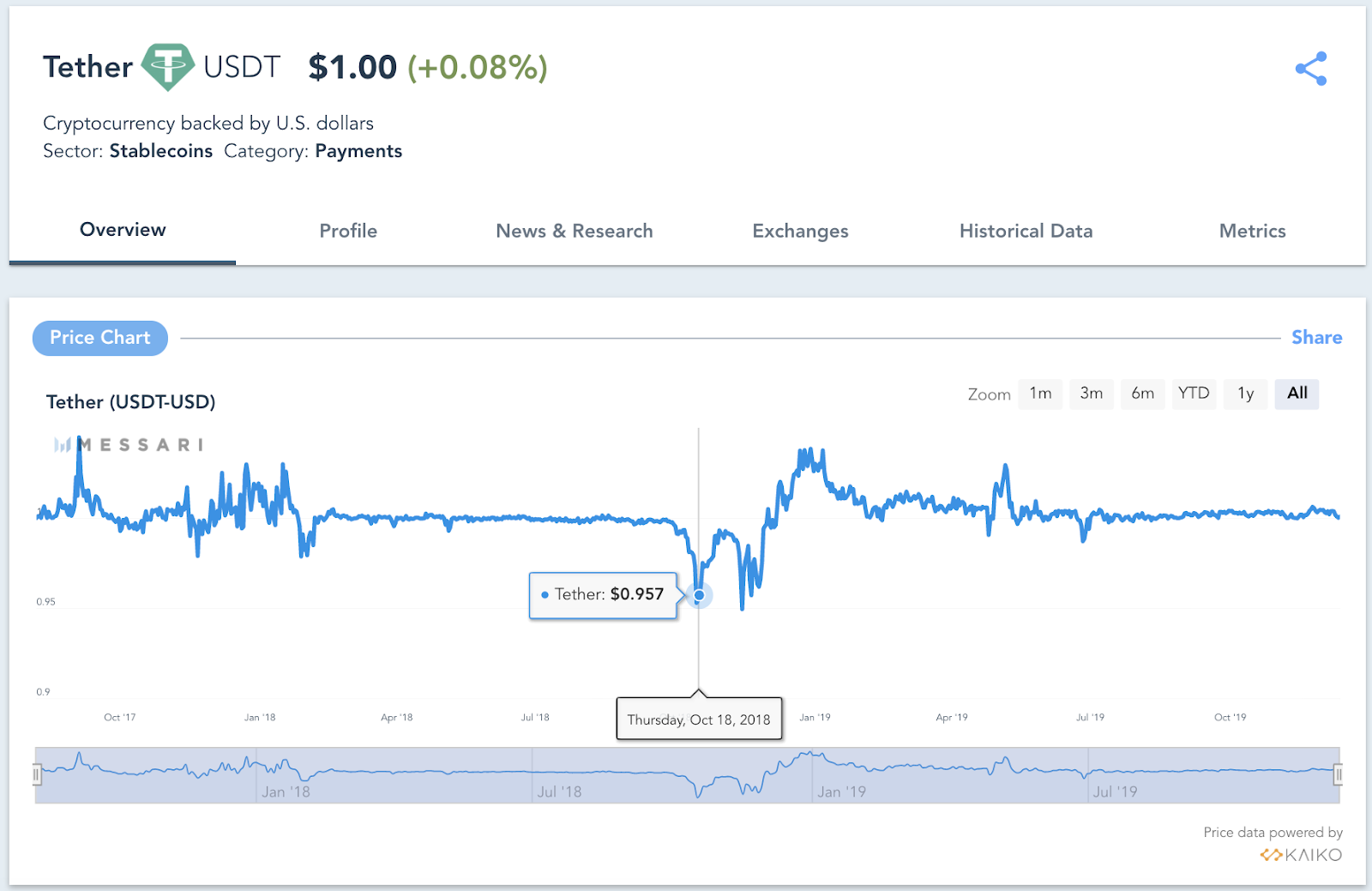
Given the rumors that have swirled around Tether’s solvency, and the fact the company had admitted USDT banking balances were (at least temporarily) under-reserved and secured by non-USD assets at Bitfinex, you’d expect Tether to trade at a discount, as it did when rumors of insolvency hit their peak in late 2018 and earlier this year.
Alas, it does not currently, and has not usually traded at a discount, but a premium. Magical.
2 USDC, Paxos, et al. USD Coin and Paxos are basically the professional, fully-banked and regulated versions of Tether. Like Tether, USDC and PAX are fully-reserved with U.S. dollars. Unlike Tether they are issued by regulated financial institutions (Circle, Coinbase, and Paxos, primarily) whose deposits are audited monthly by real accounting firms. USDC and PAX are the top current competitors vying to overtake Tether as the dominant liquid reserve for inter-exchange trade settlement. It’s unclear that these assets are fungible, given they rely on tight banking relationships, and it would be likely the issuers would attempt to blacklist any assets involved in suspicious or illegal transactions. USDT’s weakness may be its lack of reliable banking partners, but its strength is the same: the hydra has proven hard to kill My bet is that early regulated USD stablecoins exist primarily as medium-term fixes that boost exchange liquidity. They’ll end up competing long-term with central bank digital currencies, and look less like “crypto,” and more like business as usual with an updated transaction ledger.
3 DAI We covered Dai at length in our DeFi section on MakerDAO, but the asset has truly been a bright spot from the bear market. For those worried about the seizability of USDC, or uncertain reserves in USDT, Dai presents a compelling alternative. Dai survived a major market test in 2018, answering the question, “Can Dai survive a market crash?” when ETH drew down 94%. It hit another major milestone last month when it moved from its single-collateral model (beholden solely to ETH) to a multi-collateral model that could one day open the door to support for thousands of collateral assets. Although competition is fierce and growing in the stablecoin market, I bet both ETH locked in Maker CDPs (currently 2.7mm ETH) as well as circulating Dai (currently just north of $100mm) doubles in 2020. Has the issuance of ETH collateralized stablecoins has destroyed the “ether is money” narrative? The long-term bull thesis for ETH is now “digital collateral for Defi”.
4 Emerging Market Dai. I predict Dai (though don’t write off USDT!) will ultimately be the dominant stablecoin of choice in emerging markets like Latin America, where no one actually wants to hold the local currency. Maker’s Mariano Conti gave an inspiring keynote at DevCon “How I Survive Argentina’s 50% inflation” that is worth a watch if you want to understand how important a decentralized USD-stablecoin is for emerging market users. (Yes, I know he’s talking his book as a Maker Foundation employee. Just watch the presentation.)
5 Algorithmic Stablecoins We covered fiat-backed stablecoins and collateralized stablecoins above, but there’s a third, under-explored option: algorithmic stablecoins, where the original creator (at least at first) incubates and then gradually decentralizes an algorithmically managed central bank. One mega-hyped algorithmic stablecoin project, Basis, shut down and returned investor capital last December, amidst concerns their dual token structure would run afoul of U.S. regulators. I’m much more bullish on one of their counterparts, Reserve, which is backed by investors like Peter Thiel, Coinbase, and DCG, and appears to be delivering against its roadmap in anticipation of a full 2020 launch targeting several emerging market economies. (It is already in beta in Venezuela.) Reserve is one of my top projects to watch in 2020.
6 Libra It’s odd to bury the year’s biggest story in the middle of the stablecoin section towards the back of this report, but frankly, that’s where this belongs. The Facebook / Calibra team severely underestimated how unpopular their announcement would be, and their plans to decentralize the project in any real way out of the gates are more or less DOA. All of their meaningful payments partners (Visa, Mastercard, Stripe, PayPal) were scared off by the strong-arm tactics of Congress, and the group that’s left would do well to pare back the initial ambitions of the project.
The Libra team’s opening salvo to run a basket-weighted international reserve is definitively not going to happen in the next several years. Instead, it’s more likely the team starts developing single currency stablecoins for the markets in which it operates. Who knows, perhaps it even gets co-opted by the US government to develop Fedcoin in the event they get spooked by the pace of development of China’s stablecoin (we’ll get to that). That type of coup would be some 4D chess, indeed, but I think Congress hates Zuck enough that that will not happen. I’d trust the Libra team to manage the economic complexity of a new global reserve currency, but not the political complexity of getting it from 0 to 1. Odds are, they’ll end up with a strategy similar to that of Binance.
7 Venus Less than two months after Facebook’s initial announcement around LIbra, Binance announced its Venus initiative to develop localized stablecoins and fiat-pegged assets worldwide. (You have to love the troll, too, as Venus is the ruling planet of Libra in astrology.) The individualized approach makes sense for Binance to run in parallel to their more general regulatory conversations, as they seek banking relationships and government blessings across a wide range of jurisdictions. My bet is that we need to see stablecoins pegged to most major world currencies before we see a basket-weighted version successfully come to market. At that point, the basket-weighted alternative could just as easily be a new synthetic instrument built atop the fiat-pegged tokens.
8 Stablecoin Economics Fiat-reserved stablecoins are a funny thing in that if you know you can make a bunch of interest on the deposits, then you may be willing to sometimes sell a dollar for $0.99...particularly during your bootstrapping period. This is exactly what Gemini tried last year as they tried to win back some of their plummeting market share from USDC and Paxos. The Gemini dollar looked like it would be competitive for a while, hitting $95mm in supply in January vs. Paxos’ $135mm, TrueUSD at $210mm and USDC’s $335mm. Their gambit didn’t work, as the trading rebates Gemini offered OTC desks were quickly arbitraged away, and the exchange ultimately couldn’t get over its lack of listing on (and liquidity from) Binance. GUSD is now just a $4mm stablecoin. It’s functionally dead.
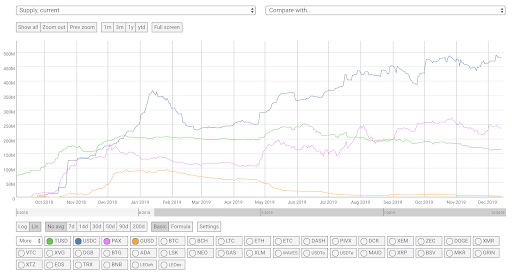
Source: Coinmetrics
In general, you might expect stablecoins to be priced at a slight discount that reflects catastrophic default risk or uncertain holding periods (in the event of account seizures). The present value of the future implied default risk should end up providing basis points (or full points) or discount, but we haven’t seen that yet.
9 DCEP (China) “As global macro fears return, talk of central bank digital currencies — and their Orwellian surveillance and control — will excite Big Brothers globally. BTC will remain an antidote to financial totalitarianism. CBDCs “replacing bitcoin” will become this cycle’s “blockchain not bitcoin” stupid establishment meme.” We wrote this a year ago and it’s more relevant than ever, but maybe not entirely correct in light of the pace at which China seems hellbent on building out its “DCEP” (Digital Currency / Electronic Payment).
On October 25th, China made the most important cryptocurrency related announcement of the year as President Xi Jinping touted blockchain as a revolutionary industry China would invest in heavily. Bitcoin rallied nearly 40% until everyone realized Xi’s comments had nothing to do with crypto currencies, so much as they did with challenging the US Dollar’s monetary hegemony, and expanding the country’s sphere of regional influence at hyperspeed.
It’s been reported that the PBoC is "expected" to launch the tests of DCEP in Shenzhen and Suzhou with China’s “Big Four” commercial banks in early 2020. It’s one thing for western nations to ignore announcements of China’s coming central bank digital currency; it’s an entirely different thing for them to ignore the actual launch. DCEP could give China the generational opportunity to seize greater control over its monetary system, while still offering neighbors a 10x improvement over the USD in terms of transparency and utility. That vision alone should be scary enough to shake Western leaders out of their anti-crypto stupor and get in the game.
10 Fed / EU Efforts Of course western nations will not stand by and watch this all play out without responding, right? Although there have been no proposals to date for a FED or ECB-backed digital currency, both organizations are ramping up their research on the possibilities. Fed Chairman Jerome Powell appears lukewarm to the idea, questioning whether a CBDC would offer the same benefits to the US as it would to other nations. (Are we caught in a national monetary innnovator’s dilemma?) European Bank President Christine Lagarde, on the other hand, appears warmer to the idea, and some pilot programs are already being planned in France. It may be off to the CBDC races everywhere except the U.S.

Prior to founding Messari, Ryan was an entrepreneur-in-residence at ConsenSys, and on the founding teams of Digital Currency Group, where he managed the firm’s seed investing activity, and CoinDesk, where he led the company’s restructuring & annual Consensus conferences. He has been an investor & prolific writer in the crypto industry since 2013.