SparkLend is the leading institutional-grade, blue-chip money-market protocol in DeFi, beating out Aave V3’s Prime Market instance in market size, variety of blue-chip assets offered, and maximum leverage on a risk-adjusted basis.
Alternatively architected lending and borrowing protocols like Morpho and Maple Finance are complementary to SparkLend, serving as higher-yielding markets for Spark’s Liquidity Layer (SLL) to deploy capital outside of SparkLend’s conservative architecture and parameters.
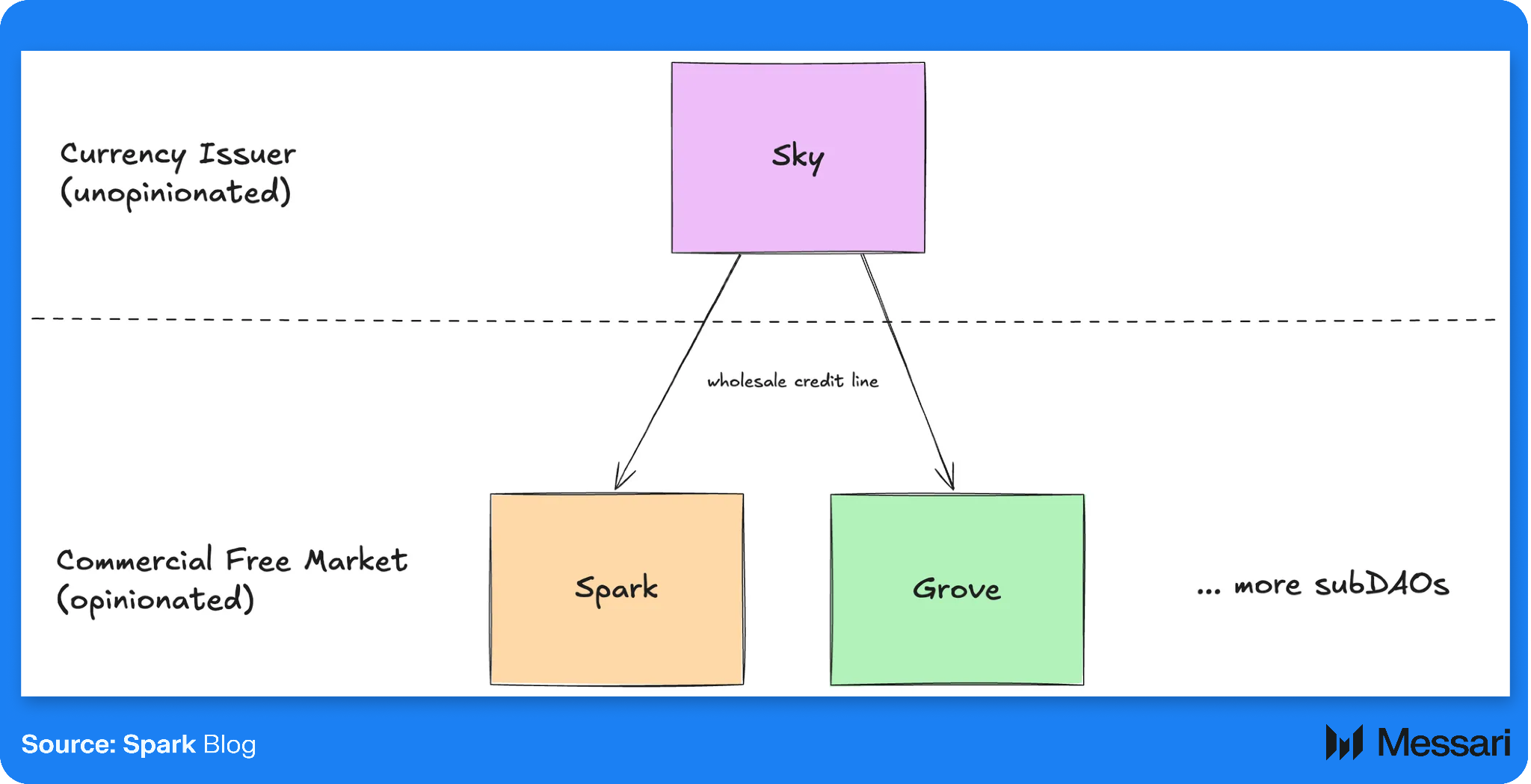
As a Star (SubDAO) of Sky, Spark can borrow billions of USDS at the Base Rate and leverage the Peg Stability Module to rapidly scale blue-chip stablecoin markets on SparkLend, like PYUSD.
Spark is integrating with Anchorage, a leading qualified custodian offering tri-party collateral management. Initial borrowers under this structure include three institutional counterparties which have borrowed $150 million USDC against $222 million of BTC collateral.
Spark prioritizes security and capital preservation as reflected by SparkLend’s high-quality asset composition of ETH and ETH derivatives, U.S. dollar stablecoins, and BTC derivatives. The protocol has been configured to primarily enable ETH, ETH derivatives, and BTC derivatives as collateral to borrow U.S. dollar stablecoins.
Introduction to Spark
Spark as a Star (SubDAO) of Sky
Spark (SPK) is a Star (SubDAO) of USDS stablecoin issuer Sky. Metaphorically, under this structure, Sky acts like a central bank responsible for stablecoin issuance and interest rate adjustment, while Spark is a commercial bank and onchain money market fund, responsible for liquidity allocation, lending, and borrowing. Technically, Spark operates as an open-source liquidity and lending protocol via three main modules: the Spark Liquidity Layer (SLL), Savings, and SparkLend.
Spark Liquidity Layer (SLL): The SLL is Spark’s capital routing system, responsible for minting, bridging, deploying, and managing ETH and USDS, sUSDS, USDC, and USDT stablecoin liquidity borrowed from Sky across supported networks to yield-generating opportunities in DeFi and RWA protocols.
Savings:Spark’s Savings protocol allows users to deposit stablecoins to earn the Sky Savings Rate (SSR). The APY rate paid for the SSR is set by Sky governance and comes from the yield generated on deposits to RWAs such as Blackrock’s U.S. T-Bill RWA BUIDL or onchain money markets like SparkLend.
Under Sky’s SubDAO structure, a Star can borrow as much USDS as it wants, provided that it pays the “Base Rate” to Sky. This USDS needs to be swapped into another asset to generate yield. For example, regarding USDC, Sky’s Peg Stability Module (PSM), which allows for 1:1 swaps of USDS to USDC with no slippage, practically acts as the limit on the amount of USDC that can be put into yield-bearing opportunities.
As such, the SLL acts as a yield-seeking engine deploying as much capital as possible at a yield higher than the Base Rate, retaining 100% of the spread above it.
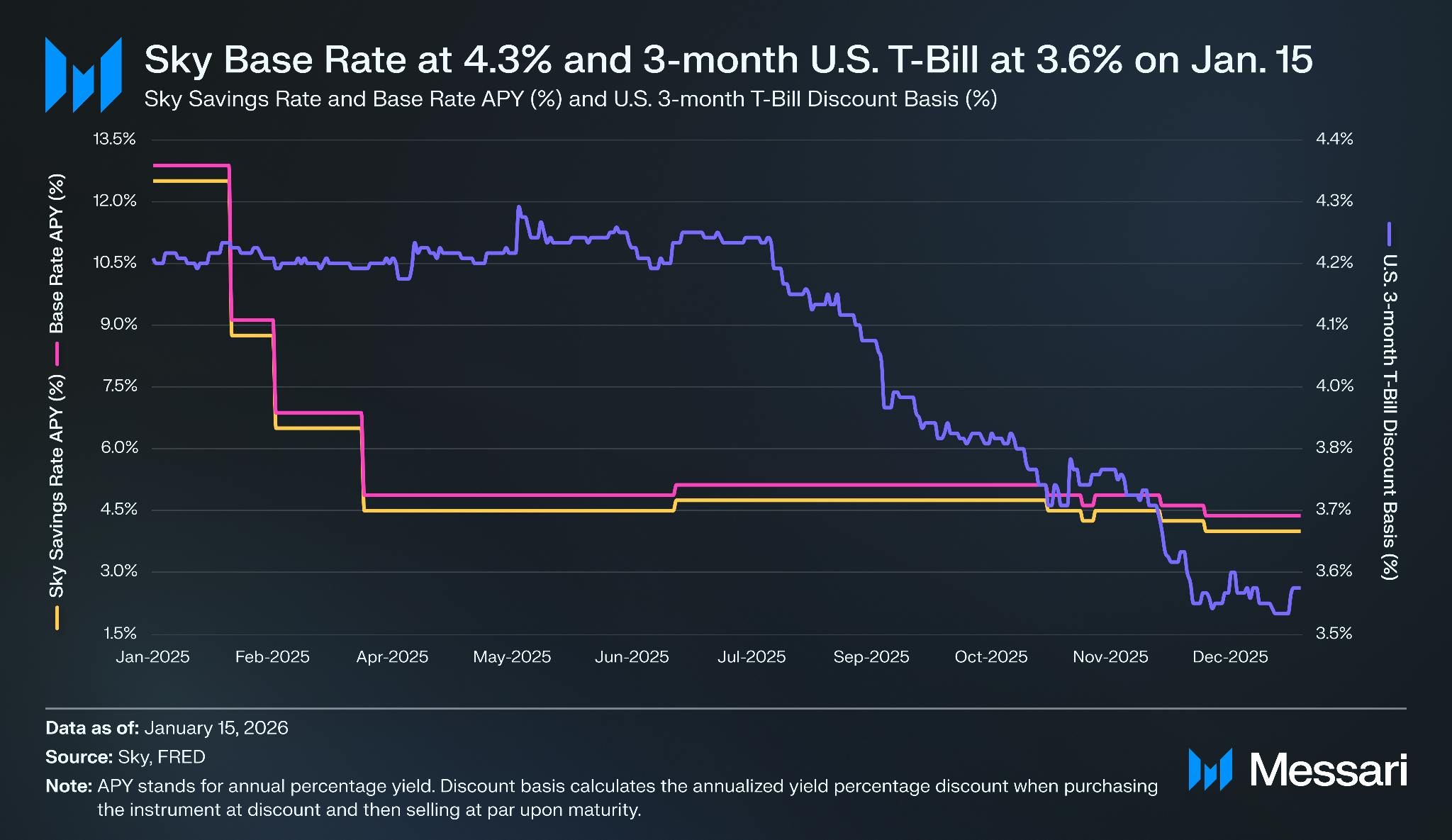
The determination of Sky’s USDS Base Rate is analogous to a Compound-style utilization curve covering the entire Sky balance sheet, with stablecoins like USDC and USDT counted as Actively Stabilizing Collateral (ASC). Under this model, if the collective utilization of non-ASC assets exceeds 75%, the Base Rate will increase, while if it is lower, it will decrease.
If the Base Rate is ever below short-term U.S. Treasury rates, then Stars are incentivized to mint as much USDS as they can and deploy it into U.S. Treasury products, such as BUIDL to capture the spread, ensuring a Base Rate floor at this rate. As such, the Base Rate will almost always be above the rate of U.S. short-term treasuries. Under this condition, Stars allocate to the best spread up to the 75% utilization mark (25% ASC), after which the Base Rate will increase, which Stars want to avoid to maintain as low a borrowing cost as possible.
The Base Rate is always 0.3% above the Sky Savings Rate (SSR), which is the rate USDS holders can earn on their USDS in the Sky Savings Rate smart contracts. The SSR is a dynamic rate set by governance. Of the 0.3% spread, 0.2% goes to the Star that allocated the USDS deposit (Distribution Reward Rate), leaving 0.1% as profit to Sky protocol (Sky Spread).
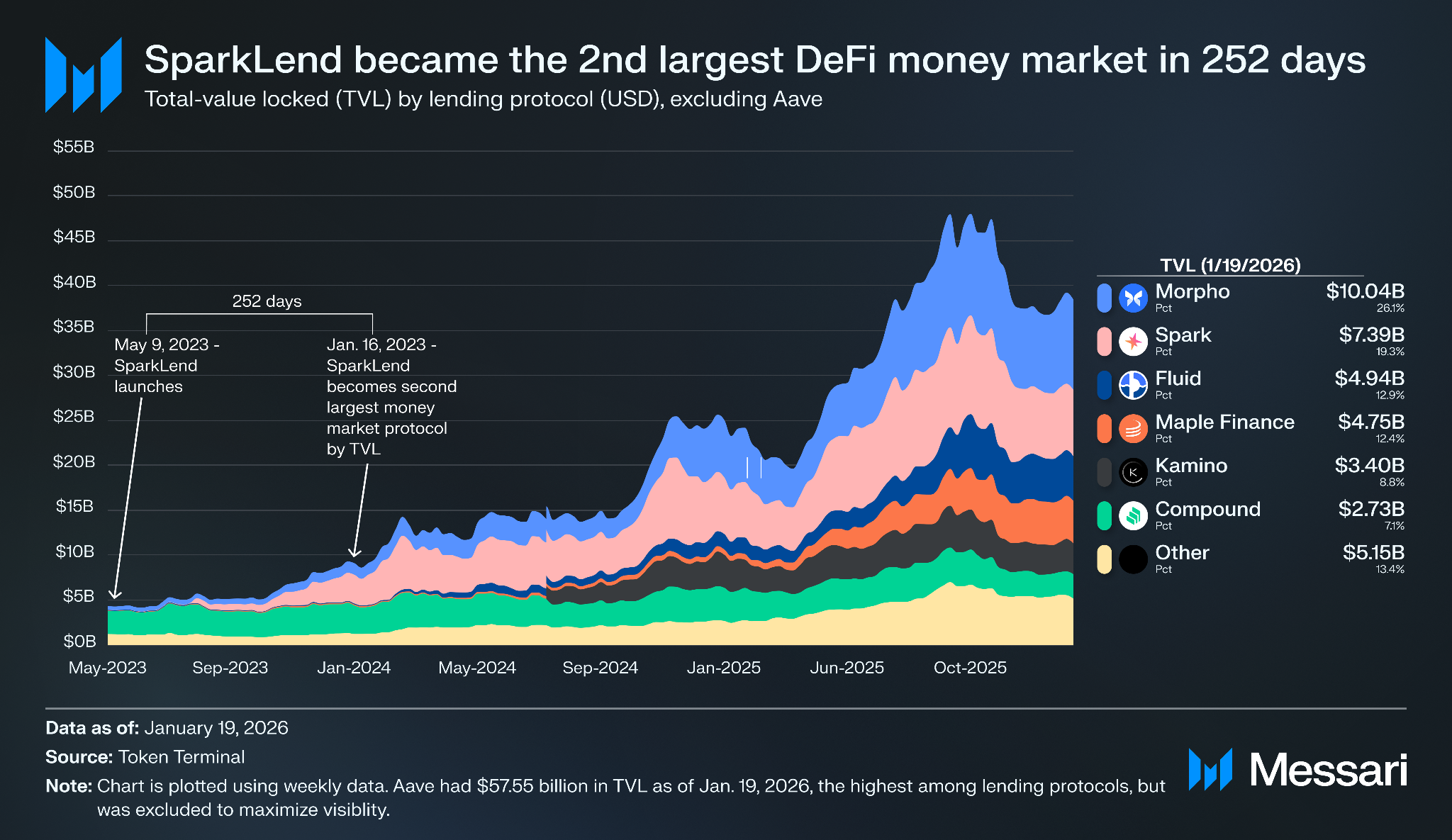
Access to the Base Rate is extremely powerful as it has enabled Spark to borrow USDS via the SLL at a rate lower than borrowing stablecoins on other platforms during the ongoing bull market for stablecoin demand. As a result, after its launch on May 9, 2023, SparkLend became the second-largest money market in DeFi by total-value locked (TVL) behind Aave in just 252 days. As of Jan. 19, Spark is the third-largest money market by TVL at $7.39 billion behind Aave ($57.55 billion) and Morpho ($10.04 billion).
Spark Revenue
Q3 2025 was Spark’s first quarter operating and generating its own revenue independent of Sky. Previously, Spark received a one-time capital allocation of 25 million USDS from Sky, which it operated under while Sky covered all expenses and retained Spark’s revenue.
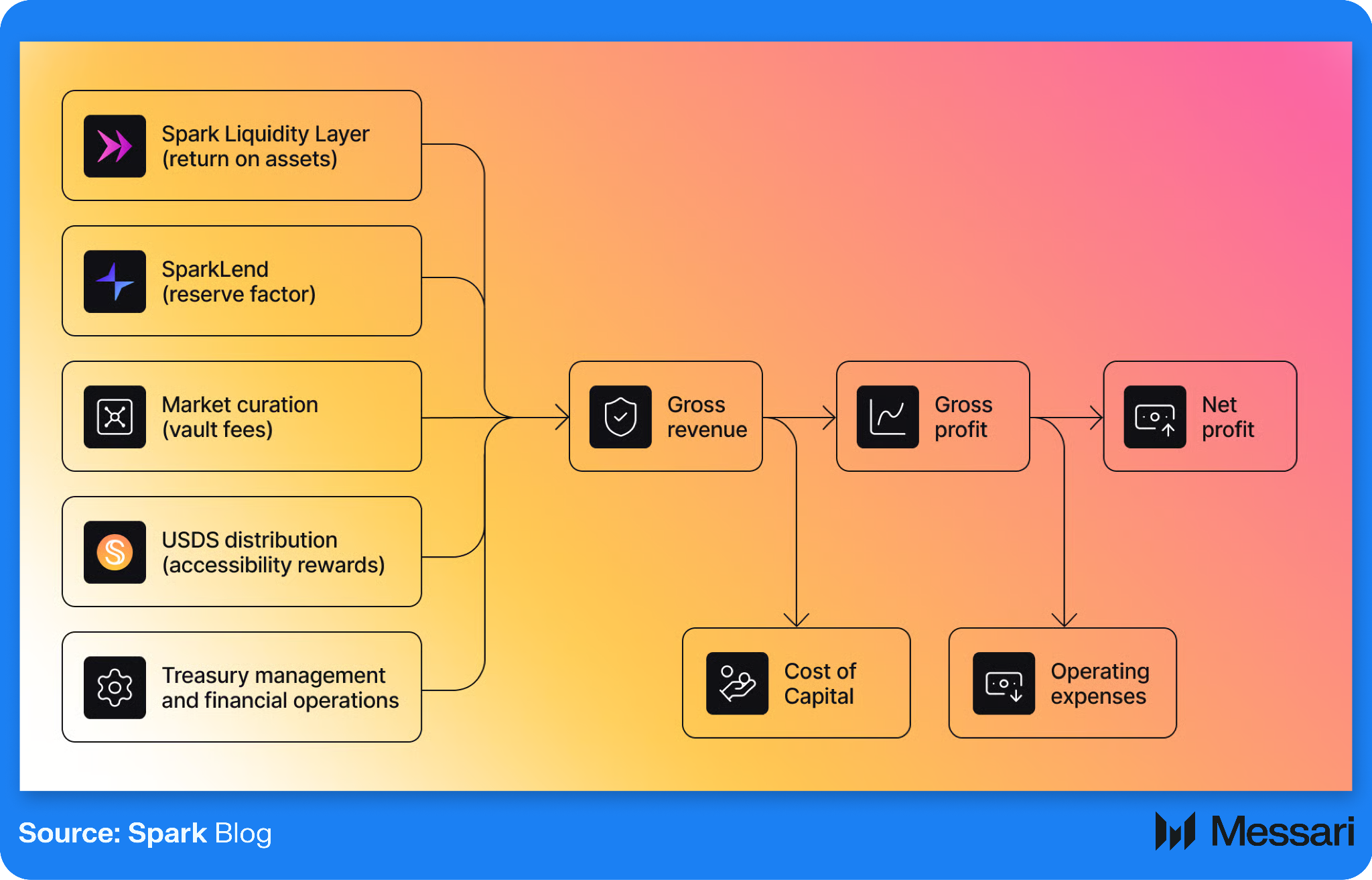
In addition to earning the Distribution Reward Rate and 100% of the yield above the Base Rate paid to Sky, SparkLend’s treasury accumulates earnings from the reserve factor fee for each SparkLend market. For example, the reserve factor for WETH is 5%, meaning 95% of the interest generated from ETH borrows goes to WETH suppliers, while 5% goes to the SparkLend treasury. Spark also earns Morpho curator fees (inclusive of a performance fee and management fees) for all Morpho vaults it curates, and any yield generated on Spark’s treasury.
From these product lines, Spark generated a total of $9.88 million in net revenue (-30.4% QoQ) in Q4 2025 as follows:
SLL: $4.95 million (-51.5% QoQ) on average deployment of $2.82 billion (-10.2% QoQ) at an average APY of 5.9% (+1.7% QoQ), capturing a 0.7% spread (-38.6% QoQ) above the Base Rate.
Distributions Rewards: $4.47 million on $2.07 billion in distributed USDS (+203.5% QoQ) at a Distribution Reward Rate of 0.6% (flat QoQ).
SparkLend: $215,050 in reserve factor fees (-29.6% QoQ) from $6.4 billion in deposits (-12.9% QoQ).
Morpho Curator Fees: $123,000 in Morpho curator fees (-30.3% QoQ).
Spark Treasury Yield: $117,900 in yield generated(-86.3% QoQ).
Spark’s decision to publish its consolidated statement of earnings in quarterly reports highlights the project’s alignment with crypto’s core values of openness and transparency. With $6.6 million in net protocol surplus in Q4 2025 and $12.1 million in Q3 2025, Spark is off to a strong start as a SubDAO of Sky.
Institutional-Grade Custody with Anchorage
On Jan. 15, Spark announced it is integrating with Anchorage Digital, the first federally regulated crypto platform in the U.S., via Atlas, Anchorage Digital's rapid settlement infrastructure, to extend its existing crypto-backed lending to institutional borrowers that are not yet comfortable operating independently onchain and prefer custodial workflows. Anchorage Digital is a leading qualified custodian and provides tri-party OTC collateral management services to clients, enabling Spark to lend directly to counterparties while maintaining collateral monitoring and risk controls.
Initial borrowers under this structure include three institutional counterparties, which have borrowed $150 million USDC against $222 million of BTC collateral. The Spark Data Dashboard allows for real-time tracking of loans to ensure they remain collateralized.
Integrations like these with qualified custodians provide institutions with access to Spark’s large-scale liquidity, amidst sustained institutional demand for crypto-backed loans outside of DeFi, as evidenced by the estimated $33 billion offchain crypto lending market.
SparkLend: Where Blue Chip Onchain Institutional Lending and Borrowing Happen
This report is broken into two parts:
A snapshot of the state of deposits, borrows, and rates on SparkLend that includes an explanation of SparkLend’s architecture and design choices.
A risk analysis of SparkLend comparing it to other lending and borrowing protocols on Ethereum, including Aave V3, Morpho, Euler V2, and Maple Finance.
Together, these sections explain how and why SparkLend is where blue chip onchain institutional lending and borrowing happen.
SparkLend Architecture and Snapshot
Asset Listing Criteria
SparkLend differentiates itself as a permissionless institutional-grade, blue-chip money-market protocol. All asset listings are thoroughly screened for institutional-grade standards. The protocol defines blue-chip assets via three main criteria:
High market cap and liquidity: Assets must have a large active market that can absorb institutional-scale transactions.
Low volatility: Prices should stay relatively stable to minimize protocol risk from sharp drops in collateral value.
Proven resilience: Assets must have a long track record that demonstrates reliability.
Supplied Assets Overview
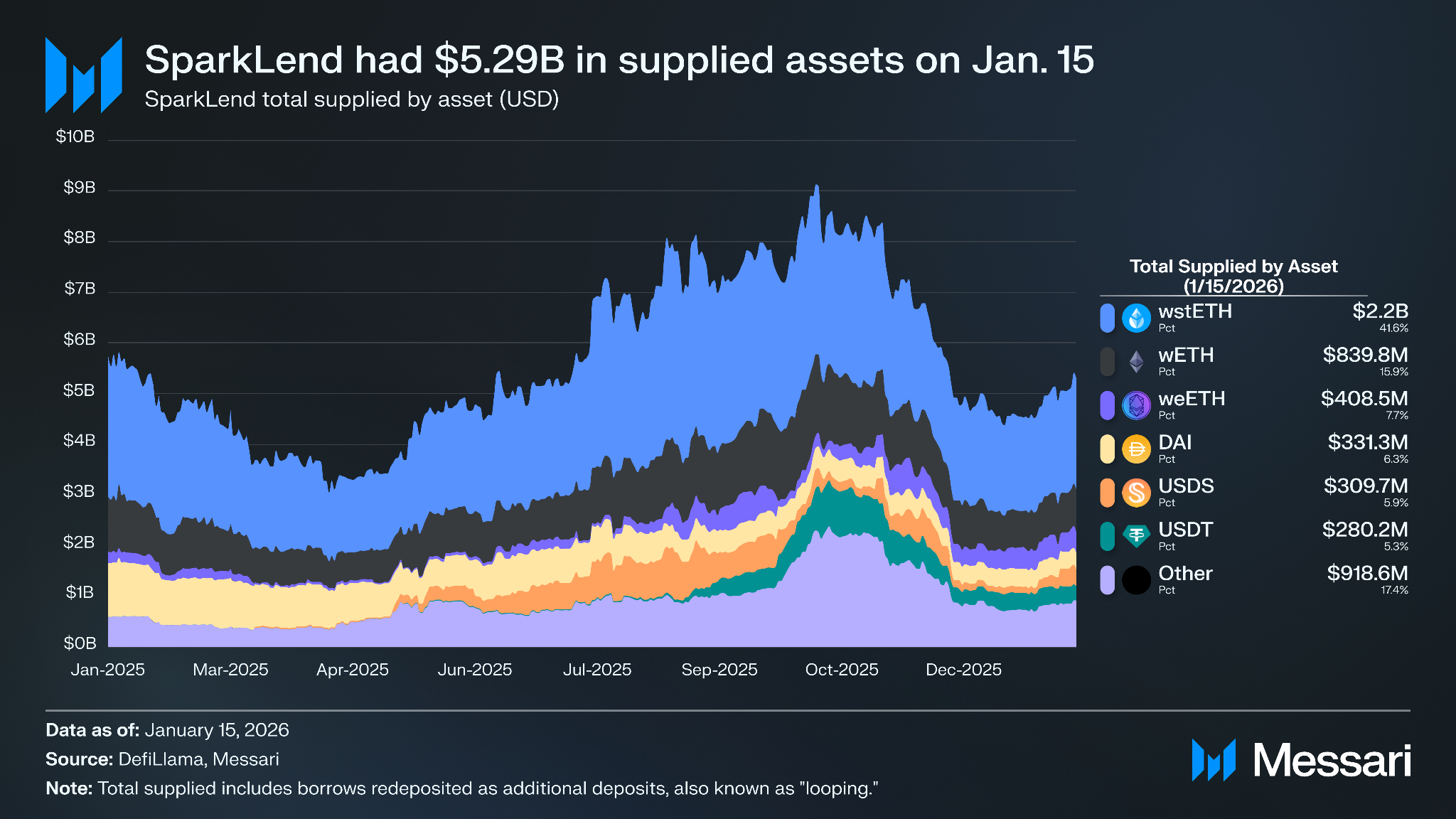
On Jan. 15, 2026, SparkLend had $5.29 billion in supplied assets. The protocol operates on Ethereum and Gnosis, with historically more than 99.8% of supplied assets on Ethereum, including so far in Q1 2026.
Assets Listed
Spark prioritizes security and capital preservation as reflected by SparkLend’s high-quality asset composition. Under the protocol’s blue-chip criteria, supplying has been primarily enabled for ETH and ETH derivatives, U.S. dollar stablecoins, and BTC derivatives. To date, users can supply the following assets:
ETH and ETH derivatives: wETH, wstETH, weETH, rETH, ezETH, rsETH
U.S. dollar stablecoins: DAI, USDT, PYUSD, USDS, USDC
BTC derivatives: LBTC, cbBTC, WBTC, tBTC
Other: Euro stablecoin EURe, sUSDS, and sDAI (non-rebasing yield accruing versions of the tokens), and Gnosis’ governance token GNO.
SparkLend Basic Design
Supplied assets earn yield in the underlying token and can be used as collateral/borrowed if either action is enabled for the asset by governance. When depositing, users receive spTokens, which act as the receipt to withdraw assets from the protocol and are rebasing, meaning yield accrues to the holder by receiving an increased balance of spTokens. Likewise, debt accrues to borrowers as the balance needed to repay borrowed assets increases continuously.
Utilization Curves
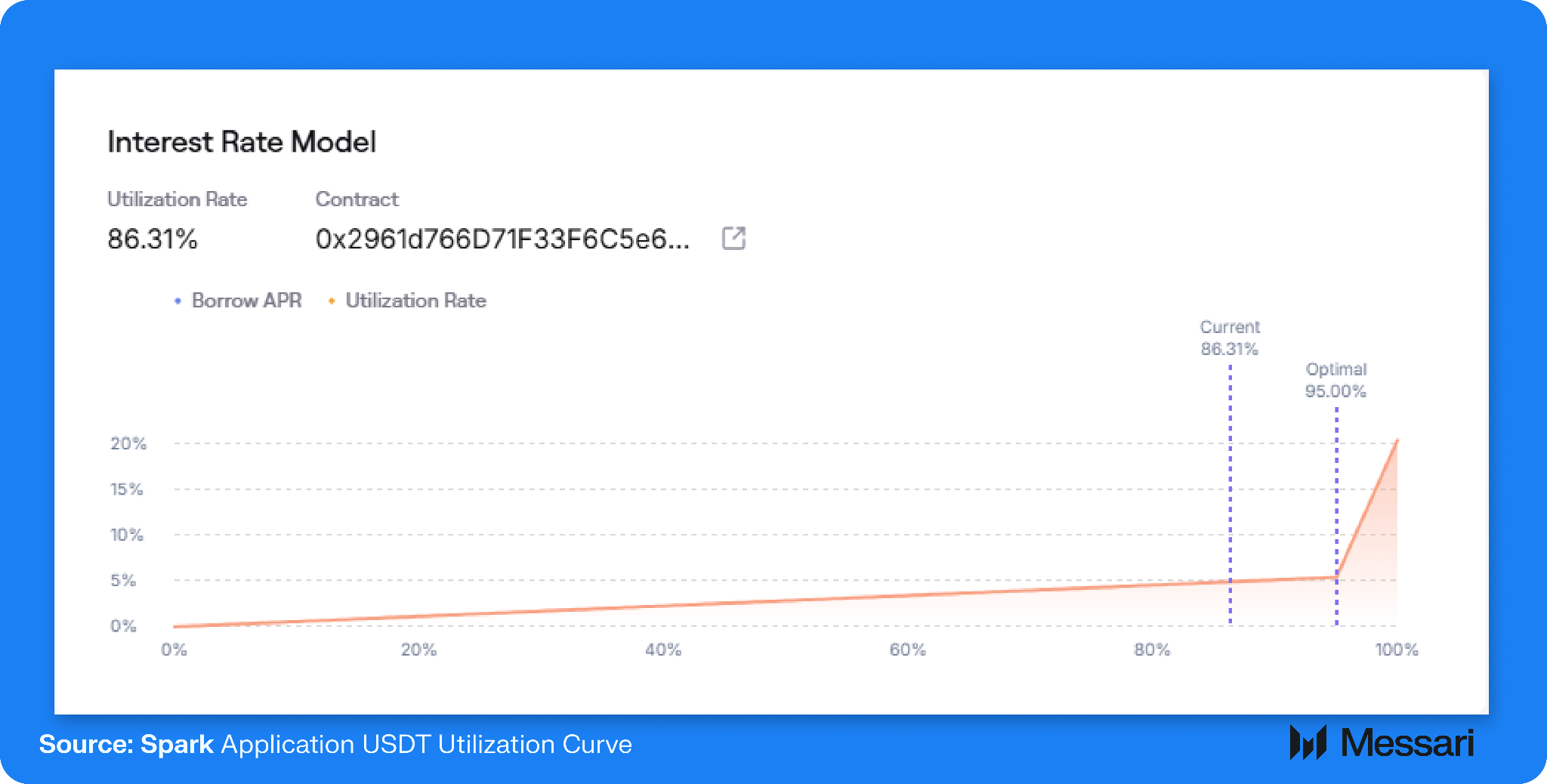
As an Aave V3 fork, the supply rate and borrow rate for each asset are set by a utilization curve with a “kink” set by governance at a target level. Below the target, borrowing rates increase gradually, while above it, they increase more sharply to protect liquidity. The supply rate for a given asset is funded by borrower interest, less the reserve factor, and also increases as utilization rises.
Borrowing is overcollateralized, meaning the value of deposits must exceed the value of assets borrowed for any given user. The maximum Loan-to-Value (LTV) is the percentage of how much value in U.S. dollars can be borrowed against a deposited asset priced in U.S. dollars.
SparkLend Key Parameters by Asset on Ethereum
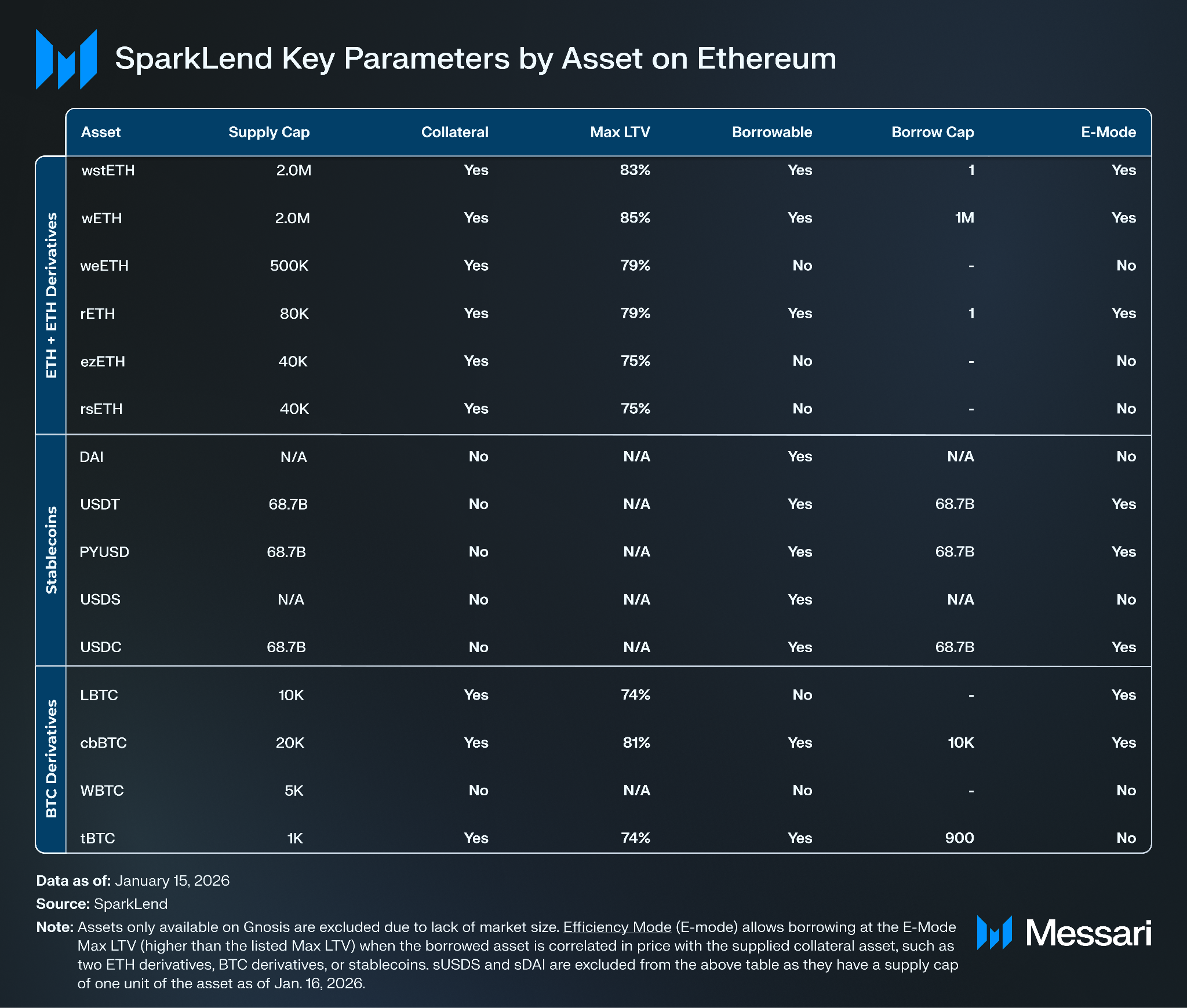
Specific parameters for each supported asset can be seen on the asset’s liquidity market page. SparkLend has been configured to primarily enable ETH, ETH derivatives, and BTC derivatives as collateral to borrow U.S. dollar stablecoins, as shown in the table below.
ETH and all supported ETH derivatives can be used as collateral, as can all but one supported BTC derivative (WBTC), while no stablecoins can be used as collateral. Historically, there has been very little demand for shorting crypto assets like BTC and ETH via onchain lending markets, so Spark has disabled stablecoins as collateral, thereby eliminating the tail risk of bad debt that could accrue from allowing such positions.
In contrast, all stablecoins are borrowable, while only wETH, cbBTC, and tBTC are effectively borrowable, as all other assets are either not borrowable or have a protocol-wide borrow cap of one unit of the asset, making them effectively unborrowable.
Notably, DAI and USDS do not currently have supply caps on SparkLend. The supply and borrow cap for USDS and DAI is controlled by Sky governance, while for all other assets it is controlled by Spark governance. The supply cap limits SparkLend’s exposure to a given asset, thereby mitigating attacks, such as infinite minting or price oracle manipulation, that could lead to losses or insolvency. The borrow cap also reduces insolvency risk by limiting the amount of an asset that can be borrowed.
Borrowed Assets Overview
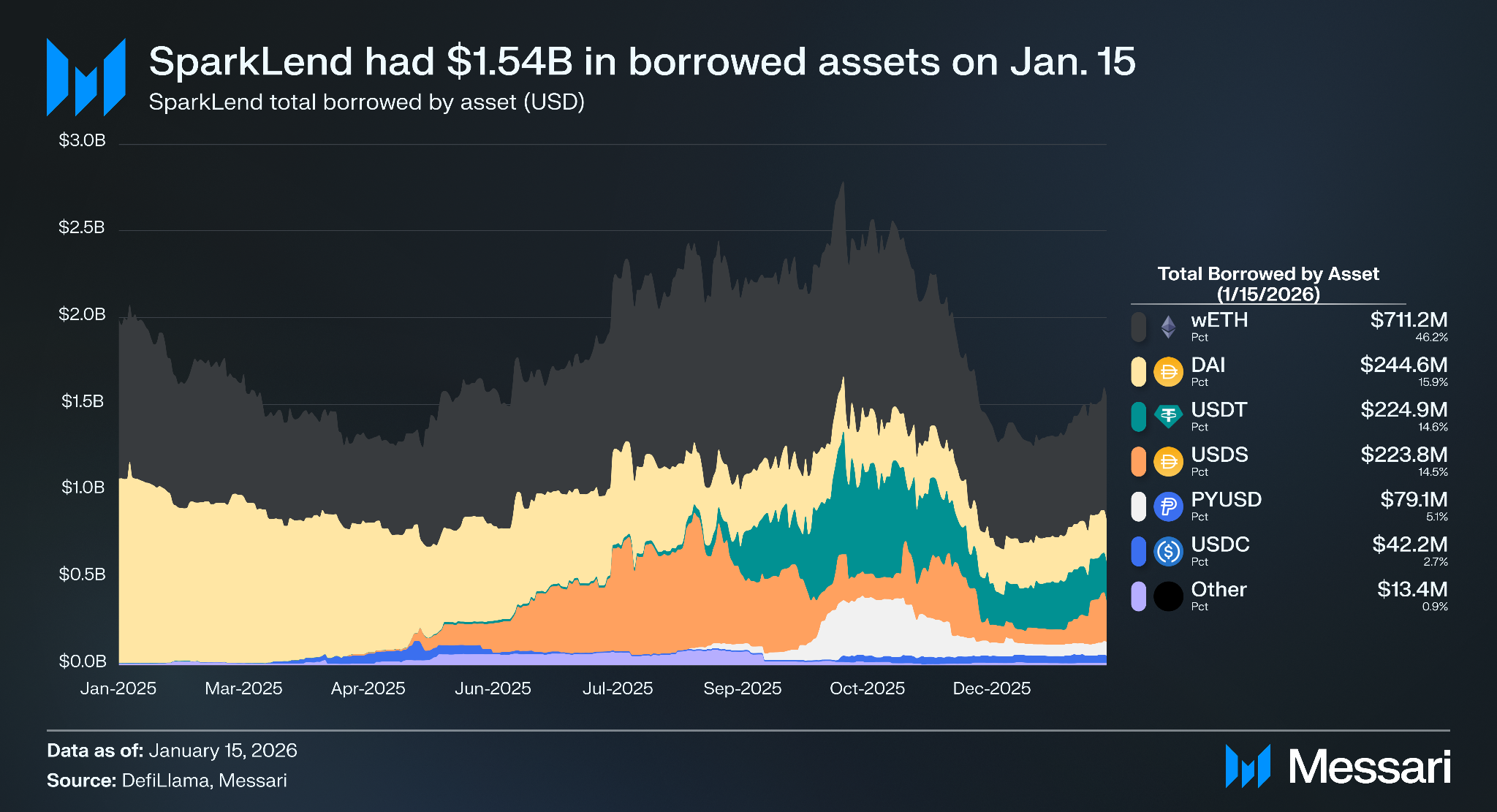
On Jan. 15, 2026, SparkLend had $1.54 billion in borrowed assets and an overall utilization rate of 29.1%. $711.1 million (46.2%) of that was wETH, with the remaining $827.9 million (53.8%) almost all stablecoins.
Only eight assets (wETH, DAI, USDT, PYUSD, USDS, USDC, cbBTC, tBTC) are borrowable at meaningful levels (borrow cap greater than one unit of the asset) on Ethereum when borrowed against an uncorrelated asset (e.g., depositing tBTC to borrow wETH).
E-mode
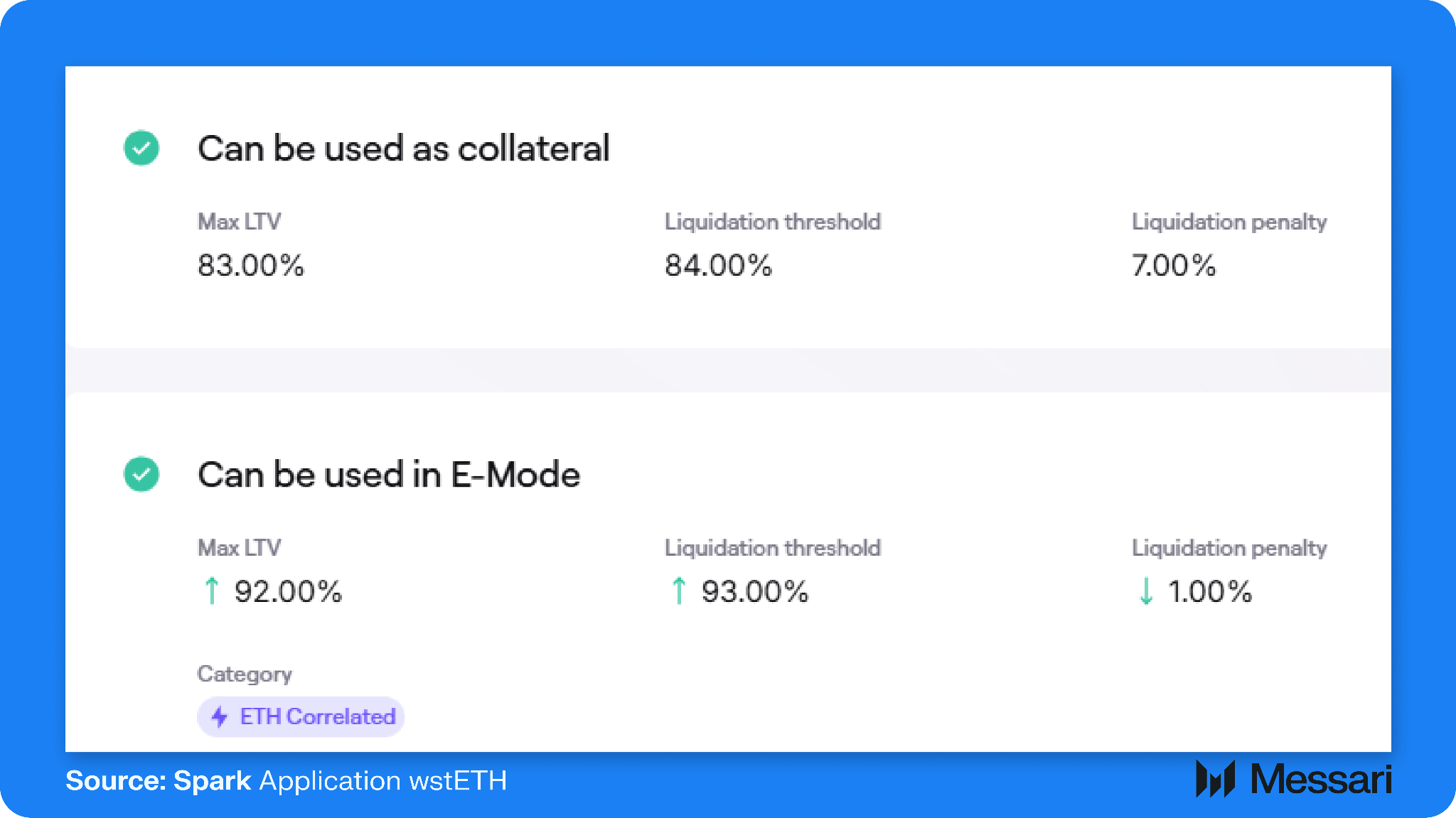
Efficiency Mode (E-mode) allows borrowing at a higher maximum LTV when the borrowed asset is correlated in price with the supplied collateral asset, such as two ETH derivatives, BTC derivatives, or stablecoins. To date, three assets (wstETH, rETH, and LBTC) are borrowable in E-mode, but not borrowable against an uncorrelated asset, as their borrow cap for uncorrelated assets is set at 1. Notably, E-mode cannot be enabled from a wallet address when already borrowing an asset uncorrelated to the deposit asset, such as borrowing USDT against wETH.
Liquidations
On SparkLend, the liquidation threshold is the percentage at which a portion of a user’s collateral deposits is liquidated to bring the user’s LTV below the threshold. There is also a liquidation penalty paid to liquidators as a percentage of collateral liquidated from the protocol. As an example, the current max LTV for SparkLend’s cbBTC liquidity market is 74%, while the liquidation threshold is 75%, and the liquidation penalty is 8%.
Each borrower has a health factor (HF) that accounts for the above parameters and represents the value of collateral against the value of the debt. If a user’s HF goes below 1, anyone can make a ‘liquidationCall()’ to the asset’s pool contract to pay back part of the debt owed and receive discounted collateral according to the liquidation penalty. At any time, debt can be repaid to withdraw supplied assets used as collateral, provided the withdrawal does not cause the borrower to exceed the allowed LTV.
Isolation Mode, Siloed Borrowing, and Other Risk Management Features
In addition to this baseline design, which manages lending and borrowing risk for all assets, SparkLend also features isolation mode and siloed borrowing to further manage asset-specific lending and borrowing risk.
Isolation Mode: Makes the supplier of an asset in isolation mode unable to supply other assets as collateral and only borrow stablecoins up to a specified debt ceiling.
Siloed Borrowing: Assets marked with siloed borrowing cannot be used as collateral and cannot be borrowed alongside any other asset. The feature is enabled by Sky governance when the asset is marked as having potentially manipulable oracles.
Currently, no assets on SparkLend have siloed borrowing, and only GNO on Gnosis is listed in isolation mode.
Finally, as an Aave V3 fork, SparkLend has a number of other notable carry-over features to manage risk that are currently not enabled:
Risk Admins: Allow Sky Governance to grant entities permission to update Spark risk parameters without needing a governance vote for each change.
Price Oracle Sentinel: Introduces a grace period for liquidations and disables borrowing under specific circumstances. This feature is designed for L2s to handle possible sequence downtime, but could in the future be extended to apply to L1s.
Variable Liquidation Close Factor: Sets additional parameters for partial and full liquidation of a borrower based on the health factor (HF).
Oracles
SparkLend uses Chronicle, Chainlink, and RedStone as oracle providers for its lending markets. Oracle price feeds from all three providers are used for certain assets to create redundancy and reduce risk in the event one price feed should fail. A Uniswap Time-weighted average price is used in the event all three oracles fail at the same time. Which oracle is used for a specific market is shown on the SparkLend markets page. Sky governance controls which oracles are used for a given SparkLend market. SparkLend uses four types of oracles:
Market Price: Reflects the live market value the asset is being traded at on various exchanges. WETH uses a market price oracle with redundancy. WBTC also uses market price oracles.
Fixed Price: The asset price is set by a contract at a predefined value, adjustable only through Sky governance. DAI, USDT, PYUSD, USDS, and USDC use a fixed price of 1.00 USD so that the price does not deviate even if the market price of the stablecoin deviates from this value. This is done to prevent oracle-manipulation attacks, where an attacker increases a stablecoin’s value on the underlying price feed to borrow more than the real value of the stablecoin, leaving bad debt, or decreases the stablecoin’s value to cause liquidations. The tradeoff of using a fixed price oracle for stablecoins is that if a stablecoin were to depeg, the protocol would credit debt repaid at $1, even though users could acquire the stablecoin for less than $1 on the open market. Because Spark does not allow stablecoins to be used as collateral against non-correlated assets, the attack vector under this scenario of depositing stablecoins overvalued by the protocol to borrow a non-correlated asset like WETH, is not possible. However, this attack vector would be possible if the depegged stablecoin is supported in E-mode, which allows for correlated borrowing against the supplied asset. Currently, USDT, PYUSD, and USDC are supported in E-mode, while DAI and USDS are not.
Underlying Asset Price: Derives the asset price from a market price oracle that tracks the underlying asset. LBTC, cbBTC, and tBTC use underlying asset price oracles to track the price of BTC. This design choice optimizes for reducing oracle manipulation risk as the price of BTC is far less manipulable than the price of these BTC derivatives. However, underlying asset price oracles risk bad debt accumulation to the protocol, were the underlying BTC derivative to ever significantly diverge in price from the underlying asset, which would allow exploiters to supply or borrow to profit at the expense of the protocol accumulating bad debt, depending on whether the BTC derivative depegged to the upside or downside.
Yielding Fixed: Calculates the asset price using both an exchange rate and a market price oracle, where the exchange rate is a conversion rate of the asset and its underlying asset. weETH, rETH, ezETH, and rsETH use yielding fixed price oracles with redundancy, whereby the exchange rate of the ETH derivative is multiplied by the market price of WETH.
Borrowed Assets Breakdown
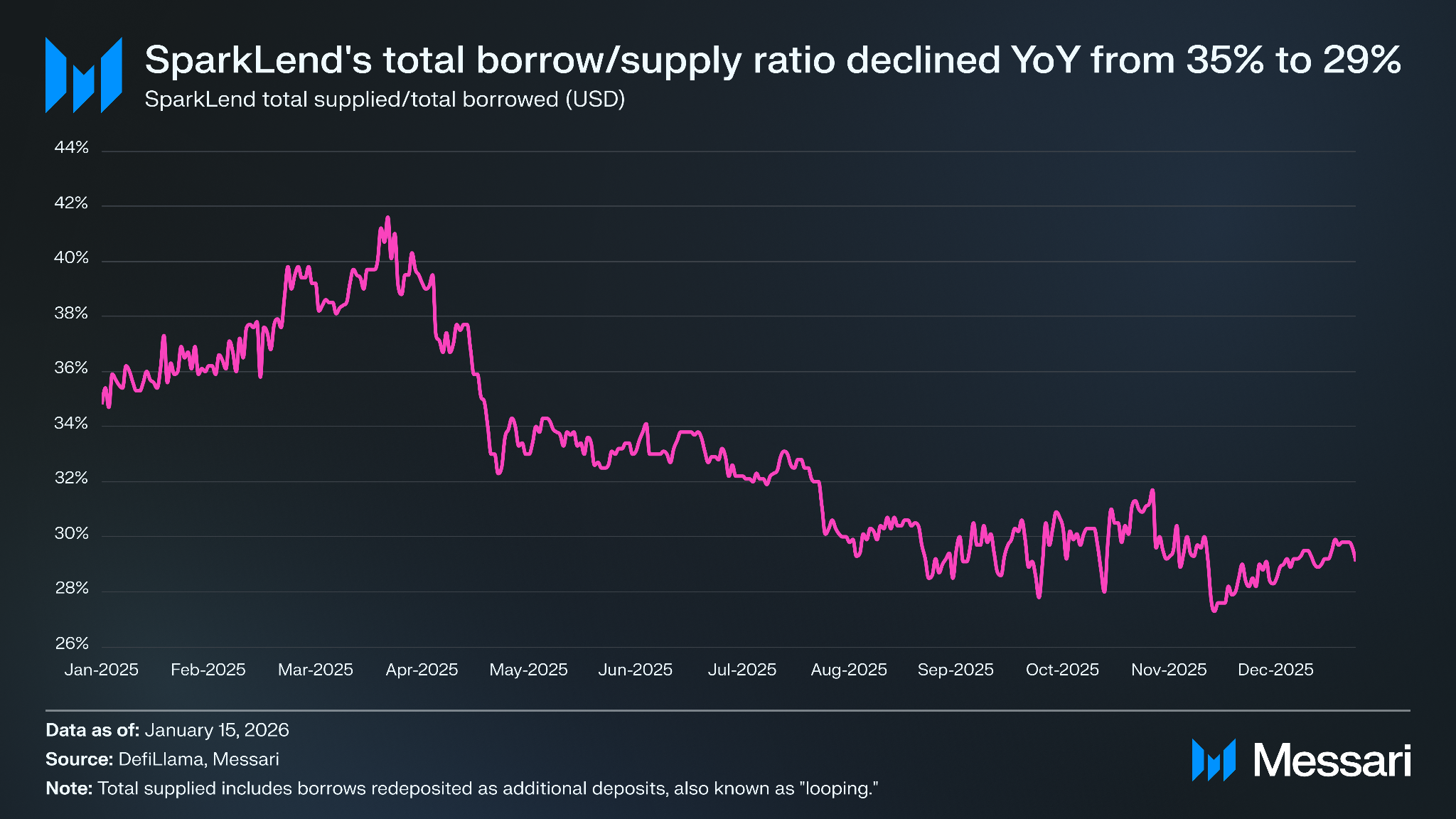
From Jan. 16, 2025, to Jan. 15, 2026, SparkLend’s total borrow to supply ratio declined from 34.8% to 29.1%. The ratio peaked at 41.6% on April 9, 2025, and bottomed at 27.3% on Dec. 5, 2025.
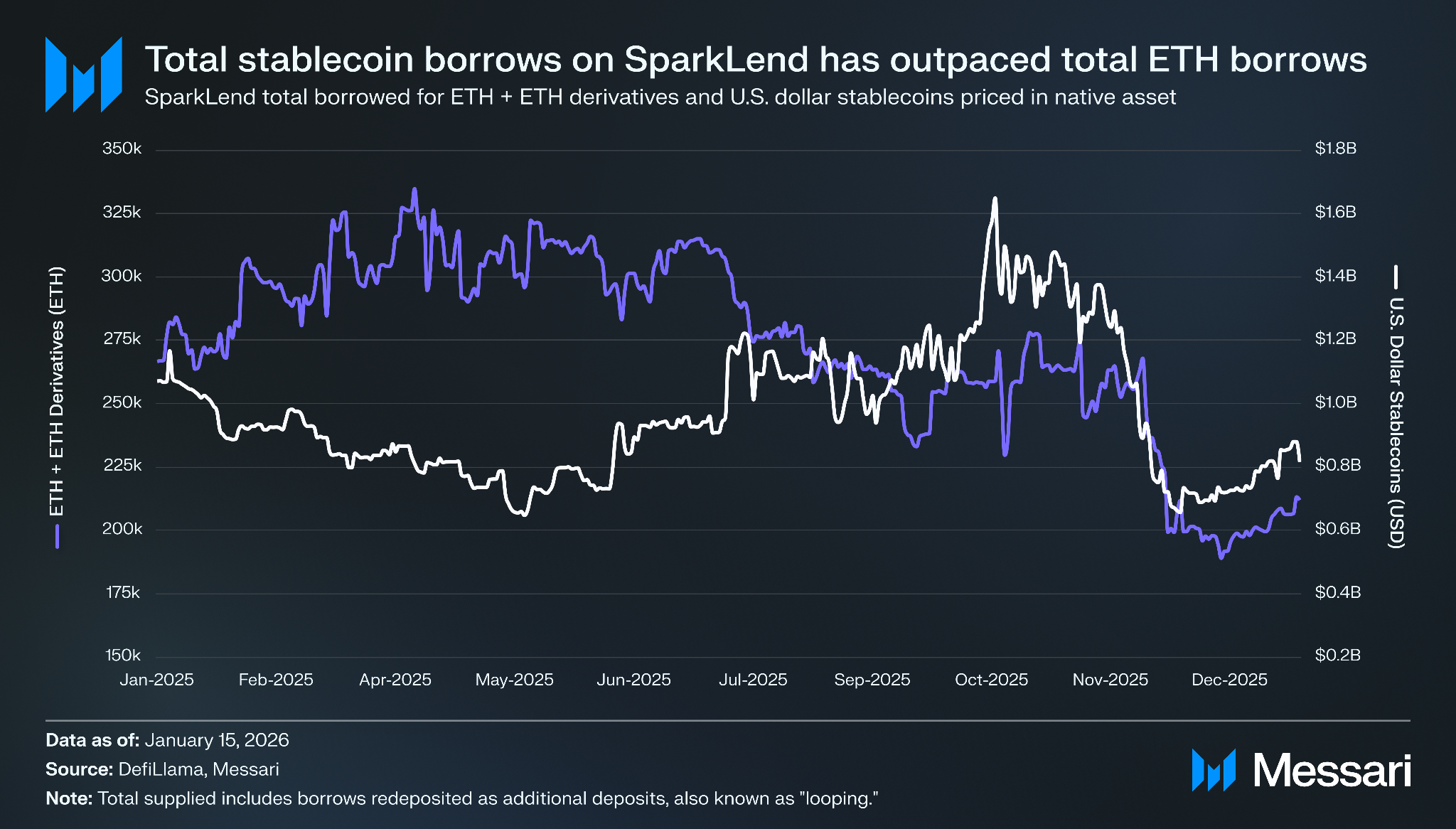
Historically, more than 99% of borrows on SparkLend are either U.S. dollar stablecoins or ETH/ETH derivatives. In the last year, total U.S. dollar stablecoin borrows on SparkLend have outpaced total ETH borrows when priced in their native asset. Stablecoin borrows hit a local high of $1.65 billion on Oct. 10 (+30% in 2025), while ETH and ETH derivative borrows hit a local low of 189,000 ETH on Dec. 21 (-36.9% in 2025).
Supplied Assets Breakdown
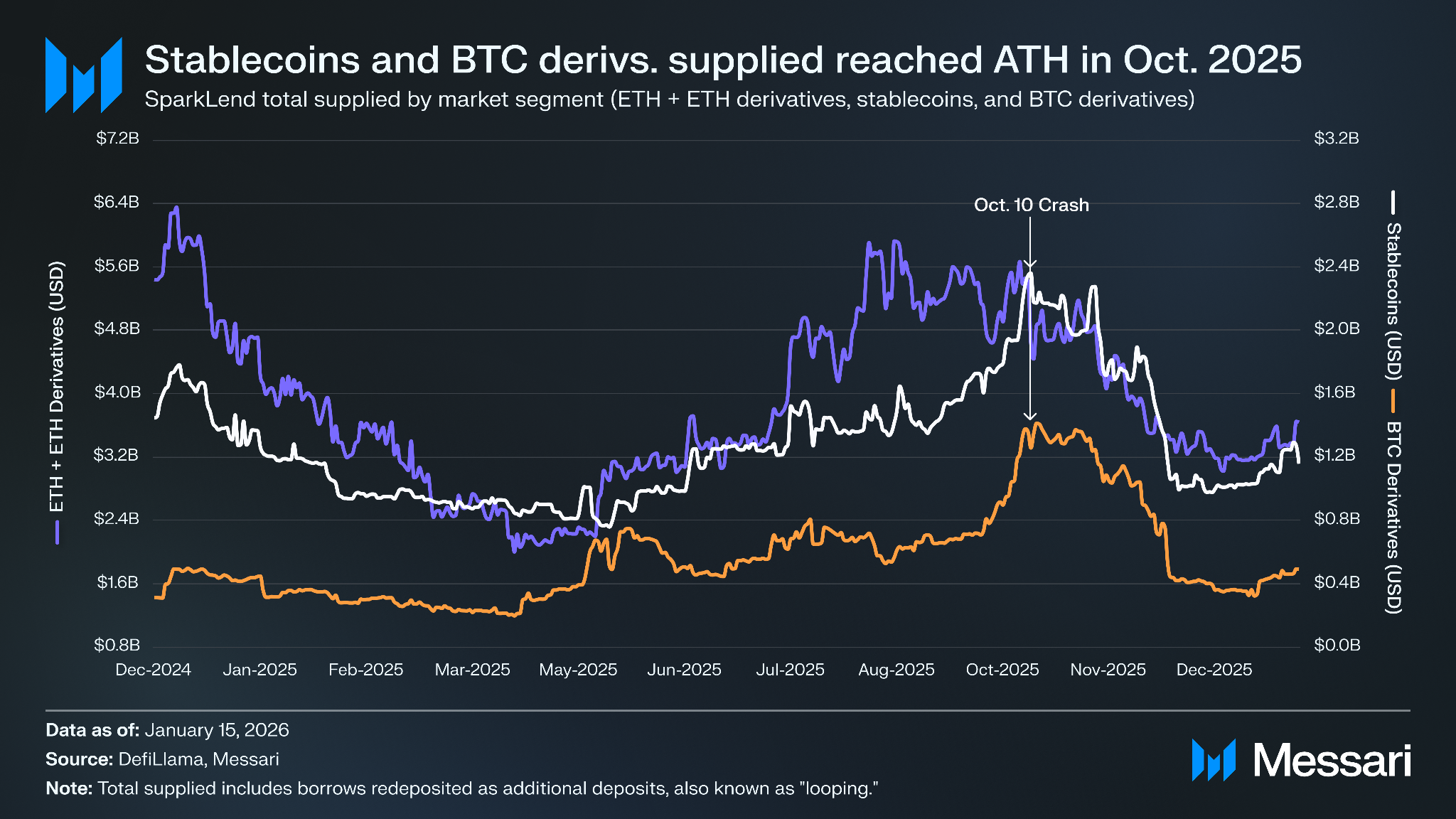
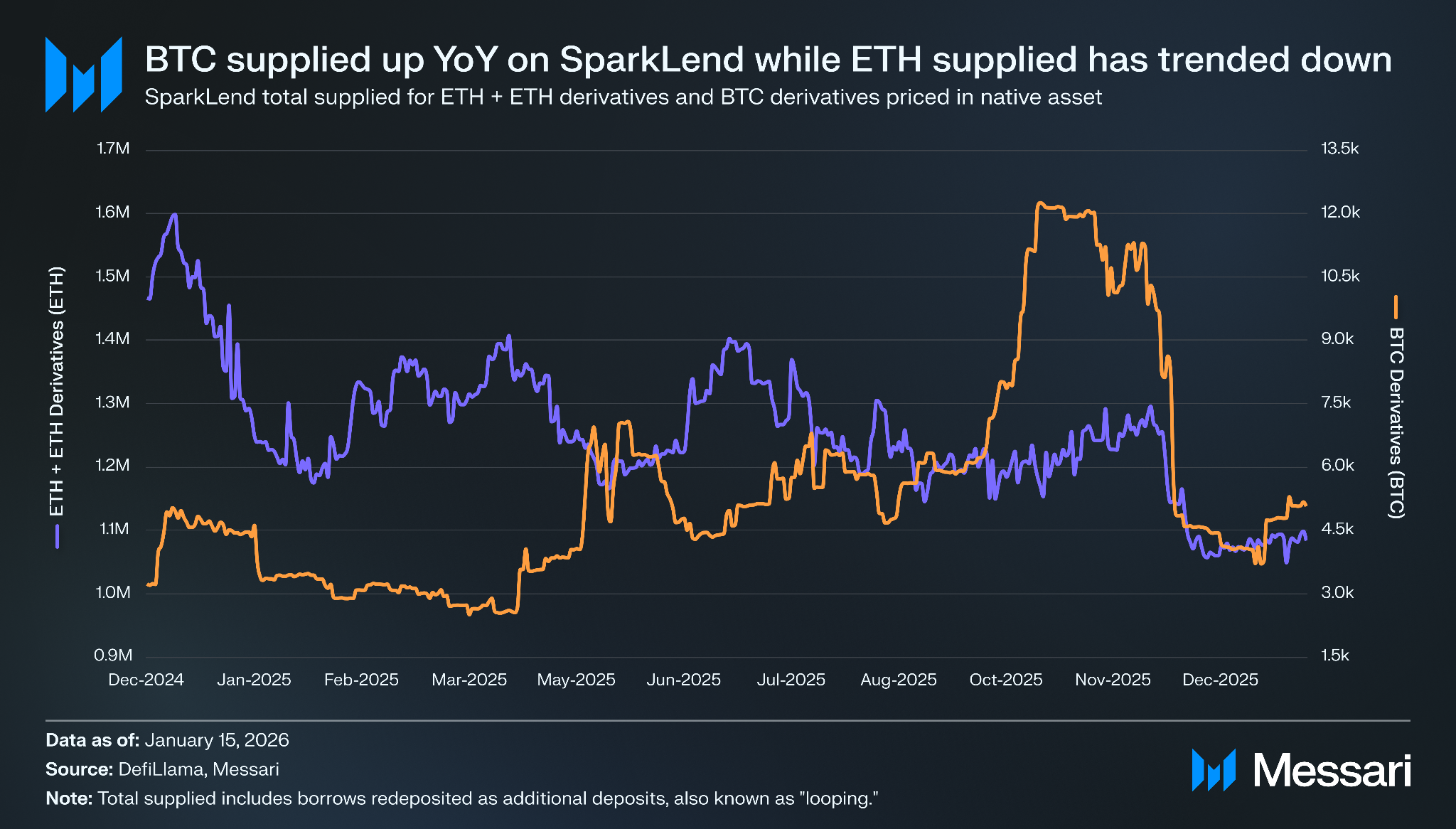
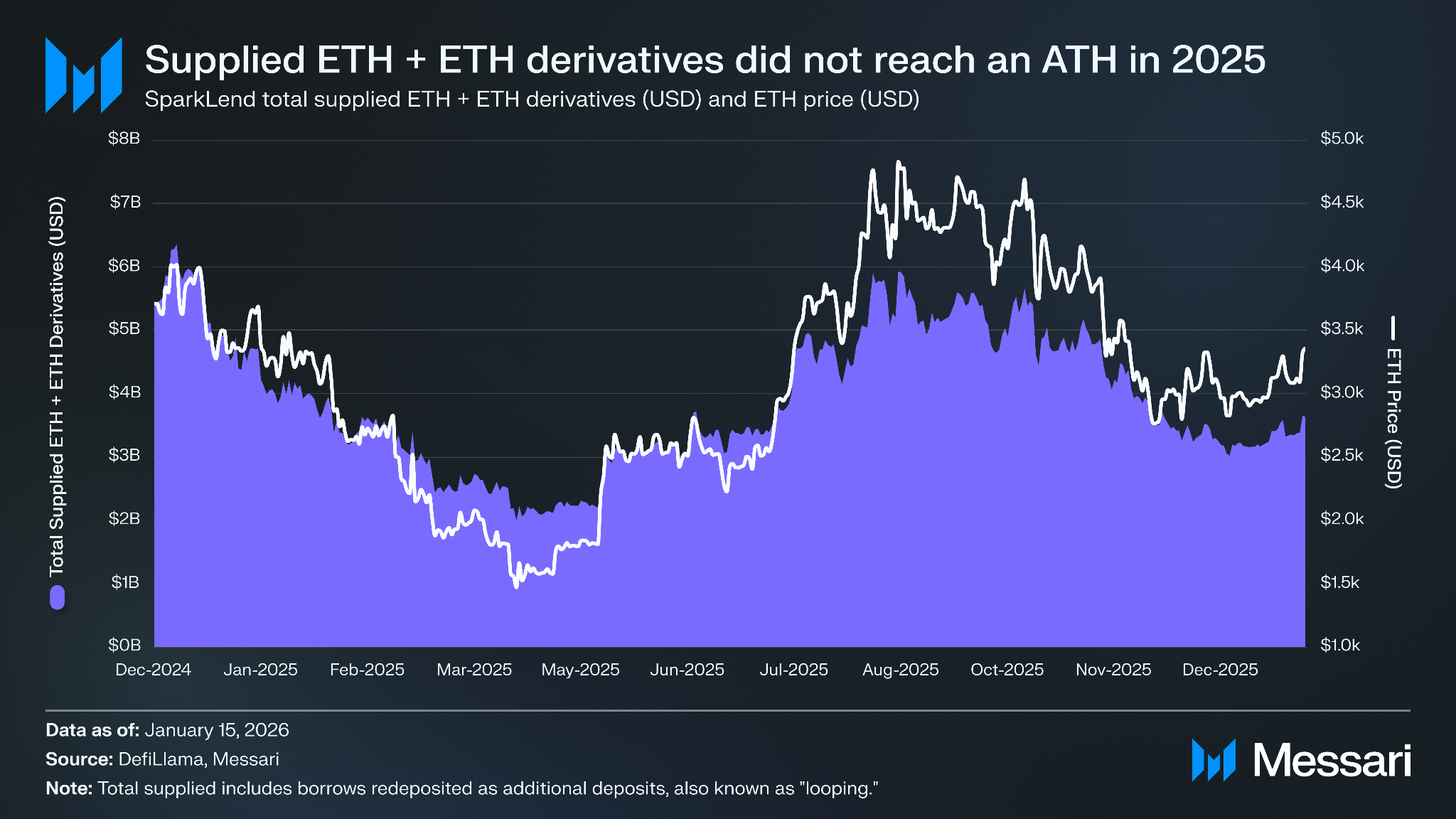
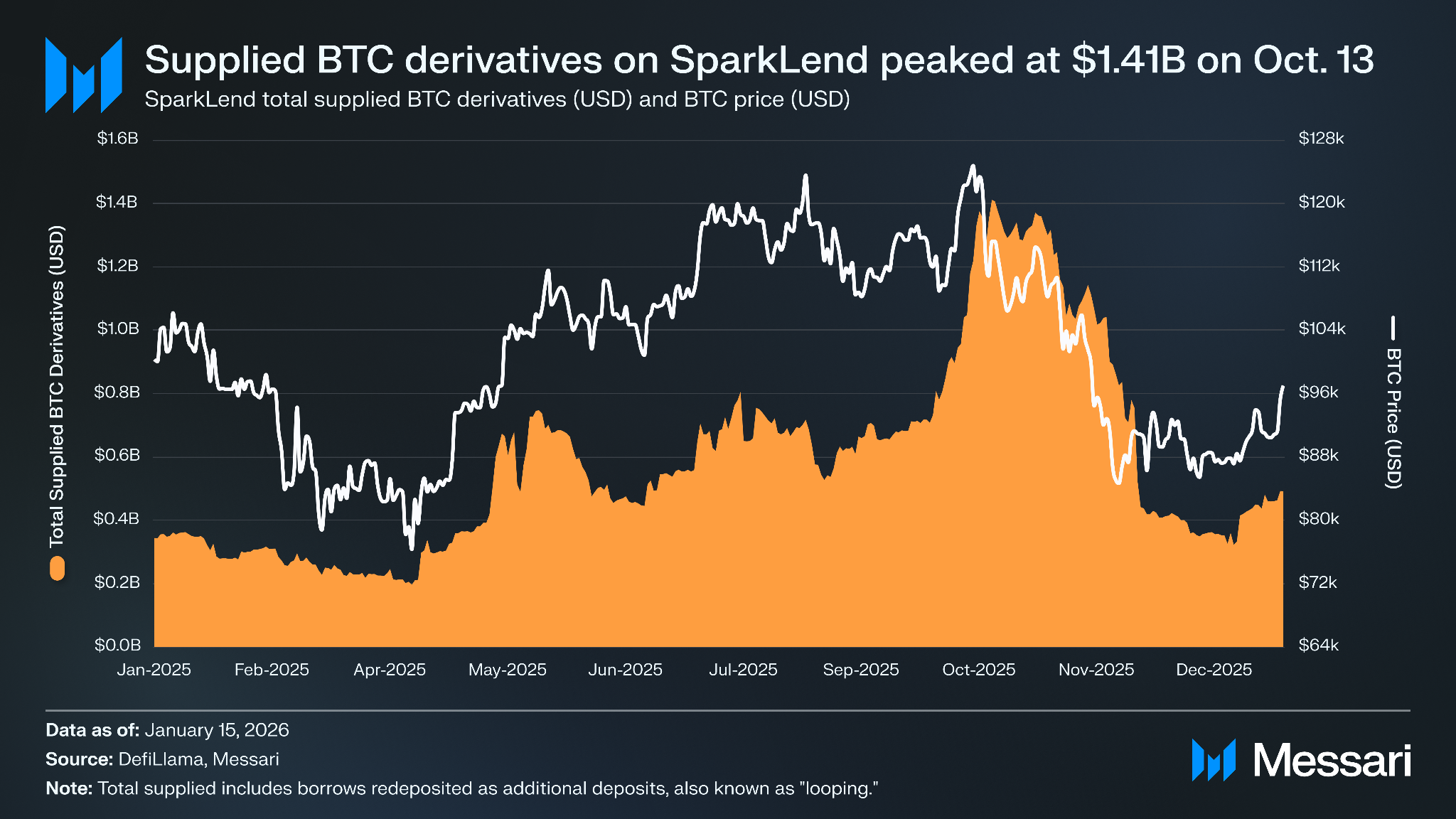
Like with borrows, supplied ETH and ETH derivatives declined absolutely and as a share of total borrows when priced in USD. In contrast, stablecoins and BTC derivatives supplied reached all-time highs of $2.36 billion (+84.7% in 2025) and $1.41 billion (+240.2% in 2025) after the Oct. 10 market crash, while ETH and ETH derivatives supplied failed to reach an all-time high with a local peak of $5.67 billion supplied, 12.1% below the $6.35 billion supplied Dec. 9, 2024.
This same trend applies when priced in their native asset. Supplied BTC derivatives reached a high of 12,250 on Oct. 13 (+176.3% from Jan. 1, 2025), while ETH and ETH derivatives supplied peaked at 1.6 million ETH on Dec. 11, 2024, and have yet to make a new high in 2025. Contributing to the rise in supplied BTC derivatives, tBTC and LBTC were onboarded as new assets to supply in March, while the supply cap for cbBTC increased in 2025 from 5,000 to 20,000.
Even as ETH hit an all-time high price of $4,950 on Aug. 24, 2025, supplied ETH and ETH derivatives failed to reach an all-time high, underscoring declining deposits in ETH despite all-time high asset prices for ETH and ETH derivatives. SparkLend is home to the second-largest amount of ETH in lending markets after Aave, with over $800 million in total deposits.
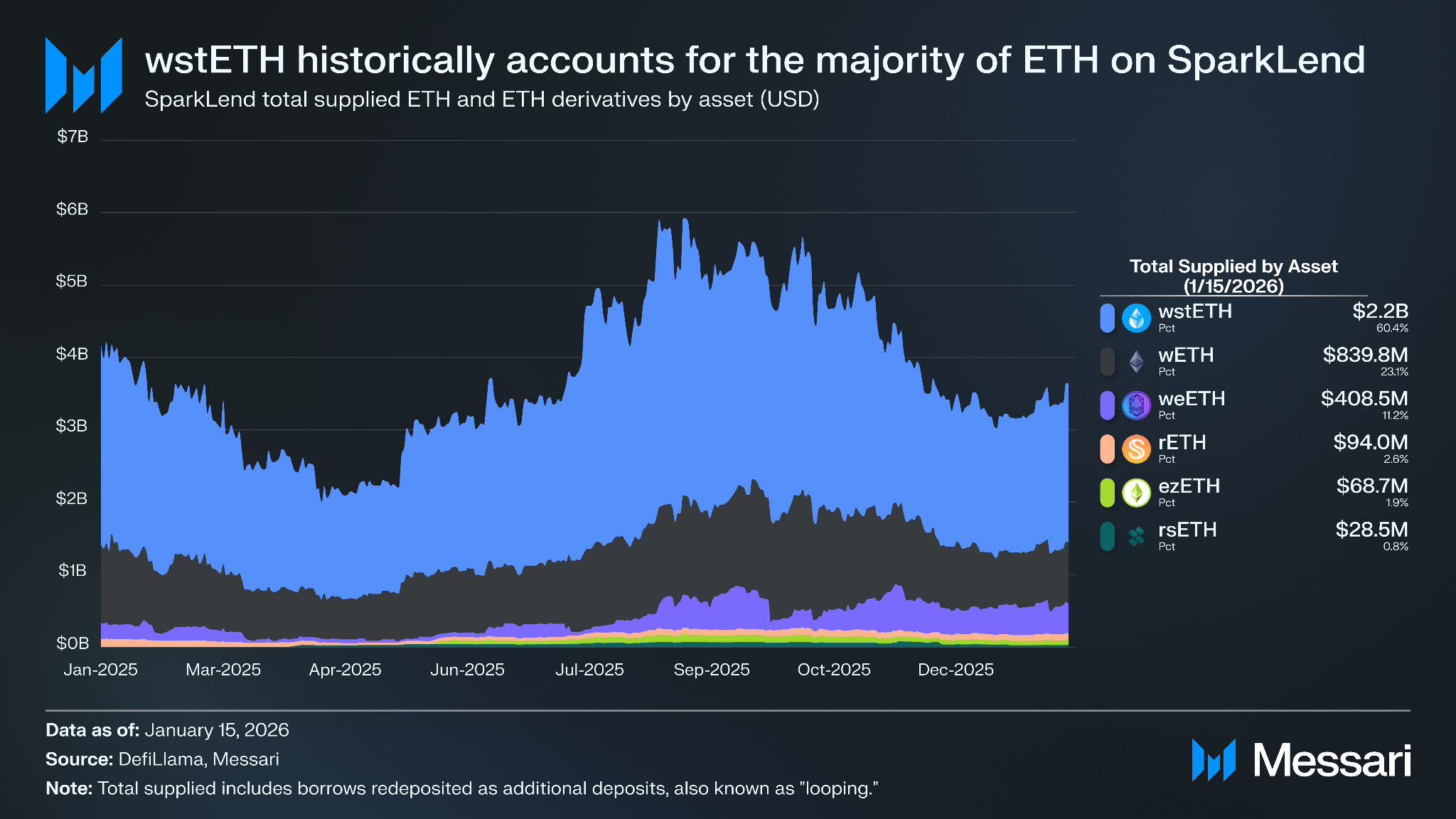
wstETH historically accounts for the majority of ETH and ETH derivatives supplied on SparkLend. From Dec. 1, 2024, to Nov. 30, 2025, wstETH accounted for between 53% to 71%, while wETH accounted for between 22% to 31%, and weETH 1% to 15%.
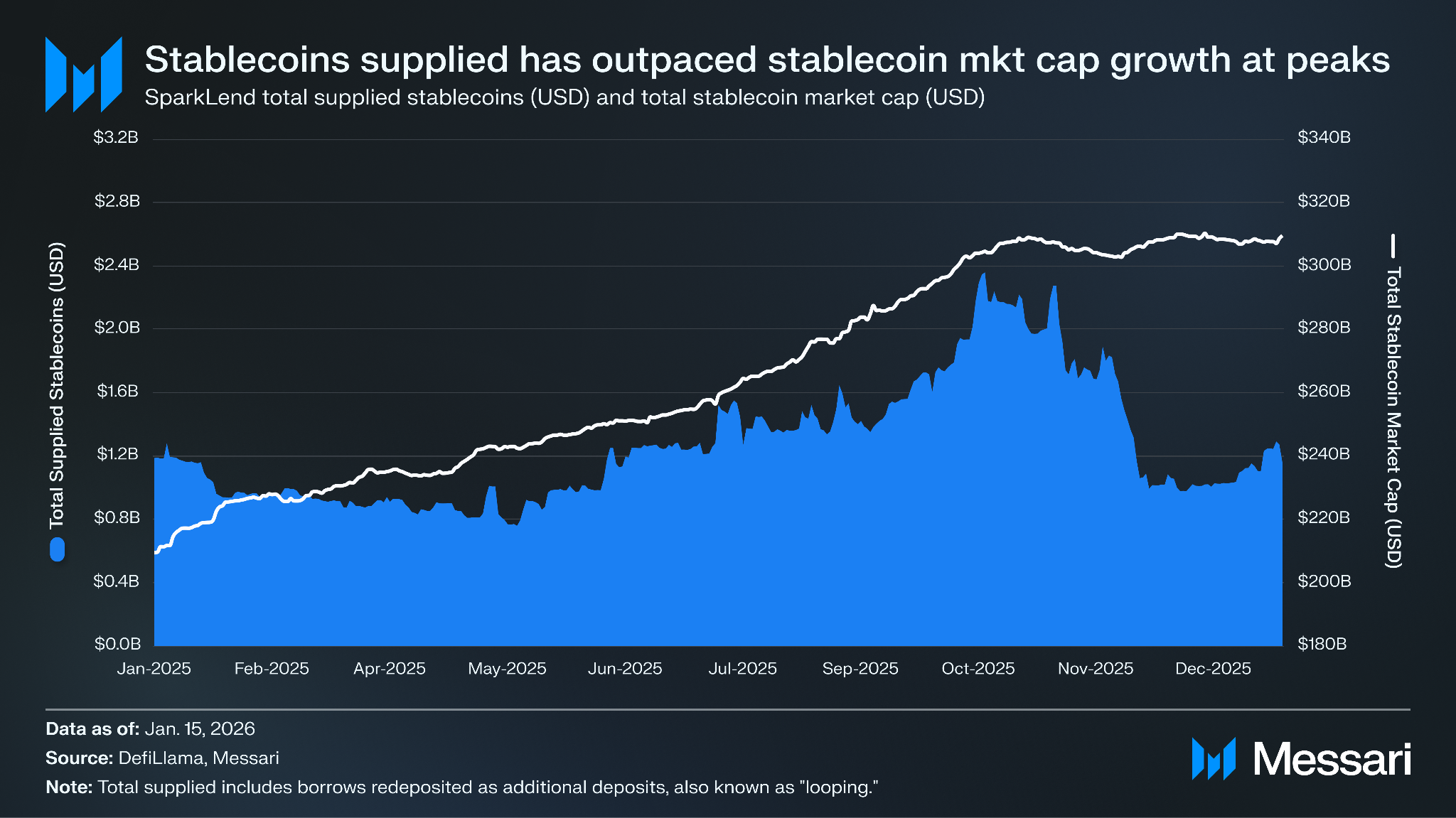
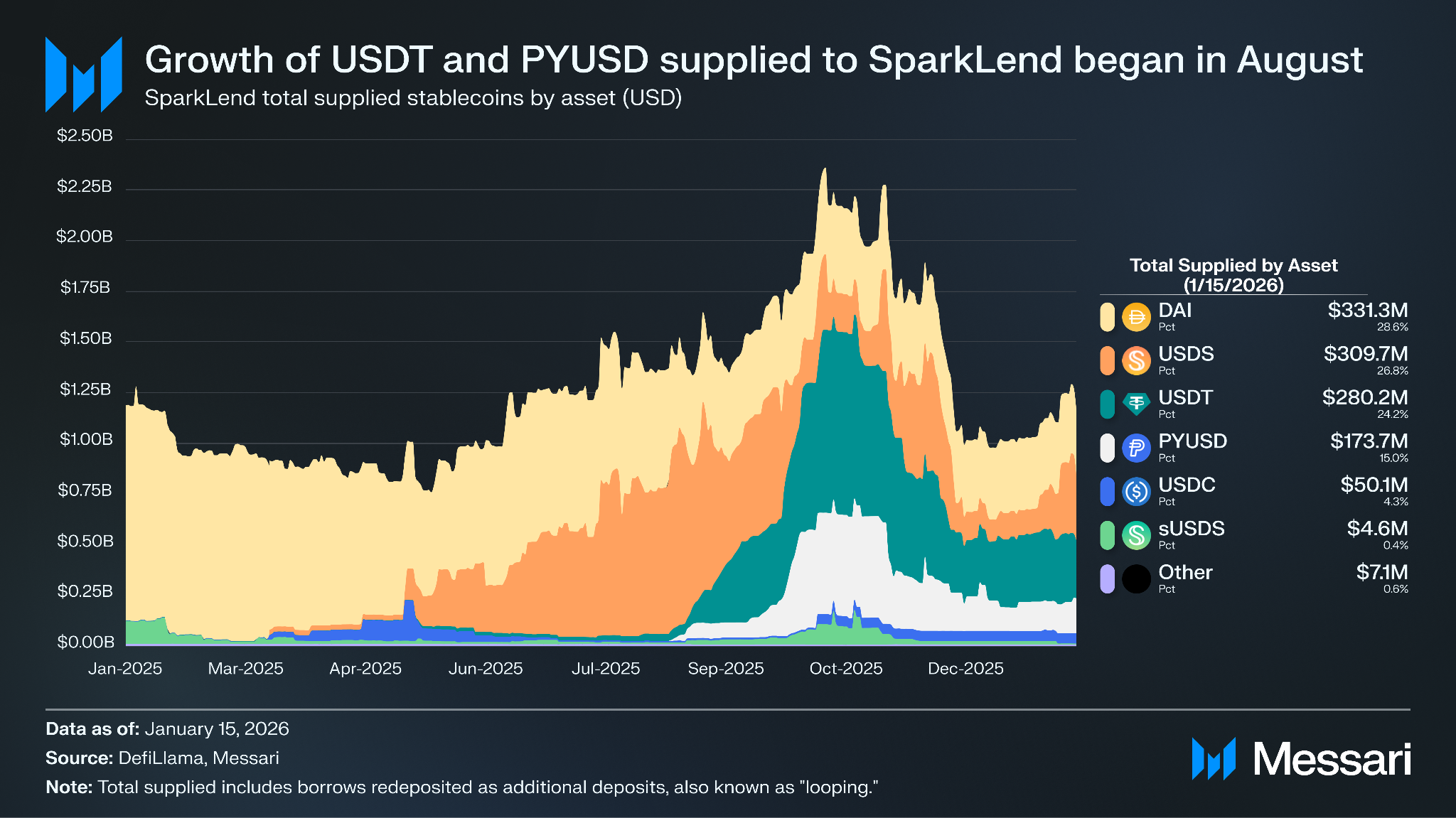
The total stablecoin market cap reached an all-time high of $310.29 billion on Dec. 21, a 51.2% increase from $205.24 billion on Jan. 1, 2025. While more volatile due to the leveraged nature of money markets, supplied stablecoins to SparkLend grew at an even faster rate, increasing 84.7% since Jan. 1, 2025 from $1.43 billion to an all-time high of $2.36 billion on Oct. 21, 2025.
Following the addition of PYUSD as a supplyable asset in mid-August, the supply of both PYUSD and USDT rapidly grew. Supplied PYUSD supplied peaked at $501.1 million (22% share) on Nov. 2, while USDT supplied peaked earlier on Oct. 22 at $906.5 million (40.9% share).
Leveraging the Spark Liquidity Layer to Scale Supplied Stablecoins
Spark can scale these blue-chip stablecoin money markets desired by institutions so rapidly because of its access to the Spark Liquidity Layer. By borrowing USDS and leveraging the Peg Stability Module to swap 1:1 to a supported stablecoin, Spark can inject supply of that stablecoin to a target allocation on SparkLend. Institutional-grade users posting blue-chip collateral can then borrow up to hundreds of millions of idle supply of a given stablecoin. Moreover, because SparkLend only supports blue-chip collateral, it is able to offer market-leading leverage for borrowers safely at a risk profile desirable to its institutional users.
As supplied PYUSD and USDT fell steadily from their peaks, DAI and USDS gained market share. DAI’s share of total stablecoins supplied to SparkLend increased from 18.5% on Oct. 22 to a peak of 36.3% on Dec. 15, while USDS’s share increased from 7.8% on Oct. 22 to a peak of 31.8% on Nov. 20.
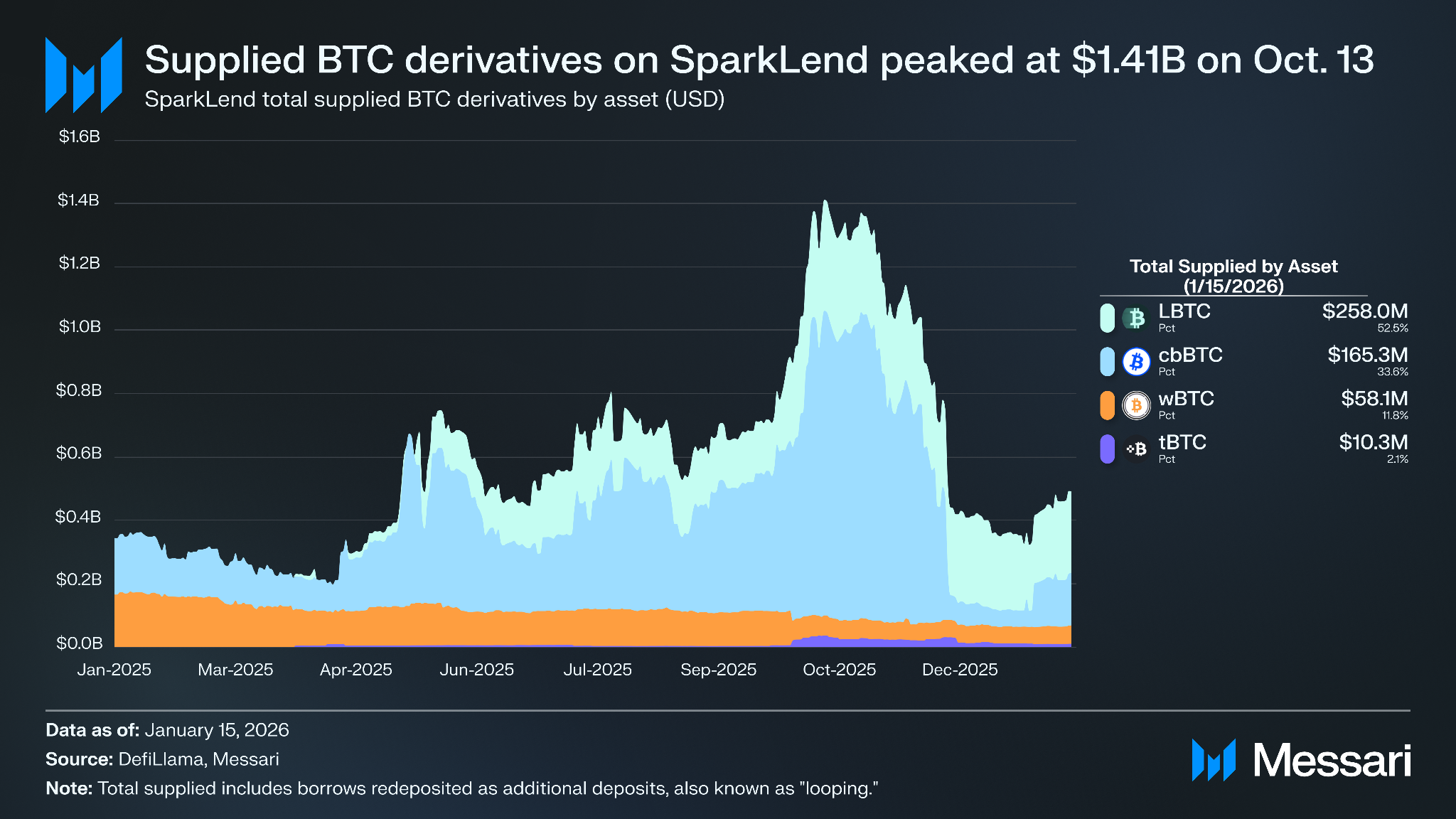
Supplied BTC derivatives on SparkLend reached an all-time high at $1.41 billion (+240.2% in 2025) on Oct. 13, after the Oct. 10 market crash. BTC reached an all-time high of $126,200 just days earlier on Oct. 6.
As of Jan. 15, $258 million LBTC was supplied on SparkLend, a 52.5% share of all supplied BTC derivatives. cbBTC followed with $165.3 million supplied, a 33.6% share. Until Nov. 29, cbBTC led with a market share of between 50% to 71% in Q4, while LBTC had between 22% to 38%.
SparkLend Treasury
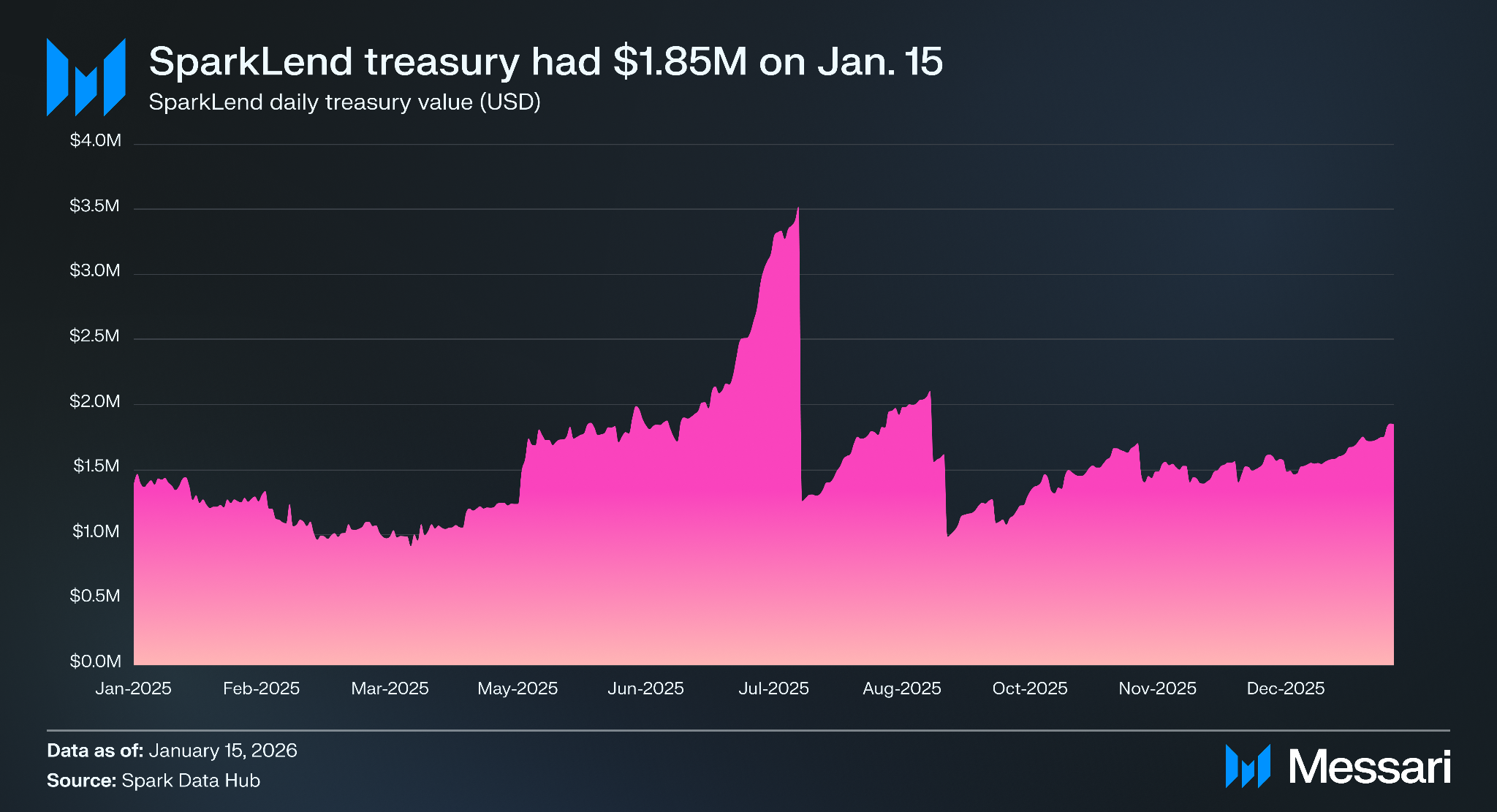
On Jan. 15, the SparkLend treasury held $1.85 million in assets, with the top five assets held on Jan. 22 as follows:
wETH: $427,600 (26.2%)
wstETH: $336,960 (20.7%)
USDT: $297,870 (18.3%)
PYUSD: $253,560 (15.6%)
cbBTC: $105,100 (6.5%)
Additionally, $208,180 (12.7%) was held in other assets, most of which was USDC, weETH, DAI, WBTC, WXDAI, and rETH.
SparkLend Risk Analysis
Scope
This risk analysis comparing SparkLend to other lending and borrowing protocols, including Aave, Morpho, and Euler, will focus on three main subjects:
Collateral: How SparkLend’s blue-chip-only collateral assets position it as institutional-grade relative to competitors.
Protocol Architecture: How differences in the architecture of these money market protocols distinguish their risk profiles with SparkLend optimized for institutions.
Parameter Differences: Likewise, how SparkLend’s parameter settings comparatively tailor it for institutional use-cases and users.
Analysis is focused on Ethereum deployments as almost all (>99%) of assets supplied to SparkLend are on Ethereum. References to SparkLend’s collateral assets, architecture, and additional parameters will be concise, as each has been explained in detail in the previous section of this report.
Aave V3
SparkLend is a fork of Aave V3, making it the natural starting point of comparison. There are two major permissionless Aave V3 instances deployed on Ethereum.
Prime Market
The Prime Market instance had roughly $884.8 million in deposits as of Jan. 22, 2026, and is a direct competitor to SparkLend, as parameters are optimized for blue-chip collateral and high leverage of correlated assets. As on Spark, supported stablecoins cannot be used as collateral. The Prime Market instance features only three major stablecoins (GHO, USDC, and USDS) compared to Spark’s five (USDT, USDC, PYUSD, USDS, DAI). It also features one less ETH derivative (supports tETH but not weETH or rETH) and no BTC derivatives. Moreover, maximum LTVs for uncorrelated assets are set 1% lower across the board than Spark, making leverage slightly lower in this scenario on the Prime Market. The E-Mode max LTV parameter is also equal to or higher on SparkLend for all assets except wstETH, which is higher on the Prime Market and thus allows for higher leverage with WETH and supported ETH derivatives. Even so, SparkLend had roughly four times more wstETH supplied compared to the Prime Market instance as of Jan. 22, 2026, likely due to its more comprehensive and established support of blue-chip assets. Ultimately, SparkLend has much deeper liquidity, more blue-chip assets to offer, and higher leverage to offer, excluding wstETH, than Aave V3’s Prime Market instance.
Core
With $45.4 billion in supplied assets as of Jan. 22, 2026, Aave V3 Core is the largest money market in all of DeFi. Four additional types of assets are accepted as collateral on Core, distinguishing it from SparkLend, which only accepts ETH, ETH derivatives, and BTC derivatives as collateral.
Blue-chip stablecoins as collateral: The five blue-chip stablecoins (USDC, DAI, USDT, PYUSD, USDS) supplyable to SparkLend but not enabled as collateral are enabled as collateral on Core, as is USDe. This increases insolvency risk and tail-risk exposure, as it opens the Core instance up to additional ways a stablecoin depeg or oracle issue could result in bad debt for the protocol. Moreover, Aave V3 uses Chainlink price feed oracles for stablecoins, which list market prices rather than a fixed price of 1.00 as SparkLend does. Using live market price data protects against exploits during a depeg event, but exposes the protocol to exploits due to oracle manipulation.
Long-tail assets as collateral (non-isolated): Core allows a number of longer-tail assets compared to blue-chip assets to be used as collateral without being isolated including LINK and AAVE. These tokens are more at risk of price manipulation that allow attackers to deposit collateral at inflated prices and then borrow against it, leaving the protocol with bad debt.
Long-tail assets as collateral (isolated): In addition to LINK and AAVE, Core supports supplying MKR and XAUt in isolation mode. Isolation mode reduces risk by only allowing borrowing against governance approved stablecoins to a specified debt ceiling, limiting the maximum debt and thereby reducing potential systemic risk. Isolation mode is also enabled for SNX, ENS, 1INCH, MKR, LDO, CRV, UNI, and BAL, but the Max LTV is set to 0% for these assets.
Yield-tokens as collateral: Non-rebasing, yield-accruing versions of stablecoins can be used as collateral, as can smaller market cap non-rebasing, yield-accruing ETH and BTC derivatives, as well as Pendle PT tokens for USDe, eUSDE, sUSDE. Collateral enablement of these assets increases risk in the same way as the long-tail asset discussed above, while also introducing underlying credit and term-structure risk, as well as reduced liquidity.
Additional wrapped tokens as collateral: These include FBTC (wrapped BTC), and XAUT (wrapped gold), and introduce additional risk of the applicable types discussed above.
To account for this, collateral assets on Core have lower LTVs and higher reserve factors compared to SparkLend. Still, the optimal utilization for some blue-chip assets, such as WETH and USDS, is higher on Core than SparkLend, raising its overall capital efficiency to be more competitive with SparkLend, albeit at the expense of increasing bad-debt risk in a black-swan scenario.
Morpho
Morpho’s architecture is fundamentally different from SparkLend and Aave V3. The protocol is fully market-isolated, with each market just one collateral asset and one loan asset. Because of this, bad debt can only accrue to its own market. Under this structure, a market can be made for any pair of ERC-20 tokens with an oracle that prices the collateral against the loan asset and enough external liquidity for liquidations to clear. On top of this, Morpho Vaults are strategy contracts that spread deposits across underlying Morpho markets in defined proportions.
As the modular, isolated-market that anyone can build on, Morpho is complementary to SparkLend. The SLL can first route capital to SparkLend’s institutional-grade, blue-chip money market as a source of liquidity, and then to Morpho for custom higher-yielding markets outside of SparkLend’s conservative architecture and parameters. As of Jan. 22, 2026, the SLL has allocated less than $1 million in USDC to Morpho vaults curated by Spark, though historically it has allocated up to $1 billion to the protocol.
Euler V2
Euler V2 can be effectively thought of as a blend between Morpho’s isolation/modularity and SparkLend’s pooled efficiency via its configurable architecture.
Vaults: Vaults are ERC-4626 smart contracts that by default function as an isolated structure holding a single ERC-20 token. Anyone can deploy a Vault for an asset using the Euler Vault Kit (EVK).
Ethereum Vault Connector (EVC): Used to manage relationships between Vaults, including enabling an asset from a given Vault as collateral to borrow an asset from another Vault.
This model seeks to maximize flexibility compared to a money market protocol like SparkLend that is committed to pooled capital as set by its parameters, or Morpho, which is fixed with modular, isolated markets. Technically, by default, each asset is isolated in a dedicated Vault, however, in practice, these Vaults are configured to share protocol risk based on what borrowing and lending relationships are enabled by the Ethereum Vault Connector.
Vault parameters configurable via the EVK include tokens accepted as collateral, the type of interest rate curve, max TVL, borrow caps, liquidation threshold, type of price oracle, and the type of governance applied to Vault (i.e., non-managed with fixed parameters, or managed via a curator that can adjust parameters). This maximizes flexibility rather than imposing a fixed design like other protocols such as SparkLend, Aave V3, or Morpho.
On top of Vaults are Markets, which make use of Vaults to form a marketplace for lending and borrowing. Markets are built by deploying Vaults with the EVK and linking them using the EVC. Standard market types are as follows:
Collateral-debt pairs with rehypothecation: Assets from Vault A are collateral to borrow assets from Vault B, while assets in Vault B are simultaneously collateral to borrow from Vault A.
Markets with multiple collaterals: To improve capital efficiency further, a Market can allow multiple assets as collateral for borrowing.
Cross-collateralized markets: To build on this even further, the most capital-efficient Markets enable cross-collateralized clusters of multiple Vaults.
In practice, the risk composition of Euler V2 on Ethereum is evaluated based on the actual configuration of its largest markets, rather than the full spectrum of design possibilities enabled by its modular architecture.
As of Jan. 22, 2026, Euler V2 had five main markets with over $15 million in supplied assets, four of which are for supply and borrowing stablecoins/stablecoin derivatives (Sentora PYUSD: $336.9 million, Sentora RLUSD: $286.7 million, Usual Stability Loan: $275 million, and Euler Yield: $15.4 million). The fifth, Euler Prime ($26.5 million) is a market tailored for borrowing stablecoins against blue-chip crypto assets such as ETH and ETH derivatives, BTC derivatives, and stablecoins. This level of usage shows Euler V2 lags SparkLend and Aave V3 despite its novel architecture.
Maple Finance
Maple Finance is fundamentally different from SparkLend and Aave V3. There are two core lending products:
Syrup Pools: Users can permissionlessly supply USDC or USDT to receive non-rebasing, yield-accruing syrupUSDC or syrupUSDT. Yield comes from interest paid on overcollateralized loans from institutional borrowers.
Maple Institutional: Permissioned pools for accredited/institutional lenders funding bespoke loans underwritten by Maple’s in-house credit team. These loans target higher yields on specific strategies such as RWA collateral.
USDC and USDT Syrup deposits fund automated collateralized lending to a borrower whitelist. All loans come from crypto-native institutions deemed creditworthy under Maple Finance’s underwriting process, with liquid digital assets posted as collateral. The majority of collateral is blue-chip (BTC, XRP, LBTC, weETH, ETH), with some arguably blue-chip adjacent assets (jitoSOL and HYPE). Loans are overcollateralized and currently range from 125% to 425% overcollateralized. Borrowers post one asset as collateral and either borrow USDT or USDC. Outstanding collateral assets posted by borrowers to date include BTC, XRP, LBTC, jitoSOL, weETH, HYPE, and ETH.
Lending rates are fixed and higher than onchain money market protocols. Current interest rates range from 5.1% to 10%. In exchange, depositors take concentrated credit risk and are reliant on Maple Finance’s underwriting process. Notably, USDC and USDT withdrawals are not permissionless and are queued first-in, first-out, following a request for withdrawal by the depositor. Documentation states, “most withdrawals are processed in under 24-hours but could take up to 30 days.”
These design differences differentiate Maple Finance so significantly from SparkLend that a deeper analysis of Maple Finance’s liquidation methodology and other risk parameters is unnecessary under this scope. Like with Morpho, Maple Finance is fundamentally complementary to Spark, providing another avenue for the SLL to deploy capital at a higher rate of return than SparkLend. As of Jan. 22, 2026, the SLL had allocated $100 million in USDC to Maple.
Closing Summary
SparkLend is the leading institutional-grade, blue-chip money-market protocol in DeFi, beating out Aave V3’s Prime Market instance in market size, variety of blue chip assets offered, and maximum leverage on a risk-adjusted basis. Alternatively architected lending and borrowing protocols like Morpho and Maple Finance are complementary to SparkLend, serving as higher-yielding markets for Spark’s Liquidity Layer (SLL) to deploy capital outside of SparkLend’s conservative architecture and parameters.
As a Star of Sky, Spark can borrow billions of USDS at the Base Rate and leverage the Peg Stability Module to rapidly scale blue-chip stablecoin markets on SparkLend like PYUSD via the SLL. Moreover, access to the Base Rate allowed SparkLend to be bootstrapped after its launch on May 9, 2023, and become the second-largest money market in DeFi by TVL behind Aave in only 252 days.
Ultimately, Spark prioritizes security and capital preservation as reflected by SparkLend’s high-quality asset composition of ETH and ETH derivatives, U.S. dollar stablecoins, and BTC derivatives. SparkLend has been configured to primarily enable ETH, ETH derivatives, and BTC derivatives as collateral to borrow U.S. dollar stablecoins.
Under this protocol architecture, parameter configuration, relationship with Sky, and competitive landscape, SparkLend is where blue chip onchain institutional lending and borrowing happen.
This report was commissioned by Spark. All content was produced independently by the author(s) and does not necessarily reflect the opinions of Messari, Inc. or the organization that requested the report. The commissioning organization may have input on the content of the report, but Messari maintains editorial control over the final report to retain data accuracy and objectivity. Author(s) may hold cryptocurrencies named in this report. This report is meant for informational purposes only. It is not meant to serve as investment advice. You should conduct your own research and consult an independent financial, tax, or legal advisor before making any investment decisions. Past performance of any asset is not indicative of future results. Please see our Terms of Service for more information.
No part of this report may be (a) copied, photocopied, duplicated in any form by any means or (b) redistributed without the prior written consent of Messari®.
Matt is a Research Manager at Messari for the Protocol Reporting team. A generalist at heart, who's curious about anything and everything, and ultimately, on an adventure to find out what's true. He was an investigative reporter and multifamily/senior housing development associate before joining Messari in 2022.
Matt is a Research Manager at Messari for the Protocol Reporting team. A generalist at heart, who's curious about anything and everything, and ultimately, on an adventure to find out what's true. He was an investigative reporter and multifamily/senior housing development associate before joining Messari in 2022.