Solana's Redemption Arc

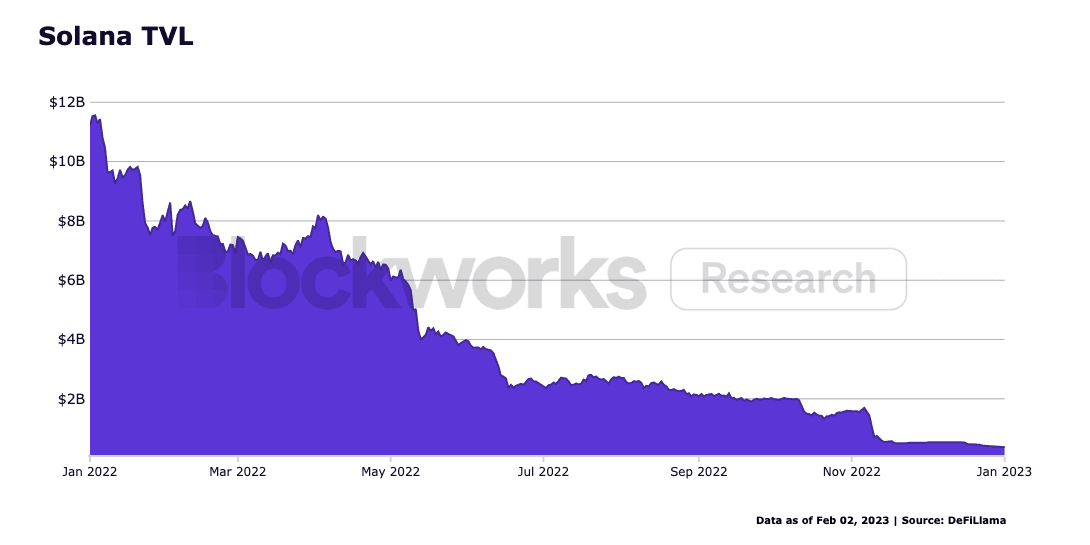
After being heavily backed by Alameda and tied closely with FTX, the Solana ecosystem experienced a brutal drawdown during the month of December, bottoming at a price of ~$8. TVL fell from $12B to $250M. The Solana Foundation announced exposure to FTX of $1M cash, 3.24M shares of FTX stock, 3.43M FTT tokens, and 134.54M SRM tokens. Further, Alameda and FTX purchased 50.5M SOL tokens from the Foundation with varying unlock schedules that run until 2028. The outlook for these tokens is unknown - these could either be locked for years in bankruptcy proceedings or liquidated in an attempt to meet obligations.
The Solana ecosystem is notorious for low float, high FDV tokens, such as SRM, MAPS, STEP, and OXY. The playbook for these was simple: VCs could get tokens for pennies on the dollar and later dump them on public markets for 50-100x their cost basis. This was a huge factor for bad sentiment in the Solana ecosystem, where it was often viewed that buying any Solana ecosystem token was equivalent to lighting money on fire. However, with many of these predatory funds getting shaken out, the market looks open to buying and HODLing SOL and related tokens for the long run.
Several key developments are set to go live on Solana this year, including the rebirth of CLOB protocol Serum as Openbook, Solana’s mobile phone, Saga, and even Jump Crypto’s upcoming validator client, Firedancer.
DeFi on Solana
Perhaps one of the biggest hits to Solana in 2022 was the deprecation of its central limit order book (CLOB), Serum. Serum, home of both liquidity and trading infrastructure, powered the majority of Solana’s DeFi ecosystem. After the collapse of FTX, it became known that an FTX wallet actually controlled the program update key, meaning that Serum developers could not control potential rogue actions from the FTX wallet exploiter. Solana developers rushed to create OpenBook: a Serum fork that enables all the same functionality as the past protocol, which is currently live on mainnet. DEXs and aggregators such as Raydium and Jupiter have already implemented OpenBook support, which will allow Solana DeFi to push on. There is no token for Open Book at the moment, but it is worth paying attention in case of potential OPB token incentives.
Several other protocols have risen from the ashes of the Solana fallout, including perpetual futures exchange Drift, NFT AMM Hadeswap, and upcoming lending market MarginFi. Drift previously experienced an exploit in late 2022, which led to a loss in user funds and a halt in trading. The DEX launched V2 in December and has seen ~$1M in daily volume. This is still pennies when compared to venues like dYdX or GMX, but signals substantial progress for the ecosystem. Another promising project on Solana is Hadeswap, which acts as an NFT AMM similar to SudoSwap. The protocol also houses a DEX. Since launch, Hadeswap has seen $40M in trading volume and boasts a TVL of $12M.

Pibblez leads coverage on emerging L1s, infrastructure, and stablecoins. Previously worked as a Research Analyst at Kraken.