Solana Spreads: The Black Hole Begins

Introduction
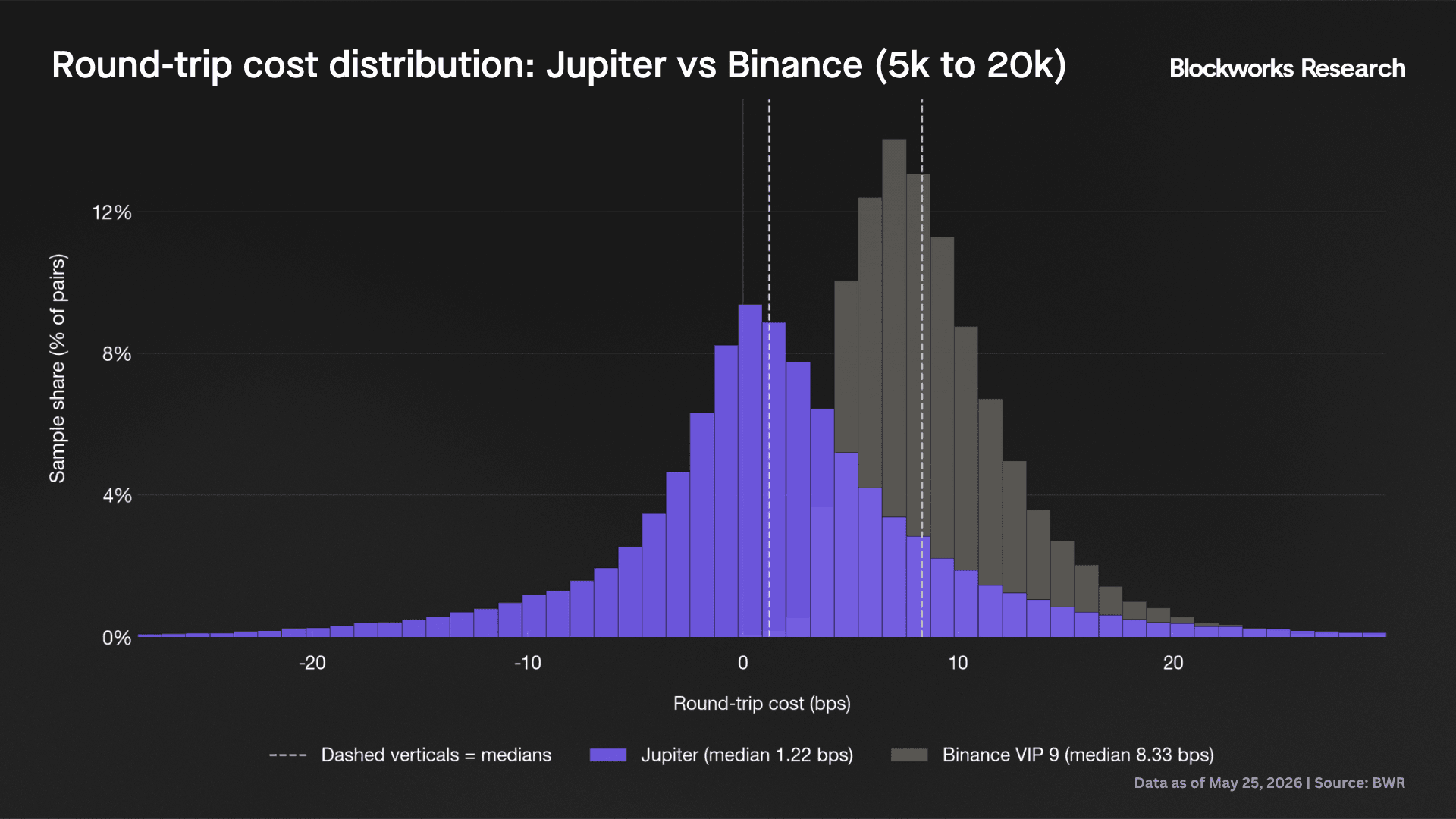
Solana execution is no longer just catching up to centralized exchanges. Over the past year, SOL-USDC $5k to $20k trades have realized round-trip costs of 1.22 bps on Jupiter versus 8.33 bps for Binance VIP 9. And now, the median Jupiter user is getting a better buy-or-sell price than Binance before fees are even included.
The more important question is whether this extends beyond SOL-USDC. If prop AMM liquidity can scale across more assets, Solana starts to look less like a crypto venue and more like a competitive execution layer for global markets, especially as equities move onchain.
Solana’s edge is that permissionless access runs both ways. Anyone can build the application, quote the market, or access the liquidity, all inside one verifiable state machine. The prop AMM and aggregator stack is the first real proof point that this model can beat traditional venues, with the setup becoming more performant as the ecosystem develops and infrastructure strengthens.
Prop AMM Success
A prop AMM is essentially a market maker quoting directly onchain. The program holds the maker's live bid and ask, references the deepest CEX books, runs an internal price model, and then writes their resulting quotes onchain.
