Solana's Restaking Big Bang

We believe restaking on Solana offers a fundamentally different opportunity set than that of Ethereum, as Solana restaking enables two types of restaking: endogenous restaking (restaking at the application level for prioritization) and exogenous restaking (restaking for some external service, i.e., shared sequencing). Endogenous services are only possible because of stake-weighted quality of service (swQoS). swQoS is a mechanism which enables new use-cases for restaking, such as fastlanes for transactions or revenue sharing. swQoS allows block producers to prioritize transactions through a staked validator. swQoS for Solana are connections made to validators for transaction processing that can only be used by other staked validators. The implications for restaking is that a protocol could have its own LST and dedicated validator or group of validators and use this specific LST to push transactions for that application faster. Applications like Kamino could have their own LST and use their stake to provide quality access to transaction fast lanes for their own users. A restaking protocol could act as a hub for this activity and manage the staked tokens across applications to maximize their performance. Notably, this is only accessible for validators with more than 15k SOL.
Endogenous services are already being pursued by small LST protocols like Delegate.so, which offers an LST with revenue sharing on Sanctum, a liquid staking aggregation protocol.
As for exogenous restaking, it’s unknown what the AVS ecosystem will look like for Solana going forward. Currently, there exist three AVSs that use Solana: Rome Protocol (which uses Solana to offer L2s enshrined services, such as shared sequencers), Mantis L2 (a Cosmos consumer chain by Picasso), and Solana IBC. All of these AVS solutions use Picasso as their restaking layer.
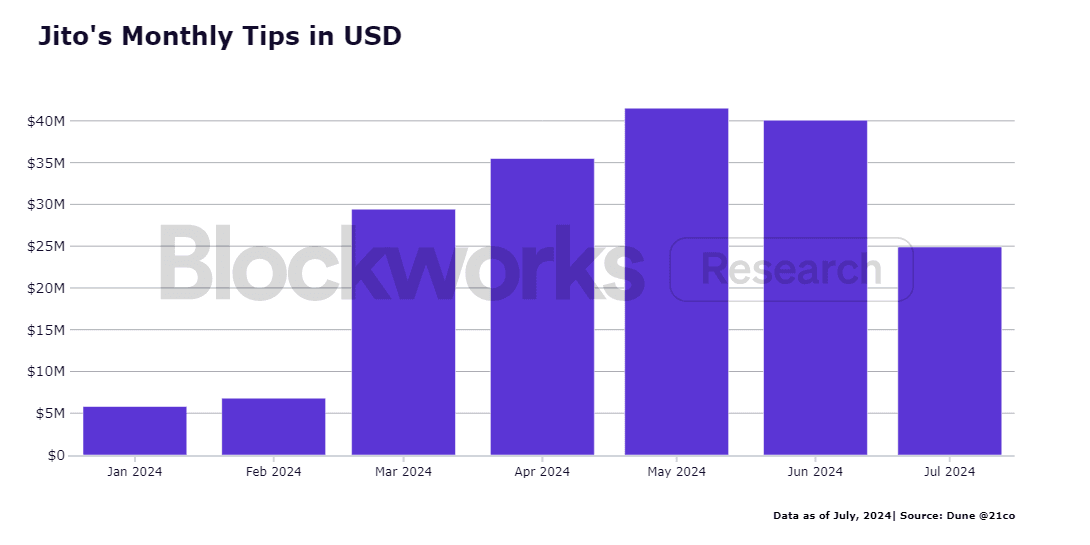
The Jito team may have their work cut out for themselves to get ahead of competitors that have an edge in restaking. Solayer already has dedicated TVL, Picasso already has clients, and LST providers like Sanctum aim to create endogenous services for themselves. In particular, Sanctum uses INFINITY, a pool of multiple LST tokens, where users maintain the option to stake to certain validators. Some LSTs in their hub offer swQoS, but only for that specific token. This would especially pair nicely with endogenous staking if they embrace more swQoS variants or make a universal swQoS variant.
Importantly, Jito has already launched an airdrop and is unlikely to execute another; however, Jito could create an incentive program to increase JTO liquidity and jitoSOL usage, as had been discussed in prior governance discussions. Thus, Picasso, Solayer, and Cambrian have an additional tool to bootstrap their user base, albeit temporarily. For Jito there are different possibilities for how it can approach restaking. The protocol will likely leverage its MEV capabilities with its restaking infrastructure using a future Jito Firedancer combined client. Jito could dig a deeper moat for itself with its market dominance by having the sheer amount of SOL to have access to hundreds of validators for protocols to gain access to QoS lanes.
Jito could use its restaking to provide blockspace bidding access to validators. It could also create an MEV-Channel for itself that leverages swQoS fast lanes and reaps MEV opportunities in the process for endogenous services. It might draw inspiration from the Ethereum ecosystem and implement a variant of MEV-Boost, where it secures a relay network as an exogenous service for a block creation marketplace, allowing for builders to compete to create the most profitable blocks. Finally, Jito’s restaking platform will allow users to restake a variety of SPL tokens, which potentially opens conversations for using JTO to secure AVSs.
