Solana: Analyzing Downtimes, Statistics, and Ecosystem Development

Key Insights
- Most of the causes behind Solana’s downtime issues have been solved. 100% uptime also isn’t strictly necessary for success, and Solana’s functional uptime can be argued to be higher than Ethereum’s.
- NFT compression unlocks massive scale for NFT issuance at low cost. Render network’s recent RNP-002 has already discussed a potential implementation.
- Solana hackathons continue to show growth. Promising projects from January’s Sandstorm and March’s Grizzlython include Root, Tinydancer, Tinbet, Bunkr, and others.
- Solana network stats lag behind in terms of TVL and on-chain volumes. Arbitrum in particular has shot ahead of the network. Introducing incentive programs of its own could help close those gaps.
Solana made headlines last month due to, yet again, another downtime issue. Opposing chain maximalists rejoiced.
To most critics, each instance of downtime is viewed as confirmation of the thesis that Solana is fundamentally flawed at a technical level. On top of the downtime issues, headline metrics like TVL lag far behind Solana’s competitors in the ETH Layer-2 space.
However, Solana FUDsters should consider some room for nuance in this story before dismissing the chain. A more accurate viewpoint of Solana should consider:
- Solutions to the downtime problem
- A broader view of current activity metrics
- Future developer activity: hackathons and new infrastructure
Let’s take a look at each.
Downtimes: Causes and Solutions
It cannot be overstated: For every downtime issue Solana has faced (excluding the most recent, at least in an explicit sense, more on that later), core contributors have found and implemented one or more solutions to the issue.
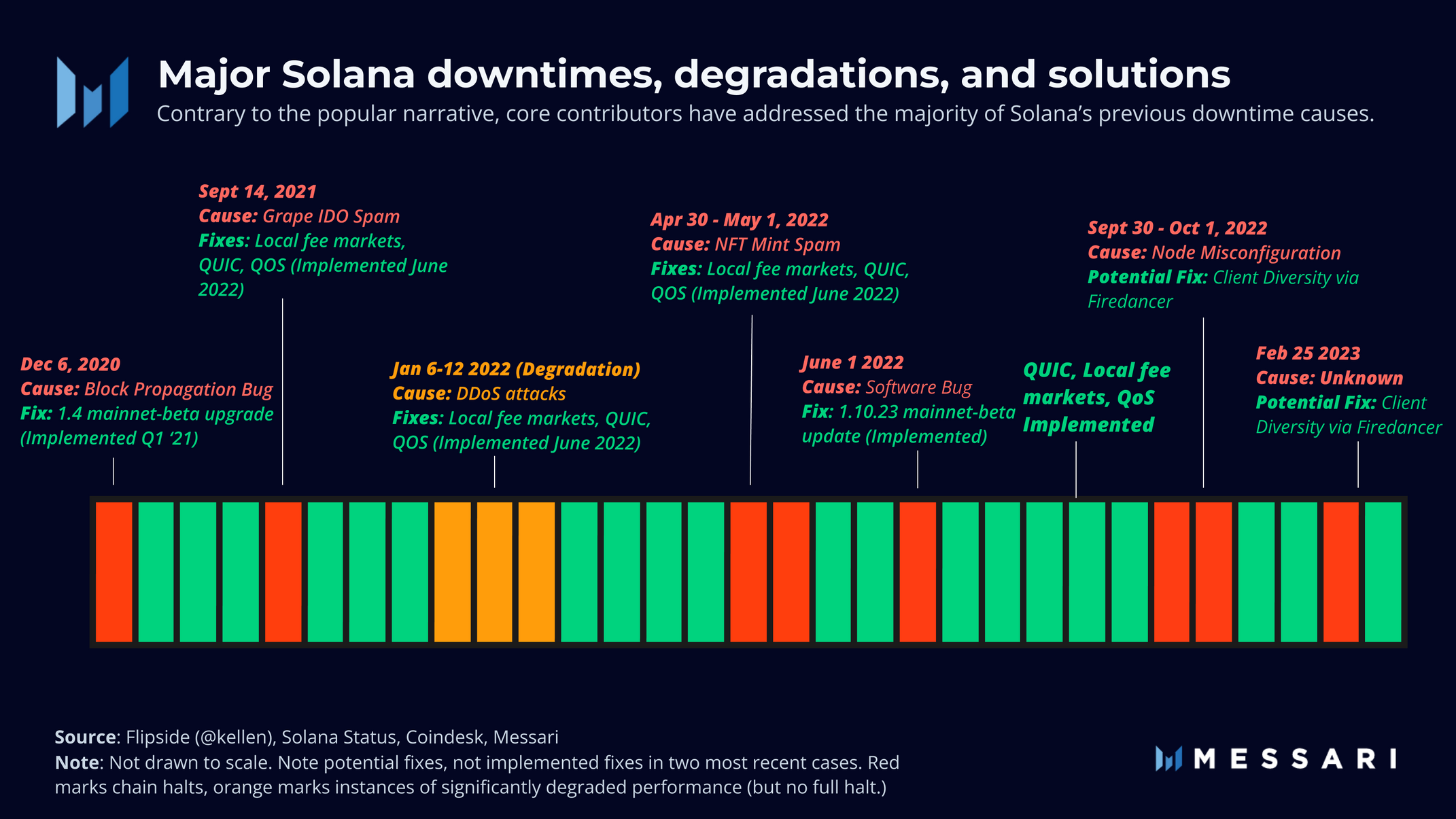
Solana’s downtime issues historically have to do with software bugs or spam. The main solutions to those are QUIC, QoS, priority fees / local fee markets, and client diversity:
QUIC: A past network upgrade that reimplemented Solana’s core messaging protocol using QUIC. QUIC is a protocol designed for fast communication with sessions and flow control like the Transmission Control Protocol (TCP, another messaging protocol), but it’s better suited to Solana’s use case. This upgrade provided more control over network traffic and optimized data ingestion, helping to eliminate Solana's downtime issues. QUIC replaced the User Datagram Protocol (UDP), Solana’s original messaging protocol that struggled with spam messages.
Stake-weighted quality of service (QoS): This model prioritized transaction processing based on the staked amount of the node submitting the transaction, ensuring more efficient use of network bandwidth. The increased bandwidth efficiency in turn helped mitigate Solana's downtime issues caused by network congestion.
Priority Fees: This upgrade introduced a new instruction in the Compute Budget program. It allowed users to specify an arbitrary "additional fee" to be collected upon execution of the transaction. The ratio of this fee and the requested compute units was used to determine the priority weight of each transaction. This upgrade helped eliminate Solana's downtime issues caused by inefficient transaction processing. No more bot spam if spamming causes drastic cost increases.
Client Diversity: This is the theoretical solution to Solana’s latest software-level issues. The theory is that if you have two or more completely different clients running at once, the likelihood of them all containing the same bug at the same time approaches zero. If one client has a bug, like in the recent network halt on February 25, validators would be able to quickly switch over to the bug-less client. This would allow the network to stay running while teams work to debug the faulty client. The deployment of Jump’s “Firedancer” client will most likely be the first step towards achieving client diversity.
Critiques
The first major critique levied against Solana’s problem-solving approach comes from those with zero tolerance for downtimes. In our opinion, zero downtime tolerance is unjustified.
For starters, even systems as globally essential as AWS have an extensive history of downtimes. If the cloud can go down without sparking armageddon, so too can financial rails briefly experience downtimes without it being catastrophic. Moreover, chains like ETH effectively “go down” when gas prices spike. Yes, the richest users can still transact, but a system that only favors the rich in times of stress is a far cry from the democratized ideals of crypto.
Another major critique is that constant upgrades diminish the “credible neutrality” of the network. In other words, constantly upgrading code diminishes long-term confidence in its safety, because the code is always subject to change. However, upgradability is found almost everywhere throughout the smart contract platform landscape. Popular Ethereum L2s like Arbitrum and Optimism are upgradeable, as are many — if not most — DeFi applications on ETH L1. That said, Solana updates itself at a more frequent rate. As such, Solana should not be singled out for its frequent need to update.
Beyond the Downtimes - Network Activity
At face value, Solana is a mixed bag when it comes to on-chain data. The four charts below are sourced from Artemis. Starting with TVL, well, quite frankly, Solana's getting killed with respect to TVL.
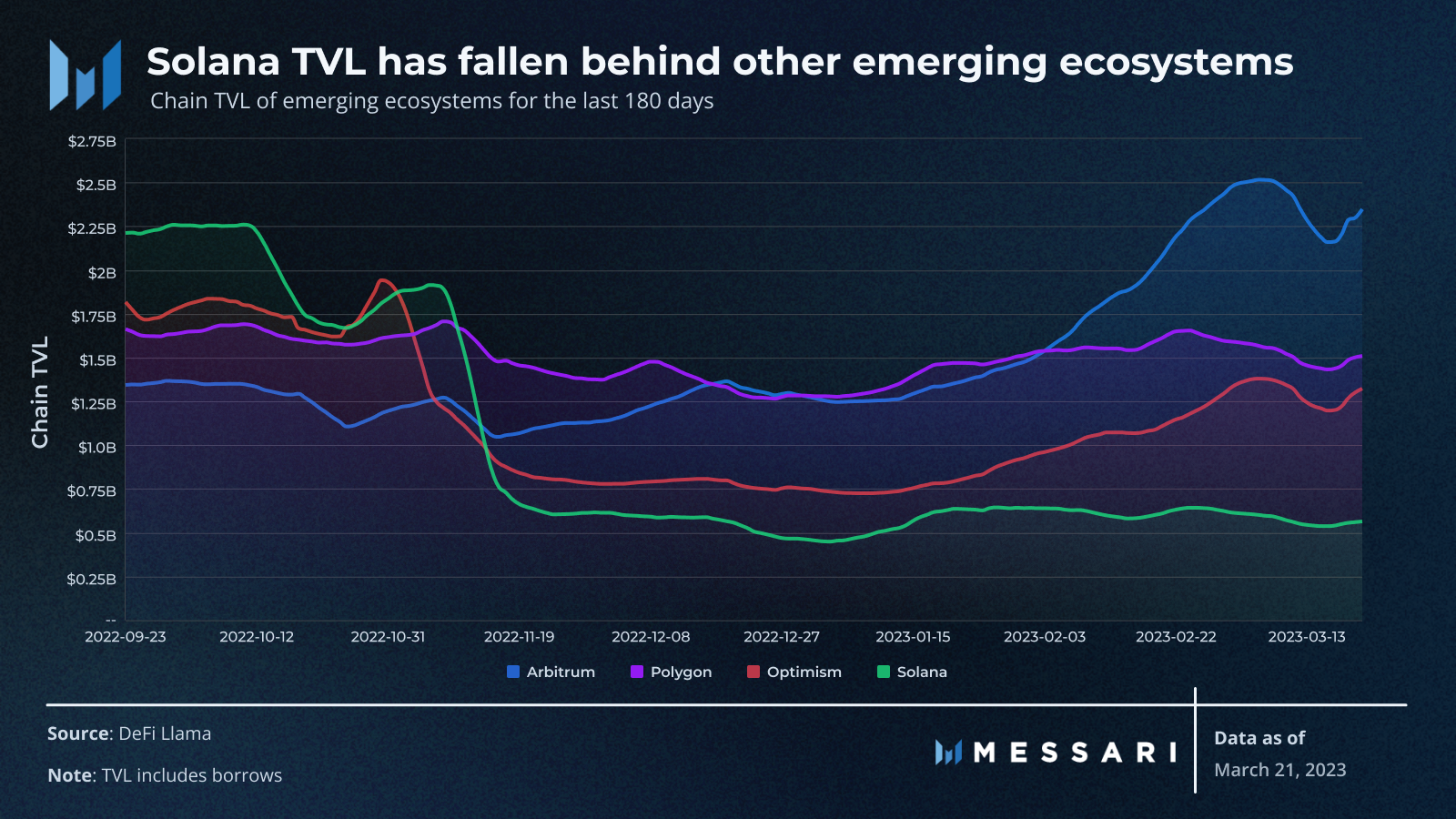
But TVL doesn’t tell the full story. First off, Solana’s top transaction generators are derivatives DEXs, specifically Drift and Zeta Markets. Unless incentivized, on-chain derivatives platforms don’t tend to attract large amounts of TVL, regardless of which ecosystem they are in. Outside of derivatives, Solana’s main usage has also been driven by other use cases that aren’t TVL dominant, like NFTs and DePIN networks.
In contrast, the Ethereum ecosystem heavily utilizes money market protocols like Aave on ETH L1 or Radiant on Arbitrum to access leverage via common strategies like “looping” trades. These protocols attract large amounts of TVL by nature.
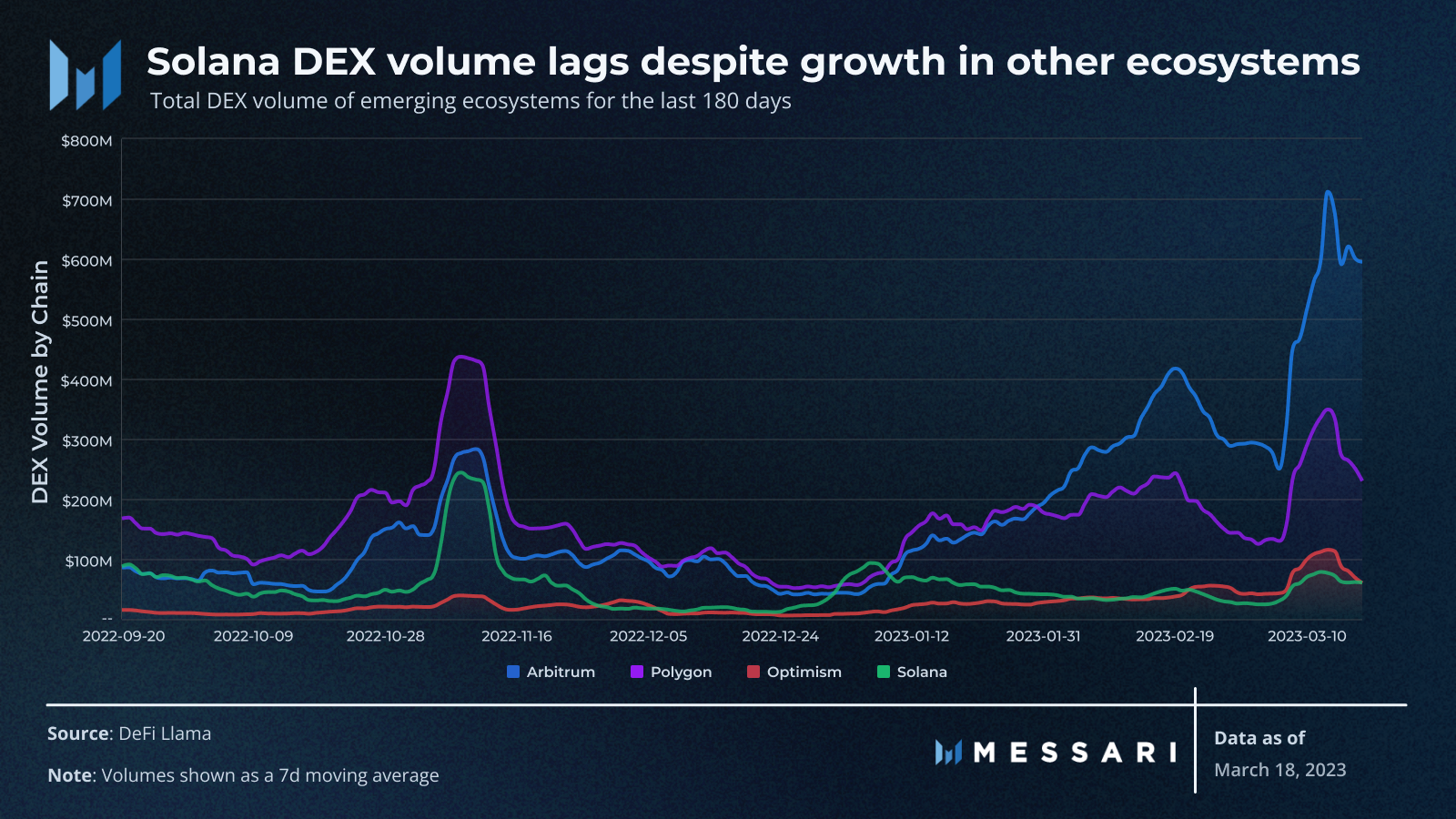
Arbitrum and Polygon have 3-5x the daily DEX volume Solana has, but Optimism and Solana have roughly been at par the last few months. That Solana is even in the same ballpark with other notable chains is impressive, considering the lack of incentivization in the Solana ecosystem versus multiple levels of incentives for protocols based on Optimism and Arbitrum.
If the Solana ecosystem (both Solana Labs and individual projects) ever decides to turn on incentives of their own, we could quickly see volume approach parity with the top L2s. It only took two months (Jan-Mar) for Arbitrum to go from parity with Solana to 6x the on-chain volumes.
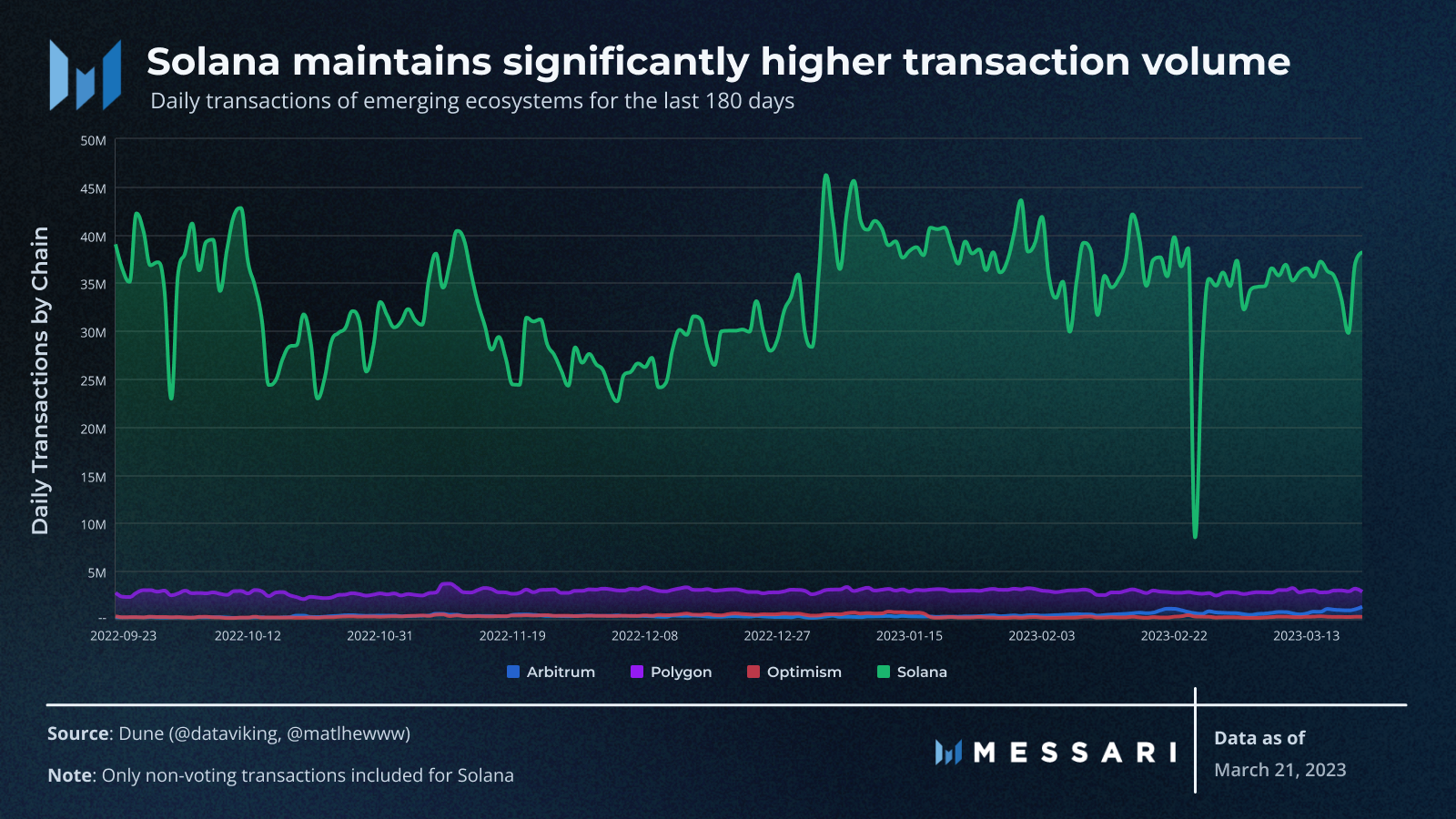
Solana still maintains a distinct lead in terms of daily transactions, though Arbitrum seems to be closing that gap – even post-airdrop. Optimism’s relatively flat numbers stand out, considering the constant presence of incentives throughout that ecosystem. Note that this chart is adjusted to remove non-fee paying transactions for Solana. This allows for a like-to-like comparison of transaction activity.
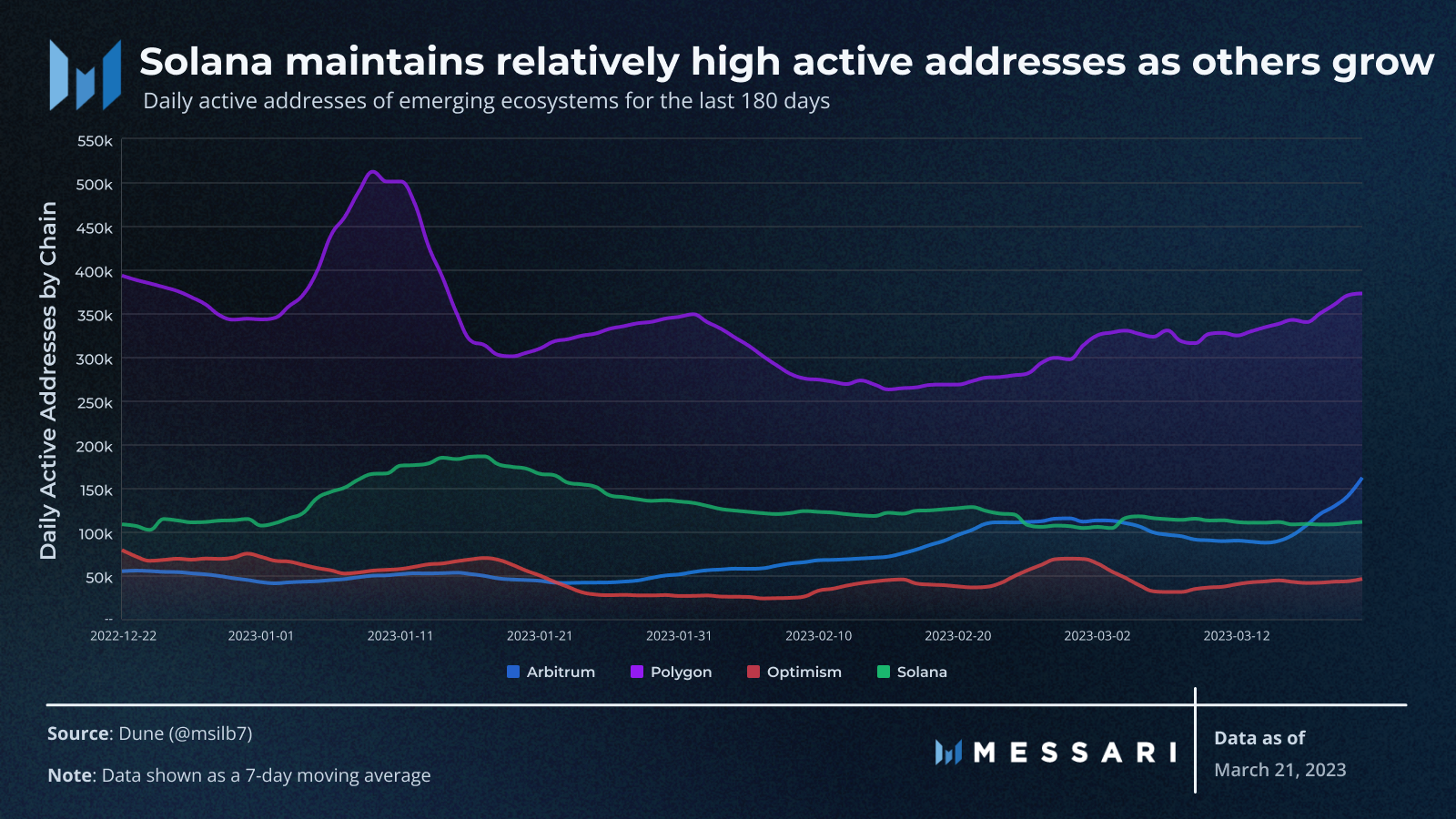
Solana saw relatively flat active address growth over the last 6 months, standing in contrast to Polygon and especially Arbitrum’s (~3x active addresses) growth. Active addresses may be the murkiest statistic of them all, but we included it here because of how frequently it’s referenced throughout the crypto space at large. With such low address creation and bot activity costs on all four of these networks, it’s impossible to determine the real user numbers by examining active addresses alone. That said, considering the metric is equally flawed for every protocol, Arbitrum outgrowing the rest is still worth taking note.
Overall, metrics aren’t as bad as the current narrative suggests. That said, the collective Solana ecosystem may have to employ drastic tactics — soon — if they want to attract capital flow into the ecosystem. In a financial game, the more liquidity you have, the better. As it stands, it’s relatively hard for Solana to be considered competitive with such a large gap at the capital level.
Future Developer Activity: Hackathons and New Infrastructure
Since our ecosystem overview last December and the Solana Q4 report in early January, Solana has had two major hackathons: Sandstorm and the ongoing Grizzlython. While both hackathons saw applicants build projects for a wide range of sectors, the most promising trend seems to be at the application-tooling level.
Specifically, teams are building tools to simplify builders’ ability to deploy creative DeFi strategies, automate onchain instructions, secure onchain wallets with 2fa, deploy Web3-native websites with ease, and more. By contrast, Ethereum hackathons have recently leaned more towards an infrastructure-tooling level focus: novel L2s and L3s, bridges, etc. In a world where lack of demand seems to be the primary issue at hand, application level focus may prove to be a better strategy.
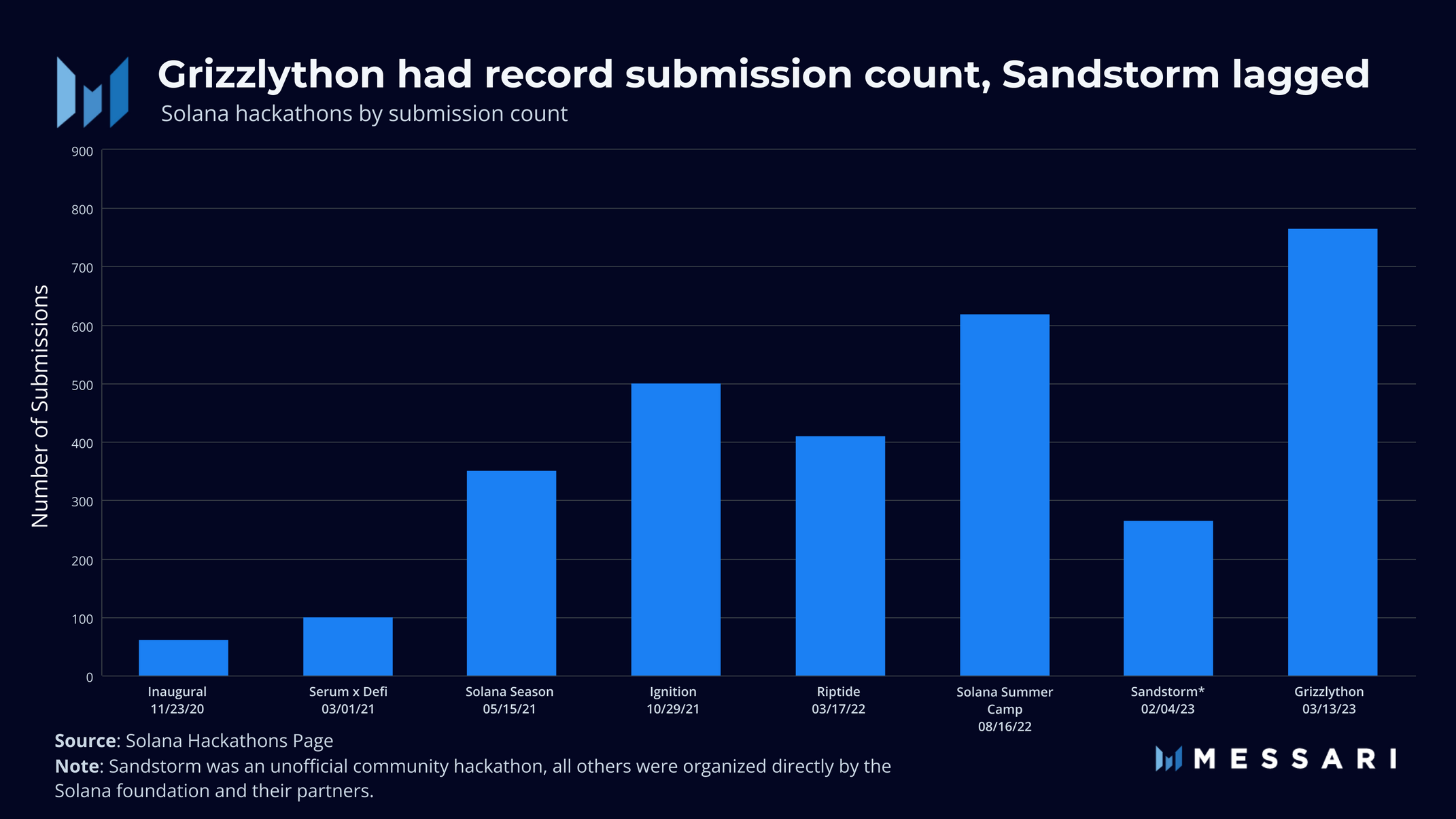
Quick highlights from Sandstorm include:
- Bokken: Tool for debugging programs.
- Crossbow: Tooling to track growth data and user activity with no-code solutions.
- Jito-related tools:
- jitoGPT: AI chatbot finetuned on Jito documentation.
- Bundle Stream: Custom RPC stream enabling searchers to subscribe to all bundles built using Jito.
- tmev: A mempool explorer specifically for Jito.
- Tinbet: A betting app with Tinder-like swiping UX.
- Triggr Intersect: Automated Zapier integrations for Solana dApps.
- Root: AMM strategy management tools.
The full list of award winners can be found in this Solblaze thread recapping the hackathon.
The Grizzlython winners have yet to be announced, but some projects we found interesting include:
- XRAY: Solana explorer with human-readable transaction visualization.
- Nodia: Nocode website builder for Web3 communities.
- Shyft: API tools for simplified dApp development.
- Bunkr: On-chain 2FA tools (allows you to connect Google authenticator/ any auth to wallet for transactions).
- Tinydancer: Light client for Solana.
- Fermi Labs: Order book DEX built on just-in-time liquidity.
Dean’s List DAO: Developer feedback and advisory group.
Again, we can observe somewhat novel tooling like on-chain 2FA as well as improvements in key tooling like block explorers. Most notably, Tinydancer has huge potential to massively increase the decentralization of the network. Solana is notorious for having hardware-intensive nodes. With a light client, thousands, if not millions, could participate, albeit not fully, in validating Solana’s mainnet.
NFT Compression: Solana’s Newest Piece of Infrastructure
One of the top new initiatives was NFT compression. It allows developers to mint millions of NFTs at a fraction of previous costs. Metaplex has the complete technical breakdown, but for our purposes all we need to know is that:
- The implementation stores the majority of NFT state information off-chain.
- To represent data on-chain, millions of NFTs are “compressed” into one account via a Merkle tree.
- The Merkle tree validates the data of the underlying NFTs by hashing together all of their contents into one meta-hash or “root hash.”
- This architecture maintains NFT security (due to essential data still being hosted on-chain) while expanding NFT scalability (by moving a large portion of the data off-chain)
Most notably, Render Network has already cited NFT compression as one reason why it is considering moving to Solana in its most recent chain migration proposal.
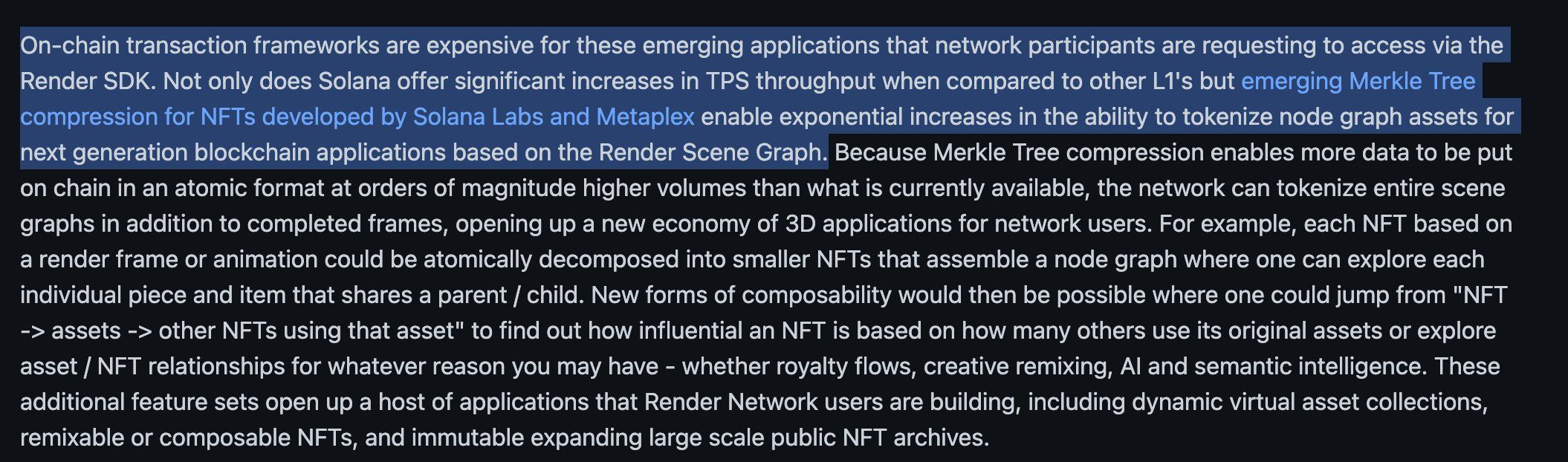
Source: Render
Use cases for compression are still being fleshed out, but if Render is any indication, then NFT compression will become useful beyond the typical NFTs-as-collectibles use case.
Final Thoughts
We get it – FUDding Solana is fun. But it’s important to balance out that fear, uncertainty, and doubt with reality. The popular narratives that focus on low TVL and Solana’s downtime issues are missing the point. One by one, Solana’s core contributors have fixed the downtime problems. And TVL starts to look cherrypicked after considering some of Solana’s other metrics. Builders are definitely still building. Ignoring the good signs to focus on the bad ones is putting builders, researchers, and investors at risk of throwing the Solana baby out with the bathwater.
-----
Let us know what you loved about the report, what may be missing, or share any other feedback by filling out this short form. All responses are subject to our Privacy Policy and Terms of Service.
All content was produced independently by the author(s) and does not necessarily reflect the opinions of Messari, Inc. Author(s) may hold cryptocurrencies named in this report. This report is meant for informational purposes only. It is not meant to serve as investment advice. You should conduct your own research, and consult an independent financial, tax, or legal advisor before making any investment decisions. Nothing contained in this report is a recommendation or suggestion, directly or indirectly, to buy, sell, make, or hold any investment, loan, commodity, or security, or to undertake any investment or trading strategy with respect to any investment, loan, commodity, security, or any issuer. This report should not be construed as an offer to sell or the solicitation of an offer to buy any security or commodity. Messari does not guarantee the sequence, accuracy, completeness, or timeliness of any information provided in this report. Please see our Terms of Service for more information.
No part of this report may be (a) copied, photocopied, duplicated in any form by any means or (b) redistributed without the prior written consent of Messari®.
Looking to dive deeper? Subscribe to Messari Pro. Messari Pro memberships provide access to daily crypto news and insights, exclusive long-form daily research, advanced screener, charting & watchlist features, and access to curated sets of charts and metrics. Learn more at messari.io/pro.
