Slip Sliding Away?: ETH 2.0 Liquid Staking Discounted Ahead of Merge

In the run up to Ethereum’s much anticipated Beacon Chain merge, there has been increased discussion around the apparent merits or pitfalls of liquid ETH staking. With roughly 20% of all staked Ether sitting in liquid pools and an even larger percentage staked via centralized crypto exchanges, the debate is warranted. Especially considering exchanges or pools could potentially enforce a strong, quasi delegated influence on the future of the network. By separating staking from block production via liquid staking options, another argument goes, staking pool and node operators could at some point lack adequate incentive to ensure the orderly operation of the Ethereum network.

Source: Elias Simos, Dune Analytics, https://dune.xyz/eliasimos/Eth2-Liquid-Staking
Despite the relevance of such a governance debate, the percentage of ETH staked to the circulating supply stands around 7% currently, a far cry from the 50%+ seen on first mover PoS L1 chains like Polkadot, Solana, and Cosmos.
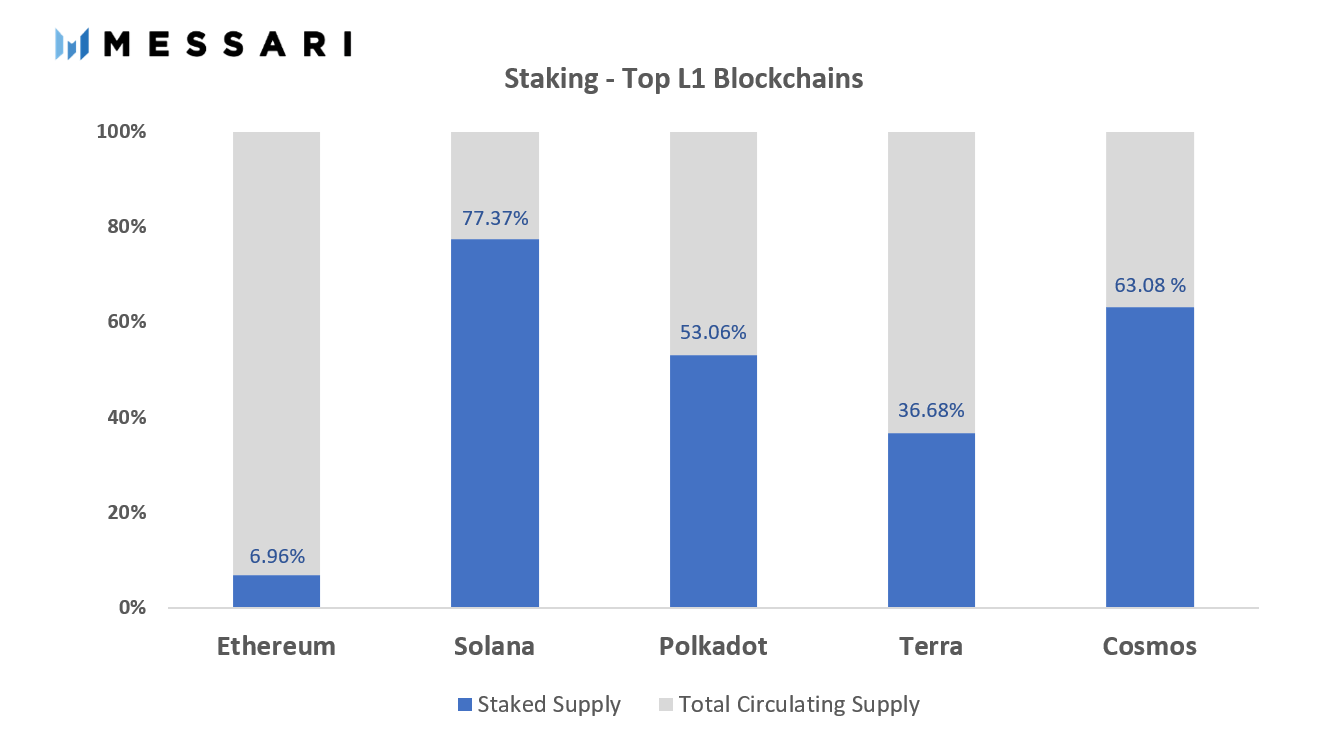
Source: Messari, https://messari.io/screener/staking-supply-(top-5-pos)-C1C07858
In absolute terms, though, total staked Ether is valued at approximately $34 billion, which would place it on its own in the top 10 for all digital assets by market cap, over $7 billion of which is in staking pools like Lido, Stakehound and StakeFi. From this perspective, there is in fact significant network value at play, the amount of staked ETH as percentage of total supply notwithstanding. Anyone interested in the orderly functioning of the Ethereum network in coming years or its pricing dynamics in the mid-term should keep an eye on the changing dynamics of liquidity in ETH staking pools.
