Should I Stake Or Should I Go? An Overview of Liquid Staking

Ethereum’s transition towards Proof-of-Stake is being touted as a game changer not just for Ethereum, but for the entire cryptocurrency space that has been pushed to move away from Proof-of-Work for some time. JP Morgan analysts expect the staking industry to grow up to $40 billion (staking income) by 2025. Because staked tokens are deposited in an escrow account, a consequence of the increase in staking is that fewer tokens will be circulating in DeFi protocols. While this may have favorable implications in terms of protocol security, it introduces a trade-off for investors between deciding whether to stake or to pursue yield farming strategies (e.g., liquidity mining, lending, etc.). However, liquid staking aims at providing the best of both worlds.
What is liquid staking?
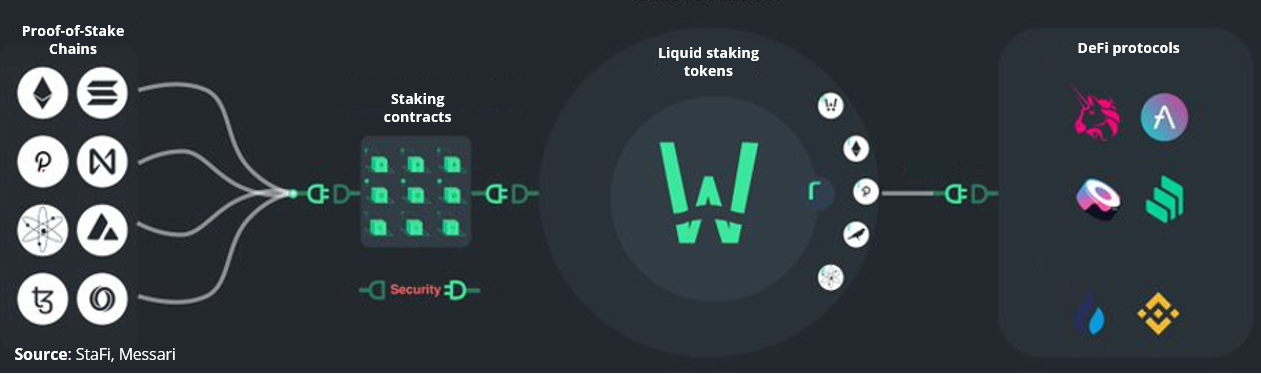
As the name suggests, liquid staking is the process through which a user can gain liquidity on their staked assets. The process begins with an investor staking a token (i.e., ETH) into a protocol which stakes on their behalf, then mints them a 1:1 claim on that underlying asset. The staking rewards accrue to the liquid staking token, similarly to what happens with liquidity provider tokens on decentralized exchanges. These liquid staking tokens could be swapped or used as collateral to borrow assets, de facto unlocking an additional source of income on top of staking rewards. Liquid staking tokens can be immediately redeemed to allow investors to get their original tokens back without waiting for unbonding periods. When staking a token to mint a liquid staking token, investors can choose validators among those provided by the protocol used.
Market size and expected growth rate
The market size of liquid staking protocols is currently at $10.5 billion and the penetration rate (staked tokens in liquid staking protocols divided by the total value staked in the market) is equal to approximately 7%. If these figures seem slim (and they are), the growth rate looks more interesting.
Assuming $40 billion in staking rewards by 2025 with an average staking yield in the range of 5-10% implies total staked tokens would be in the range of $400-800 billion. To put things into perspective, the current value of all staked tokens is $146 billion, and the current total value locked in DeFi stands at $186 billion (as of September, 15th). It’s pretty clear that liquid staking might have a sizable market to attack with the expected massive transition towards Proof-of-Stake.
