Shadow launched a self-funded 3.0 million S incentive program to reward Shadow ecosystem participants.
Shadow introduced limit orders and TWAP execution tools, expanding trading functionality and supporting its goal of becoming Sonic’s central liquidity hub.
Emissions shifted from xSHADOW to SHADOW, reducing friction for participants and creating a more liquid rewards token. Shadow remained one of the most active protocols on Sonic, attracting 73,071 daily active users (DAA) since its inception.
Shadow surpassed $11.4 billion in cumulative trading volume, reinforcing its position as a key driver of Sonic activity.
Primer
Shadow Exchange was launched in November 2024 by a pseudonymous founder, 24dollars, who serves as the project lead and a core developer. Working with a team of anonymous builders, 24dollars helped establish the foundation of Shadow and remains an active advocate for Sonic, having been involved since the early days of the Fantom blockchain. He has also appeared in podcasts and media as a recognizable voice for the ecosystem. The team behind Shadow is primarily composed of anonymous builders supporting 24dollars' vision, focusing on creating sustainable DeFi infrastructure rather than seeking traditional venture capital funding. Shadow originally did a presale with their community that took place over two rounds. At TGE, 3.0 million SHADOW tokens were released into circulation from a total supply of 10.0 million. Of this initial amount, 750,000 xSHADOW were allocated during the two rounds, equal to 7.5% of the total supply.
Shadow Exchange’s mission is to address the limitations of traditional ve(3,3) DEX models by replacing static lock-ups with dynamic value creation. Its x(3,3) framework rewards active participation and protocol contribution while preserving exit flexibility, fostering a self-selecting community where incentives align with long-term growth. Shadow pursues this vision through an organic growth model funded by protocol-generated fees and community-driven incentives. As the Sonic blockchain continues to mature, Shadow has become the de facto liquidity hub for DeFi users and for projects to launch their liquidity pools (LP). Shadow has continued to advance its platform to provide a better experience to its users by integrating decentralized exchange aggregation (DEX) with this smart routing. Shadow Exchange offers additional swapping options through platforms such as Magpie and ODOS to offer users fast and cheap swaps.
As part of Sonic’s incentive framework, the network introduced the Gems program to reward applications for driving engagement. Each season, a fixed supply of Gems is competitively allocated to protocols based on factors such as category type, exclusivity to Sonic, revenue generation, and reward distribution practices. Gems are then redeemed for S tokens, which protocols manage independently. While there is no formal requirement to share rewards, the program design favors applications that pass through a larger portion of their S tokens to users.
For Season 2, Shadow Exchange elected to pre-allocate 50% of its estimated Gems rewards upfront, deploying them as liquidity incentives to maximize capital efficiency and network growth. As a result, 3.0 million S tokens are available for users to farm.
Limit Orders and TWAPs
Shadow Exchange has expanded its trading capabilities with the introduction of limit orders and time-weighted average price (TWAP) execution, adding tools that enhance execution flexibility while supporting the protocol’s vision of becoming Sonic’s central liquidity hub.
Limit Orders with English Auction Bidding
Limit orders on Shadow Exchange allow traders to set a specific price at which they wish to buy or sell an asset, with execution occurring if the price is met. Shadow implements these via English auction bidding, where counterparties competitively bid to fill the order, driving optimal execution prices in a decentralized environment.
Time-Weighted Average Price (TWAP)
TWAP execution enables traders to split a large order into smaller trades over a set time interval, averaging the execution price and mitigating market impact. On Shadow, TWAP parameters are customizable, giving users control over interval length and execution window.
Emissions update
Shadow Exchange has revised its emissions framework to distribute liquid SHADOW directly to liquidity providers (LPs), replacing the prior model where rewards were issued as xSHADOW. LPs used to require users to vest rewards over 180 days to unlock them at full value or accept an immediate 50% exit penalty, with half of the forfeited amount rebased to active xSHADOW stakers. This structure limited capital flexibility and redirected value from LPs to governance participants.
The new approach eliminates both the conversion step and the early-exit penalty, allowing LPs to deploy rewards immediately for trading, reinvestment, or liquidity provisioning. This adjustment improved user experience, reduced participation frictions, and enhanced yield competitiveness. For SHADOW holders, the removal of illiquid rewards allowed for less sell pressure on the x33 token so that it can reach its ceiling ratio against xSHADOW.
In parallel, the shift reinforced the protocol’s x(3,3) mechanics, enabling the system to reach its compounding ceiling, currently at 97%. When reaching the compounding ceiling, x33 will use its rewards to purchase SHADOW to continue compounding and increase the x33/xSHADOW ratio. While below the ceiling, the function will purchase x33 to compound into the ratio.
Shadow by the Numbers
Shadow has remained one of the leading protocols on Sonic since its inception, averaging 73,071 daily active users. More recently, Shadow has seen a decline in active addresses, in line with Sonic’s network-wide contraction as most protocols recorded drawdowns. Despite this, Shadow sustained a leading share of user activity on the chain.
Shadow has consolidated its role as a leading liquidity venue on Sonic, processing $11.4 billion in cumulative trading volume as of the end of August. Its depth of liquidity and steady order flow position it as a key entry point for new users and capital within Sonic, while the revised emissions structure is likely to strengthen its share of network-wide trading activity.
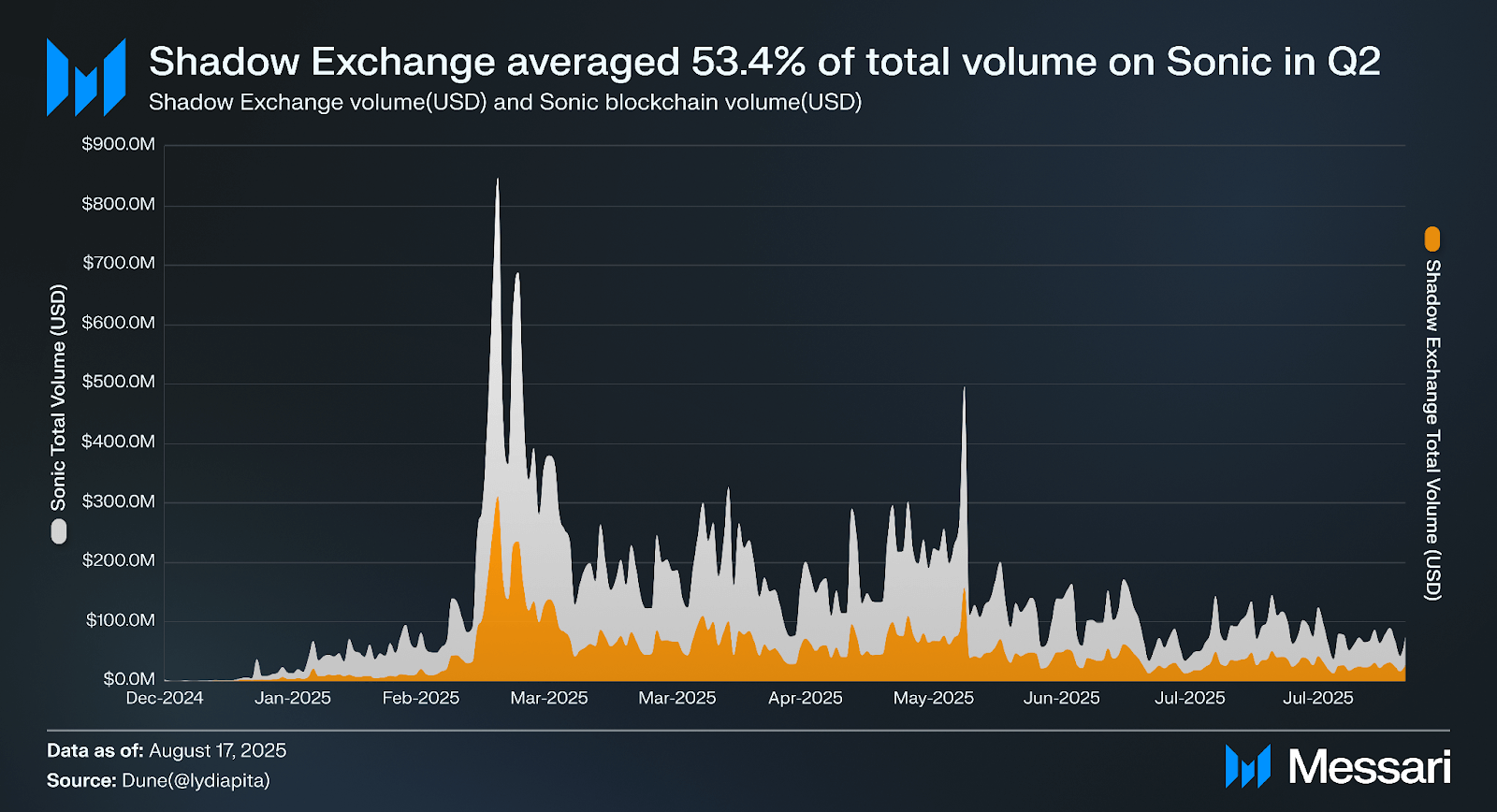
Shadow cemented its position as Sonic’s central liquidity hub, capturing 53.0% of trading volume in Q2’25 and 47.3% since launch. Although overall network activity declined, Shadow remained the dominant venue for trading on Sonic.
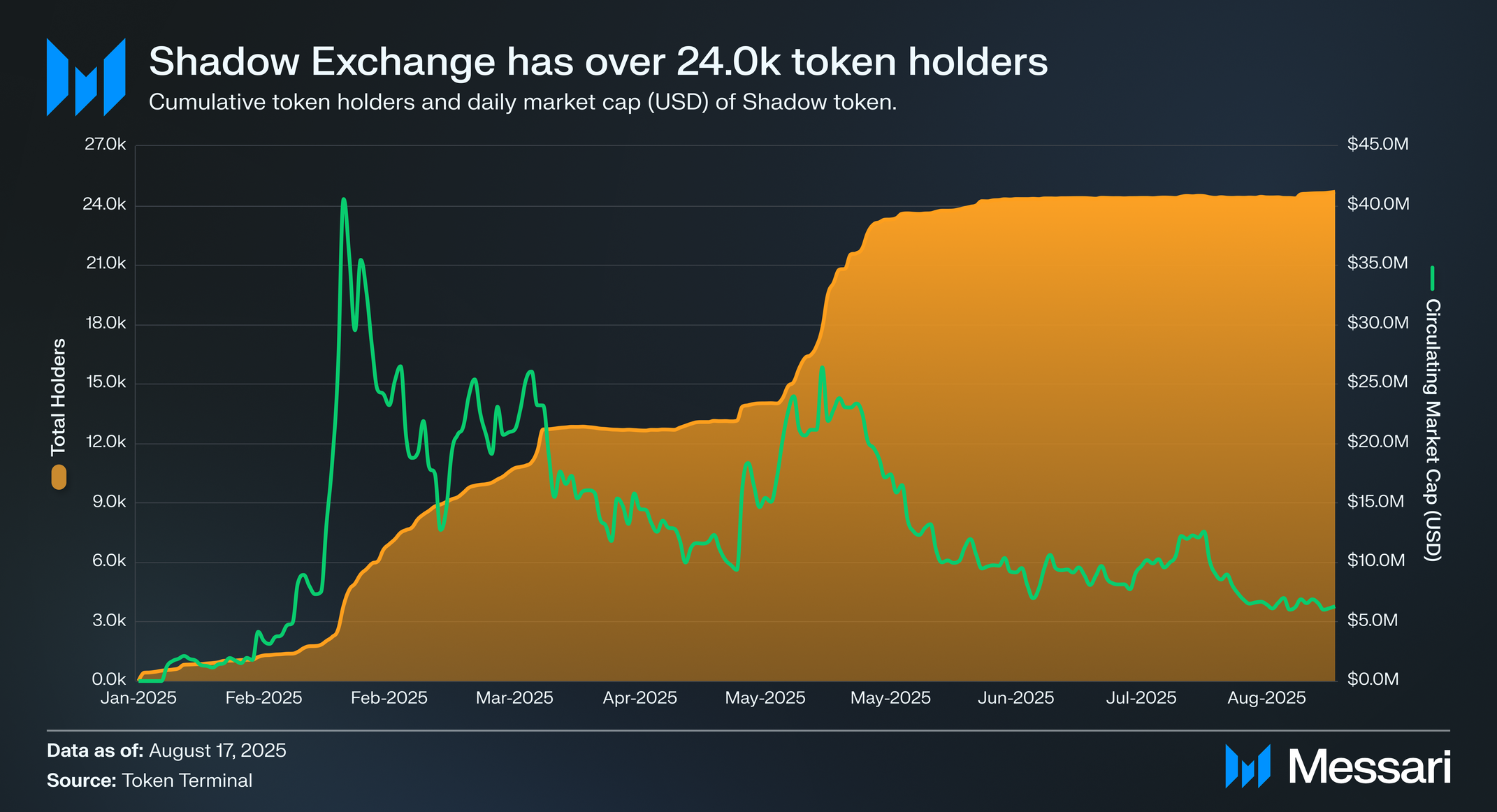
Shadow’s circulating market capitalization has declined since its inception, reflecting the broader contraction of the Sonic ecosystem. Despite this, Shadow Exchange continues to add token holders, suggesting sustained platform adoption even as the network goes through changes. Growth has been supported by product improvements such as limit orders and TWAP execution developments, along with the decision to distribute its full Sonic Gems airdrop to users.
FeeM Success
The Sonic blockchain features the FeeM initiative, which returns 90% of transaction fees to the originating application. This model creates a direct incentive for high-throughput projects, effectively linking protocol success with fee revenue. Shadow has emerged as the leading participant in FeeM, generating more than 242,000 S in rewards returned to the protocol, reinforcing its position as Sonic’s top application.
Closing Summary
Shadow Exchange continued to strengthen its position as Sonic’s leading liquidity hub, surpassing $11.4 billion in cumulative trading volume and maintaining the highest share of user activity on the network despite ecosystem-wide contraction. Key product enhancements, including limit orders and TWAP execution, expanded the protocol’s functionality, while the shift from xSHADOW to SHADOW emissions simplified rewards.
The protocol also leveraged Sonic’s Gems program to front-load incentives, deploying 3.0 million S tokens to attract liquidity and reinforce network growth. Although Shadow’s market capitalization declined alongside Sonic’s broader downturn, user adoption and tokenholder growth suggest resilience and continued alignment with long-term protocol expansion.
This report was commissioned by Shadow Exchange. All content was produced independently by the author(s) and does not necessarily reflect the opinions of Messari, Inc. or the organization that requested the report. The commissioning organization may have input on the content of the report, but Messari maintains editorial control over the final report to retain data accuracy and objectivity. Author(s) may hold cryptocurrencies named in this report. This report is meant for informational purposes only. It is not meant to serve as investment advice. You should conduct your own research and consult an independent financial, tax, or legal advisor before making any investment decisions. Past performance of any asset is not indicative of future results. Please see our Terms of Service for more information.
No part of this report may be (a) copied, photocopied, duplicated in any form by any means or (b) redistributed without the prior written consent of Messari®.
Gunkan is a Research Analyst at Messari with a focus on gaming, DeFi, and memecoins. He began working in crypto in 2022, with prior experience at Crypto.com and Cointelegraph.
Gunkan is a Research Analyst at Messari with a focus on gaming, DeFi, and memecoins. He began working in crypto in 2022, with prior experience at Crypto.com and Cointelegraph.