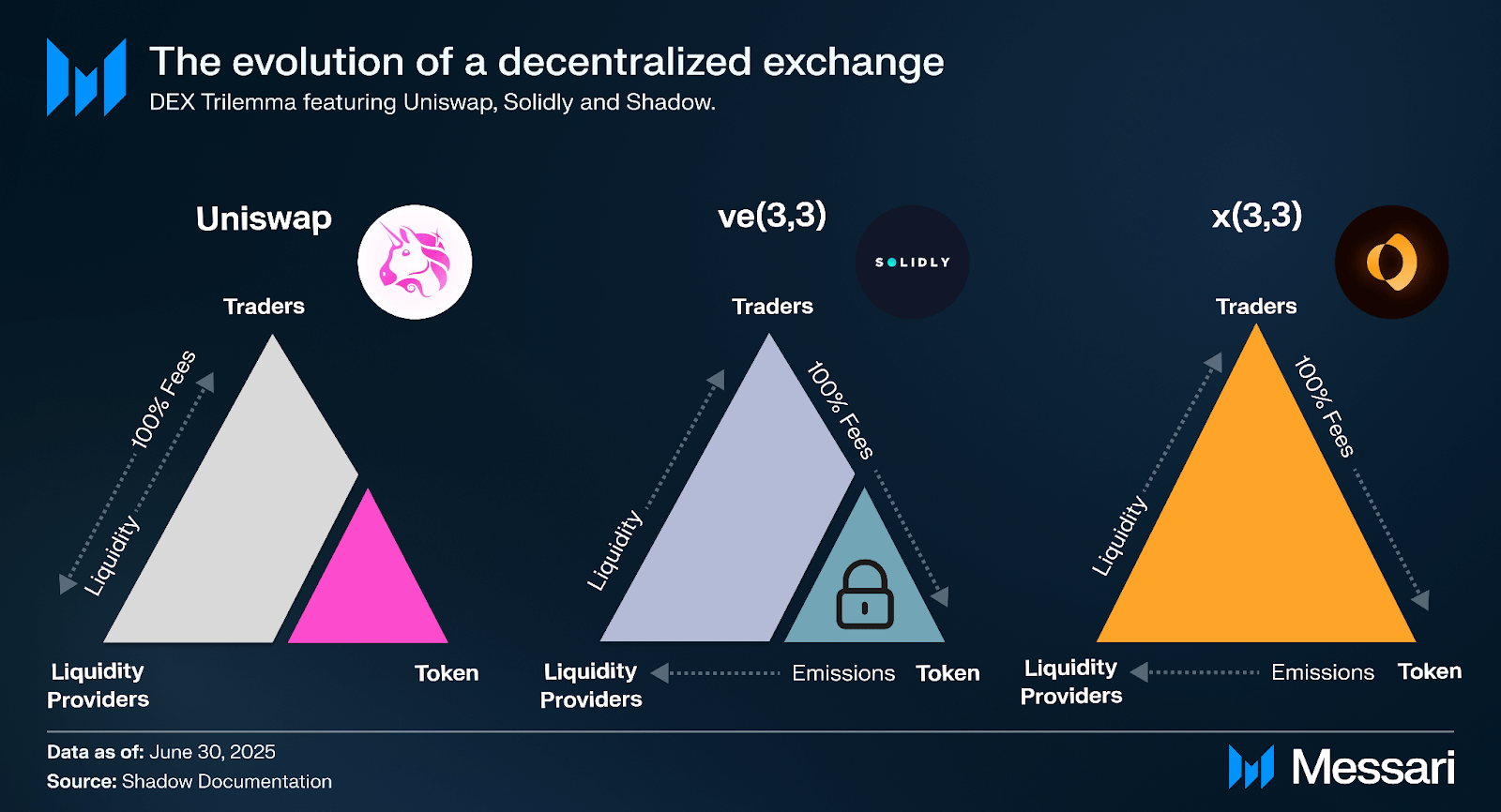
Shadow is an x(3,3) decentralized exchange (DEX), an evolution of the ve(3,3) first introduced by Andre Cronje that took aspects from Ohm and Curve to build a more sustainable DEX.
At the heart of Shadow Exchange is xSHADOW, a non-transferable token used for governance and rewards. Once staked, xSHADOW stakers earn trading fees and bribes, and rebase rewards by voting on gauge emissions.
Shadow differentiates itself with its x33 token. The x33 token is the liquid-staked version of xSHADOW, which automates the xSHADOW token features, accruing value from conducting votes, claims, swaps, and compounds, all rewards
Shadow ranks in the top 20 for holder revenue. Over the past 30 days, Shadow has generated over $2.36 million in fees for its holders.
Since its inception, Shadow has averaged over 46% of the daily total volume on Sonic, even going as high as 52% starting from April, cementing itself as a central hub for liquidity on the Sonic blockchain.
Primer
Shadow Exchange was launched in November 2024 by 24dollars, while his real name isn’t known to the public, 24dollars serves as the project lead and has been seen on various media. He is a well-known figure and advocate of Sonic, coming from the early days of the Fantom blockchain, and has appeared on various podcasts and media. The team behind Shadow is primarily composed of anonymous builders supporting 24dollars' vision, focusing on creating sustainable DeFi infrastructure rather than seeking traditional venture capital funding. Shadow originally did a presale with their community that took place over two rounds. During these two rounds, 750,000 SHADOW tokens were allocated from an initial 3.0 million supply, representing 7.5% of the total 10.0 million supply of SHADOW.
Shadow Exchange's mission is to provide a more fluid and accessible incentive model on the Sonic network while redefining alignment between traders, liquidity providers, and long-term stakeholders. Shadow has adopted an organic growth model funded through protocol-generated fees and community incentives. As the Sonic blockchain continues to mature, Shadow has become the de facto liquidity hub for DeFi users and for projects to launch their liquidity pools (LP). Shadow has continued to advance its platform to provide a better experience to its users by integrating decentralized exchange aggregation (DEX) with this smart routing Shadow Exchange offers additional swapping options through platforms such as Magpie and ODOS to offer users fast and cheap swaps.
The traditional ve(3,3) model suffered from fundamental design flaws such as the accumulation of dead voting power from users holding tokens indefinitely without active participation, unfair access to rewards heavily skewed toward protocols rather than individual users, and the absence of exit mechanisms that trapped users in long-term commitments regardless of changing circumstances. With x(3,3) Shadow Exchange seeks to alleviate the pain points of the ve(3,3) model, making it a more active protocol with less restrictive and punishing mechanics. xSHADOW can be exited at any time for a 50% penalty, which is then rebased and distributed to other xSHADOW stakers, eliminating forced lock-ups while maintaining strong participation incentives, addressing key limitations that have plagued traditional vote-escrow systems.
What is Shadow?
Shadow Exchange operates as an order-book-style concentrated liquidity decentralized exchange built natively on the Sonic blockchain. While not an order book by definition, Shadow uses concentrated liquidity similar to a Uniswap V3. By allowing LPs to concentrate their capital within specific price ranges, Shadow creates deep liquidity zones that mirror traditional order book depth charts while still being an automated market maker, similar to traditional DEXs in crypto. Shadow Exchange isn’t just a place to trade; it’s a system designed to grow liquidity. Projects offer incentives to get votes, votes direct token rewards to pools, LPs earn more, and that attracts even more liquidity over time.
Staking SHADOW for xSHADOW
Flexible Exit
Users can exit xSHADOW at any time through a flexible vesting system that balances immediate liquidity needs with long-term commitment incentives. Instant exits incur a 50% penalty (1:0.5 ratio), while full 180-day vesting periods allow 1:1 redemption with no penalty. Once a user exits their xSHADOW position the 50% penalty is then distributed among other xSHADOW stakers. The system includes a 14-day cancellation period during which users can reverse their vesting decision without penalty, providing a safety mechanism for those who change their minds shortly after initiating the process.
Partial vesting periods offer proportional ratios that create a smooth incentive curve. For example, a 90-day vesting period might yield a 1:0.73 ratio, allowing users to balance their need for liquidity against the penalty for early exit. This flexibility addresses one of the primary criticisms of traditional ve(3,3) systems, where users were locked into multi-year commitments regardless of changing circumstances.
Player vs. Player Rebase Mechanics
The PVP (player vs. player) rebase mechanism proportionally streams 100% of forfeited tokens from early exits to remaining xSHADOW stakers, creating sustainable dilution protection without requiring new token emissions. The PVP rebase serves multiple functions within Shadow's ecosystem. It acts as an anti-dilution mechanism, protecting long-term holders from the inflationary effects of token emissions. It also provides additional yield beyond standard protocol fees and vote incentives, and creates natural selection pressure that encourages active participation while discouraging passive holding.
Voting on Liquidity Gauges
xSHADOW stakers vote weekly in what are called Epochs to decide how SHADOW emissions are allocated across liquidity pools. For projects to attract votes they will typically add extra tokens as incentives that are called bribes/rewards. These are tokens that the projects use to entice voters to vote on their pools so that they are able to receive more emissions. At the start of each new epoch, votes are tallied and SHADOW rewards are distributed proportionally to pools based on vote weight. These emissions are then streamed to LPs in those pools over the course of the week. In return for voting, xSHADOW stakers earn 100% of the trading fees and bribes/rewards from the pools they support. Voting power resets each epoch, and only actively staked xSHADOW is eligible to vote and receive rewards.
The x33 token
The x33 token is the liquid-staked version of xSHADOW and can be minted with xSHADOW. The x33: xSHADOW ratio starts at 1.00:1.00 and increases in x33's favor as rewards accrue from fees, vote incentives, and rebases. Holding x33 automates the functions of xSHADOW, such as:
Voting: The x33 token automatically chooses the most yield-rewarding pool to vote on.
SHADOW Buybacks: Sells its rewards for SHADOW or x33, depending on what’s more profitable at the time.
Compounding: All rewards from votes and incentives are used to increase the x33:xSHADOW ratio.
Claims Rebase: Claims and rebases are used to increase the x33:xSHADOW ratio.
Zero Fees: There are no fees associated with deposits, withdrawals, and compounding.
Swaps: Since the token is liquid, users can swap it freely rather than being locked in with their xSHADOW token.
As x33 compounds rewards, its value increases relative to xSHADOW. Designed for flexibility, x33 lets users benefit from Shadow’s governance and rewards system without locking capital. Its price is protected by arbitrage mechanics that prevent trading below the redemption value. To maintain system integrity, x33 includes a 12-hour cooldown after each epoch flip (to finalize rewards and ratios) and a 1-hour minting pause before the epoch ends (to preserve voting accuracy).
Providing liquidity and staking
Users can provide liquidity to either legacy (Uniswap V2-style) or concentrated (Uniswap V3-style) pools on Shadow. Legacy LPs receive a standard ERC-20 LP token, while concentrated LPs receive an NFT representing their position within a custom price range. To earn SHADOW emissions, LPs must stake their position in a pool’s gauge. If a pool doesn’t have a gauge, LPs still earn trading fees, which are automatically reinvested but aren’t given a cut of the emissions given out by Shadow Exchange every epoch. Emissions are distributed continuously over the epoch and can be claimed anytime, with the option to receive rewards as liquid SHADOW (with a 50% penalty) or as xSHADOW (full amount, locked). Managing concentrated liquidity requires setting and adjusting price ranges, while legacy pools offer simpler full-range exposure.
Claiming rewards
Users earn rewards from two sources: liquidity rewards and voting. LPs in gauge-enabled pools accumulate SHADOW emissions in real time and can claim them anytime. Rewards can be claimed as liquid SHADOW (subject to a 50% early-exit penalty) or as xSHADOW. xSHADOW voters receive their share of trading fees, bribes, and rebase rewards at the end of each epoch, claimable immediately once the epoch flips.
Incentive participation
Shadow supports a two-sided bribe market that allows anyone to influence the gauge votes. Projects or users can deposit token incentives, called bribes, into a pool’s gauge to attract xSHADOW votes. These bribes must be submitted before the epoch ends and are visible in the voting UI throughout the epoch. When the epoch flips, the bribes are distributed proportionally to voters who supported that gauge. As a voter, interacting with bribes is passive; you simply vote for pools offering incentives and claim the tokens at epoch end. This system aligns incentives between protocols seeking liquidity and voters optimizing for yield.
Shadow employs a positive feedback loop in which projects bribe their pools, which gets voters to vote. This pushes emissions to specific pools, these LPs earn, and the liquidity deepens.
Shadow by the Numbers
Since going live in December 2024, Shadow has found itself at the center of the Sonic ecosystem. Shadow has impressively averaged over 46% of the total daily volume conducted since its inception in December 2024. Shadow has gone as high as 69% of the daily volume done on Sonic.
Shadow has quickly established itself as a leading revenue-generating protocol. Over the past 30 days, it ranked among the top ten projects by holder revenue, distributing $2.04 million to xSHADOW stakers and voters. This performance places Shadow alongside established networks like Ethereum, Solana, Tron, and Hyperliquid, underscoring its rapid adoption and the strength of its incentive design.
Where is Shadow Heading Next?
Immediate Product Enhancements
Shadow has introduced instant reward claiming in SHADOW tokens, streamlining the user experience and eliminating the complexity of multi-token claiming. The team is also building a native silo market for borrowing and lending against x33. This feature expands Shadow’s DeFi utility by enabling new yield strategies while preserving the liquidity benefits of liquid staking. By isolating these markets from core exchange functions, the design minimizes systemic risk and protects against cascading failures.
Memecoin Ecosystem Development
Shadow is developing a more secure and incentive-aligned launch process for memecoins. At the core of this strategy is the FeeShare system, which splits trading fees among xSHADOW holders, token creators, and LPs. Launches can configure these splits, for example, 80% to voters, 15% to creators, and 5% to LPs, creating sustainable revenue streams while discouraging short-term exploitation.
Technical Infrastructure Advancement
Shadow is strengthening MEV protection through upcoming features like backrun arbitrage systems and delayed reward mechanisms that disincentivize just-in-time liquidity. These upgrades are designed to protect LPs from toxic flow and ensure rewards go to genuine market makers.
A new fee-tracking system will link emissions directly to real swap activity, ensuring only productive liquidity earns rewards. Additional abuse prevention modules will leverage subgraph data and external monitoring to identify and restrict exploitative behaviors, complementing Shadow’s MEV defenses and safeguarding long-term protocol integrity.
Closing Summary
Shadow Exchange represents a significant evolution in DEX design, successfully addressing fundamental limitations of traditional ve(3,3) systems while maintaining the benefits of aligned incentives and community governance. The protocol's x(3,3) innovation eliminates forced lock-ups through flexible vesting mechanisms and PVP rebase dynamics, creating a more accessible and sustainable participation model that rewards active engagement over passive holding. This foundation has enabled Shadow to capture market share on Sonic and become one of the leading revenue-generating platforms for its holders. While still early, Shadow Exchange shows promise as it continues to develop its platform and aims to become the central liquidity hub on Sonic.
This report was commissioned by Shadow Exchange. All content was produced independently by the author(s) and does not necessarily reflect the opinions of Messari, Inc. or the organization that requested the report. The commissioning organization may have input on the content of the report, but Messari maintains editorial control over the final report to retain data accuracy and objectivity. Author(s) may hold cryptocurrencies named in this report. This report is meant for informational purposes only. It is not meant to serve as investment advice. You should conduct your own research and consult an independent financial, tax, or legal advisor before making any investment decisions. Past performance of any asset is not indicative of future results. Please see our Terms of Service for more information.
No part of this report may be (a) copied, photocopied, duplicated in any form by any means or (b) redistributed without the prior written consent of Messari®.
Gunkan is a Research Analyst at Messari with a focus on gaming, DeFi, and memecoins. He began working in crypto in 2022, with prior experience at Crypto.com and Cointelegraph.
Gunkan is a Research Analyst at Messari with a focus on gaming, DeFi, and memecoins. He began working in crypto in 2022, with prior experience at Crypto.com and Cointelegraph.