In November 2025, CMC20 launched on BNB Chain as Reserve’s core broad-market onchain index, allowing holders to gain diversified exposure to the top 20 cryptocurrencies by market capitalization through a single token.
CMC20 supports permissionless minting and redemption. Any market participant can arbitrage price discrepancies between the index token and its underlying assets, helping keep prices aligned without relying on authorized intermediaries.
CMC20 has shown high trading activity relative to its size, with an average daily turnover of 56.5%, driven by roughly $3.1 million in daily trading volume against a market capitalization averaging about $5.9 million.
CMC20 affects Reserve’s fee generation and RSR supply dynamics through trading activity. Periods of higher minting activity increase platform fee revenue, which is currently used for RSR token burns but can be redirected through governance over time.
Primer
Reserve (RSR) builds infrastructure for onchain index investing through Decentralized Token Folios (DTFs), its open standard for tokenized portfolios. The platform supports two primary product lines:
The Yield Protocol – focuses on RTokens designed to maintain pegs and generate yield, with RSR staking providing protocol-level backstopping.
The Index Protocol supports the creation and governance of tokenized index products known as Index DTFs, including CMC20, a broad-market index designed to provide diversified crypto market exposure through a single onchain token.
Index DTFs are governed by a mechanism called vote locking. Each Index DTF is governed by a token chosen by its creator. This can be an existing governance token, a newly created token specific to the DTF, or another compliant onchain asset. While RSR is often used, it is not required. Governance token holders can lock tokens to a specific Index DTF to gain voting power over that product, allowing them to approve changes to parameters such as basket composition, rebalancing logic, and fee rates.
Vote locking is distinct from staking. While staking RSR secures Yield Protocol products and exposes participants to slashing in the event of collateral default, vote locking grants governance rights only and does not expose tokens to slashing or permanent loss in the event of collateral default. This separation allows participants to engage in index governance without assuming collateral or credit exposure.
For a full primer on Reserve, refer to our Initiation of Coverage report.
CMC20 Overview
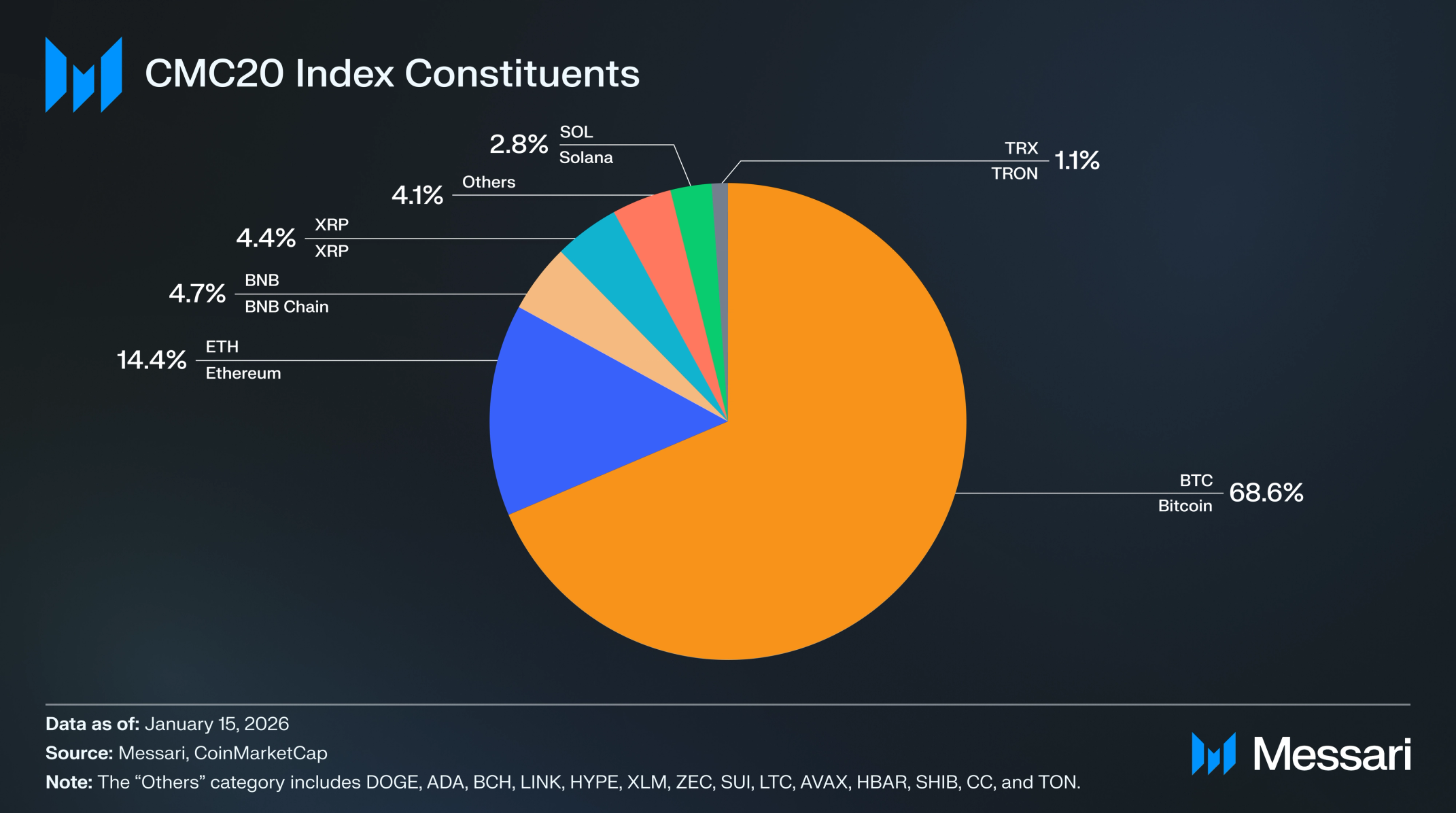
CMC20 is an Index DTF on BNB Chain built with Reserve’s Index Protocol and serves as a broad-market reference product. While many Index DTFs target specific themes or niche strategies, CMC20 is designed to approximate aggregate crypto market exposure through a basket of leading digital assets, such as BTC, ETH, and BNB. The index follows a predefined methodology, is rebalanced monthly, and excludes stablecoins, pegged tokens, and assets with limited investability.
At the time of writing, CMC20 holds 20 large-cap cryptocurrencies. Each constituent’s weight is determined by the index methodology and implemented onchain through the protocol.
Permissionless Minting and Redemption
CMC20 allows any user to mint or redeem tokens directly against its underlying asset basket. Reserve supports this through Zapper, an interface that compares the cost of minting CMC20 from the underlying assets with the cost of purchasing existing liquidity on secondary markets. It helps users compare the cost of minting with available secondary market liquidity to identify the more cost-effective option.
This design enables arbitrage participation beyond a restricted set of intermediaries. When CMC20 trades at a premium or discount to the value of its underlying basket, market participants can respond by minting or redeeming tokens, which can reduce pricing discrepancies under sufficient liquidity and reasonable transaction costs. During periods of market stress or limited liquidity, these mechanisms may operate less efficiently.
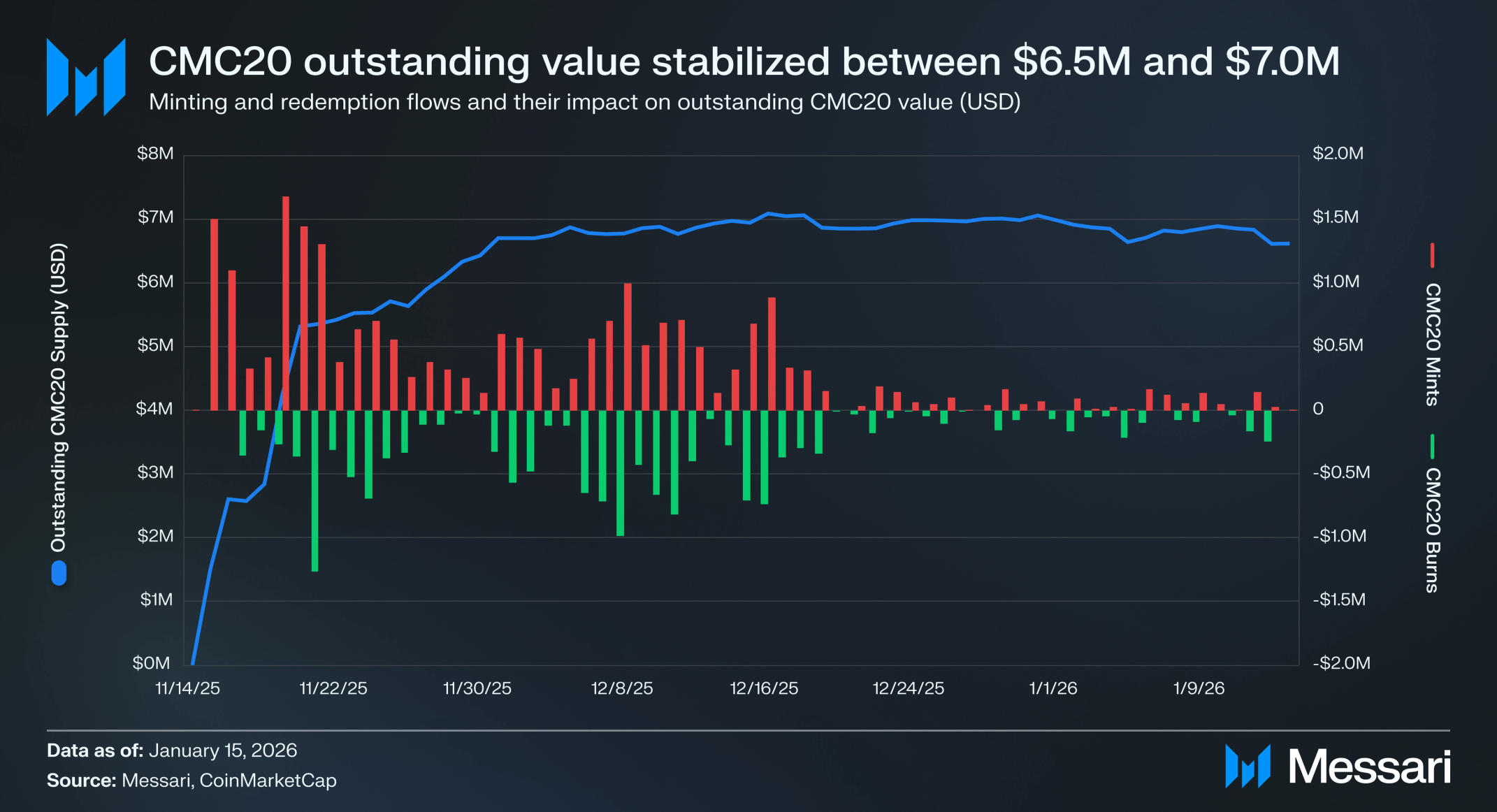
Changes in CMC20’s outstanding supply are driven by ongoing minting and redemption activity. In the initial days following launch, minting volumes significantly exceeded redemptions, driving rapid supply growth to more than $5.0 million by late November. In subsequent weeks, minting and redemption volumes became more balanced, resulting in slower net supply growth and several periods of flat or declining outstanding supply. By mid-January 2026, the total CMC20 value has stabilized between approximately $6.5 and $7.0 million.
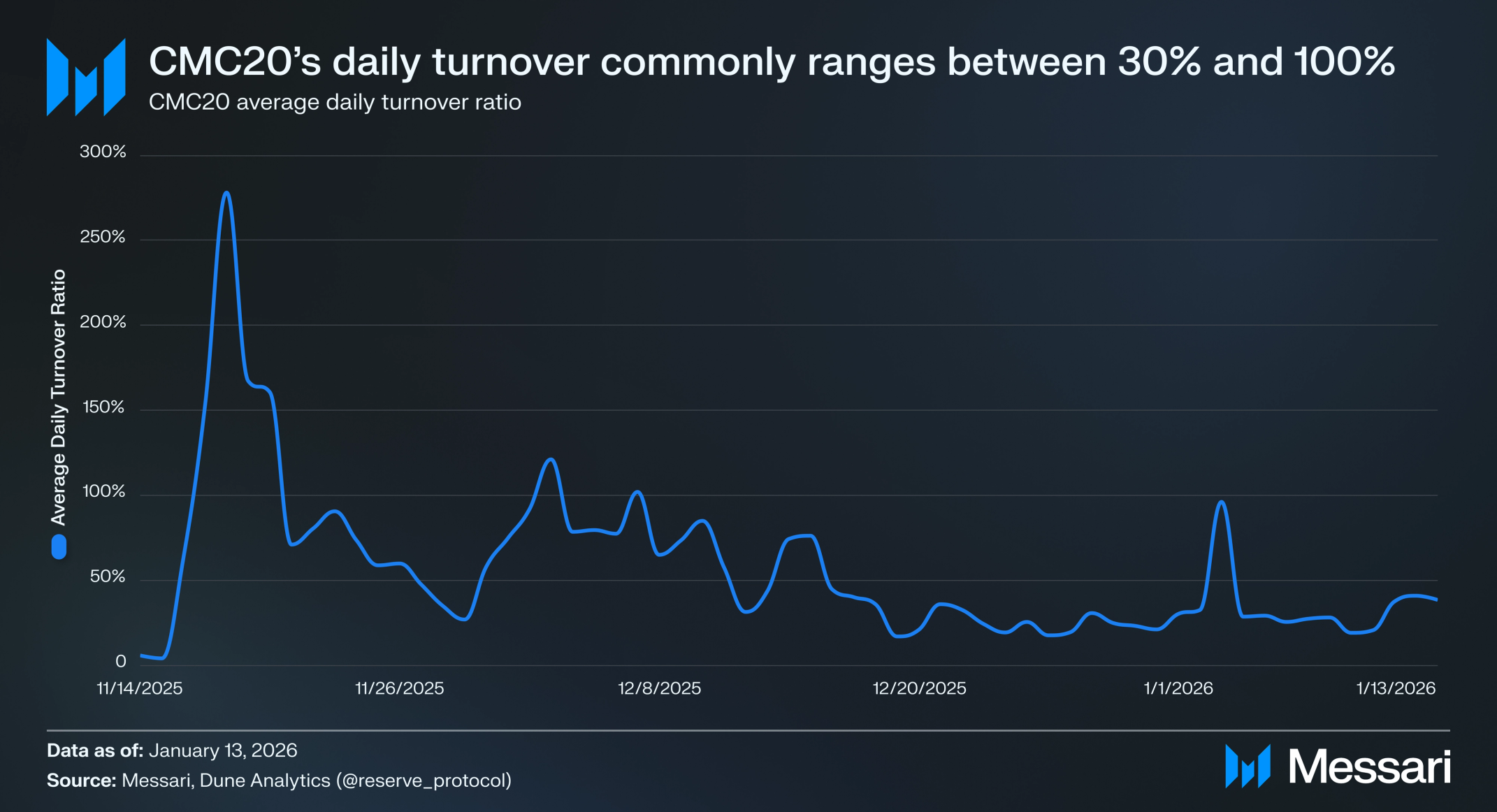
The turnover ratio measures daily trading volume relative to market capitalization and is commonly used to gauge how actively an asset is traded. CMC20 has regularly recorded between $2 million and $5 million in daily trading volume against a market capitalization that largely ranges between $5 million and $7 million, resulting in an average daily turnover of 56.5%.
During the observed period, turnover was most pronounced during the early post-launch phase, averaging 94.8% from Nov. 16 to Nov. 30 and peaking at 278.1% on Nov. 18, a pattern consistent with active price discovery and index arbitrage behavior. Although turnover declined as outstanding supply stabilized, it remained elevated at approximately 29.9% on average from Dec. 20 onward. This indicates sustained trading activity and periodic arbitrage even in the absence of continued net issuance.
Mint fee – charged whenever new CMC20 tokens are issued.
TVL-based fee – assessed on the value of assets held in the portfolio over time.
Fee rates and designated recipients are specific to CMC20 and are adjustable through its governance process, while platform fee parameters are supplied via the protocol’s platform fee registry.
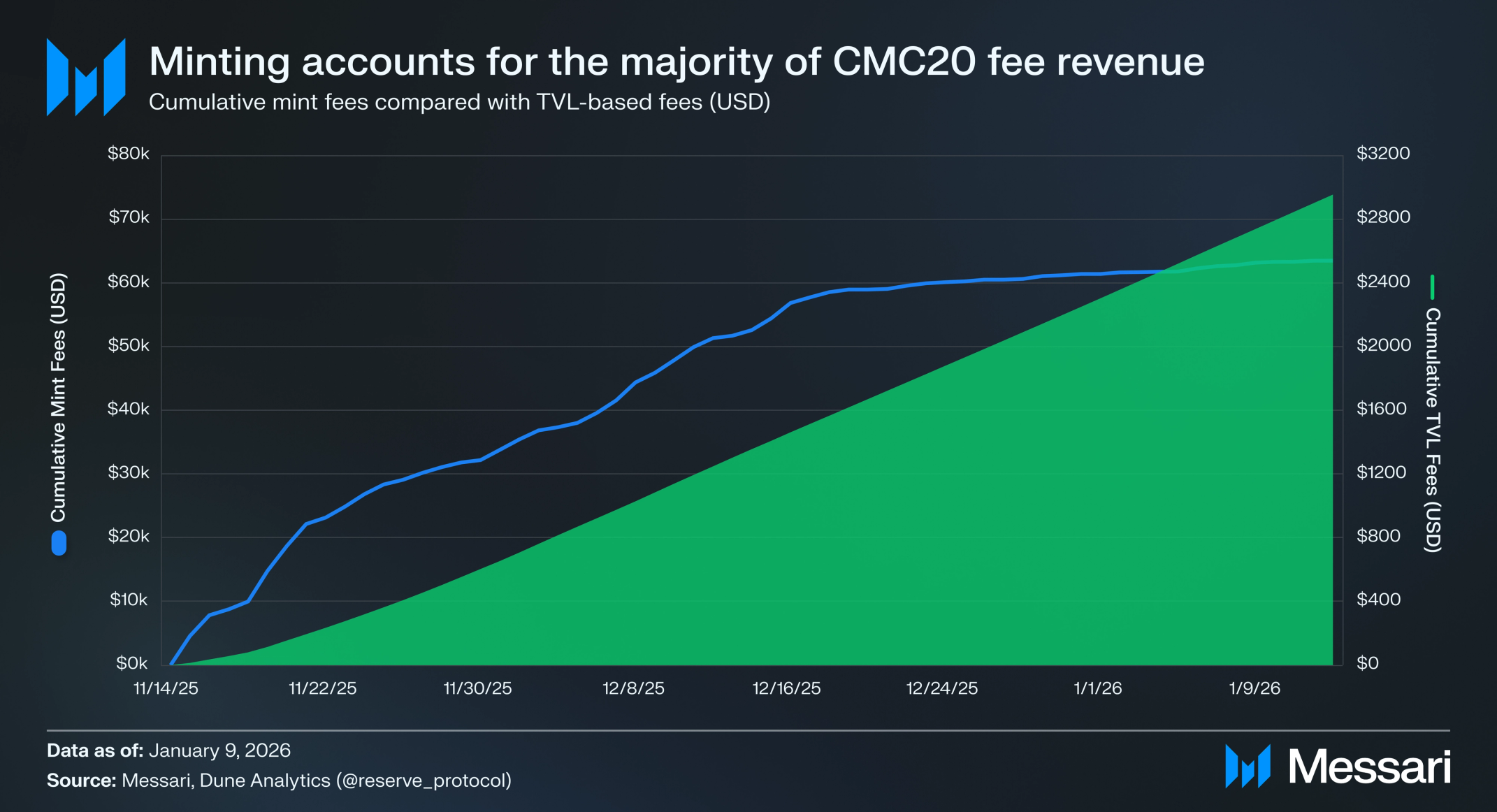
Because mint fees are triggered by issuance activity, fee generation has been closely tied to minting volumes rather than to assets held over time. As of Jan. 15, 2026, cumulative mint fees total approximately $63,000, compared with roughly $3,000 in TVL-based fees. Mint fee growth was strongest during the initial expansion phase following launch and slowed as issuance activity moderated. In contrast, TVL-based fees increased steadily throughout the period, reflecting their dependence on assets remaining deployed rather than on new token issuance.
Platform Fees
After collection, CMC20’s mint and TVL fees are split between the Reserve platform and the product’s designated fee recipients according to a progressive, TVL-based platform fee schedule. Platform fees are calculated marginally across defined TVL tranches on a slice-by-slice basis, with each tranche applying a fixed platform share only to the portion of assets within that range. Under this structure, higher TVL tiers are associated with lower platform fee percentages, increasing the share of incremental fee revenue distributed to product-level recipients when the progressive schedule applies.
Both mint and TVL fees are subject to protocol-level constraints that enforce a minimum net platform fee of 15 basis points. If the progressive schedule would result in a lower platform take, a floor override applies to ensure a baseline level of platform revenue, while still allowing product-level recipients to capture a larger share of fees as assets under management increase.
RSR Buybacks and Protocol-Level Allocation
The platform’s share of fees generated by CMC20 accrues at the protocol level. These fees are currently directed toward RSR burns to reduce the circulating supply. The use of protocol-level fees, including whether they are allocated to token burns, retained in a treasury, or redirected toward ecosystem growth initiatives, is subject to governance by RSR holders. While CMC20 does not grant protocol-level governance authority over its index parameters, its activity contributes to protocol revenue that can be deployed through RSR governance decisions over time.
Economic Flywheel
CMC20 usage affects protocol-level economics through fee flows rather than through direct governance control. Periods of higher minting activity increase the amount of fee revenue accrued at the protocol level, while RSR governance determines how those funds are ultimately allocated. According to current protocol practice, these fees are directed toward RSR token burns, though governance retains the ability to redirect them toward other approved uses over time.
This relationship links CMC20 activity to broader Reserve governance outcomes without granting protocol-level governance authority over CMC20’s index parameters. Notably, the resulting feedback loop is incentive-driven and conditional, relying on both sustained market activity and governance decisions rather than operating as an automatic or guaranteed growth mechanism.
Index Protocol Expansion Outlook
According to the Reserve team, Reserve’s longer-term goal is to expand the Index Protocol to support permissionless creation of Index DTFs by third parties. If implemented, this would allow external teams to launch index products using the same minting, fee, and arbitrage mechanics observed in CMC20. No timeline for such an expansion has been publicly disclosed, and implementation details remain subject to governance and technical constraints.
Closing Summary
CMC20 is an early implementation of a broad market onchain index, and its initial trading and issuance activity demonstrate how open index mechanics operate in live market conditions. High trading volume relative to market capitalization, along with recurring mint and redeem activity, shows that CMC20 is being used as a tradable market exposure rather than a passive buy-and-hold vehicle.
As a result, CMC20 provides a concrete example of how permissionless index arbitrage, activity-linked fee models, and protocol-level governance incentives can function together without relying on authorized intermediaries. Its early performance offers a practical reference point for evaluating Reserve’s index architecture as a DeFi-native alternative to traditional index products.
This report was commissioned by Reserve Protocol. All content was produced independently by the author(s) and does not necessarily reflect the opinions of Messari, Inc. or the organization that requested the report. The commissioning organization may have input on the content of the report, but Messari maintains editorial control over the final report to retain data accuracy and objectivity. Author(s) may hold cryptocurrencies named in this report. This report is meant for informational purposes only. It is not meant to serve as investment advice. You should conduct your own research and consult an independent financial, tax, or legal advisor before making any investment decisions. Past performance of any asset is not indicative of future results. Please see our Terms of Service for more information.
No part of this report may be (a) copied, photocopied, duplicated in any form by any means or (b) redistributed without the prior written consent of Messari®.