Real takeaways from real trading volumes

After a lackluster December, real trading volumes for the top ten cryptoassets surged at the beginning of 2020. This boost in demand peaked on March 12, during which a mass-market selloff resulted in the highest volumes seen since Jun. 2019. As prices fell, exchange activity subsided throughout April before coincidentally picking back up in time for Bitcoin’s third halving.
Trading volumes are certainly an indicator of a crypto exchange’s success. But exchanges weren’t the only beneficiaries of the market chaos. Tether has seen a significant increase in real trading volume relative to other large cap assets since the start of 2020. It has ceded some trading interest to Bitcoin in the weeks leading up to the halving; however, Tether’s volume remains on par with that of Bitcoin.
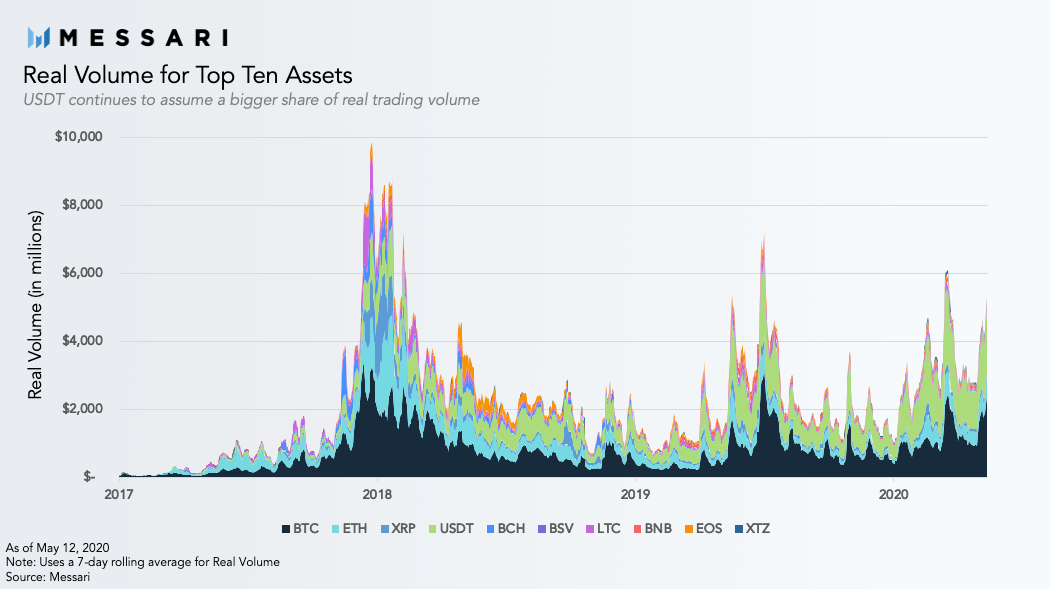
Tether’s increasing share of real trading volume is not surprising. As we’ve mentioned before, crypto is dollarizing at a rapid rate, a trend that dates back to the ICO bubble fallout in early 2018. Stablecoins not only provide investors with a safety net in times of uncertainty, but they also serve as a more familiar, and perhaps preferable, medium of exchange (MoE) and unit of account (UoA). As the demand for stability has increased, the exchange activity and respective market capitalizations for Tether and most stablecoin competitors have followed suit.
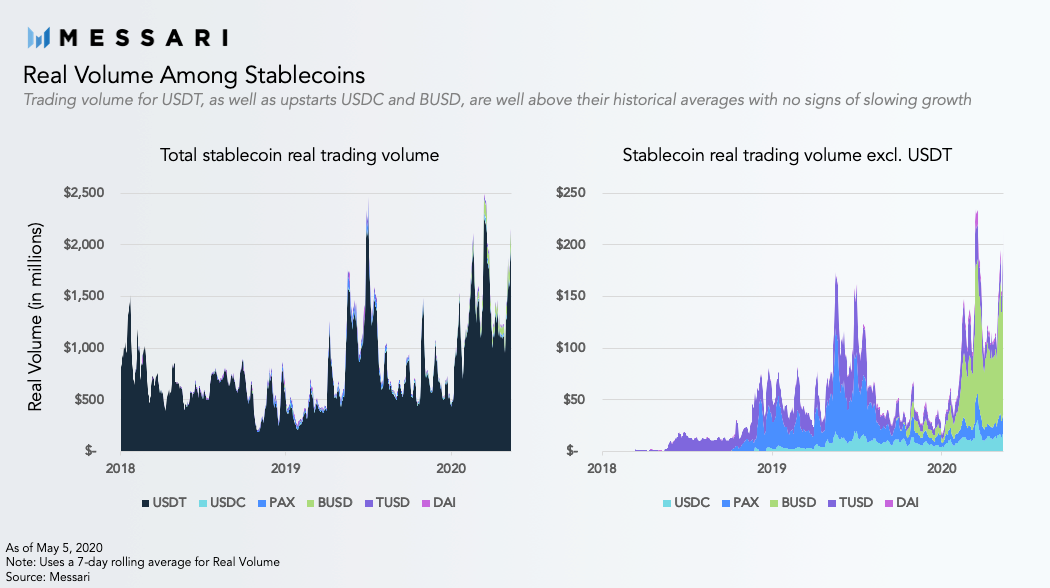
This growth in stablecoin demand shows no sign of slowing down, particularly with a looming economic recession. As Qiao recently wrote, “the world still views the USD as a great store of value, especially in times of crisis.” Thus stablecoins could see an influx of demand from people outside of the U.S. looking to store their wealth in USD in addition to crypto users trying to hedge their investments. If these uncertain times persist, Tether and the rest of the stablecoin sector should quickly assume and maintain the majority share of all real trading volume for the foreseeable future.
Tether’s rise in popularity is also evidence that investor demand within crypto is once again consolidating at the top. Despite the Cambrian explosion of new crypto projects in 2017 and 2018, Bitcoin and Tether generated ~76% of the real trading volume among top ten assets last month. Add in Ethereum, and that total jumps to almost 90%, a substantial increase from just a year ago when the three combined for ~75% of the real trading volume within the same subset.

Wilson Withiam was a Senior Research Analyst at Messari. Previously, he worked at Circle Research where he conducted research on cryptoassets. He graduated with a B.Sc. in Kinesiology and Exercise Science before studying computer science and economics at UConn.