Rayls is a modular blockchain infrastructure stack designed for institutional adoption to transact onchain and to connect private institutional chains with public chains, allowing institutions to access DeFi primitives. It preserves client privacy, supports regulatory compliance, and is composed of privacy nodes, private networks, the Enygma transaction privacy protocol, and the Rayls public chain.
In Q4 2025, the RLS token will launch with 15.0% (1.5 billion RLS) of the 10 billion total supply circulating at TGE.
RLS is used for staking, governance, and transaction fees, where fee distribution is split between validators, the Rayls Foundation treasury, and the Ecosystem Development Fund.
In Q1 2026, the Rayls team plans to launch the public chain mainnet, followed by the release of Privacy Node V3 in Q2 and the deployment of the Enygma privacy protocol on the public chain in Q3.
Primer
Rayls (RLS) is a tech stack built for institutions to transact onchain while maintaining transaction and account privacy and regulatory compliance. Rayls is also designed to connect private institutional chains with public chains, allowing institutions to access DeFi primitives. It has four components: Privacy Nodes, Private Networks, the Enygma transaction privacy protocol, and the Rayls public chain, an EVM-compatible L1.
Each privacy node is an institution's self-operated private EVM chain for internal token issuance, transfers, and client account management. They process up to 10,000 transactions per second (TPS), are live in production for a limited set of institutions, including Nuclea, and will be open-source beginning in Q1 2026.
Privacy nodes transact with other institutions through Rayls private networks, permissioned blockchains governed under independent regulatory frameworks. These networks allow institutions under the same regulatory regime to exchange assets in line with local regulations while keeping internal client data private and auditable through Enygma.
Enygma is a private transaction protocol that validates transactions without revealing the sender, recipient, or amount, and uses ZK proofs and post-quantum authenticated key exchange to secure communication. Optional selective disclosure and audit functions let institutions provide verifiable proofs to regulators while preserving confidentiality for clients and partners.
Privacy nodes can also bridge to the Rayls public chain, an EVM-compatible L1, to interact with external applications. The public chain uses a proof-of-staked authority consensus model, a proof-of-stake variant with permissioned block production.
In Q4 2025, Rayls will hold a Token Generation Event for its native RLS token, which has a fixed total supply of 10 billion. RLS is used for validator staking, governance participation, and transaction fee payments.
Staking
Validators stake RLS to secure the network and earn RLS fees, and Rayls’ consensus protocol slashes dishonest validators. Tokenholders may delegate RLS to validators to earn a portion of staking payouts. A permissioned validator set composed of Rayls-approved financial institutions verifies transactions and ZK proofs produced by privacy nodes, private networks, and the public chain.
Governance
The Rayls Foundation currently governs the protocol, however, the foundation plans to transition governance to the Rayls Governance DAO. Once the DAO is operational, RLS holders can vote on protocol upgrades, propose rule changes, approve ecosystem grant funding, and elect foundation representatives to make time-sensitive decisions. Governance will shift in phases once onchain voting infrastructure is in place, which is expected to begin in 2026.
Transaction Fees
Transaction fees across the Rayls network settle in RLS. Standard asset transfers will have a fixed dollar-denominated fee (i.e., $0.01 per transfer) while complex transactions such as lending will incur higher gas costs. Fees will be payable in Rayls-approved tokens, expected to include USDC, USDT, ETH, and RLS, though the final list has not yet been confirmed by the team.
Transactions on privacy nodes and private networks do not include user-facing gas fees, though institutions pay volume-based fees to the Rayls Foundation in RLS. Volume includes internal token issuance and client transfers on privacy nodes, and inter-institution transactions on private networks.
RLS transaction fees are distributed in three ways to the validator pool, the Rayls Foundation treasury, and the Ecosystem Development Fund. The fund will be used to incentivise early liquidity providers, validators, institutional asset issuers, developers, ethical hackers through bug bounties and community participation. The foundation plans to initiate strategic partnerships that connect financial institutions to application teams, and Rayls plans to reward active users through airdrops, staking incentives, referral bonuses, and governance participation.
Flywheel and Proof of Usage (PoU)
Rayls designed the RLS token to propel a demand loop that links institutional and retail activity to RLS's open-market purchases. As usage grows, institutions transacting on privacy nodes and private networks purchase RLS directly to pay usage-based fees, and on the public chain, users will pay gas fees in a stablecoin (i.e., USDT) that the protocol converts into RLS at settlement. This structure increases demand for RLS and redistributes the token to validators and ecosystem programs as network activity scales.
To provide transparency into institutional activity, Rayls is building a Proof of Usage (PoU) system that will surface private transaction data without disclosing client details. The system will publish aggregate RLS-denominated fees paid by institutions operating privacy nodes and participating in private networks. Rayls’ most recent version, the RLS Payments Dashboard, will also display transaction counts across private chains.
Tokenomics
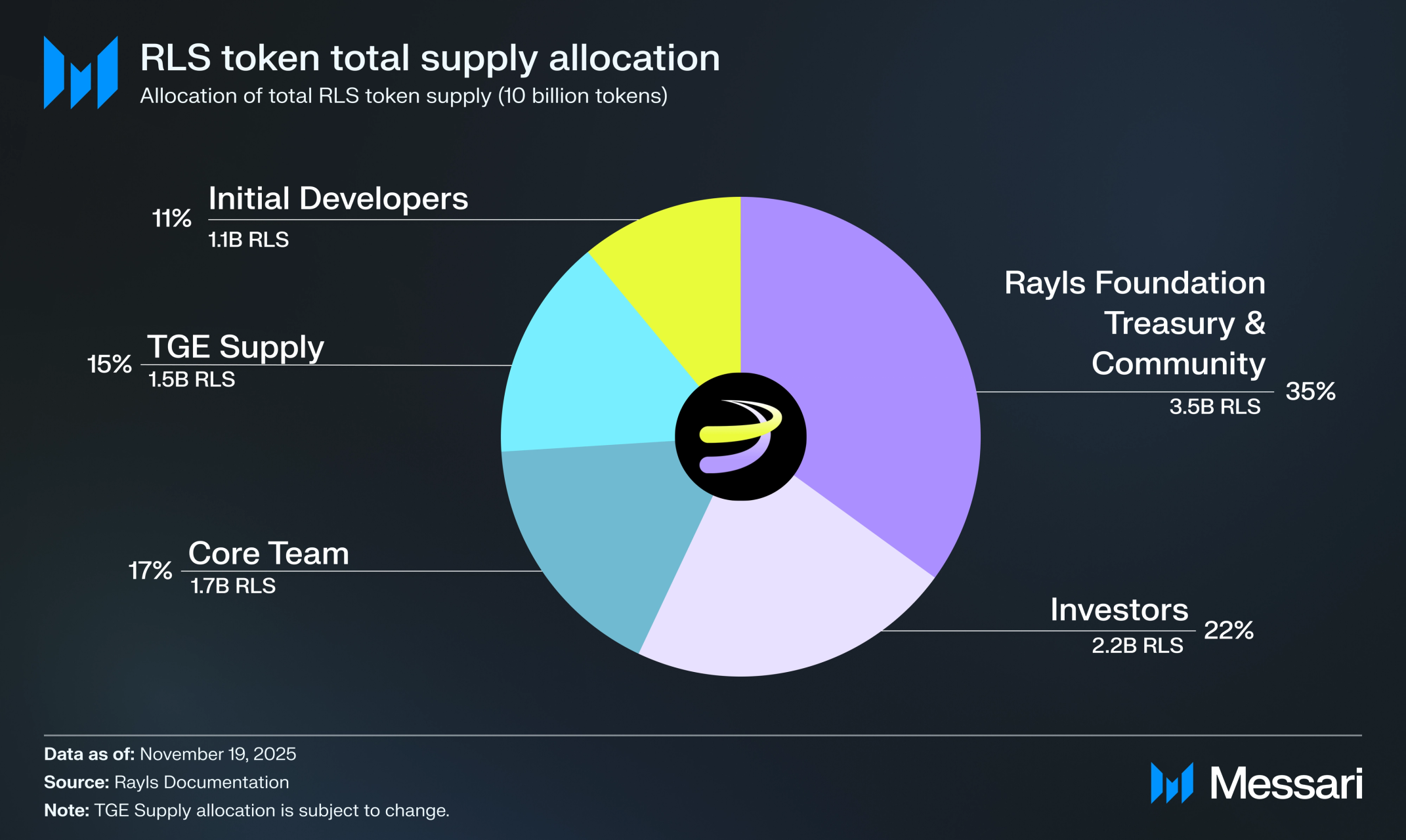
In Q4 2025, Rayls will hold a Token Generation Event (TGE) for its native RLS token. At launch, 15.0% (1.5 billion RLS) of the 10 billion total supply will be circulating.
Allocations and Unlocks
Rayls Foundation Treasury and Community, 35.0% (3.5 billion RLS):
The Rayls Foundation custodies this allocation in a multisig wallet, which vests linearly over 48 months. Within this category, an estimated 10.0% of the total supply (1.0 billion RLS) will fund community initiatives, including liquidity programs, developer grants, and security initiatives. The remaining estimated 25.0% (2.5 billion RLS) will support long-term network initiatives at the foundation’s discretion.
Investors, 22.0% (2.2 billion RLS):
Private investors receive this allocation with a 12-month cliff followed by linear vesting over 36 months.
Core Team, 17.0% (1.7 billion RLS):
Rayls’ core team members receive this allocation with a 12-month cliff followed by linear vesting over 36 months.
TGE Supply, 15.0% (1.5 billion RLS):
Rayls fully unlocked this allocation at TGE for public purchase of RLS on centralized exchanges.
Initial Developer, 11.0% (1.1 billion RLS):
Early protocol developers receive this allocation with a 12-month cliff followed by linear vesting over 36 months.
Roadmap
In June 2024, Rayls launched its first private network with Nuclea, a Brazil-based financial market infrastructure and payments processor. In June 2025, the team deployed their first public Testnet and has recently launched a new Testnet using the Rayls RBFT L1 technology stack, with additional upgrades and features ahead of mainnet launch.
In Q1 2026, Rayls plans to launch the V1 Mainnet. In Q2 2026, they plan to release Privacy Node V3 with multi-network connectivity, and in Q3 2026, they will deploy Enygma on the public chain. Ahead of mainnet, Rayls is prioritizing privacy node deployment among financial institutions, integration with private networks, and improving the onboarding process for institutional clients.
Closing Summary
Rayls is a blockchain infrastructure stack built for institutions to transact onchain while preserving client privacy and complying with regulatory requirements. Its modular architecture includes institution-operated privacy nodes, interlinked private networks, the Enygma transaction privacy protocol, and an EVM-compatible L1.
In Q4 2025, Rayls will launch the RLS token with a total supply of 10 billion, used for validator staking, protocol governance, and transaction fee settlement across the ecosystem. At TGE, 15.0% of the total supply (1.5 billion RLS) will be circulating.
Since June 2025, Rayls has operated the public chain testnet and has recently launched a new testnet using the Rayls RBFT L1 technology stack. In Q1 2026, Rayls plans to launch the mainnet, alongside plans for upgraded privacy nodes and the public chain deployment of Enygma. With private infrastructure already in production at major institutions, including the Central Bank of Brazil and JPMorgan, Rayls is developing a phased rollout to connect compliant institutional finance to public blockchain infrastructure.
This report was commissioned by Rayls Group. All content was produced independently by the author(s) and does not necessarily reflect the opinions of Messari, Inc. or the organization that requested the report. The commissioning organization may have input on the content of the report, but Messari maintains editorial control over the final report to retain data accuracy and objectivity. Author(s) may hold cryptocurrencies named in this report. This report is meant for informational purposes only. It is not meant to serve as investment advice. You should conduct your own research and consult an independent financial, tax, or legal advisor before making any investment decisions. Past performance of any asset is not indicative of future results. Please see our Terms of Service for more information.
No part of this report may be (a) copied, photocopied, duplicated in any form by any means or (b) redistributed without the prior written consent of Messari®.
Austin is a Sr. Research Analyst for Messari’s Protocol Services team. He focuses on Prediction Markets, DeFi, & Interop. protocols. He previously worked on PwC's Digital Assets team.
Austin is a Sr. Research Analyst for Messari’s Protocol Services team. He focuses on Prediction Markets, DeFi, & Interop. protocols. He previously worked on PwC's Digital Assets team.