Q2'20 Review: Platform wars narrative poised for a comeback

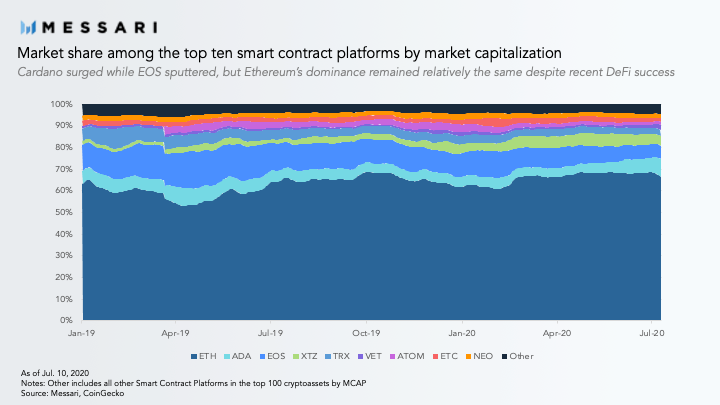
With DeFi exploding, the race to build a “better” Ethereum seemed, well, boring. Despite several new Smart Contract Platforms hitting the market over the last year at nine-figure valuations, Ethereum’s dominance over its competitors hasn’t budged. It continues to wield a shield forged by a grassroots mindshare among developers and a liquidity gravity well that makes it seem impervious to encroaching intruders.
However, Ethereum’s most recent fee woes coupled with an elongated transition to Ethereum 2.0 may provide a window of opportunity for more scalable competitors to gain some market share. This window just happens to coincide with several high-profile “Ethereum Killers,” such as Polkadot and Cardano, starting to take off their training wheels. Even though the DeFi narrative is strong, expect the activity around the Platform Wars to pick up over the next few quarters.
Where there’s competition lies an opportunity. How investors spend their money and which scaling or interoperability narratives pan out could determine where new talent and liquidity flows next. These open questions might hold the answer to whether Ethereum retains its current market dominance for the foreseeable future.
Sky-high valuations for ETH Killers
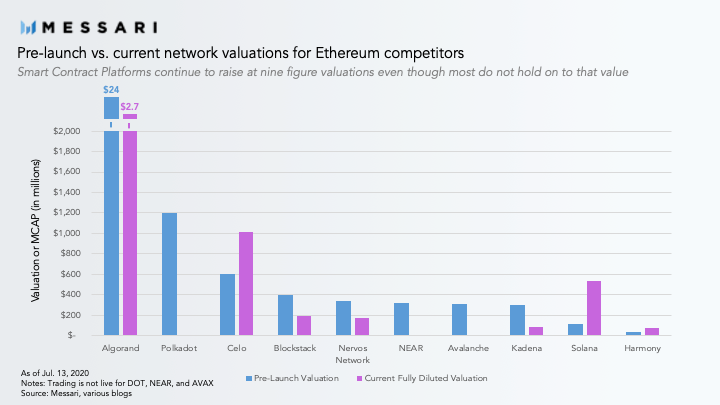
The last two years were down years (or rebuilding seasons for optimists) in terms of most crypto network valuations. But that didn’t stop investors from continuing to pour money into pre-mainnet Ethereum competitors. Since Harmony’s modest $5 million raise in May 2019, thirteen Smart Contract Platforms have raked in over $300 million combined. Almost all were valued well north of $100 million.

Wilson Withiam was a Senior Research Analyst at Messari. Previously, he worked at Circle Research where he conducted research on cryptoassets. He graduated with a B.Sc. in Kinesiology and Exercise Science before studying computer science and economics at UConn.