Power and Wealth in Cryptoeconomies

Imagine you’re designing a new economic system from scratch. You’re deciding everything from resource allocation to property rights to how this entire system will ultimately be governed and controlled. How would you design it?
In truth, there’s no right answer. This is a question that philosophers, politicians, and economists have struggled with for centuries as they’ve designed institutions. In any case these architects attempt to satisfy society’s shared ideals when doing so, such as freedom, opportunity, fairness, and security.
Whether they know it or not, blockchain architects face similar questions as they design blockchains. Like firms, markets, and governments, blockchains are also an institutional technology. They not only regulate the supply and distribution of scarce digital assets, they also provide a governance system for a wide variety of social, political, and economic activities. Ultimately blockchains may grow to become the foundation of the global economy and usher in a new economic system. But before they fulfill this ambition they must first answer the most basic questions about power and wealth distribution.
With this in mind, how have blockchain architects done so far? Well, the results are mixed.
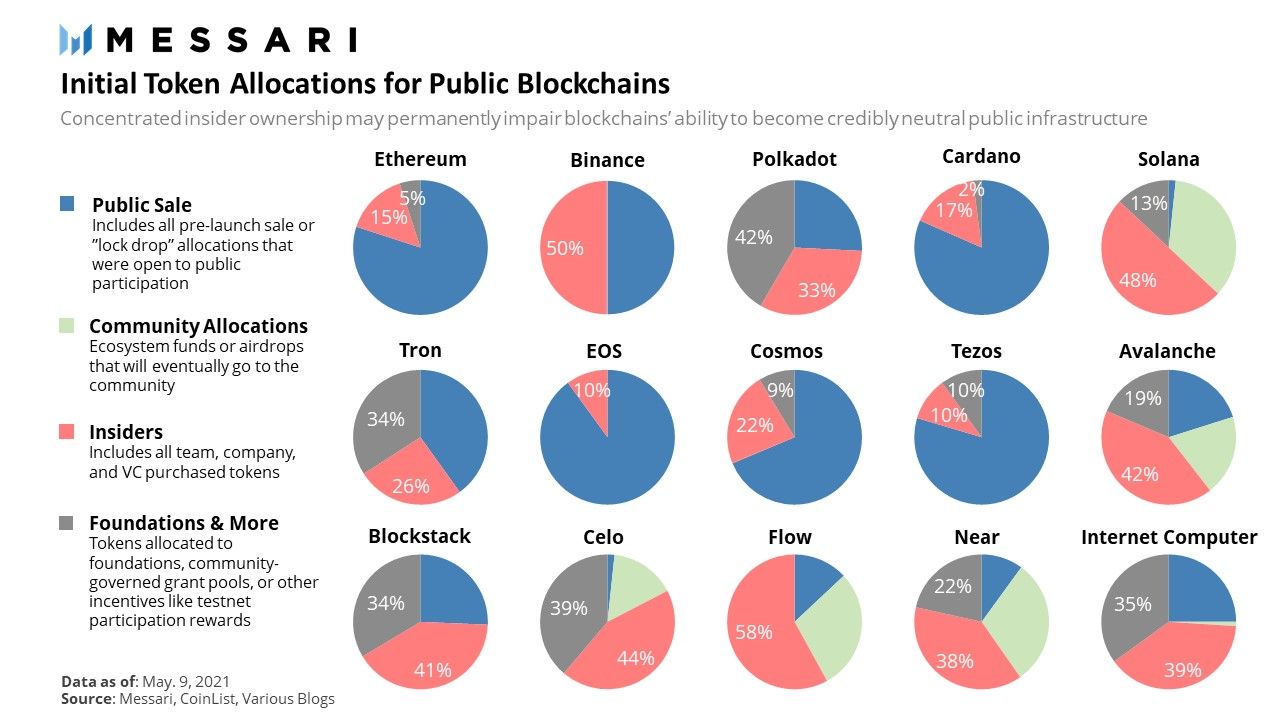
An Erosion of Values?
The original philosophy underpinning token sales centered around the idea of communities funding open source projects and receiving ownership in return. Many of the older smart contract platforms took this philosophy to heart, allocating the majority of their token supplies to their communities in this fashion. Projects such as Ethereum, Cosmos, Tezos, and EOS for example allocated more than 70% of their token supplies to their communities for this purpose.

Ryan Watkins was a Senior Research Analyst at Messari. Previously, he worked at Moelis & Company as an Investment Banking Analyst where he worked on deals in the technology, telecom, and fintech sectors. Ryan graduated Magna Cum Laude from the Gabelli School of Business at Fordham University.