Polkadot unlocks on-chain governance features and completes first community-led upgrade

Polkadot's on-chain governance system has approved and completed its first vote, which removed the "super-user" privileges (aka Sudo) held by the Web3 Foundation. This Sudo ability allowed the Foundation to manage the chain and initiate runtime upgrades during Polkadot's early phases, such as when the network converted to its Proof-of-Stake protocol. With the removal of these admin keys, Polkadot has now transitioned from a candidate chain to its official mainnet.
The network's future direction is now in the hands of its on-chain governance system, a three-chamber model consisting of a Council, a Technical Committee, and DOT token holders. The Web3 Foundation upgraded the chain yesterday to give the newly elected 13-member Council the ability to spearhead this inaugural vote.
Why it matters:
- This official mainnet "launch" was somewhat of a quiet event. It does usher in a new era of decentralized governance and means Polkadot no longer operates similarly to a permissioned network. But the event was more of a trial run for the on-chain voting model. What the upgrade does mean for token holders is that unlocking token transfers is the next stage in Polkadot's mainnet rollout. In a previous post, the Web3 Foundation said, "one of the first post-Sudo upgrades will likely enable balance transfers in the network."
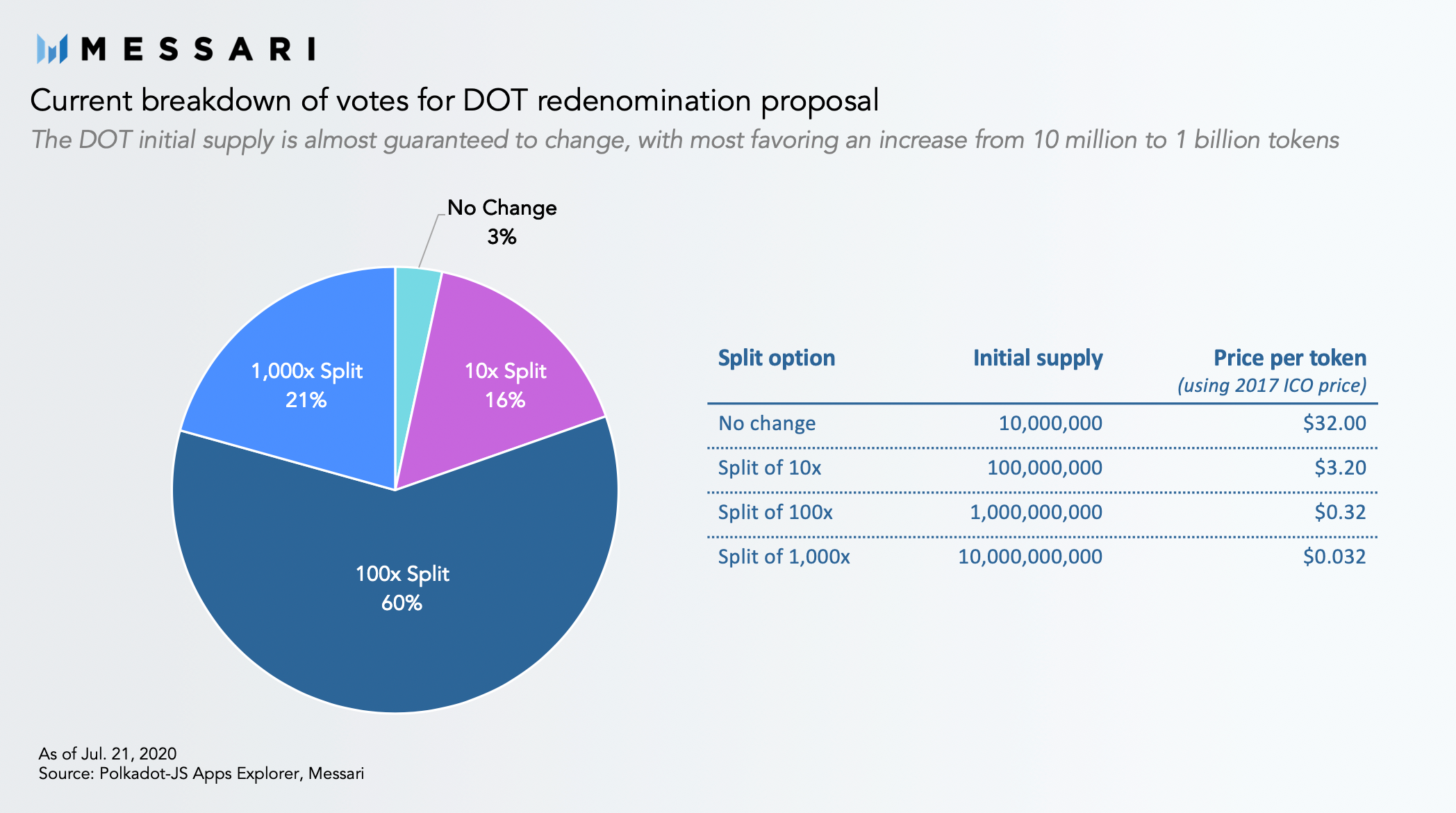
- Speaking of DOTs, the Web3 Foundation is currently holding a vote to redenominate the token supply. Holders can choose to increase the initial DOT supply by 10x, 100x, 1,000x, or keep it the same (currently 10 million) while decreasing their dollar amount by the same option. This vote will not change Polkadot's pre-trading market cap, but a lower price can aid distribution by making it more accessible to retail investors. The flip side is users could view it less like a store of value (SoV). As of now, the 100x split is the overwhelming favorite.