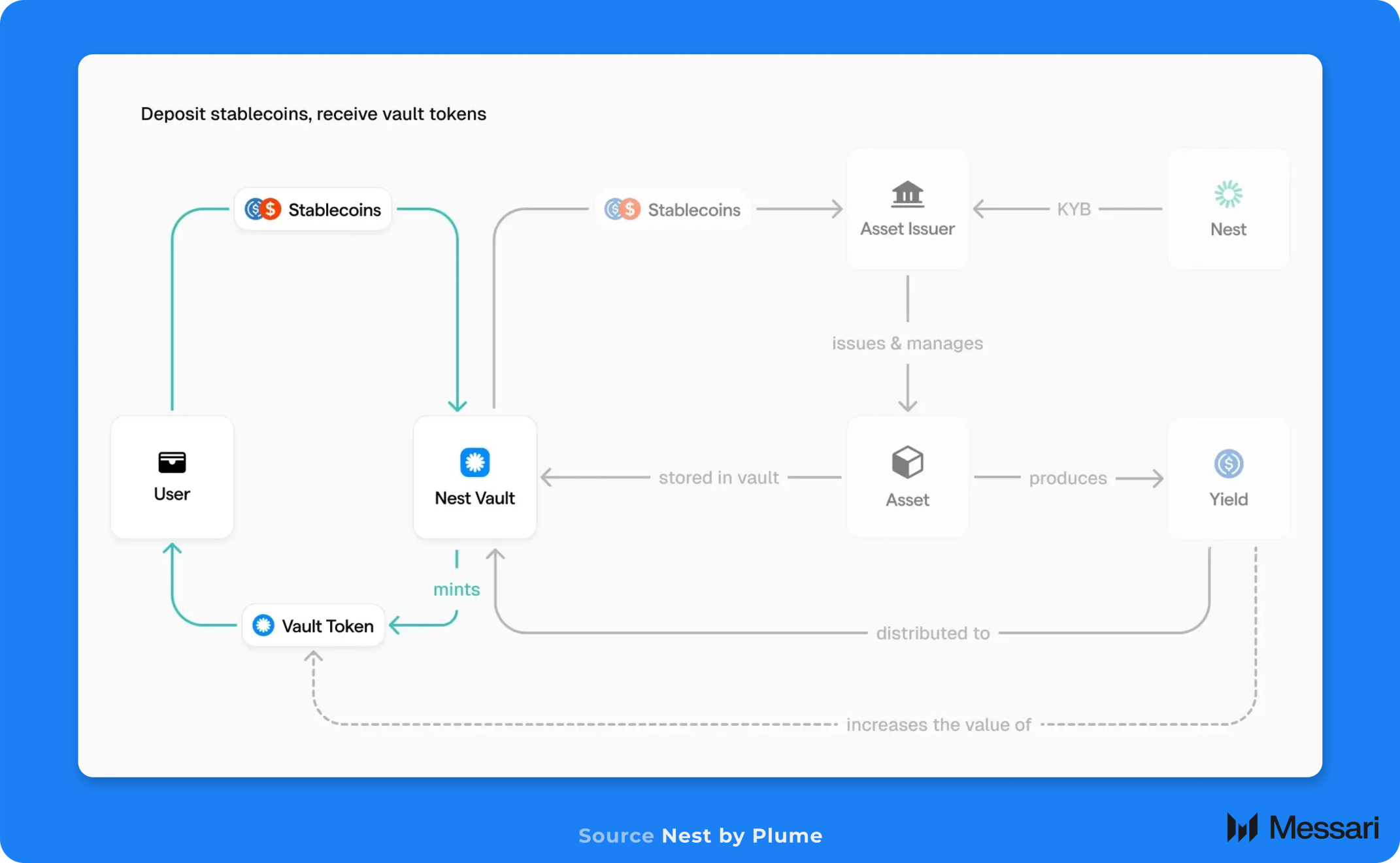
Nest is Plume’s flagship RWA protocol that allows users to deposit stablecoins into institutional-grade vaults to receive liquid-staking tokens that accrue yield based on underlying RWA performance.
On Nov. 4, 2025, Nest was upgraded to expand the vault set and redesign the platform interface.
On Dec. 11, 2025, Plume announced that five Nest vaults would be deployed on Solana, increasing the availability of stable yield options for DeFi users.
On March 5, 2026, Plume announced an integration with Solana-based stablebank Perena, enabling its USD* product to allocate to Nest vaults and embed RWA-backed yield directly into a stablecoin-like asset, signaling a shift toward yield-bearing stable assets as a core primitive in onchain finance.
On March 19, 2026, Plume announced a partnership with EtherFi to integrate Nest vault infrastructure into its platform, enabling access to RWA-backed yield for a user base with over $6 billion in deposits and positioning Nest as embedded yield infrastructure within consumer-facing crypto applications.
Primer
Plume is the Open Finance network for institutional assets, enabling asset issuers and institutions to deploy onchain assets through its native infrastructure and grow those assets through its flagship real-world yield protocol, Nest.
On June 5, 2025, Plume (PLUME) officially launched Plume Genesis, the public mainnet designed for real-world asset finance. Since launch, Plume has integrated with established traditional financial titans (e.g., WisdomTree and Apollo) and DeFi mainstays (e.g., Pendle and Morpho), onboarding over $150 million in utilized RWAs. Plume’s Series A was backed by major investors (e.g., Brevan Howard, Apollo, Galaxy), and the network is live with more than 200 projects live or in development.
Plume’s architecture is centered on standardizing how real-world assets are issued, verified, and composably deployed across financial applications. The network offers a vertically integrated stack that abstracts regulatory, data, and operational complexity for asset issuers while enabling DeFi protocols to incorporate structured financial products with predictable compliance boundaries. This approach is intended to unify traditionally siloed components of the RWA lifecycle into a consistent onchain framework.
The count of addresses holding RWAs on Plume jumped to over 103,000 within weeks of launch, and currently stands at over 250,000. Through the Plume Portal, users can bridge assets into Plume, swap tokens, and explore protocols like Nest, Rooster, and Morpho. By abstracting away complexity, the portal helps make RWAs feel like native crypto by making them instantly swappable, composable, and accessible.
DeFi protocols offer many forms of onchain yield, but most returns remain sensitive to market cycles, incentive emissions, and short-term liquidity conditions. This variability limits adoption by users seeking predictable income, such as retail participants treating DeFi as a savings or yield-generation tool. As a result, users increasingly seek yields tied to underlying economic activity rather than speculative token flows.
Plume addresses this demand by enabling onchain access to yield generated from tokenized RWAs. Nest serves as the primary interface through which users access these asset-backed yield strategies. In November 2025, Nest was upgraded to expand how users participate in and engage with these strategies by broadening the range of supported vaults, improving capital deployment workflows, and introducing a participation-based incentives layer.
Nest Platform Updates
Nest is Plume’s RWA yield interface. It allows users to deposit stablecoins into vaults and receive ERC-20 vault tokens that reflect exposure to the underlying assets. These tokens provide yield tied to RWAs, such as short-duration treasury products, basis strategies, and private credit, and can be used across DeFi protocols. The model focuses on yield accrual, composability, and onchain transparency, enabling users to monitor vault performance and activity in real time. The upgrade broadens this structure in several ways that directly affect how users access and enhance stable yield:
Expanded vault set – increasing the range of RWA strategies available to depositors.
Redesigned interface – improving usability and access to vault strategies.
Multichain expansion – Nest is now accessible across Ethereum, Solana, Plume, and BNB Chain, with initial vault deployments on Solana expanding access to stable yield beyond the Plume ecosystem.
Plume has also paired Nest’s product expansion with regulatory engagement intended to support compliant access to tokenized RWAs across markets. In October 2025, Plume announced SEC approval as a registered transfer agent, enabling it to manage digital securities, shareholder records, issuance, transfers, and dividends with planned DTCC interoperability. Plume has also participated in policy discussions through General Counsel Salman Banaei’s March 2026 testimony before the U.S. House Financial Services Committee and a comment letter to the Bermuda Monetary Authority’s asset tokenization consultation. These efforts reflect Plume’s broader strategy of shaping regulatory frameworks around the operational realities of onchain assets, including compliance-aware RWA infrastructure such as Nest vaults.
How Vaults Work
Nest vaults convert stablecoin deposits into onchain representations of real-world financial exposures through a standardized nTOKEN model. When a user deposits stablecoins, the vault issues an ERC-20 token (written as nTOKEN, with the token name representing the vault) that reflects a proportional claim on the assets held within that vault. The protocol allocates deposited capital into predefined instruments like short-duration treasuries, basis strategies, or private credit based on the vault’s mandate. Yield generated by these assets is transmitted onchain through changes in the nTOKEN’s redemption value. No emissions-based rewards are used, and accrual is tied to the performance of the underlying assets.
These issued tokens retain full transferability and can be used across integrated apps without severing their link to the underlying collateral. A user can exit a position by redeeming these tokens for the stablecoins backing the vault, subject to asset-level liquidity and settlement timing.
All Nest asset issuers are either audited by a Big Four or equivalent accounting firm, or undergo a dedicated risk assessment, commissioned by Nest, by onchain risk management partners like Cicada Partners.
Current Vaults
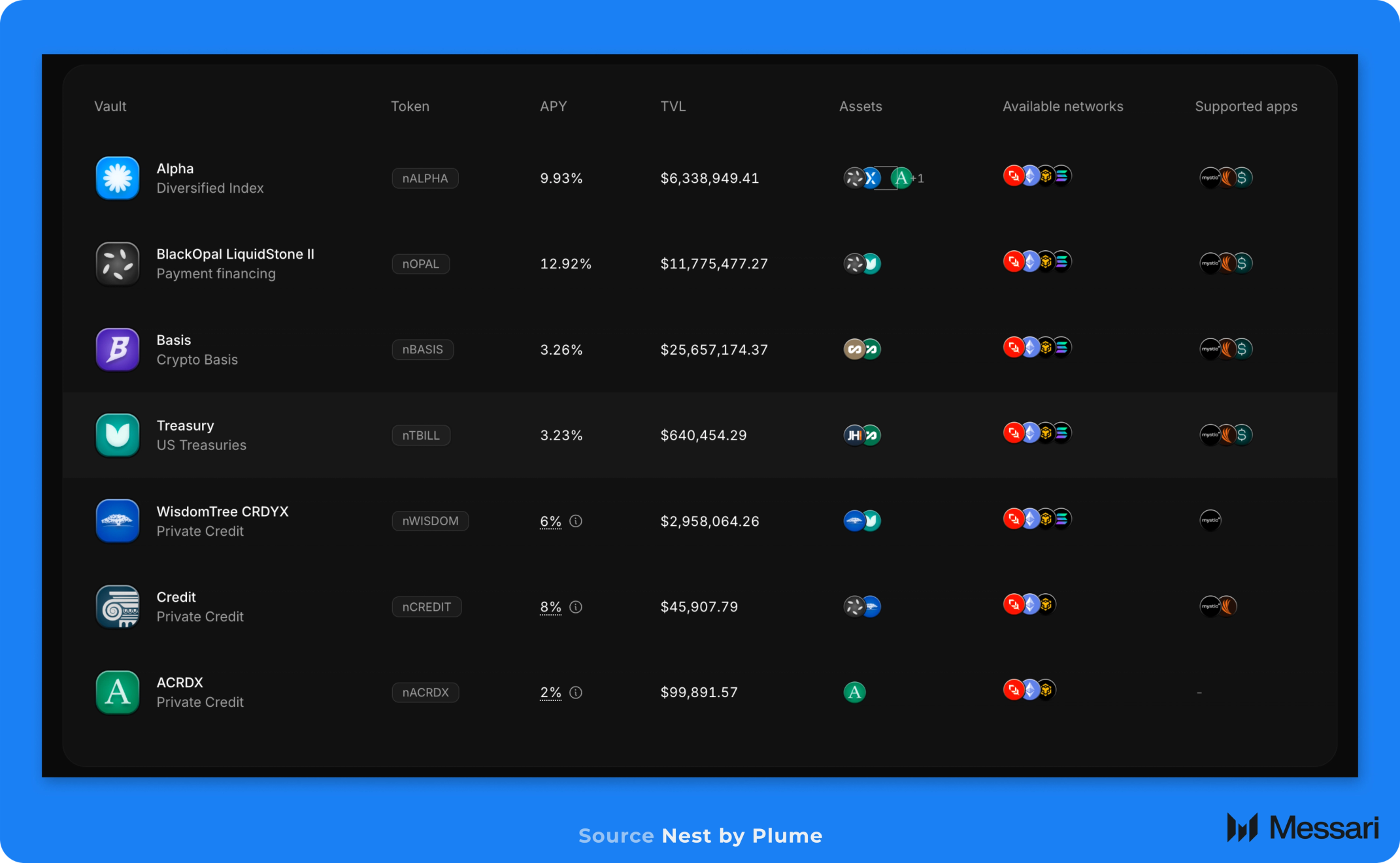
Nest currently offers seven institutional-grade vaults that provide exposure to distinct real-world asset strategies. Integrated Returns may combine a base vault rate with incentives and optional boosts earned through integrated DeFi applications. Each vault issues a standardized nTOKEN that represents a proportional claim on its underlying assets.
Nest Treasury (nTBILL) – offers low-volatility income backed by short-duration U.S. Treasuries, with redemptions typically available within minutes to four days. The vault is fully allocated to short-duration U.S. Treasuries, currently split between Superstate’s USTB Treasury Fund (78%) and the Janus Henderson U.S. Treasury Fund (22%).
Nest Basis (nBASIS) – targets a market-neutral yield profile through a delta-neutral basis strategy. Redemptions range from minutes to four days. Asset exposure is concentrated in crypto carry trades (95%), complemented by a 5% allocation to U.S. Treasuries, sourced from Superstate’s USCC Crypto Carry Fund and USTB Treasury Fund.
Nest Alpha (nALPHA) – seeks enhanced yield through a diversified and actively curated set of real-world assets. Redemption timing varies from minutes to seven days, depending on asset liquidity. Current allocations span payment financing (63.5%), prime brokerage lending (17.5%), private credit (1.6%), liquid assets (1.3%) and U.S. treasuries (0.5%).
Nest BlackOpal LiquidStone II (nOPAL) – built for higher yield through concentrated exposure to structured payment receivables. Redemptions are typically available within minutes to seven days. The vault is heavily allocated to Brazilian credit card receivables (99%) issued by BlackOpal’s LiquidStone II, with a residual 1% allocation to U.S. Treasuries via the Nest Treasury Vault.
Nest WisdomTree CRDYX (nWISDOM) – provides access to institutional private credit and alternative income strategies. Redemption times vary between minutes to four days. Asset exposure is weighted toward private credit (95%) through WisdomTree’s CRDYX fund, with the remaining 5% allocated to U.S. Treasuries via the Nest Treasury Vault.
Nest Credit (nCREDIT) – combines public and private credit strategies for diversified income exposure. Redemptions are available within minutes to seven days. The vault allocates capital across payment financing (67.7%), private credit (30.7%), and liquid assets (1.6%), drawing exposure from WisdomTree’s CRDYX fund, the Nest Opal Vault, and the Nest Treasury Vault.
ACRDX (nACRDX) – provides access to Apollo’s diversified global credit strategy, spanning direct corporate lending, asset-backed lending, and dislocated credit across public and private markets. The vault is majority backed by Apollo ACRDX private credit.
Performance Metrics and Adoption Trends
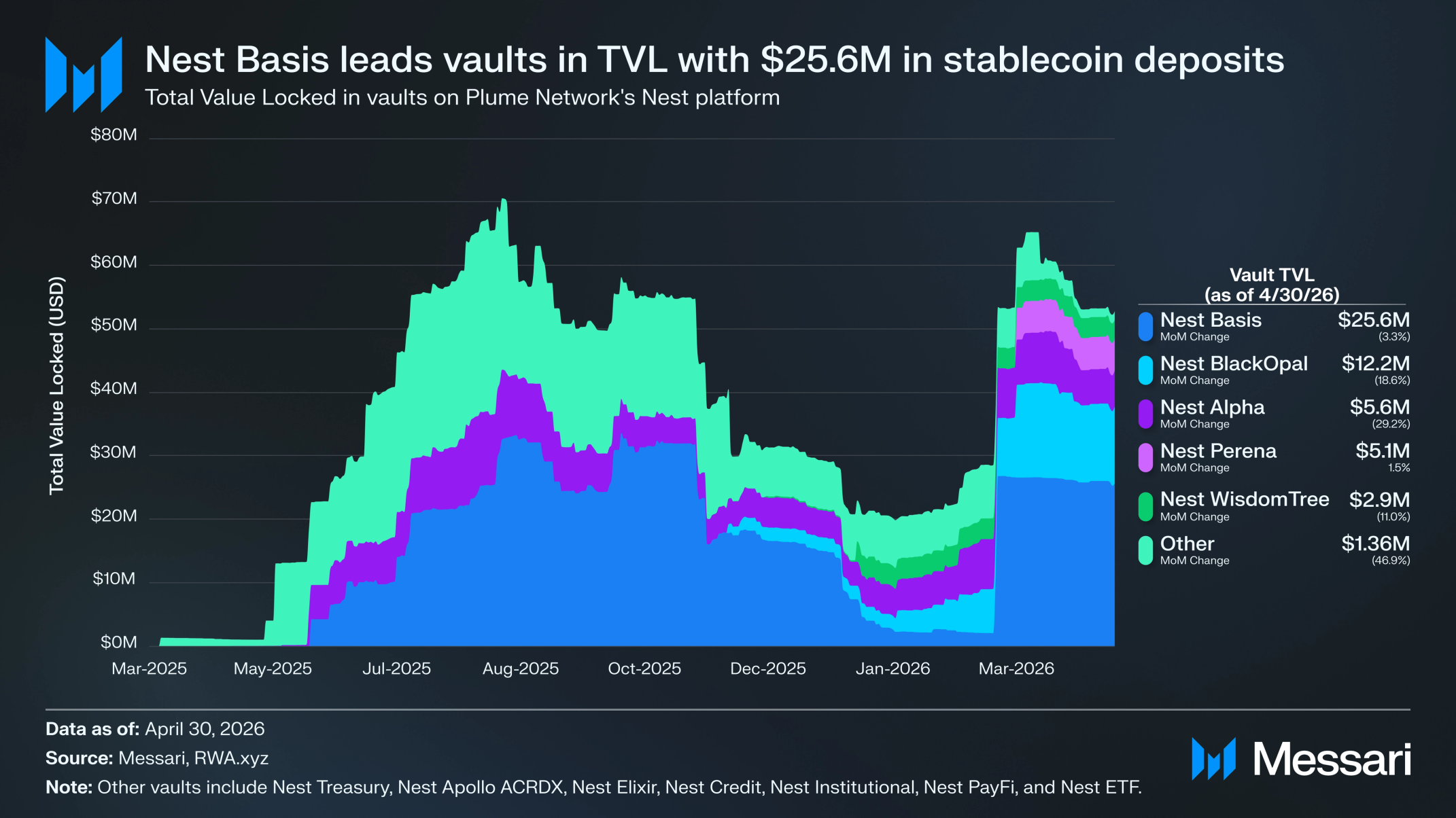
Nest has $52.8 million in total value locked (TVL) amongst its vaults. Nest Basis holds the largest share of stablecoin deposits with $25.6 million allocated to the vault. It is followed by Nest BlackOpal LiquidStone II, Nest Alpha, Nest Perena, Nest WisdomTree, Nest Treasury, and others.
Partnerships and Ecosystem Expansion
On Dec. 4, 2025, Plume announced the deployment of several Nest vaults on Solana, including Nest Basis (nBASIS), Nest Alpha (nALPHA), Nest Treasury Vault (nTBILL), Nest WisdomTree CRDYX (nWISDOM), and Nest BlackOpal LiquidStone II (nOPAL). This deployment extends access to Nest’s stable yield strategies beyond Plume’s existing supported networks, which include Plume, Ethereum, and BNB Chain.
Plume also confirmed an integration with Loopscale to support Nest assets on Solana. Through this integration, users can maintain collateralized exposure to Nest vaults while accessing additional yield opportunities through Solana-native DeFi markets.
Plume’s Solana expansion also includes an integration with Perena, a Solana-native stablebank. On March 5, 2026, Plume announced that Perena would integrate Nest vault infrastructure to provide users with access to RWA yield on Solana, including exposure to institutional-grade assets such as private credit funds. Perena’s USD* product will allocate a portion of its diversified backing to a Nest-curated vault, expanding the role of stable assets from payments and DeFi liquidity into productive RWA-backed income strategies.
Plume has also extended Nest distribution through EtherFi. On March 19, 2026, Plume announced a partnership with EtherFi to integrate Nest vault infrastructure into its platform. The integration will initially center on EtherFi’s allocation to nBASIS, powered by Superstate’s USCC fund, before later integrating access directly into EtherFi’s user interface for eligible users. Plume stated that the partnership would make RWA yield available to a platform with over $6 billion in customer deposits, positioning Nest as embedded yield infrastructure for consumer-facing crypto finance applications.
Together, these integrations suggest that Nest’s growth strategy is shifting beyond direct vault deposits toward distribution through wallets, stablebanks, neobanks, and DeFi applications. This matters because RWA adoption is likely to depend less on users manually seeking out standalone vaults and more on whether tokenized yield can be embedded into familiar onchain financial products.
Closing Summary
Nest reflects Plume’s approach to integrating RWA yield into DeFi through standardized onchain infrastructure rather than standalone yield products. By packaging exposure to Treasuries, private credit, and other institutional asset classes into transferable vault tokens (nTOKENS), Nest lowers the operational and access barriers that typically restrict participation in these markets, enabling users to access asset-backed yield without relying on traditional brokerage or custodial frameworks.
Beyond access, Nest enables RWAs to function as composable financial primitives. Vault tokens remain transferable and usable across integrated protocols while continuing to accrue yield from their underlying assets, allowing users to combine real-world returns with lending, collateralization, and other onchain strategies. This positions Nest not just as a yield product, but as a bridge between offchain capital formation and onchain financial activity.
Recent integrations with platforms such as Perena and EtherFi suggest that Nest’s growth strategy is increasingly centered on distribution rather than direct user acquisition. By embedding RWA-backed yield into stable assets, wallets, and consumer-facing applications, Nest is moving toward a model where tokenized yield is accessed passively within broader financial products, through neobanks and exchanges. This shift may be critical for RWA adoption, as long-term growth is likely to depend less on standalone vault interfaces and more on whether real-world yield can be integrated into the default user experience across crypto financial platforms.
All content was produced independently by the author(s) and does not necessarily reflect the opinions of Messari, Inc. Author(s) may hold cryptocurrencies named in this report. This report is meant for informational purposes only. It is not meant to serve as investment advice. You should conduct your own research and consult an independent financial, tax, or legal advisor before making any investment decisions. Nothing contained in this report is a recommendation or suggestion, directly or indirectly, to buy, sell, make, or hold any investment, loan, commodity, or security, or to undertake any investment or trading strategy with respect to any investment, loan, commodity, security, or any issuer. This report should not be construed as an offer to sell or the solicitation of an offer to buy any security or commodity. Messari does not guarantee the sequence, accuracy, completeness, or timeliness of any information provided in this report. Please see our Terms of Service for more information.
No part of this report may be (a) copied, photocopied, duplicated in any form by any means or (b) redistributed without the prior written consent of Messari®.