Pendle: The Intersection of Yield Trading and RWAs

Pendle is a yield trading protocol currently live on four different chains: Ethereum, Arbitrum, Optimism, and BNB Chain. The protocol enables users to split a yield-bearing token into separate principal and yield tokens, and allows users to trade these tokens through an AMM. Pendle also has ve-tokenomics where vePENDLE holders can vote for gauge rewards.
Pendle Mechanics
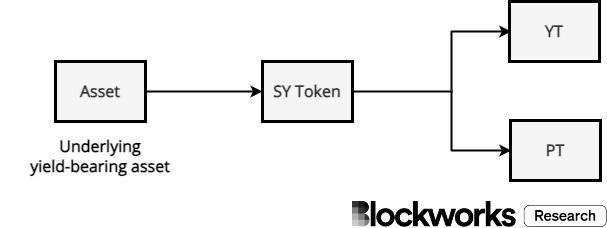
Pendle allows users to trade yield by splitting a yield-bearing token into two separate tokens. Yield-bearing tokens are tokens that generate yield, either in the form of rebasing tokens such as stETH or compounding/elastic tokens such as cUSDC (USDC supplied to Compound). Pendle wraps these yield-bearing tokens into an EIP-5115 token, henceforth known as a standardized yield token standard (SY token).
A SY token comprises equal amounts of principal tokens (PT) and yield tokens (YT). For example, depositing one stETH SY token will result in 1.0216 PT stETH and 1.0216 YT stETH being minted for the 24 Dec 2025 maturity. Principal tokens represent the underlying asset solely (ETH for stETH) and can be redeemed 1:1 for the underlying asset upon maturity, e.g., 1 PT stETH can be redeemed for 1 ETH worth of stETH. As a certain market approaches maturity, 1 SY token deposited will also tend towards 1 PT and 1 YT minted. This is due to the fact that the PT discount relative to the underlying asset will tend towards zero as the price of the YT trends towards zero because there is no yield left towards maturity. The yield token represents the yield component of the underlying yield-bearing asset and entitles the holder to receive the yield up until maturity.
Instead of forcing liquidity providers to deposit into a liquidity pool consisting of three tokens –the SY token, PT, and YT – Pendle uses a liquidity pool that only contains the PT and SY token. When one wants to swap between the PT and SY tokens, they can do so in a straightforward manner through the liquidity pool. If one wants to swap to or from the YT, this is enabled via flash swaps in the same pool. As one may have noticed, if you split up a bond into the principal and interest components, the summation of those two is equal to the current price of the bond. This means that the YT price has an inverse relationship to the PT price, and the Pendle AMM uses that function to help facilitate YT trading.
PurchasingYTs can be achieved by first sending the SY token or any major token (ETH, WBTC, USDc, USDT, DAI, CRV, etc.) into the swap contract. From there, the contract withdraws a larger amount of SY tokens from the PT AMM pool than what was deposited and mints PTs and YTs. It sends the YTs to the buyer according to the AMM exchange rate and then sells the PTs for the SY token to return it to the PT AMM pool the contract borrowed from. A similar set of actions where PT is borrowed from the pool and then used to redeem SY tokens with the YT takes place when YTs are sold.

Ren leads coverage on Options, Structured Products, Money Markets, and AMMs. Previously worked at a crypto hedge fund managing DeFi strategies.