PartyDAO––Collective Building and Bidding

DAO use-cases continue to proliferate. Service DAOs, or those formed to bring together and coordinate skilled individuals are an important experiment for how DAOs can potentially outcompete regular corporations. In the spirit of the original DAO, investment DAOs are becoming commonplace with frameworks like Moloch and OpenLaw, enabling successful DAOs like MetaCartel, The LAO, and FlamingoDAO. However, these DAOs are often limited to accredited investors, leaving it challenging for the average individual to coordinate and pool capital. PartyDAO was formed shortly after the release of PartyBid, a permissionless mechanism launched in early August that enables individuals to trustlessly start a public auction for an NFT.
In the physical world, art ownership is typically limited to one person and collective bidding is not possible. Traditional funds that pool capital to bid collectively and own physical art pieces are limited to one individual showcasing the artwork. Similarly, Masterworks – a platform that fractionalizes and securitizes art – allows multiple parties to own the same piece of art, but obviously limits the ability of who can display the artwork.
Fractional assets and NFTs unlock distributed ownership of almost any piece of media in the digital world. PartyBid is the first of its kind in enabling community building and collective bidding. Fractionalization platforms will become as important as any secondary marketplace as more people enter the NFT space.
Partying for NFTs
Much like PleasrDAO, who recently collected Wu-Tang’s single edition album, PartyBid allows for social and collective ownership of NFTs. A user starts a “party” for an open NFT auction, which anyone can join. If the party wins the auction, they are given the proportional share of ERC-20 tokens from the fractionalized piece. But, if the auction is lost, funds are returned to the respective bidders. In order to fractionalize NFTs, PartyBid relies on Fractional, a smart contract protocol that separates NFTs into fractional ERC-20 tokens.
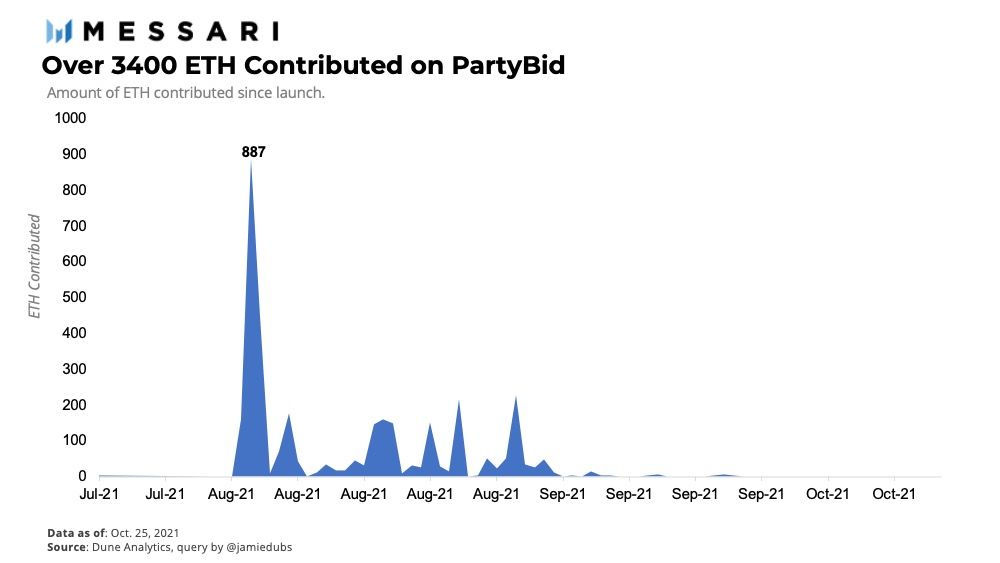
PartyDAO launched via a Mirror crowdfund, and investors were allocated $PARTY tokens. A limited number of $PARTY tokens were created and token owners subsequently formed PartyDAO, which was formed to build and govern PartyBid. Recently, PartyDAO passed a proposal to recapitalize – creating a bigger reserve of tokens – for contributors as they iterate on PartyBid. Since launch, 3,421 ETH have been contributed to 172 parties (auctions) with 887 ETH as the highest single-day contribution. The largest successful auction, Party of the Living Dead amassed 1,201 ETH from bidders, accounting for about 35% of the total ETH contributed on PartyBid. Since then, the number of ETH contributed and parties started has teetered off–– with about one party on average created per day.

Eshita is a Research Analyst at Messari focused on Web3 topics. Previously, she was a Venture Fellow at Bloomberg Beta and prior to that was working on data at Shareworks by Morgan Stanley.