Osmosis: Q1 2024 Update & Valuation

After struggling to amass mindshare outside its core community for several years, the Cosmos ecosystem is coming alive again. Celestia, dYdX, and Dymension recently launched, more rollups and projects are joining the party, and interoperability and liquid staking are improving. Functioning as the DeFi hub for the ecosystem, Osmosis had an impressive latter half of 2023, with strong performance continuing in Q1 2024. KPIs have grown across the board due to the aforementioned projects bringing in more users, trading activity, and market conditions improving.
In addition to robust performance, Osmosis has continued to develop its value accrual mechanisms, materializing adjustable taker fees across all of its liquidity pools, passing signaling proposals on how to distribute ProtoRev revenue, as well as allowing cw-hyperlane contracts to be uploaded. For a refresher on Osmosis’ H1 2023 developments, please refer to our “Osmosis: Q2 Update” report.
Recent Updates
Since the end of H1 2023, Osmosis governance has worked on advancing parameters connected to OSMO’s value accrual. Signaling proposals related to the usage of revenue generated by the ProtoRev module, which has priority on performing non-harmful arbitrage across liquidity pools on Osmosis, were passed in January 2024. Revenue denominated in OSMO is to be burned, while non-OSMO revenue is to be sent to the community pool. As of February 21, 2024, the ProtoRev pool contains ~$1.6M worth of OSMO, ~$104K worth of ATOM, and ~$30K worth of USDC.
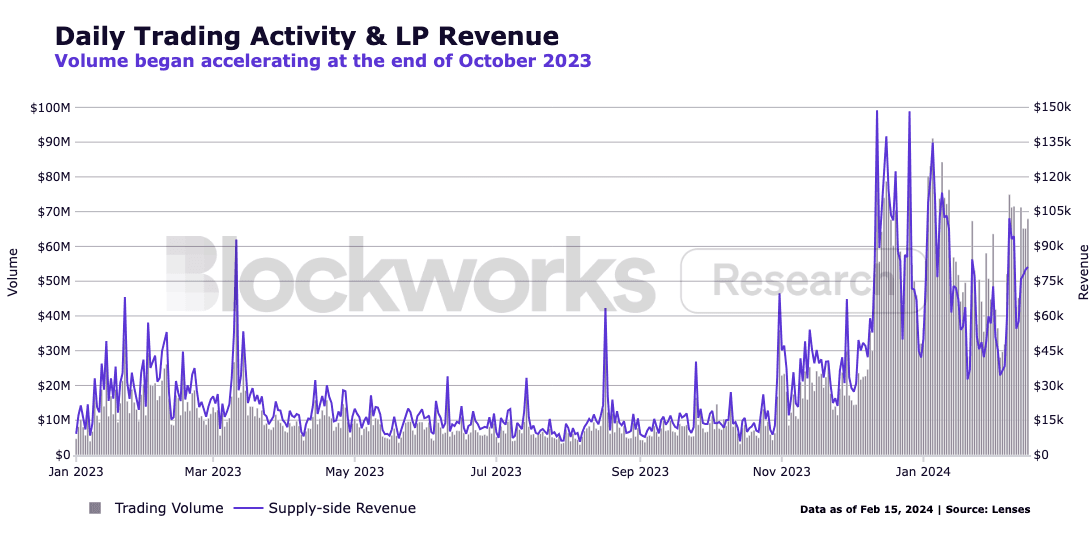
The proposal to set the default taker fee on all trade pairs to 0.1% was passed in October 2023. Previously, the community had passed a signaling proposal to add a default taker fee of 0.15%, but concerns about multihop transactions and the impact on volume deterred this decision. The Protocol Fee SubDAO can change the default fee for specific pairs by decreasing it to 0.02% or zero. Taker Fees accrue from a trading pair’s quote asset, with all OSMO-denominated fees being distributed to stakers, while 67% of non-OSMO fees are converted to OSMO and then distributed to stakers. The decision to turn on taker fees was facilitated by Supercharged Liquidity Pools (akin to Uniswap v3 concentrated liquidity pools), first implemented in July 2023, which allowed the Spread Factor (swap fees to LPs) to be reduced from 0.3% to 0.2% across most pools. Albeit the lowering, supply-side fees have increased as trading volume saw stepwise growth at the beginning of December.
With the reduction of the Spread Factor, many community members feared that liquidity would migrate to other platforms. Dollar-denominated liquidity continued to fall following the Spread Factor decrease, but from the graph below, it is clear that this was mainly driven by the price of OSMO falling. OSMO and stOSMO make up ~44% of all liquidity on Osmosis as of February 15, 2024. Consequently, dollar-denominated liquidity has now returned to similar levels seen in February 2023, as the price of OSMO has increased drastically since the middle of October 2023. Simply put, liquidity does not currently pose a bottleneck for growth. Supercharged Liquidity Pools are more capital efficient than the previous liquidity pool design, enabling Osmosis to serve similar volumes with less liquidity.

Brick leads coverage on Aevo, Chainlink, and MakerDAO. Previously he worked in investment banking as a sector-agnostic M&A and ECM advisor.