Open Finance Fundamentals: Uniswap takes DEXs by storm in 2019

This report is part of a weekly series where we will explore the mechanics behind major Open Finance protocols and evaluate them on a fundamental basis. You can view prior reports here.
Uniswap was started in November 2017 by Hayden Adams who took inspiration from a Reddit post from none other than Vitalik Buterin. After receiving a grant from the Ethereum Foundation, he worked on it until it launched a year later. Within its first few months, Uniswap became a growing piece of the decentralized exchange landscape which quickly led to a fundraising round by Paradigm. As it stands today, Uniswap accounts for more volume than any other DEX.
Rather than employing a traditional order-book model where traders place buy-sell orders that are eventually matched up, Uniswap uses an automated market maker model which allows anyone to deploy capital into a pool of funds which buyers then trade against. This model allows there to be liquidity in otherwise illiquid assets making it ideal for the long tail of cryptoassets. However, this comes to the detriment of increased price slippage on larger orders as seen on the chart below (and described in more detail here).
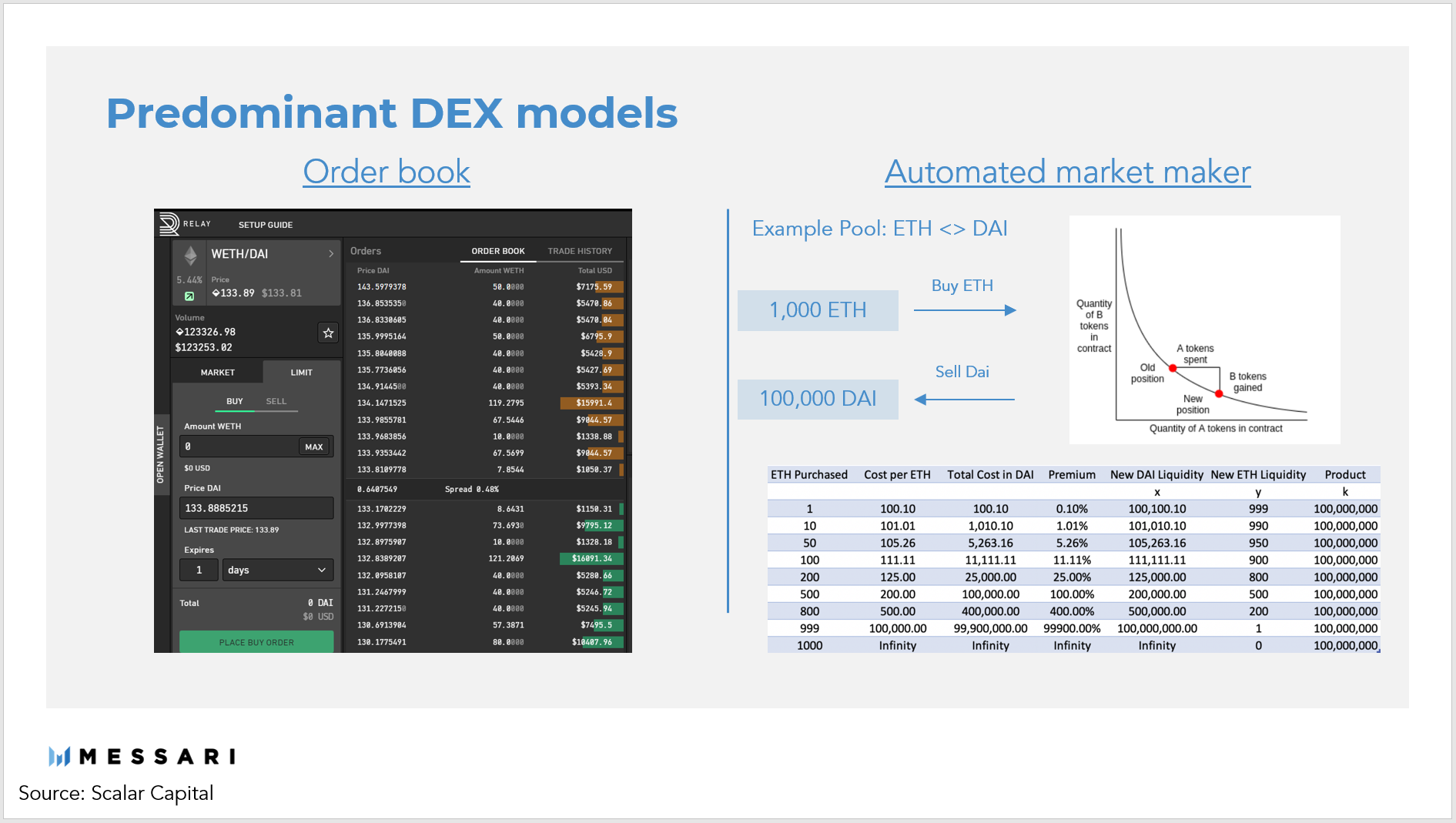
This compares to traditional markets that have market makers providing liquidity by offering prices at which you can buy and sell. Doing so requires professional risk management tools and significant capital. With Uniswap, anyone can market make simply by depositing assets into a pool and then passively earning money from a fixed 0.3% fee on each trade. However, it's not guaranteed passive income as there are ways to lose money providing liquidity as a result of price movements. Regardless, you can still measure the fundamental growth of Uniswap by looking at the amount of fees accumulating to liquidity providers.
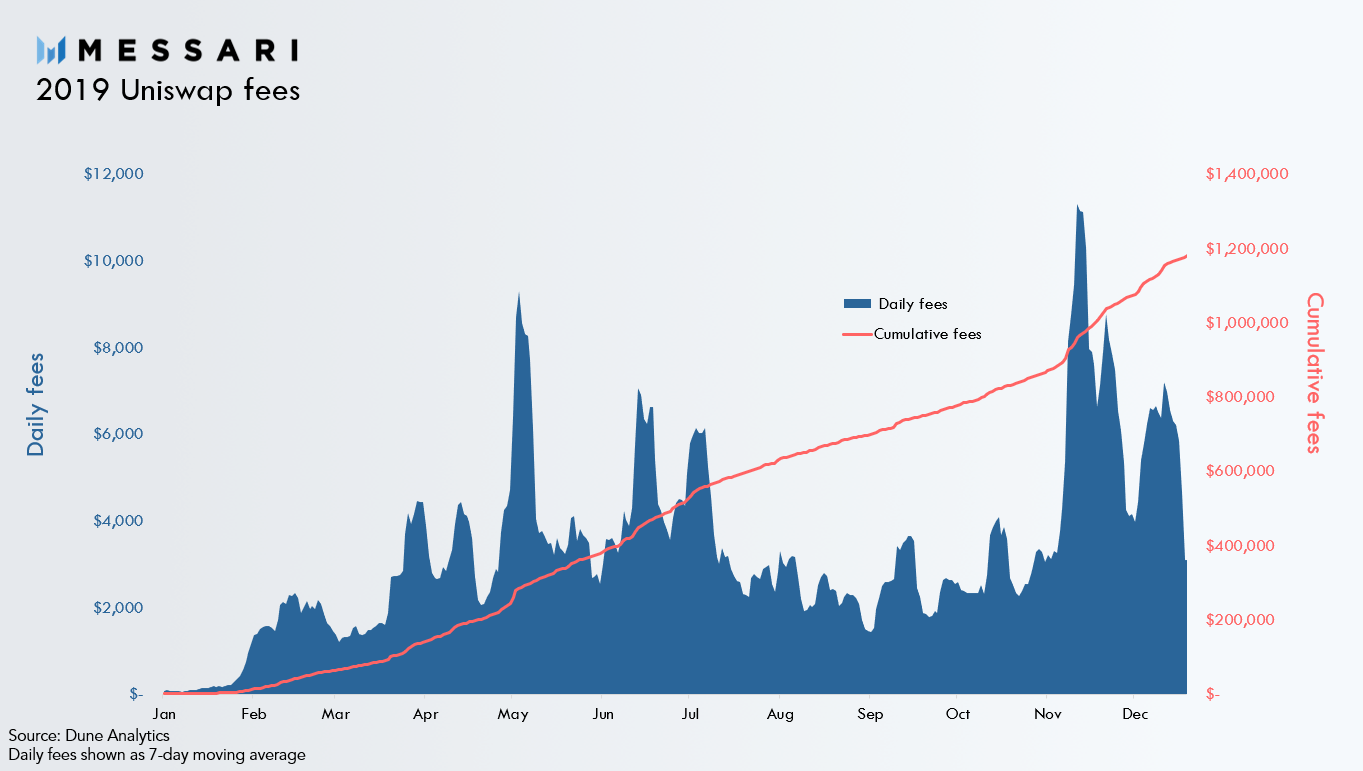
The growth of Uniswap was nothing short of impressive as half a million in fees accumulated within the first six months. While there was a decline this fall coinciding with a decrease in overall crypto volume, Uniswap fees have since increased as it handles more volume than any other DEX with nearly $3 million traded over the last 7 days. As the user experience of DEX trading improves to rival that of its centralized competitors, volume will likely continue to increase on these non-custodial exchanges. A large part will be a result of aggregators such as 1inch and DEX.AG that enables traders to source liquidity from a variety of decentralized exchanges to get the best spread, a problem that has plagued DEXs. This composable nature allows permissionless access to various liquidity sources, something that is impossible in centralized models. We will likely see altogether new financial applications as a byproduct while DEXs continue to contribute to the burgeoning DeFi ecosystem.
