Onchain Reinsurance: DeFi's Uncorrelated Yield Frontier

Onchain Global Reinsurance Opportunity
Reinsurance, companies that insure the insurers, has long been one of the highest yielding corners of traditional finance, offering consistent returns with near zero correlation to equities and credit. Adding an uncorrelated return stream to a portfolio improves its Sharpe ratio without increasing overall risk, which is why institutional allocators have historically paid a premium for access.
The global reinsurance market manages over ~$750B in dedicated capital. By absorbing a portion of an insurer's risk, reinsurers free up balance sheet capacity for primary carriers to write more policies, stabilize earnings against loss events, and ultimately keep premiums affordable for end consumers.
A parallel channel known as insurance-linked securities (ILS) has grown to ~$125B over the past few decades, allowing outside investors to back reinsurance contracts directly through standalone vehicles rather than deploying capital through a traditional reinsurer. Collateralized reinsurance (~$40B to $50B), where capital is posted into trusts backing specific contracts in exchange for premium income, is the main segment onchain protocols are tokenizing.
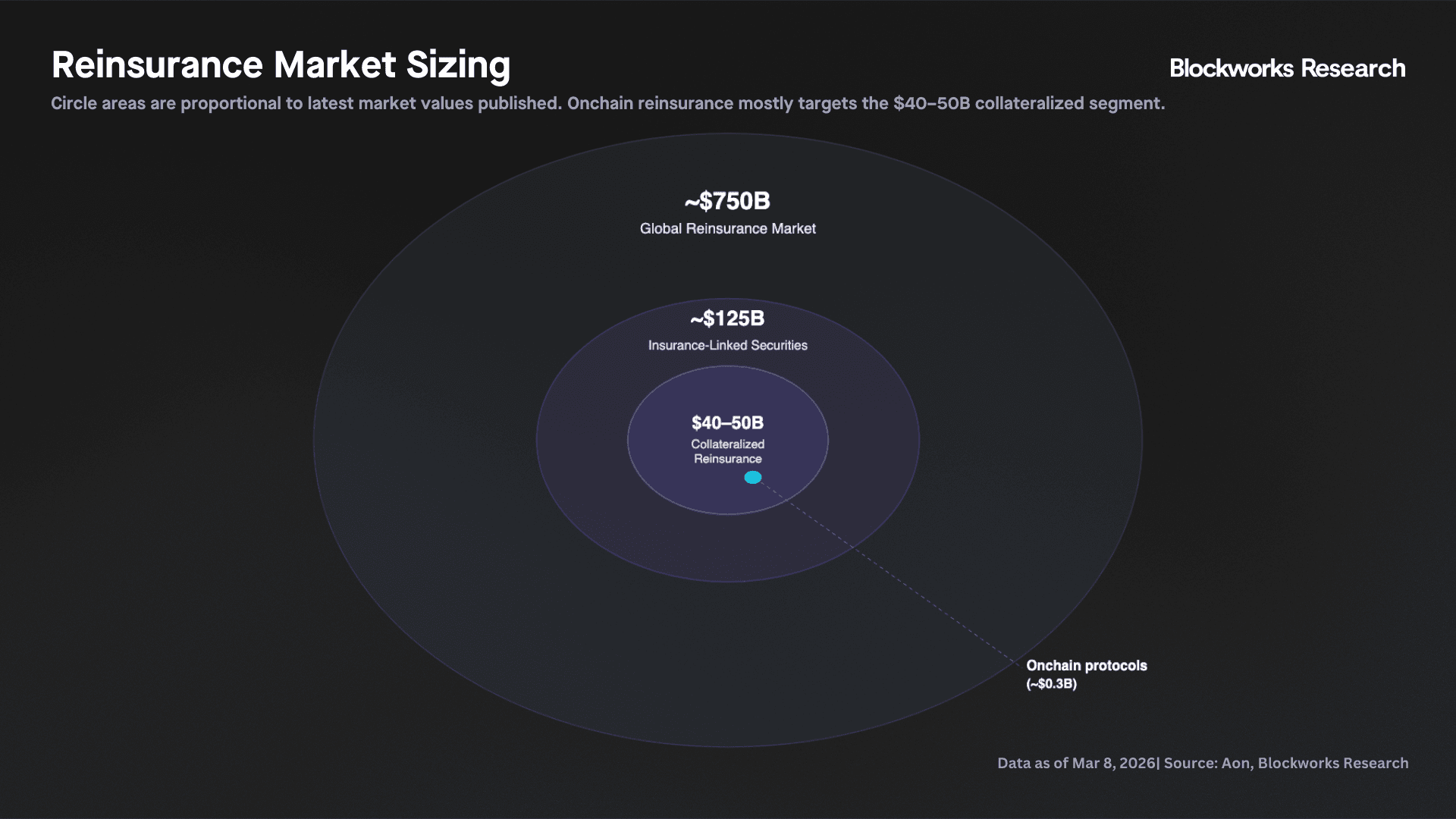
Onchain reinsurance protocols follow the same logic, substituting tokenized pools for the legal SPV wrapper while retaining the same underlying deal flow and expertise. The structure maps naturally onto DeFi's collateral-based primitives, and tokenizing participation unlocks permissionless access, real-time settlement, and composability with the broader onchain yield ecosystem.
Why is this important for DeFi?
