Privacy in crypto remains largely confined to simple financial actions like shielding balances and privately sending funds. Octraseeks to expand privacy beyond money itself by enabling computation, coordination, and application-level activity to occur directly on encrypted data.
Octra is built around Fully Homomorphic Encryption (FHE), a cryptographic primitive that allows arbitrary computation to be performed on encrypted data without revealing the underlying information. Its proprietary Hypergraph Fully Homomorphic Encryption (HFHE) scheme is designed to address the performance constraints that have historically limited FHE's practical adoption.
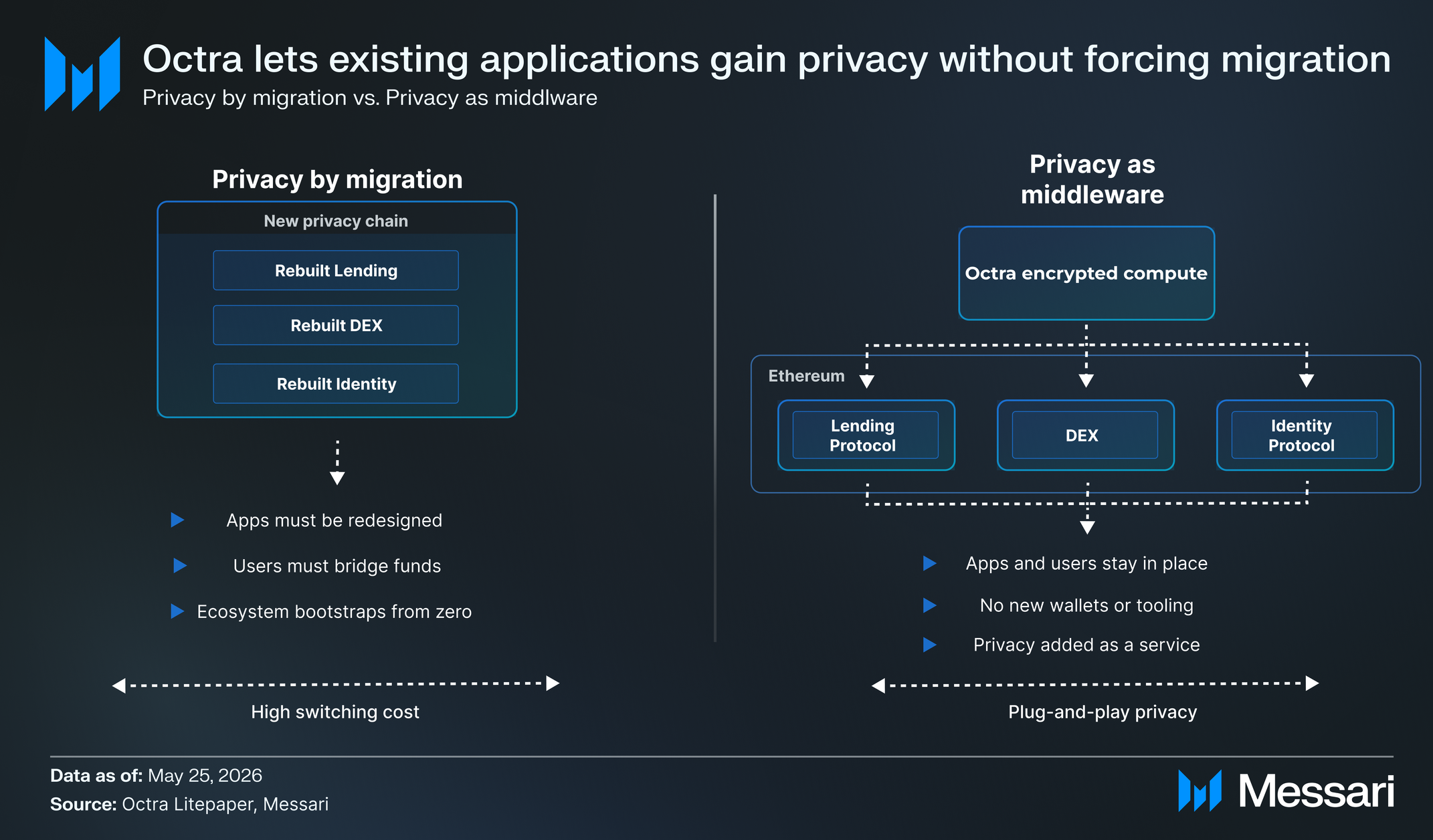
Unlike most privacy-focused blockchains that require developers to rebuild applications from scratch,Octra can also function as encrypted middleware for existing networks. This approach allows blockchains and applications to add privacy-preserving functionality without requiring users or assets to migrate to a new ecosystem.
Octra's ecosystem remains nascent, but key components of its vision are already live, including encrypted balances, stealth transfers, isolated execution environments (Circles), and early onchain AI inference experiments. These implementations provide an initial proof point for programmable private state as a broader cryptographic primitive than private payments alone.
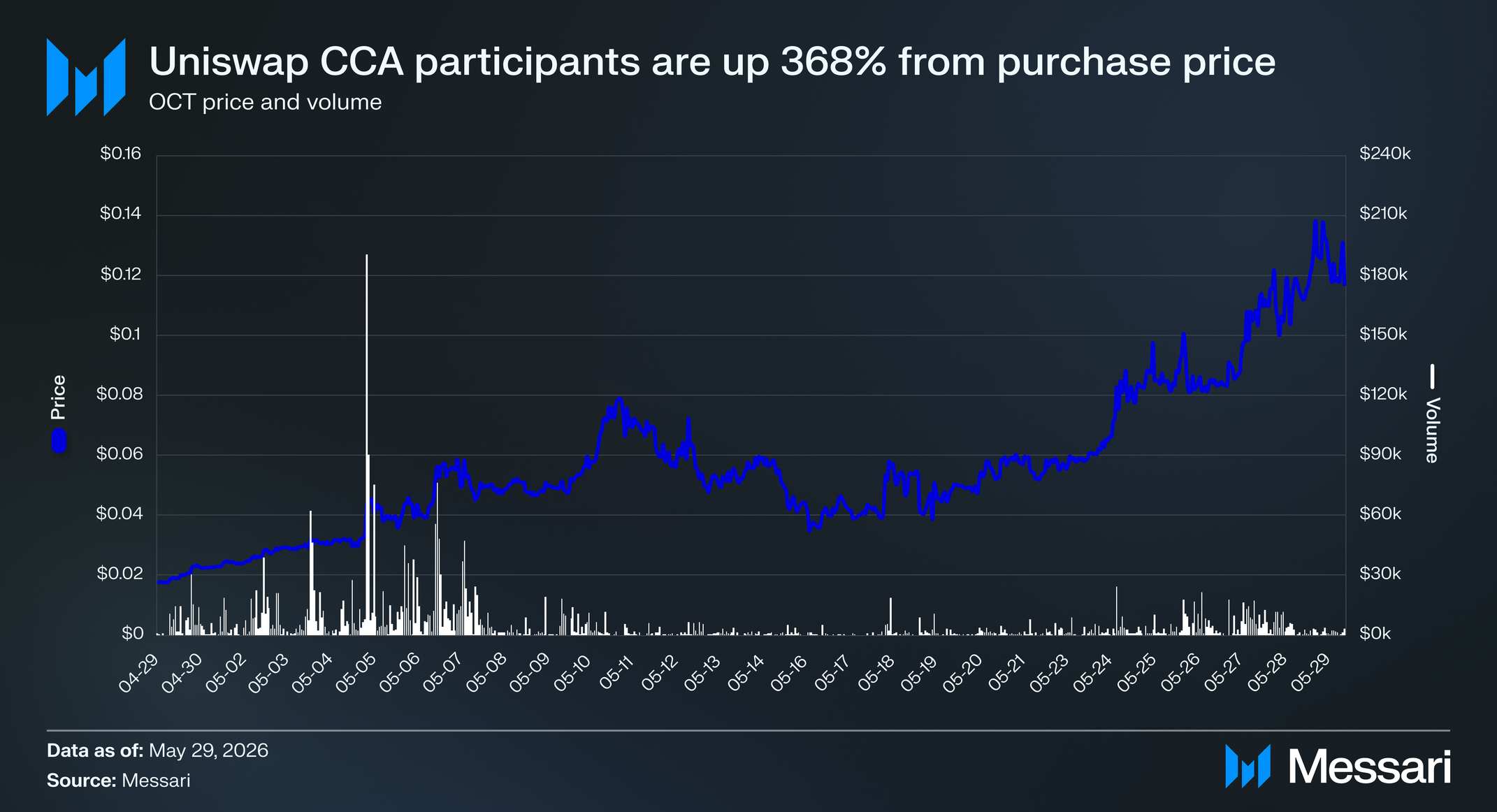
OCT has been one of crypto's strongest-performing assets since its Uniswap CCA, appreciating 450% from its auction price. The launch structure stands in contrast to the high-FDV, low-float model that has dominated recent token launches, allowing for more organic price discovery as it leaves the token's performance largely dependent on Octra's execution of its encrypted-computation thesis rather than being weighed down by an initial high valuation.
Introduction
Eric Hughes’ A Cypherpunk’s Manifesto opens with the foundational principle that “privacy is necessary for an open society in the electronic age.” Bitcoin and crypto more broadly emerged from that cypherpunk tradition. Yet many of the systems the industry has built over the past decade drift sharply from those original ideals: radically transparent public ledgers where nearly every transaction and interaction is permanently exposed.
Combined with the near-universal adoption of KYC by centralized exchanges, linking blockchain activity to real-world identities has become increasingly straightforward, a process AI will only accelerate. An ecosystem originally conceived around sovereignty and anonymity now leaves behind immutable financial histories that can be analyzed indefinitely by corporations, governments, and surveillance firms.
To the cypherpunks who imagined digital cash as a tool for personal freedom, today’s crypto landscape would likely feel deeply unsettling as its a world where transparency became absolute, anonymity became suspicious, and privacy became the exception rather than the default.
Yet amid today’s financial panopticon, parts of the industry appear to be returning to their cypherpunk roots. While still small relative to the broader crypto market, privacy-focused solutions and private digital assets have seen renewed momentum over the past year.
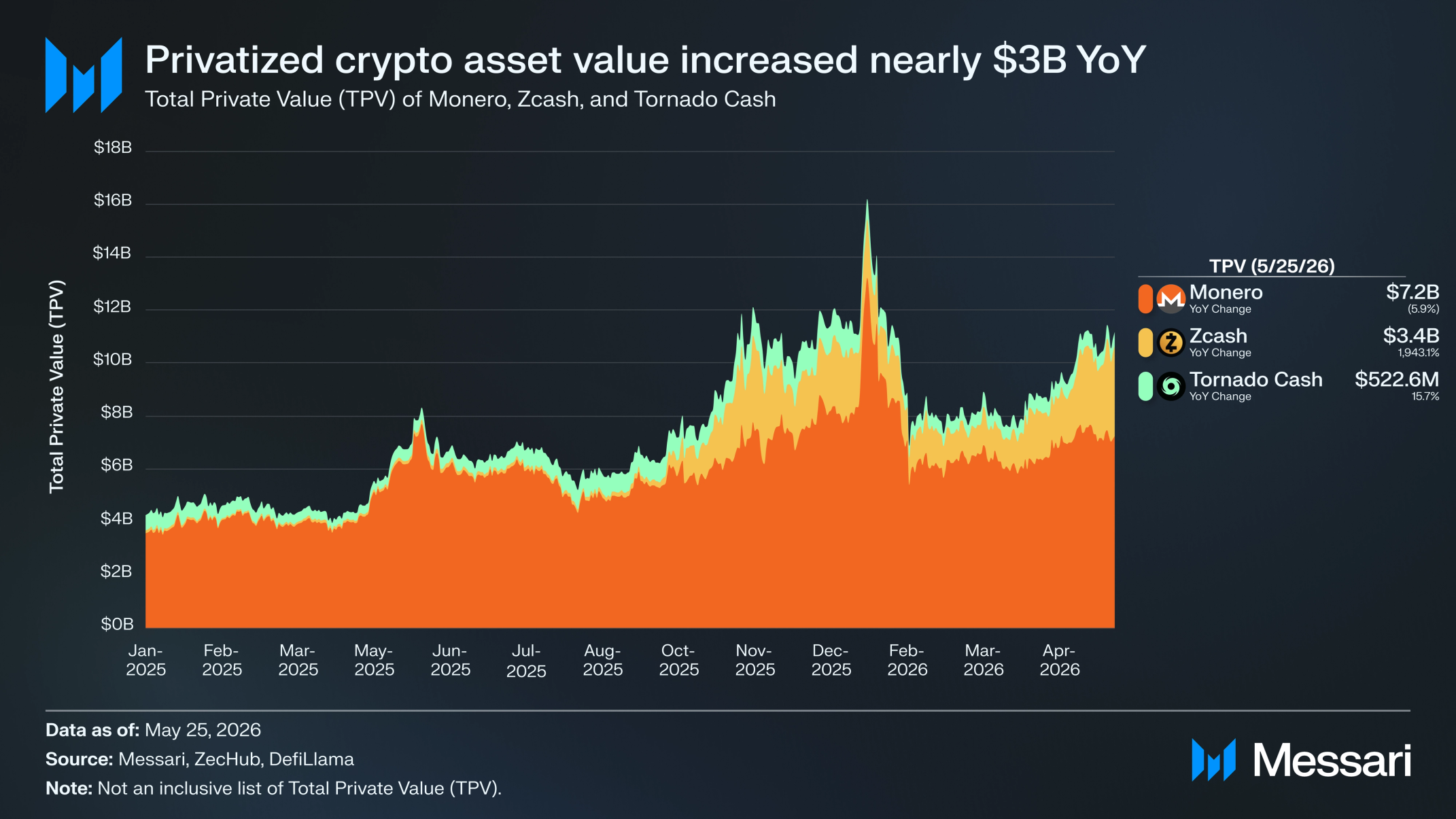
Led by Zcash, the total private value (TPV) across Monero (XMR market cap), Zcash (market cap of shielded ZEC), and Tornado Cash (total value locked) has grown by $2.86 billion, increasing from $8.31 billion to $11.17 billion (up 34% YoY). This is not a comprehensive measure of all private value in crypto. Still, these three protocols represent the largest privacy-focused solutions by TPV and account for the majority of the sector.
While the resurgence of private crypto money is a welcome development, the scope of privacy in crypto remains extremely narrow. Today’s privacy solutions are largely confined to simple financial actions like holding assets, shielding balances, and privately sending or receiving funds. Yet privacy should extend far beyond money itself. Every digital action, whether trading, borrowing, identity verification, communication, coordination, or application-level activity, leaves behind data that can be tracked, analyzed, and tied back to individuals.
For privacy to have meaningful utility in digital systems, users need the ability to interact, coordinate, and transact without exposing every action to public scrutiny by default. The problem is that truly private interactions within cryptographically secure systems remain rare. Most onchain applications still operate in fully transparent environments, where users are expected to expose their activity as a prerequisite for participation. If privacy is to become a foundational property of cryptographic systems rather than a niche feature attached to money, it must extend into every layer where users interact, compute, and coordinate onchain.
One protocol aiming to solve this problem, expanding cryptographic privacy beyond simple financial actions, is Octra. Octra is a Layer-1 (L1) blockchain built around Fully Homomorphic Encryption (FHE), a cryptographic primitive that enables arbitrary computation to be performed directly on encrypted data without decrypting it. In this report, we'll examine how Octra aims to build the substrate for that broader vision of privacy, one where privacy is a default property of computation rather than an opt-in feature of money.
Fully Homomorphic Encryption (FHE)
The reason crypto's privacy has stayed narrow is, at its root, a cryptographic one. Encryption has always been good at protecting data while it sits in storage. What it has not been good at is letting that data actually be used without first being decrypted. The moment a balance has to be checked, an order has to be matched, or a model has to be queried, the data has to be exposed to whoever is performing the operation. Privacy ends where computation begins.
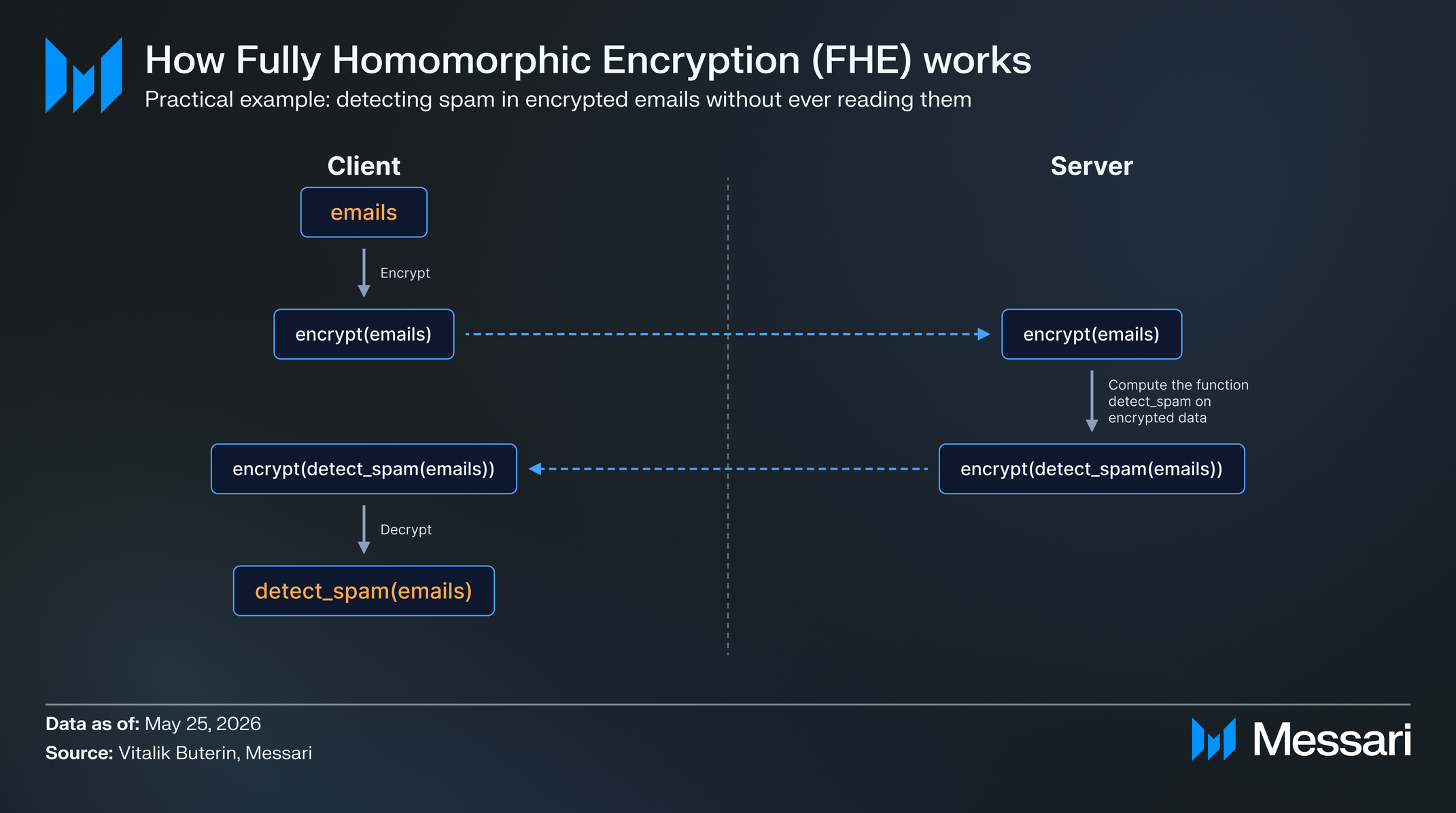
Fully Homomorphic Encryption (FHE) is what changes that. With FHE, arbitrary operations can be performed directly on encrypted data, and the output, when decrypted, is mathematically identical to what would have come out of the same operations on the plaintext. There is no point in the process at which the underlying data has to be revealed, not to the operator running the computation, not to the validators confirming it, and not to any third party observing the network. In his 2020 blog on FHE, Vitalik Buterin described the technology as one of the most important unsolved problems in cryptography, and one that, if it could be made performant, would change what private computation is possible at all.
FHE is considered the holy grail of cryptography for the breadth of what it makes possible: machine learning models that can be trained on private medical records without those records ever being decrypted, financial markets where order flow and balances are private to everyone including the matching engine, identity systems where credentials can be verified without being disclosed, and onchain applications where the logic is fully auditable but the data flowing through it is not.
For most of FHE's history, that promise has stayed locked inside academic papers. The early schemes were too slow to be useful in practice, often requiring hours of compute for what would have taken seconds in plaintext, and the years since have been a long effort to bring those costs down to a point where real applications could run on top. However, with the Octra mainnet alpha live since December 2025, production-grade FHE applications and middleware can finally be built.
A Technical View of Octra
As previously mentioned, Octra is an L1 blockchain combined with an encrypted compute layer, with isolated execution environments called Circles serving as the primary developer surface. The network can operate as a standalone chain, as a coprocessor for existing blockchains that need encrypted state without rebuilding their settlement layer, or as a private storage and key management layer for offchain applications. Most of the codebase is written in OCaml and C++, while applications can be built in Rust, C++, WASM, or Octra's native programming language, Applied (aka AppliedML).
Underneath that flexibility are two technical components worth understanding: the cryptographic engine that makes encrypted computation fast enough to be useful, and the developer interface that exposes it as a programmable substrate.
Hypergraph Fully Homomorphic Encryption (HFHE)
Octra's specific FHE implementation is called Hypergraph Fully Homomorphic Encryption (HFHE). Standard FHE schemes treat encrypted data as a flat sequence of bits, processing them one at a time. Each operation on that data adds noise to the ciphertext, and if too much noise accumulates, the data eventually becomes unreadable. Periodically clearing that noise, a process called "bootstrapping," is computationally expensive and has been the main reason FHE has remained impractical at scale.
HFHE addresses this by modeling encrypted data as hypergraphs, where a single connection can link many data points at once. Each operation only affects the part of the structure it touches, rather than forcing the entire ciphertext to be treated as one large object. Multiple regions of encrypted data can therefore be processed in parallel by standard CPUs, without requiring specialized hardware. This is intended to make FHE fast enough for real applications to actually run on top of Octra.
The math underlying HFHE is published, the scheme is open source, and the benchmarks are reproducible. Rigorous academic cryptanalysis is still underway; however, HFHE remains a nascent technology that has not yet accumulated the years of adversarial review that more established cryptographic schemes have. A preprint formalizing the design has been announced for release shortly, which would open the scheme up to broader peer review.
Circles
Above the cryptography sits the developer interface, known as Circles. Circles are isolated execution environments distributed throughout the Octra network, each with its own runtime, memory, and access control logic. They function as something between a server and a smart contract, as developers can deploy entire applications, including the logic, state, and frontend interfaces, inside a single Circle.
In a recent post, Octra's co-founder described Circles as "a truly first-of-its-kind private substrate, where addressing, program runtime, publishing, sealed delivery, and wallet access all live in the same space." The comparison they draw is to Tor's .onion services, but without the single exit nodes that have historically been a security liability. Any application that runs on a normal web stack, whether a checkout flow, a forum, or a model inference endpoint, can be deployed inside a Circle and accessed via an oct:// address from the Octra web client.
What makes Circles useful from a developer's perspective is that they externalize the question of what gets encrypted to the application layer. Developers can keep program logic public while encrypting state, encrypt everything, or only encrypt specific values. Each Circle deploys with a proxy contract that mediates between the public chain state and the Circle's internal encrypted state, ensuring validators never see plaintext. Circles are currently in alpha, with developer tooling rolling out incrementally.
What's Possible on Octra
The ultimate determinant of a project's success is not the technical breakthroughs it introduces, but the applications and user experiences those breakthroughs make possible. While Octra's architecture is novel, its long-term significance will be determined by what developers can build with private programmable state. The ecosystem remains nascent, but several early applications, developer tools, and proofs-of-concept have already emerged on the network. The developer community surrounding Octra is also unusually diverse and active for a project at this stage, with engagement that has built up organically over time.
Private Payments and Balances
The most basic application of encrypted state is private value transfer. Stealth transactions and selectively encrypted balances are both live today. Both operate at the protocol level, meaning private transfers and shielded balances are first-class properties of the network rather than opt-in features layered on top of plaintext transactions.
Octra as Middleware
One of the challenges faced by all new blockchains, private or not, is convincing users and developers to migrate to a new stack. This challenge is particularly acute for privacy-focused blockchains, as existing applications, wallets, and infrastructure are often built around the assumption that state is publicly visible.
Take a practical example like Aave. Deploying Aave to a new EVM-compatible environment, such as an Ethereum layer-2 (L2), is relatively straightforward because the underlying execution model remains largely unchanged. Deploying Aave to a blockchain with native privacy is a different challenge altogether. Core components of the protocol, including collateral positions, health factors, liquidations, and risk management systems, assume public state by default. A privacy-preserving version would require many of these mechanisms to be redesigned from first principles. As a result, privacy-focused blockchains often struggle to bootstrap an ecosystem, as developers must rebuild applications rather than simply redeploy them, and users have little reason to migrate before those applications exist.
Octra has a significant advantage over many privacy-focused blockchains because it can also function as middleware for existing networks. As middleware, Octra sits alongside an existing chain and handles only the computations that require encryption, while settlement and user assets stay where they are. The integration model is chain-agnostic, so any EVM or SVM network can use Octra as a middleware or encrypted state store. A theoretical example is private ERC-20 transfers on Ethereum, where the token itself stays on Ethereum throughout, and Octra handles the encrypted balance state and transfer logic, allowing users to transact privately without their assets ever moving to a different chain.
Lastly, the Octra team has announced Octra EVM, a fully compatible HFHE+EVM stack that keeps the EVM specification intact while moving execution into an encrypted layer. The system is positioned to launch as an L2, with a working internal prototype already in place and components rolling out gradually. The Ethereum bridge and private ERC-20 transfers are the first publicly available pieces, and the full stack will eventually be released as open source, giving existing projects another low-friction path to adding privacy without rebuilding from scratch.
Private DeFi and Dark Pools
DeFi operates almost entirely in public. Orders are visible in the mempool before they execute, positions are visible on the ledger after they settle, and the gap between the two is where front-running, sandwich attacks, and copy-trading thrive. The result is a market structure where sophisticated actors extract value from informed retail flow simply by observing the queue.
Private DeFi on Octra would let traders submit orders, hold positions, and manage collateral without revealing any of those primitives publicly. Dark pool mechanics, private lending positions in which leverage and liquidation thresholds are hidden from observers, and private AMMs in which reserve balances can be encrypted while preserving execution integrity all become possible.
A functional AMM proof-of-concept has already been deployed on Octra mainnet by a pseudonymous developer. This proof of concept can also support dark pool mechanics, enabling markets on Octra that more closely resemble how traditional markets actually function. According to Bloomberg data, off-exchange activity, which happens internally at major firms or in dark pools, accounted for 52% of all US stock trading volume in January 2025, marking the first time on record that the majority of trades occurred outside public exchanges. DeFi's default transparency forces participants into a market structure that TradFi has spent decades moving away from, and Octra can bring that same selective privacy onchain without requiring participants to trust a venue operator the way TradFi dark pools do.
Encrypted AI
As AI expands into high-stakes domains like healthcare, finance, and government, the integrity of both the models being deployed and the sensitive data being fed into them has shifted from an optional feature to a core requirement for trust and adoption. The most valuable data for these systems, including physiological data, personally identifiable information, sensitive and regulated material like medical or financial records, and confidential business data, is also the data users and institutions are least willing to expose. With the supply of high-quality public data largely exhausted, the next wave of AI capability depends on unlocking the much larger pool of data that is too sensitive to put on a public ledger or hand over to a centralized provider.
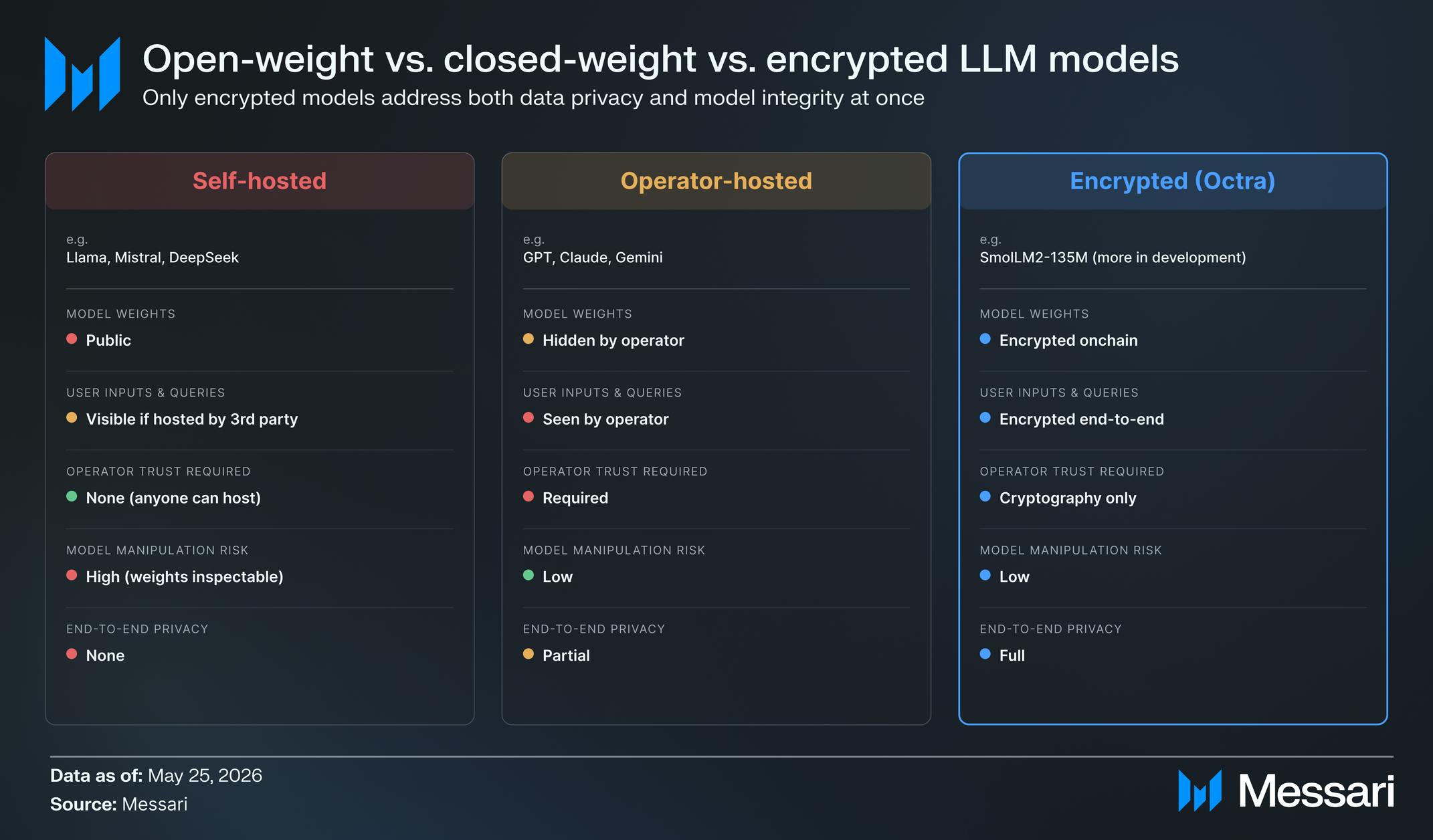
Sensitive data is one half of the AI privacy problem. The models themselves are the other. As Vitalik Buterin laid out in his 2024 blog on crypto and AI, one of the harder open problems at the intersection of the two is giving AI agents trustworthy black-box behavior, where computation can be verified without the model itself being open to adversarial attack. Existing approaches address one side of this at a time, as open-weight models are transparent but expose their internals to manipulation, while closed-weight commercial models are opaque but require trust in the operator.
Octra can potentially address both halves of this problem directly. A model can be hosted on Octra with its weights encrypted, queries can be submitted in ciphertext, and inference can run end-to-end without any participant in the computation seeing either the model or the input. Earlier this spring, the Octra team demonstrated the first onchain inference cycle on the network with SmolLM2-135M, with the model weights, execution state, and program logic all publicly viewable. By mid-May, a roughly 16,000x speedup in single-transaction execution within the ML state was achieved, alongside a 10x increase in token cluster size, achieved by redesigning storage structures and distributing complex multiplications across available GPU resources. The encrypted version of this stack is being built on top of Circles. The team has signaled that Circles will support the creation of "multiple, fully private and verifiable models" that can be assigned tasks, combined into rooms, and given different access rights, with agents able to operate directly in encrypted network state.
With encrypted models, the use cases span much more than running a chatbot privately, and some could include:
A medical AI agent could review encrypted patient records and return an encrypted diagnosis that only the patient can decrypt.
A trading agent could hold encrypted strategy parameters and execute against encrypted market state, removing the risk of strategy theft.
Recommendation systems could operate on encrypted user behavior without ever building a profile in plaintext.
Model marketplaces could let developers sell access to proprietary models without exposing the weights.
Production-ready versions of these applications are still a long way off, on Octra or anywhere else. What Octra has shipped, working FHE on mainnet, a live onchain inference cycle, and a Circles framework explicitly oriented toward private models, is the substrate that makes them technically possible.
Additional Applications
Beyond DeFi and AI, Octra opens up applications that have struggled to exist onchain because they involve sensitive data no user would willingly publish to a transparent ledger.
Personal data onchain is the most direct extension. Encrypted health records, credit history, identity documents, and biometric data could be stored on Octra and queried by applications without being decrypted, with the user keeping the decryption key and the application getting only the answer.
The same logic enables continuous proof of humanity. Encrypted biometric or behavioral data could be queried repeatedly, with verifiers receiving only a yes-or-no answer and no plaintext access to the underlying signal, turning Sybil resistance into a recurring property rather than a single attestation.
Private data marketplaces are the natural extension. A buyer could run paid queries against encrypted datasets without seeing the underlying rows, letting high-value data like financial records, medical research, and proprietary training data trade in open markets for the first time.
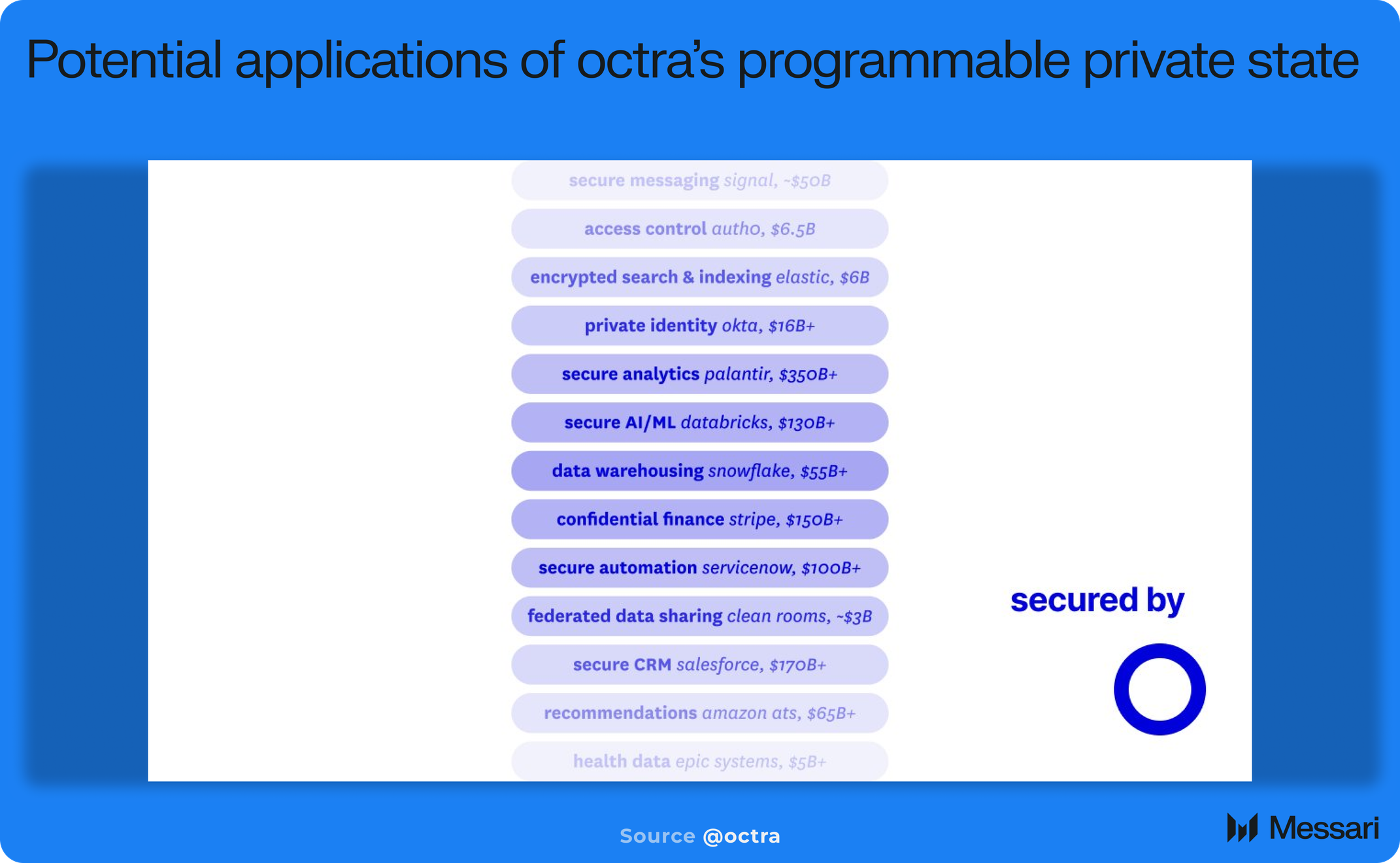
These applications are all further from production than the financial and AI use cases above, and none has been demonstrated on Octra today. The data they involve cannot live on a transparent ledger without being exposed publicly, which is why almost none of it is onchain today. The pool of data and compute sitting offchain for this reason is far larger than the pool of activity that currently runs on public chains, and Octra's strategy is to grow that pie rather than compete with existing chains on transaction speed or fees.
OCT
Underpinning Octra is the OCT token. It is the native asset of the Octra network and is used to pay for network actions and fees. Additionally, OCT is also used to reward validators for maintaining the network.
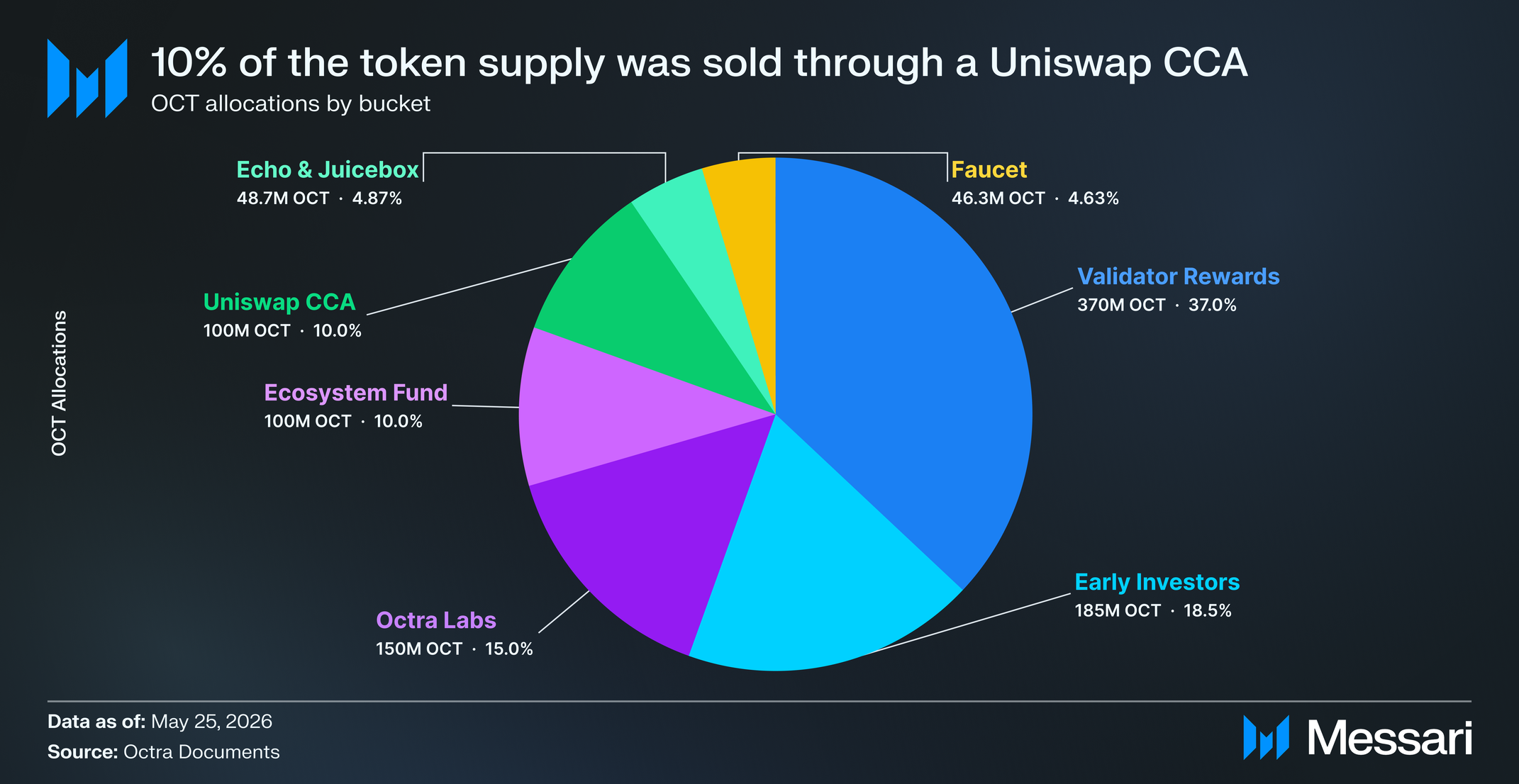
The total token supply of OCT is 1 billion tokens, and was distributed accordingly:
Validator Rewards - 370,000,000 (37% of the total supply)
Early Investors - 185,000,000 (18.5% of the total supply)
Octra Labs - 150,000,000 (15% of the total supply)
Ecosystem Fund - 100,000,000 (10% of the total supply)
Uniswap CCA - 100,000,000 (10% of the total supply)
Echo & Juicebox Contributors - 48,700,000 (4.87% of the total supply)
Faucet - 46,300,000 (4.63% of the total supply)
All operational wallets are locked indefinitely and for a period of at least 2 years, as Octra Labs, the development team behind Octra, is fully funded. At genesis, 580 million (58% of the total token supply) was circulating.
Wrapped OCT and the Uniswap CCA
The OCT token has also been bridged to Ethereum as an ERC-20 token, wrapped OCT (wOCT). wOCT does not have any of the network-level features of native OCT, as it is not used to pay for fees or validator rewards, but it gives OCT a presence on Ethereum for liquidity, trading, and price discovery.
wOCT was also the asset that Octra distributed through the Uniswap Continuous Clearing Auction (CCA), a permissionless token launch mechanism built on Uniswap V4. Rather than selling tokens at a single fixed price or resolving an auction in one block, the CCA distributes tokens over many blocks based on the demand observed in each block. Bidders submit a total budget and a maximum price they are willing to pay per token, and the protocol calculates a single clearing price that all participants pay equally. Because the auction runs continuously rather than at a single moment, the design discourages gas wars and last-second sniping, both of which typically distort fixed-price launches dominated by automated bots.
Octra's auction closed on April 20, 2026, distributing 10% of OCT's total supply (100 million tokens) at a final clearing price of 0.0000124 ETH (~$0.025) per token, raising roughly 1,240 ETH (~$2.5 million) and implying a fully diluted valuation of $25.0 million at launch. An additional 1% of supply was deposited directly into the resulting Uniswap V4 liquidity pool to seed onchain trading.
Closing Thoughts
Since OCT’s Uniswap CCA, it has been one of the best-performing assets in crypto. Participants in the sale are up nearly 450%, with OCT appreciating from $0.025 to $0.137. While this performance is undoubtedly a reflection of what the team has built, it is also a byproduct of how the token was launched.
OCT largely avoided the playbook that has come to define token launches over the past few years. Tokens are launched at increasingly absurd valuations, only a fraction of supply reaches the market, and exchanges and market makers are compensated with token allocations to support listings and liquidity. The outcome has become predictable: insiders get an exit, retail gets the unlock schedule, and the chart trends down and to the right.
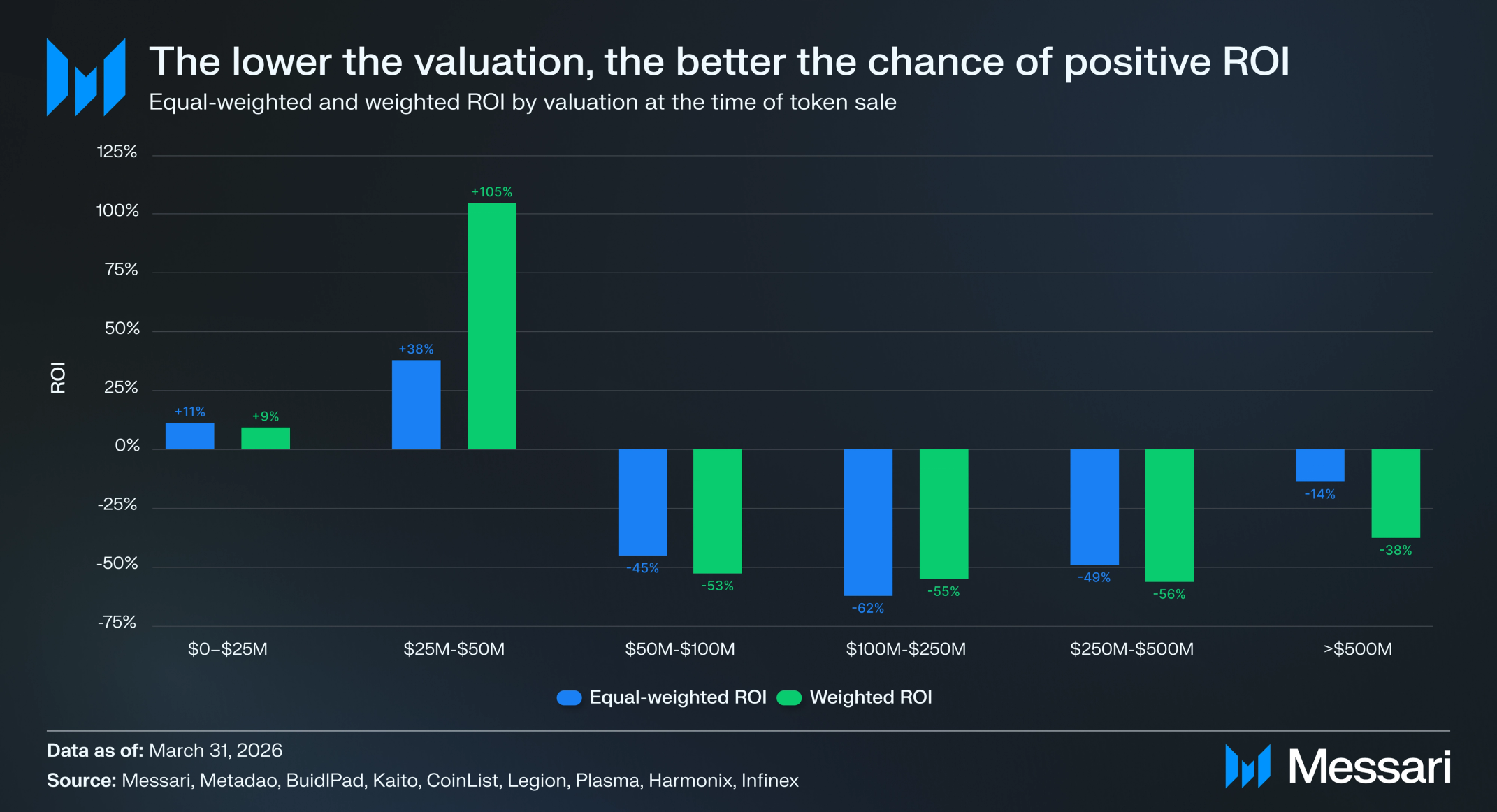
In our An Analysis on Public Token Sales report, valuations emerged as the single strongest predictor of investor outcomes. Token sales conducted below $50 million generated the only consistently positive returns, while every valuation bucket above $50 million produced negative performance on average.
OCT instead launched at a $25 million fully diluted valuation with trading initially limited to DEXs. No allocation was reserved for exchange listings, and no tokens were distributed to market makers as part of a listing strategy. The result was a launch structure that allowed for more organic price discovery than has become typical across much of the industry.
And as a direct example of why launch structure matters, look no further than the performance of OCT versus ZAMA. Zama is another FHE-focused project and arguably Octra's closest competitor. In January, Zama raised $44 million at a $550 million valuation, 22x the valuation at which Octra conducted its token sale. Today, ZAMA trades at a $408 million fully diluted valuation, 26% below its token sale valuation. OCT, meanwhile, has appreciated 450% since its CCA.
Perhaps the most refreshing aspect of Octra's launch is that it did not ask investors to pay for success before it existed. In a recent report on MegaETH, we argued that market participants were valuing MEGA not as an experiment that might work, but as one that already would (MEGA launched as the second-most valuable L2 token, behind only MNT). The same dynamic has defined much of crypto over the past several years. Investors are routinely asked to pay valuations that assume future adoption, revenue, and product-market fit have already been achieved.
At a $137 million fully diluted valuation, OCT sits in a very different position. That does not guarantee future returns, nor does it mean Octra will succeed in its ambition to become a foundational privacy layer for digital systems. But unlike many recent token launches, market participants are not valuing Octra as though widespread adoption of fully homomorphic encryption is already inevitable. For investors who believe encrypted computation and programmable private state represent an important frontier in cryptography, much of that thesis remains ahead of the project rather than already presumed in its valuation.
This report was commissioned by Octra Labs. All content was produced independently by the author(s) and does not necessarily reflect the opinions of Messari, Inc. or the organization that requested the report. The commissioning organization may have input on the content of the report, but Messari maintains editorial control over the final report to retain data accuracy and objectivity. Author(s) may hold cryptocurrencies named in this report. This report is meant for informational purposes only. It is not meant to serve as investment advice. You should conduct your own research and consult an independent financial, tax, or legal advisor before making any investment decisions. Past performance of any asset is not indicative of future results. Please see our Terms of Service for more information.
No part of this report may be (a) copied, photocopied, duplicated in any form by any means or (b) redistributed without the prior written consent of Messari®.
AJC is a Research Manager at Messari for the Enterprise team. His primary focuses are on Bitcoin and Consumer. Prior to joining Messari, AJC wrote an independent crypto blog.
AJC is a Research Manager at Messari for the Enterprise team. His primary focuses are on Bitcoin and Consumer. Prior to joining Messari, AJC wrote an independent crypto blog.